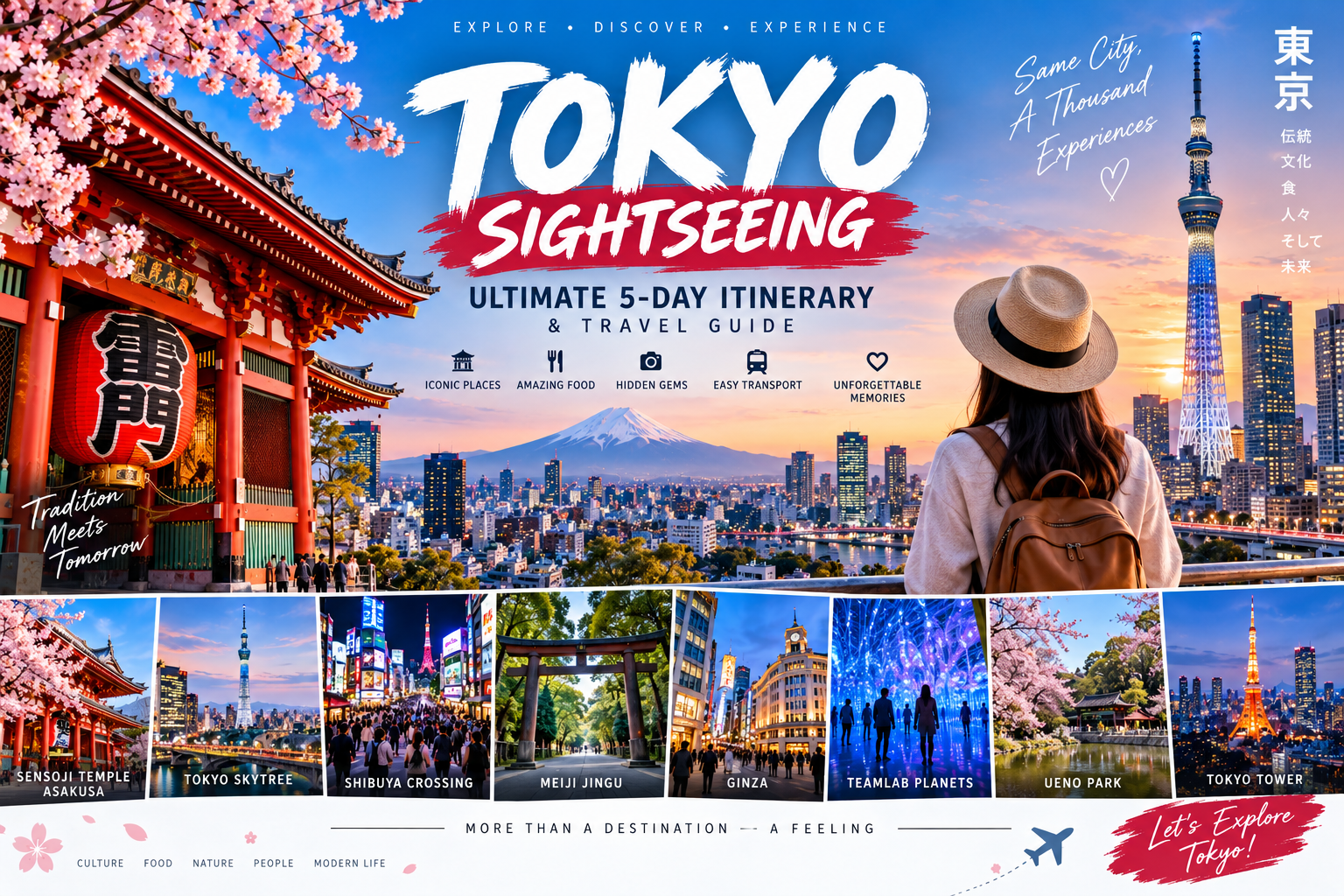
Tokyo Sightseeing: Ultimate 5-Day Itinerary & Travel Guide
Wondering how to experience Tokyo without spending your entire vacation inside train stations? This Tokyo sightseeing guide combines the city’s iconic attractions, historic neighborhoods, modern landmarks, food districts, cultural experiences, and hidden gems into practical routes designed to reduce unnecessary travel and give you more time to actually enjoy Tokyo. For most first-time visitors, the smartest approach to Tokyo sightseeing is not trying to see every famous attraction. Instead, group places by neighborhood, balance major landmarks with quieter experiences, and leave enough flexibility for food, shopping, photography, weather, crowds, and unexpected discoveries Tokyo Scams
Why Tokyo Sightseeing Requires a Different Travel Strategy
Tokyo is not a conventional sightseeing city where the biggest attractions are concentrated around one central square.
Its attractions are distributed across a huge urban landscape.
One neighborhood may feel like an old Japanese town, another like a futuristic technology district, and another like a global fashion capital.
That diversity is one of Tokyo’s greatest strengths.
It is also why first-time travelers sometimes struggle.
Tokyo Is a City of Contrasts
A typical Tokyo day can begin at a centuries-old temple, continue through a modern shopping district, include lunch at a tiny neighborhood restaurant, and end beneath illuminated skyscrapers.
The official Tokyo tourism guide specifically emphasizes the contrast between Tokyo’s historical sites and its modern or futuristic attractions.
This contrast should influence how you plan.
Instead of visiting only modern landmarks, combine old and new.
Instead of spending the entire day shopping, add a garden or temple.
Instead of visiting several observation decks, choose one and spend the remaining time exploring the neighborhood around it.
Tokyo Sightseeing Is About Neighborhoods
The best way to understand Tokyo is to think in clusters.
For example, Asakusa naturally connects with Sensoji, Nakamise-dori, the Sumida River and the Tokyo Skytree area.
Harajuku connects naturally with Meiji Jingu, Takeshita Street, Omotesando and Shibuya.
Ueno connects museums, parks, cultural attractions and traditional shopping.
Shinjuku connects gardens, skyscrapers, shopping, restaurants and nightlife.
The official Tokyo sightseeing resources provide numerous neighborhood-based walking routes, including Asakusa, Ueno, Yanaka, Odaiba, Ginza, Shinjuku and Harajuku.
How Many Days Do You Need for Tokyo Sightseeing?
There is no single correct number of days.
A weekend can introduce you to Tokyo.
Three days can cover many major highlights.
Five days gives first-time visitors enough time to experience different sides of the city.
Seven days allows a slower pace and more neighborhood exploration.
Longer stays make it possible to include areas outside the traditional tourist circuit.
Tokyo Sightseeing in 2 Days
Two days require strict prioritization.
A good structure is:
Day one: Asakusa, Sensoji, Tokyo Skytree and an evening in Shibuya.
Day two: Meiji Jingu, Harajuku, Shibuya, Shinjuku and a selected observation deck.
This is intense but possible.
Tokyo Sightseeing in 3 Days
Three days provide a better balance.
Add Ueno, Akihabara, Ginza, Tokyo Station or another cultural district.
Tokyo Sightseeing in 5 Days
Five days is an excellent first-time framework.
You can dedicate each day to a different part of Tokyo rather than constantly crossing the city.
Tokyo Sightseeing in 7 Days
A week allows you to include neighborhoods such as Yanaka, Shimokitazawa, Nakameguro, Koenji, Kichijoji, Odaiba and other areas.
It also allows a weather buffer.
This matters because Tokyo sightseeing is significantly easier when you do not have to force outdoor attractions into bad weather.
The Ultimate 5-Day Tokyo Sightseeing Itinerary
The following itinerary is designed around geography rather than simply ranking attractions.
It is suitable for general travelers, first-time visitors, couples, solo travelers and families who want a balanced introduction to Tokyo.
Day 1: Traditional Tokyo and Tokyo Skytree
The first day should introduce you to Tokyo’s historical side.
Start in Asakusa.
Morning: Sensoji Temple and Asakusa
Begin your day at Sensoji Temple.
The approach through Kaminarimon Gate and Nakamise-dori immediately gives you a sense of traditional Tokyo.
Sensoji is one of the city’s best-known historical attractions, and the surrounding area contains shops, food stalls, traditional architecture and streets that are worth exploring beyond the main temple complex.
Do not rush.
Spend time looking at the details of the temple buildings, lanterns, decorations and surrounding streets.
Late Morning: Nakamise-dori
Walk slowly along Nakamise-dori.
This is one of those places where shopping and sightseeing overlap.
You can find traditional snacks, souvenirs, crafts and Japanese-themed products.
Avoid buying everything immediately.
You may find better or more specialized products later during your trip.
Lunch: Asakusa
Have lunch in Asakusa rather than immediately moving to another district.
Possible choices include tempura, soba, sushi, unagi, ramen or traditional Japanese sweets.
The point is not to find the most famous restaurant.
The point is to experience the neighborhood.
Afternoon: Sumida River
After lunch, walk toward the Sumida River.
A river walk provides a quieter transition between Asakusa and the modern Tokyo skyline.
The official Tokyo tourism guide recommends the Sumida River as a sightseeing experience, including cruises and views of Tokyo’s bridges.
Late Afternoon: Tokyo Skytree
Continue toward Tokyo Skytree.
The tower provides a dramatically different experience from Sensoji.
You move from historic Tokyo to one of the city’s most recognizable modern structures.
Tokyo Skytree is particularly useful for first-time visitors because the surrounding area also provides shopping, restaurants and other attractions.
Evening: Skytree and Asakusa
If you visit the observation deck around sunset, you may see Tokyo transition from daylight into its evening lights.
Alternatively, return to Asakusa for dinner.
This creates a more relaxed first day.
Day 2: Meiji Jingu, Harajuku, Shibuya and Shibuya Sky
Day two focuses on modern Tokyo, youth culture, fashion and one of the city’s most famous urban landscapes.
Morning: Meiji Jingu
Start early at Meiji Jingu.
The shrine sits within a large forested environment close to Harajuku.
This is one of Tokyo’s most effective examples of contrast.
You can be surrounded by one of the world’s busiest metropolitan environments and suddenly find yourself walking beneath trees in a quiet shrine setting.
GO TOKYO highlights Meiji Jingu as one of Tokyo’s major historical and cultural attractions.
Late Morning: Harajuku
Walk toward Harajuku.
Explore Takeshita Street if you want to experience its youth-fashion atmosphere.
Do not limit yourself to the main street.
Side streets often provide a calmer experience.
Lunch: Harajuku or Omotesando
Harajuku and Omotesando offer a wide range of dining choices.
You can choose casual Japanese food, cafés, dessert shops or more sophisticated restaurants.
Afternoon: Omotesando
Walk through Omotesando.
This is an excellent area for travelers interested in fashion, architecture and contemporary Japanese design.
The neighborhood also creates a natural transition from Harajuku’s youthful atmosphere to Shibuya’s energetic urban environment.
Late Afternoon: Shibuya Crossing
Continue toward Shibuya.
Visit Hachiko and experience Shibuya Crossing.
Do not simply cross the intersection once and leave.
Take some time to observe the surrounding streets.
The official Tokyo tourism guide identifies Shibuya among Tokyo’s major sightseeing areas and highlights its distinctive urban character.
Evening: Shibuya Sky
If observation decks interest you, consider Shibuya Sky.
Sunset and early evening can be particularly appealing for photographers, but popular time slots may require advance planning.
Finish with dinner in Shibuya.
The district has everything from casual Japanese restaurants to international cuisine and high-end dining.
Day 3: Tokyo Station, Imperial Palace, Ginza and Hamarikyu
Day three slows the pace slightly.
This is the day for architecture, history, gardens, shopping and central Tokyo.
Morning: Tokyo Station and Marunouchi
Start around Tokyo Station.
The station itself is worth seeing because of its historic red-brick architecture and its role as one of Tokyo’s major transportation hubs.
The official Tokyo tourism guide highlights Tokyo Station’s restored historic architecture among Tokyo’s notable landmarks.
Morning: Imperial Palace Area
Walk toward the Imperial Palace area.
The palace grounds provide an important connection to Japanese history and Tokyo’s development from Edo into the modern capital.
Do not assume you need to spend hours inside the palace area.
Even walking around the surrounding districts can be worthwhile.
Lunch: Marunouchi
Marunouchi provides numerous dining options.
This is a good day to enjoy a slightly slower lunch.
Afternoon: Ginza
Continue to Ginza.
Ginza represents a different Tokyo.
It is associated with luxury shopping, department stores, architecture, restaurants and high-end Japanese retail.
The official Tokyo tourism guide describes Ginza as one of Tokyo’s elegant and luxurious districts.
Late Afternoon: Hamarikyu Gardens
Move toward Hamarikyu Gardens.
The garden offers an important change of pace.
Instead of another shopping district, you get landscaped grounds, water, historical atmosphere and open space.
The attraction is particularly valuable for travelers who feel overwhelmed by Tokyo’s density.
Evening: Tokyo Bay or Ginza
Finish with dinner in Ginza or explore the nearby waterfront areas.
Day 4: Ueno, Akihabara and Old Tokyo
Day four introduces culture, museums, traditional shopping and Japanese pop culture.
Morning: Ueno Park
Start in Ueno.
Ueno Park contains multiple cultural institutions and attractions.
This makes it ideal for travelers interested in art, history, science and Japanese culture.
Morning: Tokyo National Museum
If you enjoy museums, dedicate several hours to the Tokyo National Museum.
Do not attempt to see everything.
Choose collections that match your interests.
Lunch: Ueno
Have lunch around Ueno.
You can then explore the local shopping streets.
Afternoon: Ameyoko
Explore Ameyoko.
This area provides a very different experience from Ginza’s polished commercial environment.
It is more energetic, casual and street-oriented.
Late Afternoon: Akihabara
Continue to Akihabara.
Akihabara is particularly valuable for travelers interested in anime, manga, gaming, electronics and Japanese pop culture.
GO TOKYO identifies Akihabara, Ikebukuro and Nakano as important areas for anime and manga enthusiasts.
Evening: Akihabara or Kanda
Spend the evening around Akihabara or explore nearby Kanda.
Do not assume Akihabara is only about large electronics stores.
Small shops, arcades, collectibles and niche stores can make the experience much more interesting.
Day 5: Shinjuku, Garden, Observation and Nightlife
The final core day focuses on the enormous scale and energy of modern Tokyo.
Morning: Shinjuku Gyoen
Start at Shinjuku Gyoen.
A garden in the middle of one of Tokyo’s busiest areas provides a useful contrast.
It also prevents your final day from becoming another nonstop urban experience.
Afternoon: Shinjuku
Explore Shinjuku.
Visit department stores, shopping areas and side streets.
Afternoon: Tokyo Metropolitan Government Building
The Tokyo Metropolitan Government Building is another option for city views.
This can be particularly useful for travelers who do not want to pay for multiple commercial observation decks.
Evening: Shinjuku
Stay in Shinjuku after dark.
Explore the illuminated streets and entertainment districts.
Depending on your interests, you can visit Omoide Yokocho, explore Kabukicho from appropriate public areas, enjoy dinner or simply walk through the neighborhood.
Tokyo’s official tourism resources continue to highlight Shinjuku as one of the city’s major sightseeing areas.
Tokyo Sightseeing for First-Time Visitors
First-time visitors often make one major mistake: trying to follow a universal “top 20” list.
A better strategy is to choose one attraction from each major category.
Historic Tokyo
Choose Sensoji or Meiji Jingu.
Modern Tokyo
Choose Shibuya or Shinjuku.
Skyline Tokyo
Choose Tokyo Skytree, Tokyo Tower or Shibuya Sky.
Cultural Tokyo
Choose Ueno and a museum.
Futuristic Tokyo
Choose teamLab Planets or Odaiba.
Local Tokyo
Choose Yanaka, Shimokitazawa, Nakameguro or Koenji.
This creates a more complete experience.
Tokyo Sightseeing for Couples
Couples do not necessarily need to visit romantic attractions all day.
Tokyo’s most memorable couple experiences often come from combining sightseeing with atmosphere.
Best Couple Experiences
Consider:
Tokyo Tower at night.
Shibuya Sky around sunset.
A Sumida River cruise.
Hamarikyu Gardens.
Ginza dinner.
Odaiba waterfront.
Nakameguro evening walks.
A traditional restaurant in Kagurazaka.
A quiet café in Daikanyama.
The key is allowing time between attractions.
A romantic itinerary becomes less romantic when both travelers are exhausted and checking train maps every five minutes.
Tokyo Sightseeing for Families
Family travel requires a different rhythm.
Children may enjoy Tokyo immensely, but long walking days can become difficult.
Best Family-Friendly Attractions
Potential choices include:
Tokyo Disneyland.
Tokyo DisneySea.
Tokyo Skytree.
teamLab Planets.
Miraikan.
Ueno Zoo.
Aquariums.
Odaiba.
Parks.
Interactive museums.
Family Itinerary Rule
Use one major attraction per half-day.
For example:
Morning museum → lunch → park → hotel break → evening neighborhood.
Or:
Theme park → dinner → hotel.
Do not try to add three unrelated attractions after a full day at a theme park.
Tokyo Sightseeing for Solo Travelers
Tokyo is particularly suitable for solo travel.
You can eat alone, visit museums alone, walk through neighborhoods and change plans without coordinating with anyone else.
Best Solo Areas
Asakusa is excellent for culture.
Ueno is excellent for museums.
Akihabara is excellent for gaming and pop culture.
Shibuya is excellent for urban exploration.
Shimokitazawa is excellent for independent shopping and cafés.
Yanaka is excellent for slower walking.
Shinjuku is excellent for nightlife and restaurants.
Tokyo Sightseeing for Budget Travelers
You do not need to pay admission to an attraction every few hours.
Some of Tokyo’s most memorable experiences are free.
Free or Low-Cost Experiences
Consider:
Sensoji grounds.
Meiji Jingu.
Neighborhood walks.
Parks.
Street photography.
Shibuya Crossing.
Certain observation viewpoints.
Traditional shopping streets.
Public gardens with modest admission fees.
Tokyo’s official tourism resources specifically include free attractions as a sightseeing category.
Budget Planning Strategy
Choose one or two paid attractions per day.
Spend the rest of your time exploring neighborhoods.
This can significantly reduce costs.
Tokyo Sightseeing for Luxury Travelers
Luxury travelers have almost unlimited options.
Ginza, Marunouchi, Azabu, Roppongi, Omotesando and upscale parts of Shibuya provide premium shopping and dining.
Luxury Experiences
Consider:
High-end sushi.
Traditional kaiseki dining.
Luxury hotels.
Private guides.
Premium observation experiences.
Designer shopping.
Traditional tea experiences.
Private cultural tours.
The most important point is not to assume that luxury means skipping local neighborhoods.
Some of the most interesting premium experiences involve traditional craftsmanship, food and cultural heritage.
Tokyo Sightseeing for Photography
Tokyo is almost endlessly photogenic.
The most obvious subjects are Shibuya Crossing, Tokyo Tower and Tokyo Skytree.
But photographers should look beyond them.
Best Photography Themes
Try photographing:
Traditional architecture against skyscrapers.
Quiet streets beside major stations.
Neon reflections after rain.
Shrine entrances.
Japanese gardens.
Train stations.
Riverside scenes.
Small restaurants.
Tokyo’s changing light.
The Best Time for Tokyo Photography
Early morning provides quieter streets.
Late afternoon offers softer light.
Blue hour creates a strong combination of natural and artificial lighting.
Night photography works particularly well in Shinjuku, Shibuya, Ginza and Tokyo Station.
Tokyo Sightseeing for Food Lovers
Food should be integrated into your sightseeing itinerary.
Instead of traveling across the entire city for one restaurant, choose a neighborhood and explore its food scene.
Asakusa Food
Try traditional snacks, soba, tempura, unagi and Japanese sweets.
Tsukiji Food
The outer market remains useful for seafood, sushi and market-style eating.
Shinjuku Food
Shinjuku offers enormous variety, from casual restaurants to high-end dining.
Ginza Food
Ginza is appropriate for premium dining and traditional Japanese cuisine.
Ueno Food
Ueno provides casual options and traditional shopping-street food.
Tokyo Sightseeing by Season
Tokyo changes considerably throughout the year.
Spring Tokyo Sightseeing
Spring is strongly associated with cherry blossoms.
Popular parks and riversides can become extremely crowded.
If you want photographs without the largest crowds, visit early in the day.
Summer Tokyo Sightseeing
Summer can be hot and humid.
Schedule outdoor sightseeing in the morning and evening.
Use museums, department stores, aquariums and indoor attractions during the hottest part of the day.
Autumn Tokyo Sightseeing
Autumn is excellent for gardens and foliage.
It can also be a strong period for walking because temperatures are generally more comfortable than midsummer.
Winter Tokyo Sightseeing
Winter can provide clearer skies and attractive nighttime illuminations.
It is also a good period for museums, shopping, food and urban photography.
Tokyo’s official event calendar is updated throughout the year with festivals, markets, exhibitions, performances and seasonal events, so checking it before finalizing an itinerary is worthwhile.
Tokyo Sightseeing in Rainy Weather
Rain does not automatically mean canceling your day.
Tokyo has many indoor attractions.
Best Rainy-Day Attractions
Consider:
Museums.
Department stores.
Shopping complexes.
Aquariums.
Arcades.
teamLab.
Indoor exhibitions.
Cafés.
Covered shopping streets.
Tokyo Station underground areas.
Rainy-Day Planning Rule
Avoid creating an itinerary that requires walking between four distant outdoor attractions.
Instead, choose one indoor cluster.
This can make a rainy day much easier.
Tokyo Sightseeing in Extreme Heat
Heat is becoming a more important travel-planning consideration.
GO TOKYO currently provides heat-safety information and advises visitors to take precautions during hot periods.
How to Adjust Your Itinerary
Start earlier.
Take longer indoor breaks.
Carry water.
Use air-conditioned facilities.
Avoid long outdoor walks during peak afternoon heat.
Move outdoor sightseeing toward morning or evening.
This is especially important for children, older travelers and people who are not accustomed to Tokyo’s summer conditions.
Tokyo Sightseeing During Typhoon or Severe Weather
Weather conditions can change travel plans quickly.
Tokyo’s official tourism website currently provides warnings relating to approaching typhoons, heavy rain, high waves and transport conditions, and directs travelers to weather and transportation information.
What to Do During Severe Weather
Check:
Weather warnings.
Railway status.
Airport information.
Attraction announcements.
Local government guidance.
Do not insist on following an itinerary if authorities advise against unnecessary travel.
How to Use Tokyo Public Transportation for Sightseeing
Tokyo’s transportation system is one of the biggest reasons the city is practical for tourists.
But there is an important distinction between having excellent transportation and having simple transportation.
Major stations can be enormous.
Plan the Station, Not Just the Train
When you search for directions, pay attention to the actual station entrance and exit.
Sometimes choosing the right exit can save considerable walking.
Avoid Unnecessary Transfers
If two routes take a similar amount of time, prefer the one with fewer transfers.
This is especially valuable with luggage, children or older travelers.
Group Your Attractions
This is more important than choosing the “perfect” rail pass.
The official Tokyo tourism guide provides information about trains, buses, sightseeing buses and tourist passes.
Tokyo Sightseeing Mistakes and Their Solutions
Mistake: Too Many Attractions
Trying to visit 10 attractions in one day creates stress.
Solution: Choose three major stops and allow time for meals and walking.
Mistake: Ignoring Travel Time
A destination that appears close may require a complicated station transfer.
Solution: Check door-to-door journey time.
Mistake: Booking Every Hour
A rigid itinerary leaves no room for weather, crowds or spontaneous discoveries.
Solution: Leave at least one flexible block each day.
Mistake: Ignoring Opening Hours
Not every attraction follows the schedule you expect.
Solution: Check official information before leaving your hotel.
Mistake: Visiting Every Famous Observation Deck
Tokyo has several excellent viewpoints.
Visiting all of them can consume hours.
Solution: Choose one or two based on your priorities.
Mistake: Staying Only in Tourist Districts
You may see Tokyo without experiencing everyday Tokyo.
Solution: Add one neighborhood walk.
Mistake: Underestimating Walking
Tokyo sightseeing can involve long distances inside stations and between attractions.
Solution: Wear comfortable shoes and schedule breaks.
Ten Major Tokyo Sightseeing Experiences Compared
| Attraction / Brand | Experience | Best For | Recommended Time | Budget Level | Main Strength |
|---|---|---|---|---|---|
| Sensoji | Temple and old Tokyo | First-time visitors, culture lovers | 1.5–3 hours | Low | History |
| Tokyo Skytree | Observation and city views | Families, photographers | 2–4 hours | Medium–High | Skyline |
| Tokyo Tower | Landmark and observation | Couples, first-time visitors | 1.5–2.5 hours | Medium | Iconic Tokyo |
| Shibuya Sky | Rooftop observation | Couples, photographers | 1.5–2.5 hours | Medium | Urban views |
| Meiji Jingu | Shrine and forest | Culture lovers | 1.5–2.5 hours | Low | Peaceful atmosphere |
| teamLab Planets | Immersive digital art | Families, younger travelers | 1.5–3 hours | Medium | Technology |
| Tokyo Disneyland | Theme park | Families, Disney fans | Full day | High | Entertainment |
| Tokyo DisneySea | Theme park | Families, couples | Full day | High | Immersive themes |
| Miraikan | Science museum | Families, technology fans | 2–4 hours | Medium | Education |
| Ueno Park & Museums | Culture and nature | History and art lovers | 3–6 hours | Low–Medium | Cultural depth |
The table is not a universal ranking.
A family with young children may place Disneyland at number one.
A history enthusiast may choose Sensoji.
A photographer may prefer Shibuya Sky.
A technology enthusiast may choose teamLab or Miraikan.
The correct choice depends on your travel purpose.
The Hidden-Gem Side of Tokyo Sightseeing
Tokyo’s famous attractions deserve their popularity.
But returning visitors should deliberately explore beyond them.
Yanaka
Yanaka provides a slower, neighborhood-oriented experience.
Its streets, temples and small businesses create an atmosphere that feels different from central Tokyo.
Shimokitazawa
Shimokitazawa is associated with independent shops, cafés, music and vintage fashion.
Nakameguro
Nakameguro is particularly attractive for its riverside environment, cafés and neighborhood atmosphere.
Koenji
Koenji is known for its alternative culture, music scene, small restaurants and independent businesses.
Kichijoji
Kichijoji offers a mix of shopping, cafés, residential streets and access to Inokashira Park.
GO TOKYO’s current neighborhood listings include these and many other districts, demonstrating how broad Tokyo sightseeing can be beyond the standard tourist circuit.
Tokyo Sightseeing for Travelers With Limited Mobility
Accessibility should be part of itinerary planning rather than an afterthought.
Tokyo’s official 2026 Accessibility Guide provides sightseeing courses, accessibility information and travel-time information for attractions across the city.
Practical Accessibility Strategy
Choose attractions with clear accessibility information.
Reduce unnecessary transfers.
Check station elevators and accessible routes.
Allow extra time.
Consider taxis for difficult connections.
The Tokyo Metropolitan Government also operates tourist information centers and provides accessibility support, including wheelchair and stroller availability at selected locations.
Tokyo Sightseeing With Children
Children experience Tokyo differently from adults.
A temple may fascinate an adult but bore a six-year-old.
A technology attraction may have the opposite effect.
Better Family Planning
Use a three-part structure:
One attraction children love.
One attraction adults enjoy.
One flexible activity.
For example:
Skytree → lunch → aquarium.
Or:
Meiji Jingu → Harajuku → dessert.
Or:
Museum → park → dinner.
Tokyo Sightseeing With Teenagers
Teenagers may be particularly interested in:
Shibuya.
Harajuku.
Akihabara.
TeamLab.
Gaming.
Anime and manga.
Shopping.
Food.
Observation decks.
A good strategy is to allow teenagers to choose one major attraction.
This can make the overall itinerary more enjoyable for everyone.
Tokyo Sightseeing for Older Travelers
Older travelers may benefit from shorter daily routes.
A good day could involve one major attraction followed by a garden, café or restaurant.
Avoid scheduling multiple distant neighborhoods on the same day.
The objective is not maximum sightseeing.
It is maximum enjoyment per hour.
How Much Does Tokyo Sightseeing Cost?
Costs vary dramatically.
A budget traveler can spend much of the day walking through neighborhoods and visiting free attractions.
A luxury traveler can spend thousands on dining, hotels, private tours and premium experiences.
Low-Budget Tokyo
Focus on:
Walking.
Temples.
Shrines.
Parks.
Neighborhoods.
Free viewpoints.
Affordable restaurants.
Mid-Range Tokyo
Combine:
Paid observation decks.
Museums.
Occasional premium meals.
Public transportation.
Moderately priced accommodation.
Luxury Tokyo
Add:
Private guides.
Premium dining.
Luxury hotels.
Exclusive experiences.
High-end shopping.
Private transportation.
How to Build a Flexible Tokyo Sightseeing Itinerary
A strong itinerary should have three layers.
Fixed Activities
These are attractions that require reservations or have limited availability.
Examples include certain immersive attractions and popular observation experiences.
Flexible Activities
These are places you can visit depending on energy and weather.
Examples include shopping districts and neighborhoods.
Optional Activities
These are your backup attractions.
If the weather changes or you become tired, you can remove them without damaging the itinerary.
This three-layer system is much more resilient than a rigid schedule.
The Best Tokyo Sightseeing Time of Day
Different attractions work at different times.
Morning
Best for:
Temples.
Shrines.
Gardens.
Photography.
Quiet streets.
Afternoon
Best for:
Museums.
Shopping.
Indoor attractions.
Restaurants.
Evening
Best for:
Observation decks.
Shibuya.
Shinjuku.
Ginza.
Tokyo Tower.
Night photography.
Late Night
Best for:
Nightlife.
Photography.
Food.
Quiet city walks in suitable areas.
Tokyo Sightseeing and Local Etiquette
Travelers should remember that sightseeing happens within a living city.
Tokyo’s official tourism guidance encourages visitors to respect local etiquette, avoid littering and be considerate of people around them.
Practical Etiquette
Keep your voice moderate on public transportation.
Do not block station entrances.
Follow photography restrictions.
Do not enter private property.
Carry your trash if a bin is unavailable.
Respect temple and shrine rules.
Follow restaurant instructions.
Stand on the appropriate side of escalators when local conditions indicate.
The goal is simple: travel through Tokyo without making life harder for the people who live there.
Tokyo Sightseeing Trends to Watch
Tokyo tourism is changing.
The traditional sightseeing model was built around famous landmarks.
The emerging model is more personalized.
Neighborhood Tourism
Visitors increasingly want experiences that feel local.
This benefits neighborhoods outside the traditional tourist core.
Immersive Attractions
Interactive digital art, projection mapping, augmented experiences and technology-driven entertainment are becoming increasingly important.
AI-Assisted Travel Planning
Tokyo’s official tourism infrastructure now offers Tokyo Navigation AI as a 24/7 online tourism consultation service.
This signals a wider shift toward real-time, personalized tourism information.
Accessible Tourism
Tokyo is also expanding practical accessibility information and routes.
The 2026 Tokyo Sightseeing Accessibility Guide provides courses and travel information across the city.
Seasonal and Event-Based Tourism
Tokyo’s tourism calendar includes festivals, exhibitions, markets, sports, theater and local events throughout the year.
This means future visitors may increasingly plan trips around events rather than simply visiting permanent landmarks.
New and Emerging Tokyo Experiences
Tokyo continues to evolve.
The official tourism site currently highlights new attractions, cultural developments, neighborhood projects and technology-driven experiences.
One example is Tokyo Aqua Symphony, a waterfront fountain facility in Odaiba that opened in March 2026.
The city is also promoting new cultural festivals, projection-mapping programs, hands-on craft experiences and next-generation mobility initiatives.
This matters because Tokyo sightseeing is not static.
A guide written several years ago may still correctly describe Sensoji or Shibuya, but it can miss new attractions, new events, renovated museums, changed transportation patterns and emerging neighborhoods.
The Future of Tokyo Sightseeing
The future of Tokyo tourism is likely to combine physical attractions with digital assistance.
Visitors may increasingly receive recommendations based on:
Weather.
Crowds.
Personal interests.
Age.
Mobility.
Time available.
Transportation conditions.
Restaurant availability.
Event schedules.
This can make sightseeing more efficient.
However, there is a potential downside.
If every traveler follows algorithmically optimized routes, popular attractions could become even more concentrated.
The best future travel strategy may therefore involve using technology for logistics while retaining human curiosity for exploration.
Use AI to help decide how to get somewhere.
Do not let an algorithm decide every street you walk down.
How Tokyo Sightseeing Could Become More Sustainable
Tokyo’s dense transportation system already makes car-free sightseeing practical for many visitors.
Future tourism may place greater emphasis on:
Public transportation.
Walking routes.
Neighborhood experiences.
Local businesses.
Longer stays.
Seasonal dispersion.
Reduced waste.
Accessible tourism.
Water-based transportation.
The official Tokyo tourism platform is already highlighting next-generation mobility, waterfront experiences and neighborhood-based tourism.
A One-Day Tokyo Sightseeing Itinerary
If you only have one day, do not attempt to see everything.
Choose a route such as:
Asakusa → Sensoji → Nakamise-dori → Sumida River → Tokyo Skytree → Shibuya → Shibuya Crossing.
This gives you traditional Tokyo, modern architecture, a skyline and one of the city’s most recognizable urban scenes.
Japan’s official national tourism organization also publishes a one-day Tokyo itinerary combining traditional and contemporary experiences, including Tsukiji, Asakusa, Akihabara and Shibuya.
A Tokyo Sightseeing Itinerary for a Long Layover
If you have only several hours, choose attractions close to a convenient transportation route.
Do not attempt to cross the entire city.
A short layover might focus on:
Asakusa.
Tokyo Station.
Ginza.
Shibuya.
The best choice depends on which airport you are using, your available time, luggage situation and transport conditions.
GO TOKYO specifically provides layover and stopover itinerary guidance for seeing Tokyo’s main attractions in a limited period.
A Tokyo Sightseeing Itinerary for Repeat Visitors
Repeat visitors should not simply recreate their first trip.
Try a theme.
History Theme
Yanaka → Nezu → Ueno → Asakusa.
Food Theme
Tsukiji → Ginza → Nihonbashi → Kanda.
Architecture Theme
Tokyo Station → Marunouchi → Ginza → Omotesando → Harajuku.
Pop Culture Theme
Akihabara → Ikebukuro → Nakano.
Nature Theme
Meiji Jingu → Shinjuku Gyoen → Kichijoji.
Waterfront Theme
Toyosu → Odaiba → Tokyo Bay.
This approach makes a second Tokyo trip feel completely different.
What Tokyo Sightseeing Gets Right and Wrong
Tokyo is exceptionally rewarding for tourists, but it is not perfect.
Advantages
Tokyo has extraordinary cultural diversity.
Public transportation is highly developed.
There are attractions for almost every age group.
Food quality is exceptionally broad.
The city is visually distinctive.
There are numerous free attractions.
Travelers can explore famous landmarks and ordinary neighborhoods.
Seasonal experiences change throughout the year.
Disadvantages
The city can be overwhelming.
Popular areas become crowded.
Large stations can be confusing.
Walking distances can be underestimated.
Some attractions require advance reservations.
Summer can be physically demanding.
Tokyo can encourage travelers to over-plan.
The Balanced View
Tokyo’s greatest strength is also its greatest challenge.
There is too much to do.
The solution is not to create a bigger list.
The solution is to become more selective.
The Most Efficient Tokyo Sightseeing Formula
A simple formula works extremely well:
One major attraction.
One neighborhood.
One meal.
One flexible activity.
For example:
Sensoji + Asakusa + lunch + Sumida River.
Or:
Meiji Jingu + Harajuku + lunch + Shibuya.
Or:
Ueno museum + Ueno + dinner + Akihabara.
This structure leaves enough time for real travel rather than checklist tourism.
What to Pack for Tokyo Sightseeing
Comfort matters more than fashion when sightseeing.
Essential Items
Comfortable walking shoes.
Portable phone battery.
Small day bag.
Weather-appropriate clothing.
Reusable water bottle.
Compact umbrella when appropriate.
Translation or navigation tools.
Some payment backup options.
A small amount of cash can also be useful depending on where you travel and what you purchase.
Tokyo Sightseeing Planning Checklist
Before departure, check:
Passport and entry requirements.
Accommodation location.
Airport transfer.
Major attraction reservations.
Weather forecast.
Seasonal events.
Transportation routes.
Restaurant reservations where necessary.
Local etiquette.
Emergency information.
Travel insurance.
Then create your daily neighborhood clusters.
Do not build the entire itinerary around restaurants or social-media photos.
FAQs
What is the best way to do Tokyo sightseeing?
The best approach is to group attractions geographically. Instead of traveling randomly across Tokyo, dedicate each day to connected neighborhoods such as Asakusa and Skytree, Harajuku and Shibuya, or Ueno and Akihabara.
How many days are enough for Tokyo sightseeing?
Five days is an excellent starting point for first-time visitors. Three days can cover major highlights, while seven days or more allows travelers to explore Tokyo at a slower pace.
What are the must-see places in Tokyo?
Sensoji, Meiji Jingu, Shibuya Crossing, Tokyo Skytree, Tokyo Tower, Shibuya Sky, Shinjuku, Ueno, Ginza and at least one neighborhood outside the main tourist circuit are strong choices.
Is Tokyo sightseeing expensive?
It can be, but it does not have to be. Tokyo has free temples, shrines, parks, neighborhoods and public spaces. Your total cost depends heavily on accommodation, dining, paid attractions and shopping.
What is the best Tokyo sightseeing itinerary for first-time visitors?
A five-day route can include Asakusa and Skytree on day one, Meiji Jingu and Shibuya on day two, Tokyo Station, Imperial Palace, Ginza and Hamarikyu on day three, Ueno and Akihabara on day four, and Shinjuku on day five.
What are the best free things to do in Tokyo?
Shibuya Crossing, Meiji Jingu, many temple and shrine grounds, neighborhood walks, parks and selected public viewpoints can be free or inexpensive.
Is Tokyo easy to explore without a tour?
Yes. Tokyo’s transportation network makes independent sightseeing practical. However, first-time visitors may benefit from researching station exits, routes and attraction locations before traveling.
Should I buy a Tokyo sightseeing pass?
It depends on your itinerary. A pass is useful only when the attractions and transportation included match your actual plans. Do not buy a pass simply because it is marketed as a tourist discount.
What is the best area to stay for Tokyo sightseeing?
There is no single best neighborhood. Shinjuku, Shibuya, Tokyo Station, Ueno, Asakusa and Ginza can all work well depending on budget and interests. A hotel near a convenient station can be more important than being beside a particular attraction.
Is Tokyo Skytree better than Tokyo Tower?
They offer different experiences. Skytree provides a higher observation experience and a modern landmark environment, while Tokyo Tower has a classic Tokyo identity. Choose based on your preferred skyline experience and itinerary.
Is Shibuya worth visiting?
Yes. Shibuya combines the famous crossing with shopping, restaurants, entertainment, fashion and observation experiences. It is particularly valuable for first-time visitors.
What is the best time of day for Tokyo sightseeing?
Morning is generally excellent for temples, shrines and quieter streets. Afternoon works well for museums and shopping, while evening is ideal for observation decks, nightlife and illuminated districts.
What should I do in Tokyo when it rains?
Visit museums, aquariums, shopping complexes, department stores, indoor entertainment venues, teamLab experiences and covered shopping streets. Keep outdoor neighborhoods as flexible options.
What should I do in Tokyo during extreme heat?
Start outdoor activities early, take frequent indoor breaks, drink water and move major walking routes toward morning or evening. Tokyo’s official tourism site provides heat-safety information for visitors.
What are the best Tokyo attractions for families?
Tokyo Disneyland, Tokyo DisneySea, Tokyo Skytree, teamLab Planets, Miraikan, Ueno Zoo, aquariums and Odaiba can all work well. Choose based on the children’s ages and interests.
What are the best Tokyo attractions for couples?
Shibuya Sky, Tokyo Tower, Tokyo Skytree, Hamarikyu Gardens, Sumida River, Ginza and Odaiba can provide memorable experiences for couples.
What are the best Tokyo attractions for solo travelers?
Solo travelers can comfortably explore museums, temples, shopping districts, cafés, observation decks and neighborhoods. Asakusa, Ueno, Akihabara, Shibuya and Shimokitazawa are particularly useful.
What are the best Tokyo sightseeing areas for repeat visitors?
Consider Yanaka, Nezu, Shimokitazawa, Koenji, Nakameguro, Kichijoji, Kagurazaka, Kiyosumi-Shirakawa and areas of Tokyo outside the traditional sightseeing circuit.
Is Tokyo sightseeing suitable for older travelers?
Yes. The key is to reduce the number of daily attractions, minimize unnecessary transfers and use accessible routes where possible. Tokyo’s 2026 Accessibility Guide provides dedicated sightseeing courses and accessibility information.
Can I do Tokyo sightseeing with limited mobility?
Yes, but route planning is important. Tokyo’s official tourism resources provide accessibility information, and Tokyo tourist information centers offer accessible tourism support.
What are the biggest Tokyo sightseeing mistakes?
The biggest mistakes include trying to visit too many attractions, ignoring travel time, failing to check reservations, underestimating walking, and spending the entire trip in famous tourist districts.
Is it better to plan Tokyo sightseeing in advance?
Major attractions with timed entry or limited capacity should generally be researched or booked in advance. Neighborhood exploration can remain flexible.
What is the best month for Tokyo sightseeing?
The best month depends on your priorities. Spring is popular for cherry blossoms, autumn is attractive for foliage and comfortable walking, winter can provide clear skies and illuminations, and summer offers long days but can be hot.
Is Tokyo good for a week-long trip?
Absolutely. A week gives you enough time to combine famous landmarks with less-touristed neighborhoods, museums, food experiences, shopping and seasonal events without rushing every day.
Conclusion
Tokyo sightseeing is most rewarding when you stop treating the city as a checklist of famous attractions and start treating it as a collection of connected experiences. The strongest itinerary combines historic temples, modern landmarks, neighborhoods, gardens, food, culture, shopping and quiet moments rather than trying to visit every attraction in one trip. For a first visit, five days provides an excellent balance. Start with the traditional atmosphere of Asakusa and Sensoji, experience the scale of Tokyo from Skytree, explore the cultural contrast of Meiji Jingu and Harajuku, experience the energy of Shibuya, slow down around the Imperial Palace and Hamarikyu Gardens, explore Ueno’s cultural institutions, discover Akihabara’s pop culture and finish with the lights and energy of Shinjuku.


2 Comments