
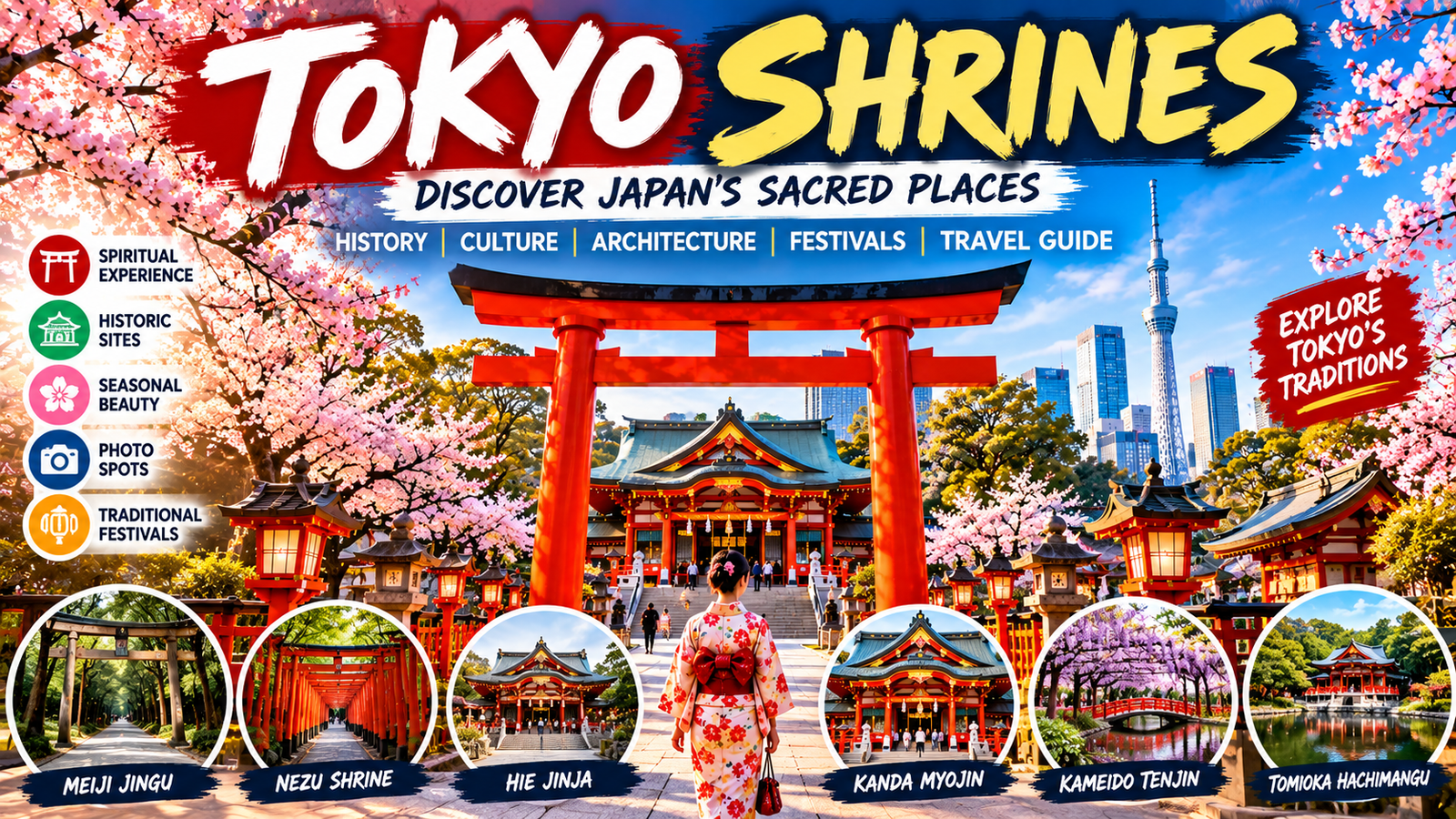
Tokyo Shrines: 15 Sacred Places, History, Etiquette, Festivals & Travel Guide
What if one of the best ways to understand Tokyo was to step away from its neon streets for a few minutes? Behind busy railway stations, shopping districts and skyscrapers, Tokyo contains hundreds of Shinto shrines. Some sit inside enormous forests, some occupy tiny urban plots, and others are surrounded by office towers that reveal just how dramatically the city has changed. Tokyo shrines offer travellers a direct encounter with Japanese Shinto traditions, architecture, festivals, seasonal landscapes and local community life. From the vast forest of Meiji Jingu and the historic buildings of Nezu Shrine to the red torii of Hie Shrine and the technology-connected culture of Kanda Myojin, each shrine provides a different perspective on Tokyo Tokyo Planner
What Is a Shinto Shrine?
A Shinto shrine is a place associated with Japan’s indigenous Shinto tradition.
The Japanese word commonly used for a shrine is jinja or jingu, although names vary.
Shinto does not have a single founder or one central scripture comparable to some other major world religions. It places strong emphasis on kami, often translated as divine or sacred spirits, and on relationships between people, nature and the sacred.
The Japan National Tourism Organization explains that shrines are associated with Shinto, while Buddhist temples belong to the Buddhist tradition. A torii is traditionally used to mark the boundary between ordinary space and sacred ground.
This distinction is useful when travelling in Tokyo.
A common example of confusion is Sensoji in Asakusa.
Sensoji is a Buddhist temple, not a Shinto shrine.
Meiji Jingu, Hie Jinja and Nezu Jinja are Shinto shrines.
Both can be spectacular cultural destinations, but their religious traditions are different.
Shrines vs Temples in Tokyo
The difference can be simplified as follows:
| Feature | Shinto Shrine | Buddhist Temple |
|---|---|---|
| Tradition | Shinto | Buddhism |
| Common entrance | Torii | Sanmon or temple gate |
| Sacred beings | Kami | Buddhas, bodhisattvas and other Buddhist figures |
| Typical worship | Bowing, clapping and prayer | Customs vary by school and temple |
| Common architectural feature | Torii, honden, haiden | Main hall, pagoda, sanmon |
| Examples in Tokyo | Meiji Jingu, Hie Jinja, Nezu Jinja | Sensoji, Zojoji |
Japan’s history also includes long periods of interaction between Buddhism and Shinto, so the cultural landscape is more complicated than this simple table suggests.
For travellers, the most important point is to recognise that the two traditions are related historically but are not identical.
The Historical Role of Tokyo Shrines
Tokyo’s shrine landscape reflects the city’s transformation from Edo into modern Tokyo.
During the Edo period, shrines played important roles in local communities.
They were associated with:
- Festivals
- Local identity
- Protection
- Agricultural traditions
- Seasonal events
- Community gatherings
- Religious observances
Some shrines became connected with the Tokugawa shogunate and Edo Castle.
Others served particular neighbourhoods or groups.
Still others had much older origins.
The result is an extraordinary historical layering.
A shrine that appears surrounded by modern buildings may have roots extending back centuries.
Meiji Jingu: Tokyo’s Famous Forest Shrine
Meiji Jingu is perhaps the most internationally recognised shrine in Tokyo.
Located beside Harajuku and Yoyogi, it creates an extraordinary contrast with one of the city’s busiest urban areas.
The shrine was established in 1920 and is dedicated to Emperor Meiji and Empress Shoken. Its approximately 70-hectare forest was created using around 100,000 donated trees from across Japan, with the original planners intending it to develop into a self-sustaining forest.
That detail is important.
The forest is not simply a piece of untouched ancient woodland.
It was deliberately designed.
The planners imagined what the forest could become over a very long period.
This makes Meiji Jingu an interesting example of Japanese landscape planning as well as religious architecture.
Why Meiji Jingu Feels So Different
Visitors often notice the silence first.
The surrounding city can be extremely busy, but the shrine approach passes beneath a thick canopy of trees.
The transition is gradual.
You leave the station area.
You enter the forest.
The sound of traffic becomes less noticeable.
Then the shrine buildings appear.
This physical transition helps explain why shrine architecture and landscape should be considered together.
Meiji Jingu After World War II
The original shrine buildings were destroyed during the air raids of World War II.
The present main buildings were completed in 1958.
The shrine explains that the current buildings use copper roofs partly for fireproofing, while the original structures had used traditional bark roofing.
This is a reminder that historic-looking Tokyo does not necessarily mean every visible building is centuries old.
Some cultural sites have been reconstructed after disasters or war.
Their significance can therefore include both historical continuity and modern reconstruction.
Visiting Meiji Jingu
Meiji Jingu is large.
The official access information notes that the walk from the entrances to the main shrine takes around ten minutes.
In reality, visitors should allow considerably more time if they want to walk slowly, take photographs where permitted and explore the surrounding grounds.
The shrine is open every day, but opening hours vary according to season.
For this reason, check the official schedule before travelling.
Hie Jinja: A Shrine Among Tokyo’s Government District
Hie Jinja sits in central Tokyo near Nagatacho and Akasaka.
The shrine is particularly famous for its red torii staircase.
The setting is fascinating.
Modern office buildings surround a traditional sacred space.
Hie Jinja has long been associated with the protection of Tokyo, and its Sanno Festival is one of the city’s major traditional festivals. GO TOKYO describes the festival as one of Japan’s three largest festivals.
Why Hie Jinja Is Special
Hie Jinja demonstrates one of Tokyo’s most fascinating contrasts:
ancient-style religious architecture inside a modern political and business district.
A visitor can leave a major office complex and arrive at a shrine within minutes.
That contrast makes Hie Jinja particularly useful for understanding Tokyo as a city where different historical layers coexist.
The Red Torii Tunnel
The staircase lined with red torii is one of the shrine’s most photographed features.
It is visually striking, but visitors should remember that the torii are not simply decoration.
They represent movement into sacred space.
Slow down.
Observe.
Avoid blocking the passage for photographs.
Nezu Shrine: One of Tokyo’s Most Photogenic Shrines
Nezu Shrine is located in Bunkyo, near the old neighbourhoods of Nezu and Sendagi.
It is one of the most rewarding shrines for travellers interested in architecture, gardens and seasonal flowers.
The shrine’s history is traditionally traced back roughly 1,900 years, while the present complex was established in the early eighteenth century under Tokugawa Tsunayoshi. Many of its buildings from that period remain and have been designated Important Cultural Properties.
Nezu Shrine’s Torii Path
The path of red torii leading toward Otome Inari Shrine is one of its defining visual features.
Visitors often compare it to the famous torii paths of Kyoto.
The experience in Tokyo, however, has a different atmosphere.
The shrine is surrounded by a residential and historic neighbourhood rather than a remote mountain landscape.
Nezu Azaleas
Nezu Shrine is particularly famous for azaleas.
GO TOKYO notes that the shrine has around 3,000 azalea plants representing approximately 100 varieties.
This makes spring an especially attractive time to visit.
But there is an important lesson here:
Seasonality can change the experience of the same shrine completely.
Visit in spring and flowers dominate the landscape.
Visit in another season and architecture, greenery and quiet pathways become more prominent.
Kanda Myojin: A Shrine Connected With Old and New Tokyo
Kanda Myojin, formally Kanda Shrine, has a history extending roughly 1,300 years.
The shrine’s official history traces its foundation to 730 in what is now the Otemachi area. It later moved as Edo developed, eventually reaching its current location in 1616.
The shrine became closely associated with the protection of central Edo.
Today, its location near Akihabara gives it an unusual contemporary identity.
Kanda Myojin and Akihabara
Akihabara is internationally famous for electronics, anime, manga and gaming.
Kanda Myojin sits nearby.
This creates an unusual cultural combination.
Traditional shrine architecture exists close to one of the world’s most recognisable centres of Japanese popular technology culture.
Kanda Myojin has also developed cultural facilities and programmes that connect traditional arts with contemporary audiences.
Its EDOCCO complex includes workshops and performances involving traditional arts, kimono, Japanese food and other cultural themes.
Kanda Matsuri
Kanda Matsuri is one of Tokyo’s major festivals.
The shrine describes the festival as having become one of Japan’s renowned festivals, with the main festival traditionally taking place every other year in May.
For travellers interested in Japanese festivals, Kanda is an important name to know.
Akasaka Hikawa Shrine
Akasaka Hikawa Shrine offers a quieter alternative to some of Tokyo’s more famous shrines.
GO TOKYO describes it as a peaceful shrine surrounded by greenery and notes its major three-day festival, Akasaka Hikawa Matsuri, held in mid-September in odd-numbered years.
The shrine is particularly appealing for visitors who want:
- A quieter atmosphere
- Traditional architecture
- Green surroundings
- A local neighbourhood setting
- Festival culture
Because it is near Akasaka, it can easily be combined with Hie Jinja and other central Tokyo attractions.
Atago Shrine: The Famous Stone Steps
Atago Jinja is located near Tokyo Tower and the Toranomon business district.
Its most famous feature is the steep staircase known as the “stone steps to success.”
There are 86 steps.
The shrine was established in 1603 on Atago Hill, and the staircase has become part of the shrine’s identity.
Why Atago Shrine Is Interesting
The shrine is a good example of how landscape influences religious experience.
Tokyo is normally associated with flat streets, railway stations and high-rise buildings.
Atago introduces elevation.
Climbing the stairs creates a physical challenge before reaching the shrine.
That experience has also developed symbolic associations with success.
However, visitors with mobility limitations should consider the steep staircase carefully and investigate current accessibility information before planning a visit.
Kameido Tenjin Shrine
Kameido Tenjin is famous for seasonal flowers, particularly wisteria.
Its wisteria trellises create a distinctive spring landscape, with flowers reflected in the shrine’s pond.
GO TOKYO reports that more than 50 wisteria plants grow around the shrine and that the Wisteria Festival takes place in April.
Kameido Tenjin and the God of Learning
Kameido Tenjin is dedicated to Sugawara no Michizane, a scholar who became associated with learning.
This makes the shrine particularly interesting for students and families visiting during examination periods.
Its traditions also include the unusual Usokae ceremony, in which wooden bullfinch figures are exchanged.
GO TOKYO notes that this tradition has been held since 1820 and is associated with replacing bad events with better fortune.
Tomioka Hachimangu Shrine
Tomioka Hachimangu is located in Fukagawa.
It is particularly famous for the Fukagawa Hachiman Festival.
The festival is traditionally held around August 15 and is considered one of the three great festivals of Edo. During the event, water is splashed over mikoshi, giving the celebration its distinctive atmosphere.
Why Tomioka Hachimangu Matters
The shrine demonstrates the community dimension of Shinto.
A festival is not simply something to watch.
Local participants carry mikoshi.
Neighbourhoods become involved.
Traditional performances and rituals take place.
The streets become part of the cultural event.
For visitors, this can provide a much deeper understanding of Japanese community traditions than simply visiting a shrine building on a quiet afternoon.
Shinagawa Shrine
Shinagawa Shrine is part of the group known as the Tokyo Jissha, or Tokyo Ten Shrines.
GO TOKYO describes the ten shrines as a group forming a ring around the Imperial Palace and notes that Shinagawa Shrine is known for its decorative torii with carved dragons.
The shrine is particularly convenient because it is close to Shimbamba Station.
That makes it a useful choice for travellers who want to experience a historic shrine without spending a large portion of the day travelling.
Nogi Shrine
Nogi Shrine is located in Akasaka near Roppongi.
It was established in 1923 to honour General Maresuke Nogi and his wife.
The shrine has a calm atmosphere despite being surrounded by one of Tokyo’s busiest central districts. GO TOKYO highlights its greenery, orange torii and traditional architecture.
The contrast between the shrine and the nearby Roppongi skyline makes it an interesting destination for photographers.
Hanazono Inari Shrine
Hanazono Inari Shrine is located within the wider Ueno cultural area.
Its red torii create a compact visual experience that can be combined with visits to nearby museums and Ueno Park.
It is useful for travellers who want to experience a smaller shrine rather than a huge complex.
This is an important point about Tokyo:
A shrine does not have to be famous to be culturally interesting.
Small neighbourhood shrines can offer a more intimate experience.
Tokyo Ten Shrines
The Tokyo Ten Shrines, or Tokyo Jissha, provide an interesting way to explore Tokyo’s historical shrine network.
Kanda Myojin’s cultural information explains that in 1868 the Meiji government designated twelve shrines around Tokyo as special guardian shrines, and that the modern “Tokyo Ten Shrines Pilgrimage” was organised in 1975.
The ten-shrine route provides a ready-made cultural journey.
It can also encourage travellers to explore parts of Tokyo outside the standard tourist circuit.
The group includes:
- Hie Shrine
- Nezu Shrine
- Shiba Daijingu
- Kanda Shrine
- Hakusan Shrine
- Kameido Tenjin Shrine
- Shinagawa Shrine
- Tomioka Hachimangu
- Oji Shrine
- Akasaka Hikawa Shrine
Rather than visiting all ten in one day, consider spreading them across several neighbourhood trips.
Understanding Shrine Architecture
Tokyo shrines can look very different, but certain architectural elements appear repeatedly.
Torii
The torii marks the entrance into sacred space.
It is usually the first major sign that you are approaching a Shinto shrine.
Temizuya
This is the purification area where visitors traditionally cleanse their hands and mouth.
Haiden
The haiden is generally the worship hall where visitors pray.
Honden
The honden is the main sanctuary associated with the kami and is usually not an ordinary visitor space.
Shimenawa
Ropes and sacred decorations can indicate a spiritually significant object or boundary.
Ema
Wooden prayer plaques allow visitors to write wishes or messages.
Omamori
These are protective amulets associated with different purposes.
Goshuin
A goshuin is a calligraphic shrine seal or stamp record that visitors can collect as a memento of their visit.
How to Enter a Tokyo Shrine Respectfully
Shrine etiquette is relatively simple once you understand the basic principles.
According to the Japan National Tourism Organization, visitors traditionally bow once before entering through a torii and avoid walking directly through its exact centre because the centre is associated with the kami.
A practical sequence is:
- Approach the torii.
- Pause.
- Bow once.
- Walk slightly to one side.
- Follow the approach.
- Purify at the water pavilion.
- Approach the worship hall.
- Make your offering.
- Follow the shrine’s customary prayer procedure.
- Step away respectfully.
There can be local variations, so follow signs or instructions at the specific shrine.
How to Purify Yourself
The purification fountain is usually called a temizuya or chozuya.
The traditional sequence involves:
- Pick up the ladle with your right hand.
- Rinse your left hand.
- Change hands.
- Rinse your right hand.
- Transfer the ladle again.
- Pour some water into your left hand.
- Use that water to rinse your mouth.
- Avoid placing your mouth directly on the ladle.
- Rinse the handle by tilting the ladle before returning it.
The purpose is symbolic purification rather than drinking the water.
The Japan National Tourism Organization provides the same basic sequence in its shrine etiquette guide.
How to Pray at a Shrine
A common shrine prayer sequence is:
Two bows → two claps → prayer → one final bow.
The JNTO describes the traditional sequence after making an offering and ringing the bell.
However, do not become anxious about making a mistake.
Respect and quiet observation are more important than performing every movement perfectly.
If a shrine provides specific instructions, follow them.
What Should You Wear?
There is usually no special dress code for ordinary shrine visits.
However, modest and respectful clothing is appropriate.
Avoid treating a shrine as a fashion studio.
This becomes particularly important when attending:
- Weddings
- Festivals
- Religious ceremonies
- Memorial events
Comfortable shoes are also useful because many shrine grounds involve walking.
Can You Take Photographs?
Photography rules vary.
Some outdoor areas are very photography-friendly.
Other areas may restrict photography around sacred buildings or during ceremonies.
Look for signs.
If there is a rope, barrier or “no photography” notice, respect it.
Photography Tips
The best shrine photographs often focus on:
- Torii
- Architecture
- Forest paths
- Seasonal flowers
- Lanterns
- Roof details
- Stone features
- Festival scenes
Avoid photographing people in intimate religious moments without permission.
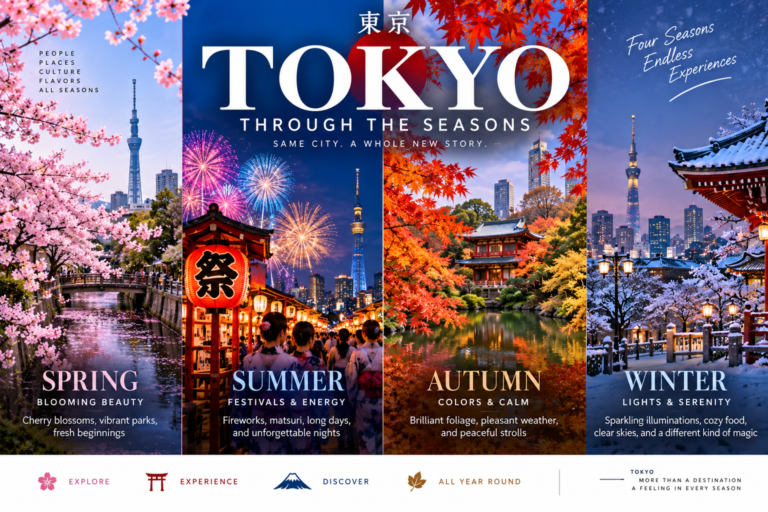
Best Time to Visit Tokyo Shrines
Tokyo shrines can be visited throughout the year, but each season creates a different atmosphere.
Spring
Spring is ideal for:
- Nezu azaleas
- Kameido wisteria
- Cherry blossoms near shrine grounds
- Fresh greenery
Nezu Shrine’s azalea season is particularly well known.
Kameido Tenjin is famous for wisteria.
Summer
Summer brings:
- Matsuri
- Mikoshi processions
- Lanterns
- Traditional performances
- Lush greenery
Tomioka Hachimangu’s Fukagawa Hachiman Festival is an important summer event.
Autumn
Autumn brings:
- Red and orange foliage
- Cooler temperatures
- Seasonal festivals
- Photography opportunities
The combination of traditional architecture and autumn leaves can be especially beautiful.
Winter
Winter offers:
- Quiet mornings
- New Year shrine visits
- Hatsumode
- Decorative New Year traditions
- Clearer views
New Year’s Day is one of the busiest periods for famous shrines.
If you want a peaceful experience, avoid peak New Year crowds.
Hatsumode: New Year Shrine Visits
Hatsumode refers to the first shrine or temple visit of the New Year.
Major Tokyo shrines can become extremely crowded.
Meiji Jingu is particularly famous for New Year’s visits.
For travellers who want to experience this tradition, prepare for crowds, queues and changes to normal movement through the shrine.
For those who prefer quiet sightseeing, visiting outside the New Year period may be more comfortable.
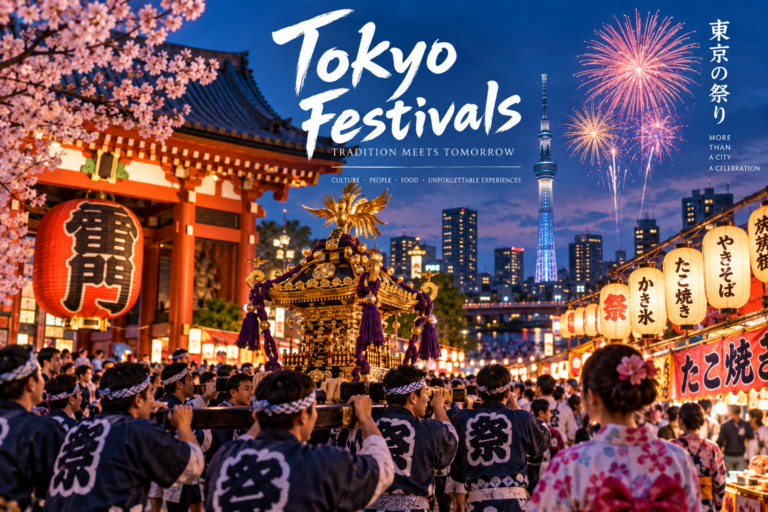
Tokyo Shrine Festivals
Festivals are among the most important ways to understand shrines as living community institutions.
A festival can include:
- Mikoshi
- Floats
- Drums
- Traditional dances
- Food stalls
- Music
- Processions
- Local community participation
Kanda Matsuri
Associated with Kanda Myojin, it is one of Tokyo’s major festivals.
Sanno Matsuri
Associated with Hie Jinja, it is one of Japan’s major traditional festivals.
Fukagawa Hachiman Festival
Associated with Tomioka Hachimangu, it is known for water being splashed over mikoshi.
Nezu Shrine Grand Festival
The annual festival takes place in September.
In 2026, the Shinkosai procession is scheduled for September 27 as part of the four-year cycle.
Shrine Festivals vs Tourist Events
This distinction matters.
A festival may be open to tourists, but it remains a religious and community event.
Visitors should:
- Stay out of processions
- Follow barriers
- Avoid blocking participants
- Ask before photographing close-up
- Keep noise reasonable
- Follow staff instructions
The best photographs often come from observing rather than interfering.
Tokyo Shrines for Families
Shrines can be excellent family destinations.
Children can learn about:
- Japanese architecture
- Nature
- Festivals
- Traditional clothing
- Seasonal flowers
- Cultural customs
However, explain the basics before arriving.
Tell children that a shrine is a religious place.
Encourage them to walk quietly near worship areas.
At larger shrine grounds, allow time for children to explore the surrounding nature.
Tokyo Shrines for Couples
Shrines are popular settings for traditional Japanese weddings.
Visitors may occasionally see wedding ceremonies or couples wearing formal traditional clothing.
If this happens, give them space.
Do not treat a wedding as a public performance.
For couples travelling together, shrine visits can also be combined with gardens, cafés and neighbourhood walks.
Tokyo Shrines for Students
Some shrines have strong associations with learning.
Kameido Tenjin is dedicated to Sugawara no Michizane, a scholar associated with academic success.
This makes it particularly relevant to students.
Students can also use shrine visits to study:
- Japanese history
- Religious studies
- Architecture
- Urban development
- Anthropology
- Tourism
- Art history
Tokyo Shrines for Photographers
Tokyo shrines provide unusually varied photographic subjects.
Wide Landscapes
Meiji Jingu’s forest offers deep perspective.
Repetition
Torii create strong geometric compositions.
Details
Roof ornaments, lanterns and wooden carvings provide close-up subjects.
Human Activity
Festivals create movement and colour.
Contrast
Hie Shrine and Kanda Myojin are particularly interesting because modern buildings surround traditional architecture.
Tokyo Shrines for Older Travellers
Not every shrine is physically demanding.
But some have:
- Stairs
- Uneven surfaces
- Long approaches
- Gravel paths
- Slopes
Choose destinations according to mobility needs.
Hie Jinja provides accessibility features including an escalator, wheelchair ramp and wheelchair loan according to GO TOKYO’s current listing.
Nezu Shrine also lists accessibility-related facilities.
Atago Shrine’s 86 steep steps make it a different proposition.
This illustrates why accessibility should be assessed shrine by shrine.
Tokyo Shrines for Wheelchair Users
Travellers using wheelchairs should check the individual shrine before visiting.
Consider:
- Entrance routes
- Steps
- Slopes
- Gravel
- Accessible toilets
- Wheelchair loan
- Alternative entrances
- Assistance availability
Historic sites can have physical constraints because of their age and original design.
Modern accessibility improvements may help, but they cannot always eliminate every barrier.
Tokyo Shrines for Budget Travellers
Most shrine grounds do not charge a general admission fee.
That makes shrines excellent options for budget travellers.
You can experience:
- Architecture
- Nature
- History
- Seasonal flowers
- Festivals
- Cultural atmosphere
without paying a museum-style entrance fee.
Optional costs can include:
- Omamori
- Ema
- Goshuin
- Festival food
- Special exhibitions
- Donations
There is no requirement to buy something.
Understanding Omamori
Omamori are protective amulets commonly associated with shrines.
Different types can be associated with themes such as:
- Safety
- Health
- Education
- Travel
- Business
- Relationships
- Protection
Visitors should understand that these are religious and cultural objects, not simply souvenirs.
Treat them respectfully.
Understanding Ema
Ema are small wooden plaques on which people write wishes or prayers.
You may see them hanging together in dedicated areas.
If you purchase one, follow the shrine’s instructions.
Writing a personal wish can become a meaningful part of the visit.
Understanding Goshuin
Goshuin are calligraphic records associated with visits to temples and shrines.
They have become popular among travellers and collectors.
However, they are fundamentally connected with religious practice.
Do not treat the goshuin desk simply like a souvenir counter.
Follow the shrine’s rules and timings.
Tokyo Shrines and Local Communities
One of the most important things tourists can miss is the connection between shrine and neighbourhood.
A shrine can function as:
- Religious centre
- Festival organiser
- Community gathering place
- Historical landmark
- Seasonal attraction
- Cultural education space
During a festival, the surrounding streets can become extensions of the shrine grounds.
This is why Tokyo shrine visits become more meaningful when combined with neighbourhood exploration.
How Tokyo’s Urban Growth Changed Its Shrines
Tokyo’s development has transformed the surroundings of many shrines.
A shrine may now be:
- Between skyscrapers
- Beside a railway line
- Behind an office building
- Inside a residential district
- Near a shopping street
But the shrine itself may retain traditional architectural elements.
This produces one of Tokyo’s strongest visual contrasts.
A centuries-old tradition can exist next to a modern train station.
Ten Major Tokyo Shrines Compared
Rather than ranking shrines, the following comparison shows what makes each one useful for different types of travellers.
| Shrine | Area | Main Appeal | Best For | Standout Feature |
|---|---|---|---|---|
| Meiji Jingu | Harajuku / Yoyogi | Forest and major shrine complex | First-time visitors | Vast man-made forest |
| Nezu Shrine | Nezu | History and seasonal flowers | Photographers | Red torii and azaleas |
| Hie Jinja | Akasaka | Central Tokyo shrine culture | Architecture and culture | Red torii staircase |
| Kanda Myojin | Akihabara / Ochanomizu | History and modern Tokyo | Culture and technology fans | Kanda Matsuri |
| Kameido Tenjin | Kameido | Flowers and learning | Families and students | Wisteria |
| Tomioka Hachimangu | Fukagawa | Edo festival culture | Festival enthusiasts | Fukagawa Hachiman Festival |
| Shinagawa Shrine | Shinagawa | Historic Tokyo | Short cultural stops | Dragon-carved torii |
| Atago Jinja | Toranomon | Historic hilltop shrine | Active travellers | 86 stone steps |
| Akasaka Hikawa Shrine | Akasaka | Quiet greenery | Slow travellers | Peaceful grounds |
| Nogi Shrine | Akasaka | History and architecture | Photographers | Traditional setting near Roppongi |
This comparison is deliberately not a ranking.
The right shrine depends on what you want to experience.
A One-Day Tokyo Shrine Itinerary
Trying to visit ten shrines in one day is not recommended.
Instead, choose a geographic cluster.
Option One: Harajuku and Shibuya
Start with Meiji Jingu.
Explore the forest.
Then continue to Harajuku for food and shopping.
This combines:
- Traditional culture
- Nature
- Fashion
- Youth culture
Option Two: Roppongi and Akasaka
Visit:
- Nogi Shrine
- Hie Jinja
- Akasaka Hikawa Shrine
This is a compact route with strong contrasts between traditional architecture and modern Tokyo.
Option Three: Ueno and Nezu
Combine:
- Nezu Shrine
- Ueno Park
- Nearby museums
- Yanaka neighbourhood
This works particularly well for travellers interested in history and traditional Tokyo.
Option Four: Eastern Tokyo
Combine:
- Kameido Tenjin
- Tomioka Hachimangu
- Other Fukagawa-area cultural attractions
This route is especially suitable for travellers interested in Edo history and seasonal flowers.
A Three-Day Tokyo Shrine Itinerary
Day One: Famous Tokyo Shrines
Visit:
- Meiji Jingu
- Hie Jinja
Day Two: Historic and Seasonal Shrines
Visit:
- Nezu Shrine
- Kameido Tenjin
Day Three: Local and Modern Connections
Visit:
- Kanda Myojin
- Nogi Shrine
- Akasaka Hikawa Shrine
This gives a broader perspective than simply visiting the most famous shrine.
Common Mistakes When Visiting Tokyo Shrines
Mistake 1: Treating Shrines Like Museums
Shrines are active religious spaces.
Solution: Behave respectfully and observe worshippers.
Mistake 2: Walking Through the Centre of the Torii
Traditionally, the centre is associated with the kami.
Solution: Walk slightly to one side.
Mistake 3: Skipping Purification
The purification fountain is part of the traditional shrine visit.
Solution: Learn the basic hand and mouth purification sequence.
Mistake 4: Photographing Private Religious Moments
Solution: Give people privacy.
Mistake 5: Blocking Torii for Photographs
Solution: Step aside after taking your photograph.
Mistake 6: Assuming Every Shrine Has the Same Hours
Solution: Check the individual shrine’s official information.
Mistake 7: Ignoring Festival Etiquette
Solution: Follow barriers and organiser instructions.
Mistake 8: Buying Religious Items Without Understanding Them
Solution: Learn the basic purpose of omamori, ema and goshuin.
Mistake 9: Visiting Only Famous Shrines
Solution: Include one quieter neighbourhood shrine.
Mistake 10: Planning Too Many Shrines in One Day
Solution: Group two or three geographically.
Pros of Visiting Tokyo Shrines
Cultural Depth Tokyo shrines
Shrines provide direct insight into Japanese religious traditions.
Low Cost Tokyo shrines
Many can be visited without general admission fees.
Beautiful Landscapes Tokyo shrines
Forests, gardens, flowers and traditional architecture create strong visual experiences.
Seasonal Variety Tokyo shrines
The same shrine can look completely different throughout the year.
Local Connections Tokyo shrines
Festivals reveal neighbourhood traditions.
Photographic Opportunities Tokyo shrines
Torii, architecture, gardens and festivals create varied subjects.
Challenges of Visiting Tokyo Shrines
Crowds Tokyo shrines
Major shrines can become extremely busy.
Language Tokyo shrines
Some smaller shrines may have limited English information.
Accessibility Tokyo shrines
Historic sites can include steps and uneven paths.
Weather Tokyo shrines
Rain, heat and humidity can affect the experience.
Cultural Uncertainty Tokyo shrines
First-time visitors may feel unsure about etiquette.
These challenges are manageable with simple preparation.
The Best Time of Day to Visit
Early morning is often ideal.
There are generally fewer tourists.
The atmosphere can feel calmer.
The light can be excellent for photography.
Late afternoon can also be beautiful.
However, always check the shrine’s opening and closing times.
Meiji Jingu, for example, adjusts opening hours seasonally.
Tokyo Shrines During Rain
Do not automatically cancel a shrine visit because of rain.
Wet stone paths, dark wooden structures and green foliage can create a completely different atmosphere.
Bring:
- Compact umbrella
- Waterproof shoes
- Protective camera cover
- Small towel
But be careful on slippery surfaces.
Tokyo Shrines During Summer
Summer can be hot and humid.
Plan outdoor shrine visits earlier in the day.
Carry water.
Take breaks.
Avoid rushing through large shrine grounds.
Festivals can make summer particularly rewarding, but crowds and heat can also be significant.
Tokyo Shrines During Winter
Winter provides cooler conditions for walking.
The atmosphere can be quieter outside New Year.
Traditional architecture can look especially striking under clear winter skies.
Tokyo Shrines and Sustainable Tourism
Shrines are often green spaces within dense urban environments.
Meiji Jingu is an especially interesting example because its forest was intentionally designed as a long-term ecological landscape.
Visitors can support responsible tourism by:
- Using public transportation
- Avoiding litter
- Staying on paths
- Respecting plants
- Not touching sacred structures
- Carrying reusable water bottles
- Following local rules
The goal is to leave the shrine environment as you found it.
The Future of Tokyo Shrines
Tokyo shrines are old institutions, but they are not frozen in time.
They continue to adapt.
Digital Information Tokyo shrines
More shrines are providing multilingual websites and digital information.
Cultural Education Tokyo shrines
Workshops and programmes can introduce traditional culture to younger generations.
Kanda Myojin’s EDOCCO facility is one example of a shrine-linked cultural space offering traditional arts and workshops.
Accessibility Tokyo shrines
Major sites are improving visitor access where historic structures allow.
Environmental Stewardship Tokyo shrines
Shrine forests and gardens may become increasingly important urban green spaces.
International Visitors Tokyo shrines
Tourism is bringing more overseas visitors into shrine environments.
This creates both opportunities and responsibilities.
Shrines can introduce international visitors to Japanese culture, while visitors must learn how to participate respectfully.
Tokyo Shrines and the Next Generation
One of the biggest questions is how younger generations will relate to shrines.
Technology changes quickly.
Religious traditions change more slowly.
But the two can coexist.
Young visitors may discover shrines through:
- Anime
- Games
- Social media
- Festivals
- Family traditions
- School events
- Local community activities
Kanda Myojin provides an interesting example of how traditional culture can exist close to Akihabara’s modern technology and entertainment ecosystem.
The future may therefore involve not replacing tradition with technology, but using contemporary tools to help people understand tradition.
Why Seasonal Shrines Matter Tokyo shrines
A shrine’s identity can be connected strongly to nature.
Nezu has azaleas.
Kameido has wisteria and other seasonal flowers.
Other shrines become particularly beautiful during autumn foliage or New Year celebrations.
This reflects a broader Japanese cultural relationship with seasonal change.
The shrine is not simply a building.
It is an environment.
Tokyo Shrines as Urban Green Spaces
This may be one of the most overlooked aspects of shrine tourism.
Tokyo is one of the world’s largest metropolitan areas.
Yet shrine grounds can provide:
- Trees
- Shade
- Water
- Birds
- Quiet
- Gardens
- Open space
Meiji Jingu is the most dramatic example.
But even smaller neighbourhood shrines can provide moments of relief from dense urban development.
This makes shrine tourism relevant not only to religious and cultural travellers but also to people seeking calm within the city.
Tokyo Shrines and Architecture
Shrine architecture can teach visitors about:
- Roof design
- Wood construction
- Painted surfaces
- Gate structures
- Spatial organisation
- Sacred boundaries
- Decorative motifs
Look carefully at the roof.
Look at the joinery.
Look at the gates.
Look at the relationship between building and path.
You will notice more after understanding the basics.
Tokyo Shrines and Festivals as Living History Tokyo shrines
A museum can preserve history in objects.
A festival preserves history through participation.
This distinction is important.
When a mikoshi is carried through a neighbourhood, people are not simply recreating a historical scene.
They are continuing a living tradition.
That is why festivals can be among the most powerful cultural experiences available to visitors.
How to Create a Meaningful Shrine Visit
Instead of rushing in, taking three photographs and leaving, spend a little more time.
Observe the Entrance Tokyo shrines
Look at the torii.
Notice the transition from city to shrine.
Walk Slowly Tokyo shrines
Pay attention to the path.
Observe the Architecture Tokyo shrines
Look beyond the obvious.
Watch Local Visitors Tokyo shrines
Without photographing intrusively, notice how people use the space.
Learn One Historical Fact Tokyo shrines
Knowing why the shrine exists changes your perception of it.
Spend a Few Quiet Minutes Tokyo shrines
You do not need to pray if that is not part of your personal practice.
But you can pause respectfully.
Explore the Neighbourhood Tokyo shrines
The shrine is usually connected to the community around it.
FAQs
What is the most famous shrine in Tokyo?
Meiji Jingu is one of Tokyo’s best-known shrines and one of the most visited Shinto sites in the city. Its large forested grounds near Harajuku and dedication to Emperor Meiji and Empress Shoken make it a popular cultural destination.
Which Tokyo shrine should first-time visitors visit?
Meiji Jingu is a convenient starting point because of its central location, large grounds and connection with modern Tokyo. Travellers who want a different atmosphere can also consider Nezu Shrine, Hie Jinja or Kanda Myojin.
What is the difference between a shrine and a temple in Japan?
A shrine is associated with Shinto, Japan’s indigenous religious tradition, while a temple is associated with Buddhism. Shrines commonly feature torii gates, whereas Buddhist temples may have structures such as temple gates and pagodas. Visitors should also follow the appropriate etiquette at each type of site.
Can tourists enter Tokyo shrines?
Yes. Most Tokyo shrines welcome visitors, although some buildings and sacred areas may be restricted. Visitors should remain within areas open to the public and follow signs and instructions.
Do I need to pay to visit a shrine in Tokyo?
Many shrine grounds can be visited free of charge. Some special gardens, museums, events or other attractions associated with a shrine may have separate admission fees.
What should I do when entering a Japanese shrine?
A common practice is to make a small bow before passing through the torii. If a purification fountain is available, visitors can purify their hands and mouth before approaching the main worship area. It is also respectful to avoid walking directly through the centre of the shrine approach, as the centre is traditionally regarded as the path of the kami.
How do you pray at a Shinto shrine?
At many shrines, the commonly taught procedure is to make two bows, clap twice, offer your prayer or gratitude, and finish with one final bow. Procedures can vary, so visitors should follow any instructions displayed at the particular shrine.
Can I take photographs inside Tokyo shrines?
Photography is often permitted in outdoor areas, but restrictions vary between shrines and specific buildings. Always look for signs and avoid photographing worshippers or restricted areas without permission.
What is an omamori?
An omamori is a traditional Japanese protective charm associated with a shrine or temple. Different charms may be connected with themes such as health, safety, studies, travel or general protection. They are normally purchased from the shrine’s designated area.
What is an ema?
Ema are small wooden plaques on which visitors write wishes, prayers or messages. They are usually hung in a designated area at the shrine.
What is goshuin?
A goshuin is a traditional shrine or temple seal inscription recorded in a goshuincho, or seal book. It generally combines calligraphy and a red seal and is collected as a record of a visit.
When is the best time to visit Tokyo shrines?
Early morning is often a good choice for travellers who want a quieter atmosphere and softer light for photography. Spring and autumn can be particularly attractive because of seasonal scenery, while New Year is one of the busiest periods because of hatsumode, the traditional first shrine visit of the year.
What is hatsumode?
Hatsumode is the first shrine or temple visit of the New Year. Millions of people in Japan participate, making major Tokyo shrines particularly busy around New Year’s Eve and the first days of January.
Which Tokyo shrines are famous for festivals?
Several Tokyo shrines host major traditional festivals. Kanda Myojin is associated with Kanda Matsuri, Hie Jinja with the Sanno Festival, and Tomioka Hachimangu with the Fukagawa Hachiman Festival. Many smaller shrines also hold local annual celebrations.
Is Nezu Shrine worth visiting?
Nezu Shrine is known for its historic architecture, attractive grounds and rows of red torii gates. It is particularly popular during its seasonal azalea display and can be a good choice for travellers looking for a shrine with a distinctive traditional atmosphere.
Is Kanda Myojin worth visiting?
Kanda Myojin is historically important and has a strong connection with the Kanda area and nearby Akihabara. Its location makes it particularly convenient for visitors combining traditional culture with Tokyo’s technology, electronics and pop-culture districts.
Is Hie Jinja difficult to access?
Hie Jinja is centrally located, but one of its best-known approaches includes a steep staircase. Visitors who have mobility limitations should investigate the shrine’s accessible entrances and facilities before visiting.
Are Tokyo shrines suitable for families?
Yes. Many shrine grounds provide open spaces where families can experience Japanese architecture, traditions and seasonal events. Parents should supervise children and explain that shrine grounds are religious spaces where respectful behaviour is expected.
Can wheelchair users visit Tokyo shrines?
Accessibility varies considerably between shrines because of steps, slopes, historic buildings and uneven surfaces. Major shrines may provide accessible routes or facilities, but travellers with mobility requirements should check the individual shrine before travelling.
Are Tokyo shrines crowded?
Popular shrines can become very crowded during weekends, holidays, festivals and New Year celebrations. Visiting on a weekday morning is often a quieter option.
How many shrines should I visit in one day?
There is no fixed number. For a relaxed cultural experience, visiting two or three shrines in one day can provide enough time to appreciate each location without turning the experience into a rushed checklist.
Can I visit a shrine and a Buddhist temple on the same day?
Yes. Tokyo has many shrines and temples located relatively close to one another, and visiting both can help travellers understand the differences and connections between Shinto and Buddhism in Japanese culture.
What should I wear when visiting a Tokyo shrine?
There is generally no strict dress code for ordinary visitors, but modest, clean and respectful clothing is appropriate. During very hot weather, comfortable clothing is practical while still respecting the religious setting.
Can I eat inside a shrine?
Rules vary. Visitors should not eat in areas where eating is prohibited and should avoid treating sacred spaces like picnic areas. If food stalls or festival vendors are present, follow the designated eating arrangements.
What should I avoid doing at a shrine?
Avoid shouting, blocking pathways, touching sacred objects without permission, entering restricted areas, ignoring photography restrictions, littering or behaving disrespectfully during prayers and ceremonies.
Are Tokyo shrines open every day?
Many shrine grounds are accessible throughout the year, but opening hours for offices, worship buildings, gardens and other facilities can differ. Check the individual shrine’s official information before making a special trip.
What is the best Tokyo shrine for photography?
There is no single answer because different shrines offer different visual experiences. Meiji Jingu is known for its forested approach, Nezu Shrine for its red torii gates and seasonal flowers, Hie Jinja for its striking torii staircase, and Kanda Myojin for its colourful architecture.
Can I buy souvenirs at Tokyo shrines?
Many shrines have designated areas selling omamori, ema, goshuin and other religious or commemorative items. Availability varies between locations.
Should I visit Tokyo shrines even if I am not religious?
Yes. Visitors can experience shrines from cultural, historical, architectural and artistic perspectives while still respecting their religious purpose. The important point is to behave respectfully and understand that these are active places of worship.
What is the most peaceful shrine in Tokyo?
The experience depends on the time and day of your visit. Smaller neighbourhood shrines can often feel quieter than major tourist destinations, particularly outside festival periods and peak visiting hours.
What is the best way to explore Tokyo shrines?
Choose a small group of shrines based on your interests rather than trying to visit as many as possible. Combine them with nearby cultural attractions and allow enough time to walk around, observe the architecture and experience the surrounding neighbourhood.
Conclusion
Tokyo’s shrines offer much more than beautiful places to visit. They provide a window into Japanese history, Shinto traditions, local communities, seasonal festivals, architecture, and the relationship between modern Tokyo and its cultural roots. From the peaceful forest surrounding Meiji Jingu to the colourful torii gates of Nezu Shrine, the historic atmosphere of Kanda Myojin, the distinctive staircase at Hie Jinja, and the seasonal beauty of Kameido Tenjin, each shrine has its own character and story. Some are major landmarks visited by international travellers, while others are quieter neighbourhood sanctuaries where visitors can experience a more intimate side of Tokyo.


One Comment