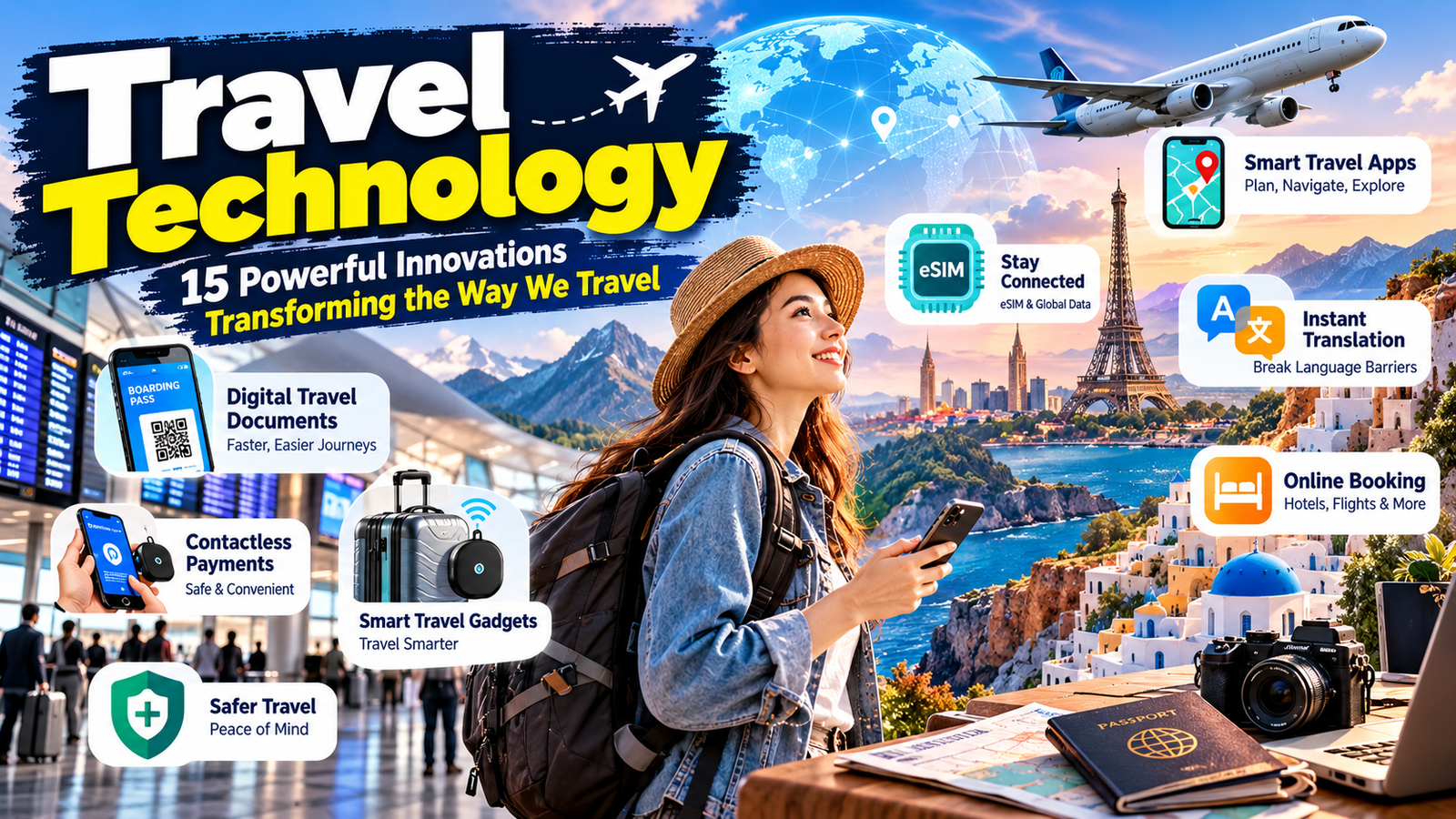
Travel Technology: 15 Powerful Innovations Transforming the Way We Travel
Imagine planning an international holiday without spending hours comparing flights, checking hotel availability, translating unfamiliar signs or searching for directions in a new city. Today, digital tools can help travellers organise much of this work before they even leave home. Travel technology has transformed the way people discover destinations, book accommodation, navigate unfamiliar places and manage their journeys. Travel technology includes the digital tools, software, devices and connected services that make planning, booking and experiencing travel easier. From artificial intelligence and mobile boarding passes to eSIMs, smart luggage and contactless payments, the right technology can make journeys more convenient, informed and flexible Tokyo Local Markets
What Is Travel Technology?
Travel technology refers to the hardware, software, digital platforms and communication systems used to plan, sell, manage and experience travel.
It connects different parts of the travel journey, including transportation, accommodation, tourism services, payments, customer support and destination information.
In the past, travellers often relied on printed maps, paper tickets, guidebooks and telephone reservations. Many of these activities can now be completed using a smartphone, although traditional methods remain important when technology is unavailable or unsuitable.
The main categories of travel technology
Booking technology: Online platforms that help travellers reserve flights, hotels, rental cars, tours and other services.
Artificial intelligence: Systems that generate itinerary suggestions, summarise information and support customer service.
Mobile technology: Smartphones, applications, digital tickets and travel documents that help travellers manage journeys.
Connectivity technology: Mobile networks, eSIMs, Wi-Fi routers and satellite communication that enable internet access.
Travel hardware: Power banks, smart luggage accessories, trackers, translation devices and other useful equipment.
Transport technology: Systems used for digital boarding, automated check-in, passenger information and transport coordination.
Hospitality technology: Digital room keys, automated guest services, smart room controls and online concierge systems.
Safety technology: Emergency alerts, location-sharing features, account security tools and services that help travellers respond to disruptions.
These categories often overlap. A smartphone, for example, can function as a boarding pass, navigation device, translation tool, payment method and communication system.
Why travel technology matters
The value of technology is not simply that it replaces paperwork. Its greatest benefit is that it helps travellers make decisions with less uncertainty.
A traveller facing a delayed flight can check the airline’s official updates. Someone exploring an unfamiliar city can compare routes. A family can store booking confirmations in one place instead of carrying several printed documents.
Technology can also help businesses coordinate operations, reduce repetitive administrative work and provide more personalised services.
The challenge is deciding which tools deserve your attention and which introduce unnecessary complexity.
How Travel Technology Has Evolved
The early era of travel information
Before widespread internet access, travellers often depended on travel agents, printed guidebooks, paper timetables and telephone bookings.
These methods could provide valuable expertise, but updating information was difficult. A printed timetable could become outdated, and a traveller might not discover a transport disruption until arriving at the station.
The rise of online travel booking
As internet access became widespread, online booking platforms changed how people compared flights, hotels and holiday packages.
Travellers gained the ability to examine prices, read reviews and make reservations without visiting a physical travel agency.
This created more choice, but it also introduced new challenges. Comparing offers across different platforms can be time-consuming, and the cheapest headline price may exclude important charges.
The smartphone revolution
Smartphones brought multiple travel functions into one portable device.
Travellers could use digital maps, mobile boarding passes, translation applications, online banking and messaging without carrying separate equipment for each task.
The result was a shift from planning a trip in advance and following a fixed itinerary to managing many details dynamically during the journey.
Cloud services and connected travel
Cloud-based systems made it easier to access reservations, documents and travel information across devices.
Airlines, hotels and travel platforms could also coordinate information more efficiently, although the quality of integration differs between providers.
For travellers, cloud services reduce the need to keep every document on one device. However, they also make account security, internet availability and access recovery more important.
The current era of AI-assisted travel
Artificial intelligence has introduced new ways to search for information, organise itineraries and summarise complicated options.
Instead of manually researching every attraction, a traveller can describe a budget, preferred activities and trip duration, then use AI to create a starting itinerary.
The result still requires verification. AI can misunderstand opening hours, overlook seasonal closures or suggest unrealistic travel times.
The most useful modern travel process combines automated assistance with reliable official information and human judgement.
Artificial Intelligence and Travel Planning
AI is one of the most significant developments because it can help people work through large amounts of information and generate personalised suggestions.
How AI travel planners work
AI travel tools can process a traveller’s stated preferences and create suggested plans.
For example, someone planning a five-day visit might specify:
- A total spending limit.
- Preferred accommodation style.
- Interest in museums and local food.
- A preference for public transport.
- Limited walking distances.
- A desire to avoid crowded attractions.
An AI tool can use these details to propose a draft itinerary, organise activities by neighbourhood and identify questions that need further research.
This is particularly useful during the early planning stage, when the traveller may not yet know which destinations fit their interests.
What AI does well
AI can be particularly useful for:
- Generating initial itineraries.
- Summarising destination information.
- Comparing different travel styles.
- Suggesting activities based on stated interests.
- Rewriting complex information in simpler language.
- Translating or explaining travel-related text.
- Producing packing lists and planning checklists.
- Identifying gaps in an itinerary.
It can also help travellers adapt plans. If rain is forecast, for example, an AI assistant can suggest indoor alternatives, provided the relevant weather and venue information is checked.
What AI does poorly
AI-generated travel information can sound convincing even when it is incorrect.
Potential problems include:
- Invented or outdated attractions.
- Incorrect prices or operating hours.
- Unrealistic travel times.
- Recommendations that ignore local restrictions.
- Failure to account for visa requirements.
- Inaccurate assumptions about accessibility.
- Recommendations that do not reflect the traveller’s actual needs.
AI should therefore be treated as a planning assistant rather than the final authority on bookings, immigration rules, transport disruptions or safety instructions.
A practical example: planning a Tokyo day trip
Suppose you want to visit a museum, eat at a local restaurant and explore a traditional shopping street.
An AI assistant can suggest a logical sequence, identify transport questions and estimate how much time to reserve for each activity.
You should then verify the museum’s opening hours, restaurant availability and transport arrangements before committing.
This division of work is efficient: AI helps structure the research, while reliable sources establish the facts.
How to get better results from AI
Give the tool specific constraints rather than asking for a generic itinerary.
For example, describe your travel dates, starting point, budget, mobility needs, interests and preferred pace.
Ask it to distinguish confirmed information from estimates, identify assumptions and list the details that require verification.
The more clearly you describe your needs, the more useful the resulting plan is likely to be.
Smart Travel Apps Every Traveller Should Understand
A well-organised collection of travel applications can reduce friction throughout a trip. However, installing too many apps can create confusion, duplicate notifications and unnecessary battery use.
The goal is to choose a small set of tools that cover your essential needs.
Navigation applications
Navigation apps help travellers find hotels, restaurants, stations and attractions.
They can provide walking directions, public transport suggestions, estimated journey times and information about nearby services.
Before travelling, download offline maps where supported and save the addresses of important destinations.
Remember that an offline map may not provide live traffic information, current service disruptions or every detail available through an internet connection.
Flight tracking and airline applications
Airline applications can help travellers manage reservations, check in, access boarding passes and receive flight updates.
Some flight-tracking services also display estimated arrival times and aircraft movements.
For decisions about delays, cancellations, baggage rules and rebooking, the airline’s own communication remains particularly important.
A third-party notification can be useful, but it should not replace instructions from the carrier.
Accommodation applications
Hotel and accommodation apps help travellers manage reservations, communicate with hosts and review booking details.
Keep the confirmation number, address, check-in instructions and cancellation conditions accessible offline.
For accommodation booked through a third party, understand whether changes must be handled through the platform or directly with the property.
Translation applications
Translation tools can assist with menus, transport signs, basic conversations and written instructions.
Some support camera-based translation, voice input or offline language packs.
Download the languages you need before departure and test the offline features. A tool that translates typed text may not offer the same capabilities when scanning a sign without internet access.
For important legal, medical or immigration matters, obtain qualified assistance where necessary rather than relying solely on automated translation.
Budget and expense apps
Travel budget tools can help track accommodation, meals, transport and activities.
They are especially useful for longer trips or group travel, where expenses may be shared between several people.
A simple spreadsheet may be enough for many travellers. A dedicated app is worth using when it saves time or offers useful features such as currency conversion and receipt organisation.
Itinerary management apps
An itinerary organiser can bring flights, accommodation, reservations and activities together.
The main advantage is convenience: you do not need to search through messages every time you want to check a booking.
However, confirm that important details are stored locally or otherwise accessible without a connection.
How to avoid app overload
Use a practical minimum:
- One main navigation tool.
- One place to store bookings and travel documents.
- One communication method.
- One reliable way to access money.
- One backup source for essential travel information.
Add specialist tools only when they solve a real problem.
Digital Travel Documents and Contactless Check-In
Digital documents have changed how travellers manage the administrative side of a journey.
Boarding passes, hotel confirmations, train tickets and some entry documents can now be stored electronically, depending on the provider and destination.
Mobile boarding passes
Many airlines offer digital boarding passes through their applications or mobile websites.
These can reduce the need to print tickets and make it easier to retrieve travel information.
However, not every airport, route or passenger category supports the same process. Some journeys require document checks or additional procedures at the airport.
Always follow the airline’s instructions.
Digital hotel keys
Some accommodation providers support mobile room keys that allow guests to access rooms using a compatible smartphone.
This can reduce the need to collect a physical key card at reception.
Availability depends on the property, device and access system. Keep the hotel’s contact details available in case your phone is lost, discharged or unable to access the key.
Electronic visas and entry documents
Some destinations offer electronic visa applications, digital authorisations or online arrival forms.
These systems can make preparation easier, but eligibility requirements vary by nationality, passport type, travel purpose and length of stay.
A successful online application does not automatically guarantee admission to a country. Travellers must comply with current immigration requirements and any document checks at the border.
Contactless airport processes
Airports and airlines continue to introduce technologies designed to reduce repetitive paperwork and speed up passenger processing.
These can include automated check-in kiosks, electronic gates and biometric verification in eligible locations.
Participation may be optional or subject to specific eligibility requirements. Travellers should understand how their biometric information is used and whether an alternative process is available.
The importance of a backup
Digital convenience creates a dependency on devices and accounts.
Before departure:
- Save documents for offline access.
- Keep important booking references separately.
- Ensure your phone can be charged during the journey.
- Know how to retrieve your reservations if you lose access to an account.
- Carry required physical documents when regulations or providers demand them.
Digital documents should simplify travel, not become a single point of failure.
Travel Connectivity: Wi-Fi, eSIMs and Mobile Data
Connectivity is the foundation of many travel technology services. Navigation, digital payments, translation, booking management and online communication can all depend on a working internet connection.
Travel eSIMs
An eSIM is a digital SIM profile that can provide mobile service on a compatible device.
For international travel, a suitable eSIM can offer a convenient way to access data without physically replacing your existing SIM card.
Before purchasing one, check:
- Whether your phone supports eSIM.
- Whether the device is unlocked.
- The data allowance and validity period.
- The supported mobile network.
- Whether hotspot sharing is allowed.
- Whether voice calls or text messages are included.
Some travel eSIMs provide data only, so do not assume that they include a local phone number.
Physical travel SIM cards
A physical SIM can be a useful alternative for phones that do not support eSIM.
Compatibility, network access and plan features vary, so check the exact phone model and service before buying.
Keep your original SIM secure if you remove it during the trip.
Pocket Wi-Fi
Portable Wi-Fi routers connect to a mobile network and share an internet connection with several devices.
They can be useful for families, groups and travellers who need internet access on laptops or tablets.
The main disadvantages are the need to charge another device, manage the rental and comply with data restrictions.
Free public Wi-Fi
Public hotspots can reduce data costs in airports, hotels, cafés and other participating facilities.
Their limitations include variable coverage, login requirements, congestion and security considerations.
For travellers who need reliable access while moving around, public Wi-Fi works best as a supplement rather than the only connection.
Satellite connectivity
Satellite communication can provide connectivity in certain remote environments where terrestrial networks are unavailable.
Its suitability depends on the device, service, location, subscription and local regulations. It should not be assumed to work everywhere or to be a simple substitute for ordinary mobile data.
Building a reliable connectivity plan
For a typical international trip, consider a primary mobile connection, accommodation Wi-Fi and offline copies of essential information.
Travellers going to remote areas may need additional preparation, such as checking coverage, carrying emergency communication equipment and informing someone about their itinerary.
Smart Travel Gadgets Worth Considering
Travel gadgets can improve convenience, but buying every new device is rarely necessary. Choose equipment based on a specific problem you want to solve.
Power banks
A power bank can keep your phone and other compatible devices charged during long travel days.
Capacity, weight, charging speed and port compatibility all matter.
Airline rules for spare lithium batteries vary by jurisdiction and carrier, so check the applicable requirements before flying. Many airlines require spare power banks to be carried in cabin baggage rather than checked baggage.
Universal travel adapters
A travel adapter allows a compatible plug to fit a different socket type.
An adapter does not automatically convert electrical voltage. Check whether your device supports the destination’s power supply and whether a voltage converter is necessary.
Smart luggage trackers
Bluetooth and compatible network-based trackers can help travellers locate misplaced luggage or personal belongings.
Their effectiveness depends on the tracking technology, battery, nearby devices or network coverage and the manufacturer’s system.
A tracker can help locate a bag, but it does not guarantee recovery and should not replace airline baggage reporting procedures.
Noise-cancelling headphones
Noise-cancelling headphones can make flights, railway journeys and busy terminals more comfortable.
They may also help travellers concentrate during remote work.
Consider battery life, comfort, weight and whether the device offers a wired mode if its battery runs out.
E-readers and digital notebooks
An e-reader can reduce the need to carry several books, while a digital notebook may help organise travel notes and plans.
These devices are most useful when they replace equipment you would otherwise carry.
Translation devices
Dedicated translation devices may help travellers who prefer not to rely on a smartphone.
However, many require an internet connection for their best features. Check supported languages, offline capabilities, battery life and the quality of speech recognition.
Compact chargers and cables
A small charging kit can reduce the risk of arriving at a destination with incompatible or missing cables.
Choose equipment that supports your devices and meets relevant safety requirements. Avoid buying chargers solely because they advertise high wattage; confirm that the connected device supports the charging standard.
How to decide whether a gadget is worth buying
Ask three questions:
- Does it solve a problem you are likely to encounter?
- Can your existing phone or equipment already perform the same function?
- Is the convenience worth the cost, weight and charging requirements?
The best travel gadget is often the one that removes a genuine inconvenience without adding another device to manage.
Ten Travel Technology Brands and Services to Know
The travel technology market includes booking platforms, navigation tools, accommodation services, payment systems and digital travel assistants. These brands solve different problems, so the best choice depends on what you need.
The following comparison is a practical overview rather than a universal ranking. Features, regional availability and prices may change.
1. Google Maps
Main purpose: Navigation and location discovery.
Google Maps helps travellers search for attractions, restaurants, transport connections and nearby services. Depending on the destination and available data, it can provide walking directions, public transport routes and business information.
Advantages:
- Combines maps, directions and location discovery.
- Useful for exploring unfamiliar cities.
- Supports offline maps in eligible areas.
Limitations:
- Some business information may be outdated.
- Offline maps do not provide every live feature.
- Routes and accessibility details may need verification.
2. Google Travel
Main purpose: Travel research and trip planning.
Google’s travel tools can help users explore flights, accommodation and destination information. Available features depend on the service and region.
Advantages:
- Useful for researching travel options.
- Can help compare dates and possible routes.
- Supports early-stage holiday planning.
Limitations:
- Features vary by region.
- Prices and availability can change.
- Final booking conditions must be checked.
3. Booking.com
Main purpose: Accommodation booking.
Booking.com provides a platform for searching accommodation and other travel products in participating markets. Filters and property details help travellers compare different options.
Advantages:
- Offers a broad range of accommodation choices.
- Provides property details and guest reviews.
- Helps organise reservation information.
Limitations:
- Cancellation terms and taxes vary.
- Property descriptions should be reviewed carefully.
- Changes may be subject to booking-specific conditions.
4. Expedia
Main purpose: Travel booking and trip organisation.
Expedia offers travel booking services, including accommodation and flights, with other products available in selected markets.
Advantages:
- Can help organise several aspects of a journey.
- Offers comparison tools for travel products.
- Useful for managing eligible reservations.
Limitations:
- Booking conditions differ by product.
- Changes may involve fees or separate provider rules.
- The lowest displayed price may not include every additional cost.
5. Skyscanner
Main purpose: Flight comparison.
Skyscanner helps users search and compare airfares from different airlines and booking providers.
Advantages:
- Useful for exploring different travel dates.
- Helps compare routes and fare options.
- Can support flexible trip planning.
Limitations:
- Final prices may differ.
- Baggage and fare conditions vary.
- Booking terms should be checked with the selected provider.
6. Trip.com
Main purpose: Travel booking.
Trip.com offers travel booking products such as flights, hotels and selected transport services.
Advantages:
- Combines several travel services.
- Provides digital booking management.
- Useful for comparing available options.
Limitations:
- Product availability varies.
- Change and cancellation terms differ.
- Support arrangements depend on the booking.
7. Tripadvisor
Main purpose: Reviews and destination discovery.
Tripadvisor helps people explore attractions, restaurants, accommodation and travel experiences.
Advantages:
- Provides ideas for activities and places to visit.
- Offers traveller reviews and ratings.
- Helps users create a shortlist of destinations.
Limitations:
- Reviews can be subjective.
- Some information may become outdated.
- Individual experiences may not represent typical service quality.
8. Uber
Main purpose: App-based transport.
Uber connects eligible riders with transport services in participating locations.
Advantages:
- Convenient ride requests where available.
- Provides digital trip information.
- Can simplify some local transport arrangements.
Limitations:
- Availability varies by destination.
- Fares can change with demand.
- Local transport regulations and vehicle options differ.
9. Revolut
Main purpose: Digital financial services.
Revolut offers financial services in supported markets, with features depending on the user’s country and account plan.
Advantages:
- Can help users manage eligible card payments.
- Offers certain currency-related features.
- Provides digital account management.
Limitations:
- Fees and exchange limits vary.
- Not every service is available in every country.
- It does not guarantee acceptance at every merchant.
10. ChatGPT
Main purpose: AI-assisted planning and research.
ChatGPT can help structure trip plans, compare travel styles, create packing lists, explain transport options and suggest questions to investigate.
Advantages:
- Flexible assistance based on a traveller’s needs.
- Useful for organising complex information.
- Can generate checklists and itinerary drafts.
Limitations:
- Generated information can be incomplete or inaccurate.
- Prices, schedules and rules require verification.
- It should not replace official guidance for important decisions.
Travel technology comparison table
| Brand | Main purpose | Best use case | Important limitation |
|---|---|---|---|
| Google Maps | Navigation | Finding routes and nearby places | Some information may be outdated |
| Google Travel | Travel research | Exploring flights and trip options | Features vary by region |
| Booking.com | Accommodation booking | Comparing places to stay | Cancellation rules vary |
| Expedia | Travel booking | Organising multiple travel components | Booking conditions differ |
| Skyscanner | Flight comparison | Exploring routes and fares | Final fare may differ |
| Trip.com | Travel booking | Managing travel reservations | Product terms vary |
| Tripadvisor | Reviews and discovery | Researching attractions and experiences | Reviews can be subjective |
| Uber | App-based transport | Booking eligible rides | Not available everywhere |
| Revolut | Digital financial services | Eligible travel payments | Account features and fees vary |
| ChatGPT | AI assistance | Planning and organising travel | Facts require verification |
How to choose: Start with the problem you need to solve. A navigation tool, a booking platform and an AI assistant are not direct substitutes for one another. You may benefit from using several tools together, provided you keep essential information organised.
Digital Payments and Currency Management While Travelling
Travel technology has made it easier to pay for transport, accommodation, food and activities without carrying large amounts of cash.
However, payment options vary considerably between countries, merchants and financial institutions.
Contactless payments
Contactless cards and compatible mobile wallets can make transactions quicker at participating terminals.
Before departure, check whether your card is enabled for international use, whether your bank charges foreign transaction fees and whether your preferred mobile wallet is supported at your destination.
Digital wallets
Digital wallets can store eligible payment cards on a compatible device.
They may reduce the need to take a physical card out for every transaction, but they depend on device compatibility, merchant acceptance and account security.
Keep a backup payment method in case your phone is lost, discharged or unable to complete a transaction.
Currency conversion tools
Currency converters help travellers estimate prices in a familiar currency.
However, an exchange-rate estimate is not necessarily the rate you will receive on a card transaction, cash withdrawal or currency exchange.
Compare the actual fees and conversion terms before deciding how to pay.
Expense tracking
Expense tracking applications can help organise spending by category and identify when a trip is exceeding its budget.
For group travel, shared expense tools can make it easier to record who paid for meals, transport or accommodation.
The most important habit is to record expenses consistently. A complicated app is not useful if you stop updating it after the first day.
Avoid relying on one payment method
A practical strategy is to carry a primary payment card, a separate backup and an appropriate amount of local currency.
Store the backup separately so that losing your main wallet does not remove every way to pay.
Travel Technology for Safety and Emergencies
Technology can improve situational awareness and help travellers respond to unexpected events, but it cannot eliminate every travel risk.
Emergency alerts
Official emergency alerts can provide important information about severe weather, natural disasters, public safety incidents and transport disruption.
Learn how alerts are delivered at your destination and whether you need to enable specific notification settings.
Location sharing
Location-sharing tools can help family members or travel companions coordinate meetings and check that everyone has reached an agreed destination.
Use these features deliberately. Share location information only with people you trust and review the duration of any active sharing arrangement.
Digital copies of important documents
Store secure copies of essential documents where you can retrieve them if originals are lost.
Examples include passport information, insurance details, emergency contacts and reservation confirmations.
Digital copies do not replace original documents when authorities or providers require them, but they can make recovery and reporting easier.
Account security
Travel can expose people to unfamiliar networks, shared devices and unexpected login requests.
Useful precautions include:
- Using unique passwords.
- Enabling multifactor authentication.
- Keeping operating systems updated.
- Avoiding suspicious links and attachments.
- Securing access to email accounts.
- Knowing how to freeze or block payment cards.
Email security is especially important because access to an email account can sometimes be used to reset other travel-related accounts.
Location trackers and lost luggage
A luggage tracker may help you determine whether a bag is nearby or has moved to another location.
However, tracker information can be delayed or unavailable, depending on the device and network.
If an airline loses your luggage, follow the airline’s reporting procedure and retain your baggage claim reference. A tracker is supporting evidence, not a replacement for an official claim.
Technology for solo travellers
Solo travellers can use navigation, trusted contacts, emergency information and scheduled check-ins to improve coordination.
For remote hikes or journeys through areas with limited coverage, check whether the route requires a dedicated emergency communication device rather than relying on a smartphone alone.
Travel Technology for Families, Older Travellers and People with Disabilities
Good travel technology should improve access and reduce unnecessary difficulty. The most suitable tools depend on individual needs rather than age or ability alone.
Families travelling with children
Families may benefit from shared itineraries, digital copies of bookings, location-sharing arrangements and offline entertainment for long journeys.
Agree on a simple procedure for meeting if the group becomes separated. Do not rely exclusively on a child’s phone, because the battery may run out or the device may lose connectivity.
Older travellers Travel technology
Larger text, voice assistance, accessible navigation features and simplified booking records can make technology easier to use.
Before departure, practise the essential tasks: opening a boarding pass, locating a hotel address, making a call and accessing emergency contacts.
A printed backup of critical information may be reassuring for travellers who do not want to depend entirely on a phone.
Travellers with visual impairments Travel technology
Screen readers, voice assistants, accessible navigation tools and audio descriptions can help travellers access information.
However, accessibility varies between applications and destinations. A route that appears accessible on a map may contain steps, temporary obstructions or difficult crossings.
Check accessibility information with the relevant transport operator or attraction when the details are essential.
Travellers with mobility limitations Travel technology
Technology can help identify accessible hotels, transport services and attractions.
When planning, investigate practical details such as step-free station access, lift availability, accessible bathrooms and distances between transport stops.
A general accessibility label may not describe every requirement, so confirm important details directly with the service provider.
Travellers with hearing impairments Travel technology
Live transcription, captioning and visual notifications can improve access to announcements and communication.
However, not every transport or emergency system provides the same accessibility features. Familiarise yourself with local visual signage and emergency procedures.
Neurodivergent travellers Travel technology
Visual schedules, saved instructions, offline maps and itinerary reminders can reduce uncertainty.
Travellers who prefer predictable routines may benefit from keeping plans organised in one place and allowing extra time for transitions between activities.
Technology should support the traveller’s preferred way of organising the journey rather than creating additional notifications and complexity.
Travel Technology for Business Travellers and Digital Nomads
Business travel requires reliable coordination, access to work systems and careful management of information.
Digital nomads face similar challenges, often over longer periods and across multiple countries.
Video meetings and remote work Travel technology
A reliable connection matters for meetings, document sharing and collaboration.
Before an important call, test your connection, confirm the time zone and ensure you have a backup option.
Do not assume hotel Wi-Fi is suitable for every workload simply because it is advertised as high-speed.
Time-zone management Travel technology
Calendar tools can reduce confusion when meetings involve people in different countries.
Confirm the time zone in the invitation and check whether the calendar automatically adjusts when you travel.
For important appointments, keep the time and date visible in the calendar rather than relying on memory.
Secure access to company systems Travel technology
Business travellers should follow their employer’s security policies.
Use approved authentication methods, avoid installing unknown software and report suspicious login requests.
If your organisation requires a particular VPN or managed device, configure it before departure where possible.
Digital expense management Travel technology
Expense tools can help capture receipts, categorise purchases and prepare reimbursement reports.
Check which expenses require original receipts and whether your employer has rules about currencies, spending limits or approved booking platforms.
Managing work-life boundaries Travel technology
Travel technology makes it easy to remain available at all times, but constant notifications can reduce the quality of the trip.
Set appropriate notification rules, schedule focused work periods and protect time for rest or sightseeing.
For digital nomads, reliable connectivity is valuable, but it should not turn every destination into an extension of the office.
Common Travel Technology Mistakes and Their Solutions
Mistake 1: Assuming internet access will always be available Travel technology
Even well-connected cities have underground areas, rural locations and buildings where reception is weak.
Solution: Download offline maps, save booking confirmations and keep essential contact details accessible without internet.
Mistake 2: Trusting AI without checking facts Travel technology
AI can generate an attractive itinerary containing incorrect opening hours, unsuitable transport routes or outdated prices.
Solution: Verify essential details with official providers before paying or committing to a schedule.
Mistake 3: Installing too many travel apps Travel technology
Multiple applications can create duplicated information, extra notifications and confusion about which reservation is current.
Solution: Choose a small set of tools and store your final itinerary in one reliable place.
Mistake 4: Ignoring subscription costs Travel technology
Some services renew automatically or charge extra for features that are not obvious during setup.
Solution: Review pricing, renewal terms, trial periods and cancellation conditions before subscribing.
Mistake 5: Forgetting device compatibility Travel technology
A travel eSIM, charger or adapter may not work with every phone or electrical system.
Solution: Check the exact device model, supported networks, connector types and voltage requirements before buying equipment.
Mistake 6: Depending on a single phone Travel technology
A lost, stolen or damaged phone can interrupt navigation, communication, payments and access to reservations.
Solution: Keep important documents accessible through a secure backup method, save emergency contacts separately and know how to recover essential accounts.
Mistake 7: Ignoring battery management Travel technology
A phone used continuously for maps, photographs, translation and video may run out of power before the day ends.
Solution: Charge devices overnight, carry a suitable power bank and reduce unnecessary background activity.
Mistake 8: Using public Wi-Fi without checking the network Travel technology
A network name that looks familiar is not proof that the hotspot is legitimate.
Solution: Confirm the network details with the venue and avoid entering sensitive information on suspicious pages.
Mistake 9: Booking based only on the cheapest headline price Travel technology
A low fare or hotel price may exclude baggage, taxes, flexible cancellation or other essential services.
Solution: Compare the final price and full terms before confirming a reservation.
Mistake 10: Forgetting to check local rules Travel technology
Technology cannot guarantee that a digital ticket, drone, recording device or payment method is permitted in every destination.
Solution: Check local regulations and service requirements before using specialised equipment or relying on a digital process.
Advantages and Disadvantages of Travel Technology
Travel technology provides substantial benefits, but a balanced approach recognises its limitations.
The main advantages Travel technology
Convenience: Travellers can organise reservations, access documents and check transport information from a mobile device.
Greater choice: Digital platforms make it easier to compare accommodation, flights, activities and travel services.
Personalisation: AI assistants and recommendation systems can help travellers explore options that match their interests and constraints.
Better communication: Messaging, translation and internet connectivity help people communicate across language barriers and time zones.
Improved coordination: Shared itineraries, digital tickets and booking records can make group travel easier to manage.
Accessibility: Screen readers, captions, translation tools and other assistive features can make travel information more accessible.
Time savings: Automated processes can reduce repetitive work such as organising reservations or searching for basic destination information.
The main disadvantages Travel technology
Dependence on devices: Losing access to a phone can interrupt several essential travel activities at once.
Privacy concerns: Applications may collect location, booking, payment or behavioural data.
Information overload: Endless recommendations and notifications can make planning more complicated rather than easier.
Unequal access: Not everyone has a compatible smartphone, reliable internet access or the skills needed to use digital services.
Potential inaccuracies: AI-generated content, user reviews and outdated listings may provide misleading information.
Hidden costs: Subscription fees, roaming charges, foreign transaction fees and booking extras can increase the total travel budget.
Reduced human interaction: Digital self-service can make some processes faster, but it may be frustrating when travellers need personal assistance.
A balanced comparison
| Area Travel technology | Potential benefit Travel technology | Potential drawback Travel technology | Best practice Travel technology |
|---|---|---|---|
| AI planning | Faster itinerary creation | Incorrect or outdated suggestions | Verify essential facts |
| Booking platforms | Easier comparison | Complex conditions and extras | Check the final price |
| Digital documents | Convenient access | Device or account failure | Keep secure backups |
| Mobile connectivity | Easier navigation | Coverage gaps and costs | Prepare offline information |
| Digital payments | Quick transactions | Compatibility and fraud risks | Carry a backup method |
| Smart gadgets | Added convenience | Extra weight and charging needs | Buy only useful equipment |
| Location sharing | Easier coordination | Privacy concerns | Share selectively |
| Reviews and ratings | Broader perspectives | Bias and manipulation | Compare multiple signals |
The most important principle Travel technology
Technology should support a traveller’s goals, not dictate every decision.
A digital map can help you reach a destination, but it cannot fully replace local awareness. An AI itinerary can suggest a route, but it may not understand that you want time to explore spontaneously.
The best travel experience combines useful technology with flexibility, sound judgement and an awareness of the world around you.
The Future of Travel Technology: Trends to Watch
The next stage of travel technology is likely to focus on more connected services, greater personalisation and smoother coordination between different parts of a journey.
These developments are trends to watch rather than guarantees that every technology will become universal.
More capable AI travel assistants Travel technology
AI assistants may increasingly help travellers move from initial research to more structured trip management.
Potential applications include summarising booking conditions, comparing itinerary alternatives and helping travellers reorganise a day after a disruption.
The key challenge will be reliable access to current information and clear confirmation before consequential actions, such as purchasing tickets or changing reservations.
More personalised travel experiences Travel technology
Recommendation systems can use stated preferences and other permitted information to suggest suitable destinations, activities and accommodation.
Personalisation may make travel planning more efficient, but it also raises questions about privacy and whether recommendations expose travellers to a narrow range of options.
Travellers should retain control over their preferences and avoid sharing unnecessary sensitive information.
More connected journeys Travel technology
Transport providers, accommodation services and travel platforms may continue improving how they share information.
Better integration could make it easier to coordinate connections, receive disruption alerts and organise bookings across several services.
However, integration depends on participating providers, compatible systems and the availability of accurate information.
Greater use of biometrics Travel technology
Some airports and transport systems use biometric technologies for identity verification and passenger processing.
These systems may reduce certain manual steps, but availability and participation requirements differ by location.
Privacy, data protection, accessibility and alternative procedures will remain important considerations.
Smarter luggage and personal devices Travel technology
Trackers, connected luggage accessories and device-management features may help travellers monitor belongings and manage equipment.
Their usefulness will depend on battery life, network availability, security and compliance with airline rules.
More connected devices also mean travellers need to understand how data is collected and protected.
Improvements in accessibility technology Travel technology
Live captions, voice interfaces, real-time translation and more detailed accessibility information could make travel easier for a wider range of people.
The greatest benefit will come when these technologies are supported by accessible physical infrastructure and well-trained staff.
More attention to sustainable travel Travel technology
Digital tools can help travellers compare routes, understand transport alternatives and organise trips that reduce unnecessary journeys.
However, a sustainability label or estimated emissions figure should not automatically be treated as definitive. Calculation methods and assumptions can differ.
Useful technology should make relevant information easier to understand without overstating environmental benefits.
Stronger emphasis on privacy and digital identity Travel technology
As more travel services move online, secure identity verification and account recovery will become increasingly important.
Travellers will need to understand what information they are sharing, how long it is retained and whether a service genuinely needs access to their location or documents.
Convenience should not require giving every application unrestricted access to personal information.
Practical Travel Technology Checklist Before Departure
A few simple preparations can prevent many common technology problems.
One week before travelling Travel technology
- Confirm your phone is compatible with the mobile service you intend to use.
- Check whether your payment cards work internationally.
- Install essential travel applications.
- Review airline baggage and battery rules.
- Save booking confirmations and accommodation details.
- Check whether you need electronic travel authorisation or other documents.
- Review the destination’s power sockets and voltage.
- Confirm whether your itinerary includes areas with limited connectivity.
One day before travelling Travel technology
- Charge your phone, headphones and power bank.
- Download offline maps and translation resources.
- Save important addresses and emergency contacts.
- Check that your boarding pass is available.
- Confirm hotel check-in instructions.
- Back up important documents securely.
- Review the battery and charging condition of your devices.
- Make sure you understand how to recover access to important accounts.
On arrival Travel technology
- Confirm that your mobile connection works.
- Check local transport information.
- Save your accommodation address for offline use.
- Review any travel alerts relevant to your itinerary.
- Keep your phone and payment devices secure.
- Test your backup payment method if appropriate.
During the trip Travel technology
- Keep devices charged.
- Review bookings before important connections.
- Avoid connecting to suspicious public networks.
- Monitor data usage and roaming costs.
- Save changes to your itinerary.
- Keep copies of essential documents accessible.
- Allow time for unexpected delays instead of relying entirely on estimated journey times.
How to Build a Simple Travel Technology Setup on a Budget
You do not need expensive gadgets or multiple paid subscriptions to benefit from technology. A practical setup can begin with equipment you already own.
Step 1: Use your existing smartphone Travel technology
A modern smartphone can handle navigation, communication, digital documents, translation and many payment functions.
Before buying a dedicated device, determine whether your phone already meets your needs.
Step 2: Choose one suitable connectivity option Travel technology
Compare international roaming, travel eSIMs, physical SIMs and pocket Wi-Fi.
Choose the service that fits your device, trip length and data consumption. Include all charges when comparing costs.
Step 3: Download free offline resources Travel technology
Offline maps, saved reservations and downloaded translation resources can reduce your dependence on mobile data.
Test them before departure rather than assuming they will work as expected.
Step 4: Keep travel records organised Travel technology
Use a single itinerary document or a suitable travel application to store reservation references, dates, addresses and important instructions.
Avoid spreading critical information across numerous messaging threads.
Step 5: Buy only essential accessories Travel technology
A suitable charger, cable and power bank may be more useful than several specialist gadgets.
Check compatibility and airline requirements before buying equipment.
Step 6: Use a backup plan Travel technology
Keep important information accessible without your primary phone and ensure you have a second way to pay.
A backup plan is particularly valuable when travelling alone or visiting destinations where internet access may be limited.
Example: A budget-conscious city traveller Travel technology
A traveller taking a short city break might use an existing smartphone, an appropriate data plan, offline maps, digital boarding passes and a compact power bank.
They may not need a separate translation device, dedicated camera or portable router.
The money saved can be used for accommodation, meals or activities that add more value to the trip.
FAQs
What is travel technology?
Travel technology includes digital tools, software, devices and connected systems used to plan, book, manage and experience travel. Examples include navigation apps, online booking platforms, eSIMs, digital boarding passes and AI travel assistants.
Why is technology important in tourism?
It can make travel planning easier, improve access to information, simplify reservations and help businesses manage services. It also helps travellers communicate, navigate unfamiliar places and respond to changes.
What are the most useful travel technology tools?
For many travellers, the most useful tools are a reliable navigation app, a way to manage reservations, mobile connectivity, digital payment options and a secure place to store important travel information.
The ideal combination depends on the destination and the traveller’s needs.
How is AI changing travel planning?
AI can help generate itineraries, summarise information, suggest activities and organise research around a traveller’s preferences. However, prices, schedules, visa requirements and booking details should be verified before making decisions.
Is travel technology expensive?
It can be inexpensive if you use existing devices and free tools. Costs increase when you add paid subscriptions, international roaming, specialist equipment or premium booking services.
Compare the total cost with the practical benefit before purchasing.
Can I travel without a smartphone?
Yes. Travellers can use printed documents, physical maps, traditional tickets and in-person assistance. However, some services rely heavily on digital access, so check requirements before departure and keep the documents necessary for your journey.
What technology should I take on an international trip?
A smartphone, suitable charging equipment and an appropriate connectivity option are useful starting points. Depending on your itinerary, you may also benefit from a travel adapter, tracker, translation tool or dedicated camera.
Is public Wi-Fi safe for travel?
Public Wi-Fi can be useful, but travellers should verify network names, use encrypted services and avoid ignoring security warnings. For sensitive tasks, a trusted mobile data connection is often a practical alternative.
Are travel apps better than travel agents?
They serve different needs. Apps provide convenient self-service and rapid comparisons, while a travel professional can offer personal guidance and assistance with complex arrangements.
Some travellers benefit from using both.
How can AI help with a travel budget?
AI can help organise estimated costs, compare travel styles and create a budget template. Its estimates should be checked against current prices, and the budget should include taxes, transport, meals, insurance and emergency expenses.
What are the disadvantages of travel technology?
Common disadvantages include privacy risks, inaccurate information, device dependence, hidden costs, digital exclusion and excessive notifications. Offline preparation and a small number of trusted tools can reduce many of these problems.
What is the future of travel technology?
Likely areas of development include more capable AI assistants, connected travel services, biometric processes, digital identity tools and accessibility improvements. The pace of adoption will vary by destination, provider and regulatory environment.
How can families use travel technology safely?
Families can use shared itineraries, location-sharing tools, digital booking records and offline maps. They should also agree on what to do if devices lose power or members become separated.
How can technology make travel more accessible?
Screen readers, voice interfaces, captions, translation tools and detailed accessibility information can help people plan and navigate journeys. These tools work best when combined with accurate information and accessible physical facilities.
Should I rely entirely on digital travel documents?
No. Digital documents are convenient, but some authorities and providers require original passports, visas or other physical documents. Keep secure backups and follow the rules for your particular journey.
Conclusion
Travel technology has changed how people discover destinations, plan itineraries, manage reservations and navigate unfamiliar environments. From AI planning assistants to mobile connectivity and digital payments, the right tools can reduce uncertainty and help travellers make better use of their time. However, technology is most useful when it solves a specific problem. More applications, more gadgets and more automated recommendations do not automatically create a better travel experience. A reliable navigation tool, a secure way to access bookings, a suitable internet connection and a practical backup plan may be more valuable than a collection of expensive devices.