Tokyo Accessibility Guide: Accessible Travel, Transport & Tips
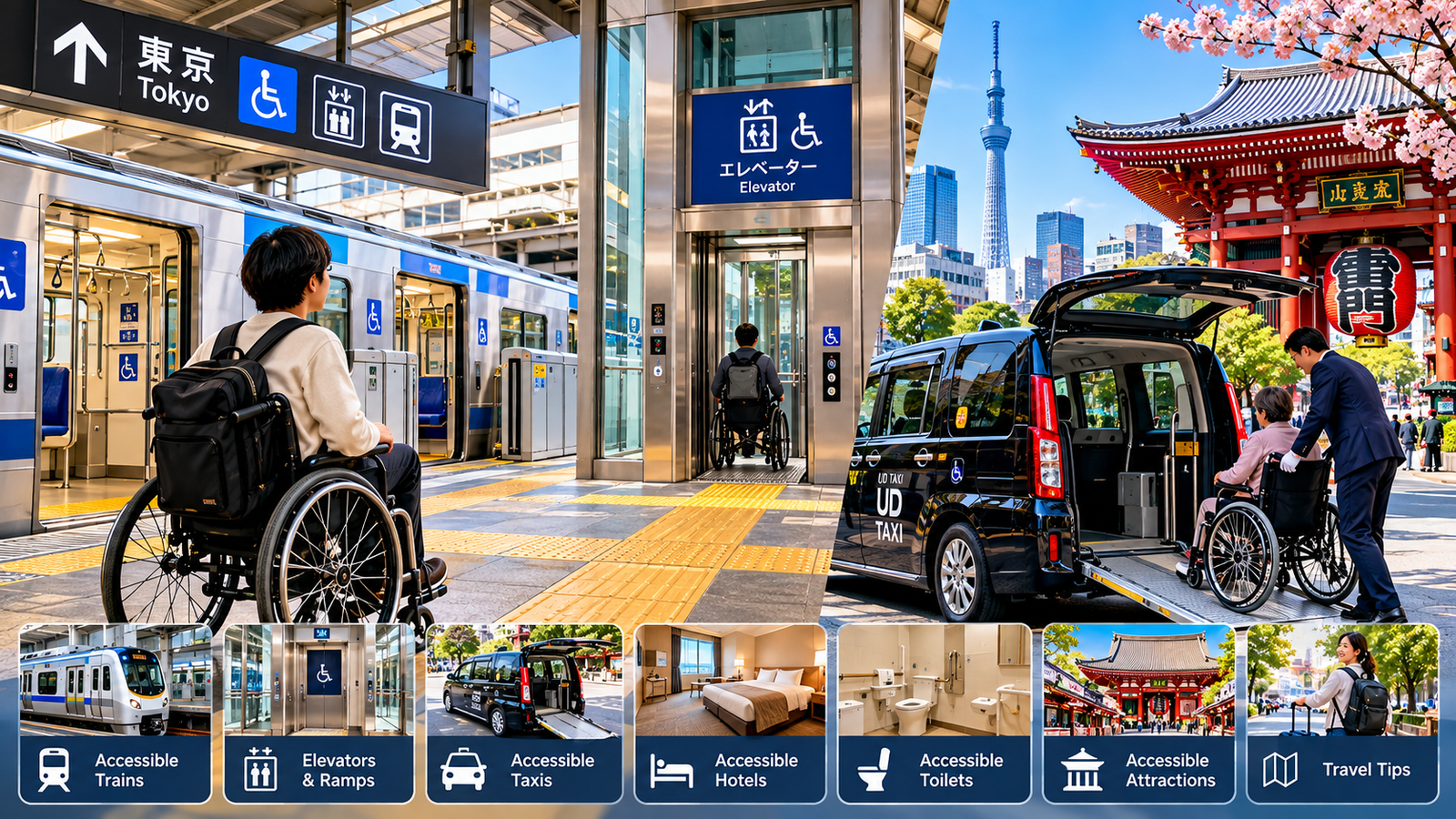
Can a city as large, crowded, and fast-moving as Tokyo really be easy to explore for wheelchair users, older travellers, families with strollers, people with visual or hearing impairments, and visitors with other accessibility needs? Tokyo accessibility has improved significantly, with barrier-free transportation, elevators, tactile paving, accessible toilets, staff assistance, universal-design taxis, and accessibility information available across many parts of the city. However, Tokyo is not uniformly step-free, so successful accessible travel still depends on choosing suitable routes, checking individual facilities, and planning ahead Tokyo Experiences
What Does Tokyo Accessibility Mean?
Tokyo accessibility is broader than wheelchair access.
When people hear the phrase “accessible Tokyo,” they may immediately think about elevators and ramps.
Those features are important, but accessibility can include many different needs.
These can include:
- Wheelchair accessibility
- Limited mobility
- Elderly travellers
- Visual impairments
- Hearing impairments
- Cognitive accessibility
- Accessible communication
- Families with young children
- Travellers using mobility scooters
- People travelling with service animals
- Temporary injuries
- People who find crowded environments difficult
- Travellers carrying large luggage
A city becomes more accessible when people can independently or safely complete common activities.
These activities include:
- Entering a railway station
- Buying a ticket
- Reaching a platform
- Boarding a train
- Finding a toilet
- Crossing a street
- Entering a restaurant
- Checking into a hotel
- Visiting a museum
- Taking a taxi
- Understanding announcements
- Finding an alternative route when equipment is unavailable
This is why accessibility should be viewed as a journey rather than a single facility.
An elevator at a station entrance is useful only if another accessible route connects the elevator to the ticket gate, platform, train, and destination.
Is Tokyo an Accessible City?
Tokyo has extensive accessibility infrastructure, but the most accurate answer is not simply “yes” or “no.”
Many major stations, tourist attractions, transportation systems, and public facilities provide barrier-free features. The official Tokyo tourism accessibility guide notes that many train stations have elevators, wheelchair-accessible toilets, tactile paving, and designated spaces for wheelchair and stroller users.
At the same time, Tokyo is an enormous and highly complex city.
Some older buildings, small shops, narrow streets, traditional properties, and older infrastructure may present challenges.
Even within a modern station, an accessible route may take longer than the normal route.
An elevator may be located far from the most convenient entrance.
An accessible toilet may be outside the ticket gates.
A particular elevator may temporarily be closed for maintenance.
Tokyo Metro specifically publishes information about elevator closures and accessibility equipment, demonstrating why checking current station information can matter.
Therefore, the best way to understand Tokyo accessibility is:
Tokyo provides many strong accessibility options, but accessible travel requires route-level planning rather than assuming every path will be barrier-free.
Why Accessibility Matters So Much in Tokyo
Tokyo’s scale makes accessibility particularly important.
The city combines:
- Large railway stations
- Multiple train operators
- Underground passages
- Dense commercial districts
- Busy pedestrian areas
- High-rise buildings
- Historic neighbourhoods
- Narrow streets
- Major tourist attractions
- Extensive public transportation
For an able-bodied traveller, changing trains may simply mean following signs.
For a wheelchair user, the same transfer may involve finding a specific elevator, leaving one station area, following a longer accessible route, and entering another part of the network.
The difference between a theoretical route and a practical route can therefore be substantial.
This is one reason Tokyo’s accessibility information is valuable.
The city’s 2026 Sightseeing Accessibility Guide provides 35 sightseeing courses across the 23 wards and Tama area, with accessibility information along the routes.
That approach is particularly useful because accessibility is rarely about one destination.
It is about the entire route.
Tokyo Accessibility and Public Transportation
Public transportation is one of the most important parts of accessible Tokyo.
Tokyo’s rail network is enormous, and several operators run different services.
For travellers with accessibility needs, the most important questions are not simply:
“Can I use the train?”
Instead, ask:
- Can I enter the station?
- Is there an elevator?
- Does the elevator connect the correct levels?
- Can I reach the platform?
- Can I board the specific train?
- Will station staff assist me?
- Is there an accessible toilet?
- Is there an alternative if an elevator is closed?
- Is the transfer between lines accessible?
Tokyo’s major transport operators provide detailed accessibility information, which makes route planning considerably easier.
Tokyo Metro Accessibility
Tokyo Metro operates a major part of Tokyo’s subway network.
Its accessibility program includes elevators, escalators, slopes, accessible toilets, wide ticket gates, stair lifts, tactile guidance blocks, Braille information, audio guidance, and wheelchair spaces.
Tokyo Metro also provides a station search tool that allows travellers to check accessibility facilities, including:
- One-route barrier-free access
- Elevators
- Escalators
- Stair lifts
- Wheelchair-accessible toilets
- Infant facilities
- Ostomate facilities
- Mobility-scooter availability
This is especially useful because not every station has exactly the same equipment.
What Is a One-Route Accessible Station?
Tokyo Metro uses the term “One-route” for a station with at least one route connecting the ground level, ticket gate, and platform using an elevator, slope, stair lift, or wheelchair-accessible escalator.
This is an important distinction.
A station may have an elevator somewhere in the building without every possible route being accessible.
For travellers using wheelchairs, the existence of a complete accessible path is more useful than simply knowing that a station contains an elevator.
Tokyo Station Example
Tokyo Metro’s Tokyo Station accessibility information shows an elevator route connecting the platform and ticket-gate level, as well as elevators connecting the ticket-gate level with exits.
However, the same station page also shows that different accessibility features can vary by location.
This illustrates an important principle:
Always check the exact station and route rather than relying on a general statement that a station is accessible.
Toei Transportation Accessibility
Toei Transportation operates subway services and buses within Tokyo.
Its official accessibility information states that portable wheelchair ramps are available at all Toei Subway stations for boarding and leaving trains. It also says elevators have been installed at all Toei Subway stations to provide at least one barrier-free route connecting ground level, ticket-gate level, and platform level.
Toei also provides:
- Elevators
- Escalators
- Wide ticket gates
- Accessible routes
- Wheelchair ramps
- Assistance from station staff
The availability of a wide ticket gate at every row of ticket gates is particularly useful for wheelchair users and travellers with larger mobility equipment.
JR East Accessibility
JR East is particularly important because its network connects Tokyo with surrounding areas and other destinations in eastern Japan.
JR East provides accessibility facilities including:
- Elevators
- Slopes
- Accessible toilets
- Stair lifts
- Wider ticket gates
- Staff assistance
The company also provides advance online assistance through JRE Odekake Support for certain services and stations.
JR East states that wheelchair users can receive assistance from station staff to reach the platform and board or leave trains. It also notes that accessibility can depend on the wheelchair, train, and station.
Wheelchair Dimensions on JR East
JR East publishes guidance stating that wheelchairs generally need to be within:
- 120 cm in length
- 120 cm in height
- 70 cm in width
Travellers with equipment exceeding these dimensions are advised to consult JR East in advance.
This is an excellent example of why accessible travel planning should include the actual dimensions of mobility equipment, not just the statement “I use a wheelchair.”
Accessibility Assistance on Tokyo Trains
One of the most valuable features of Tokyo’s railway system is human assistance.
Station staff can help passengers:
- Find accessible routes
- Reach platforms
- Use ramps
- Board trains
- Leave trains
- Coordinate with destination stations
JR East describes a process in which staff can coordinate with the destination station and prepare a slope board when necessary.
For travellers, this means that accessibility does not depend entirely on infrastructure.
Human support is another part of the system.
Travelling During Rush Hour
Crowds are one of the biggest practical accessibility challenges in Tokyo.
The official Tokyo tourism accessibility guide recommends avoiding peak periods for wheelchair travel where possible, identifying approximately 7:30–9:00 in the morning and 17:30–19:30 in the evening as particularly busy periods.
Avoiding rush hour can help because:
- Platforms are less crowded
- Elevators may be easier to use
- Staff can assist more comfortably
- Boarding can be less stressful
- Transfers can take place with more space
- People using mobility equipment have greater manoeuvring room
For a traveller with limited mobility, changing the travel time can sometimes make a bigger difference than changing the destination.
Tokyo Accessibility for Wheelchair Users
Wheelchair accessibility involves more than finding ramps.
A traveller should consider five stages:
Stage One: Accommodation
Can you enter the hotel?
Stage Two: Street
Can you travel between the hotel and station?
Stage Three: Station
Can you reach the platform without stairs?
Stage Four: Train
Can the train accommodate your wheelchair?
Stage Five: Destination
Can you enter and move around the attraction?
If any one of these stages fails, the entire journey becomes more difficult.
This is why accessible route planning should be done from door to door.
Accessible Taxis in Tokyo
Taxis are particularly useful when railway routes become difficult.
Tokyo has universal-design taxis that can accommodate different passengers, including wheelchair users and people travelling with strollers.
The official Tokyo tourism guide notes that universal-design taxis can be found at airports, major stations and popular tourist destinations, and that they can also be requested through taxi apps such as GO.
Accessible taxis can be particularly useful for:
- Hotel-to-attraction travel
- Short trips where station transfers are complicated
- Travellers carrying mobility equipment
- Families with strollers
- Late-night journeys
- Travellers who want to avoid crowded stations
Uber Assist in Tokyo
Uber’s accessible transportation service provides another option.
Uber Assist uses Universal Design Toyota JPN Taxi vehicles and trained drivers. The service is designed to support passengers with wheelchairs and other mobility needs.
Uber states that drivers can assist with:
- Ramp setup
- Boarding
- Getting out of the vehicle
- Securing or stowing equipment
- Wheelchair-related loading
Uber also specifies wheelchair dimensions and weight limits because the vehicle ramp and interior have physical limits.
This is an important practical lesson:
An “accessible taxi” does not mean every wheelchair automatically fits.
Travellers using larger powered or specialized wheelchairs should check dimensions and weight before relying on the service.
Recent Expansion of Uber Assist
Uber announced in June 2026 that Uber Assist was being expanded from its previous Tokyo-area coverage to all 47 prefectures in Japan, subject to Uber Taxi service availability. The company also noted that wheelchair-accessible vehicle availability can vary depending on vehicle supply and time.
For Tokyo travellers, this is useful because it reflects the broader expansion of accessible mobility services.
However, availability should still be checked at the time of booking.
Tokyo Accessibility at Airports
Airports are often the first accessibility test for international visitors.
Tokyo is primarily served by:
- Haneda Airport
- Narita International Airport
Accessible travel begins before reaching the city.
Travellers should consider:
- Wheelchair assistance
- Accessible toilets
- Step-free boarding
- Airport transfers
- Accessible taxis
- Train accessibility
- Luggage handling
- Mobility equipment transport
The Tokyo tourism authority identifies Haneda and Narita as the city’s principal international air gateways.
When requesting airport assistance, it is useful to describe your actual needs rather than simply saying “I need wheelchair assistance.”
For example:
“I can walk short distances but cannot climb stairs.”
or:
“I need to remain in my wheelchair during vehicle boarding.”
Specific information helps staff provide appropriate support.
Tokyo Accessibility for People With Visual Impairments
Accessibility is not limited to wheelchair users.
Tokyo has extensive tactile paving.
The official Tokyo tourism guide notes that yellow tactile paving can be found on many streets to assist people with visual impairments.
Tokyo Metro also provides:
- Tactile guidance blocks
- Braille information
- Audio guidance
- Voice announcements
- Tactile maps in relevant settings
Tokyo Metro specifically identifies guide blocks for visually impaired passengers and Braille information boards among its accessibility measures.
Why Tactile Paving Matters
Tactile paving creates physical information through texture.
Different patterns can help indicate:
- A walking route
- A hazard
- A platform edge
- A change in direction
It is a good example of universal design because the infrastructure communicates information without depending entirely on visual signs.
Accessibility for Deaf and Hard-of-Hearing Travellers
Hearing accessibility can involve:
- Visual displays
- Written instructions
- Digital information
- Station signage
- Mobile communication
- Captioned content
- Staff assistance
Tokyo’s large transportation systems use visual information displays alongside announcements.
Travellers who have difficulty hearing announcements should rely on visual displays and confirm platform information when necessary.
Carrying a written destination name in Japanese can also make communication easier.
A simple phone note can be extremely useful:
- Hotel name
- Hotel address
- Station
- Destination
- Emergency contact
- Required assistance
Cognitive Accessibility in Tokyo
Cognitive accessibility is often overlooked.
A traveller may not have a physical disability but may still find Tokyo’s scale overwhelming.
The city can involve:
- Crowded stations
- Multiple exits
- Complex signs
- Large crowds
- Noise
- Fast-moving passengers
- Multiple train operators
- Frequent transfers
For some travellers, the best accessibility strategy is to reduce complexity.
That might mean:
- Fewer daily destinations
- Direct routes
- Fewer transfers
- Longer connection times
- Quiet accommodation
- Off-peak travel
- Familiar routines
- Digital maps prepared in advance
Accessibility is therefore also about reducing cognitive load.
Tokyo Accessibility for Older Travellers
Older travellers may not use wheelchairs but may experience:
- Reduced walking speed
- Difficulty climbing stairs
- Fatigue
- Balance problems
- Need for more frequent rest
- Difficulty standing for long periods
For these travellers, accessible planning can include:
- Choosing hotels near stations
- Using elevators
- Taking taxis for short difficult connections
- Scheduling rest periods
- Avoiding rush hour
- Selecting attractions with seating
Tokyo’s accessibility infrastructure can therefore benefit a much wider population than people with formally recognized disabilities.
Tokyo Accessibility for Families With Strollers
Families often encounter many of the same challenges as wheelchair users.
A stroller needs:
- Elevators
- Wide gates
- Step-free entrances
- Accessible toilets
- Space on trains
- Suitable sidewalks
The official Tokyo accessibility guide specifically notes that trains include spaces intended for wheelchair users and stroller users.
Parents should nevertheless avoid assuming that every station exit is equally convenient.
Large stations may have many exits but only some will provide elevators.
Accessible Toilets in Tokyo
Accessible toilets are an important part of comfortable travel.
Tokyo’s transportation systems and major attractions increasingly provide accessible toilet facilities.
Tokyo Metro’s station accessibility database allows travellers to check whether wheelchair-accessible toilets are available inside or outside ticket gates.
This distinction can matter.
If you leave the paid area of a station to use a facility, you may need to re-enter the station.
When planning a long journey, identify suitable accessible toilets before leaving your accommodation.
Accessibility and Accommodation
Hotels are another essential part of accessible travel.
A hotel can advertise itself as accessible while still having limitations.
Before booking, ask specific questions.
Entrance
- Is the entrance step-free?
- Is there a ramp?
- Are automatic doors available?
Room
- Is there enough turning space?
- Is the bathroom accessible?
- Is the shower step-free?
- Are grab rails available?
Bathroom
- Is the toilet transfer-friendly?
- Is there enough side space?
- Is the sink accessible?
Bed
- What is the bed height?
- Is there enough space beside it?
Emergency Procedures
- How are guests with mobility limitations evacuated?
The phrase “accessible room” can mean different things in different hotels.
Specific questions are safer than assumptions.
Choosing an Accessible Hotel Location
Location can be more important than the hotel’s star rating.
A hotel that is technically accessible but located far from an accessible station may create more difficulty than a simpler hotel near a convenient station.
Consider:
- Distance to station
- Accessible station entrance
- Sidewalk conditions
- Nearby restaurants
- Nearby convenience stores
- Taxi availability
- Accessible attractions
A short, predictable route can be more valuable than luxury amenities.
Tokyo Tourist Information and Accessibility Support
The Tokyo Metropolitan Government operates tourist information centres at several locations, including:
- Tokyo Metropolitan Government Building
- Busta Shinjuku
- Haneda Airport
- Keisei Ueno
- Yaesu
- Tama
The centres provide sightseeing, transportation and accommodation information and also offer accessible tourism support, including wheelchair and stroller use at relevant locations.
Tokyo also provides an online tourist guide called Tokyo Navigation AI, available around the clock for travel consultations.
For visitors with complex needs, these official information channels can be useful because accessibility conditions may change.
Tokyo Sightseeing Accessibility Guide
One of the most useful resources for accessible visitors is the Tokyo Sightseeing Accessibility Guide.
The 2026 guide covers the 23 wards and Tama area and contains 35 sightseeing courses with accessibility information along the routes.
This route-based approach is particularly valuable.
Instead of asking:
“Is this attraction accessible?”
you can ask:
“Can I travel from my hotel to the attraction, enter it, use its facilities, and continue to my next destination?”
That is a much more realistic accessibility question.
Accessible Tokyo Attractions
Many major attractions have accessibility features, but the details vary.
Before visiting an attraction, check:
- Wheelchair entrance
- Elevator availability
- Accessible toilets
- Seating
- Service animal policy
- Sensory conditions
- Accessible viewing areas
- Advance reservation requirements
- Wheelchair rental
Do not assume that an attraction is accessible simply because the building is modern.
Similarly, do not assume that an old building is inaccessible.
The only reliable approach is to check the current facility information.
Tokyo Disneyland and Accessibility
Large theme parks generally provide accessibility services because they accommodate visitors with a wide range of needs.
For visitors considering Tokyo Disneyland or Tokyo DisneySea, accessibility planning should include:
- Attraction access
- Wheelchair transfer requirements
- Accessible restrooms
- Accessible transportation
- Guest services
- Waiting arrangements
Policies can differ by attraction, and visitors should consult the official current accessibility information before travelling.
teamLab and Accessibility
Interactive digital attractions such as teamLab can provide a different accessibility experience because technology itself can create flexible visual and interactive environments.
However, interactive exhibitions can also involve:
- Dark spaces
- Uneven floors
- Water
- Mirrors
- Crowds
- Narrow areas
- Sensory effects
Visitors should check the specific venue’s current accessibility guidance before visiting.
This illustrates an important point:
Accessibility is not automatically created by technology.
A high-tech attraction can still create physical or sensory barriers.
Accessibility in Traditional Tokyo
Traditional Tokyo can present a different accessibility challenge.
Historic temples, shrines, gardens, traditional restaurants, and older buildings may have:
- Steps
- Gravel
- Uneven surfaces
- Narrow entrances
- Raised thresholds
- Limited interior space
However, this does not mean every traditional attraction is inaccessible.
Some provide alternative routes or accessible entrances.
The key is to research each location individually.
Streets and Sidewalks in Tokyo
Tokyo’s sidewalks vary.
Modern areas can have wide, well-maintained paths.
Older neighbourhoods may have:
- Narrow sidewalks
- Utility poles
- Uneven surfaces
- Crowded pedestrian areas
- Bicycle traffic
- Temporary obstacles
Tactile paving is common, but travellers should still remain aware of their surroundings.
For wheelchair users, a route that looks short on a map may take longer if crossings or narrow sections require detours.
The Accessibility Challenge of Tokyo’s Size
Tokyo’s greatest accessibility challenge may also be one of its greatest strengths: scale.
The city gives travellers many options.
But more options create complexity.
A simple five-minute journey on a map might involve:
- Leaving the hotel
- Finding an elevator
- Entering a station
- Finding the correct ticket gate
- Reaching the platform
- Waiting for a train
- Changing lines
- Finding another elevator
- Exiting the station
- Navigating the street
For an accessible traveller, the physical distance is only one part of the journey.
The number of transitions matters too.
A Better Way to Plan Accessible Tokyo
Instead of planning by neighbourhood alone, plan by “accessibility chains.”
For each journey, check:
Door
Can I leave the hotel?
Street
Can I reach the station or taxi?
Station
Can I enter without stairs?
Platform
Can I reach the correct platform?
Train
Can I board?
Transfer
Can I change lines?
Destination
Can I enter?
Experience
Can I use the facilities?
Return
Can I get back to transportation?
This method identifies problems before they happen.
Practical Tokyo Accessibility Planning Checklist
Before travelling, prepare the following.
Before Booking Flights
Check airport assistance requirements.
Before Booking Hotels
Confirm the exact room features.
Before Booking Attractions
Check current accessibility policies.
Before Using Trains
Check the exact station and accessible route.
Before Using a Taxi
Confirm wheelchair dimensions if relevant.
Before Leaving the Hotel
Charge your phone.
During the Journey
Allow additional time.
Keep a Backup Plan
Know the nearest accessible taxi or alternative station.
What to Carry
An accessibility-focused Tokyo trip can be easier with a small preparation kit.
Consider carrying:
- Smartphone
- Portable battery
- Hotel address in Japanese
- Emergency contact information
- Mobility-equipment specifications
- Medication information if applicable
- Identification
- Payment cards
- Some cash
- Translation application
- Offline map
- Written accessibility requirements
The purpose is not to carry everything imaginable.
It is to make communication easier if technology or language becomes a problem.
Common Accessibility Mistakes in Tokyo
Mistake One: Assuming Every Station Exit Is Accessible
Large stations may have many exits.
Only some may provide the easiest step-free route.
Solution
Identify the exact accessible exit before travelling.
Mistake Two: Checking the Destination but Not the Journey
An attraction may be accessible, but the route to it may involve difficult transfers.
Solution
Plan the entire door-to-door journey.
Mistake Three: Assuming an Elevator Is Always Available
Elevators can undergo maintenance.
Tokyo Metro publishes elevator stoppage information for planned inspections and renewal work.
Solution
Check current status and have an alternative route.
Mistake Four: Travelling During the Busiest Periods
Crowded platforms make navigation more difficult.
Solution
Where possible, travel outside peak periods.
Mistake Five: Not Providing Enough Information About a Wheelchair
Saying “wheelchair user” may not tell a taxi operator whether the chair can be accommodated.
Solution
Know the wheelchair’s width, height, length, and weight.
Mistake Six: Booking a Hotel Without Confirming the Bathroom
A hotel may have an accessible entrance but an unsuitable bathroom.
Solution
Ask for photographs, measurements, or a detailed room description.
Mistake Seven: Planning Too Many Attractions
Accessible travel often requires more time.
Solution
Choose fewer attractions and leave larger gaps between activities.
Mistake Eight: Ignoring Sensory Accessibility
Crowds, noise, darkness, flashing lights, or immersive environments can create challenges.
Solution
Research the sensory characteristics of attractions before visiting.
Mistake Nine: Depending Entirely on Smartphone Navigation
A route may be technically correct but physically unsuitable.
Solution
Combine digital navigation with official accessibility information.
Mistake Ten: Forgetting That Conditions Change
Construction, maintenance, temporary closures, and operational changes can affect accessibility.
Solution
Check current information shortly before travelling.
Ten Tokyo Accessibility Brands and Services Compared
The following comparison focuses on recognizable transportation, mobility, tourism, and visitor-service brands or operators that can be relevant to accessible travel. They are not direct competitors in every category, so the comparison is intended to show where each option fits into an accessible Tokyo journey, rather than rank them.
| Brand / Service Tokyo accessibility | Category | Accessibility Features or Role | Best Use Tokyo accessibility |
|---|---|---|---|
| Tokyo Metro | Subway | Elevators, accessible toilets, tactile guidance, wide gates, staff assistance | Central Tokyo subway travel |
| Toei Transportation | Subway & bus | Barrier-free routes, elevators, ramps, wide gates | Subway and bus journeys |
| JR East | Railway | Elevators, ramps, accessible toilets, staff assistance, advance support | Tokyo and eastern Japan |
| Uber Assist | Accessible taxi | UD Toyota JPN Taxi, trained drivers, wheelchair boarding support | Door-to-door travel |
| Toyota JPN Taxi | Universal-design taxi | Designed to accommodate wheelchair users and diverse mobility needs | Accessible taxi journeys |
| GO | Taxi platform | Taxi booking and access to available vehicle types | Booking taxis |
| Haneda Airport | Airport | International gateway with accessibility assistance and accessible ground transport connections | Arrival and departure |
| Narita International Airport | Airport | Airport accessibility services and connections to Tokyo | International arrival/departure |
| Tokyo Metropolitan Tourist Information Centers | Visitor support | Transportation, sightseeing and accessible-tourism information | Travel planning and assistance |
| Tokyo Navigation AI | Digital travel service | 24/7 tourism consultation | Planning routes and activities |
Tokyo Metro and Toei provide detailed station-level accessibility information, while JR East offers station assistance and advance support.
Uber Assist is particularly useful when a traveller wants door-to-door transportation and meets the service’s vehicle and wheelchair requirements.
The Tokyo Metropolitan Government’s tourist information network also provides accessible tourism assistance, while Tokyo Navigation AI provides 24-hour travel consultation.
Tokyo Accessibility for Different Traveller Groups
Wheelchair Users Tokyo accessibility
Prioritize:
- Accessible hotel rooms
- Station elevator routes
- Train boarding assistance
- Accessible taxis
- Wheelchair-compatible attractions
- Accessible toilets
Allow additional travel time.
Older Travellers Tokyo accessibility
Prioritize:
- Hotels near transportation
- Fewer daily activities
- Seating opportunities
- Taxi use when useful
- Avoiding peak hours
Families With Strollers Tokyo accessibility
Prioritize:
- Elevator access
- Wide gates
- Accessible toilets
- Family facilities
- Accommodation with suitable room space
Visually Impaired Travellers Tokyo accessibility
Prioritize:
- Tactile routes
- Audio information
- Staff assistance
- Clearly prepared destinations
- Written destination details
Tokyo’s tactile paving and railway accessibility systems can be useful, but station environments can still be crowded and complex.
Deaf or Hard-of-Hearing Travellers Tokyo accessibility
Prioritize:
- Visual displays
- Written communication
- Digital information
- Station information screens
- Advance communication with hotels and attractions
Travellers With Cognitive or Sensory Needs Tokyo accessibility
Prioritize:
- Simple routes
- Quiet accommodation
- Fewer transfers
- Off-peak travel
- Predictable schedules
- Advance knowledge of sensory environments
Pros of Tokyo Accessibility Tokyo accessibility
Extensive Public Transportation Tokyo accessibility
Tokyo has an enormous transportation network with significant investment in barrier-free infrastructure.
Strong Station Assistance Tokyo accessibility
Staff assistance can be valuable when infrastructure alone is not enough.
Detailed Information Tokyo accessibility
Transport operators increasingly publish station-level accessibility information.
Tactile Infrastructure Tokyo accessibility
Tactile paving supports people with visual impairments.
Universal-Design Taxis Tokyo accessibility
Accessible taxis create alternatives when public transportation is difficult.
Accessible Tourism Resources Tokyo accessibility
Tokyo provides dedicated tourism accessibility information and route guides.
Growing Digital Support Tokyo accessibility
Apps and online services make it easier to find transportation and visitor information.
Cons and Challenges Tokyo accessibility
Tokyo Is Extremely Large
The scale of the city creates complexity.
Crowds Tokyo accessibility
Busy stations can be physically difficult to navigate.
Older Infrastructure Tokyo accessibility
Some older buildings and streets may remain challenging.
Not Every Route Is Equally Accessible Tokyo accessibility
An accessible station does not mean every entrance or transfer is equally convenient.
Maintenance Tokyo accessibility
Elevators and other facilities can temporarily be unavailable.
Accessibility Varies by Attraction Tokyo accessibility
Major attractions may have strong facilities while smaller businesses may have limited access.
Wheelchair Specifications Matter Tokyo accessibility
Some vehicles have specific size and weight limitations.
Advance Planning Can Be Necessary Tokyo accessibility
Spontaneous travel is possible, but detailed planning can make accessible travel significantly easier.
Why Accessibility Is More Than Infrastructure
There is an important difference between accessible infrastructure and accessible experience.
Imagine a station with an elevator.
Technically, the station may be accessible.
But if the elevator is difficult to find, the signage is confusing, the route is crowded, or the transfer requires a long detour, the experience may still be challenging.
This is why inclusive design increasingly focuses on the complete user journey.
The same principle applies to hotels and attractions.
A ramp alone does not create accessibility.
A successful accessible experience considers:
- Information
- Physical access
- Communication
- Safety
- Time
- Comfort
- Independence
- Dignity
The Human Side of Tokyo Accessibility
Technology and infrastructure are important, but human assistance remains central.
A station employee helping someone board a train can be just as important as the elevator.
A hotel employee who understands a guest’s needs can make a major difference.
A taxi driver trained in accessible boarding can transform a difficult journey into a simple one.
This is why Tokyo’s accessibility system should be understood as a combination of:
Infrastructure + Information + Staff + Technology + Planning
If one component is missing, the experience can become more difficult.
Future Trends in Tokyo Accessibility
Tokyo accessibility is likely to continue evolving.
Several trends are particularly important.
More Universal-Design Transportation
Transportation providers are continuing to expand barrier-free facilities.
Tokyo Metro publishes ongoing accessibility investment and maintenance information, while JR East continues its own barrier-free development programs.
Smarter Route Planning
Future travel applications could provide more detailed information about:
- Elevator availability
- Crowding
- Step-free routes
- Accessible entrances
- Toilet locations
- Temporary closures
This could make route planning much more personalized.
AI-Assisted Travel
AI could help travellers identify routes according to individual requirements.
For example:
“Find me a route with the fewest transfers and no stairs.”
or:
“Find an attraction with accessible toilets and a quiet environment.”
Tokyo’s existing Tokyo Navigation AI service shows how tourism information is already moving toward conversational digital assistance.
More Accessible Mobility Services Tokyo accessibility
The expansion of services such as Uber Assist demonstrates a broader movement toward accessible door-to-door transportation.
Better Inclusive Tourism Information Tokyo accessibility
Route-based accessibility guides are likely to become increasingly important.
Instead of simply labeling attractions “accessible,” future systems may provide complete journey information.
Universal Design as a Mainstream Concept Tokyo accessibility
Universal design benefits more people than people with disabilities.
It can help:
- Parents
- Older adults
- Injured travellers
- People carrying luggage
- Visitors unfamiliar with Tokyo
- Travellers with temporary mobility limitations
That makes accessibility a mainstream tourism issue rather than a niche subject.
Tokyo Accessibility and the Future of Inclusive Tourism
The future of accessible tourism will likely move away from the question:
“Does this attraction have a ramp?”
toward:
“Can different people comfortably complete the entire experience?”
That includes booking, transportation, arrival, entry, navigation, restrooms, activities, communication, and departure.
Technology can help.
AI can help identify routes.
Digital maps can provide information.
Smartphone translation can reduce communication barriers.
Sensors can improve navigation.
Accessible taxis can solve difficult connections.
But technology should support rather than replace thoughtful human-centred design.
A Practical One-Day Accessible Tokyo Example
Imagine a wheelchair user staying near a major Tokyo station.
The traveller begins by checking the station’s official accessibility information.
Instead of choosing the nearest exit, they identify the exit with an elevator.
They leave the hotel outside rush hour.
At the station, staff provide assistance to the platform.
The traveller uses a train with appropriate wheelchair space.
At the destination station, staff help with the arrival process.
The traveller follows a pre-planned accessible route to the attraction.
After sightseeing, an accessible taxi takes them directly to dinner.
The day contains the same basic elements as any Tokyo sightseeing day.
The difference is preparation.
That is one of the most important lessons of accessible travel:
Accessibility does not necessarily require avoiding Tokyo. It often requires designing the journey differently.
How to Make Tokyo Travel More Comfortable Tokyo accessibility
A comfortable accessible itinerary should not be packed.
Instead of six major attractions, consider two or three.
Instead of multiple train transfers, consider a direct route.
Instead of walking for 20 minutes because it looks close on a map, consider a taxi.
Instead of visiting during peak hours, consider a quieter period.
Instead of choosing accommodation solely by price, consider its location and accessibility.
Small decisions can significantly reduce physical and mental fatigue.
Best Planning Strategy for First-Time Accessible Visitors
A first-time visitor can follow this sequence.
Step One: Identify Your Needs Tokyo accessibility
Write down exactly what you require.
Step Two: Choose the Right Area Tokyo accessibility
Stay near a suitable transportation hub.
Step Three: Confirm the Hotel Tokyo accessibility
Ask specific accessibility questions.
Step Four: Select Attractions Tokyo accessibility
Check their official accessibility information.
Step Five: Build Accessible Routes Tokyo accessibility
Check the station and exit information.
Step Six: Prepare a Taxi Backup Tokyo accessibility
Know how to request an accessible taxi.
Step Seven: Travel Outside Peak Periods Tokyo accessibility
Where possible, avoid the busiest commuter periods.
Step Eight: Leave Extra Time Tokyo accessibility
Assume accessible routes may take longer.
Step Nine: Carry Important Information Tokyo accessibility
Keep hotel and destination information available offline.
Step Ten: Recheck Before Travel Tokyo accessibility
Confirm temporary closures and operational changes.
Why Tokyo Accessibility Is Improving Tokyo accessibility
Accessibility improvements are influenced by several factors.
These include:
- Aging populations
- Disability inclusion
- Tourism growth
- Government policy
- Transportation investment
- Universal design
- International visitors
- Family travel
- Corporate accessibility initiatives
Japan’s barrier-free transportation framework has supported continued investment in railway accessibility.
Tokyo Metro notes that its barrier-free development uses the national railway station barrier-free fare system established in 2021.
JR East similarly describes its use of the national barrier-free fare system for station accessibility development.
What Other Cities Can Learn From Tokyo accessibility
Tokyo offers several useful lessons for other major cities.
Accessibility Should Be Built Into Transportation Tokyo accessibility
It should not be treated as an optional feature.
Information Is Infrastructure Tokyo accessibility
Knowing where the elevator is can be almost as important as having the elevator.
Staff Training Matters Tokyo accessibility
Physical infrastructure cannot solve every problem.
Accessibility Should Be Measured as a Journey Tokyo accessibility
A single accessible building is not enough.
Universal Design Benefits Everyone Tokyo accessibility
Parents, seniors, travellers with luggage, and people with temporary injuries also benefit.
Digital Tools Can Improve Independence Tokyo accessibility
Good information can reduce the need for assistance.
FAQs
Is Tokyo wheelchair accessible?
Many parts of Tokyo are wheelchair accessible, particularly major railway stations, subway stations, tourist destinations, and public facilities. However, accessibility varies by route and individual facility, so travellers should check specific stations, entrances, attractions, and accommodation before travelling.
Is Tokyo Metro wheelchair accessible?
Tokyo Metro provides accessibility features including elevators, accessible toilets, wide ticket gates, tactile guidance, ramps and other facilities. Its official station search allows travellers to check individual accessibility features.
Are all Tokyo Metro stations step-free?
Tokyo Metro provides barrier-free routes at many stations, but travellers should check the specific station and route rather than assuming every entrance or transfer is step-free.
Is the Tokyo subway accessible for wheelchair users?
Wheelchair users can use accessible subway services, and station staff can provide assistance. However, some routes can require additional planning, particularly when changing lines or navigating large stations.
Can wheelchair users use JR trains in Tokyo?
Yes. JR East states that wheelchair users can board trains with station assistance, although accessibility depends on the specific wheelchair, train, and station.
Does Tokyo have accessible taxis?
Yes. Tokyo has universal-design taxis and accessible taxi services. The official Tokyo tourism guide identifies UD taxis as an option for wheelchair users, stroller users, and travellers with large luggage.
Does Uber have wheelchair-accessible taxis in Tokyo?
Uber offers Uber Assist, which uses Universal Design Toyota JPN Taxi vehicles and trained drivers. The service has specific wheelchair dimensions and weight requirements, so users should check their equipment against the current requirements.
Can wheelchair users remain in their wheelchair inside an accessible taxi?
Some accessible vehicles are designed for wheelchair boarding, but the exact process depends on the vehicle and wheelchair. Uber Assist, for example, provides wheelchair boarding support but publishes specific size and weight conditions.
Is Tokyo accessible for visually impaired travellers?
Tokyo provides tactile paving, Braille information, audio guidance, and other features intended to assist people with visual impairments. Tokyo Metro specifically lists guide blocks and Braille information among its accessibility measures.
Is Tokyo accessible for elderly travellers?
Many accessibility features can benefit older travellers, including elevators, escalators, accessible transportation, seating, staff assistance, and barrier-free routes. Planning shorter days and avoiding peak crowds can also improve comfort.
Is Tokyo accessible for families with strollers?
Many transportation systems and attractions provide facilities useful for families with strollers. Tokyo’s official accessibility guide notes that trains include spaces for wheelchair and stroller users.
Are accessible toilets available in Tokyo?
Accessible toilets are available at many railway stations and major facilities. Tokyo Metro provides station-specific information showing whether accessible toilets are located inside or outside ticket gates.
Can I rent a wheelchair in Tokyo?
Wheelchair rental is available at some stations, museums, and tourist attractions. The official Tokyo tourism guide also identifies services that can deliver rental wheelchairs to locations such as hotels and airports.
Does Tokyo have accessibility information in English?
Yes. Tokyo’s official tourism website provides accessibility information in English, and JR East and Tokyo Metro also provide English-language accessibility information. Tokyo tourist information centres provide multilingual assistance, including English, Chinese, and Korean.
Can I get help at Tokyo train stations?
Yes. Station staff can provide assistance with accessible routes, boarding and exiting trains, and ramps where necessary. JR East specifically describes staff assistance for wheelchair passengers.
Should I avoid Tokyo during rush hour if I use a wheelchair?
Avoiding peak periods can make travel easier because stations and trains are less crowded. Tokyo’s official accessibility guidance recommends avoiding the busiest commuter periods where possible.
Are Tokyo’s tourist attractions accessible?
Many major attractions provide accessibility features, but conditions vary. Visitors should check each attraction’s current official information rather than assuming that every facility has identical accessibility.
Is old Tokyo accessible?
Some historic areas, temples, shrines, traditional buildings, and narrow streets can present accessibility challenges. However, accessibility varies considerably, and some historic attractions provide alternative routes or facilities.
Does Tokyo have an official accessible tourism guide?
Yes. Tokyo publishes a Sightseeing Accessibility Guide covering the 23 wards and Tama area. The 2026 guide includes 35 sightseeing courses with accessibility information along the routes.
Where can I get accessibility information after arriving in Tokyo?
Tokyo Metropolitan Government tourist information centres operate at several locations, including Haneda Airport, Busta Shinjuku, Keisei Ueno, Yaesu, Tama, and the Tokyo Metropolitan Government Building. They provide tourism and transportation information and accessible tourism support.
What is the biggest accessibility challenge in Tokyo?
For many visitors, the main challenge is not the absence of accessibility infrastructure but the complexity and scale of the city. Large stations, crowds, transfers, long walking distances, and differences between individual facilities can make detailed planning important.
Is Tokyo becoming more accessible?
Tokyo continues to invest in barrier-free transportation and accessible tourism. Tokyo Metro and JR East both report ongoing accessibility development, while new services and route-based tourism information are expanding options for travellers with different needs.
Conclusion
Tokyo accessibility has developed into an important part of the city’s transportation and tourism experience. Elevators, accessible toilets, tactile paving, ramps, wide ticket gates, wheelchair spaces, staff assistance, universal-design taxis, tourist information centres, and dedicated accessibility guides provide travellers with a growing range of options. But the most important lesson is that accessible Tokyo is not simply about finding an accessible building or station. It is about creating a complete journey that works from the hotel door to the transportation system, from the station platform to the attraction, and eventually back again. Tokyo’s enormous rail network demonstrates both the possibilities and the challenges of accessibility. Major operators such as Tokyo Metro, Toei Transportation


One Comment