
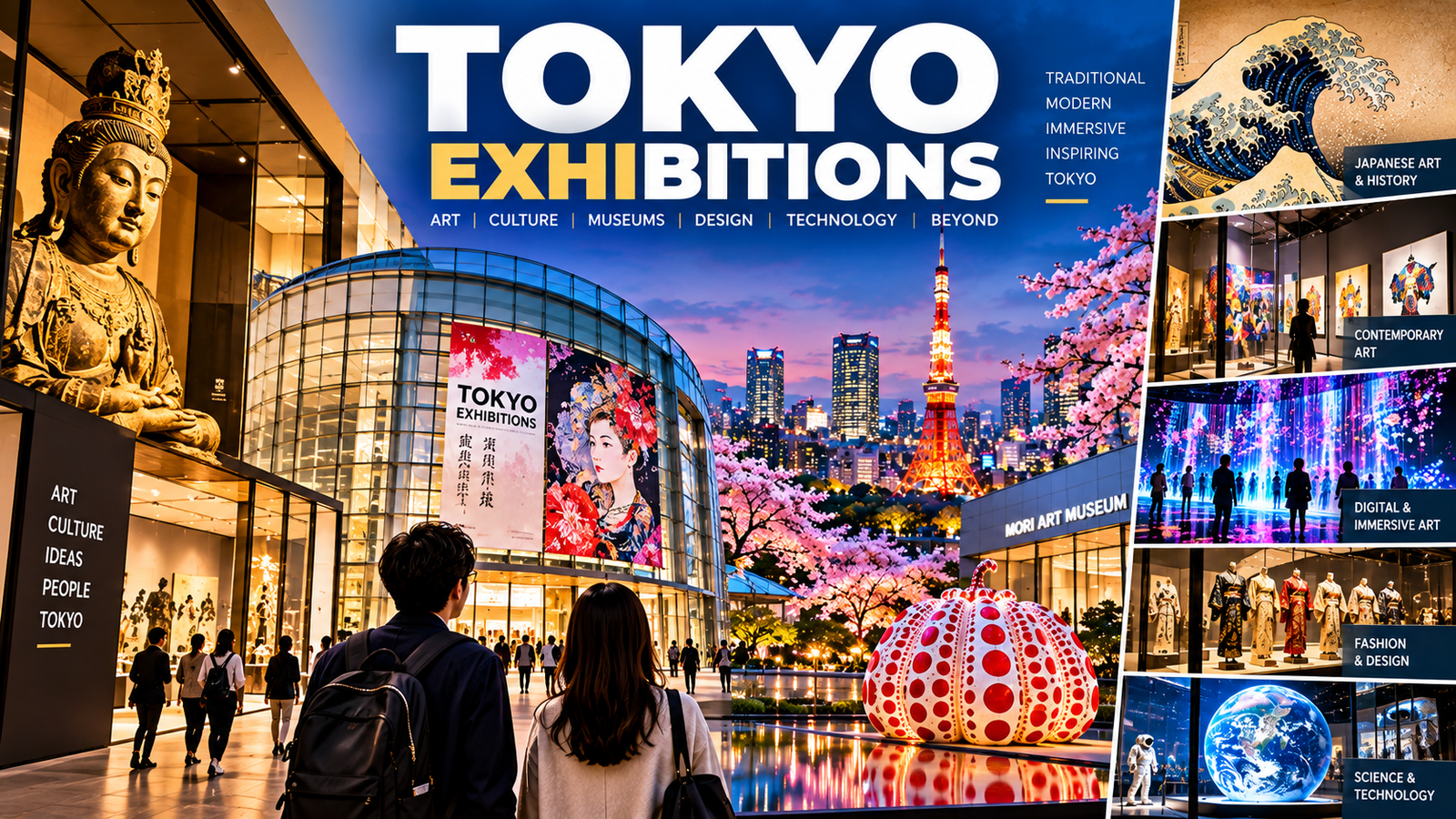
Tokyo Exhibitions: The Ultimate Guide to Art, Culture, Museums & Must-See Shows
Tokyo exhibitions offer an extraordinary mixture of Japanese history, traditional art, contemporary creativity, international masterpieces, design, photography, manga, fashion, science and immersive digital experiences. From major museums in Ueno and Roppongi to specialist galleries and temporary cultural events, Tokyo gives visitors the opportunity to experience both centuries-old traditions and rapidly changing creative ideas in the same city. Tokyo is not a destination where you need to choose between historical and modern culture Tokyo Architecture
What Are Tokyo Exhibitions?
Tokyo exhibitions are temporary or permanent displays presented by museums, galleries, cultural institutions, universities, commercial venues and other organisations throughout the city.
They can include:
- Japanese paintings
- Ukiyo-e prints
- Calligraphy
- Ceramics
- Sculpture
- Photography
- Contemporary art
- Western art
- Fashion
- Architecture
- Graphic design
- Manga
- Anime-related culture
- Science
- Natural history
- Technology
- Digital art
- Historical objects
- Archaeological discoveries
- Cultural artefacts
- Craft
- Food culture
- Popular culture
The word “exhibition” therefore covers much more than an art show.
A museum may organise an exhibition around a historical period.
A gallery may present a single artist.
A science museum may explain a new discovery.
A fashion institution may examine the career of a designer.
A digital venue may create an immersive environment rather than display physical objects.
This diversity is one reason Tokyo works so well for exhibition-focused travel.
Why Tokyo Has Such a Diverse Exhibition Culture
Tokyo’s exhibition ecosystem reflects the city’s broader cultural history.
The city has been influenced by:
- Edo-period culture
- Japanese craftsmanship
- Modernisation
- International exchange
- Industrial development
- Post-war cultural change
- Pop culture
- Technology
- Globalisation
- Contemporary design
These influences have produced an environment where traditional and modern creative practices coexist.
A historical Japanese scroll can be displayed in one museum while another venue nearby presents experimental digital art.
A traditional craft exhibition can sit within a modern architectural complex.
A fashion exhibition can explore both Japanese textiles and international design.
This mixture gives Tokyo exhibitions a distinctive character.
Tokyo’s Major Exhibition Areas
Tokyo is enormous, so understanding where exhibitions are concentrated can save considerable time.
Some areas are particularly useful for cultural travellers.
Ueno: Traditional Art, History and Major Museums
Ueno is one of the most important museum districts in Tokyo.
The area around Ueno Park contains several major cultural institutions, making it possible to create an entire day around exhibitions.
Visitors can find museums covering:
- Japanese art
- Western art
- Natural history
- Science
- Cultural history
- Modern art
- Temporary exhibitions
The Tokyo National Museum is especially important for visitors interested in Japanese and Asian art.
Ueno is a good starting point for travellers who want historical context before exploring contemporary Tokyo.
Why Ueno Works for Exhibition-Hopping
One of the biggest advantages of Ueno is concentration.
Instead of spending an hour travelling between unrelated parts of the city, visitors can explore several cultural institutions within the same broad area.
However, there is a danger.
Trying to visit every museum in one day can become exhausting.
A better plan is to choose one major exhibition as the day’s main attraction and add one smaller cultural experience.
Roppongi: Contemporary Art and International Exhibitions
Roppongi is one of Tokyo’s most recognisable contemporary-art districts.
The area is associated with major institutions including:
- The National Art Center, Tokyo
- Mori Art Museum
- Suntory Museum of Art
- Design and cultural spaces
- Commercial galleries
- Public art
Roppongi is particularly useful for travellers who prefer contemporary exhibitions, international artists, modern design and large temporary shows.
The National Art Center, Tokyo operates a changing exhibition programme rather than relying on a conventional permanent collection model.
Its schedule demonstrates the diversity of Tokyo’s exhibition culture, ranging from Renaissance masterpieces to manga, modern art and exhibitions organised by Japanese artist associations.
This makes Roppongi particularly attractive for repeat visitors.
You can return to the district several times and experience something completely different.
Ginza: Commercial Galleries, Design and Luxury
Ginza is often associated with shopping, department stores and luxury brands.
But the district also has an important gallery culture.
Visitors can discover exhibitions related to:
- Contemporary painting
- Photography
- Design
- Jewellery
- Crafts
- Architecture
- Fashion
- Commercial art
Ginza offers a different atmosphere from a national museum.
Here, art is closely connected with commerce and the luxury economy.
This makes the district useful for visitors interested in the business side of creativity.
Aoyama: Art, Design and Japanese Aesthetics
Aoyama has a sophisticated creative atmosphere.
The area contains galleries, design spaces, architecture and institutions such as the Nezu Museum.
The Nezu Museum is particularly notable for Japanese and Asian art and its carefully designed garden.
This combination illustrates an important principle in Japanese exhibition culture:
The environment surrounding an artwork can be almost as important as the object itself.
Architecture, gardens, light, space and seasonal atmosphere can influence how visitors experience an exhibition.
Sumida: Hokusai and Edo Culture
Sumida is particularly significant for visitors interested in ukiyo-e and Katsushika Hokusai.
The Sumida Hokusai Museum explores the life and work of one of Japan’s most internationally influential artists.
For visitors who know Hokusai mainly through The Great Wave off Kanagawa, an exhibition visit can reveal a much broader artistic career.
Hokusai was extraordinarily productive and worked across different subjects and formats.
His work provides a useful entry point into:
- Edo-period culture
- Printmaking
- Landscape art
- Commercial publishing
- Illustration
- Japanese visual storytelling
Kiyosumi-Shirakawa: Independent and Contemporary Spaces
Kiyosumi-Shirakawa is attractive to visitors who want to explore Tokyo beyond the most famous museums.
The area has developed a reputation for galleries and creative spaces.
Smaller exhibitions can be particularly rewarding because they introduce visitors to artists who may not yet have international recognition.
There is also a different rhythm.
You may spend twenty minutes in one small gallery rather than several hours in a huge museum.
That intimacy can create a stronger personal connection with an artist.
Tennoz: Art in Repurposed Urban Spaces
Tennoz offers another interesting side of Tokyo’s exhibition culture.
Industrial and warehouse-style architecture has been adapted for creative use.
This reflects a broader Tokyo trend in which former commercial or industrial environments become cultural destinations.
The result is an interesting combination of:
- Art
- Architecture
- Urban regeneration
- Photography
- Design
- Waterfront scenery
For travellers who enjoy unusual exhibition environments, this can be more memorable than another conventional white-walled gallery.
Major Types of Tokyo Exhibitions
One of the easiest ways to plan your visit is to classify exhibitions according to your interests.
Traditional Japanese Art Exhibitions
Traditional Japanese exhibitions can include:
- Painting
- Calligraphy
- Ceramics
- Lacquerware
- Textiles
- Buddhist sculpture
- Decorative arts
- Samurai-related objects
- Screens
- Scrolls
- Ukiyo-e
These exhibitions can help visitors understand Japanese history through visual culture.
Rather than viewing an object simply as something beautiful, look for information about its original purpose.
Was it religious?
Was it decorative?
Was it produced commercially?
Was it used by an elite household?
Was it created for everyday life?
These questions make historical exhibitions much more meaningful.
Contemporary Art Exhibitions
Contemporary exhibitions may focus on:
- Identity
- Technology
- Environment
- Politics
- Society
- Gender
- Urban life
- Memory
- Globalisation
- Artificial intelligence
- Human relationships
Contemporary art can sometimes feel confusing.
That is normal.
Unlike historical objects, contemporary works may not have an immediately obvious function.
The exhibition text is therefore useful.
Read it before making a judgment.
Sometimes the concept behind an apparently simple work is more interesting than its visual appearance.
Photography Exhibitions
Tokyo has a strong photography culture.
Photography exhibitions can explore:
- Japanese street life
- Portraiture
- Architecture
- Fashion
- Documentary photography
- Nature
- History
- Experimental photography
Photography is especially useful for visitors who want to understand Tokyo as a changing city.
A photograph captures a particular moment.
When you compare historical photographs with contemporary images, you can see how neighbourhoods, transportation, fashion and architecture have changed.
Fashion Exhibitions
Fashion is another important exhibition category.
Japanese fashion has had enormous international influence, and Tokyo is a natural place to study relationships between:
- Textiles
- Craftsmanship
- Identity
- Street culture
- Design
- Technology
- Global fashion
A fashion exhibition should not be viewed only as a collection of clothing.
Look at construction.
Look at fabric.
Look at colour.
Look at cultural references.
Look at how designers challenge conventional ideas about the human body and clothing.
Manga and Pop Culture Exhibitions
Manga and popular visual culture are deeply connected to modern Japanese creativity.
Exhibitions may explore:
- Original drawings
- Storyboards
- Character development
- Publishing
- Animation
- Illustration
- Cultural influence
- Artist careers
These exhibitions can be especially valuable for visitors who grew up with Japanese animation or comics but want to understand the creative process behind them.
A finished manga page can look simple.
An exhibition can reveal the layers of work required to create it.
Digital Art Exhibitions
Digital exhibitions represent one of the most distinctive developments in Tokyo’s cultural landscape.
Instead of displaying physical objects, digital art may use:
- Projection
- Sound
- Sensors
- Motion tracking
- Interactive systems
- Artificial intelligence
- Computer-generated environments
teamLab’s immersive experiences are among the best-known examples.
The important difference is that visitors are no longer simply observing an artwork.
They may become part of the environment.
This changes the relationship between artwork and audience.
Science and Technology Exhibitions
Tokyo exhibitions are not limited to art museums.
Science museums and technology-focused institutions provide exhibitions about:
- Space
- Robotics
- Biology
- Engineering
- Earth science
- Transportation
- Computing
- Medicine
- Natural history
These are particularly valuable for families and students.
They also demonstrate that exhibition culture is not restricted to cultural heritage.
It can be a method of explaining the future.
International Art Exhibitions
Tokyo regularly hosts exhibitions featuring artists and collections from outside Japan.
This creates an opportunity to experience international art without travelling to several different countries.
Recent and current programming across Tokyo institutions illustrates the scale of this international exchange.
For example, The National Art Center, Tokyo’s 2026 programme includes a major Renaissance exhibition from the Musée du Louvre.
The Tokyo Metropolitan Art Museum’s 2026 centenary programme includes exhibitions connected with collections from the British Museum and Musée d’Orsay.
These international collaborations demonstrate how Tokyo operates as a global cultural hub rather than simply a destination for Japanese art.
Tokyo Exhibitions in 2026
For travellers visiting during 2026, exhibition schedules are particularly interesting because several major institutions are marking important programmes and anniversaries.
The Tokyo Metropolitan Art Museum is celebrating its 100th anniversary in 2026 with a programme that includes international loans and exhibitions focused on Japanese art and the museum’s own history.
The National Art Center, Tokyo’s 2026 programme spans multiple genres, including historical art, modern and contemporary art, fashion and manga.
The museum’s current schedule includes Masterpieces of the Renaissance from the Musée du Louvre, running from September 9 to December 13, 2026, while Shojo Manga Infinity is scheduled from October 28, 2026 to February 8, 2027.
The Tokyo tourism authority also lists the Tokyo Museum Grutto Pass as an option for admission and discounts across participating cultural facilities.
Because temporary exhibitions change frequently, visitors should verify dates, prices, reservation requirements and opening days directly with the relevant museum before travelling.
How to Choose the Right Tokyo Exhibition
Choosing an exhibition becomes easier if you ask five questions.
What Do You Already Like?
If you love history, begin with traditional collections.
If you love photography, look for photography exhibitions.
If you enjoy technology, explore digital and science exhibitions.
If you love fashion, look for designer retrospectives.
How Much Time Do You Have?
A two-hour gap is ideal for a smaller exhibition.
A half-day is more suitable for a major museum.
Do not attempt a large museum immediately before a flight or important reservation.
Where Are You Staying?
Tokyo’s transport system is extensive, but travel still consumes time.
Choose exhibitions that fit naturally into your daily route.
Who Are You Travelling With?
Children, older travellers, photographers, art professionals and first-time visitors may all have different needs.
Do You Need a Reservation?
Some popular exhibitions use timed entry.
Always check before arriving.
Tokyo Exhibitions for First-Time Visitors
If this is your first Tokyo trip, avoid building your entire holiday around exhibitions.
Tokyo has too much to offer.
Instead, choose two or three exhibition experiences that represent different sides of the city.
A good introductory combination could be:
Traditional: Tokyo National Museum
Contemporary: Roppongi
Digital: Immersive digital art
This creates a cultural journey from historical Japan to modern Tokyo and then into a technology-driven future.
Tokyo Exhibitions for Families
Families should choose exhibitions based on attention span rather than prestige.
A three-hour exhibition filled with text may be less enjoyable for children than a one-hour interactive experience.
Look for:
- Interactive displays
- Workshops
- Science exhibitions
- Digital installations
- Hands-on activities
- Family programmes
- Large visual works
Before visiting, check age recommendations and photography rules.
For young children, also consider toilets, seating, food options and the distance between exhibition areas.
Tokyo Exhibitions for Students
Students can turn exhibitions into research opportunities.
Instead of simply taking photographs, keep notes.
Record:
- Artist
- Date
- Medium
- Subject
- Historical context
- Exhibition theme
- Personal response
Then compare two exhibitions.
For example:
Traditional Japanese landscape painting vs contemporary digital landscape
How has the representation of nature changed?
What stayed the same?
What changed because of technology?
This approach transforms tourism into meaningful cultural learning.
Tokyo Exhibitions for Art Professionals
Professionals may want to look beyond major museums.
Commercial galleries, artist-run spaces, art fairs and smaller exhibitions can provide insight into emerging practices and the commercial ecosystem.
Pay attention to:
- Artist representation
- Exhibition design
- Curatorial themes
- Collector behaviour
- Materials
- Installation techniques
- Pricing where publicly available
- International partnerships
- Digital presentation
Tokyo is particularly interesting for professionals because traditional craftsmanship and advanced technology often coexist.
Tokyo Exhibitions for Photographers
Photographers should research the venue’s photography rules before visiting.
Some exhibitions allow photography.
Others prohibit it completely.
Some permit photography without flash.
When photography is permitted, think beyond taking a record of every artwork.
Instead, study:
- Exhibition lighting
- Architecture
- Visitor interaction
- Display design
- Spatial composition
- Reflections
- Signage
- Urban context
Sometimes the exhibition building itself becomes the best photographic subject.
Tokyo Exhibitions for Budget Travellers
You do not need a huge budget to explore Tokyo’s exhibition culture.
Consider:
- Free galleries
- Public museums
- Discount passes
- University exhibitions
- Smaller cultural venues
- Free public art
- Museum gardens
- Exhibition areas with no admission charge
The Tokyo Museum Grutto Pass can also be worth researching for travellers planning multiple participating museums and cultural facilities.
Always calculate whether the pass makes financial sense for your individual itinerary.
Tokyo Exhibitions for Older Travellers
Older travellers may prefer a slower schedule.
Choose one major exhibition per day and allow time for:
- Rest
- Lunch
- Seating
- Gardens
- Cafés
- Nearby attractions
Do not underestimate the physical effort required to stand and walk through a major exhibition.
A slower visit often produces a better experience.
Tokyo Exhibitions for Travellers With Accessibility Needs
Accessibility varies by venue.
Before visiting, check:
- Step-free entrances
- Elevators
- Accessible toilets
- Wheelchair policies
- Seating
- Assistance services
- Guide dogs
- Sensory considerations
- Accessible ticketing
- Exhibition layout
Major museums generally publish accessibility information, but individual temporary exhibitions may have different requirements.
Do not assume that because a building is accessible, every part of a temporary exhibition will necessarily have identical arrangements.
Planning ahead is the safest approach.
How to Plan a Tokyo Exhibition Day
A successful exhibition day should have structure but also flexibility.
Step 1: Choose One Main Exhibition
Make this the centre of your day.
Step 2: Add One Nearby Experience
This could be a gallery, museum garden, café or architectural landmark.
Step 3: Avoid Excessive Travel
Tokyo is large.
Group attractions geographically.
Step 4: Check Opening Days
Many museums have regular closure days.
Step 5: Check Ticketing
Some exhibitions require advance reservations.
Step 6: Leave Time for the Unexpected
You may discover a small gallery that was not in your original plan.
Leave room for it.
A One-Day Tokyo Exhibition Itinerary
Morning: Historical Art
Start at a major museum in Ueno.
Spend two to three hours exploring Japanese or Asian art.
Lunch: Local Neighbourhood
Choose a restaurant or café nearby.
Afternoon: Contemporary Art
Travel to Roppongi.
Visit a major contemporary exhibition.
Evening: Urban Art
Explore public art, architecture and the surrounding neighbourhood.
This itinerary provides variety without excessive rushing.
A Two-Day Tokyo Exhibition Itinerary
Day One
Focus on traditional and historical culture.
- Tokyo National Museum
- Ueno Park
- Nearby cultural institution
- Traditional neighbourhood
Day Two
Focus on contemporary and digital experiences.
- The National Art Center, Tokyo
- Roppongi galleries
- Mori Art Museum
- Digital art experience
This two-day structure works particularly well for first-time art travellers.
A Three-Day Tokyo Exhibition Itinerary
Day One: Japanese Heritage
Explore:
- Traditional painting
- Ukiyo-e
- Ceramics
- Calligraphy
- Decorative arts
Day Two: Contemporary Tokyo
Explore:
- Contemporary art
- Photography
- Design
- Architecture
- International exhibitions
Day Three: Future Culture
Explore:
- Digital art
- Technology
- Science
- Interactive experiences
- Creative neighbourhoods
This gives visitors a chronological and conceptual journey through Tokyo’s creative identity.
How to Read an Exhibition Like an Expert
You do not need an art degree.
Start with observation.
Look Before Reading
Spend a few seconds looking at the artwork without reading the label.
Ask yourself what you notice first.
Read the Label
Then look at:
- Artist
- Date
- Material
- Title
- Historical context
Compare
Look at nearby works.
What changes?
What remains consistent?
Ask Why
Why did the curator place these works together?
This question can reveal the exhibition’s central argument.
Understanding Curatorship
A museum exhibition is rarely just a collection of objects.
Someone has decided:
- Which works to include
- Which works to exclude
- The order
- The lighting
- The wall text
- The room structure
- The narrative
That person is often a curator.
Curators create relationships between objects.
This means two identical artworks can produce different experiences depending on the exhibition surrounding them.
Understanding this makes museum visits considerably richer.
Common Mistakes When Visiting Tokyo Exhibitions
Mistake 1: Trying to See Everything
Tokyo has too many museums for that.
Solution: Choose a theme.
Mistake 2: Ignoring Temporary Exhibition Dates
A museum may be open while the exhibition you wanted has already ended.
Solution: Check the exhibition’s exact dates.
Mistake 3: Arriving Without Checking Tickets
Popular exhibitions may use timed entry.
Solution: Check the official ticketing page before visiting.
Mistake 4: Assuming Every Exhibition Is in English
Some exhibitions have limited English information.
Solution: Download relevant information in advance when available.
Mistake 5: Spending the Entire Day Indoors
Tokyo itself is part of the cultural experience.
Solution: Combine exhibitions with neighbourhood exploration.
Mistake 6: Taking Photographs Without Checking Rules
Photography policies differ.
Solution: Follow venue instructions.
Mistake 7: Judging Contemporary Art Too Quickly
Some contemporary works require context.
Solution: Read the curatorial statement before forming an opinion.
Mistake 8: Ignoring Smaller Galleries
Major museums receive most of the attention online.
Solution: Add one independent gallery to your itinerary.
Advantages of Tokyo Exhibitions
Tokyo’s exhibition culture offers several advantages.
Exceptional Variety
Few cities provide such a wide combination of historical, contemporary, scientific and digital exhibitions.
Strong Cultural Depth
Visitors can connect exhibitions with Japanese history and society.
International Access
Tokyo regularly hosts international artists and collections.
Technology Integration
Digital and interactive exhibitions provide experiences that traditional museums cannot.
Neighbourhood Diversity
Different parts of Tokyo have different exhibition identities.
Suitable for Different Audiences
Families, students, professionals and casual tourists can all find appropriate experiences.
Challenges of Tokyo Exhibitions
Information Overload
There are simply too many options.
Crowds
Popular temporary exhibitions can become busy.
Language Differences
Not every venue provides extensive multilingual information.
Changing Schedules
Exhibitions are temporary by nature.
Cost
Visiting several major paid exhibitions can become expensive.
Travel Time
Tokyo’s size means that geographically distant museums can consume valuable time.
The answer to these challenges is planning, not trying to do more.
Ten Major Tokyo Exhibition Brands and Institutions Compared
The following table compares ten major institutions and exhibition brands by their general focus. It is not a ranking because each serves a different purpose.
| Institution / Brand | Main Focus | Best For | Exhibition Style | Area |
|---|---|---|---|---|
| Tokyo National Museum | Japanese and Asian art | History and heritage | Traditional / historical | Ueno |
| The National Art Center, Tokyo | Changing exhibitions | Major temporary exhibitions | Diverse | Roppongi |
| Mori Art Museum | Contemporary art | Modern international creativity | Contemporary | Roppongi |
| Tokyo Metropolitan Art Museum | Art exhibitions and cultural programmes | Broad audiences | Diverse | Ueno |
| Nezu Museum | Japanese and Asian art | Traditional art and aesthetics | Classical | Aoyama |
| Artizon Museum | Modern and contemporary art | Art-history connections | Modern / contemporary | Kyobashi |
| Sumida Hokusai Museum | Hokusai and ukiyo-e | Japanese print culture | Historical / specialist | Sumida |
| teamLab | Digital and immersive art | Interactive experiences | Digital / immersive | Tokyo |
| Suntory Museum of Art | Japanese art and design | Decorative arts | Traditional / modern | Roppongi |
| 21_21 Design Sight | Design | Designers and creative thinkers | Experimental | Tokyo Midtown |
The important point is that these institutions are complementary.
A visitor interested in Japanese history may prefer the Tokyo National Museum.
Someone interested in contemporary international art may prefer Roppongi.
A design enthusiast may choose 21_21 Design Sight.
Someone seeking an immersive experience may choose digital art.
Tokyo Exhibitions and the Creative Economy
Exhibitions are also part of Tokyo’s wider creative economy.
They create demand for:
- Curators
- Artists
- Conservators
- Designers
- Architects
- Translators
- Educators
- Photographers
- Exhibition technicians
- Museum staff
- Publishers
- Art handlers
- Security professionals
- Hospitality workers
The exhibition economy also connects with tourism.
Visitors spend money on:
- Tickets
- Transport
- Hotels
- Restaurants
- Museum shops
- Books
- Art objects
- Local experiences
This makes cultural tourism an important part of the wider urban ecosystem.
The Role of Museum Shops
Do not ignore museum shops.
They often contain:
- Exhibition catalogues
- Art books
- Reproductions
- Stationery
- Design products
- Traditional crafts
- Educational materials
For travellers who cannot afford original art, museum shops provide a more accessible way to take part in the cultural experience.
An exhibition catalogue can also become a valuable long-term reference.
Exhibition Design Is an Art Form
One of the most overlooked aspects of Tokyo exhibitions is exhibition design.
Consider:
- Lighting
- Wall colour
- Display height
- Room size
- Sound
- Furniture
- Labels
- Movement through space
These elements affect how visitors perceive artworks.
A dark room creates a different emotional experience from a bright white gallery.
A narrow passage creates a different rhythm from an open hall.
Digital exhibitions make this even more obvious because the environment itself can become part of the artwork.
Tokyo Exhibitions and Architecture
Tokyo’s exhibition buildings are often worth visiting even when you are not interested in every show.
Architecture can communicate:
- Minimalism
- Japanese aesthetics
- Modernism
- Industrial design
- Technology
- Urban density
Visitors should therefore consider photographing and studying the building as part of the cultural experience.
The Relationship Between Traditional and Contemporary Exhibitions
Traditional and contemporary exhibitions are not opposites.
Contemporary Japanese artists frequently draw inspiration from:
- Nature
- Craft
- Buddhist philosophy
- Japanese architecture
- Manga
- Traditional materials
- Seasonal culture
- Historical imagery
Likewise, contemporary technology can be used to reinterpret historical ideas.
This is why moving from a traditional museum to a digital-art venue can reveal unexpected connections.
Tokyo Exhibitions and Artificial Intelligence
Artificial intelligence is becoming increasingly relevant to the global art world.
In Tokyo, the relationship between technology and creativity is particularly interesting because Japan has a long history of connecting design, engineering and visual culture.
AI can influence:
- Image generation
- Animation
- Interactive installations
- Museum interpretation
- Archiving
- Restoration
- Visitor guides
- Curatorial research
But AI also creates difficult questions.
Who is the artist?
Who owns the output?
What training data was used?
How should museums preserve AI-generated works?
What happens when software changes?
These questions will likely become increasingly visible in future exhibitions.
Immersive Art and the Changing Visitor
Traditional museums ask visitors to look.
Immersive exhibitions ask visitors to participate.
That difference is important.
In an immersive environment:
- Movement can affect the artwork.
- Sound can change the atmosphere.
- Light can respond to people.
- Visitors can become part of the composition.
This can make exhibitions accessible to people who do not normally enjoy conventional museums.
However, immersive experiences can also create a challenge.
Spectacle can sometimes become more important than artistic substance.
The future of digital exhibitions will therefore depend partly on whether technology is used meaningfully rather than simply for visual impact.
Sustainability and Tokyo Exhibitions
Exhibitions have environmental costs.
Temporary displays require:
- Construction materials
- Transportation
- Packaging
- Lighting
- Climate control
- Digital infrastructure
Museums are therefore increasingly confronted with sustainability questions.
Future exhibitions may place greater emphasis on:
- Reusable materials
- Low-energy lighting
- Local production
- Sustainable transport
- Digital catalogues
- Reduced waste
Environmental themes may also become increasingly visible in the content of contemporary exhibitions.
The Future of Tokyo Exhibitions
Several trends are likely to shape Tokyo’s exhibition culture.
More Immersive Experiences Tokyo exhibitions
Visitors increasingly expect participation.
More Digital Interpretation Tokyo exhibitions
Smartphones and digital guides can provide additional information without overwhelming gallery walls.
Artificial Intelligence Tokyo exhibitions
AI may become a tool for both artists and museums.
International Collaboration Tokyo exhibitions
Japanese institutions will continue to exchange exhibitions and collections with overseas museums.
More Cross-Disciplinary Exhibitions
Art may increasingly overlap with:
- Science
- Technology
- Fashion
- Architecture
- Food
- Design
- Environmental studies
Greater Accessibility Tokyo exhibitions
Museums are likely to continue developing programmes for visitors with different physical, sensory, linguistic and cognitive needs.
Personalised Cultural Experiences Tokyo exhibitions
Digital systems may eventually recommend exhibition routes based on visitor interests, available time and location.
How Technology Could Change Your Next Exhibition Visit
Imagine entering a Tokyo museum and receiving a personalised route:
“You have two hours and are interested in Japanese landscape art.”
The system could suggest:
- Five key works
- A short historical route
- Related objects
- A nearby exhibition
- A café
- An accessible route
This kind of personalised experience could make large museums less overwhelming.
However, human curiosity should remain part of the experience.
Sometimes the best discovery is the exhibition you did not plan to see.
Tokyo Exhibitions for Different Travel Problems
If You Have Only Two Hours Tokyo exhibitions
Choose one compact exhibition near your existing route.
If You Have One Free Day Tokyo exhibitions
Select one museum district such as Ueno or Roppongi.
If You Are Travelling With Children Tokyo exhibitions
Prioritise interactive, science or digital experiences.
If You Are Travelling on a Budget Tokyo exhibitions
Combine free galleries with one paid exhibition.
If You Love Traditional Culture Tokyo exhibitions
Focus on Japanese art, ukiyo-e, ceramics and crafts.
If You Love Technology Tokyo exhibitions
Explore digital art, science and interactive installations.
If You Are a Photographer Tokyo exhibitions
Look for photography, architecture and visually distinctive exhibition spaces.
If You Have Mobility Requirements Tokyo exhibitions
Check accessibility information before booking and minimise unnecessary transfers.
If You Are an Art Student Tokyo exhibitions
Choose exhibitions that allow comparison between periods, media or cultures.
If You Are a Professional Artist Tokyo exhibitions
Explore major institutions alongside independent galleries and emerging spaces.
A Practical Tokyo Exhibition Checklist
Before leaving your hotel, confirm:
- Exhibition name
- Venue
- Opening date
- Closing date
- Opening hours
- Closed days
- Ticket price
- Advance booking requirement
- Time-slot requirement
- Photography policy
- Accessibility information
- Language support
- Nearest station
- Nearby food options
- Museum shop
- Weather conditions
- Next destination
This simple checklist can prevent many common problems.
How to Make the Most of Your Exhibition Ticket
Arrive with enough time to enter calmly.
Do not rush directly to the most famous artwork.
Walk through the exhibition once.
Then return to the pieces that interest you most.
If the exhibition is large, take a short break.
Drink water.
Sit when possible.
Your ability to concentrate declines when you are physically tired.
The goal is not to maximise the number of objects seen.
The goal is to remember something meaningful.
The Most Important Rule for Tokyo Exhibitions
Do not treat an exhibition as a checklist.
It is tempting to photograph the famous artwork, post it online and move to the next attraction.
But exhibitions are designed to encourage slower observation.
Look carefully.
Read.
Compare.
Question.
Notice materials.
Notice space.
Notice how other visitors respond.
Then move on.
You may remember one unexpected artwork more clearly than the famous masterpiece you originally came to see.
FAQs
What are the best Tokyo exhibitions to visit?
The best exhibition depends on your interests. Visitors interested in traditional Japanese culture may prefer exhibitions at the Tokyo National Museum, while contemporary-art enthusiasts can explore Roppongi institutions such as Mori Art Museum and The National Art Center, Tokyo. Digital-art enthusiasts may prefer immersive experiences.
Where can I find major exhibitions in Tokyo?
Major exhibitions are hosted throughout the city. Ueno, Roppongi, Ginza, Aoyama, Sumida and Kiyosumi-Shirakawa are useful areas to explore, although exhibitions can also be found in many other Tokyo neighbourhoods.
What is the best area for art exhibitions in Tokyo?
Roppongi is one of the most convenient areas for major contemporary-art exhibitions, while Ueno is particularly valuable for museums and traditional Japanese art. The best area depends on the type of exhibition you want to experience.
Are Tokyo exhibitions available in English?
Many major museums provide English information, captions or exhibition materials, but the level of English support varies between venues and individual exhibitions. Checking the official website before visiting is recommended.
Do I need to book Tokyo exhibitions in advance?
Some popular temporary exhibitions and immersive experiences require advance reservations or timed-entry tickets. Others allow visitors to purchase tickets at the venue. Always check the current ticketing requirements before travelling.
Are Tokyo exhibitions expensive?
Prices vary significantly. Major temporary exhibitions may have admission fees, while smaller galleries and some cultural spaces may be free. Travellers visiting several museums should compare individual admission prices with any available museum passes or discount programmes.
What can I see at Tokyo exhibitions besides traditional Japanese art?
Tokyo exhibitions can cover contemporary art, photography, fashion, architecture, design, manga, science, technology, digital art, natural history and international collections.
Where can I see Japanese traditional art in Tokyo?
The Tokyo National Museum is one of the most important destinations for Japanese and Asian art. Other institutions, including the Nezu Museum and specialist museums, offer additional perspectives on Japanese painting, calligraphy, ceramics, decorative arts and other traditional forms.
Where can I see Hokusai exhibitions in Tokyo?
The Sumida Hokusai Museum is dedicated to Katsushika Hokusai and is a key destination for travellers interested in his life and artistic work.
Where can I see contemporary exhibitions in Tokyo?
Roppongi is a strong starting point. Visitors can explore institutions including Mori Art Museum, The National Art Center, Tokyo and Suntory Museum of Art, along with nearby galleries and creative spaces.
Are there digital art exhibitions in Tokyo?
Yes. Tokyo has become particularly well known for immersive digital-art experiences involving projection, sound, interactive technology and digital environments. teamLab is one of the best-known names associated with this type of experience.
Are Tokyo exhibitions suitable for children?
Yes. Families can find exhibitions focused on science, technology, nature, manga, interactive art and other visually engaging subjects. Before visiting, check age recommendations and whether the exhibition offers family programmes or interactive activities.
What are the best Tokyo exhibitions for students?
Students can choose exhibitions related to their interests, including Japanese history, art, design, architecture, science and technology. Keeping notes about artists, materials, historical context and exhibition themes can turn a museum visit into a useful educational experience.
Can photographers take pictures inside Tokyo exhibitions?
Photography policies vary. Some exhibitions allow photography while others prohibit it or restrict flash and video recording. Visitors should always follow the specific rules displayed by the museum or exhibition organiser.
Are there free exhibitions in Tokyo?
Yes. Tokyo has many galleries and cultural spaces where admission can be free. Some museums also offer free areas, special events or discounted admission at particular times.
How many days should I spend exploring Tokyo exhibitions?
One day can provide a useful introduction, while two or three days allow visitors to explore traditional art, contemporary exhibitions and digital experiences separately. Serious art enthusiasts could spend much longer exploring Tokyo’s cultural scene.
What should I do if I only have a few hours?
Choose an exhibition close to your current location or another attraction on your itinerary. Focus on one exhibition rather than spending most of your available time travelling between distant museums.
Are Tokyo exhibitions accessible for wheelchair users?
Accessibility varies by venue and exhibition. Many major institutions provide facilities such as elevators and accessible toilets, but travellers with specific requirements should check the individual venue’s current accessibility information before visiting.
When is the best time to visit Tokyo exhibitions?
There is no single best season because exhibitions operate throughout the year. However, checking the exhibition calendar before your trip can help you plan around special shows, temporary exhibitions and cultural events.
How can I find current Tokyo exhibitions?
The most reliable approach is to check the official websites of Tokyo museums, galleries and cultural organisations shortly before your visit. Temporary exhibition schedules can change, and some popular shows require advance booking.
What should I bring to a Tokyo exhibition?
A small bag, comfortable shoes, your ticket or booking confirmation and a phone for directions are usually sufficient. If photography is permitted, a phone or camera can be useful, but always follow the venue’s photography rules.
What makes Tokyo’s exhibition scene unique?
Tokyo combines traditional Japanese heritage, international art, contemporary creativity, design, popular culture and advanced technology. Visitors can move from centuries-old artworks to futuristic digital installations within the same trip.
What is the future of Tokyo exhibitions?
Future exhibitions are likely to feature more immersive technology, artificial intelligence, interactive installations, digital interpretation, international collaboration and sustainable exhibition design. The challenge will be balancing technological innovation with meaningful artistic and cultural experiences.
Conclusion
Tokyo exhibitions offer an exciting way to understand Japan through art, history, design, science, technology and popular culture. From traditional Japanese paintings and ukiyo-e to contemporary installations, international exhibitions and immersive digital experiences, the city’s exhibition scene offers something for almost every type of traveller. For first-time visitors, it is better to choose a few meaningful exhibitions rather than trying to visit as many museums as possible. Ueno is particularly useful for historical and traditional collections, while Roppongi provides a strong introduction to contemporary art and international exhibitions. Other areas, including Ginza, Aoyama, Sumida, Kiyosumi-Shirakawa and Tennoz, offer different perspectives on Tokyo’s creative culture.

3 Comments