
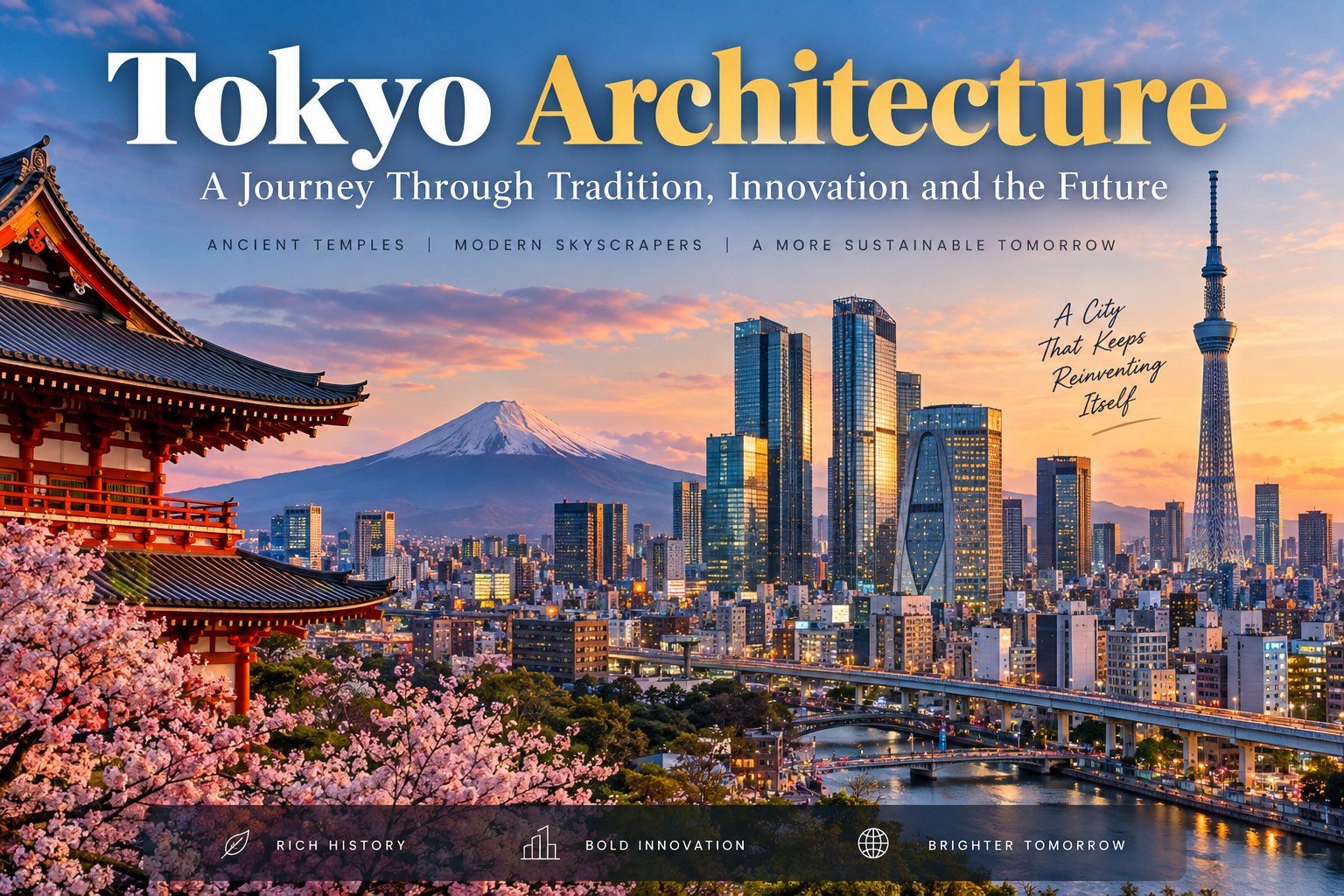
Tokyo Architecture: 25+ Iconic Buildings, Design Styles, History & Future Trends
Tokyo architecture is the remarkable result: a constantly changing mixture of temples, wooden homes, imperial structures, concrete modernism, futuristic towers, tiny experimental houses, commercial complexes, and cutting-edge contemporary buildings. Rather than following one architectural style, Tokyo allows old and new design to exist within the same neighbourhood, sometimes within the same street Tokyo Vacation
What Makes Tokyo Architecture Different?
Tokyo’s architecture can seem chaotic to a first-time visitor.
Buildings may vary dramatically in height, age, colour, materials and purpose. A traditional wooden structure may sit next to a modern concrete building, while a narrow house can occupy a surprisingly small plot between commercial properties.
This visual variety is not simply accidental.
Tokyo has developed through repeated cycles of construction, destruction, redevelopment and adaptation.
The official Tokyo Metropolitan Government describes the city as having transformed from Edo into the modern capital through major historical periods, including modernization during the Meiji era, the Great Kanto Earthquake, wartime destruction and postwar rebuilding.
A City That Rarely Stays Still
In many historic European cities, buildings can remain standing for centuries and create a relatively consistent streetscape.
Tokyo works differently.
Land values, redevelopment pressures, changing regulations, structural standards and the economics of Japanese housing have contributed to a built environment where buildings are frequently replaced.
Tokyo’s contemporary architectural landscape has consequently developed a sense of impermanence.
The Tokyo Metropolitan Government recently highlighted this characteristic, noting that residential buildings can have relatively short economic lives compared with the value placed on the land itself.
This helps explain why a Tokyo street can feel new even when the neighbourhood itself is historically old.
Architecture as a Reflection of Everyday Life
Tokyo architecture is not limited to monumental landmarks.
Some of the most interesting examples are:
- Small urban houses
- Convenience stores
- Apartment buildings
- Train stations
- Underground passages
- Department stores
- Coffee shops
- Small galleries
- Schools
- Religious buildings
- Office towers
- Mixed-use developments
This makes Tokyo particularly useful for studying the relationship between architecture and everyday urban life.
A Brief History of Tokyo Architecture
Understanding Tokyo architecture becomes much easier when you understand how the city developed.
Edo: The Foundation of Modern Tokyo
Before it became Tokyo, the city was known as Edo.
Edo grew dramatically after Tokugawa Ieyasu established the Tokugawa shogunate in 1603.
By the eighteenth century, Edo had become one of the world’s major cities, with a population exceeding one million according to the Tokyo Metropolitan Government.
The urban structure of Edo established patterns that still influence Tokyo.
The city developed around:
- The castle
- Samurai districts
- Merchant neighbourhoods
- Temple districts
- Waterways
- Roads
- Markets
- Entertainment areas
Traditional Japanese architecture placed considerable importance on relationships between buildings, gardens, streets, courtyards and natural elements.
These ideas continue to influence contemporary Japanese architects.
Traditional Japanese Architectural Principles
Traditional Japanese architecture often emphasizes:
- Natural materials
- Modularity
- Flexible interior spaces
- Connection with gardens
- Controlled light
- Simplicity
- Proportion
- Seasonal awareness
- Transitional spaces
Elements such as sliding partitions, verandas, timber structures and carefully framed views created flexible relationships between interior and exterior spaces.
Contemporary Tokyo architects often reinterpret these principles rather than copying historic forms.
Meiji Modernization
The Meiji Restoration of 1868 transformed Japan.
Tokyo became the national capital and rapidly adopted technologies, institutions and architectural influences from the West.
Brick and stone buildings appeared in areas undergoing modernization. Tokyo’s government profile notes that Western-style architecture became increasingly visible during this period.
The result was a fascinating architectural transition.
Traditional Japanese construction did not disappear.
Instead, Japanese and Western ideas began interacting.
The Great Kanto Earthquake
The Great Kanto Earthquake struck in September 1923.
The earthquake and resulting fires devastated large areas of Tokyo.
The disaster became one of the most important turning points in the city’s architectural history.
Reconstruction required enormous changes in:
- Infrastructure
- Building standards
- Roads
- Fire protection
- Urban planning
- Public facilities
- Structural engineering
The earthquake also strengthened the importance of designing buildings capable of surviving seismic events.
World War II and Reconstruction
Tokyo suffered extensive destruction during World War II.
After the war, rebuilding became another major chapter in the city’s architectural history.
Japan’s rapid economic recovery created demand for:
- Housing
- Offices
- Transportation infrastructure
- Schools
- Commercial buildings
- Industrial facilities
Tokyo became a laboratory for modern urban development.
The 1964 Tokyo Olympics
The 1964 Olympics represented a major moment in Tokyo’s international identity.
New infrastructure and landmark architecture helped present Japan as a technologically advanced modern nation.
One of the most famous results was Kenzo Tange’s Yoyogi National Gymnasium.
Its sweeping suspended-roof structure remains one of Tokyo’s most influential examples of modern architecture.
The Metabolist Movement
Japan’s Metabolist movement emerged around the idea that cities should be capable of growth, replacement and transformation.
Architects associated with the movement imagined buildings and cities as living systems.
Important figures included:
- Kenzo Tange
- Kiyonori Kikutake
- Kisho Kurokawa
- Fumihiko Maki
Although many of the movement’s most ambitious visions were never fully realized, its ideas influenced architectural thinking worldwide.
Traditional Tokyo Architecture
Tokyo is often associated with skyscrapers and futuristic buildings, but traditional architecture remains essential to understanding the city.
Senso-ji
Senso-ji in Asakusa is one of Tokyo’s most recognizable religious landmarks.
The complex demonstrates how traditional architectural forms can function within a modern megacity.
Its large entrance gates, temple structures, lanterns and surrounding streets create a dramatic contrast with the contemporary Tokyo skyline.
The experience is as much about the surrounding urban environment as the buildings themselves.
Meiji Jingu
Meiji Jingu offers another architectural experience.
Located within a large forested setting, the shrine creates a sense of separation from the dense city.
Its architecture emphasizes traditional Japanese shrine design and natural materials.
The contrast is particularly striking because Shibuya and Harajuku are among Tokyo’s busiest urban districts.
Nezu Shrine
Nezu Shrine provides another opportunity to observe traditional Japanese shrine architecture.
Its gates, pathways, structures and landscaped setting demonstrate the importance of movement through architectural space.
Rather than treating a building as an isolated object, Japanese shrine design often creates a sequence of experiences.
Modern Tokyo Architecture
Modern Tokyo architecture developed through several overlapping movements.
Japanese Modernism
Japanese modernism often combined international modernist ideas with local traditions.
Architects explored:
- Concrete
- Steel
- Glass
- Modular planning
- Structural expression
- Natural light
- Flexible interiors
Rather than simply copying European or American modernism, Japanese architects developed their own interpretations.
Kenzo Tange and Monumental Modernism
Kenzo Tange is one of the most important figures in twentieth-century Japanese architecture.
His work combined modern structural technology with ideas drawn from Japanese spatial traditions.
Yoyogi National Gymnasium remains a particularly powerful example.
Its roof structure creates an enormous interior volume while producing an expressive silhouette.
Yoyogi National Gymnasium
Yoyogi National Gymnasium is among Tokyo’s most significant modern architectural landmarks.
Designed for the 1964 Olympics, it is famous for its dramatic suspended roof.
The building demonstrates how structural engineering can become part of architectural expression.
For architecture enthusiasts, it is worth studying from multiple viewpoints.
Look at:
- The roof profile
- Structural supports
- Entrance sequence
- Relationship between interior and exterior
- Scale compared with surrounding trees
- Movement of pedestrians around the building
Contemporary Tokyo Architecture
Tokyo’s contemporary architecture is extraordinarily diverse.
The city is home to work by architects including:
- Kengo Kuma
- Tadao Ando
- Toyo Ito
- Kazuyo Sejima
- Ryue Nishizawa
- Sou Fujimoto
- Jun Aoki
- Shigeru Ban
- Fumihiko Maki
- Nikken Sekkei
Kengo Kuma
Kengo Kuma is internationally recognized for architecture that frequently explores the relationship between buildings and natural materials.
His projects often use:
- Timber
- Screens
- Layered façades
- Light
- Texture
- Repetition
One of the best-known examples in Tokyo is the Japan National Stadium, developed for the Tokyo 2020 Olympic and Paralympic Games.
The stadium uses extensive timber elements and layered roof geometry to create a softer architectural character.
Tadao Ando
Tadao Ando is famous for his disciplined use of concrete, light and geometry.
His Tokyo projects often demonstrate how relatively simple materials can produce powerful spatial experiences.
Ando’s approach frequently emphasizes:
- Controlled natural light
- Strong geometric forms
- Concrete surfaces
- Movement through space
- Contrast between darkness and brightness
Toyo Ito
Toyo Ito’s architecture often explores technology, fluidity and changing relationships between people and urban environments.
His work demonstrates that contemporary architecture does not need to look like a conventional rectangular office building.
Kazuyo Sejima and SANAA
Kazuyo Sejima and Ryue Nishizawa’s work is known for lightness, transparency and unusual spatial relationships.
Their approach often questions the conventional boundaries between:
- Public and private
- Interior and exterior
- Building and city
- Individual and collective space
25+ Tokyo Architectural Landmarks Worth Exploring
Tokyo Station
Tokyo Station is one of the city’s most important architectural landmarks.
Its historic red-brick Marunouchi façade provides a strong contrast to the skyscrapers surrounding it.
The station also demonstrates Tokyo’s relationship between historic preservation and modern infrastructure.
It is not simply a building.
It is an enormous transportation environment integrated with commercial and office districts.
Tokyo Metropolitan Government Building
The Tokyo Metropolitan Government Building in Shinjuku is an important example of late twentieth-century monumental architecture.
Designed by Kenzo Tange, its twin-tower composition gives the building a distinctive presence.
Its observation areas have also made the building popular with visitors.
Tokyo International Forum
Tokyo International Forum is one of the city’s most recognizable contemporary public buildings.
Its huge glass atrium demonstrates how architecture can create an indoor public space that feels almost urban in scale.
The building is particularly interesting for photographers because changing daylight transforms the appearance of its glass surfaces.
Tokyo Tower
Tokyo Tower became a symbol of postwar Tokyo.
Its bright orange-and-white structure has long been part of the city’s visual identity.
The tower also represents an era when communications infrastructure could become a major urban landmark.
Tokyo Skytree
Tokyo Skytree represents a later generation of broadcast architecture.
Its enormous height and distinctive structural design make it visible from many parts of the city.
Unlike traditional towers, its presence is strongly integrated with a large mixed-use urban district.
National Stadium
The National Stadium represents another major chapter in Tokyo’s architectural story.
The building’s timber elements and layered design reflect a contemporary interest in connecting large-scale infrastructure with Japanese material traditions.
21_21 Design Sight
Located in Roppongi, 21_21 Design Sight is associated with design culture and contemporary architecture.
Its partially embedded architecture and folded roof create a distinctive relationship with the surrounding landscape.
Prada Aoyama
The Prada store in Aoyama demonstrates how commercial architecture can become an urban landmark.
Its unusual structural façade changes how people perceive the relationship between interior retail space and the street.
Omotesando Architecture
Omotesando is effectively an open-air architecture gallery.
International and Japanese architects have contributed buildings for fashion houses and commercial brands.
Visitors can compare very different approaches within a relatively compact area.
Mode Gakuen Cocoon Tower
The Cocoon Tower in Shinjuku has a distinctive curved form designed to suggest a cocoon.
Its unusual shape demonstrates how educational architecture can become part of a city’s skyline.
Ginza Architecture
Ginza offers a different architectural experience.
Here, luxury retail architecture, historic commercial buildings and contemporary façades compete for attention.
The district is particularly useful for studying architecture as branding.
Hillside Terrace
Hillside Terrace in Daikanyama is important because it demonstrates a more restrained approach to urban development.
The complex integrates architecture, pedestrian spaces and commercial functions.
Azabudai Hills
Azabudai Hills illustrates Tokyo’s contemporary approach to large-scale mixed-use development.
The project combines offices, residences, retail, public spaces and landscaped areas.
It represents a broader movement toward vertically integrated urban districts.
Shibuya Architecture
Shibuya provides an entirely different architectural landscape.
Large transport infrastructure, commercial towers, digital signage and pedestrian flows create an urban environment where architecture, advertising and transportation become difficult to separate.
Harajuku Architecture
Harajuku is particularly interesting for smaller-scale contemporary design.
Behind busy commercial streets, visitors can discover experimental façades, narrow buildings and unusual retail spaces.
Daikanyama Architecture
Daikanyama is useful for visitors interested in pedestrian-scale architecture.
Its streets demonstrate how smaller buildings, cafés, shops and landscaped areas can produce a very different urban atmosphere from Shinjuku.
Architecture by Tokyo Neighbourhood
Asakusa
Look for:
- Traditional temples
- Historic streets
- Small-scale shops
- Traditional materials
- Tourist-oriented commercial architecture
Ueno
Look for:
- Museums
- Cultural institutions
- Historic structures
- Parks
- Public architecture
Ginza
Look for:
- Luxury retail façades
- High-end commercial buildings
- Contemporary architecture
- Historic commercial structures
Marunouchi
Look for:
- Tokyo Station
- Corporate towers
- Preserved historic façades
- Large public plazas
- Contemporary office architecture
Shinjuku
Look for:
- Skyscrapers
- Transportation infrastructure
- Government architecture
- Department stores
- High-density commercial development
Shibuya
Look for:
- Large-scale redevelopment
- Transport architecture
- Digital façades
- Mixed-use towers
- Pedestrian infrastructure
Harajuku
Look for:
- Fashion architecture
- Experimental retail buildings
- Small urban plots
- Contemporary façades
Omotesando
Look for:
- International fashion brands
- Flagship stores
- Contemporary architecture
- Glass façades
- Structural experimentation
Roppongi
Look for:
- Museums
- Mixed-use developments
- Contemporary cultural architecture
- High-rise buildings
- Public art and landscaped spaces
Daikanyama
Look for:
- Smaller buildings
- Residential architecture
- Pedestrian-friendly streets
- Design-focused retail
- Cafés and galleries
Why Tokyo Has So Many Small and Unusual Houses
One of the most fascinating parts of Tokyo architecture is residential design.
Tokyo contains countless homes built on extremely small plots.
Small Plots Create Big Design Challenges
Architects may need to solve:
- Limited daylight
- Privacy
- Noise
- Storage
- Vertical circulation
- Parking
- Neighbouring buildings
- Building regulations
- Structural requirements
Instead of treating small sites as a limitation, many architects use them as design opportunities.
Vertical Living
A small Tokyo house may distribute its functions vertically.
One floor may contain the kitchen.
Another may contain bedrooms.
Another may function as a living room or workspace.
This produces a very different relationship between architecture and daily life.
Natural Light
Because neighbouring buildings can be close, architects often use:
- Skylights
- Light wells
- Internal courtyards
- Clerestory windows
- Transparent materials
- Reflective surfaces
The goal is to bring daylight deep into compact interiors.
The Role of Earthquake Engineering
Tokyo’s architecture cannot be separated from seismic risk.
Earthquakes have profoundly influenced Japanese construction.
Designing for Movement
Modern Japanese buildings can incorporate structural systems designed to accommodate earthquake forces.
Depending on the building, technologies may include:
- Base isolation
- Dampers
- Flexible structural systems
- Reinforced structural frames
- Advanced monitoring
- Redundant structural elements
The engineering behind a building can be just as important as its visible appearance.
Why Earthquake Design Matters to Visitors
When you admire a Tokyo skyscraper, remember that its design is not simply about reaching higher.
It must also respond to:
- Wind
- Earthquakes
- Density
- Infrastructure
- Emergency access
- Building codes
Tokyo therefore provides an excellent real-world lesson in how architecture must respond to environmental conditions.
How Tokyo’s Building Regulations Shape Its Appearance
Architecture is influenced by rules as much as by artistic vision.
Tokyo’s contemporary architectural character is partly shaped by regulations involving:
- Building height
- Fire safety
- Sunlight
- Setbacks
- Land use
- Structural safety
- Emergency access
The Tokyo Metropolitan Government’s recent discussion of contemporary architecture notes that sunlight regulations help explain some of the angled roofs seen across Tokyo, while gaps between buildings can also be related to fire-safety and access requirements.
This is an important lesson for architecture visitors.
A strange-looking building may not simply be an architect’s artistic experiment.
It may be the visible result of solving several practical constraints.
The Relationship Between Architecture and Nature
Japanese architecture has historically maintained a strong relationship with nature.
Modern Tokyo may look highly urban, but this relationship remains visible.
Gardens
Gardens can provide:
- Visual relief
- Privacy
- Shade
- Seasonal change
- Cultural continuity
Timber
Timber is increasingly important in contemporary Japanese architecture.
Tokyo’s Wood City Tokyo Model Architecture Awards demonstrate ongoing efforts to promote innovative timber use and create greater demand for domestic wood.
This trend connects architecture with forestry, material science and sustainability.
Green Roofs and Terraces
Contemporary developments increasingly incorporate:
- Rooftop gardens
- Landscaped terraces
- Public plazas
- Green corridors
- Trees around large buildings
These spaces can help soften the environmental impact of dense urban development.
Ten Major Architecture Brands, Architects and Design Practices to Know
The term “brand” in architecture is different from the way it is used in consumer products. Here, the comparison refers to major architects or architectural practices associated with influential Tokyo projects and design approaches.
| Architect / Practice | Associated Approach | Tokyo Relevance | What to Look For |
|---|---|---|---|
| Kenzo Tange | Monumental modernism | Yoyogi National Gymnasium, Tokyo Metropolitan Government Building | Structure, scale, urban symbolism |
| Kengo Kuma | Timber, texture, nature | National Stadium and other Tokyo projects | Wood, layering, filtered light |
| Tadao Ando | Concrete and light | Contemporary cultural and commercial projects | Geometry, shadow, movement |
| Toyo Ito | Technology and fluidity | Major contemporary projects | Lightness, unusual forms |
| SANAA | Transparency and openness | Contemporary cultural architecture | Boundaries, circulation, light |
| Sou Fujimoto | Experimental spatial design | Tokyo residential and cultural projects | Porosity, layering, unusual volumes |
| Jun Aoki | Minimal contemporary architecture | Tokyo commercial and cultural buildings | Geometry and restraint |
| Fumihiko Maki | Urban modernism | Hillside Terrace and major projects | Human scale and urban relationships |
| Nikken Sekkei | Large-scale integrated design | Major Tokyo commercial and infrastructure projects | Complex systems and mixed-use planning |
| Shigeru Ban | Innovative structural and material design | Japanese and international projects | Material experimentation and structural logic |
This table should not be read as a ranking. Each architect or practice represents a different design philosophy and architectural contribution.
Tokyo Architecture Compared With Other World Cities
Tokyo vs Paris
Paris is strongly associated with relatively consistent historic urban blocks and monumental boulevards.
Tokyo is more visually fragmented.
Tokyo vs New York
New York has an iconic skyscraper tradition, but Tokyo combines high-rise development with much smaller residential structures and traditional sites.
Tokyo vs London
London contains many architectural layers, but Tokyo’s rapid rebuilding produces a different relationship between old and new.
Tokyo vs Singapore
Singapore is known for highly planned urban development.
Tokyo is generally more fragmented and neighbourhood-driven.
Tokyo vs Dubai
Dubai often emphasizes monumental new construction and futuristic forms.
Tokyo’s architectural character is more heterogeneous, combining small-scale buildings, historic structures, infrastructure and experimental architecture.
The Hidden Architecture of Tokyo
One of the biggest mistakes visitors make is concentrating only on famous landmarks.
Tokyo’s most interesting architectural lessons are often hidden.
Alleyways
Small alleys reveal:
- Compact housing
- Utility infrastructure
- Small shops
- Tiny gardens
- Building additions
- Informal urban adaptations
Convenience Stores
Even ordinary convenience stores can demonstrate how architecture responds to:
- Limited sites
- Visibility
- Pedestrian access
- Parking
- Signage
- Delivery logistics
Railway Stations
Tokyo’s stations are architectural ecosystems.
They combine:
- Railways
- Shops
- Restaurants
- Offices
- Underground passages
- Pedestrian routes
- Public transportation
The station is often more important to the urban experience than the individual building above it.
A Practical Tokyo Architecture Tour
If you want to experience Tokyo architecture rather than simply photograph famous buildings, plan your visit by neighbourhood.
Route One: Traditional Tokyo
Start in Asakusa.
Explore:
- Senso-ji
- Nakamise area
- Side streets
- Traditional commercial buildings
- Sumida River surroundings
Then continue toward Ueno.
Route Two: Historic and Modern Tokyo
Start at Tokyo Station.
Walk through:
- Marunouchi
- Tokyo Station area
- Marunouchi office district
- Ginza
This route demonstrates the relationship between preserved architecture and modern corporate development.
Route Three: Contemporary Architecture
Start around Omotesando.
Continue through:
- Omotesando
- Harajuku
- Aoyama
- Shibuya
This is particularly useful for studying contemporary commercial architecture.
Route Four: Modernism and Urban Scale
Explore:
- Shinjuku
- Tokyo Metropolitan Government Building
- Skyscraper district
- Major transport spaces
This route demonstrates the scale of postwar and late twentieth-century Tokyo development.
Route Five: Roppongi Design District
Explore:
- Roppongi Hills
- 21_21 Design Sight
- Museums
- Contemporary developments
- Smaller surrounding streets
How to Photograph Tokyo Architecture
Tokyo is an excellent city for architectural photography.
Shoot From Street Level
Do not photograph everything from the centre of the road.
Try:
- Looking upward
- Shooting along façades
- Using reflections
- Photographing entrances
- Framing buildings through trees
- Capturing people for scale
Photograph Details
Instead of only photographing the entire building, capture:
- Door handles
- Concrete textures
- Timber screens
- Windows
- Roof edges
- Signage
- Staircases
- Shadows
Visit at Different Times
Morning light can produce a completely different appearance from evening illumination.
Rain can also transform Tokyo architecture by creating reflections on:
- Pavements
- Glass
- Metal
- Shop windows
How to Read a Tokyo Building
You do not need an architecture degree to understand Tokyo architecture.
Ask five simple questions.
Question One: What Problem Was the Architect Solving?
Was the site:
- Small?
- Noisy?
- Crowded?
- Dark?
- Commercial?
- Public?
- Seismic?
Question Two: Why Are These Materials Used?
Look at:
- Concrete
- Wood
- Glass
- Steel
- Stone
- Ceramic
- Metal screens
Ask what each material contributes.
Question Three: How Does the Building Meet the Street?
Does it:
- Invite pedestrians?
- Create a plaza?
- Hide behind a wall?
- Open a shopfront?
- Use landscaping?
Question Four: How Does Light Enter?
Look for:
- Skylights
- Courtyards
- Glass walls
- Screens
- Windows
- Openings
Question Five: What Happens Around the Building?
Architecture is not only the building.
Observe:
- Pedestrians
- Cars
- Bicycles
- Shops
- Trees
- Signs
- Railways
- Neighbouring buildings
Common Mistakes When Exploring Tokyo Architecture
Only Visiting Famous Buildings
Famous landmarks are useful starting points, but they do not represent the entire city.
Solution: Spend time in ordinary neighbourhoods.
Ignoring Residential Architecture
Tokyo’s houses can be more experimental than its famous commercial buildings.
Solution: Walk quietly through residential districts and observe from public streets without entering private property.
Looking Only Up
Skyscrapers naturally attract attention.
But much of Tokyo’s architectural character exists at eye level.
Solution: Look at entrances, materials, signs, gardens and street edges.
Treating Every Unusual Building as a Landmark
Not every unusual building has a famous architect.
Solution: Research the building before assigning historical or architectural significance.
Ignoring History
A contemporary building becomes more interesting when you understand what existed before it.
Solution: Study the area’s historical development before your visit.
Pros and Challenges of Tokyo’s Architectural Model
Advantages
Tokyo’s constantly evolving architectural environment creates several advantages.
It encourages:
- Design experimentation
- Architectural diversity
- Efficient land use
- New construction technologies
- Adaptation to changing needs
- Mixed-use development
- Architectural innovation
Challenges Tokyo architecture
The same system also creates challenges.
Rapid redevelopment can lead to:
- Loss of historic buildings
- Disappearing neighbourhood character
- Construction waste
- Short building lifespans
- Pressure on heritage preservation
Tokyo’s official historic-building preservation initiatives show that conserving architectural heritage remains an active issue. The Tokyo Metropolitan Government’s historical-building listings include structures ranging from early twentieth-century residences to universities, hospitals and commercial buildings.
The Central Architectural Tension Tokyo architecture
Tokyo therefore faces an important question:
How can a city continue to evolve without losing the physical evidence of its past?
There is no single answer.
Some buildings should be preserved.
Others may need to be replaced.
Some can be adapted.
The challenge is deciding which architectural qualities matter most.
Preservation vs Redevelopment Tokyo architecture
Tokyo provides a fascinating case study in this debate.
Why Redevelopment Happens Tokyo architecture
Redevelopment can respond to:
- Aging infrastructure
- Safety requirements
- Population changes
- Transport improvements
- Economic activity
- New public facilities
- Environmental objectives
Why Preservation Matters Tokyo architecture
Older buildings can provide:
- Cultural identity
- Historical evidence
- Architectural diversity
- Community memory
- Tourism value
The challenge is that preserving every building is neither practical nor necessarily desirable.
Adaptive Reuse Tokyo architecture
One potential middle ground is adaptive reuse.
Instead of demolishing a building, designers can modify it for a new purpose.
Examples can include turning older structures into:
- Hotels
- Offices
- Galleries
- Restaurants
- Cultural facilities
- Shops
This approach can preserve architectural character while allowing the building to remain useful.
Tokyo Architecture and Sustainability
Sustainability is becoming increasingly important in contemporary architecture.
Timber Construction Tokyo architecture
Timber is receiving renewed attention in Japan.
Tokyo’s government has actively promoted model timber architecture through its Wood City Tokyo initiative.
Timber can offer:
- Lower structural weight
- Renewable material potential
- Warm visual qualities
- Opportunities for prefabrication
Its sustainability depends on sourcing, forest management, transportation, durability and lifecycle considerations.
Energy Efficiency Tokyo architecture
Modern buildings increasingly use:
- High-performance glazing
- Efficient HVAC systems
- Smart controls
- Improved insulation
- Solar technology
- Energy monitoring
Green Urban Spaces Tokyo architecture
Large redevelopment projects increasingly incorporate landscaped areas.
The challenge is ensuring that greenery is not merely decorative.
The best urban landscapes can provide:
- Shade
- Biodiversity
- Social space
- Rainwater management
- Cooling
- Pedestrian comfort
The Future of Tokyo Architecture
Tokyo’s future architecture is likely to be shaped by several forces.
More Timber and Hybrid Materials Tokyo architecture
The growing interest in timber suggests that future Japanese architecture may continue combining wood with:
- Steel
- Concrete
- Glass
- Composite materials
Smarter Buildings Tokyo architecture
Buildings will increasingly integrate sensors and automated systems.
Possible applications include:
- Energy management
- Indoor environmental monitoring
- Predictive maintenance
- Lighting control
- Occupancy management
More Mixed-Use Districts Tokyo architecture
Tokyo’s major redevelopment projects increasingly combine multiple functions.
A single district may include:
- Offices
- Apartments
- Retail
- Hotels
- Schools
- Cultural facilities
- Public spaces
- Transportation connections
Greater Attention to Resilience Tokyo architecture
Future architecture will need to respond to:
- Earthquakes
- Extreme weather
- Heat
- Aging infrastructure
- Energy demand
Preservation Through Technology Tokyo architecture
Digital documentation may become increasingly important for recording buildings before they disappear.
The renewed Edo-Tokyo Museum, which reopened in 2026 after a major renovation, demonstrates how models, projections and interactive technology can communicate the city’s architectural and urban history.
The City Will Keep Changing Tokyo architecture
One of the safest predictions about Tokyo architecture is that Tokyo will continue to change.
A 2026 Tokyo Metropolitan Government report on the city’s changing skyline highlights redevelopment around Shinjuku Station, including major transformation around the west exit.
For architecture enthusiasts, this creates an unusual opportunity.
A Tokyo architecture guide written today may document buildings that future generations will know only through photographs.
How to Plan a Tokyo Architecture Trip
For Beginners Tokyo architecture
If you are new to architecture, focus on:
- Tokyo Station
- Asakusa
- Senso-ji
- Meiji Jingu
- Omotesando
- Shibuya
- Shinjuku
These areas provide an accessible introduction to different architectural periods.
For Intermediate Architecture Fans
Add:
- Daikanyama
- Roppongi
- Aoyama
- Ginza
- Yoyogi
- Tokyo International Forum
- Contemporary museums
- Smaller residential neighbourhoods
For Architecture Professionals and Students
Consider studying:
- Urban density
- Seismic engineering
- Transit-oriented development
- Small-site housing
- Metabolist ideas
- Adaptive reuse
- Timber construction
- Public-private space
- Mixed-use redevelopment
Tokyo Architecture for Different Types of Travellers
For Families Tokyo architecture
Prioritize:
- Large public spaces
- Museums
- Parks
- Accessible landmarks
- Architecture near major transport hubs
For Photographers Tokyo architecture
Focus on:
- Omotesando
- Shibuya
- Ginza
- Shinjuku
- Tokyo Station
- Roppongi
Visit during different lighting conditions.
For Students Tokyo architecture
Focus on:
- Yoyogi National Gymnasium
- Tokyo Metropolitan Government Building
- Contemporary museums
- Residential architecture
- Railway infrastructure
For History Lovers Tokyo architecture
Focus on:
- Asakusa
- Meiji-era buildings
- Tokyo Station
- Historic districts
- Edo-related sites
- Preserved buildings
For Design Lovers Tokyo architecture
Focus on:
- Aoyama
- Omotesando
- Daikanyama
- Roppongi
- Ginza
A Deeper Way to Understand Tokyo Architecture
The most useful way to understand Tokyo is to stop asking:
“What style is this building?”
Instead ask:
“Why does this building look this way in this particular place?”
That question produces better answers.
A narrow house may exist because the plot is tiny.
A sloping roof may respond to sunlight regulations.
A gap between buildings may have practical safety reasons.
A tower may be connected to transportation infrastructure.
A wooden façade may reference traditional materials while meeting modern structural requirements.
A glass building may be designed to create visual permeability.
Architecture is therefore a record of decisions.
Why Tokyo’s “Messiness” Is Important Tokyo architecture
Tokyo sometimes looks visually inconsistent.
Yet that inconsistency can be valuable.
A perfectly coordinated city can be beautiful.
But a visually diverse city can reveal more about how people actually live.
Tokyo’s architecture shows:
- Individual choices
- Corporate development
- Government regulation
- Historical memory
- Land economics
- Technology
- Cultural traditions
- Environmental constraints
The Tokyo Metropolitan Government’s recent architectural commentary specifically describes the city’s lack of visual cohesion as part of what makes discovering buildings there surprising and engaging.
The Architecture Between Buildings
This may be the most important idea for anyone visiting Tokyo.
Architecture does not stop at the façade.
Look at the spaces between buildings.
Notice:
- Narrow pedestrian paths
- Tiny gardens
- Utility poles
- Bridges
- Railway lines
- Underground connections
- Street corners
- Shopfronts
- Small plazas
These spaces reveal how Tokyo actually functions.
The city is not simply a collection of famous buildings.
It is a network of relationships between buildings, infrastructure and people.
Practical Tips for Exploring Tokyo Architecture
Use Public Transport Strategically
Tokyo’s rail system allows visitors to explore very different architectural environments efficiently.
Instead of trying to walk across the entire city, choose neighbourhood clusters.
Walk Slowly
Architecture rewards slow observation.
A 20-minute walk can reveal more than rushing between famous landmarks.
Check Opening Rules
Some buildings are private, some are commercial, and some have restricted access.
Always verify visitor access before planning an interior visit.
Respect Residential Areas
Tokyo’s residential architecture is fascinating, but homes are private spaces.
Observe from public areas and avoid photographing people or entering private property without permission.
Carry a Comfortable Camera or Phone Tokyo architecture
You do not need professional equipment.
A phone camera can capture:
- Geometry
- Reflections
- Textures
- Details
- Street scenes
Photograph Context Tokyo architecture
Include surrounding buildings to show scale and relationships.
A Balanced View Tokyo architecture
Tokyo should not be presented as a perfect architectural model.
Its strengths and challenges exist together.
Strengths Tokyo architecture
- Extraordinary diversity
- Strong earthquake engineering
- Architectural experimentation
- Efficient use of dense urban land
- World-class architects
- Strong transport integration
- Continued design innovation
- Combination of tradition and modernity
Challenges Tokyo architecture
- Loss of historic buildings
- Rapid redevelopment
- Construction waste
- High land pressure
- Fragmented visual identity
- Difficulty preserving some modernist buildings
- Complex relationships between private property and public space
The city is therefore valuable precisely because it contains contradictions.
FAQs
What is Tokyo architecture known for?
Tokyo architecture is known for its extraordinary mixture of traditional Japanese forms, modernist buildings, skyscrapers, small urban houses, experimental contemporary architecture, transportation infrastructure and rapidly changing neighbourhoods.
Why does Tokyo have so many different architectural styles?
Tokyo has experienced several major periods of rebuilding and modernization. Earthquakes, wartime destruction, economic development, changing regulations and redevelopment have repeatedly transformed the city.
Who are the most famous Tokyo architects?
Important architects associated with Tokyo and Japanese architecture include Kenzo Tange, Kengo Kuma, Tadao Ando, Toyo Ito, Kazuyo Sejima, Ryue Nishizawa, Sou Fujimoto, Fumihiko Maki, Jun Aoki and Shigeru Ban.
What is the most famous modern building in Tokyo?
There is no single universally accepted answer. Yoyogi National Gymnasium, Tokyo Metropolitan Government Building, Tokyo International Forum, Tokyo Tower, Tokyo Skytree and the National Stadium are among the city’s major architectural landmarks.
Is Tokyo architecture mostly modern?
No. Tokyo combines traditional temples, shrines and historic structures with modern and contemporary buildings.
Is Tokyo good for architecture tourism?
Yes. The city offers an unusually broad range of architectural experiences, from traditional Japanese religious buildings to modern skyscrapers and experimental houses.
Where can I see contemporary architecture in Tokyo?
Omotesando, Aoyama, Roppongi, Ginza, Shibuya, Daikanyama and parts of Shinjuku are particularly useful areas for discovering contemporary architecture.
Why are Tokyo houses often so small?
High land values, dense urban development, irregular plots and planning constraints can produce very small residential sites. Architects respond by using vertical layouts, compact planning and creative daylight strategies.
What is Metabolist architecture?
Metabolism was a postwar Japanese architectural movement that explored cities and buildings as systems capable of growth, replacement and transformation.
What should architecture students study in Tokyo?
Students can study seismic design, urban density, small-site housing, transit-oriented development, Japanese modernism, Metabolism, timber architecture, mixed-use developments and the relationship between public and private space.
Why are some Tokyo buildings so close together?
Dense land use, plot patterns, regulations and historical urban development all contribute to the close relationship between buildings.
Why do some Tokyo buildings look temporary?
Japan’s building economics and redevelopment patterns can mean that buildings have shorter economic lives than the land beneath them.
Why is there so much rebuilding?
Redevelopment can be driven by aging buildings, infrastructure improvements, safety requirements, changing economic conditions and changing urban needs.
Why does Tokyo mix old and new so closely?
The city has undergone repeated cycles of rebuilding while retaining important temples, shrines, gardens and historic buildings.
Conclusion
Tokyo architecture is not one style. It is a story of adaptation. Edo traditions created an early urban foundation. Meiji modernization introduced new materials and Western influences. The Great Kanto Earthquake forced the city to reconsider construction and planning. Wartime destruction led to another period of rebuilding. The 1964 Olympics helped create a new international image. Postwar architects experimented with concrete, steel and large-scale urban concepts. Contemporary architects continue exploring timber, glass, light, technology, sustainability and human-scale design.


One Comment