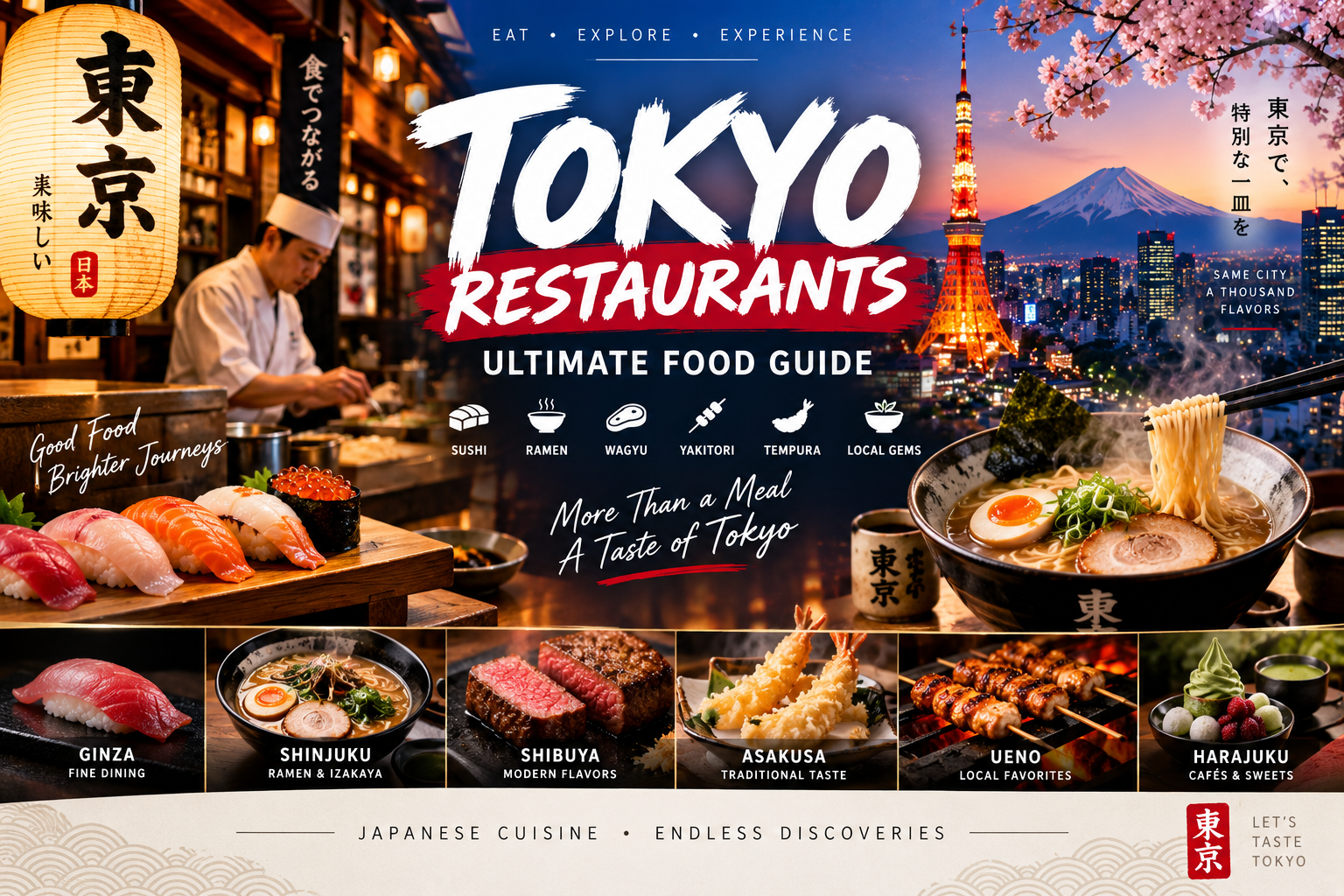
Tokyo Restaurants: Best Food Guide, Areas & Dining Tips
Looking for the best Tokyo restaurants but unsure where to start? Tokyo offers everything from tiny ramen counters and conveyor-belt sushi to traditional kaiseki, premium wagyu, yakitori, tempura and some of the world’s most celebrated fine-dining restaurants. The smartest way to explore Tokyo’s food scene is not to chase a single “best restaurant.” Instead, build your dining itinerary around neighborhoods, cuisine, budget and experience, leaving room for both famous restaurants and small local establishments you discover along the way Tokyo Travel
Understanding the Tokyo Restaurant Scene
Tokyo’s restaurant culture developed through centuries of Japanese culinary traditions, regional influences and changing urban lifestyles.
The result is a food environment where old and new exist side by side.
A traditional restaurant may focus on seasonal ingredients and techniques developed over generations.
A modern restaurant may combine Japanese ingredients with French, Italian, Thai, Korean or other international influences.
The 2026 Michelin selection specifically highlights this mixture of traditional Japanese techniques and international culinary influences, including French, Austrian, Thai, Chinese, Korean and Italian cuisine.
Why Tokyo Has So Many Different Restaurants
Tokyo’s enormous population, tourism industry, business districts, residential neighborhoods and transportation network create demand for almost every type of dining experience.
You can find:
- Luxury sushi
- Affordable sushi
- Ramen
- Soba
- Udon
- Tempura
- Tonkatsu
- Yakitori
- Wagyu
- Kaiseki
- Shabu-shabu
- Sukiyaki
- Japanese curry
- Unagi
- Izakaya
- Dessert cafés
- Vegan restaurants
- Vegetarian restaurants
- Muslim-friendly restaurants
- International cuisine
- Fast-casual Japanese food
- Department-store food halls
- Market-style dining
This diversity means that the question “Where should I eat in Tokyo?” is almost too broad.
A better question is:
What kind of Tokyo food experience do you want today?
Best Tokyo Restaurants by Cuisine
The easiest way to build a Tokyo food itinerary is to understand the major categories.
Best Tokyo Restaurants for Sushi
Sushi is one of Tokyo’s defining culinary experiences.
Tokyo is particularly important to sushi history because Edo-style sushi developed in the city.
For travelers, the experience can range from inexpensive conveyor-belt restaurants to highly formal omakase counters.
At the premium end, reservations can be difficult and meals can be expensive.
At the casual end, conveyor-belt sushi can provide an accessible introduction to the cuisine.
One important mistake is assuming that expensive sushi automatically means better sushi for every traveler.
The best restaurant depends on what you value.
A sushi enthusiast may want a highly traditional omakase experience.
A first-time visitor may prefer a relaxed restaurant where they can order individual pieces.
A family may prioritize accessibility and speed.
A budget traveler may choose conveyor-belt sushi.
Best Tokyo Restaurants for Ramen
Ramen is one of the easiest ways to experience Tokyo’s everyday food culture.
You can find different styles of broth, noodles and toppings throughout the city.
Some restaurants specialize in tonkotsu-style ramen.
Others focus on shoyu, shio, miso, chicken-based broths, seafood broths or more experimental combinations.
For visitors, ramen has another advantage.
It is usually quick.
You can often turn a restaurant stop into a 30-minute meal rather than spending several hours at a formal restaurant.
ICHIRAN Shinjuku Station Central East Exit is particularly recognizable among international visitors for its individual booth-style ramen experience.
Afuri Shinjuku Lumine is another well-known option, particularly for travelers interested in lighter, citrus-influenced ramen.
For visitors seeking a more intense and highly individual style, Ramen Jiro Shinjuku Kabukicho represents a very different ramen experience from mainstream tourist-oriented ramen.
Best Tokyo Restaurants for Tempura
Tempura is deceptively simple.
The ingredients may look basic, but excellent tempura depends on batter, oil temperature, timing and ingredient quality.
High-end tempura restaurants often serve pieces individually so diners can experience the texture and temperature at their best.
For travelers on a budget, tendon—tempura served over rice—is an easier way to experience the cuisine.
Tendon Tenya is a useful example of a more accessible tempura-focused restaurant brand.
Best Tokyo Restaurants for Tonkatsu
Tonkatsu consists of breaded and deep-fried pork cutlet.
The best versions have a crisp exterior while remaining tender inside.
It is a practical lunch choice because it is filling, relatively straightforward and usually easier to understand for first-time visitors.
Tonkatsu Maisen Aoyama is a well-known name for visitors wanting to explore Tokyo’s tonkatsu culture.
Best Tokyo Restaurants for Yakitori
Yakitori is grilled chicken prepared on skewers.
It can be casual, social and highly atmospheric.
Yakitori restaurants range from inexpensive chains to small specialist counters.
YAKITORI Torikizoku Shinjuku East Exit Store is one example of the accessible chain-style experience.
Yakitori is particularly good for evening itineraries because it naturally fits into an izakaya-style night.
Best Tokyo Restaurants for Wagyu and Gyukatsu
Wagyu is one of Japan’s most famous premium food categories.
However, visitors should distinguish between wagyu steak, yakiniku and gyukatsu.
Gyukatsu is a breaded beef cutlet, often served so diners can cook the interior further on a small hot stone or grill.
Gyukatsu Motomura Shinjuku South Exit Branch is a recognizable choice for travelers wanting to try this style.
Best Tokyo Restaurants for Shabu-Shabu and Sukiyaki
These dishes are excellent for travelers who want a social dining experience.
Thinly sliced meat and vegetables are cooked at the table.
Shabu-shabu generally involves swishing ingredients through broth.
Sukiyaki uses a sweeter, richer cooking style.
Momo Paradise Shinjuku Higashi-guchi is one example of a popular shabu-shabu and sukiyaki restaurant experience in Shinjuku.
Best Tokyo Restaurants for Kaiseki
Kaiseki is a multi-course Japanese dining tradition built around seasonality, presentation and balance.
It is less about eating a large quantity of food and more about experiencing the sequence of dishes.
The setting, ceramics, service and seasonal ingredients can be as important as the food itself.
GO TOKYO explains that kaiseki reflects Japanese traditions and places particular importance on seasonality and presentation.
For first-time visitors, kaiseki can be one of the most memorable high-end Japanese dining experiences.
It can also be intimidating.
Do not worry about knowing every dish in advance.
Listen to the explanation from the restaurant and enjoy the progression.
Best Areas for Tokyo Restaurants
Tokyo’s dining scene becomes much easier when divided by neighborhood.
Tokyo Restaurants in Shinjuku
Shinjuku is one of the easiest neighborhoods for visitors who want variety.
You can find:
- Ramen
- Sushi
- Yakitori
- Izakaya
- Shabu-shabu
- Korean food
- International restaurants
- Dessert cafés
- High-end dining
- Late-night restaurants
The major advantage is density.
You can spend an entire evening in Shinjuku without needing to travel to another part of Tokyo.
For a first-time traveler, this makes Shinjuku one of the most practical areas for dining.
Tokyo Restaurants in Shibuya
Shibuya is particularly strong for younger travelers, couples and visitors interested in contemporary food culture.
The area offers casual restaurants, cafés, international dining, sushi, ramen, yakiniku and modern Japanese cuisine.
Uobei Shibuya Dogenzaka Store is a useful option for travelers who want a casual conveyor-belt sushi experience in a famous sightseeing district.
Tokyo Restaurants in Ginza
Ginza is strongly associated with upscale dining.
You can find high-end sushi, kaiseki, tempura, French cuisine and sophisticated Japanese restaurants.
It is an ideal area for a special dinner.
The downside is that premium dining can become expensive quickly.
Ginza works best when you intentionally choose the experience you want rather than simply selecting the most expensive restaurant.
Tokyo Restaurants in Asakusa
Asakusa is an excellent area for traditional Japanese food.
After visiting Sensoji and exploring the historic streets, you can look for:
- Tempura
- Soba
- Unagi
- Sushi
- Japanese sweets
- Traditional cafés
- Casual restaurants
The neighborhood’s historical atmosphere makes the meal feel connected to the sightseeing experience.
Tokyo Restaurants in Ueno
Ueno is particularly useful for casual dining.
It is also convenient for combining food with museums and Ueno Park.
You can build a day around:
Morning museum → Ueno lunch → Ameyoko exploration → dinner.
Tokyo Restaurants in Tsukiji
Tsukiji remains important for visitors interested in seafood and market-style eating.
The area is particularly attractive for breakfast or lunch.
However, travelers should understand that Tsukiji’s role changed after the wholesale market moved to Toyosu.
The outer market remains a major food destination, but it should not be confused with the wholesale market operation at Toyosu.
Tokyo Restaurants in Tokyo Station
Tokyo Station is surprisingly useful for food.
The station and surrounding areas contain restaurants, food halls and specialized dining areas.
It is particularly convenient for travelers who are catching a train or staying near Marunouchi.
Tokyo Restaurants in Harajuku and Omotesando
This area combines cafés, modern restaurants, dessert shops, Japanese food and international cuisine.
It works particularly well for lunch during a sightseeing route involving Meiji Jingu, Harajuku and Omotesando.
Tokyo Restaurants in Akihabara
Akihabara is famous for electronics, gaming, anime and manga culture, but it also has plenty of casual restaurants.
It is a useful place to combine food with pop-culture sightseeing.
Tokyo Restaurants in Yanaka
Yanaka provides a slower alternative.
Instead of focusing on famous restaurants, you can explore neighborhood cafés, traditional shops and small eateries.
This is particularly appealing for repeat visitors.
A 5-Day Tokyo Restaurant Itinerary
Instead of randomly choosing restaurants each day, use the following neighborhood-based structure.
Day 1: Asakusa Food Day
Start with breakfast or an early snack around Asakusa.
Explore Sensoji and Nakamise-dori.
Have lunch featuring tempura, soba, sushi or unagi.
In the afternoon, walk toward the Sumida River.
Finish the evening around Asakusa or Tokyo Skytree.
This is a good day for traditional Japanese food.
Day 2: Harajuku and Shibuya Food Day
Start with coffee or breakfast.
Visit Meiji Jingu.
Walk through Harajuku.
Have lunch around Harajuku or Omotesando.
Continue toward Shibuya.
Have an early dinner or late dinner around Shibuya.
Finish with a dessert, café or nighttime city view.
This is the ideal day for modern Tokyo food culture.
Day 3: Tokyo Station and Ginza
Start near Tokyo Station.
Have breakfast or brunch.
Explore Marunouchi.
Have lunch around Tokyo Station.
Continue toward Ginza.
Spend the afternoon shopping.
Reserve a special dinner.
This should be your premium dining day if your budget allows.
Day 4: Ueno and Akihabara
Start at Ueno.
Visit a museum.
Have lunch around Ueno or Ameyoko.
Explore Akihabara during the afternoon.
Choose ramen, curry, sushi or another casual dinner.
This is a good budget-friendly day.
Day 5: Shinjuku Food and Nightlife
Have a relaxed breakfast.
Explore Shinjuku Gyoen or nearby areas.
Have lunch around Shinjuku.
Spend the afternoon shopping.
Enjoy an early dinner.
Explore Shinjuku after dark.
Finish with ramen, yakitori or another late-night option.
The Best Tokyo Restaurant Brands for Different Budgets
Not every traveler needs fine dining.
A good food trip often works better when you mix price levels.
Budget Tokyo Restaurants
Look for:
- Ramen shops
- Soba counters
- Udon shops
- Curry restaurants
- Conveyor-belt sushi
- Gyudon restaurants
- Casual tempura chains
- Family restaurants
These allow you to save money while experiencing Japanese food.
Mid-Range Tokyo Restaurants
Mid-range restaurants are ideal for travelers who want a more comfortable atmosphere without paying luxury prices.
Consider:
- Specialist sushi restaurants
- Tonkatsu restaurants
- Yakitori restaurants
- Yakiniku
- Shabu-shabu
- Modern Japanese restaurants
Luxury Tokyo Restaurants
Luxury dining can include:
- Omakase sushi
- Kaiseki
- Premium tempura
- Wagyu
- French-Japanese cuisine
- High-end yakiniku
- Chef’s tasting menus
Tokyo’s Michelin selection demonstrates how deep this category is, with hundreds of restaurants represented across different levels.
Ten Tokyo Restaurant Brands Compared
| Restaurant Brand / Example | Main Cuisine | Best For | Budget | Dining Style | Recommended For |
|---|---|---|---|---|---|
| ICHIRAN Shinjuku Station Central East Exit | Ramen | First-time ramen experience | $ | Casual, individual booths | Solo travelers |
| Afuri Shinjuku Lumine | Ramen | Lighter ramen | $–$$ | Casual | Beginners |
| Uobei Shibuya Dogenzaka Store | Sushi | Affordable sushi | $ | Conveyor belt | Families, budget travelers |
| Tonkatsu Maisen Aoyama | Tonkatsu | Traditional pork cutlet | $$ | Casual dining | First-time visitors |
| YAKITORI Torikizoku Shinjuku East Exit Store | Yakitori | Casual evening dining | $–$$ | Izakaya-style | Groups |
| Tendon Tenya | Tempura | Affordable tempura | $ | Fast casual | Budget travelers |
| Gyukatsu Motomura Shinjuku South Exit Branch | Gyukatsu | Beef experience | $$ | Casual | Couples, foodies |
| Momo Paradise Shinjuku Higashi-guchi | Shabu-shabu | Group dining | $$ | Table cooking | Families, groups |
| NOBU Tokyo | Japanese fusion | Luxury international dining | $$$$ | Fine dining | Special occasions |
| Ise Sueyoshi | Kaiseki | Traditional Japanese dining | $$$$ | Tasting-course style | Cultural travelers |
The table is intended as a planning comparison rather than a permanent ranking. Restaurant menus, prices, opening hours and reservation policies can change, so travelers should verify details directly before visiting.
How Much Do Tokyo Restaurants Cost?
One of Tokyo’s biggest advantages is the enormous range of prices.
You can eat very affordably.
You can also spend an extraordinary amount on a single meal.
Budget Meal
A casual meal such as ramen, curry, soba or gyudon may fit comfortably into a modest travel budget.
Mid-Range Meal
A better restaurant with specialist ingredients, table service or a larger meal can cost considerably more.
Premium Meal
Omakase, kaiseki, premium wagyu and high-end tempura can become expensive quickly.
Luxury Meal
High-end tasting menus can cost many times more than an ordinary Japanese meal.
The important lesson is that price and enjoyment do not always move together.
A ¥1,000–¥2,000 meal can be memorable.
A ¥30,000 meal can be disappointing if it does not match your expectations.
Tokyo Restaurants for Solo Travelers
Tokyo is one of the world’s easiest cities for solo dining.
Many restaurants are designed around individual customers.
Ramen counters are particularly suitable.
So are sushi counters, soba restaurants and casual cafés.
Solo travelers should not feel uncomfortable entering a restaurant alone.
In fact, eating alone is a normal part of Japanese urban life.
Best Solo Dining Styles
Choose:
- Ramen counters
- Sushi counters
- Soba shops
- Curry restaurants
- Conveyor-belt sushi
- Department-store food halls
- Small cafés
If you want conversation, choose an izakaya or counter-style restaurant.
Tokyo Restaurants for Couples
Couples can create a more memorable dining itinerary by combining food with sightseeing.
Try:
Shibuya sightseeing → dinner → city views.
Asakusa sightseeing → traditional Japanese meal → Sumida River.
Ginza shopping → premium dinner.
Tokyo Station → Marunouchi walk → special restaurant.
Odaiba → waterfront dinner.
The best couple experience is often about atmosphere rather than price.
Tokyo Restaurants for Families
Families should prioritize convenience.
Look for restaurants with:
- Spacious seating
- Clear menus
- Fast service
- Child-friendly dishes
- Convenient locations
- Easy transportation access
Avoid booking an extremely formal tasting menu if young children are unlikely to enjoy a long meal.
Tokyo has enough restaurant variety that families can choose food experiences according to age.
Tokyo Restaurants for Muslim Travelers
Muslim travelers need to be particularly careful when checking ingredients.
Japanese cuisine may contain:
- Pork
- Alcohol
- Mirin
- Sake
- Gelatin
- Fish-based dashi
- Alcohol-containing sauces
GO TOKYO specifically warns Muslim visitors that traditional seasonings such as mirin, soy sauce and miso may involve alcohol or other ingredients that require attention, and recommends using dedicated Muslim-friendly information resources.
Tokyo has expanded information for Muslim travelers, including dedicated guides and restaurant resources.
The important point is:
Do not assume that “no pork” automatically means halal.
Check ingredients and preparation methods.
Tokyo Restaurants for Vegetarian and Vegan Travelers
Vegetarian and vegan dining has become increasingly accessible.
However, hidden ingredients remain an issue.
A dish that appears vegetarian may contain fish-based dashi.
Some sauces may contain animal-derived ingredients.
GO TOKYO explicitly warns vegetarian and vegan travelers that apparently meat-free dishes can contain bonito-based dashi, gelatin or other animal ingredients.
The official 2026–2027 Tokyo Vegan & Vegetarian Restaurant Guide provides restaurant information for visitors with these requirements.
Best Strategy
Do not simply say:
“I’m vegetarian.”
Explain exactly what you cannot eat.
If you have a serious allergy, communicate it clearly before ordering.
Tokyo Restaurants for Travelers With Food Allergies
Allergies require more planning.
The official Tokyo tourism guidance notes that more restaurants are accommodating dietary restrictions and food allergies, but recommends checking with restaurants when booking or ordering.
Carry a written Japanese explanation of your allergy if necessary.
For serious allergies, do not rely entirely on verbal communication.
Ask about:
- Broth
- Sauces
- Cooking oils
- Cross-contact
- Garnishes
- Desserts
- Seasonings
Tokyo Restaurants and Accessibility
Accessibility is another area where planning matters.
Tokyo has an official accessible restaurant guide covering cafés, restaurants and bars working toward barrier-free facilities.
The best strategy is to check accessibility before arriving rather than assuming every small restaurant will have step-free access.
Older buildings, basement restaurants and tiny counters can present challenges.
Large modern shopping complexes often provide easier access.
Tokyo Restaurant Reservations
Reservations can be important, particularly for popular restaurants.
This is especially true for:
- Omakase sushi
- Kaiseki
- High-end tempura
- Michelin-starred restaurants
- Small specialist restaurants
- Popular tasting menus
When You Should Reserve Tokyo Restaurants
Reserve when the restaurant is:
- Small
- Famous
- Expensive
- Reservation-only
- Offering a fixed tasting menu
- Frequently booked by tourists
When You May Not Need a Reservation Tokyo Restaurants
Walk-in dining is often practical for:
- Ramen
- Casual curry
- Soba
- Udon
- Conveyor-belt sushi
- Fast-casual restaurants
- Some izakaya
Do not assume every restaurant accepts walk-ins.
How to Find Good Tokyo Restaurants
A useful restaurant-selection process has five steps.
Step One: Choose the Neighborhood Tokyo Restaurants
Pick the area where you will already be sightseeing.
Step Two: Choose the Cuisine Tokyo Restaurants
Decide whether you want sushi, ramen, tempura, yakitori or something else.
Step Three: Choose Your Budget Tokyo Restaurants
Set your approximate spending level.
Step Four: Check the Restaurant’s Current Information
Look at:
- Opening days
- Opening hours
- Reservation requirements
- Menu
- Dietary information
- Payment options
Step Five: Have a Backup Tokyo Restaurants
Popular restaurants can have long lines or unavailable reservations.
Always keep a second option nearby.
This is especially useful during busy travel seasons.
Why Restaurant Location Matters More Than Rankings
A common mistake is choosing a restaurant because it is ranked number one on a website even though it is an hour away from your planned sightseeing.
That creates unnecessary transportation.
Instead, ask:
“What is the best restaurant within my current neighborhood?”
This approach produces a better travel day.
For example:
If you are in Asakusa, eat in Asakusa.
If you are in Shibuya, explore Shibuya restaurants.
If you are visiting Ueno museums, eat around Ueno.
You will spend less time traveling and more time enjoying Tokyo.
Tokyo Restaurant Etiquette
Japanese restaurant etiquette is generally straightforward once you know the basics.
Queue Properly Tokyo Restaurants
Do not skip a line.
GO TOKYO specifically advises visitors to wait in line and avoid cutting ahead.
Keep Your Voice Down Tokyo Restaurants
Speaking loudly on public transportation and in public spaces is generally discouraged.
Do Not Bring Outside Food Tokyo Restaurants
Restaurants generally expect customers to consume food purchased there.
GO TOKYO explicitly advises visitors not to bring outside food into restaurants.
Do Not Expect Tipping Tokyo Restaurants
Tipping is not customary in Japanese restaurants.
GO TOKYO notes that there is no general tipping custom in Japanese restaurants.
Understand Otoshi Tokyo Restaurants
At some izakaya-style establishments, you may receive a small appetizer automatically.
This can function as a cover charge.
It is not necessarily a mistake or an unauthorized item.
GO TOKYO identifies this practice as otoshi.
Remove Shoes When Required Tokyo Restaurants
Some traditional restaurants have tatami seating.
If shoes need to be removed, follow the restaurant’s instructions.
Common Tokyo Restaurant Mistakes
Mistake One: Only Eating Sushi Tokyo Restaurants
Tokyo’s food scene is far bigger than sushi.
Try ramen, soba, yakitori, tempura, curry, tonkatsu and other dishes.
Mistake Two: Eating Only at Famous Chains Tokyo Restaurants
Chains are convenient, but independent restaurants can offer more distinctive experiences.
Use chains strategically rather than exclusively.
Mistake Three: Ignoring Dashi Tokyo Restaurants
Vegetarians and vegans should understand that dashi may contain fish.
Mistake Four: Assuming Halal Means Pork-Free Tokyo Restaurants
Halal requirements can involve ingredients, alcohol and preparation.
Mistake Five: Choosing a Restaurant Too Far Away Tokyo Restaurants
Do not cross Tokyo for every meal.
Mistake Six: Forgetting Restaurant Hours Tokyo Restaurants
Some restaurants close between lunch and dinner.
Others may have specific closing days.
Mistake Seven: Booking Too Many Expensive Meals Tokyo Restaurants
A luxury restaurant every night can become exhausting and expensive.
Mix premium experiences with casual meals.
Mistake Eight: Ignoring Queues Tokyo Restaurants
Some popular restaurants have long waiting times.
Decide whether the restaurant is worth the wait.
Mistake Nine: Treating Social Media as a Ranking System Tokyo Restaurants
A restaurant can be extremely photogenic without being the best restaurant for your preferences.
Mistake Ten: Overplanning Tokyo Restaurants
Leave space for unexpected discoveries.
Pros and Cons of Eating at Tokyo Restaurants
Advantages Tokyo Restaurants
Tokyo offers extraordinary culinary diversity.
Food quality is often high across multiple price ranges.
Public transportation makes restaurant-hopping relatively practical.
Traditional Japanese cuisine is widely available.
International cuisine is also strong.
Dietary information is improving.
There are restaurants for almost every budget.
Disadvantages Tokyo Restaurants
The number of choices can be overwhelming.
Popular restaurants may have queues.
Premium restaurants can be expensive.
Some small restaurants may have limited English information.
Dietary restrictions require additional research.
Small restaurants may have limited seating.
Some restaurants may not accommodate large groups easily.
How to Build the Perfect Tokyo Food Itinerary
The best strategy is to divide your meals by importance.
Make One Meal the Main Event
Choose one special restaurant per day.
This could be:
Sushi.
Kaiseki.
Wagyu.
Tempura.
Yakiniku.
Then keep the other meals flexible.
Use Lunch for Expensive Restaurants
Lunch menus can sometimes provide a more accessible way to experience premium restaurants.
However, always check the current menu and pricing.
Use Dinner for Atmosphere
Dinner is better suited to:
Izakaya.
Yakitori.
Yakiniku.
Shabu-shabu.
Sushi.
Special occasion dining.
A Budget-Friendly Tokyo Food Day
A budget traveler could structure a day like this:
Breakfast: convenience-store breakfast or bakery.
Lunch: ramen or soba.
Afternoon: Japanese dessert or café.
Dinner: conveyor-belt sushi or casual curry.
This allows you to eat well without spending heavily.
A Luxury Tokyo Food Day
A luxury traveler could choose:
Breakfast: premium Japanese breakfast.
Lunch: high-end tempura or sushi.
Afternoon: specialty tea or dessert.
Dinner: kaiseki or omakase.
This is a completely different experience.
The important thing is to avoid assuming that luxury is necessary for a great Tokyo food trip.
A Family Tokyo Food Day
Breakfast: hotel or bakery.
Lunch: tonkatsu or udon.
Snack: Japanese sweets.
Dinner: shabu-shabu or casual sushi.
This provides variety without excessive complexity.
A Vegetarian Tokyo Food Day
Breakfast: vegan café.
Lunch: vegetarian ramen or Japanese set meal.
Afternoon: tea and wagashi.
Dinner: vegan Japanese cuisine.
Check dashi and sauces carefully.
A Muslim-Friendly Tokyo Food Day
Breakfast: verified Muslim-friendly restaurant.
Lunch: halal ramen or Japanese cuisine.
Snack: clearly labeled packaged food.
Dinner: verified halal Japanese meal.
Use current official Muslim-friendly resources rather than relying on old blog lists. Tokyo’s official tourism resources specifically provide Muslim traveler guidance.
Tokyo Restaurant Trends to Watch
Tokyo’s dining culture continues to evolve.
International Japanese Cuisine Tokyo Restaurants
Japanese ingredients are increasingly being used within international culinary frameworks.
The 2026 Michelin selection includes restaurants representing French, Austrian, Thai, Chinese, Korean and Italian influences alongside Japanese cuisine.
More Inclusive Dining Tokyo Restaurants
Restaurants are increasingly responding to vegetarian, vegan, Muslim and allergy-related requirements.
GO TOKYO’s current dining guidance reflects this growing emphasis on inclusive food experiences.
Sustainable Gastronomy Tokyo Restaurants
The Michelin Green Star is becoming increasingly relevant.
In Tokyo’s 2026 selection, 13 restaurants hold Green Stars, including a newly recognized restaurant emphasizing eco-conscious sourcing and its own garden.
Dessert as a Culinary Experience
Fine dining is increasingly extending beyond savory courses.
The 2026 Michelin selection highlights elaborate dessert courses, wagashi and tea pairings.
Technology and Restaurant Discovery
Travelers increasingly use digital maps, AI recommendations, reservation platforms and translation tools to discover restaurants.
Tokyo’s official tourism infrastructure itself now provides Tokyo Navigation AI for travel consultations.
The future will probably make restaurant discovery even more personalized.
The Future of Tokyo Restaurants
The future of Tokyo’s restaurant scene is unlikely to be defined by one cuisine or one dining trend.
Instead, several developments are likely to happen simultaneously.
Traditional restaurants will continue preserving old techniques.
Young chefs will experiment with international influences.
More restaurants will accommodate dietary restrictions.
Technology will make restaurant discovery easier.
Sustainability will become more visible.
Neighborhood dining will become increasingly important as travelers search for experiences beyond the most famous tourist areas.
The most interesting development may be the combination of tradition and personalization.
A traveler might use technology to find a restaurant based on dietary requirements, budget and location, then experience a centuries-old Japanese culinary technique once inside.
That is a very Tokyo combination.
Why You Should Not Try to Eat at Every Famous Tokyo Restaurant
Tokyo rewards curiosity more than completion.
If you spend the entire trip trying to check restaurants off a list, you may miss the atmosphere around them.
A small restaurant discovered while walking through a neighborhood may become more memorable than the restaurant you spent three months trying to reserve.
That does not mean famous restaurants are overrated.
It means they are only one part of Tokyo’s culinary identity.
Use famous restaurants for specific experiences.
Use local restaurants for exploration.
Use casual restaurants for convenience.
Use markets for atmosphere.
Use cafés for rest.
Use izakaya for social dining.
Use fine dining for special occasions.
This creates a much richer food itinerary.
Practical Tokyo Restaurant Checklist
Before traveling, prepare:
- Your preferred cuisines
- Your daily food budget
- Any allergies
- Dietary restrictions
- Halal requirements if applicable
- Vegetarian or vegan requirements
- A list of special-occasion restaurants
- A few casual backup restaurants
- Neighborhood restaurant options
- Reservation information
- Restaurant opening hours
- Payment expectations
- Basic Japanese dining etiquette
Once in Tokyo, keep your itinerary flexible.
The perfect restaurant may be the one you discover after leaving the train station.
FAQs
What are the best Tokyo restaurants for first-time visitors?
First-time visitors should experience several different styles rather than searching for one “best” restaurant. A good combination is ramen, sushi, tempura, yakitori and one traditional Japanese meal such as kaiseki.
Is Tokyo expensive for food?
Tokyo can be expensive or surprisingly affordable. Casual ramen, soba, curry and sushi can be relatively accessible, while premium omakase, kaiseki and wagyu restaurants can cost substantially more.
What food should I try in Tokyo?
Try sushi, ramen, tempura, tonkatsu, yakitori, soba, unagi, Japanese curry, wagyu, shabu-shabu and Japanese desserts.
Do Tokyo restaurants require reservations?
Some do and some do not. High-end sushi, kaiseki and small specialist restaurants often require or strongly recommend reservations. Casual ramen and many fast-casual restaurants commonly allow walk-ins.
Is tipping required in Tokyo restaurants?
No. Tipping is not generally part of Japanese restaurant culture.
Are Tokyo restaurants vegetarian-friendly?
Yes, increasingly so, but visitors should check ingredients carefully because dashi and other seasonings can contain fish or animal ingredients.
Is Tokyo good for Muslim travelers?
Yes, but ingredient checking is important. Pork, alcohol, mirin, gelatin and other ingredients may appear in Japanese food unexpectedly. Tokyo provides dedicated Muslim traveler information and restaurant resources.
Where should I eat in Tokyo for affordable sushi?
Conveyor-belt sushi is one practical choice for budget-conscious travelers. Shibuya, Shinjuku, Ueno and other major neighborhoods have casual sushi options.
Where should I eat ramen in Tokyo?
Shinjuku, Shibuya, Tokyo Station and many other neighborhoods have excellent ramen choices. For first-time visitors, choose a style based on broth preference rather than simply choosing the restaurant with the longest queue.
What is the best area for Tokyo restaurants?
Shinjuku is excellent for variety, Shibuya for modern dining, Ginza for luxury, Asakusa for traditional food, Ueno for casual dining, and Tsukiji for seafood and market-style experiences.
What is the best Tokyo restaurant for couples?
Couples can choose premium sushi, kaiseki, yakiniku, waterfront restaurants or restaurants with city views. The best choice depends on budget and atmosphere.
What are the best Tokyo restaurants for families?
Families often benefit from casual sushi, ramen, tonkatsu, udon, shabu-shabu and restaurants with flexible menus. Large shopping complexes can also be convenient.
Can I eat alone in Tokyo restaurants?
Absolutely. Solo dining is very common. Ramen counters, sushi counters, soba shops and casual restaurants are particularly comfortable for solo travelers.
Are Tokyo restaurants open late?
Some are, particularly in areas such as Shinjuku and Shibuya. However, closing hours vary considerably by restaurant, so check the current schedule before planning a late-night meal.
What is an izakaya?
An izakaya is a Japanese-style drinking and dining establishment offering small dishes, drinks and casual food. It can be an excellent way to experience Tokyo nightlife and social dining.
What is omakase?
Omakase generally means leaving the selection to the chef. In sushi restaurants, this often means a chef-selected progression of dishes based on available ingredients.
What is kaiseki?
Kaiseki is a traditional Japanese multi-course dining style emphasizing seasonal ingredients, balance, presentation and hospitality.
Should I eat at Michelin-starred restaurants in Tokyo?
If you enjoy fine dining and have the budget, it can be a memorable experience. However, Michelin recognition is not necessary for a great Tokyo meal. The 2026 Michelin selection demonstrates how broad the city’s quality dining scene is, from starred restaurants to Bib Gourmand establishments.
Is Tsukiji still worth visiting for food?
Yes. The outer market remains a popular destination for seafood, sushi, snacks and food-related experiences, although the wholesale market itself is now at Toyosu.
Should I book Tokyo restaurants before my trip?
For high-demand restaurants, yes. Reserve the most important meals first, then leave casual meals flexible.
What should I do if my restaurant reservation is cancelled?
Keep a backup restaurant in the same neighborhood. Tokyo’s restaurant density makes it easier to find alternatives than in many smaller destinations.
What should I do if I cannot speak Japanese?
Many tourist-oriented and international restaurants have English information, but not every small restaurant does. Translation tools can help, and learning a few basic Japanese dining expressions can make the experience smoother.
Do Tokyo restaurants accept credit cards?
Many do, especially larger and modern establishments, but payment methods vary. It is sensible to have a backup payment option.
Can I bring outside food into Tokyo restaurants?
Generally, no. GO TOKYO advises visitors to follow restaurant rules and not bring outside food into restaurants.
Why do some Tokyo restaurants give me a small dish before ordering?
In some izakaya and drinking establishments, this may be otoshi, a small appetizer associated with a cover charge.
What is the biggest mistake tourists make with Tokyo restaurants?
The biggest mistake is trying to visit too many famous restaurants instead of planning meals around neighborhoods. A geographically efficient itinerary gives you more time to enjoy both food and Tokyo itself.
Conclusion
Tokyo restaurants are not simply a collection of places to eat; they are one of the best ways to understand the city. From the precision of sushi and the comfort of ramen to the social atmosphere of yakitori, the elegance of kaiseki and the simplicity of a neighborhood soba shop, Tokyo’s culinary identity is built around variety, craftsmanship, seasonality and attention to detail. For first-time visitors, the smartest approach is to avoid creating an itinerary based entirely on famous restaurant rankings. Instead, choose one or two memorable dining experiences, then build the rest of your meals around the neighborhoods you are already exploring. Eat tradition.



2 Comments