Tokyo Business: Companies, Startups, Finance & Global Growth
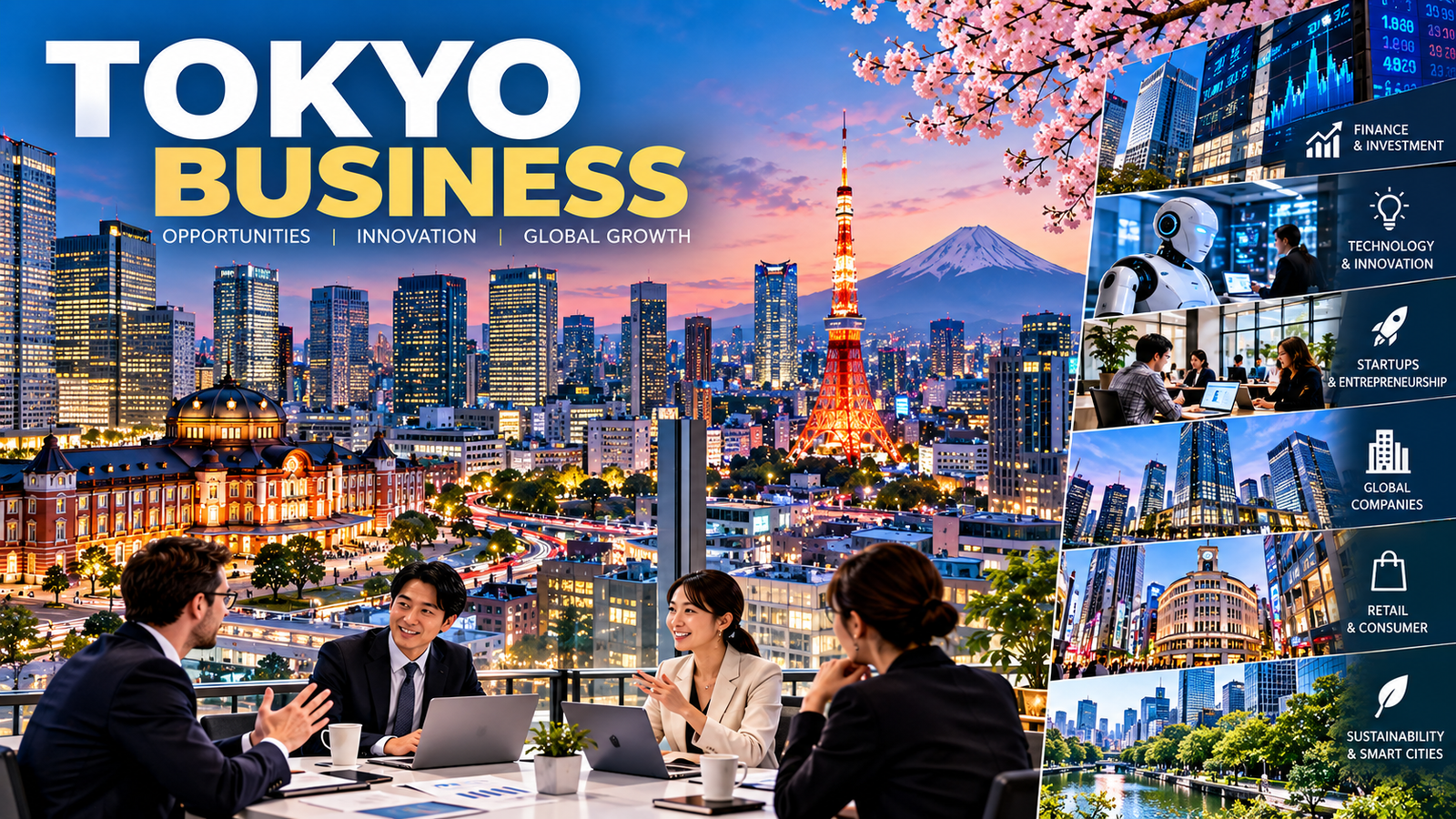
What makes Tokyo one of the world’s most important business cities, and why do companies from Japan and overseas continue to build their operations here? Tokyo business is built around a powerful combination of global corporations, financial services, startups, advanced technology, manufacturing, retail, professional services, research, and international investment. For entrepreneurs and companies looking toward Japan, Tokyo offers a huge customer base, sophisticated infrastructure, deep corporate networks, and growing support for startups and overseas businesses. Walk through Marunouchi during a weekday morning and the scale of Tokyo’s business environment becomes immediately visible. Professionals move between offices around Tokyo Station. Financial institutions operate alongside global corporations. Restaurants serve office workers, international visitors and executives Tokyo Planner
What Is Tokyo Business?
Tokyo business refers broadly to the commercial activity taking place across Tokyo’s metropolitan economy.
It includes:
- Financial services
- Banking
- Insurance
- Technology
- Artificial intelligence
- Manufacturing
- Automotive
- Electronics
- Retail
- E-commerce
- Real estate
- Construction
- Tourism
- Hospitality
- Professional services
- Consulting
- Media
- Entertainment
- Gaming
- Healthcare
- Life sciences
- Logistics
- Telecommunications
- Startups
- International companies
Some businesses operate globally from Tokyo.
Others primarily serve the Japanese market.
Many do both.
This mixture is one of the city’s defining characteristics.
Why Tokyo Matters to Global Business
Tokyo provides something that is difficult to reproduce elsewhere: a combination of scale, infrastructure, corporate concentration and purchasing power.
A business entering Tokyo can potentially access:
- Japanese consumers
- Large corporations
- Investors
- Universities
- Skilled professionals
- Technology partners
- Financial institutions
- Government programs
- International businesses
- Highly developed logistics networks
Tokyo is also the centre of many decision-making networks connected to Japan’s wider economy.
A company may establish an office in Tokyo while manufacturing products elsewhere in Japan.
A startup may develop software in Tokyo while selling internationally.
A foreign corporation may establish a Japanese headquarters in Tokyo and operate branches throughout the country.
This makes the city particularly important for companies seeking a Japanese market entry point.
The Structure of Tokyo’s Business Economy
Tokyo’s business ecosystem can be understood through several interconnected layers.
Large Corporations
These companies provide:
- Employment
- Capital
- Research
- Supply chains
- International trade
- Corporate services
Small and Medium-Sized Enterprises
SMEs are essential to the wider supply chain and local economy.
They often provide:
- Specialist manufacturing
- Professional services
- Components
- Logistics
- Retail
- Construction
- Business support
Startups
Startups contribute:
- New technology
- New business models
- Rapid experimentation
- Digital services
- Innovation
Financial Institutions
Banks, securities companies, insurers, asset managers and venture investors provide capital and financial infrastructure.
Universities and Research Institutions
These organizations contribute:
- Research
- Skilled talent
- Intellectual property
- Innovation partnerships
Government
Government programs influence:
- Business support
- Regulation
- Infrastructure
- Investment attraction
- Startup policy
- Urban development
The interaction between these layers creates the broader Tokyo business ecosystem.
Tokyo as a Global Business Centre
Tokyo has long been one of Asia’s major commercial centres.
Its importance comes from more than the number of companies headquartered there.
It is also a gateway between Japanese businesses and the international economy.
Global companies use Tokyo for:
- Japanese market entry
- Regional management
- Research
- Sales
- Partnerships
- Investment
- Corporate development
The Tokyo Metropolitan Government operates Invest Tokyo specifically to support foreign companies considering expansion into the city. Its services cover business development, establishment procedures, networking, financial support and expansion.
This institutional support reflects the city’s broader ambition to remain internationally competitive.
Tokyo Business Districts
Tokyo does not have one single business district.
Different areas have different commercial identities.
Marunouchi
Marunouchi is one of Tokyo’s best-known corporate districts.
Located beside Tokyo Station, it contains major corporate offices, financial institutions, hotels, restaurants and retail facilities.
Its biggest advantage is connectivity.
Tokyo Station links the district with:
- Shinkansen services
- Local rail
- Subway networks
- Major business areas
- Airports through connecting services
For corporate headquarters and professional services, location near major transportation infrastructure can be valuable.
Otemachi
Otemachi is closely associated with finance, major corporations and professional services.
It sits adjacent to Marunouchi and forms part of Tokyo’s central business core.
The district is particularly associated with:
- Banking
- Finance
- Insurance
- Consulting
- Corporate headquarters
- Professional services
Nihonbashi
Nihonbashi has a different character.
It combines historic commerce with modern business.
Traditional Japanese businesses operate alongside financial institutions, technology companies, retail, food businesses and new developments.
This makes Nihonbashi a useful example of how Tokyo often modernizes without completely abandoning its commercial history.
Shibuya
Shibuya has become increasingly associated with:
- Startups
- Technology
- Creative industries
- Digital businesses
- Entertainment
- Retail
Its younger demographic and concentration of technology-oriented companies have helped create a distinctive entrepreneurial environment.
Shinjuku
Shinjuku is one of Tokyo’s largest commercial and transportation centres.
Its business environment includes:
- Corporate offices
- Hotels
- Retail
- Restaurants
- Entertainment
- Government
- Professional services
The Tokyo Metropolitan Government headquarters is located in Shinjuku.
Roppongi
Roppongi has a strong international business presence.
It includes:
- Foreign companies
- International offices
- Luxury retail
- Hospitality
- Restaurants
- Professional services
For internationally oriented businesses, its concentration of foreign residents and companies can be useful.
Shinagawa
Shinagawa benefits from excellent transportation connections.
The area is important for:
- Corporate offices
- Technology
- Transportation
- Hotels
- International business
Its connection to the Shinkansen network also makes it useful for companies whose employees frequently travel between Tokyo and other Japanese cities.
Ginza
Ginza is particularly important for:
- Luxury retail
- Fashion
- Hospitality
- Restaurants
- Premium brands
- Tourism
It demonstrates the relationship between consumer spending and international business.
Tokyo Business and Finance
Finance remains one of the pillars of Tokyo business.
The city’s financial ecosystem includes:
- Commercial banking
- Investment banking
- Securities
- Insurance
- Asset management
- Venture capital
- Private investment
- Fintech
- Corporate finance
Tokyo is also home to the Tokyo Stock Exchange, making the city an important capital-markets centre.
Financial institutions support businesses through:
- Loans
- Investment
- Equity markets
- Foreign exchange
- Insurance
- Payments
- Wealth management
Tokyo Stock Exchange
The Tokyo Stock Exchange is one of the world’s major stock markets.
Its importance extends beyond listed Japanese companies.
It provides a connection between businesses and investors.
For companies, public markets can support:
- Capital raising
- Corporate visibility
- Expansion
- Acquisitions
- Investor relationships
For investors, the exchange provides access to Japanese listed businesses across many industries.
Tokyo and Corporate Headquarters
Large corporations often place headquarters or major offices in Tokyo because the city provides proximity to:
- Government
- Financial institutions
- Major clients
- Investors
- Professional services
- International partners
- Skilled employees
Headquarters also benefit from transportation.
A central Tokyo office can connect executives to domestic and international travel networks relatively efficiently.
Tokyo Business and Technology
Technology has become one of the fastest-changing components of Tokyo business.
The technology ecosystem includes:
- Artificial intelligence
- Cloud computing
- Cybersecurity
- Robotics
- Semiconductors
- Software
- Gaming
- Digital payments
- Telecommunications
- Enterprise technology
- Automation
Tokyo’s updated startup strategy explicitly identifies deep technology areas such as AI, robotics, biotechnology, space, advanced materials and other strategic fields.
This suggests that Tokyo’s future business growth is increasingly linked to technology-intensive industries.
Artificial Intelligence and Tokyo Business
AI is changing business models across Tokyo.
Businesses are exploring AI for:
- Customer service
- Marketing
- Data analysis
- Software development
- Manufacturing
- Logistics
- Fraud detection
- Financial analysis
- Translation
- Research
- Robotics
The biggest opportunity may not come from replacing entire occupations.
Instead, companies may use AI to reduce repetitive work and increase employee productivity.
For example, an accounting department could use AI to classify documents.
A retailer could use AI to analyze demand.
A manufacturer could use computer vision for quality inspection.
A logistics company could use algorithms to improve routing.
The value comes from applying AI to a specific business problem.
Tokyo Robotics Business
Japan’s long industrial history gives Tokyo access to a mature robotics ecosystem.
Robotics applications include:
- Manufacturing
- Warehousing
- Healthcare
- Retail
- Hospitality
- Logistics
- Mobility
- Research
Tokyo’s business opportunity in robotics therefore exists at multiple levels.
A company does not necessarily need to manufacture an entire robot.
It can develop:
- Sensors
- Software
- AI models
- Components
- Control systems
- Maintenance services
- Logistics applications
- Robotics-as-a-service
This creates opportunities for both large companies and startups.
Tokyo Startups
Tokyo’s startup environment has become an increasingly important focus of government policy.
The Tokyo Metropolitan Government launched Global Innovation with STARTUPS in 2022 and updated its approach through Global Innovation Strategy 2.0: STARTUP & SCALEUP in 2025. The strategy includes goals around strengthening the startup ecosystem, expanding global connections and increasing collaboration between startups and government.
The city’s startup strategy is built around the idea that startups should contribute not only to private-sector growth but also to solving urban and social problems.
This creates opportunities in areas such as:
- Mobility
- Sustainability
- Healthcare
- AI
- Robotics
- Financial technology
- Climate technology
- Urban services
Tokyo Innovation Base
Tokyo Innovation Base, or TIB, is one of the city’s major startup ecosystem initiatives.
The Tokyo Metropolitan Government describes TIB as a hub intended to connect startups and supporters from Japan and abroad and serve as a node within the global innovation ecosystem. It officially opened in May 2024.
For entrepreneurs, hubs such as TIB can provide something more valuable than office space.
They provide connections.
A startup needs more than an idea.
It may need:
- Customers
- Investors
- Mentors
- Engineers
- Corporate partners
- Government contacts
- International connections
Innovation hubs can help create these relationships.
TOKYO SUTEAM
TOKYO SUTEAM is another initiative supporting the startup ecosystem.
The program works with different organizations to provide support and build communities around startups.
In 2026, Tokyo expanded the program to include a course aimed at supporting overseas startups entering Japan and helping Japanese startups expand internationally.
This is significant because successful startup ecosystems require international connections.
A company that can only operate in one city may have limited growth potential.
A startup that can use Tokyo as a launchpad into the Japanese and international markets has a different opportunity.
Tokyo and Foreign Businesses
Foreign businesses play an important role in Tokyo.
International companies may enter the market through:
- Japanese subsidiaries
- Branch offices
- Joint ventures
- Partnerships
- Acquisitions
- Distribution agreements
- Local representatives
The Tokyo Metropolitan Government provides several support programs for foreign businesses, including Access to Tokyo, Business Development Center Tokyo, Tokyo One-Stop Business Establishment Center, financial support and startup-related programs.
This means foreign companies do not necessarily need to navigate every part of the market alone.
Invest Tokyo
Invest Tokyo is designed to support foreign companies considering expansion into Tokyo.
Its support framework includes stages such as:
- Exploring Tokyo
- Building networks
- Making decisions
- Preparing an office
- Starting operations
- Expanding the business
The program also provides multilingual assistance for international companies.
For an overseas business, this type of institutional support can reduce some of the uncertainty involved in entering a new market.
Business Development Center Tokyo
Business Development Center Tokyo provides comprehensive support for foreign companies considering establishment or expansion in Tokyo.
The service includes business consultation and support relating to market entry and expansion.
This can be useful for businesses that need help understanding:
- Japanese business practices
- Market entry
- Partnerships
- Establishment procedures
- Business networks
- Expansion strategy
Tokyo Startup Visa
Foreign entrepreneurs considering Tokyo can also investigate the city’s startup visa program.
The Tokyo Metropolitan Government describes the Startup Visa as a special status-of-residence route allowing eligible foreign entrepreneurs additional time to prepare their business in Japan after approval of their business plan.
The program covers areas including:
- Finance
- Information technology
- Environment and energy
- Healthcare
- Culture
- Food and agriculture
- Wholesale and retail
- Other approved businesses
Immigration and business requirements can change, so prospective entrepreneurs should verify the latest official requirements before applying.
Tokyo Business and Manufacturing
Tokyo’s business economy should not be viewed as purely service-based.
The city is connected to Japan’s broader manufacturing ecosystem.
Japanese companies have global strengths in:
- Automotive
- Electronics
- Robotics
- Industrial machinery
- Chemicals
- Precision equipment
- Components
- Medical technology
Many manufacturing facilities may be located outside central Tokyo, but headquarters, research, finance, sales and corporate decision-making can remain concentrated in the capital.
This creates a relationship between Tokyo and industrial regions across Japan.
Automotive Business in Tokyo
Automotive companies represent an important part of Japan’s global commercial identity.
Toyota is one of the world’s best-known Japanese companies.
But the wider automotive ecosystem includes:
- Suppliers
- Engineering companies
- Electronics companies
- Software developers
- Battery companies
- Mobility startups
- Logistics providers
The automobile industry is also changing.
Modern vehicles increasingly depend on:
- Software
- Sensors
- Connectivity
- Artificial intelligence
- Batteries
- Digital services
This creates opportunities for companies that may not have traditionally considered themselves part of automotive business.
Electronics Business
Electronics remains another important component of Tokyo’s business ecosystem.
Companies work across:
- Cameras
- Sensors
- Displays
- Gaming
- Audio
- Consumer electronics
- Industrial electronics
- Semiconductor equipment
Tokyo’s technology ecosystem benefits from Japan’s historical expertise in precision manufacturing.
Tokyo Business and Gaming
Gaming is not simply entertainment.
It is a major business involving:
- Software
- Hardware
- Digital distribution
- Intellectual property
- Animation
- Music
- Advertising
- Online services
Companies such as Sony, Nintendo and Bandai Namco operate in different parts of Japan’s broader gaming and entertainment economy.
Tokyo’s creative industries also benefit from the overlap between gaming, anime, manga, music, design and digital media.
Tokyo Retail Business
Retail remains one of Tokyo’s most visible business sectors.
The city offers everything from:
- Luxury fashion
- Department stores
- Convenience stores
- Electronics
- Specialty shops
- Food retail
- E-commerce
- Independent stores
Retail districts such as Ginza, Shibuya, Shinjuku and Harajuku each have different customer profiles.
This creates opportunities for businesses targeting different demographic groups.
Tokyo Business and E-Commerce
E-commerce has changed Japanese retail.
Consumers can purchase products through:
- Online marketplaces
- Brand websites
- Mobile applications
- Social commerce
- Subscription services
Businesses entering Japan therefore need to think about both physical and digital retail.
A foreign brand may establish a Japanese e-commerce site while using physical stores or pop-ups for brand awareness.
Tokyo Tourism Business
Tourism is another major component of Tokyo’s commercial ecosystem.
Visitors spend money on:
- Hotels
- Restaurants
- Shopping
- Transportation
- Attractions
- Entertainment
- Tours
- Cultural experiences
This creates opportunities for businesses serving international travellers.
Examples include:
- Travel technology
- Translation
- Guided tours
- Luggage services
- Accessible tourism
- Local experiences
- Hospitality
- Travel content
The growing international orientation of Tokyo’s tourism economy creates opportunities for companies that can connect Japanese businesses with overseas customers.
Tokyo Hospitality Business
Hotels, restaurants and entertainment businesses operate within a highly competitive market.
Success often depends on:
- Location
- Service quality
- Brand identity
- Customer experience
- Digital visibility
- International communication
- Operational efficiency
Foreign businesses entering hospitality should understand that Japanese customers may have different expectations regarding service, punctuality, cleanliness and communication.
Tokyo Business Culture
Business culture matters.
Japanese business relationships can place considerable importance on:
- Trust
- Reliability
- Professionalism
- Preparation
- Respect
- Long-term relationships
A quick sales approach may not always be the most effective way to build a relationship.
In many situations, credibility needs to develop over time.
This does not mean every Japanese company operates identically.
Tokyo contains international corporations, startups, family businesses, traditional companies and highly globalized teams.
Business culture is therefore changing.
Still, professionalism and preparation remain valuable.
Meetings in Tokyo
Business meetings may involve careful preparation.
Before a meeting:
- Research the company
- Understand the participants
- Prepare relevant documents
- Confirm the agenda
- Arrive early
- Bring appropriate business materials
- Understand decision-making structures
Punctuality is particularly important.
Arriving early is generally safer than arriving exactly at the scheduled time.
Business Cards
Business cards remain relevant in Japanese professional culture.
A useful practice is to:
- Keep cards clean
- Present them respectfully
- Receive cards with attention
- Read the information
- Avoid immediately putting the card away carelessly
International professionals should treat the exchange as part of relationship-building rather than simply a transaction.
Language and Tokyo Business
English is widely used in international business environments, but Japanese remains important.
Foreign businesses should consider professional Japanese support for:
- Contracts
- Government procedures
- Local customers
- Legal matters
- Negotiations
- HR
- Accounting
A bilingual employee or professional advisor can provide significant value.
Tokyo Business for Foreign Entrepreneurs
An overseas entrepreneur considering Tokyo should begin with the market rather than the office.
Ask:
- Who is the customer?
- What problem does the product solve?
- Is the market already crowded?
- Who are the local competitors?
- What regulations apply?
- How will customers buy?
- Who can provide local support?
- Does the business require a Japanese entity?
- What language requirements exist?
Only after answering these questions should the entrepreneur decide where and how to establish the business.
A Practical Market-Entry Framework
A simple framework can help.
Step One: Research
Understand the Japanese market.
Step Two: Validate
Speak with potential customers.
Step Three: Localize
Adapt products and communication.
Step Four: Partner
Identify Japanese companies or service providers.
Step Five: Establish
Choose the appropriate corporate structure.
Step Six: Launch
Start with a controlled market entry.
Step Seven: Measure
Track customer acquisition, revenue, retention and operating costs.
Step Eight: Expand
Scale only after the business model demonstrates sustainable demand.
Tokyo Business for Startups
Startups need to think differently from large corporations.
Instead of renting an expensive office immediately, founders can first focus on:
- Customer validation
- Product development
- Partnerships
- Funding
- Talent
- Market fit
Tokyo’s startup ecosystem provides networking and support opportunities, including TIB and TOKYO SUTEAM.
Tokyo Business for International Companies
Foreign companies entering Tokyo should consider five major areas.
Legal Structure
Determine the appropriate Japanese business structure.
Tax
Understand Japanese corporate and consumption tax obligations.
Employment
Understand employment regulations and payroll.
Banking
Establish appropriate banking and payment arrangements.
Market Localization
Adapt the product and customer experience to the Japanese market.
Professional legal, accounting and tax advice should be obtained for actual establishment decisions.
Tokyo Business and Special Economic Zones
Tokyo offers special zones intended to encourage investment and specific types of business activity.
The Tokyo Metropolitan Government identifies the Special Zone for Asian Headquarters and the Tokyo Area National Strategic Special Zone among relevant programs. Certain qualifying companies can receive tax incentives or other benefits.
Eligibility conditions apply.
A company should therefore investigate the exact requirements rather than assuming that every foreign business qualifies.
Tokyo Business Incentives
Business incentives can include:
- Tax measures
- Subsidies
- Startup support
- Business matching
- Consulting
- Office establishment support
- Research support
- Investment attraction programs
The Tokyo Metropolitan Government currently offers programs targeting foreign companies and deep-tech businesses.
For example, its Deep Tech Tokyo Launchpad is designed to attract overseas deep-tech companies and provides support that can reach up to ¥100 million over three years for eligible companies. The program covers fields including AI, robotics, quantum technology, biotechnology, advanced materials, cybersecurity, semiconductors, healthcare and aerospace.
Because programs have eligibility requirements and application periods, businesses should verify current terms before planning around an incentive.
Tokyo Business and Deep Technology
Deep technology could become an increasingly important component of Tokyo’s future economy.
Potential sectors include:
- AI
- Robotics
- Biotechnology
- Semiconductors
- Quantum technology
- Space
- Advanced materials
- Energy
- Cybersecurity
- Healthcare
These businesses often require more capital and longer development periods than ordinary software startups.
But they can also create technologies with significant commercial and industrial applications.
Tokyo Business and Sustainability
Sustainability is becoming increasingly important in corporate strategy.
Tokyo businesses are exploring areas such as:
- Renewable energy
- Energy efficiency
- Electric mobility
- Sustainable buildings
- Circular economy
- Green finance
- Climate technology
- Waste reduction
The Tokyo Metropolitan Government’s SusHi Tech initiatives place sustainability and technology at the centre of startup and innovation activities.
SusHi Tech Tokyo
SusHi Tech Tokyo is designed around the idea of using technology and innovation to address urban challenges.
Its focus includes:
- Sustainability
- Startups
- Global business
- Urban innovation
- Technology
- Corporate collaboration
The initiative illustrates an important direction in Tokyo business:
business growth is increasingly being connected with solving urban problems.
Tokyo Business and Healthcare
Healthcare and life sciences represent another opportunity area.
Tokyo’s aging population creates demand for:
- Healthcare services
- Medical technology
- Assistive technology
- Elder-care solutions
- Robotics
- Pharmaceuticals
- Digital health
Technology may help organizations respond to demographic changes, although healthcare businesses face substantial regulatory and operational requirements.
Tokyo Business and Demographics
Demographics are one of the most important forces shaping the future of Japanese business.
Japan has an aging population and a changing labour market.
This creates challenges for businesses.
But it can also create demand.
Companies may develop products and services for:
- Older consumers
- Care providers
- Families
- Healthcare organizations
- Employers
This is a good example of why businesses should study demographic problems rather than simply chase fashionable technologies.
Tokyo Business and Labour
Talent is a critical business issue.
Companies may need professionals in:
- Engineering
- AI
- Finance
- Sales
- Marketing
- Design
- Management
- Healthcare
- Manufacturing
Tokyo’s large labour market provides access to many skilled professionals, but competition for specialized talent can be strong.
For international companies, language skills and cultural adaptability can also be important.
Remote Work and Tokyo Business
Remote and hybrid work have changed how companies think about offices.
Some businesses have reduced office requirements.
Others continue to value physical offices for:
- Collaboration
- Corporate culture
- Client meetings
- Innovation
- Recruitment
Tokyo’s extensive transportation system means commuting remains an important consideration, but businesses have greater flexibility than before.
Tokyo Business and Real Estate
Commercial real estate is closely connected with the business ecosystem.
Companies need:
- Offices
- Retail spaces
- Warehouses
- Laboratories
- Hotels
- Data centres
Location can affect:
- Employee commuting
- Client access
- Brand perception
- Rental costs
- Recruitment
A startup does not necessarily need the same location as a multinational corporation.
The right choice depends on the business model.
Tokyo Business and Logistics
Tokyo’s huge consumer market requires sophisticated logistics.
Businesses depend on:
- Warehouses
- Delivery networks
- Ports
- Airports
- Rail
- Roads
- Inventory management
- Digital tracking
E-commerce has increased the importance of fast and reliable delivery.
Technology is increasingly used to optimize logistics.
Tokyo Business and International Trade
Tokyo’s companies operate within Japan’s broader international trade system.
Businesses may import:
- Raw materials
- Electronics
- Food
- Components
- Machinery
They may export:
- Automobiles
- Electronics
- Machinery
- Consumer products
- Entertainment
- Technology
Tokyo often acts as the corporate and financial centre supporting these international activities.
Ten Major Brands Connected With Tokyo Business
The following ten brands represent different parts of Tokyo and Japan’s broader business ecosystem. They are not all direct competitors, so the table compares their business role rather than ranking them.
| Brand | Main Sector | Tokyo Business Role | Global Reach | Notable Business Strength |
|---|---|---|---|---|
| Toyota | Automotive & mobility | Corporate, technology and business ecosystem | Global | Automotive and mobility |
| Sony | Electronics & entertainment | Major corporate and technology presence | Global | Gaming, imaging and entertainment |
| SoftBank | Telecom & investment | Tokyo-based corporate and investment ecosystem | Global | Telecommunications and technology investment |
| Mitsubishi UFJ Financial Group | Banking & finance | Major financial institution | Global | Banking and financial services |
| NTT | Telecommunications | Major communications infrastructure provider | Global | Networks and digital infrastructure |
| Hitachi | Technology & infrastructure | Major enterprise and industrial presence | Global | Digital and industrial systems |
| Fujitsu | Technology | Enterprise technology and digital services | Global | Computing, AI and enterprise systems |
| Fast Retailing | Retail | Major Tokyo-based corporate presence | Global | Fashion and retail |
| Rakuten | E-commerce & digital services | Major Tokyo technology company | Global | Digital commerce and online services |
| Bandai Namco | Entertainment | Major Tokyo entertainment business | Global | Games, toys and intellectual property |
These companies illustrate the diversity of Tokyo business.
Toyota represents mobility.
Sony represents the intersection of technology and entertainment.
MUFG represents finance.
NTT represents telecommunications.
Fujitsu and Hitachi represent enterprise and industrial technology.
Fast Retailing represents global retail.
Rakuten represents digital commerce.
Bandai Namco demonstrates the commercial value of Japanese entertainment and intellectual property.
Comparing Tokyo Business Sectors
| Sector | Major Opportunity | Main Challenge | Typical Customers |
|---|---|---|---|
| Technology | AI, software, robotics | Competition and talent | Businesses and consumers |
| Finance | Fintech, investment, asset management | Regulation and competition | Companies and investors |
| Retail | Premium products and e-commerce | High competition | Consumers |
| Tourism | Hospitality and experiences | Seasonality and service costs | International and domestic visitors |
| Healthcare | Aging-related solutions | Regulation | Patients and institutions |
| Manufacturing | Automation and advanced products | High capital requirements | Industrial customers |
| Logistics | Automation and delivery | Labour and operating costs | Retailers and businesses |
| Gaming | Digital entertainment | Global competition | Consumers |
| Sustainability | Climate technology | Financing and scale | Businesses and governments |
| Professional Services | Consulting and corporate support | Talent competition | Corporations |
Advantages of Doing Business in Tokyo
Tokyo offers several structural advantages.
Large Market
Japan provides a substantial consumer and business market.
Excellent Infrastructure
Transportation, communications and utilities support complex commercial activity.
Corporate Concentration
Large numbers of companies and professional services operate in the metropolitan area.
Strong Technology Base
Tokyo benefits from Japan’s research and engineering capabilities.
Financial Ecosystem
The city provides access to banks, investors and capital markets.
International Connectivity
Tokyo has extensive international transportation and business connections.
Startup Support
Government programs increasingly support entrepreneurs and international startups.
Skilled Workforce
The city offers access to professionals across many industries.
Challenges of Doing Business in Tokyo
Tokyo is not an effortless market.
High Operating Costs
Office space, salaries and professional services can be expensive.
Language
Japanese remains important in many commercial situations.
Competition
Established companies and sophisticated customers create high expectations.
Regulation
Businesses may face sector-specific regulatory requirements.
Relationship Building
Entering a market may require time and local relationships.
Talent Competition
Specialized professionals can be difficult to recruit.
Market Localization
Products that succeed elsewhere may require changes for Japan.
Common Mistakes Foreign Companies Make
Mistake One: Treating Japan as Just Another Asian Market
Japan has its own consumer expectations, regulations and business culture.
Solution
Conduct dedicated Japanese market research.
Mistake Two: Entering Without Local Partners
Local knowledge can reduce mistakes.
Solution
Consider distributors, consultants, advisors or strategic partners where appropriate.
Mistake Three: Translating Instead of Localizing
A direct translation may not communicate the intended message.
Solution
Localize product descriptions, websites, customer service and marketing.
Mistake Four: Underestimating Customer Expectations
Japanese customers can place strong emphasis on quality and service.
Solution
Build quality assurance into the business model.
Mistake Five: Choosing an Office Too Early
A large office can create unnecessary fixed costs.
Solution
Validate the business before committing to long-term infrastructure.
Mistake Six: Ignoring Administrative Requirements
Japan has formal procedures for establishing and operating businesses.
Solution
Use qualified legal, accounting and administrative professionals.
Mistake Seven: Expecting Immediate Results
Relationship-driven markets can take time.
Solution
Develop a long-term market-entry plan.
Tokyo Business for Small Businesses
Small businesses can succeed in Tokyo by targeting specific niches rather than competing broadly.
Potential areas include:
- International food
- Tourism services
- Specialty retail
- Digital services
- Professional consulting
- Education
- Translation
- E-commerce
- Technology services
- Accessibility services
Niche positioning can be particularly useful in a market as large and competitive as Tokyo.
Tokyo Business for Foreign Entrepreneurs
Foreign entrepreneurs can consider several models.
Local Service Business
Examples include:
- Consulting
- Translation
- Marketing
- Tourism
- Education
Technology Startup
Examples include:
- AI
- SaaS
- Cybersecurity
- Fintech
- Robotics
E-Commerce
A company can sell Japanese products internationally or bring foreign products into Japan.
Import and Export
Tokyo can serve as a base for international trade operations.
Hospitality
International tourism creates opportunities for specialized hospitality businesses.
Tokyo Business for Investors
Investors can examine Tokyo through sectors rather than individual companies.
Potential themes include:
- Technology
- Financial services
- Healthcare
- Robotics
- Mobility
- Sustainability
- Consumer goods
- Entertainment
- Real estate
Investors should independently evaluate financial statements, valuation, regulation, market conditions and risk before making investment decisions.
Future of Tokyo Business
Tokyo’s future business environment is likely to be shaped by several forces.
Artificial Intelligence
AI is likely to become a general business tool rather than a niche technology.
Companies may use AI across:
- Operations
- Customer service
- Finance
- Manufacturing
- Research
- Marketing
Robotics
Labour shortages and technological development could increase demand for automation.
Deep Tech
AI, robotics, semiconductors, biotechnology, quantum technology and advanced materials are receiving increasing policy attention.
Green Business
Climate technology and sustainable urban development are likely to remain important.
International Startups
Tokyo is increasingly trying to attract overseas startups while helping Japanese startups expand internationally.
Digital Finance
Fintech and digital financial services may continue changing the financial sector.
Aging-Related Business
Products and services supporting older populations could become increasingly important.
Smart Cities
Urban technology may create opportunities in:
- Mobility
- Energy
- Infrastructure
- Construction
- Data
- Public services
The Next Business Opportunity in Tokyo
The strongest future opportunities may emerge where multiple problems intersect.
For example:
Aging + labour shortage + robotics
can create demand for automation.
Tourism + language barriers + AI
can create demand for intelligent translation and travel services.
Climate change + urban density + energy
can create opportunities for energy technology.
E-commerce + labour shortages + logistics
can create demand for automated fulfilment.
This is a useful way to think about Tokyo business.
Do not only ask:
“What technology is growing?”
Ask:
“What problem is becoming more important, and what technology can solve it?”
Tokyo Business and Innovation
Innovation in Tokyo increasingly involves collaboration.
A startup may provide the technology.
A large corporation may provide customers.
A university may provide research.
A financial institution may provide capital.
Government may provide a testing environment.
This ecosystem model can be more powerful than any individual organization.
Tokyo’s startup programs explicitly promote collaboration between startups, government and other ecosystem participants.
How to Start a Business in Tokyo: Practical Roadmap
For someone seriously considering Tokyo, a practical sequence can look like this.
Research the Market
Understand customer demand and competitors.
Define the Business Model
Know how the company will make money.
Identify Local Requirements
Check licensing, tax, immigration and regulatory requirements.
Find Local Support Tokyo business
Investigate organizations such as Invest Tokyo and Business Development Center Tokyo.
Build Relationships Tokyo business
Meet potential partners and customers.
Test Demand Tokyo business
Use pilots, partnerships or limited launches.
Establish the Company Tokyo business
Complete the appropriate legal and administrative processes.
Hire Carefully Tokyo business
Recruit employees with the required technical and cultural skills.
Launch Tokyo business
Start with a manageable market segment.
Measure Results Tokyo business
Track revenue, customer acquisition, costs and retention.
Scale Tokyo business
Expand after the business demonstrates sustainable demand.
How to Choose a Tokyo Business District
A simple decision framework can help.
Choose Marunouchi or Otemachi if corporate and financial access is the priority.
Choose Shibuya if startup and technology networks are important.
Choose Roppongi if international business and global connections are important.
Choose Shinjuku if broad transportation access and diverse commercial activity are priorities.
Choose Nihonbashi if traditional commerce combined with modern business appeals to the company.
Choose Shinagawa if transportation connectivity is especially important.
Choose Ginza if luxury retail and premium consumer markets are central to the business.
These are general business-character observations, not guarantees about individual properties or neighbourhood performance.
Tokyo Business and the Human Element
Technology can improve efficiency, but business ultimately depends on people.
Customers need to trust companies.
Employees need good working environments.
Partners need reliable communication.
Investors need confidence.
Government agencies need accurate documentation.
A business can have excellent technology and still fail because it does not understand its customers.
This is particularly important in Tokyo.
The market is sophisticated.
Customers can compare alternatives quickly.
Quality expectations can be high.
Trust can therefore become a competitive advantage.
Why Long-Term Thinking Matters Tokyo business
Tokyo business rewards companies that can think beyond a short-term transaction.
Long-term thinking can mean:
- Building reliable partnerships
- Improving products continuously
- Investing in employees
- Maintaining quality
- Developing customer relationships
- Adapting to demographic changes
- Investing in technology
This approach is particularly relevant to companies entering Japan for the first time.
FAQs
What makes Tokyo an important business city?
Tokyo is one of the world’s major business and financial centres, with a strong concentration of multinational companies, financial institutions, technology firms, retailers, manufacturers, and startups.
Which industries are strongest in Tokyo?
Major industries include finance, technology, automotive, electronics, telecommunications, retail, e-commerce, gaming, manufacturing, healthcare, tourism, and professional services.
Is Tokyo suitable for foreign businesses?
Yes. Tokyo provides access to a large consumer market, established infrastructure, skilled professionals, international business networks, and programmes designed to support overseas companies and entrepreneurs.
What are the main business districts in Tokyo?
Important business areas include Marunouchi, Otemachi, Nihonbashi, Shibuya, Shinjuku, Roppongi, Shinagawa, and Ginza. Each area has its own mix of corporate offices, financial services, technology companies, retail, and startups.
Is Tokyo good for startups?
Tokyo has a growing startup ecosystem supported by innovation hubs, accelerators, investors, universities, corporations, and government-backed programmes. Technology, AI, robotics, fintech, healthcare, and sustainability are among the areas attracting entrepreneurial activity.
What challenges can foreign companies face in Tokyo?
Common challenges include language requirements, understanding Japanese business customs, regulatory procedures, hiring, establishing local networks, and adapting products or services to Japanese customers.
What is Tokyo known for in international business?
Tokyo is particularly recognised for its financial markets, advanced technology, automotive industry, electronics, consumer brands, retail, manufacturing, and large corporate headquarters.
Can international entrepreneurs start a business in Tokyo?
Yes. International entrepreneurs can establish businesses in Tokyo, although they need to meet the relevant legal, immigration, registration, tax, and business requirements. Tokyo also operates support programmes for foreign entrepreneurs.
Conclusion
Tokyo business is best understood as a connected ecosystem rather than a collection of corporate headquarters. The city combines finance, technology, manufacturing, retail, tourism, professional services, startups, research, entertainment and international investment in one of the world’s most sophisticated metropolitan markets. For established companies, Tokyo offers access to major customers, corporate partners, financial institutions, skilled professionals and Japan’s broader industrial network. For startups, the city increasingly provides dedicated support through initiatives such as Tokyo Innovation Base, TOKYO SUTEAM and the Tokyo Metropolitan Government’s updated Global Innovation Strategy 2.0. For foreign businesses, Tokyo also provides structured assistance through Invest Tokyo, Business Development Center Tokyo, the Tokyo One-Stop Business Establishment Center and programs designed to attract overseas companies.

2 Comments