
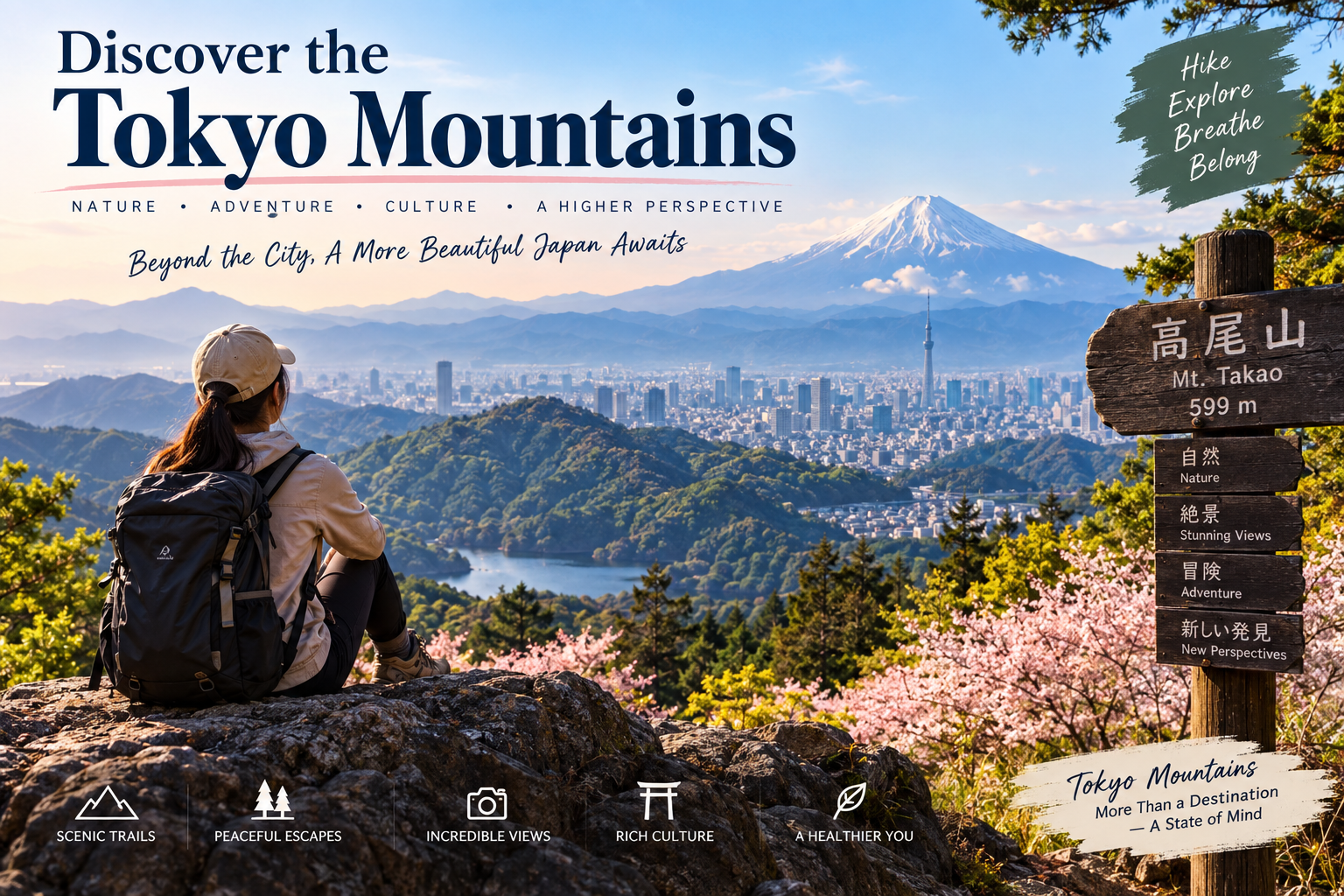
Tokyo Mountains: 15 Best Peaks, Hiking Trails, Tips & Complete Guide
What if you could leave the skyscrapers of central Tokyo in the morning and be walking through cedar forests, mountain streams, rocky ridges, and quiet valleys before lunch? Tokyo mountains offer far more than the famous Mt. Takao: western Tokyo is home to a broad network of peaks and trails ranging from beginner-friendly walks to serious multi-hour and multi-day mountain routes. For most first-time visitors, Mt. Takao and Mt. Mitake are excellent starting points, while experienced hikers can explore Mt. Mitou, Mt. Odake, Mt. Kawanori, and Mt. Kumotori in the Okutama region Tokyo Property
Tokyo is often imagined as a city of neon signs, railways, shopping districts, temples, and dense neighborhoods. Yet its western edge tells a completely different story. Here, the urban landscape gradually gives way to forests, valleys, rivers, lakes, and mountains.
The contrast is one of the most appealing things about hiking in Tokyo.
You can spend the morning drinking coffee in Shinjuku, board a train, and later find yourself standing beneath towering cedar trees. On a clear day, mountain summits can provide views toward Mt. Fuji, while autumn brings colorful forests and spring brings fresh greenery and blossoms.
The official Tokyo tourism authority identifies areas including Mt. Takao, Mt. Mitake, Mt. Mitou, Mt. Hinode, and Okutama as important destinations for hiking and outdoor recreation.
But choosing the right Tokyo mountain is important. A mountain that is perfect for a family may be too easy for an experienced trekker, while a remote Okutama route may be inappropriate for someone carrying only a smartphone and a bottle of water.
This guide explains how Tokyo’s mountain areas differ, which peaks are worth visiting, what type of traveler each one suits, what to pack, when to go, what mistakes to avoid, and how to turn a simple hike into a memorable Tokyo outdoor experience.
What Are the Tokyo Mountains?
“Tokyo mountains” is not one single mountain range or one isolated destination. The term generally refers to the mountainous areas concentrated in western Tokyo, particularly the Tama and Okutama regions.
The geography changes dramatically as you move west from central Tokyo.
The dense urban core gradually transitions into suburban neighborhoods, then forests and rural communities, before reaching much more rugged terrain around Okutama. This makes western Tokyo unusually convenient for travelers who want access to nature without completely leaving the metropolitan area.
Okutama is especially important because it contains some of the area’s best-known hiking destinations. The official Tokyo tourism guide describes Okutama as a green outdoor area with mountains, caves, camping areas, hot springs, rivers, and hiking opportunities.
The area’s mountains also vary considerably in difficulty.
Some trails can be enjoyed as relaxed half-day walks. Others require good fitness, navigation skills, proper footwear, weather awareness, and enough food and water for a long day in the mountains.
That range is what makes Tokyo mountains interesting for both tourists and experienced hikers.
Why Tokyo Mountains Are Worth Visiting
Tokyo’s mountains offer something that many major city destinations cannot.
You do not necessarily need to organize a separate countryside vacation to experience them.
A mountain trip can be combined with sightseeing, food, temples, hot springs, photography, wildlife observation, or a traditional Japanese town visit.
For many travelers, the greatest advantage is the contrast.
You might spend one day surrounded by crowds in Shibuya and the next walking beneath quiet forest canopies.
The mountains also provide a different perspective on Japanese culture. Trails may lead to shrines, temples, historic paths, rural settlements, sacred forests, and traditional communities.
Mt. Takao is an excellent example. The mountain combines hiking with Yakuoin Temple, nature attractions, restaurants, cable-car access, and an onsen near the station.
Mt. Mitake offers another combination: mountain scenery, Musashi-Mitake Shrine, cedar forests, and the moss-covered Rock Garden.
This means a Tokyo mountain trip does not have to be purely about reaching a summit.
For many visitors, the journey is the destination.
The Best Tokyo Mountains at a Glance
Here are some of the most useful mountains and hiking areas to consider.
| Mountain or Area | Approx. Elevation | Best For | Difficulty | Typical Experience |
|---|---|---|---|---|
| Mt. Takao | 599 m | Beginners, families, first visits | Easy–Moderate | Accessible hiking and views |
| Mt. Mitake | 929 m | Beginners, culture, nature | Easy–Moderate | Shrine, forest, Rock Garden |
| Mt. Hinode | 902 m | Sunrise and viewpoints | Moderate | Scenic ridge hiking |
| Mt. Mitou | 1,531 m | Beginners/intermediate | Moderate | Forest and Mt. Fuji views |
| Mt. Odake | 1,266 m | Intermediate hikers | Moderate–Hard | Rugged Okutama scenery |
| Mt. Kawanori | ~1,363 m | Intermediate hikers | Moderate–Hard | Forest, waterfalls, mountain terrain |
| Mt. Gozen | ~1,405 m | Experienced hikers | Moderate–Hard | Quiet mountain environment |
| Mt. Kumotori | 2,017 m | Experienced trekkers | Hard | Long-distance mountain adventure |
| Okutama | Varies | Outdoor travelers | Easy–Hard | Mountains, valleys, rivers |
| Mt. Tsukuba* | 877 m | Day-trip alternative | Easy–Moderate | Famous paired peaks |
*Mt. Tsukuba is not in Tokyo; it is included only as a regional comparison.
The key point is that Tokyo mountain hiking is not one experience. There is a substantial difference between riding the cable car partway up Mt. Takao and undertaking a serious route toward Mt. Kumotori.
Mt. Takao: The Best Starting Point for Tokyo Mountains
If you have never hiked in Tokyo, Mt. Takao is probably the most logical starting point.
The summit is 599 meters high, and the mountain is exceptionally accessible from central Tokyo. GO TOKYO states that it can be reached from Shinjuku in roughly 50 minutes by train, while JNTO describes the journey as less than an hour.
That accessibility explains much of its popularity.
But Mt. Takao should not be dismissed simply because it is convenient.
The mountain has several routes, allowing visitors to choose between different levels of effort and scenery. Some routes emphasize forests and natural landscapes, while others provide cultural and recreational attractions.
The official tourism information highlights trails including Trail No. 1, Trail No. 4, and Trail No. 6. Trail No. 4 includes a suspension bridge, while Trail No. 6 passes Biwa Waterfall.
Who Should Visit Mt. Takao?
Mt. Takao is particularly suitable for:
- First-time hikers
- Families
- Travelers with limited time
- Older visitors who want flexibility
- Couples
- Photographers
- Travelers who want a mountain experience without complex logistics
The availability of a cable car and chairlift also gives visitors additional flexibility.
The Main Advantage of Mt. Takao
Its greatest strength is not its height.
It is choice.
You can hike the mountain, use transportation for part of the ascent, combine multiple trails, visit Yakuoin Temple, enjoy food, explore nearby attractions, and finish with a hot spring experience.
That makes Mt. Takao less like a conventional wilderness expedition and more like a complete outdoor day trip.
The Main Disadvantage of Mt. Takao
Popularity creates crowds.
GO TOKYO specifically recommends considering weekdays because weekends and peak autumn periods can become busy.
If solitude is your priority, Mt. Takao may not be the best first choice.
Mt. Mitake: A Mountain With Culture and Forest
Mt. Mitake is one of the most interesting choices for visitors who want more than a summit.
Located in Ome, western Tokyo, Mt. Mitake reaches approximately 929 meters and is known for its shrine, forests, and Rock Garden. JNTO describes it as a beginner-friendly hiking destination, with a typical hiking experience of around three to four hours depending on the route.
The mountain is also culturally significant.
Musashi-Mitake Shrine sits near the summit area and has a long history. The route combines mountain scenery with religious architecture and traditional Japanese landscape.
Why Mt. Mitake Feels Different
Mt. Takao can feel like an urban escape.
Mt. Mitake feels more like entering the mountains.
The journey itself becomes part of the experience.
Travelers can reach Mitake Station by train and continue toward the mountain, with a bus and cable car providing access to higher areas.
The Rock Garden is another major attraction.
The moss-covered rocks and flowing water create an atmosphere that feels far removed from central Tokyo. JNTO notes that May and June are particularly attractive times for experiencing the Rock Garden.
Best Travelers for Mt. Mitake
Mt. Mitake works particularly well for:
- Nature lovers
- Couples
- First-time international visitors
- Photography enthusiasts
- Travelers interested in Japanese spirituality
- Visitors who want a quieter alternative to Mt. Takao
Mt. Hinode: One of the Best Choices for Sunrise
Mt. Hinode is especially attractive for travelers who enjoy early-morning photography.
Its name is associated with sunrise, and the mountain is known for views toward the surrounding Tokyo region.
A sunrise hike creates a very different experience from a normal afternoon walk.
You begin in darkness, move through the forest, and gradually watch the landscape brighten.
However, early starts require greater care.
Dark trails can be more difficult to navigate, and weather conditions can change your experience dramatically. Anyone attempting a pre-dawn hike should have appropriate lighting, sufficient clothing, and a clear understanding of the route.
Mt. Mitou: A Strong Choice for Beginner and Intermediate Hikers
Mt. Mitou, also written as Mt. Mito in some English-language materials, reaches 1,531 meters and has three main peaks.
GO TOKYO describes it as an appealing day hike with routes ranging from a relatively short forest walk to approximately four- to five-hour hiking routes.
The mountain is especially interesting because the higher elevation produces a stronger mountain atmosphere than the easiest Tokyo hiking destinations.
The route can include waterfalls, beech forests, viewpoints, and summit scenery.
The western summit is particularly valued for views toward Mt. Fuji when visibility is good.
Why Mt. Mitou Is a Good Progression Mountain
Think of Tokyo hiking as a staircase.
Mt. Takao can be your first step.
Mt. Mitake can be your second.
Mt. Mitou can be a useful progression toward longer and more physically demanding hikes.
This progression is safer than jumping directly from urban sightseeing into a difficult remote mountain.
Mt. Odake: For a More Serious Hiking Experience
Mt. Odake, or Mount Odake, is one of the better-known mountains in the Okutama area.
It provides a more rugged experience than the easiest routes around Mt. Takao.
Hikers should expect more elevation gain, uneven terrain, longer walking periods, and fewer conveniences.
This is where the difference between “walking in the mountains” and “mountain hiking” becomes more obvious.
You need to consider:
- Total hiking time
- Weather
- Daylight
- Water
- Navigation
- Footwear
- Physical condition
- Transport schedules
The reward is a stronger sense of being away from Tokyo’s urban environment.
Mt. Kawanori: Forests, Waterfalls and Longer Trails
Mt. Kawanori is another worthwhile choice in the Okutama region.
It appeals to hikers who want a longer and more natural mountain experience rather than a heavily developed tourist destination.
The area around Okutama contains numerous routes and outdoor environments, and the local government lists Mt. Kawanori alongside Mt. Kumotori, Mt. Mitou, Mt. Odake, and Mt. Mitake among its trekking options.
As routes become longer and more remote, planning becomes increasingly important.
A beautiful forest route can become challenging if you start too late and discover that the return journey takes longer than expected.
Mt. Kumotori: The Highest Mountain in Tokyo
For serious hikers, Mt. Kumotori is the major objective.
At 2,017 meters, it is the highest elevation in Tokyo. The mountain sits across the borders of Tokyo, Saitama, and Yamanashi prefectures.
This is not a casual city excursion.
GO TOKYO describes the hike as moderate to difficult and notes that guides recommend allowing two days for certain traverses. There is accommodation at a mountain hut and a paid camping area near the summit.
Why Mt. Kumotori Matters
Mt. Kumotori changes the way you think about Tokyo.
The city is often associated with technology, fashion, railways, and architecture. Yet the Tokyo metropolitan boundary reaches into genuinely mountainous terrain.
Standing on a 2,017-meter summit inside Tokyo’s administrative boundaries is a powerful reminder of that geographic diversity.
Who Should Attempt Mt. Kumotori?
It is better suited to:
- Experienced hikers
- Multi-day trekkers
- Physically prepared travelers
- People comfortable with mountain navigation
- Travelers who understand changing mountain weather
- Hikers carrying appropriate overnight equipment
It is not the mountain I would recommend as a first Tokyo hike.
Okutama: The Heart of Tokyo’s Mountain Experience
If Mt. Takao is the easiest introduction to Tokyo’s outdoors, Okutama is the region where the mountain experience becomes much deeper.
JNTO describes Okutama as Tokyo’s mountainous backyard, with forests, lakes, caves, hiking, fishing, kayaking, and other outdoor activities.
The local tourism information also lists multiple hiking and trekking routes, including routes toward Mt. Kumotori, Mt. Mitou, Mt. Odake, Mt. Mitake, and Mt. Kawanori.
Okutama for Families
Families do not need to climb a major summit to enjoy Okutama.
There are walking trails, riverside areas, scenic viewpoints, and easier routes.
The Mukashi Michi, for example, provides a historic walking experience between Okutama Station and the Lake Okutama area. JNTO describes it as a route following the Tama River valley.
Okutama for Serious Hikers
Experienced hikers can use Okutama as a base for significantly longer adventures.
The important distinction is preparation.
Remote terrain offers fewer conveniences than Mt. Takao. Trail conditions can also change because of weather, landslides, fallen trees, or other environmental events.
The Okutama Visitor Center maintains current trail-condition information, making it particularly important to check before hiking.
The Best Tokyo Mountains for Different Travelers
Not every visitor wants the same thing from a mountain.
The “best” Tokyo mountain depends on your objective.
Best Tokyo Mountain for Beginners
Mt. Takao is the easiest recommendation for a first introduction because of its accessibility, multiple trails, transportation options, and visitor facilities.
Best for Culture
Mt. Mitake is particularly strong because of Musashi-Mitake Shrine and its long association with mountain spirituality.
Best for Families
Mt. Takao generally provides the most flexibility because visitors can combine hiking with cable-car or chairlift access.
Best for Nature
Okutama offers a broader landscape of forests, valleys, rivers, lakes, and mountains.
Best for Fuji Views
Mt. Mitou and Mt. Takao can provide Mt. Fuji views when weather and visibility cooperate.
Best for Sunrise
Mt. Hinode is a natural choice because of its sunrise-oriented reputation.
Best for Experienced Hikers
Mt. Kumotori is the strongest choice among Tokyo’s major mountains for a serious multi-day mountain adventure.
Tokyo Mountains by Difficulty
Difficulty should never be judged only by elevation.
A lower mountain can still be challenging because of steep sections, slippery ground, heat, route-finding, or accumulated fatigue.
Easy
Suitable options include:
- Easier Mt. Takao routes
- Shorter Mt. Mitake walks
- Forest walking courses around Okutama
- Selected family-friendly trails
Moderate
Consider:
- Mt. Mitou
- Mt. Hinode
- Longer Mt. Takao routes
- More demanding Mt. Mitake routes
Moderate to Hard
Consider:
- Mt. Odake
- Mt. Kawanori
- Longer Okutama traverses
Hard
Consider:
- Mt. Kumotori
- Long-distance multi-mountain routes
The difficulty classification is a planning framework, not a substitute for checking current trail conditions.
Best Seasons for Tokyo Mountain Hiking
Tokyo’s mountains change dramatically through the year.
Spring
Spring brings fresh greenery, flowers, and comfortable hiking temperatures on many days.
Mt. Takao is particularly attractive because cherry blossoms can appear later than in central Tokyo. GO TOKYO specifically highlights spring as one of the mountain’s appealing seasons.
Spring can also bring rain and muddy trails, so waterproof layers and suitable footwear remain useful.
Summer
Summer can be hot and humid.
Mountain forests can provide shade, but heat does not disappear simply because you are hiking at elevation.
Start early, carry sufficient water, and avoid treating a forest trail as an automatic escape from summer temperatures.
Okutama also offers rivers and water-based recreation, although river conditions require careful attention after heavy rain. Local authorities warn that water levels can rise rapidly during heavy rainfall or dam releases.
Autumn
Autumn is arguably the most visually dramatic season.
Mt. Takao is famous for fall colors, and GO TOKYO notes that autumn foliage is especially impressive from early to late November.
The downside is popularity.
Beautiful autumn weekends can mean crowded trails and transportation.
Winter
Winter hiking can be rewarding because forests become quieter and visibility may improve.
But cold weather changes the safety equation.
Higher mountains can experience significantly colder conditions than central Tokyo, and snow or ice may appear on some routes.
Do not assume that a Tokyo mountain is automatically warm simply because Tokyo city is experiencing mild weather.
What to Pack for Tokyo Mountain Hiking
Your equipment should match your route.
A short Mt. Takao walk does not require the same equipment as an overnight Mt. Kumotori trek.
Essential Items for Short Hikes
Carry:
- Comfortable hiking shoes
- Water
- Mobile phone
- Portable battery
- Small first-aid kit
- Rain jacket
- Snacks
- Identification
- Some cash
- Map or offline navigation
- Hat and sun protection
Equipment for Longer Hikes
Longer routes may require:
- Proper hiking boots
- Trekking poles
- Headlamp
- Extra food
- More water capacity
- Emergency layer
- Navigation tools
- Emergency blanket
- Larger first-aid kit
- Weather protection
- Appropriate overnight equipment
The principle is simple:
The farther you go from roads, stations, shops, and populated areas, the more self-sufficient you should become.
The Best Footwear for Tokyo Mountains
Footwear is one of the most underestimated parts of mountain preparation.
For easy urban-adjacent trails, comfortable trail shoes may be enough.
For rocky, muddy, wet, or longer routes, hiking shoes with better grip and support become more valuable.
Do not choose footwear solely because it looks outdoorsy.
The right shoe should fit properly and match the terrain.
Blisters can turn a beautiful hike into a miserable journey surprisingly quickly.
Food and Water Strategy
One common mistake among tourists is assuming that every Tokyo mountain has restaurants or vending machines.
That assumption is especially dangerous on longer Okutama routes.
GO TOKYO notes that some less-developed mountain areas have few shops and recommends carrying sufficient food and water.
A good strategy is to treat mountain supplies as part of your itinerary.
Buy food before starting when necessary.
Carry enough water for the expected conditions.
In hot weather, increase your planning.
And do not build a remote hiking itinerary around the assumption that a shop will still be open when you reach it.
How to Plan a Tokyo Mountain Day Trip
A successful mountain day often begins before the hike.
Choose the Mountain Based on Your Goal
Ask yourself:
Do I want a simple walk?
Do I want a summit?
Do I want a shrine?
Do I want Fuji views?
Do I want autumn foliage?
Do I want solitude?
Do I want a serious physical challenge?
Your answer should determine the mountain.
Check Transportation
Tokyo’s rail system makes mountain access convenient, but convenience has limits.
Check the first and last trains, bus connections, cable-car schedules, and expected walking time.
A route that looks easy on a map can become stressful if you miss the final bus.
Check Weather and Trail Conditions
This is essential.
Weather conditions in mountainous terrain can differ from conditions in central Tokyo.
For Okutama in particular, check official trail information before leaving. The local visitor center publishes trail and road-condition updates.
Start Earlier Than You Think
An early start provides:
- Cooler conditions
- Better light
- More time for unexpected delays
- Fewer crowds
- Better chances of clear mountain views
For popular mountains, it can also make the entire experience more peaceful.
A Practical Tokyo Mountain Hiking Framework
Use the TIME–TERRAIN–TRANSPORT–TURNAROUND framework.
Time
How many hours do you actually have?
Do not calculate only the ascent.
Include the descent, breaks, photography, food, transportation, and possible delays.
Terrain
Understand what you are walking on.
Paved paths, forest trails, wet rocks, roots, steep ridges, and muddy sections all demand different levels of attention.
Transport
Know exactly how you will reach and leave the trail.
Turnaround
Set a time when you will turn back if conditions deteriorate or you are moving more slowly than expected.
This final principle is especially important for inexperienced hikers.
The summit is optional.
Getting back safely is not.
Tokyo Mountain Hiking for Families
Tokyo mountains can be excellent for families if the route is chosen carefully.
Mt. Takao is particularly flexible because transportation can reduce the physical demands of the trip. GO TOKYO specifically highlights its accessibility for children, older people, and people less interested in strenuous trekking.
For families, focus on:
- Shorter trails
- Rest areas
- Weather
- Toilets
- Food availability
- Emergency access
- Children’s energy levels
Do not choose a mountain solely because your child has successfully walked several kilometers in a city.
Mountain walking uses different muscles and requires greater attention to uneven ground.
Tokyo Mountains for Solo Travelers
Solo hiking can be deeply rewarding.
It can also increase risk because there is no companion to assist if you become injured, lost, or exhausted.
For solo hiking:
- Tell someone your itinerary.
- Keep your phone charged.
- Carry navigation tools.
- Avoid pushing beyond your experience.
- Check weather before departure.
- Avoid starting a difficult route late.
- Register your hike where appropriate.
- Follow local rules.
GO TOKYO specifically advises hikers heading to Mt. Kumotori to register their climb in advance and avoid planning beyond their ability.
Tokyo Mountains for Couples
A mountain day can be an excellent alternative to conventional Tokyo sightseeing.
Instead of spending the entire day in shopping districts, couples can hike together, enjoy a summit view, visit a shrine, eat local food, and finish with an onsen.
Mt. Takao is particularly convenient for this style of trip because hiking, dining, sightseeing, and hot springs can be combined around the same excursion.
For a quieter atmosphere, consider Mt. Mitake or selected Okutama routes.
Tokyo Mountains for Photographers
Photographers should think beyond summit selfies.
Tokyo’s mountains offer several different visual layers.
You can photograph:
- Forest textures
- Cedar trees
- Moss
- Mountain streams
- Waterfalls
- Shrines
- Traditional architecture
- Autumn foliage
- Sunrise
- Fuji views
- Fog
- Rural settlements
- Mountain roads
The best photographic conditions often occur early in the day, when light is softer and trails can be quieter.
Wildlife and Responsible Mountain Travel
Mountain environments are living ecosystems.
Visitors should not treat them as theme parks.
Do not feed wildlife.
Stay on designated routes.
Do not remove plants, rocks, or other natural objects.
Keep noise under control.
Carry out your rubbish.
Follow local instructions.
This is particularly important because wildlife awareness is an active issue in Okutama. Local authorities issued recent warnings concerning Japanese black bears and updated nature-park rules.
That does not mean travelers should avoid Tokyo mountains.
It means visitors should behave like mountain visitors rather than urban tourists.
Current Trail Conditions Matter More Than Old Blog Posts
One of the biggest problems with hiking content online is outdated information.
A blog post from several years ago may describe a route as open even when conditions have changed.
This matters because mountain trails can be affected by:
- Landslides
- Fallen trees
- Heavy rain
- Typhoons
- Rockfall
- Construction
- Temporary closures
- Wildlife warnings
The Okutama Visitor Center’s current trail information provides a good example of why checking official updates matters. Its recent information includes closures and restrictions on certain routes because of landslide or collapse risks.
Always prioritize current official information over an old social-media post.
Common Mistakes When Hiking Tokyo Mountains
Mistake 1: Choosing the Mountain by Instagram Photos
A beautiful photo tells you almost nothing about difficulty.
A mountain may look peaceful while involving hours of climbing.
Choose based on route length, elevation gain, terrain, weather, and your fitness.
Mistake 2: Starting Too Late
A late start reduces your safety margin.
If the hike takes longer than expected, darkness can arrive before you reach your destination.
Mistake 3: Carrying Too Little Water
Water availability is not guaranteed.
Carry enough for your route and conditions.
Mistake 4: Wearing Fashion Sneakers
Urban sneakers are not automatically appropriate for wet rocks, mud, roots, or uneven trails.
Mistake 5: Ignoring Weather
Mountain weather can change quickly.
If forecasts look poor, consider postponing or selecting a lower and easier route.
Mistake 6: Assuming Every Mountain Is Crowded
Mt. Takao can be busy, but other Tokyo mountain areas can feel much quieter.
Do not judge all Tokyo hiking based on one popular mountain.
Mistake 7: Treating a Mountain as a Theme Park
A mountain is not controlled like a city attraction.
Conditions are natural and unpredictable.
Respect the environment.
Pros and Cons of Hiking Tokyo Mountains
Pros
Tokyo mountain hiking offers exceptional accessibility.
You can reach major trail areas without renting a car.
The region offers a wide difficulty range.
Mountain trips can be combined with temples, shrines, food, museums, and hot springs.
The scenery changes substantially by season.
The mountains provide a meaningful contrast to urban Tokyo.
Cons
Popular trails can become crowded.
Weather can disrupt plans.
Remote trails require more preparation.
Some routes have limited services.
Transportation can become complicated outside the most accessible areas.
Trail conditions can change after storms or other environmental events.
Some mountains require significantly more fitness and experience than tourists expect.
10 Outdoor and Hiking Brands to Consider
The right brand depends on your route, budget, climate, and personal fit. Brand reputation should not replace trying equipment on your body and checking whether it suits the specific hike.
| Brand | Known For | Best For | Tokyo Mountain Use | Main Strength |
|---|---|---|---|---|
| The North Face | Outdoor clothing and equipment | Beginners to advanced | Excellent | Broad product range |
| Patagonia | Outdoor clothing | Conscious outdoor travelers | Excellent | Layering and outdoor apparel |
| Arc’teryx | Technical outdoor gear | Advanced hikers | Excellent | Technical construction |
| Columbia | Outdoor clothing and footwear | Beginners/intermediate | Excellent | Practical versatility |
| Salomon | Hiking and trail footwear | Active hikers | Excellent | Trail-oriented footwear |
| Merrell | Hiking footwear | Beginners/intermediate | Excellent | Comfortable hiking shoes |
| Montbell | Japanese outdoor gear | Japan-focused hikers | Excellent | Lightweight, practical equipment |
| Mammut | Alpine/outdoor equipment | Experienced hikers | Very good | Technical mountain gear |
| Osprey | Hiking packs | Day and multi-day hikers | Excellent | Backpack design |
| Black Diamond | Trekking and technical gear | Intermediate/advanced | Very good | Poles and mountain equipment |
How to Choose Between Brands
Do not ask, “Which brand is best?”
Ask:
Which product is best for this specific route and my body?
A lightweight daypack that feels perfect on Mt. Takao may not carry enough equipment for Mt. Kumotori.
Similarly, technical alpine clothing may be unnecessary for a short summer forest hike.
Tokyo Mountains Compared With Other Japanese Hiking Destinations
Tokyo’s biggest advantage is convenience.
Japan has many spectacular mountain destinations, including the Japanese Alps, Mt. Fuji, Hokkaido’s mountains, and Kyushu’s volcanic landscapes.
Those destinations may offer more dramatic high-altitude scenery.
But they also require more travel time and planning.
Tokyo mountains occupy a valuable middle ground.
You can experience genuine mountain environments without dedicating your entire vacation to mountain travel.
This makes them particularly valuable for international visitors with only a few days in Japan.
How Tokyo Mountains Fit Into a Japan Itinerary
A visitor staying in Tokyo for five to seven days could easily combine urban sightseeing with one mountain day.
For example:
Three-Day Tokyo Trip
Choose Mt. Takao for a convenient outdoor day.
Five-Day Tokyo Trip
Choose Mt. Takao or Mt. Mitake depending on your interests.
Seven-Day Tokyo Trip
Consider a more ambitious Okutama day trip if you have appropriate fitness.
Longer Japan Trip
Experienced hikers can dedicate additional time to Okutama and potentially consider a multi-day mountain route such as Mt. Kumotori.
The goal is not to collect mountains.
It is to choose the experience that fits your trip.
A Sample Mt. Takao Day
A simple itinerary might begin with an early train toward Takaosanguchi.
After arriving, you can choose an appropriate trail and climb toward the summit.
Spend time enjoying the scenery rather than rushing.
If conditions are clear, look toward the distant landscape and Fuji.
After descending, explore the area around the station and consider an onsen experience.
This creates a full day without requiring complicated logistics.
The official tourism information confirms the availability of hiking routes, cable-car and chairlift options, dining, and hot-spring experiences around Mt. Takao.
A Sample Mt. Mitake Day
Start early from central Tokyo and travel toward Mitake.
After reaching the area, continue toward the mountain access point.
Visit Musashi-Mitake Shrine, explore the forest, and continue toward the Rock Garden if conditions and fitness allow.
Allow time for the return journey.
The beauty of this itinerary is its variety.
You are not simply walking uphill.
You are experiencing landscape, spirituality, forest ecology, and traditional Japanese mountain culture.
A Sample Okutama Adventure
An Okutama day requires more planning.
Choose one route instead of trying to see everything.
Check the current trail status.
Check transportation.
Pack sufficient food and water.
Start early.
Build a conservative turnaround time into your plan.
After hiking, you can explore the surrounding countryside or enjoy a hot spring if your schedule allows.
Okutama is particularly well suited to travelers who want to slow down and experience a different side of Tokyo.
The Future of Tokyo Mountain Tourism
Tokyo’s mountain tourism is likely to become increasingly important as travelers seek experiences beyond conventional city attractions.
Several trends are particularly relevant.
More Demand for Nature-Based Travel
Travelers increasingly want outdoor experiences that complement urban tourism.
Tokyo is unusually well positioned for this because its metropolitan boundaries include extensive mountainous areas.
Growth of Short Adventure Trips
Not every traveler wants a week-long expedition.
Short hikes that fit into one day are easier to add to a city itinerary.
This favors destinations such as Mt. Takao and Mt. Mitake.
Greater Interest in Sustainable Tourism
As outdoor tourism grows, responsible trail use will become more important.
Crowding, waste, erosion, wildlife interaction, and transportation pressure require careful management.
Better Digital Planning
Modern hikers can use digital maps, weather forecasts, transport apps, emergency information, and official trail updates.
But technology should support—not replace—basic mountain judgment.
A smartphone is useful.
It is not a substitute for preparation.
More Interest in Local Experiences
The future of mountain tourism is not necessarily about climbing the highest peak.
Travelers increasingly value complete experiences that combine:
- Hiking
- Local food
- Hot springs
- Culture
- Photography
- Wellness
- Nature
- Rural communities
Tokyo mountains are particularly strong in this combination.
A New Way to Think About Tokyo Mountains
There is a tendency to rank mountains from “best” to “worst.”
That is not very useful.
Instead, think of Tokyo mountains as an experience spectrum.
At one end is accessible recreation.
Mt. Takao represents this side.
In the middle is nature and culture.
Mt. Mitake and Mt. Mitou fit here.
Further along is adventure.
Okutama’s longer routes and mountains such as Mt. Odake become more appropriate.
At the far end is serious mountain trekking.
Mt. Kumotori belongs here.
This framework helps travelers choose intelligently rather than simply following popularity.
Tokyo Mountains for Different Problems
Travelers often arrive with different problems to solve.
“I Only Have One Day”
Choose Mt. Takao or Mt. Mitake.
“I Want to Escape Tokyo Crowds”
Look toward Okutama and less-developed routes.
“I Am a Beginner”
Start with Mt. Takao or a suitable Mt. Mitake route.
“I Want a Cultural Experience”
Choose Mt. Mitake.
“I Want a Challenge”
Progress toward Mt. Mitou, Mt. Odake, or longer Okutama routes.
“I Want Tokyo’s Highest Mountain”
Choose Mt. Kumotori, but prepare appropriately.
“I Want Photography”
Choose based on the season and weather rather than simply elevation.
“I Want a Family-Friendly Mountain Day”
Mt. Takao’s accessibility makes it one of the easiest choices.
Tokyo Mountains for Different Demographics
Solo Travelers
Choose routes that match your experience and maintain a generous safety margin.
Couples
Mt. Takao and Mt. Mitake offer strong combinations of nature and sightseeing.
Families With Children
Prioritize accessible trails and flexible transportation.
Older Travelers
Consider routes with transportation options and shorter walking distances.
Fitness Enthusiasts
Explore longer and more demanding Okutama routes.
Experienced Mountaineers
Consider Mt. Kumotori and longer multi-mountain itineraries after checking current conditions.
International Visitors
Prioritize clear transportation, official information, and routes that match your time in Tokyo.
How to Make Your Tokyo Mountain Trip Better
The best mountain day is not necessarily the hardest one.
It is the one where the difficulty, weather, timing, equipment, and expectations all align.
Here is a practical formula:
Choose less than your maximum ability.
If you believe you can comfortably complete a six-hour route, do not automatically choose a six-hour route when traveling abroad.
Leave room for navigation mistakes, photographs, food breaks, transportation delays, and unexpected weather.
That extra margin often makes the difference between a relaxing adventure and a stressful day.
Frequently Asked Questions About Tokyo Mountains
What is the best mountain in Tokyo for beginners?
Mt. Takao is one of the best choices for beginners because it is highly accessible, has multiple trails, and offers cable-car and chairlift options. Mt. Mitake is another strong beginner-friendly choice.
What is the highest mountain in Tokyo?
Mt. Kumotori is the highest mountain in Tokyo, reaching 2,017 meters. It sits across Tokyo, Saitama, and Yamanashi prefectures.
Is Mt. Takao worth visiting?
Yes. Mt. Takao is worth visiting for travelers who want a convenient combination of hiking, nature, cultural attractions, mountain views, food, and hot springs. Its popularity is the main drawback because some periods can be crowded.
Can you see Mt. Fuji from Tokyo mountains?
Yes. Mt. Fuji can be visible from several Tokyo-area mountain viewpoints, including Mt. Takao and Mt. Mitou, when weather and visibility are favorable.
Is Mt. Mitake good for beginners?
Mt. Mitake can be suitable for beginners, particularly when choosing an appropriate route. JNTO describes the mountain as a beginner-friendly hiking destination.
How far are Tokyo mountains from central Tokyo?
It depends on the mountain. Mt. Takao can be reached from Shinjuku in roughly 50–55 minutes by train, while Mt. Mitake and Okutama generally require longer journeys of around 90 minutes or more from central Tokyo.
Are Tokyo mountains suitable for families?
Yes. Mt. Takao is especially suitable because of its accessible trails and transportation options. Families should still select routes according to children’s fitness and weather conditions.
What should I wear when hiking in Tokyo mountains?
Wear comfortable clothing appropriate for the season and terrain. Good footwear is especially important. For longer or more remote routes, consider hiking shoes, weather protection, layers, and other appropriate mountain equipment.
Can I hike Tokyo mountains in winter?
Yes, but winter requires additional preparation. Higher elevations can be considerably colder than central Tokyo, and some routes may experience snow or ice. Check current weather and trail conditions before departure.
Are Tokyo mountains crowded?
Some are. Mt. Takao is particularly popular, especially during weekends and peak autumn foliage periods. Less-developed areas of Okutama can offer a quieter experience.
Is Mt. Kumotori suitable for beginners?
Generally, it should not be treated as a first hiking destination. The mountain is 2,017 meters high, and official tourism information describes the climb as moderate to difficult. Some routes are best planned as a two-day trip.
Do Tokyo mountains have bears?
Wildlife exists in the mountainous areas around Tokyo, and Okutama authorities have issued recent warnings regarding Japanese black bears. Hikers should follow current local wildlife guidance and nature-park rules.
Should I check trail conditions before hiking?
Absolutely. Trail conditions can change because of landslides, storms, falling rocks, closures, or other hazards. The Okutama Visitor Center publishes trail-condition updates, making official checks particularly important for hikes in that region.
Can I hike Tokyo mountains without a car?
Yes. Several major destinations are accessible by train and connecting buses. Mt. Takao is particularly convenient by rail, while Mt. Mitake and Okutama can also be reached using public transportation.
Conclusion
Tokyo mountains reveal a side of Japan’s capital that many visitors never see.
The city is not simply a giant urban center. Its western regions contain forests, valleys, rivers, lakes, shrines, waterfalls, and genuine mountain terrain.
For a first experience, Mt. Takao is difficult to beat for convenience and flexibility. Mt. Mitake is excellent for travelers who want to combine nature with Japanese mountain culture. Mt. Mitou offers a stronger hiking challenge and rewarding scenery, while Okutama provides the broadest selection of outdoor experiences. For experienced hikers seeking Tokyo’s highest point, Mt. Kumotori offers a much more serious mountain adventure at 2,017 meters.
The most important lesson is that you do not need to climb the highest mountain to have the best Tokyo mountain experience.
Choose the route that fits your time, fitness, season, equipment, and interests.



2 Comments