
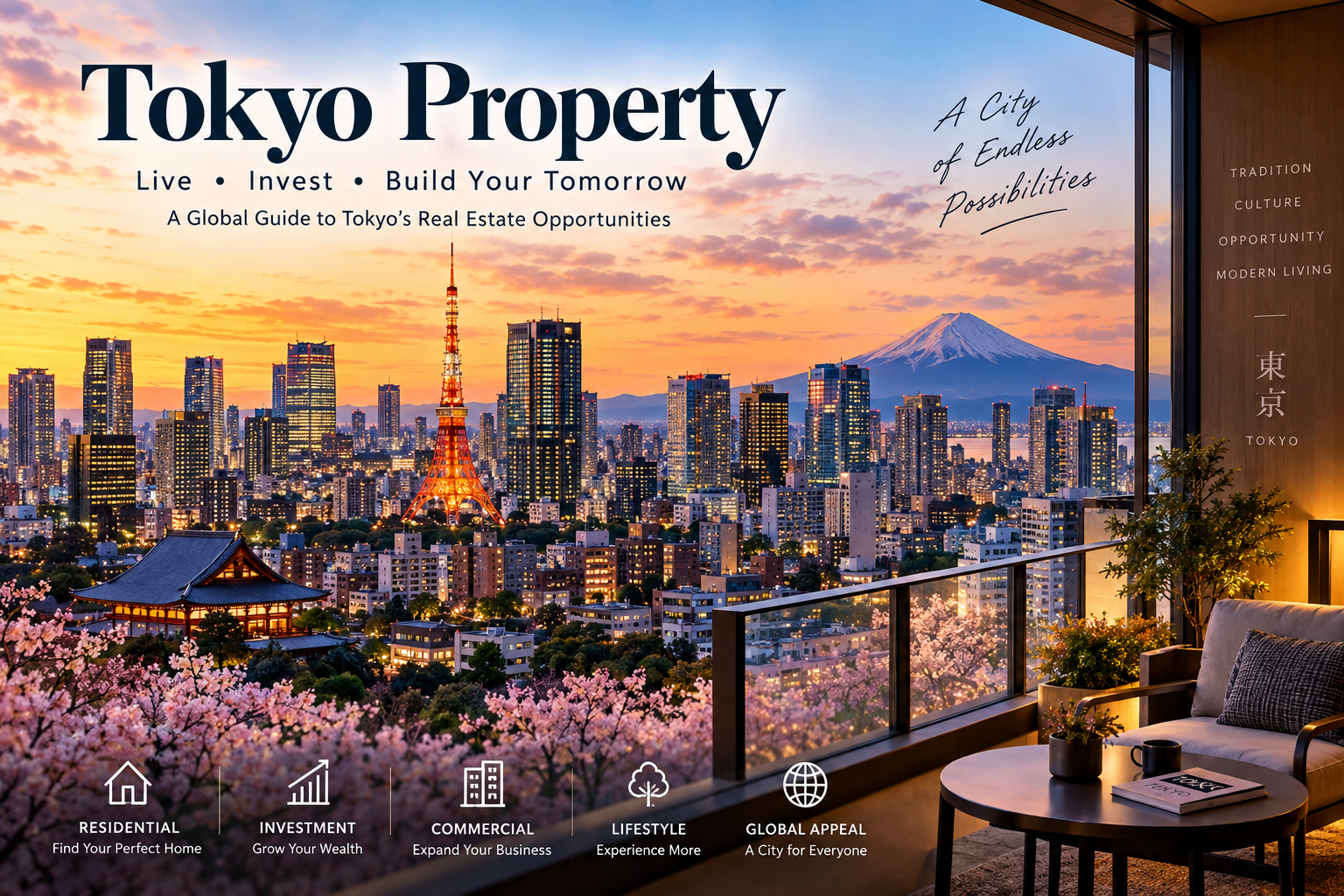
Tokyo Property: The Ultimate 2026 Guide to Buying, Investing, and Choosing Real Estate
Tokyo property is one of the world’s most closely watched real-estate markets, combining strong urban demand, limited land, excellent transport, and a huge rental economy. For buyers, investors, and international purchasers, the opportunity can be attractive—but success depends on choosing the right location, property type, building age, financing structure, and long-term strategy Tokyo Culture
Imagine arriving in Tokyo with a simple goal: buy an apartment that can become your home, rental investment, or long-term asset. The challenge is that Tokyo is not one property market. A compact apartment near a major station, a family home in a quieter ward, a luxury tower in central Tokyo, and an older house in an outer neighborhood can behave like completely different investments.
This guide explains how the Tokyo property market works, where buyers should look, what drives prices, how foreigners can purchase property, what costs to expect, which developers and brands matter, and how to evaluate an opportunity without being distracted by attractive photographs or headline prices.
The market discussion below uses official Japanese government and industry sources where current data matters. Tokyo’s land prices have continued to rise: Tokyo Metropolitan Government reported that, as of January 1, 2025, residential land prices across Tokyo rose 5.7% year over year and commercial land prices rose 10.4%. The government also reported that residential and commercial land prices had remained positive for several consecutive years.
What Is Tokyo Property?
Tokyo property refers to residential, commercial, mixed-use, and investment real estate located within Tokyo, including the 23 special wards and the wider Tokyo metropolitan area.
For most individual buyers, the most relevant categories are:
- Condominiums
- Detached houses
- Land
- Newly built apartments
- Existing or second-hand apartments
- Luxury residences
- Rental investment properties
- Small apartment buildings
- Commercial property
- Mixed-use buildings
The phrase Tokyo property therefore covers a much broader market than luxury apartments in central Tokyo.
A first-time international buyer may search for a “Tokyo apartment,” while an experienced investor may compare rental yields, land value, building depreciation, vacancy risk, station distance, and redevelopment potential.
Understanding that difference is essential.
Why Tokyo Property Remains Attractive
Tokyo has several characteristics that make its property market structurally important.
The first is population concentration. Tokyo is one of the world’s largest metropolitan economies, with enormous employment, education, tourism, retail, entertainment, and transportation networks.
The second is connectivity. A property located close to a reliable railway station can have a very different demand profile from a visually attractive property that requires a long bus journey.
The third is scarcity.
Tokyo can build upward, but desirable land in established neighborhoods remains limited. This is particularly important in central locations where buyers compete for proximity to offices, universities, shopping districts, international schools, parks, and transport hubs.
The fourth is rental demand.
Tokyo contains a large population of renters, including students, professionals, families, international residents, and people relocating for employment.
The fifth is diversification.
Tokyo contains multiple submarkets. If central Tokyo becomes too expensive for a particular investor, the investor can examine outer wards or neighboring cities rather than abandoning the market completely.
Tokyo Property Market Trends in 2026
The most important trend for 2026 is that buyers should not assume Tokyo property is uniformly rising or uniformly expensive.
Instead, the market is increasingly segmented.
Location quality, building quality, construction age, access to transport, floor area, views, management quality, and redevelopment prospects can produce major differences between properties.
Tokyo Metropolitan Government’s official land-price data shows that the broad direction has remained positive. The government’s 2025 land report recorded a 5.7% average increase in residential land prices and a 10.4% increase in commercial land prices across Tokyo.
The official Tokyo reference-land data also reported that residential land prices had increased for 13 consecutive years as of the 2025 assessment, while commercial land prices had increased for four consecutive years.
That does not mean every apartment will appreciate at the same rate.
A key lesson is:
Tokyo property should be analyzed at the neighborhood and building level, not simply at the city level.
What Is Driving Tokyo Property Prices?
Several forces influence property prices in Tokyo.
Land scarcity
Land close to major employment and transportation centers commands a premium.
Transportation access
Station distance is one of the most important practical variables.
A property advertised as “Tokyo” may be very different from one located five minutes from a major railway station.
Construction costs
Higher construction costs can affect the economics of new developments and make existing well-maintained buildings relatively more attractive.
Interest rates and financing
Mortgage costs influence what domestic buyers can afford and can also affect investment calculations.
Tourism
Tourism can influence demand for accommodation and certain neighborhoods, although investors should distinguish between long-term residential rental demand and short-term accommodation regulations.
Redevelopment
Major redevelopment can change the economic character of an area.
A neighborhood receiving new offices, retail, public spaces, transportation improvements, or large mixed-use projects may attract additional demand.
Demographic changes
Japan faces long-term demographic challenges, making micro-location increasingly important.
A property in a shrinking local market is not automatically protected simply because it is located somewhere within greater Tokyo.
Tokyo Property Areas: Where Should You Look?
Choosing the right Tokyo neighborhood depends on the buyer’s objective.
A young professional may prioritize nightlife and commuting.
A family may prioritize schools, parks, space, and quieter streets.
An investor may prioritize rental demand, tenant demographics, purchase price, management costs, and liquidity.
A luxury buyer may prioritize prestige, views, building specifications, and privacy.
Central Tokyo
Central Tokyo generally refers to the most prominent inner-city districts, including areas such as:
- Chiyoda
- Chuo
- Minato
- Shinjuku
- Shibuya
These areas contain some of Tokyo’s most expensive real estate.
They benefit from employment concentration, prestigious addresses, transport connections, luxury retail, restaurants, embassies, universities, and major business districts.
The disadvantage is obvious: entry prices can be extremely high.
For investors, a high purchase price can also mean that a property with excellent capital appreciation potential does not necessarily provide an exceptional rental yield.
Shibuya Property
Shibuya is internationally recognized for fashion, technology, entertainment, restaurants, and youth culture.
The area has experienced major redevelopment, creating modern offices, retail facilities, hotels, and residential projects.
For property buyers, the appeal is strong connectivity and international recognition.
The downside is pricing.
A buyer should avoid assuming that buying in a famous district automatically produces superior returns. A less glamorous neighborhood with better purchase economics can sometimes produce a stronger investment outcome.
Shinjuku Property
Shinjuku is one of Tokyo’s major transportation and commercial centers.
It offers:
- Major railway connections
- Offices
- Shopping
- Restaurants
- Entertainment
- Hotels
- Residential neighborhoods
Shinjuku also demonstrates why Tokyo must be analyzed at the neighborhood level.
The environment around a major station can feel completely different from quieter residential streets farther away.
Minato Property
Minato is associated with premium residential and commercial real estate.
Areas such as Azabu, Roppongi, Aoyama, and parts of Akasaka attract high-income residents and international buyers.
Luxury apartments can command substantial premiums because buyers are paying not only for floor area but also for address, building quality, security, services, views, and scarcity.
Chiyoda Property
Chiyoda includes important government, business, and cultural areas.
Land availability is limited, and prime residential locations can command significant prices.
The district is particularly relevant to buyers who value proximity to major business and institutional centers.
Chuo Property
Chuo contains areas such as Ginza, Nihonbashi, and Tsukishima.
It offers an unusual mixture of historic commercial districts, luxury retail, offices, waterfront developments, and residential towers.
For buyers, the key question is not simply whether Chuo is desirable, but which micro-market within Chuo matches the investment strategy.
Tokyo Property Outside the Most Expensive Wards
One of the biggest mistakes first-time buyers make is assuming that they must purchase in the most famous districts.
They do not.
Outer Tokyo wards can offer different combinations of:
- Larger floor areas
- Lower purchase prices
- Family-oriented neighborhoods
- Strong station access
- Established residential communities
- Different rental economics
The right question is not:
“Where is the cheapest Tokyo property?”
The better question is:
“Where can I obtain the strongest combination of location, livability, liquidity, and price?”
Condominium vs Detached House
Tokyo buyers frequently compare condominiums with detached homes.
Neither is automatically better.
Tokyo Condominiums
Condominiums are often attractive because they can offer:
- Strong transport access
- Security
- Building management
- Shared facilities
- Easier maintenance of common areas
- Convenient urban living
- Potentially stronger resale liquidity
However, buyers must examine management fees and repair reserves.
A cheap apartment can become expensive if the building has poor management or significant future repair requirements.
Detached Houses
Detached homes can offer:
- More privacy
- More floor area
- Outdoor space
- Greater control over renovations
- Family-friendly layouts
But detached houses require greater attention to land value, building condition, seismic standards, maintenance, and resale characteristics.
A major analytical distinction is that land and building value behave differently.
New Tokyo Property vs Used Property
New property has an obvious psychological advantage.
Everything looks clean.
The building is modern.
The kitchen is new.
The facilities are attractive.
But new does not automatically mean better value.
New construction commonly carries a premium because buyers are paying for freshness, modern specifications, warranties, developer reputation, and lower immediate maintenance needs.
Used property can offer a different opportunity.
An older condominium in an excellent location may provide access to a neighborhood that would be unaffordable if purchased through a brand-new development.
This is why experienced buyers often compare:
new property premium vs location premium.
If a buyer must choose between a brand-new apartment far from a desirable station and an older but well-managed apartment in an excellent location, the second option may deserve serious consideration.
How Foreigners Can Buy Tokyo Property
Japan does not generally prohibit foreign individuals from purchasing ordinary private real estate simply because they are foreign.
However, non-resident buyers should understand reporting and administrative requirements.
Japan’s Ministry of Finance states that a non-resident acquiring real property or related rights in Japan must submit a report under the Foreign Exchange and Foreign Trade Act within 20 days after acquisition, through the Bank of Japan. The report can be submitted by the buyer or by an agent resident in Japan.
This is an important distinction:
The ability to purchase property is not the same thing as having unrestricted financing, taxation, immigration, or business privileges.
Buying property does not automatically provide Japanese residency or a visa.
International buyers should therefore separate four questions:
- Can I legally purchase the property?
- Can I finance it?
- What taxes and transaction costs apply?
- What immigration or residency status do I have?
These are different issues.
Does Buying Tokyo Property Give You a Visa?
No.
Purchasing a residential apartment does not automatically grant Japanese residency.
A property purchase and immigration status are separate legal matters.
Someone can own Japanese real estate without becoming a Japanese resident, while a resident can rent rather than own property.
International buyers should therefore never purchase an apartment on the assumption that ownership itself provides a residence visa.
Costs Beyond the Tokyo Property Price
The purchase price is only one part of the budget.
Potential costs include:
- Brokerage fees
- Registration taxes
- Real estate acquisition tax
- Stamp duty
- Legal and administrative expenses
- Loan-related costs
- Insurance
- Property management
- Condominium management fees
- Repair reserve contributions
- Annual property-related taxes
- Renovation expenses
Japan’s National Tax Agency confirms that registration and licensing tax applies to real-estate registrations, including ownership transfers.
The tax rate can depend on the transaction and applicable preferential measures. For example, the NTA’s published table identifies different rates for ownership transfers and certain reduced rates under specified conditions.
Real-estate contracts can also be subject to stamp tax. The NTA currently publishes reduced stamp-tax measures for certain qualifying real-estate transfer contracts through March 31, 2027.
Because tax rules can change, buyers should obtain a transaction-specific calculation before signing.
Tokyo Property Taxes
Property ownership can involve several different taxes.
The exact treatment depends on the property, buyer, transaction structure, residency status, use, and applicable exemptions.
Potential taxes include:
- Real estate acquisition tax
- Registration and license tax
- Stamp tax
- Fixed asset tax
- City planning tax where applicable
- Income tax on rental income
- Capital gains-related taxation when selling
If an owner sells Japanese real estate, the taxation of the gain can depend heavily on the holding period and circumstances. The National Tax Agency distinguishes between long-term and short-term real-estate capital gains based on the ownership period measured under Japanese tax rules.
International owners should also investigate tax obligations in their home country.
How to Calculate the True Cost of a Tokyo Property
A useful framework is:
True Cost = Purchase Price + Acquisition Costs + Financing Costs + Initial Repairs + Ongoing Ownership Costs
For an investment property, go one step further:
Net Investment Return = Rental Income − Vacancy − Management − Repairs − Taxes − Financing − Other Operating Costs
This simple framework prevents one of the most common mistakes in property investing: confusing gross rent with actual return.
Tokyo Property for Rental Investment
Tokyo can be attractive for rental investors because of its large tenant base.
But investors should avoid focusing exclusively on headline yield.
A property with a high theoretical yield may have:
- High vacancy
- Expensive repairs
- Poor transport access
- Weak resale demand
- High management costs
- An aging building
- Limited tenant appeal
A lower-yield apartment in a highly liquid location may ultimately be easier to operate and sell.
Gross Yield vs Net Yield
Suppose an apartment costs ¥50 million and produces ¥2.5 million in annual gross rent.
The gross yield is:
¥2.5 million ÷ ¥50 million = 5%
But the investor does not keep the full ¥2.5 million.
Deduct:
- Management
- Repairs
- Taxes
- Insurance
- Vacancy
- Building fees
- Financing
- Other costs
The resulting net yield could be materially lower.
This is why experienced investors rarely make a purchase decision using gross yield alone.
The Station-Distance Premium
One of the most useful concepts in Tokyo property analysis is the station-distance premium.
Consider two apartments with similar floor area.
Apartment A is a short walk from a major station.
Apartment B requires a long walk plus a bus ride.
Even if Apartment B is newer, Apartment A may have stronger tenant demand because daily commuting is easier.
For rental property, convenience is effectively part of the product.
The apartment is not merely four walls.
It is:
home + transportation access + neighborhood + time savings.
Why Time Is an Asset in Tokyo
Tokyo residents often spend significant amounts of time commuting.
Therefore, a property that reduces commuting time can command a premium.
This is particularly important for:
- Office workers
- Students
- Dual-income households
- International professionals
- People who frequently use rail connections
A buyer should therefore measure a property’s value in minutes as well as square meters.
Ask:
- How long to the nearest station?
- How long to the workplace?
- How many transfers?
- What is the walking environment?
- How late do trains operate?
- How convenient are grocery stores?
These questions can reveal more than a property’s marketing brochure.
Tokyo Property for Families
Families should prioritize different criteria.
Important factors include:
- Floor area
- Number of bedrooms
- School access
- Parks
- Hospitals
- Grocery stores
- Quietness
- Safety
- Storage
- Building condition
- Transportation
- Future resale demand
A central studio apartment may be a fantastic investment but a poor family home.
Tokyo Property for Students
Students may prioritize:
- Affordable rent
- University access
- Station proximity
- Small apartments
- Internet connectivity
- Furnishing
- Convenience stores
- Restaurants
For an investor targeting students, proximity to universities and reliable transportation can be more important than luxury finishes.
Tokyo Property for Professionals
Professionals often want:
- Fast commuting
- Modern interiors
- Security
- Reliable internet
- Restaurants
- Fitness facilities
- Nightlife
- Convenient shopping
This creates strong demand for compact apartments near employment and transportation hubs.
Tokyo Property for Retirees
Older buyers may place greater importance on:
- Elevators
- Hospitals
- Walkability
- Quiet neighborhoods
- Nearby supermarkets
- Barrier-free access
- Building maintenance
- Community facilities
A property that looks attractive to a young investor may not be practical for long-term aging.
Tokyo Property for International Buyers
International buyers should add another layer of analysis.
Look at:
- English-language support
- International communities
- Access to airports
- Foreign-friendly property management
- Banking options
- Tax support
- Building rules
- Rental management
However, international popularity should not become the only investment thesis.
A property should work economically even if the international buyer pool changes.
Ten Important Tokyo Property Brands and Developers
Japan’s real-estate industry includes large developers, brokerage companies, housing companies, and property groups.
The following ten names are useful starting points for research. They should not be treated as rankings of investment quality.
| Brand / Developer | Main Strength | Typical Buyer Interest | What to Check |
|---|---|---|---|
| Mitsui Fudosan | Major urban development and real estate | Premium buyers, investors | Project location and pricing |
| Mitsubishi Estate | Large-scale urban development | Luxury and institutional markets | Development quality |
| Sumitomo Realty & Development | Residential and commercial property | Homebuyers and investors | Building and neighborhood |
| Tokyu Land | Urban development and residential projects | Tokyo-focused buyers | Transport and redevelopment |
| Nomura Real Estate Development | Residential developments | Condo buyers | Management and specifications |
| Tokyo Tatemono | Long-established developer | Urban residential buyers | Project location |
| Hulic | Office and urban real estate | Investors and business users | Asset type and location |
| Open House Group | Housing and residential sales | Individual homebuyers | Land, layout, and total cost |
| Daiwa House Industry | Housing and development | Families and investors | Construction and maintenance |
| Sekisui House | Residential housing and development | Homeowners and premium buyers | Building quality and land |
The correct approach is to compare specific properties, not simply brands.
A famous developer can produce a property that does not fit your budget or investment objectives.
Likewise, a less famous project may offer excellent value.
How to Compare Tokyo Property Developers
When comparing developers, examine:
Location quality
A strong developer cannot compensate for a fundamentally weak location.
Construction quality
Look at specifications, materials, seismic considerations, maintenance history, and inspection documentation.
Management
For condominiums, building management can have a major effect on long-term ownership.
Repair planning
Ask for information about planned major repairs and reserve funds.
Resale history
Look at comparable properties in the same building or neighborhood where reliable data is available.
Reputation
A developer’s history can provide useful context, but it should never replace property-level due diligence.
A Practical Tokyo Property Buying Process
Buying property in Japan is easier when approached as a sequence rather than an emotional decision.
Step 1: Define your purpose
Decide whether you want:
- Primary residence
- Second home
- Rental investment
- Long-term capital preservation
- Retirement property
- Family accommodation
Do not begin with property listings.
Begin with the objective.
Step 2: Set the total budget
Do not use the maximum amount a bank might theoretically lend.
Set a comfortable budget that includes acquisition and ownership costs.
Step 3: Choose the geography
Select several candidate wards or neighborhoods.
Avoid searching all of Tokyo simultaneously.
Step 4: Compare transportation
Measure actual station access.
Do not rely only on listing descriptions.
Step 5: Compare buildings
Study age, construction, management, repair reserves, fees, and maintenance.
Step 6: Check legal documents
Confirm ownership, boundaries, rights, restrictions, and other relevant information.
Step 7: Review the financial numbers
For investment properties, calculate realistic net income.
Step 8: Inspect the property
Visit during different times if possible.
A neighborhood that feels peaceful at noon may feel completely different at night.
Step 9: Negotiate
Price negotiation depends heavily on property type, seller motivation, market conditions, listing history, and comparable sales.
Step 10: Complete the transaction
Use qualified professional support for contracts, registration, tax, financing, and other transaction requirements.
What Should You Inspect Before Buying?
The inspection should cover more than paint and flooring.
Check:
- Structural condition
- Building age
- Seismic standards
- Water leakage
- Plumbing
- Electrical systems
- Windows
- Insulation
- Air conditioning
- Elevator
- Common areas
- Roof
- Exterior walls
- Fire safety
- Parking
- Bicycle storage
- Management records
- Repair reserve
- Planned renovations
For an older property, technical due diligence becomes even more important.
Earthquake and Disaster Risk
Tokyo property analysis should include disaster risk.
Japan is highly earthquake-aware, and buyers should investigate the building’s construction era, structural characteristics, hazard maps, flood exposure, liquefaction potential, fire risk, and evacuation information.
The correct mindset is not:
“Will Tokyo have an earthquake?”
The better question is:
“How resilient is this particular property and neighborhood if a major event occurs?”
Why Building Age Matters
Tokyo’s property market creates an unusual situation for international buyers.
A building can age faster in economic value than its land.
This means that a 30-year-old apartment should not automatically be considered worthless.
The land beneath and around the building can remain valuable.
However, an old building can also create:
- Higher repair requirements
- Financing challenges
- Lower tenant appeal
- Higher maintenance
- Greater uncertainty
The solution is not automatically to buy new.
The solution is to understand what you are actually buying.
Land Value vs Building Value
This is one of the most important concepts in Japanese property.
A property price may represent two very different assets:
Land + building
The building may depreciate for accounting and valuation purposes while the land remains strategically valuable.
This distinction becomes especially important when evaluating detached houses.
An investor should ask:
- What is the land worth?
- What is the building worth?
- What would redevelopment mean?
- What are the zoning restrictions?
- What is the property’s usable floor area?
- Could the site be attractive to another buyer?
Common Mistakes When Buying Tokyo Property
Mistake 1: Buying because the property looks beautiful
Beautiful interiors can hide weak economics.
Solution: Analyze location, comparable pricing, building condition, and long-term demand.
Mistake 2: Choosing the cheapest property
Cheap does not equal good value.
A low purchase price can reflect poor demand or expensive future maintenance.
Mistake 3: Ignoring management fees
Condominium ownership involves recurring costs.
Solution: Calculate total annual ownership costs.
Mistake 4: Looking only at gross rental yield
Gross yield can exaggerate investment performance.
Solution: Calculate net operating income.
Mistake 5: Assuming Tokyo prices always rise
Tokyo has strong fundamentals, but individual properties can underperform.
Solution: Analyze micro-location and building quality.
Mistake 6: Ignoring exit strategy
Buying is only half of an investment.
Solution: Ask who will buy the property from you later.
Mistake 7: Assuming foreign ownership means residency
Property ownership and immigration status are separate.
Mistake 8: Ignoring Japanese documentation
Important property documents may require professional translation and interpretation.
Solution: Work with professionals who can explain the documents in a language you understand.
Pros of Tokyo Property
Tokyo property offers several potential advantages.
Strong urban demand: Tokyo remains a major economic and population center.
Excellent transport: Rail connectivity supports residential and rental demand.
Market depth: Buyers can choose from many property types.
International recognition: Prime Tokyo addresses are globally recognizable.
Rental opportunities: The city has a large tenant population.
Diversification: Tokyo can provide geographic diversification for international investors.
Infrastructure: Established infrastructure supports long-term livability.
Cons of Tokyo Property
There are also important disadvantages.
High entry prices: Prime areas can be expensive.
Transaction costs: Acquisition involves more than the advertised purchase price.
Building depreciation: Older buildings require careful analysis.
Management costs: Condominiums can carry recurring fees.
Natural disaster risk: Earthquake, flood, fire, and other risks require evaluation.
Currency risk: Foreign investors may face exchange-rate movements.
Financing complexity: Non-resident borrowers may have fewer financing options.
Tax complexity: Cross-border ownership can create reporting obligations.
Is Tokyo Property a Good Investment?
There is no universal answer.
Tokyo property can be a strong investment when the buyer selects a property with:
- Sustainable tenant demand
- Good transportation access
- Appropriate purchase price
- Strong building management
- Reasonable ongoing costs
- Clear resale demand
- Acceptable disaster risk
- A realistic financing structure
It can be a poor investment when the buyer focuses only on:
- Low price
- High advertised yield
- Luxury appearance
- Tourist popularity
- New construction
- Foreign buyer hype
The investment quality comes from the relationship between price, location, income, costs, risk, and exit liquidity.
A Better Way to Think About Tokyo Property
Instead of asking:
“Will this property go up?”
Use five questions.
1. Who wants this property?
Identify the likely future buyer or tenant.
2. Why do they want it?
Is it the station, school, workplace, neighborhood, building, view, or price?
3. What could reduce that demand?
Consider demographics, new competing developments, transport changes, building deterioration, and economic conditions.
4. What is my downside?
Calculate what happens if rent falls, vacancy increases, repairs become expensive, or selling takes longer.
5. Who is my exit buyer?
A property with a clear future buyer pool is generally easier to understand than one dependent on a very narrow audience.
Tokyo Property and the “Liquidity Test”
A useful original framework is the Liquidity Test.
Before buying, imagine that you must sell the property in three years.
Ask:
Would another buyer understand why this property is valuable within five minutes?
If the answer is yes, you may have a relatively straightforward asset.
If the answer requires a complicated explanation such as:
“This neighborhood will probably become fashionable,” or “tourists might increase,” or “the seller says the area is about to boom,” then more due diligence is needed.
Liquidity is not just about price.
It is about the number and quality of potential buyers.
Tokyo Property and the “Three Clocks” Framework
Another useful way to evaluate a property is to examine three clocks.
The neighborhood clock
Is the area improving, stable, or weakening?
The building clock
How much useful life, maintenance, and repair does the building have?
The financial clock
How will interest rates, financing costs, rental income, and taxes affect the investment?
A good property aligns all three clocks.
A great location with a problematic building may still create difficulties.
A perfect building in a declining micro-market can also underperform.
How Much Money Do You Need?
There is no single minimum amount required for Tokyo property because prices vary enormously.
A small apartment in an outer area can have a completely different price from a luxury residence in central Tokyo.
Instead of choosing a budget based on an online article, calculate:
Maximum comfortable purchase price = available capital + sustainable financing − transaction costs − emergency reserve
Investors should also keep a reserve for:
- Vacancy
- Repairs
- Tax bills
- Unexpected building expenses
- Currency fluctuations
- Financing changes
Never use every available yen simply to complete the purchase.
Can Foreign Buyers Get a Mortgage?
Possibly, but eligibility depends on the lender and borrower.
Japanese mortgage providers can apply different requirements depending on:
- Residency
- Income
- Employment
- Visa status
- Japanese tax history
- Down payment
- Property characteristics
- Loan purpose
Non-resident investors should not assume that a mortgage available to a Japanese resident will be available to them under the same terms.
If financing is essential to the purchase, confirm financing eligibility before becoming emotionally attached to a property.
Tokyo Property for Airbnb and Short-Term Rentals
Short-term rental investment requires special caution.
Japan has national and local rules governing private lodging and accommodation businesses, and Tokyo-area municipalities can impose additional restrictions.
Therefore, a property that looks ideal for short-term rental may not legally or practically support the business model a buyer has in mind.
Before buying, confirm:
- National requirements
- Local municipal rules
- Building management rules
- Condominium bylaws
- Registration or licensing requirements
- Operating restrictions
- Neighbor-related considerations
Never base a property valuation on assumed short-term rental income without verifying that the operation is permitted.
Long-Term Rental vs Short-Term Rental
For many investors, long-term rental has an important advantage: predictability.
Short-term rental can potentially produce higher revenue but may introduce:
- Higher management requirements
- Regulation
- Cleaning costs
- Guest turnover
- Seasonal volatility
- Platform dependence
- Building restrictions
Long-term rental may produce lower gross income while offering a simpler operating model.
The right strategy depends on the investor’s goals and risk tolerance.
Tokyo Property and Sustainability
Energy efficiency is becoming increasingly relevant.
Buyers should consider:
- Insulation
- Windows
- Heating and cooling efficiency
- Building systems
- Energy consumption
- Solar potential where relevant
- Renovation requirements
Energy-efficient homes may become more attractive as buyers increasingly consider long-term operating costs.
Future Tokyo Property Trends
Several themes deserve attention over the coming years.
Continued neighborhood segmentation
Tokyo is unlikely to behave as a single market.
Prime areas, transit-connected neighborhoods, suburban locations, and aging districts may experience different outcomes.
Greater importance of building quality
As buyers become more sophisticated, building condition and management may receive more attention.
Redevelopment
Large-scale redevelopment can reshape neighborhoods and influence property demand.
Technology
Digital property searches, remote viewing, online documentation, and data-driven valuation will make international buying easier.
International investment
Tokyo’s global profile may continue attracting overseas buyers, although policy, currency, financing, and economic conditions can alter the pace.
Aging population
Demographic change makes location selection increasingly important.
Smaller household sizes
Compact apartments can benefit from certain household trends, but oversupply in specific micro-markets remains a risk.
What Could Cause Tokyo Property Prices to Fall?
A responsible guide must consider downside scenarios.
Potential pressures include:
- Economic recession
- Higher interest rates
- Weak employment
- Population shifts
- Oversupply of certain property types
- Major disaster
- Rising ownership costs
- Reduced foreign demand
- Currency changes
- Poor building maintenance
A strong investment thesis should survive more than one economic scenario.
A Stress Test for Tokyo Property Investors
Before buying, calculate three scenarios.
Base case
Assume normal occupancy and expected expenses.
Downside case
Assume:
- Lower rent
- Higher vacancy
- Higher repairs
- Higher financing costs
- Slower resale
Severe case
Assume a major unexpected expense and weak market conditions.
If the investment only works under the best-case scenario, it is probably too fragile.
Tokyo Property Checklist
Before making an offer, review this checklist:
-
Purpose of purchase defined
-
Total budget calculated
-
Acquisition costs estimated
-
Financing confirmed
-
Neighborhood researched
-
Station access checked
-
Comparable properties analyzed
-
Building age reviewed
-
Seismic characteristics investigated
-
Management documents reviewed
-
Repair reserve examined
-
Annual costs calculated
-
Rental demand analyzed
-
Disaster risks checked
-
Legal restrictions reviewed
-
Exit strategy defined
-
Tax advice obtained
-
Contract reviewed professionally
What International Buyers Should Ask Their Agent
Do not simply ask:
“Is this a good property?”
Ask specific questions.
- Why is this property priced at this level?
- What are recent comparable sales?
- How long has it been listed?
- Has the asking price changed?
- What are the annual management costs?
- What major repairs are planned?
- What are the building’s management reserves?
- What restrictions apply to renting?
- What is the exact land ownership structure?
- What are the relevant taxes?
- Is the property suitable for non-resident ownership?
- What documentation will I receive?
- What are the likely exit options?
Specific questions produce better answers than broad questions.
Tokyo Property Comparison by Buyer Type
| Buyer Type | Best Property Focus | Main Priority | Biggest Risk |
|---|---|---|---|
| First-time buyer | Well-connected condominium | Affordability | Overpaying |
| Family | Larger residential property | Livability | Poor location |
| Professional | Station-access apartment | Commute | High purchase price |
| Investor | Rental condominium | Net return | Vacancy |
| Luxury buyer | Prime residence | Quality and prestige | Paying a large premium |
| International buyer | Managed condominium | Convenience | Financing and tax complexity |
| Student-focused investor | Compact apartment | Tenant demand | Oversupply |
| Retirement buyer | Accessible residence | Healthcare and convenience | Long-term maintenance |
| Developer | Land/development site | Development economics | Construction costs |
| Portfolio investor | Multiple assets | Diversification | Concentration risk |
The Best Tokyo Property Strategy for Beginners
Beginners should usually keep the strategy simple.
Start with one property type.
Choose a small group of neighborhoods.
Understand the local rental market.
Compare actual comparable properties.
Learn the ownership costs.
Then make a decision.
Trying to understand every Tokyo neighborhood at once creates information overload.
A focused strategy is more effective.
The Best Strategy for Experienced Investors
Experienced investors can go further.
Analyze:
- Land-to-building value
- Cap rates
- NOI
- Financing leverage
- Renovation economics
- Redevelopment
- Demographics
- Rental absorption
- Comparable transaction history
- Exit liquidity
For larger investments, professional legal, tax, architectural, engineering, and valuation advice can become worthwhile.
Internal Linking Opportunities for a Tokyo Property Website
If you are building a broader Tokyo-focused content site, useful internal links could include:
- Tokyo real estate market
- Tokyo apartment prices
- Best neighborhoods in Tokyo
- Tokyo cost of living
- Tokyo rental apartments
- Tokyo luxury apartments
- Tokyo investment properties
- Japan property taxes
- Buying property in Japan as a foreigner
- Tokyo housing market trends
- Tokyo transportation guide
- Best Tokyo neighborhoods for families
- Tokyo property investment for beginners
- Japan mortgage guide
- Tokyo land prices
These supporting articles can create a strong topical cluster around the primary keyword Tokyo property.
Frequently Asked Questions About Tokyo Property
Can foreigners buy property in Tokyo?
Foreigners can generally purchase ordinary private real estate in Japan, subject to applicable laws and procedures. Non-resident purchasers may have reporting obligations under Japan’s Foreign Exchange and Foreign Trade Act. The Ministry of Finance states that non-residents acquiring Japanese real estate generally must submit the relevant report within 20 days after acquisition.
Is Tokyo property expensive?
Prime Tokyo property can be extremely expensive, but Tokyo contains a very wide range of property types and prices. Cost depends heavily on ward, neighborhood, station access, property size, building age, and quality.
Is Tokyo property a good investment?
It can be, but there is no universal answer. Strong locations, realistic purchase prices, sustainable rental demand, manageable expenses, and good exit liquidity are more important than the Tokyo label itself.
Can I buy Tokyo property without living in Japan?
Non-residents can purchase certain Japanese real estate, but administrative, reporting, tax, financing, and management issues need to be addressed. Professional advice is especially useful for overseas buyers.
Does buying property in Tokyo give me residency?
No. Real-estate ownership and Japanese immigration status are separate matters.
What is better: a new or old Tokyo apartment?
Neither is automatically better. New apartments offer modern specifications and lower immediate maintenance needs, while older apartments can provide access to established locations at potentially lower prices. Building condition and location should be compared together.
Should I buy a condominium or house?
That depends on your objective. Condominiums can be convenient and easier to manage, while detached houses may provide more space and land exposure. Investors should compare total ownership costs and resale demand.
Are Tokyo property prices still rising?
Official Tokyo data shows continued broad land-price growth in recent assessments. However, individual properties can perform very differently. Tokyo should be evaluated at the neighborhood and property level rather than assuming uniform price growth.
What taxes apply when buying Tokyo property?
Potential costs can include registration and license tax, real estate acquisition tax, stamp tax, and other transaction expenses. Ongoing ownership can also involve property-related taxes and condominium expenses. Exact treatment depends on the property and buyer.
How important is station distance?
Extremely important for many Tokyo properties. Convenient access to rail transportation can influence tenant demand, commuting convenience, resale liquidity, and buyer interest.
Is Tokyo property good for rental income?
It can be, especially in areas with sustainable tenant demand. However, investors should calculate net income after vacancy, management fees, repairs, taxes, financing, and other expenses rather than relying on advertised gross yield.
Is luxury Tokyo property a good investment?
Luxury property can provide scarcity and prestige, but luxury pricing can also reduce rental yield and narrow the future buyer pool. It should be evaluated separately from mass-market residential property.
What is the biggest mistake when buying Tokyo property?
One of the biggest mistakes is purchasing based on appearance or headline price without understanding location, building condition, ongoing costs, rental demand, and resale liquidity.
Conclusion
Tokyo property remains one of the world’s most interesting urban real-estate markets because it combines enormous economic activity, sophisticated infrastructure, limited prime land, deep rental demand, and a diverse range of residential and commercial assets.
But Tokyo should never be treated as a single investment.
A luxury tower in Minato, a compact apartment near Shinjuku, a family home in an outer ward, and an older detached house on valuable land can have completely different risk and return profiles.
The most successful buyers tend to focus less on excitement and more on fundamentals.
They ask who will want the property tomorrow, not only who wants it today. They calculate the complete ownership cost instead of looking only at the asking price. They examine land and building value separately. They investigate transportation, demographics, building management, disaster risk, taxes, and financing. Most importantly, they build an exit strategy before they buy.
Tokyo Metropolitan Government’s latest published land data confirms that Tokyo has experienced a sustained period of land-price growth, but that broad trend should not be interpreted as a guarantee for every property.
For foreign buyers, the opportunity can be particularly interesting, but cross-border ownership requires careful attention to reporting, taxation, financing, and professional support. Japan’s Ministry of Finance specifically maintains procedures for non-resident acquisition of Japanese real estate.




5 Comments