Tokyo Flights: The Ultimate 2026 Guide to Cheap, Smart & Stress-Free Air Travel
Tokyo flights connect travelers with one of the world’s most exciting cities, but choosing the right airport, airline, route, timing, and fare can make a major difference to cost and convenience. This guide explains how to find better Tokyo flights, compare airlines, choose between Narita and Haneda, avoid common booking mistakes, and plan a smoother journey Tokyo Culture
Tokyo is one of those destinations where the journey itself can shape your entire trip. A flight that looks cheaper at first may become expensive after baggage fees, long layovers, airport transfers, or inconvenient arrival times. On the other hand, paying slightly more for a better route can save hours and reduce travel stress.
Whether you are flying to Tokyo for tourism, business, study, shopping, family visits, or a longer Japan trip, understanding how Tokyo flights work gives you a major advantage.
Quick Summary of Tokyo Flights
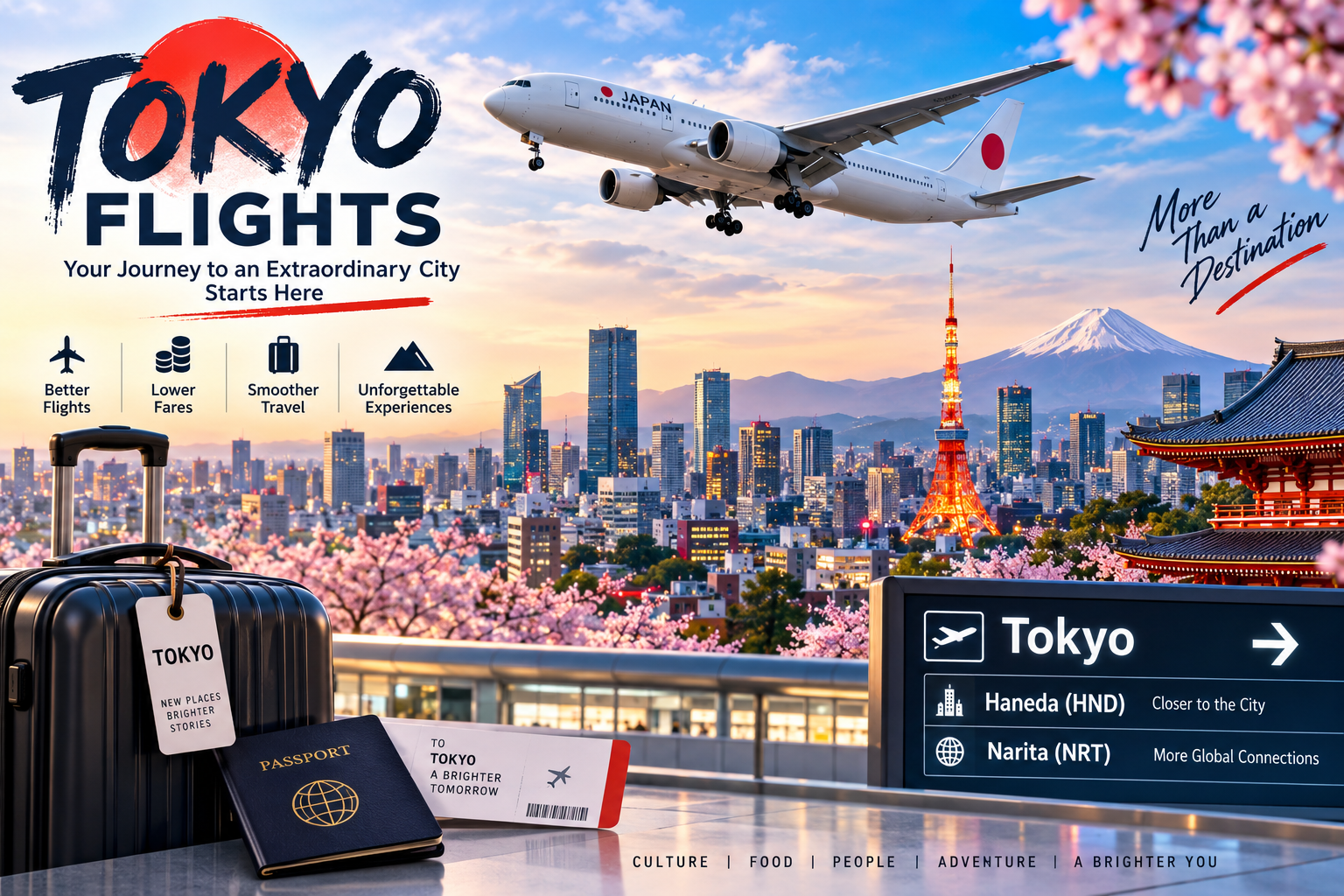
Tokyo is primarily served by two major international airports: Haneda Airport and Narita International Airport. Haneda is closer to central Tokyo and is often more convenient for travelers staying in the city, while Narita handles a large volume of international traffic and can offer many competitive long-haul options.
When comparing Tokyo flights, do not look only at the advertised ticket price. Consider:
- Departure and arrival airport
- Number and length of layovers
- Baggage allowance
- Airport transfer time
- Arrival time in Tokyo
- Connection requirements
- Airline reputation
- Fare flexibility
- Seat selection costs
- Seasonal demand
- Total travel time
The cheapest flight is not always the cheapest trip.
Understanding Tokyo Flights Before You Book
Tokyo is a huge aviation market with connections to cities throughout Asia, Europe, North America, the Middle East, Oceania, and beyond.
For an international traveler, the first important decision is usually which Tokyo airport to use.
Haneda Airport
Haneda Airport is officially Tokyo International Airport and is located much closer to central Tokyo than Narita.
Its location is one of its biggest advantages.
If you are staying around areas such as Shinjuku, Shibuya, Ginza, Tokyo Station, or Asakusa, reaching central Tokyo from Haneda can generally be considerably easier than traveling from Narita.
Haneda also has extensive domestic operations, making it particularly useful if Tokyo is only the first stop on a Japan itinerary.
Narita International Airport
Narita International Airport is located in Chiba Prefecture, outside central Tokyo.
Despite its distance from the city center, Narita remains a major international gateway.
It can be particularly useful for travelers who find better fares, better schedules, or better long-haul connections there.
Narita also has strong rail connections toward Tokyo and other parts of the Kanto region.
Haneda vs. Narita at a Glance
| Feature | Haneda | Narita |
|---|---|---|
| Distance from central Tokyo | Much closer | Farther away |
| International flights | Extensive | Extensive |
| Domestic flights | Excellent | Available |
| City transfer | Usually easier | Usually longer |
| Airport atmosphere | Large but highly convenient | Major international hub |
| Best for | Central Tokyo stays and convenient transfers | Competitive international routes and schedules |
The important lesson is simple: search both airports whenever possible.
A flight to Narita that saves $150 may still be worthwhile. A flight to Haneda that costs slightly more could be the better choice if you value time and convenience.
Why Tokyo Flights Can Be Expensive
Tokyo is a global business and tourism destination, so demand can be extremely strong.
Airfare is influenced by several factors.
Seasonal Demand
Flight prices can increase during popular travel periods.
Japan’s cherry blossom season is particularly attractive to international travelers. Golden Week can also create significant domestic travel demand. Summer holidays, autumn travel, and the New Year period can affect availability and pricing as well.
Prices are not guaranteed to follow a simple seasonal pattern, however.
Different routes behave differently.
Departure City
Your starting point has a huge influence on airfare.
For example, someone flying from a major Asian hub may have access to numerous nonstop or one-stop options. A traveler from a smaller city may first need to connect through another airport.
This means you should compare the complete journey, not simply the Tokyo segment.
Airline Competition
Routes with several competing airlines can sometimes have attractive fares.
When fewer airlines operate a particular route, prices may be less competitive.
Cabin Class
Economy, premium economy, business class, and first class have dramatically different pricing structures.
For long-haul Tokyo flights, premium economy can sometimes be an interesting middle ground because it provides additional comfort without the extreme cost of business class.
How to Find Cheap Tokyo Flights
Finding inexpensive Tokyo flights is less about one secret trick and more about using a structured search process.
Search Both Tokyo Airports
This should be your first step.
Search:
- Tokyo Haneda
- Tokyo Narita
- Both airports together
Do not assume that Haneda will always be more expensive or Narita will always be cheaper.
Airline schedules change, competition changes, and demand changes.
Compare Flexible Dates
If your travel dates are flexible, check several departure and return combinations.
Even shifting your trip by a day or two can sometimes change the fare substantially.
For travelers who are not tied to a fixed schedule, flexibility is one of the most valuable tools available.
Compare One-Stop and Nonstop Flights
A nonstop flight is usually more convenient, but a one-stop itinerary can sometimes save considerable money.
Ask yourself how much your time is worth.
A $100 saving may not feel attractive if it requires:
- Eight additional hours
- An overnight airport stay
- A difficult connection
- Separate tickets
- A long airport transfer
Check Baggage Rules
A low fare can become much less attractive after adding baggage.
Before booking, check:
- Carry-on allowance
- Checked baggage allowance
- Weight restrictions
- Number of bags
- Seat selection fees
- Change fees
- Cancellation rules
Always compare the final price, not the headline price.
The Best Time to Book Tokyo Flights
There is no universal magic number of days before departure that guarantees the lowest airfare.
Airline pricing is dynamic.
Instead of believing a rigid “book exactly X days before departure” rule, use a monitoring strategy.
Start Researching Early
Researching early gives you a baseline.
You can learn what normal pricing looks like for your route and travel dates.
This helps you recognize a genuinely attractive fare.
Watch Price Movements
Prices can rise, fall, or remain stable.
If your dates are fixed and your trip is important, waiting indefinitely for a dramatic price drop can be risky.
The closer you get to departure, the fewer attractive options may remain.
Consider Shoulder Periods
Traveling just outside peak periods can sometimes provide better value.
For example, instead of planning your entire trip around the most popular blossom dates, consider nearby weeks if your main objective is exploring Tokyo rather than seeing a specific seasonal event.
Direct vs. Connecting Tokyo Flights
One of the most important decisions is whether to fly nonstop.
Advantages of Nonstop Flights
Nonstop flights offer:
- Shorter total travel time
- Less connection risk
- Less airport stress
- No need to change planes
- Lower chance of missing a connection
- Easier baggage handling
For families, older travelers, and business travelers, these advantages can be especially valuable.
Advantages of Connecting Flights
Connecting flights may offer:
- Lower fares
- More departure options
- Better availability
- Opportunities to use airline loyalty programs
- Convenient routing from smaller cities
However, connections introduce additional complexity.
A Useful Rule
Do not compare flights only by ticket price.
Compare:
Total cost + total time + convenience + risk.
That formula gives you a much more realistic picture.
Tokyo Flights From Major World Regions
Tokyo has extensive global connectivity, but the experience differs depending on where you begin your journey.
Tokyo Flights From North America
Travelers from the United States and Canada can often find extensive connections to Tokyo.
Major North American gateways may offer nonstop service, while smaller cities commonly require connections.
When comparing routes, consider whether the itinerary arrives at Haneda or Narita.
Tokyo Flights From Europe
European travelers have numerous options through major European and Asian hubs.
Depending on the departure city, you may find nonstop services or one-stop itineraries.
A Middle Eastern or Asian connection can sometimes create competitive alternatives to a direct European route.
Tokyo Flights From the Middle East
Travelers from cities such as Dubai, Doha, Abu Dhabi, and other major regional hubs can often access Tokyo through major international airlines.
One advantage of major Middle Eastern hubs is their extensive long-haul network.
However, a connecting itinerary should be evaluated for total journey duration.
Tokyo Flights From South Asia
Travelers from Pakistan, India, Bangladesh, Sri Lanka, and neighboring markets may commonly find one-stop or two-stop itineraries.
For these routes, connection quality matters greatly.
A fare that looks attractive can become uncomfortable when it includes a very long layover.
Look carefully at:
- Transit visa requirements
- Connection airport
- Minimum connection time
- Baggage transfer
- Separate-ticket risk
- Overnight connections
Choosing an Airline for Tokyo Flights
There is no single best airline for every traveler.
The best airline depends on your priorities.
Someone traveling with children may prioritize baggage and schedule convenience. A business traveler may prioritize lounge access and arrival time. A budget traveler may care primarily about the final price.
Here are 10 major brands travelers may encounter when searching Tokyo flights.
10 Major Airlines to Compare for Tokyo Flights
| Airline | Typical Strength | Best For | Important Consideration |
|---|---|---|---|
| Japan Airlines | Full-service Japanese carrier | Comfort and service | Compare fare conditions |
| ANA | Major Japanese carrier | Long-haul and Japan connections | Often strong premium options |
| Singapore Airlines | Premium full-service carrier | Asia connections | May require a connection |
| Qatar Airways | Global hub network | Middle East and Europe connections | Check Doha connection time |
| Emirates | Large long-haul network | Middle East and global routes | Compare airport and schedule |
| Turkish Airlines | Extensive connecting network | Europe, Middle East, Africa | Istanbul connection time matters |
| Cathay Pacific | Strong Asia network | Asia and long-haul travelers | Compare Hong Kong layovers |
| Korean Air | Northeast Asia connectivity | Asia and transpacific travel | Seoul connection may be useful |
| United Airlines | Large U.S. network | North American travelers | Strong U.S. connectivity |
| Air Canada | Canadian network | Canada–Japan travelers | Compare nonstop vs connections |
These airlines are not ranked from best to worst because the right airline depends on your route and priorities.
Japan Airlines
Japan Airlines is one of Japan’s major full-service carriers.
It can be particularly attractive to travelers who value a Japan-focused travel experience and convenient onward connections within the country.
ANA
ANA is another major Japanese carrier.
Travelers should compare ANA and Japan Airlines based on schedule, airport, fare class, baggage, seat availability, and total price rather than choosing based only on brand reputation.
Singapore Airlines
Singapore Airlines can be useful for travelers connecting through Singapore.
The route may involve more flying than a direct option, but the schedule and service can make it attractive.
Qatar Airways
Qatar Airways is a major choice for travelers connecting through Doha.
Its network can be particularly useful for travelers from Europe, the Middle East, Africa, and other regions.
Emirates
Emirates provides extensive connections through Dubai.
For travelers starting in the Middle East or connecting through Dubai, it can be an important option to compare.
Turkish Airlines
Turkish Airlines connects many cities through Istanbul.
It can be useful for travelers who do not have convenient nonstop Tokyo service from their origin.
Cathay Pacific
Cathay Pacific operates through Hong Kong and can provide another strong Asian routing option.
Korean Air
Korean Air can be useful for travelers connecting through Seoul.
For some itineraries, Seoul provides a practical intermediate point between Tokyo and other destinations.
United Airlines
United Airlines has extensive connectivity in the United States and can be particularly relevant for travelers flying from American cities.
Air Canada
Air Canada is an important option for travelers starting in Canada.
When comparing Canadian itineraries, check whether a nonstop Tokyo flight or a connection provides the better overall value.
Tokyo Flights for Families
Family travel changes the calculation.
The cheapest flight may not be the best option.
Choose Convenient Departure Times
If possible, choose an itinerary that makes the journey manageable for children.
A flight that arrives at an awkward local time can make the first day difficult.
Consider Baggage
Families often carry more luggage.
A slightly more expensive fare with included checked bags can sometimes be cheaper overall.
Avoid Tight Connections
A short connection might look efficient on paper, but airports are unpredictable.
Families benefit from having enough time to:
- Walk between gates
- Use restrooms
- Eat
- Handle children
- Pass security
- Deal with unexpected delays
Tokyo Flights for Business Travelers
Business travelers often value time more than a small fare difference.
A nonstop flight may be worth paying extra for.
Arrival time also matters.
Landing in Tokyo in the morning can be useful for a full working day, but only if you have enough rest.
Look Beyond Business Class
Premium economy can sometimes provide a useful balance between price and comfort.
Depending on route and aircraft, it may offer:
- More legroom
- Wider seats
- Better recline
- Increased baggage allowance
- Enhanced meal service
Tokyo Flights for Budget Travelers
Budget travelers need to think beyond airfare.
Your real travel cost includes:
Flight + baggage + airport transfer + accommodation impact + food during layovers + local transportation.
A cheap ticket to Narita may require more money and time to reach your hotel than a slightly more expensive Haneda ticket.
That does not mean Narita is a bad choice.
It means you should calculate the complete journey.
Tokyo Flights for Students
Students often have different priorities.
Price is important, but flexibility and baggage can also matter.
If you are moving to Japan for an extended period, baggage allowances become especially important.
Compare:
- Checked baggage
- Student fares where available
- Change conditions
- Long layovers
- Connection requirements
- Arrival airport
- Train access from the airport
A $50 cheaper ticket may not be cheaper after paying for additional baggage.
Tokyo Flights for Solo Travelers
Solo travelers generally have more flexibility.
This can make them well positioned to take advantage of:
- Midweek departures
- Alternative airports
- One-stop routes
- Flexible return dates
- Longer layovers
However, solo travelers should be particularly careful with separate-ticket itineraries.
Tokyo Flights and Airport Transfers
The airport is only the beginning.
You still need to reach your destination.
Getting From Haneda to Tokyo
Haneda is well connected to central Tokyo by public transportation.
Depending on your destination, rail services can provide convenient access to areas such as Shinagawa, Hamamatsucho, and other parts of Tokyo.
Getting From Narita to Tokyo
Narita is farther away, but it has established rail and bus connections.
Travelers can generally choose among several transport approaches depending on their final destination, budget, and luggage.
Why Airport Choice Matters
Suppose two flights have these characteristics:
Flight A
- Slightly cheaper
- Arrives at Narita
- Arrives late
- Long airport transfer
Flight B
- Slightly more expensive
- Arrives at Haneda
- Arrives earlier
- Easier transfer
Flight B may provide better value even though the airfare is higher.
This is one of the most overlooked parts of Tokyo flight planning.
How Arrival Time Changes Your Tokyo Experience
Arrival time is more important than many travelers realize.
A flight arriving early in the morning can create a difficult gap if your hotel does not allow early check-in.
A very late arrival can create transportation challenges.
Morning Arrival
Advantages may include:
- More time in Tokyo
- Easier access to daytime transport
- Opportunity to start sightseeing earlier
Disadvantages can include:
- Extreme fatigue
- Early hotel arrival
- Limited check-in availability
Afternoon Arrival
This can provide a comfortable compromise.
You can reach your hotel, settle in, eat, and take a short walk without trying to fit an entire sightseeing day into your schedule.
Late-Night Arrival
Late arrivals can be convenient for certain schedules but require more planning.
Check:
- Last train times
- Airport bus schedules
- Hotel check-in policy
- Taxi availability
- Luggage needs
Tokyo Flights and Jet Lag
Tokyo’s time zone is significantly different from many major international destinations.
Long-haul travelers should plan for jet lag.
Before Departure
Gradually adjust your sleep schedule if practical.
Try to arrive rested rather than beginning your vacation after severe sleep deprivation.
During the Flight
Stay hydrated and move around periodically.
Avoid consuming excessive caffeine or alcohol if they interfere with your sleep.
After Arrival
Natural daylight can help your body adapt to the new schedule.
Do not expect yourself to explore Tokyo at maximum intensity immediately after a long international journey.
Common Tokyo Flight Booking Mistakes
Even experienced travelers make mistakes.
Choosing the Lowest Headline Price
This is perhaps the most common.
The advertised fare may exclude:
- Checked luggage
- Seat selection
- Meals
- Changes
- Refunds
Always compare the final fare.
Ignoring Airport Location
Tokyo is not one airport.
Haneda and Narita can produce very different ground-transport experiences.
Booking Separate Tickets Without Understanding the Risk
Suppose you book:
- Ticket 1: Your city → Seoul
- Ticket 2: Seoul → Tokyo
If the first flight is delayed, the second airline may not protect you.
Separate tickets can be cheaper, but they introduce additional risk.
Booking Extremely Tight Connections
A 50-minute connection may look perfect until you encounter a gate change, delay, immigration procedure, or security check.
Ignoring Transit Visa Requirements
Transit rules vary by nationality, airport, ticket structure, and itinerary.
Always verify requirements before booking.
Forgetting the Return Journey
Some travelers optimize the outbound flight but accept an inconvenient return.
Compare the complete round trip.
How to Build a Better Tokyo Flight Search
Use this five-stage framework.
Stage One: Define Your Priorities
Decide what matters most:
- Lowest price
- Shortest travel time
- Haneda
- Nonstop service
- Baggage
- Flexible ticket
- Premium comfort
Stage Two: Search Broadly
Compare:
- Haneda
- Narita
- Nearby departure airports
- Different airlines
- One-stop routes
- Nonstop routes
Stage Three: Calculate the Real Cost
Add baggage and transportation expenses.
Stage Four: Evaluate Risk
Ask:
- Is the connection protected?
- Are the tickets separate?
- Is the layover reasonable?
- Do I need a transit visa?
- What happens if the first flight is delayed?
Stage Five: Book Based on Total Value
Choose the itinerary that gives you the best combination of:
Price + time + comfort + reliability + convenience.
Tokyo Flights and Layovers
A layover does not automatically mean a bad flight.
Sometimes a longer layover can be useful.
Short Layovers
Advantages:
- Faster overall trip
- Less airport waiting
Risks:
- Less protection against delays
- More stress
Long Layovers
Advantages:
- More connection buffer
- Less stress
- Sometimes cheaper fares
Disadvantages:
- Longer travel day
- Additional airport expenses
- Possible overnight stay
The Ideal Layover
There is no universal perfect layover.
The right duration depends on:
- Airport
- Airline
- Terminal
- Domestic vs international connection
- Immigration requirements
- Separate vs protected ticket
Tokyo Flights With Stopovers
Some travelers intentionally choose long connections to experience another city.
For example, a traveler flying to Tokyo through Singapore, Doha, Istanbul, Dubai, Seoul, or Hong Kong might extend the connection into a short stopover.
This can turn one trip into two destinations.
But stopovers require additional planning for:
- Visa rules
- Baggage
- Airport transfers
- Accommodation
- Minimum connection requirements
How to Choose Between Haneda and Narita
Use this practical framework.
Choose Haneda When
Haneda may be preferable if:
- You are staying in central Tokyo
- You value a shorter airport transfer
- You have a tight itinerary
- You arrive late and want an easier transfer
- Your flight price is competitive
Choose Narita When
Narita may be preferable if:
- The fare is substantially cheaper
- The schedule is much better
- The airline offers a better itinerary
- You are connecting through Narita
- Your destination is convenient from Narita
The airport should be selected based on your whole itinerary, not airport reputation alone.
Tokyo Flights and Travel Seasons
Different seasons create different travel experiences.
Spring
Spring is one of Japan’s most popular travel periods.
Cherry blossoms can attract huge numbers of visitors.
If your trip depends on seeing blossoms, flexibility can become difficult.
Summer
Summer can bring warm weather and major travel demand.
Families may also travel during school holidays.
Autumn
Autumn can be an excellent time to explore Japan, with cooler conditions and seasonal scenery.
Demand varies by dates and destination.
Winter
Winter can provide opportunities for travelers interested in winter sports, seasonal events, shopping, and fewer crowds in some areas.
However, New Year travel can be extremely busy.
Tokyo Flights for First-Time Visitors
First-time travelers often benefit from keeping the itinerary simple.
Consider choosing:
- A manageable arrival time
- Haneda if the price difference is reasonable
- A protected connection if not flying nonstop
- A fare with suitable baggage
- Reliable airport transportation
Your first Tokyo trip should feel exciting, not like a logistical puzzle.
Tokyo Flights for Luxury Travelers
Luxury travelers may focus less on the lowest airfare and more on the overall experience.
Important factors include:
- Business class
- First class where available
- Premium lounges
- Flat-bed seats
- Airport transfer
- Priority services
- Flexible fares
For long-haul travel, seat quality can have a major effect on how you feel when you arrive.
Tokyo Flights for Backpackers
Backpackers may have more flexibility but should still consider the full journey.
A one-stop flight with a moderate layover can be a good way to save money.
However, extremely long connections can consume valuable vacation time.
If you are traveling for several weeks, saving money on airfare may matter more than saving three hours.
Tokyo Flights for Seniors
Older travelers may benefit from prioritizing:
- Fewer connections
- Shorter airport transfers
- Accessible transportation
- Reasonable connection times
- Better seating
- Reliable schedules
A slightly higher fare may be worthwhile if it significantly reduces physical strain.
Tokyo Flights and Sustainable Travel
Aviation has environmental costs, and travelers increasingly consider sustainability when selecting flights.
One practical way to reduce emissions per passenger is to avoid unnecessary additional flight segments when a reasonable nonstop route exists.
However, sustainability decisions also involve aircraft type, passenger load, routing, and airline operations.
For travelers who care about this issue, the most useful approach is to consider the complete itinerary rather than relying on simple marketing claims.
Future Trends in Tokyo Flights
Tokyo’s aviation market will continue to evolve.
Several trends are worth watching.
More Airport Competition
Competition between Haneda and Narita will remain important for international travelers.
Better Connectivity
Airlines continue adjusting schedules and networks according to demand.
Premium Economy Growth
Premium economy is increasingly relevant for travelers who want more comfort without paying full business-class prices.
More Flexible Fare Products
Travelers increasingly expect flexibility, including easier changes and clearer fare conditions.
Technology-Driven Travel
Digital check-in, mobile boarding passes, automated baggage systems, biometric processing, and real-time flight updates are likely to become increasingly common.
How AI May Change Tokyo Flight Planning
Artificial intelligence is already changing how travelers research and organize trips.
Future flight planning may become more personalized.
Instead of simply finding the cheapest ticket, travelers may receive recommendations based on:
- Preferred airports
- Baggage needs
- Sleep preferences
- Connection tolerance
- Budget
- Loyalty programs
- Hotel location
- Ground transportation
- Arrival time
The most valuable flight search tools may eventually optimize the entire travel experience, not just airfare.
Tokyo Flights: Pros and Cons
Pros
- Excellent international connectivity
- Two major airports
- Large selection of airlines
- Extensive Asian connections
- Strong domestic connectivity
- Multiple cabin classes
- Wide range of fare options
Cons
- Long-haul flights can be expensive
- Peak travel periods can be costly
- Airport choice can be confusing
- Narita is relatively far from central Tokyo
- Cheapest fares may have restrictions
- Connecting itineraries can significantly increase travel time
Tokyo Flights by Traveler Problem
Different problems require different solutions.
Problem: Flights Are Too Expensive
Try:
- Flexible dates
- Both Tokyo airports
- Alternative departure airports
- One-stop flights
- Shoulder-season travel
Problem: The Flight Is Cheap but the Journey Is Too Long
Compare nonstop flights and shorter connections.
Problem: Too Much Baggage
Prioritize fares with meaningful baggage allowances.
Problem: You Are Afraid of Missing a Connection
Choose a protected itinerary with a sensible connection time.
Problem: You Arrive Too Late
Search for earlier arrival options even if they cost slightly more.
Problem: You Are Traveling With Children
Prioritize simplicity over tiny savings.
Problem: You Want a Luxury Experience
Compare premium economy and business class rather than focusing exclusively on economy fares.
Demographic-Specific Tokyo Flight Strategies
Tokyo flights should also be chosen according to the type of traveler.
Tokyo Flights for Families
Prioritize baggage, direct routes, reasonable arrival times, and comfortable connections.
Tokyo Flights for Students
Focus on total price, baggage, flexibility, and long-term travel requirements.
Tokyo Flights for Business Travelers
Prioritize time, schedule, arrival convenience, and cabin comfort.
Tokyo Flights for Couples
Compare price and convenience while considering whether the flight schedule affects hotel check-in.
Tokyo Flights for Solo Travelers
Use flexibility to compare more combinations and potentially reduce costs.
Tokyo Flights for Seniors
Prioritize fewer connections and easier airport transfers.
Tokyo Flights for Digital Nomads
Look for flexible fares and schedules that work well with longer stays.
Tokyo Flights for Luxury Travelers
Compare premium cabins, lounges, service quality, and flexible fares.
A Tokyo Flight Booking Checklist
Before paying, confirm:
- Correct departure date
- Correct return date
- Haneda or Narita
- Correct passenger names
- Passport details where required
- Baggage allowance
- Seat conditions
- Change policy
- Cancellation policy
- Connection airport
- Transit visa requirements
- Final price
- Arrival time
- Airport transportation
- Hotel check-in arrangements
This simple checklist can prevent expensive mistakes.
Frequently Asked Questions About Tokyo Flights
What are the main airports for Tokyo flights?
Tokyo is primarily served internationally by Haneda Airport and Narita International Airport.
Is Haneda or Narita better for Tokyo flights?
Neither is automatically better. Haneda is closer to central Tokyo, while Narita can offer attractive international routes and fares. Compare the entire itinerary.
Are Tokyo flights expensive?
They can be, particularly during periods of strong demand. Prices vary significantly by origin, season, airline, cabin, and booking conditions.
What is the cheapest month to fly to Tokyo?
There is no universally cheapest month for every route. Prices depend heavily on your departure city, travel dates, demand, and airline schedules.
Are nonstop Tokyo flights worth the extra money?
For many long-haul travelers, yes. A nonstop flight saves time and reduces connection risk. However, a significantly cheaper one-stop flight can be worthwhile for flexible budget travelers.
Should I fly to Haneda or Narita?
Choose based on your hotel location, airfare, schedule, and transportation needs. If everything else is similar, Haneda is often more convenient for central Tokyo.
How early should I book Tokyo flights?
There is no guaranteed booking window. Start researching early, establish a price baseline, monitor fares, and avoid relying on rigid booking rules.
Can I find cheap Tokyo flights with a layover?
Yes. Connecting flights can sometimes be cheaper than nonstop services. Compare the money saved with the additional travel time and connection risk.
Do Tokyo flights include checked baggage?
It depends on the airline and fare type. Always check the specific fare rules before booking.
Which airlines fly to Tokyo?
Many international and Japanese airlines serve Tokyo, including major carriers such as Japan Airlines, ANA, Singapore Airlines, Qatar Airways, Emirates, Turkish Airlines, Cathay Pacific, Korean Air, United Airlines, and Air Canada.
Is Narita airport far from Tokyo?
Yes, Narita is considerably farther from central Tokyo than Haneda. However, efficient rail and bus connections make the journey manageable.
Can I use public transportation from Haneda to Tokyo?
Yes. Haneda has extensive public transportation connections serving Tokyo and surrounding areas.
Should I book separate tickets to save money?
Only if you understand the risks. Separate tickets may be cheaper, but a delay on the first ticket generally does not automatically protect your second ticket.
Are Tokyo flights cheaper during the week?
They can be, but there is no universal rule. Compare actual fares for your route rather than assuming a particular weekday will always be cheapest.
What should I consider besides airfare?
Consider baggage, airport transfers, travel time, connection risk, seat costs, fare flexibility, and arrival time.
Is Tokyo good for first-time international travelers?
Yes. Tokyo has extensive transportation infrastructure and strong international connectivity. First-time visitors should still plan their airport transfer and arrival carefully.
Conclusion: How to Book Better Tokyo Flights
Finding the right Tokyo flight is not simply about locating the lowest number on a search screen. It is about matching the flight to your budget, schedule, airport preference, baggage needs, comfort level, and travel purpose.
Haneda can provide major convenience because of its proximity to central Tokyo, while Narita remains an important international gateway with a broad selection of routes. The right choice depends on the complete itinerary.
For most travelers, the smartest approach is to compare several combinations rather than committing to the first attractive fare.