
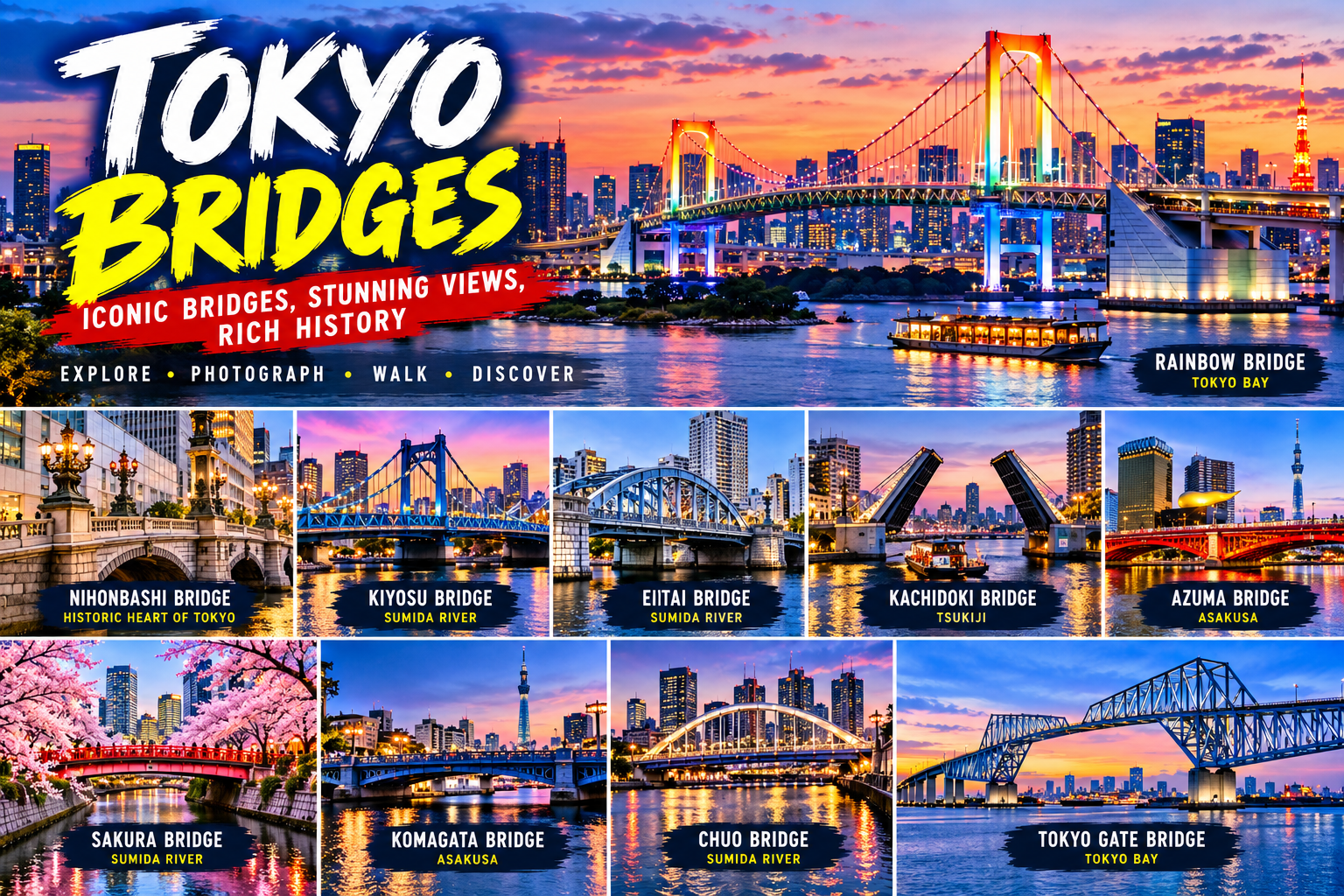
Tokyo Bridges: 10 Iconic Bridges to See, Photograph & Explore in Tokyo
Tokyo bridges are more than ways to cross rivers and canals; they are landmarks that reveal the city’s history, engineering, architecture, waterfront culture, and changing relationship with its rivers. From historic Nihonbashi and elegant Kiyosu Bridge to the futuristic Rainbow Bridge, each crossing tells a different story about Tokyo. Tokyo has developed around water for centuries. Rivers such as the Sumida, Kameido, Nihonbashi, and Arakawa waterways have influenced transportation, commerce, neighborhoods, disaster recovery, and urban development. Bridges became essential pieces of this evolution Tokyo Shrines
Tokyo Bridge Culture: A City Built Around Water
Tokyo is not simply a huge land-based metropolis. Water has always been part of its identity.
The city developed around rivers, canals, waterways, ports, and reclaimed land. During the Edo period, waterways were particularly important for moving people and goods. Bridges therefore became much more than engineering structures.
They were meeting points, commercial gateways, transportation connections, and recognizable landmarks.
Historical records preserved by the Tokyo Metropolitan Government show that bridge construction in the Tokyo area goes back many centuries. Records include crossings and temporary bridges associated with the Sumida River long before modern Tokyo developed into a major metropolis. Nihonbashi itself was first built in 1603, shortly after Tokugawa Ieyasu established the Edo shogunate.
That history helps explain why Tokyo has such a fascinating mixture of bridge styles.
You can find:
- Traditional stone bridges
- Steel arch bridges
- Suspension bridges
- Large bay bridges
- Modern road bridges
- Pedestrian-friendly crossings
- Railway bridges
- Historic bridges associated with reconstruction
- Bridges illuminated after dark
- Bridges best experienced from the water
This variety makes Tokyo particularly interesting for architecture enthusiasts and travelers who enjoy exploring beyond conventional tourist attractions.
A Brief History of Tokyo Bridges
Bridges in the Edo Period
Modern Tokyo was known as Edo during the period from 1603 to 1868. As Edo expanded, bridges became increasingly important for connecting commercial districts and neighborhoods.
Nihonbashi was one of the most significant examples.
The first Nihonbashi was constructed in 1603. By the following year, the bridge had become the starting point for major highways leading from Edo toward other parts of Japan.
This was an extraordinary development because it effectively positioned the bridge as a geographic and commercial reference point.
The surrounding area became one of Edo’s busiest districts. Merchants, travelers, fish sellers, artisans, and other businesses gathered around the waterways and streets near the bridge.
Bridges and the Great Kanto Earthquake
The Great Kanto Earthquake of 1923 dramatically changed Tokyo.
Many wooden structures and infrastructure systems were damaged or destroyed. Reconstruction created an opportunity to redesign important transportation infrastructure using modern materials and engineering.
Several famous Tokyo bridges were rebuilt or constructed during this period.
Eitai Bridge and Kiyosu Bridge are particularly important examples. Their present forms emerged from Tokyo’s post-earthquake reconstruction efforts in the 1920s.
This gives these bridges a special historical character.
They are not merely old structures. They represent the city’s ability to rebuild after disaster.
Bridges and Modern Tokyo
After World War II, Tokyo continued expanding rapidly.
Cars became more important. Tokyo Bay became increasingly integrated into the city’s transportation system. Expressways, tunnels, ports, industrial areas, railways, and large-scale waterfront developments changed the role of bridges.
The Rainbow Bridge represents this modern transformation particularly well.
Opened in 1993, it became one of the most recognizable structures around Tokyo Bay and an important connection between the Tokyo mainland and Odaiba.
10 Famous Tokyo Bridges to Explore
Tokyo has far more than ten bridges, but the following crossings provide an excellent introduction to the city’s bridge culture.
| Bridge | Area | Main Character | Best Experience | Photography Appeal |
|---|---|---|---|---|
| Nihonbashi Bridge | Nihonbashi | Historic stone arch | History and architecture | High |
| Rainbow Bridge | Tokyo Bay | Modern suspension bridge | Walking and skyline views | Very High |
| Kiyosu Bridge | Sumida River | Elegant suspension bridge | Architecture and night views | Very High |
| Eitai Bridge | Sumida River | Historic steel arch | Waterfront scenery | Very High |
| Kachidoki Bridge | Tsukiji | Historic movable bridge | Engineering and history | High |
| Azuma Bridge | Asakusa | Traditional city landmark | Asakusa walks | High |
| Sakura Bridge | Sumida | Pedestrian-oriented crossing | Cherry blossoms | Very High |
| Komagata Bridge | Sumida | Historic urban bridge | Asakusa photography | High |
| Chuo Bridge | Sumida River | Modern urban crossing | Waterfront walks | Medium |
| Tokyo Gate Bridge | Tokyo Bay | Large modern bridge | Bay scenery and engineering | Very High |
Nihonbashi Bridge
Why Nihonbashi Is Historically Important
Nihonbashi is arguably the bridge that best explains the historical development of Tokyo.
The original wooden bridge was built in 1603, and the present stone bridge was completed in 1911. It is a National Important Cultural Property.
The bridge also contains an important geographical reference point known as the Nihonbashi road-distance marker.
Major highways historically began from this area, making Nihonbashi a central point in Japan’s transportation network.
For travelers interested in history, this is one of the most meaningful bridges to visit.
What Makes the Architecture Special
The current bridge features two stone arches and substantial stonework.
Unlike Rainbow Bridge, which immediately feels modern and monumental, Nihonbashi has a much more traditional urban character.
Look closely at:
- Stone arches
- Decorative details
- Bridge railings
- Historical markers
- Sculptural elements
- Road markings
- The surrounding commercial architecture
The bridge is especially interesting because it sits within a busy modern business district.
Modern buildings surround a structure that carries more than a century of history.
Best Way to Explore Nihonbashi
Do not visit only the bridge itself.
Combine it with a walking route through:
- Nihonbashi
- Nihonbashi Mitsukoshi area
- COREDO Nihonbashi
- COREDO Muromachi
- Fukutoku Shrine
- Nearby traditional shops
- Tokyo Station area
This turns a five-minute bridge stop into a much more meaningful half-day exploration.
Best Photography Approach
Morning is often useful for travelers who want clearer architectural details and less visual clutter.
Try photographing:
- The stone arches from the side
- Bridge details at street level
- The bridge with surrounding buildings
- Reflections from the Nihonbashi River
- Close-ups of historical details
Rainbow Bridge
Why Rainbow Bridge Is Tokyo’s Most Famous Modern Bridge
Rainbow Bridge is probably the first structure many international visitors associate with Tokyo bridges.
It connects the mainland side of Tokyo with Odaiba across Tokyo Bay.
The official Tokyo waterfront information describes a 1.7-kilometer pedestrian route between the Shibaura and Odaiba entrances, generally taking around 20–30 minutes to walk.
The official Tokyo tourism guide also highlights the bridge as one of Odaiba’s iconic landmarks.
Walking Across Rainbow Bridge
Walking across Rainbow Bridge offers an experience that is very different from simply seeing it from below.
You can experience:
- Tokyo Bay
- Odaiba
- Tokyo’s skyline
- Ships and boats
- Industrial waterfront scenery
- Yurikamome trains
- Changing light conditions
The pedestrian route is open during specified hours, with seasonal differences. From April 1 to October 31, the promenade is generally open from 9:00 a.m. to 9:00 p.m.; from November 1 to March 31, it generally operates from 10:00 a.m. to 6:00 p.m. Closures can occur for maintenance or weather.
Important Walking Rules
Bicycles cannot simply be ridden across the pedestrian route. The official rules allow certain forms of bicycle hand-pushing with a dedicated arrangement, while folded bicycles can also be transported according to the stated requirements.
Wheelchair users can access the promenade, although the authorities note that the route has significant slopes and recommend assistance.
Always check current operating conditions before making Rainbow Bridge the centerpiece of your itinerary.
Best Views of Rainbow Bridge
You do not necessarily have to walk across it to enjoy it.
Excellent viewing opportunities include:
- Odaiba waterfront
- Odaiba Seaside Park
- Tokyo Bay cruises
- Yurikamome trains
- Shibaura waterfront
- Nearby observation points
- Evening waterfront areas
At night, the illuminated bridge becomes particularly dramatic.
Kiyosu Bridge
An Elegant Suspension Bridge
Kiyosu Bridge is one of the most visually distinctive historic bridges over the Sumida River.
It was constructed during Tokyo’s reconstruction following the Great Kanto Earthquake and is recognized as a National Important Cultural Property.
Its suspension design gives it a completely different visual character from the stone arches of Nihonbashi or the massive scale of Rainbow Bridge.
Why Photographers Like Kiyosu Bridge
Kiyosu Bridge has a graceful silhouette.
It works particularly well in photographs because of:
- The suspension cables
- Blue-toned structure
- Sumida River reflections
- Waterfront buildings
- Evening illumination
- Long-distance river views
The bridge is also associated with Tokyo’s film culture and has appeared as a location in Japanese cinema.
Best Time to Visit
Late afternoon is excellent if you want multiple visual moods.
You can arrive in daylight, photograph the bridge as the sun begins to fall, and remain nearby for evening illumination.
This is a smart strategy for travelers who want several types of photographs without changing locations.
Eitai Bridge
A Bridge With Centuries of History Behind It
Eitai Bridge has an especially fascinating story.
A bridge at this location dates back to the late seventeenth century. The original wooden bridge was built in 1698. It later suffered major damage, including during the Great Kanto Earthquake, after which the present steel arch structure was constructed in 1926.
Today, Eitai Bridge is one of the historic bridges that help define the visual identity of the Sumida River.
Why Eitai Bridge Matters
The bridge represents several different eras of Tokyo:
- Edo-period development
- Wooden bridge construction
- Disaster and reconstruction
- Modern steel engineering
- Contemporary waterfront tourism
That layered history makes it more interesting than a bridge that is simply old.
Best Photography Locations
Try viewing Eitai Bridge from:
- Sumida River banks
- Nearby waterfront promenades
- River cruises
- Small boats
- Parks near the bridge
Blue-hour photography can be particularly effective because the structure begins to stand out against the darker sky.
Kachidoki Bridge
Tokyo’s Historic Movable Bridge
Kachidoki Bridge is one of Tokyo’s most fascinating engineering landmarks.
Completed in 1940, the bridge was designed with a central opening mechanism that allowed vessels to pass. It was built using advanced technology for its time and was associated with plans for an international exposition that was ultimately cancelled as the war intensified.
The bridge was opened for the final time in 1970 and has remained closed to river traffic since then.
What Makes Kachidoki Bridge Unique
The bridge gives travelers a chance to see infrastructure that was designed for a very different era.
It combines:
- Industrial engineering
- Maritime transportation history
- Urban reconstruction
- Mid-century architecture
- Tokyo Bay development
Kachidoki Bridge Museum
The former electrical facility used to operate the bridge has been transformed into a museum.
Visitors can learn about the bridge’s history and see preserved machinery and engineering materials. The facility also provides information about other notable bridges across the Sumida River.
For travelers who enjoy engineering, transportation, or industrial history, this is one of the most rewarding bridge-related stops in Tokyo.
Azuma Bridge
A Classic Asakusa Bridge Experience
Azuma Bridge is located near one of Tokyo’s most popular tourist areas: Asakusa.
This makes it extremely convenient for first-time visitors.
After visiting Senso-ji and the surrounding streets, you can walk toward the Sumida River and reach the bridge.
The area offers views toward:
- Tokyo Skytree
- Sumida River
- Asakusa
- Riverside parks
- Boats
- Modern Tokyo architecture
Why Azuma Bridge Is Good for First-Time Visitors
You do not need to dedicate an entire day to the bridge.
Instead, include it in a larger Asakusa walking route.
A simple route can connect:
Senso-ji → Nakamise area → Kaminarimon → Azuma Bridge → Sumida Riverside → Tokyo Skytree area.
This is particularly convenient for travelers who want to combine historical Tokyo with modern skyline views.
Sakura Bridge
A Pedestrian-Friendly Bridge With Seasonal Appeal
Sakura Bridge offers a different experience from Tokyo’s major road bridges.
It is particularly appealing during cherry blossom season because of the riverside scenery around the Sumida River.
The surrounding area provides opportunities for walking, photography, seasonal sightseeing, and relaxed river views.
Why Cherry Blossom Season Changes the Experience
A bridge can look completely different depending on the season.
During spring, trees and blossoms frame the river.
In summer, the surrounding greenery creates a softer atmosphere.
Autumn brings changing foliage.
Winter can offer cleaner views because there is less vegetation.
This is an important lesson when photographing Tokyo bridges: the bridge is only one part of the composition.
The surrounding river, trees, skyline, weather, and seasonal colors can completely change the image.
Komagata Bridge
A Bridge Near Asakusa’s Traditional Core
Komagata Bridge crosses the Sumida River close to the Asakusa area.
Its location makes it useful for travelers who want to explore beyond the most crowded streets around Senso-ji.
Walking along the river gives you a chance to see Tokyo from a different perspective.
Instead of looking upward at temples, shops, and towers, you begin to see the city horizontally through the river landscape.
What to Look For
When visiting Komagata Bridge, pay attention to:
- River traffic
- Riverside architecture
- Nearby bridges
- Tokyo Skytree views
- Changing reflections
- Local pedestrians
- The contrast between old and new Tokyo
It is this relationship between infrastructure and everyday life that makes Tokyo’s bridges interesting.
Chuo Bridge
A Modern Bridge With Waterfront Character
Chuo Bridge is another example of how Tokyo’s bridges combine transportation with urban waterfront development.
It is not necessarily the first bridge a tourist thinks about, but that can be an advantage.
Less-famous bridges can offer:
- Fewer crowds
- More relaxed photography
- Better opportunities to observe local life
- Different views of the Sumida River
- More freedom to experiment with compositions
Travelers who have already visited Tokyo’s major attractions can use bridges such as Chuo Bridge to discover a quieter side of the city.
Tokyo Gate Bridge
A Dramatic Modern Landmark
Tokyo Gate Bridge is one of the most striking large-scale bridges around Tokyo Bay.
It has a completely different personality from the historic bridges of central Tokyo.
Instead of stone arches and traditional urban streets, the setting is dominated by:
- Tokyo Bay
- Large-scale infrastructure
- Port facilities
- Open skies
- Industrial landscapes
- Modern engineering
The bridge also provides pedestrian access under specific conditions.
According to the Tokyo Metropolitan Government’s current information, pedestrians can use the walkway between Wakasu and the Sea Forest side, with operating restrictions. The walkway is generally available from 6:00 a.m. to 7:00 p.m., with final entry at 6:30 p.m.; weather and maintenance restrictions can apply.
Why Tokyo Gate Bridge Is Different
For photographers, Tokyo Gate Bridge is an excellent choice if you want images that feel less like traditional sightseeing and more like contemporary urban photography.
The structure looks especially impressive against:
- Blue skies
- Sunset
- Cloud formations
- Tokyo Bay
- Passing ships
- Nighttime city lights
Tokyo Bridges and Japanese Architecture
Traditional Design Versus Modern Engineering
One of the best ways to understand Tokyo through its bridges is to compare architectural periods.
Nihonbashi communicates historical permanence.
Kiyosu Bridge expresses early twentieth-century engineering elegance.
Eitai Bridge represents large-scale steel construction.
Kachidoki Bridge demonstrates mechanical engineering.
Rainbow Bridge represents modern metropolitan infrastructure.
Tokyo Gate Bridge demonstrates the scale of contemporary Tokyo Bay development.
These bridges are therefore a kind of outdoor architecture museum.
Why Bridge Design Matters in Tokyo
Bridge design has always responded to practical requirements.
Engineers had to consider:
- River width
- Water depth
- Ship traffic
- Road traffic
- Earthquakes
- Flooding
- Materials
- Construction technology
- Urban population
- Future transportation needs
That is why two bridges crossing the same river can look completely different.
Tokyo Bridges and Disaster-Resistant Design
Lessons From the Great Kanto Earthquake
Tokyo’s bridge history cannot be separated from natural disasters.
The Great Kanto Earthquake of 1923 destroyed large areas of the city.
The reconstruction period encouraged new approaches to infrastructure.
Kiyosu Bridge and Eitai Bridge are particularly important examples of bridges associated with this rebuilding period. Tokyo’s official materials identify the three Sumida River bridges—Kiyosu, Eitai, and Kachidoki—as National Important Cultural Properties.
Modern Bridge Engineering
Modern Tokyo continues to invest in infrastructure resilience.
Contemporary bridges must consider:
- Earthquake resistance
- Wind
- Flooding
- Heavy traffic
- Corrosion
- Maintenance
- Pedestrian safety
- Long-term urban development
Kiyosu Bridge, for example, has been equipped with vibration-control measures as part of preservation and structural protection efforts.
This demonstrates an important principle: historic infrastructure does not necessarily mean obsolete infrastructure.
Best Tokyo Bridges for Photography
Best for Sunrise
Consider:
- Nihonbashi
- Eitai Bridge
- Kiyosu Bridge
- Sumida River bridges
Early morning provides softer light and generally calmer surroundings.
Best for Sunset
Consider:
- Rainbow Bridge
- Tokyo Gate Bridge
- Eitai Bridge
- Kiyosu Bridge
Sunset can create strong silhouettes and reflections.
Best for Night Photography
Consider:
- Rainbow Bridge
- Kiyosu Bridge
- Eitai Bridge
- Kachidoki Bridge
Always check current illumination conditions because lighting schedules can change.
Best for Architecture Photography
Nihonbashi is particularly useful because of its historical stonework.
Kiyosu Bridge is excellent for suspension-bridge geometry.
Rainbow Bridge provides large-scale engineering compositions.
Tokyo Gate Bridge is ideal for dramatic modern infrastructure photography.
How to Photograph Tokyo Bridges Like a Travel Photographer
Use the River as a Leading Line
Instead of photographing the bridge straight on, use the river to guide the viewer’s eye toward the structure.
This creates depth.
Include Tokyo’s Skyline
A bridge becomes more recognizable when the surrounding skyline is included.
For example, combining a bridge with Tokyo Skytree can immediately establish the location.
Photograph From Below
Standing directly under or beside a bridge can produce completely different images from traditional tourist viewpoints.
Look for:
- Steel beams
- Cables
- Symmetry
- Repeating patterns
- Shadows
- Geometric shapes
Try Blue Hour
Blue hour is often one of the best periods for bridge photography.
The sky remains visible while city lights begin to appear.
This is particularly effective around Tokyo Bay and the Sumida River.
Best Tokyo Bridge Walks
Asakusa and Sumida River Walk
A practical route can begin around Senso-ji and continue toward the Sumida River.
Possible highlights include:
- Senso-ji
- Kaminarimon
- Azuma Bridge
- Sumida Riverside
- Tokyo Skytree views
- Additional river crossings
This is a strong choice for first-time visitors.
Nihonbashi Historical Walk
Begin around Nihonbashi and explore the surrounding commercial district.
Combine:
- Nihonbashi Bridge
- Historic streets
- Department stores
- Traditional businesses
- Nearby shrines
- Tokyo Station
This route works particularly well for travelers interested in history and architecture.
Sumida River Bridge Trail
For a more bridge-focused experience, follow the river and photograph multiple crossings.
The advantage is that you begin to notice how different bridge designs interact with one another.
You can compare:
- Suspension structures
- Arch bridges
- Road bridges
- Pedestrian crossings
- Historic structures
Tokyo Bridges From a River Cruise
Why Water-Level Views Are Different
A bridge viewed from a riverbank is completely different from the same bridge viewed from a boat.
From the water, you can see:
- Underside structures
- Bridge piers
- Cable systems
- Full spans
- Reflections
- Relationship between multiple bridges
Official Tokyo information highlights the Sumida River’s bridges as a particularly interesting feature of traditional yakatabune cruises.
Yakatabune and Bridge Sightseeing
Traditional yakatabune boats offer a distinctive way to experience Tokyo’s waterways.
Rather than visiting one bridge at a time, a river cruise can provide a sequence of bridges.
This makes it easier to understand the city’s waterfront as a connected system.
For visitors interested in photography, the changing viewpoints are especially valuable.
Best Tokyo Bridges for Families
Families may prefer bridges that can be combined with parks, attractions, and open waterfront spaces.
Good options include:
- Rainbow Bridge area
- Azuma Bridge
- Sakura Bridge
- Odaiba waterfront
- Sumida River walking areas
When traveling with children, focus less on seeing every bridge and more on choosing bridges that fit naturally into a wider sightseeing route.
Best Tokyo Bridges for Couples
Bridges can be particularly attractive around sunset and evening.
Good choices include:
- Rainbow Bridge
- Kiyosu Bridge
- Eitai Bridge
- Sumida River viewpoints
The best experience is often not simply standing on the bridge.
Find a waterfront viewpoint where you can see the bridge, river, and city lights together.
Best Tokyo Bridges for Solo Travelers
Solo travelers have an advantage when exploring bridges: flexibility.
You can stop whenever you see an interesting angle.
A solo bridge itinerary can combine:
- Photography
- Architecture
- Walking
- Coffee stops
- Local neighborhoods
- River cruises
This makes bridge exploration an excellent slow-travel activity.
Best Tokyo Bridges for Architecture Lovers
Architecture-focused travelers should prioritize:
- Nihonbashi
- Kiyosu Bridge
- Eitai Bridge
- Kachidoki Bridge
- Rainbow Bridge
- Tokyo Gate Bridge
Each represents a different engineering or historical period.
Best Tokyo Bridges for History Lovers
For historical context, focus on:
- Nihonbashi
- Kiyosu Bridge
- Eitai Bridge
- Kachidoki Bridge
These bridges connect directly with important periods in Tokyo’s development.
Best Tokyo Bridges for Families With Limited Time
If you have only one day for sightseeing, do not attempt to visit ten bridges.
Instead, choose one area.
Option One: Asakusa
Combine:
Senso-ji → Azuma Bridge → Sumida River → Skytree
Option Two: Odaiba
Combine:
Rainbow Bridge views → Odaiba waterfront → museums and attractions
Option Three: Nihonbashi
Combine:
Nihonbashi Bridge → historic district → shopping → Tokyo Station
Best Time of Year to Explore Tokyo Bridges
Spring
Spring is particularly attractive around riverside areas because of cherry blossoms.
Sakura-lined waterways can transform ordinary infrastructure into highly photogenic landscapes.
Summer
Summer provides long daylight hours.
It is useful for travelers who want to walk longer routes.
However, heat and humidity can be significant.
Autumn
Autumn provides comfortable walking conditions and seasonal foliage.
It is particularly good for photographers.
Winter
Winter can offer clearer visibility and fewer tourists.
The main disadvantage is shorter daylight.
For some travelers, however, winter’s crisp atmosphere can produce excellent city photographs.
Best Time of Day for Tokyo Bridges
Early Morning
Best for:
- Quiet streets
- Soft light
- Architecture
- Minimal crowds
Midday
Best for:
- Clear structural details
- Walking
- Combining bridges with attractions
Golden Hour Tokyo bridges
Best for:
- Warm photographs
- River reflections
- Skyline compositions
Blue Hour Tokyo bridges
Best for:
- City lights
- Waterfront photography
- Long-exposure images
Night Tokyo bridges
Best for:
- Illuminated bridges
- Urban photography
- Tokyo Bay scenery
Common Mistakes When Visiting Tokyo Bridges
Mistake 1: Visiting Only the Most Famous Bridge
Rainbow Bridge is spectacular, but focusing only on it means missing much of Tokyo’s bridge history.
Mistake 2: Ignoring the River Tokyo bridges
The surrounding water is often what makes a bridge photograph interesting.
Look for reflections, boats, and changing light.
Mistake 3: Visiting at the Wrong Time Tokyo bridges
A bridge can look completely different at noon and after sunset.
Plan your timing around the experience you want.
Mistake 4: Forgetting Weather Conditions Tokyo bridges
Wind, rain, storms, or maintenance can affect bridge access.
This is particularly important for pedestrian routes such as Rainbow Bridge and Tokyo Gate Bridge.
Mistake 5: Treating Bridges as Isolated Attractions
The best bridge experiences usually happen when the bridge is connected to a neighborhood itinerary.
Practical Tips for Exploring Tokyo Bridges
Wear Comfortable Shoes Tokyo bridges
A bridge-focused itinerary can involve much more walking than expected.
Check Opening Conditions Tokyo bridges
Pedestrian access is not universal.
Some bridges are primarily roads or rail crossings, while specific bridges have designated pedestrian routes.
Carry Water Tokyo bridges
Tokyo summers can be hot and humid.
Use Public Transportation Strategically Tokyo bridges
Tokyo’s rail network makes it easy to approach bridge areas from different directions.
Plan Around Sunset Tokyo bridges
If photography matters to you, check sunset times before leaving your hotel.
Keep Your Itinerary Flexible Tokyo bridges
A river walk may reveal another bridge that was not on your original plan.
Leave some room for spontaneous exploration.
Pros and Cons of Exploring Tokyo Bridges
Pros Tokyo bridges
- Bridges reveal Tokyo’s history.
- Many are free to view.
- They provide excellent photography opportunities.
- They connect different neighborhoods.
- River walks are relatively flexible.
- Historic bridges offer architectural insight.
- Modern bridges show Tokyo’s engineering scale.
- They can be combined with major attractions.
Cons Tokyo bridges
- Some bridges are primarily transportation infrastructure.
- Pedestrian access varies.
- Weather can affect outdoor experiences.
- Some viewpoints require additional walking.
- Night illumination schedules can change.
- Traffic noise can reduce the peacefulness of some locations.
10 Tokyo Bridges Compared for Travelers
| Bridge | Historical Interest | Architecture | Photography | Family Friendly | Night Appeal | Best For |
|---|---|---|---|---|---|---|
| Nihonbashi | Very High | Very High | High | High | Medium | History |
| Rainbow Bridge | High | Very High | Very High | High | Very High | Skyline views |
| Kiyosu Bridge | Very High | Very High | Very High | High | Very High | Architecture |
| Eitai Bridge | Very High | Very High | Very High | High | High | River scenery |
| Kachidoki Bridge | Very High | High | High | Medium | High | Engineering |
| Azuma Bridge | Medium | High | High | Very High | High | Asakusa |
| Sakura Bridge | Medium | High | Very High | Very High | Medium | Cherry blossoms |
| Komagata Bridge | Medium | High | High | High | Medium | River walks |
| Chuo Bridge | Medium | Medium | Medium | High | Medium | Local exploration |
| Tokyo Gate Bridge | High | Very High | Very High | Medium | Very High | Modern infrastructure |
This table is not a ranking. Each bridge serves a different travel purpose, and the most suitable choice depends on whether your priority is history, architecture, photography, walking, family travel, or modern city scenery.
Tokyo Bridges and Sustainable Tourism
Why Walking Matters Tokyo bridges
Walking across or around bridges allows travelers to experience Tokyo at a slower pace.
Instead of moving directly between major attractions, you notice:
- Local streets
- Riverside parks
- Small businesses
- Boats
- Residential areas
- Architectural details
This can make a trip feel less rushed.
Public Transportation and Bridge Tourism
Tokyo’s extensive public transportation network also means travelers can visit bridge areas without relying on private vehicles.
For environmentally conscious travelers, combining trains with walking and river transportation can create an efficient sightseeing experience.
Tokyo Bridges and Local Neighborhoods
One of the biggest advantages of bridge tourism is that bridges rarely exist in isolation.
Nihonbashi Tokyo bridges
Historic commerce, department stores, traditional businesses, and modern redevelopment.
Asakusa Tokyo bridges
Temples, traditional streets, river views, food, and Tokyo Skytree.
Kiyosumi-Shirakawa Tokyo bridges
Cafes, galleries, warehouses, and waterfront atmosphere.
Tsukiji and Kachidoki Tokyo bridges
Markets, waterfront redevelopment, food culture, and historic infrastructure.
Odaiba Tokyo bridges
Modern entertainment, waterfront parks, museums, and Rainbow Bridge views.
This makes bridge sightseeing a useful way to organize a Tokyo itinerary geographically.
The Hidden Value of Bridge Tourism
Bridges Show Everyday Tokyo
Major tourist attractions are designed to be seen.
Bridges are different.
They are used every day by:
- Commuters
- Cyclists
- Drivers
- Pedestrians
- Delivery vehicles
- Boats
That makes them valuable places for observing ordinary Tokyo.
Bridges Connect Old and New Tokyo
This may be the most interesting feature of Tokyo’s bridge landscape.
You can stand near a bridge built in the early twentieth century and see modern towers in the background.
You can walk through a historic district and then look across the river toward contemporary architecture.
This contrast is one of the defining visual characteristics of Tokyo.
Tokyo Bridges and Japanese Popular Culture
Tokyo’s bridges have also appeared in photography, cinema, television, literature, and popular culture.
Kachidoki Bridge, for example, became internationally recognizable through its appearance in the original 1954 Godzilla film. Tokyo’s official location information documents the bridge’s appearance in the movie.
Kiyosu Bridge has also been used as a film location.
For travelers interested in Japanese cinema, bridges can therefore become part of a location-based exploration of Tokyo.
Future Trends for Tokyo Bridges
More Waterfront Tourism Tokyo bridges
Tokyo continues to rediscover its waterfront.
As riverside districts become more attractive for walking, dining, recreation, and tourism, bridges are likely to become increasingly important viewing points.
Preservation of Historic Bridges
Historic bridges such as Kiyosu, Eitai, and Kachidoki demonstrate that infrastructure can have cultural value.
Their preservation allows future generations to understand how Tokyo developed.
Better Earthquake Resilience Tokyo bridges
Seismic resilience will remain a major concern for Tokyo.
Future bridge maintenance and upgrades are likely to continue focusing on structural safety, vibration control, durability, and disaster preparedness.
Greater Integration With Walking Routes Tokyo bridges
As cities place more emphasis on walkability, bridges can become part of larger pedestrian networks.
Instead of being viewed merely as transportation infrastructure, they can function as links between parks, neighborhoods, cultural attractions, and waterfront spaces.
More Waterfront Photography and Tourism
Social media has increased interest in visually distinctive urban infrastructure.
Tokyo’s bridges are particularly well suited to photography because they combine architecture, water, skyline views, and changing light.
A One-Day Tokyo Bridges Itinerary
If you want to build an entire day around bridges, start in the historic center.
Morning: Nihonbashi
Begin at Nihonbashi Bridge.
Explore the surrounding historical district before continuing toward the river.
Late Morning: Asakusa
Travel to Asakusa and visit Senso-ji.
Continue toward the Sumida River and Azuma Bridge.
Afternoon: Sumida River
Walk along the waterfront and explore additional bridges.
Take your time rather than trying to collect as many bridges as possible.
Sunset: Rainbow Bridge Tokyo bridges
Finish the day around Odaiba.
Watch the sunset over Tokyo Bay and photograph Rainbow Bridge as the city lights begin to appear.
This route combines historic Tokyo, traditional culture, riverside scenery, and modern Tokyo Bay.
A Two-Day Tokyo Bridges Itinerary
A longer itinerary allows a deeper exploration.
Day One: Historic Tokyo
Focus on:
- Nihonbashi
- Asakusa
- Azuma Bridge
- Sumida River
- Sakura Bridge
- Komagata Bridge
Day Two: Modern Waterfront Tokyo
Focus on:
- Kachidoki Bridge
- Eitai Bridge
- Kiyosu Bridge
- Rainbow Bridge
- Tokyo Gate Bridge
This approach creates a clear historical progression from Edo-era Tokyo to the modern waterfront metropolis.
FAQs
What is the most famous bridge in Tokyo?
Rainbow Bridge is probably the most internationally recognizable modern bridge in Tokyo. It connects the Tokyo mainland with Odaiba and provides both pedestrian and transportation functions.
What is the oldest famous bridge in Tokyo?
Nihonbashi has one of the most important historical origins among Tokyo’s famous bridges. The first bridge at the site was built in 1603 and became a major starting point for highways connecting Edo with other regions of Japan.
Can you walk across Rainbow Bridge?
Yes. Rainbow Bridge has a pedestrian promenade between the Shibaura and Odaiba sides. The pedestrian route is approximately 1.7 kilometers and normally takes around 20–30 minutes. Operating hours vary seasonally, and weather or maintenance can cause restrictions.
Is Rainbow Bridge free to walk across?
The pedestrian promenade is available without a standard sightseeing admission fee. Travelers should still check current access conditions before visiting.
Can you cycle across Rainbow Bridge?
You cannot simply ride a bicycle across the pedestrian promenade. The official rules provide specific arrangements for transporting or hand-pushing bicycles.
What is the best Tokyo bridge for photography?
There is no single answer because different bridges provide different photographic styles. Rainbow Bridge is excellent for skyline and waterfront images, Kiyosu Bridge is strong for architectural photography, and Nihonbashi is ideal for historic architectural details.
Which Tokyo bridges are historic?
Nihonbashi, Kiyosu Bridge, Eitai Bridge, and Kachidoki Bridge are among the most historically significant bridges to explore.
Why is Nihonbashi important?
Nihonbashi was established as a major transportation starting point during the Edo period. The current stone bridge was completed in 1911 and is designated a National Important Cultural Property.
Why is Kachidoki Bridge famous?
Kachidoki Bridge is notable for its historic movable center section. It was completed in 1940 and used advanced bridge-opening technology for its era. Its opening mechanism has not been operated for river traffic since 1970.
Can you visit the inside of Kachidoki Bridge?
There are facilities dedicated to the history of Kachidoki Bridge, including preserved mechanical equipment and information about the bridge’s operation. The Tokyo Metropolitan Government also provides information about tours of the bridge’s internal structures.
Which Tokyo bridge is best for families?
Rainbow Bridge and bridges around Asakusa and the Sumida River can work well for families because they can be combined with parks, sightseeing attractions, river views, and other activities.
Which Tokyo bridge is best at night?
Rainbow Bridge is particularly impressive after dark, while Kiyosu Bridge and Eitai Bridge can also provide attractive evening views depending on illumination conditions.
Are Tokyo bridges accessible to wheelchair users?
Accessibility varies by bridge. Rainbow Bridge’s pedestrian promenade is accessible to wheelchairs, although the official guidance notes that the route includes significant slopes and recommends assistance.
Can you walk across Tokyo Gate Bridge?
Pedestrians can use the designated walkway under specified conditions. The Tokyo Metropolitan Government currently lists operating hours and restrictions, and access can be limited by weather or maintenance.
What is the best season for Tokyo bridge photography?
Spring is excellent for cherry blossoms, autumn is attractive for foliage and comfortable walking, and winter can provide clearer skies. Summer offers longer daylight but can be hot and humid.
Can you see Tokyo bridges from a boat?
Yes. River cruises and traditional yakatabune boats offer views of several bridges from the water. Tokyo’s official tourism information specifically highlights the Sumida River’s bridges as an important feature of these cruises.
Are Tokyo bridges worth visiting if I only have a few days?
Yes, but they should be incorporated into neighborhood itineraries rather than treated as separate attractions. For example, you can combine Nihonbashi with the historic commercial district, Azuma Bridge with Asakusa, and Rainbow Bridge with Odaiba.
Do Tokyo bridges have historical significance?
Many do. Some are associated with Edo-period transportation, others with reconstruction following the Great Kanto Earthquake, and others with Tokyo’s modern waterfront development.
What should I bring when exploring Tokyo bridges?
Comfortable walking shoes, water, a phone or camera, and a portable battery are useful. A tripod can be helpful for serious night photography, but always follow local rules and avoid obstructing pedestrian traffic.
Conclusion
Tokyo’s bridges deserve far more attention than they usually receive. They are not simply structures that allow people and vehicles to cross water. They are physical records of the city’s transformation from Edo-period settlement to modern global metropolis. Nihonbashi tells the story of transportation, commerce, and the origins of modern Tokyo. Kiyosu and Eitai bridges demonstrate the engineering response to one of the city’s greatest disasters. Kachidoki Bridge preserves the memory of a time when river traffic and movable infrastructure played a larger role in urban transportation. Rainbow Bridge represents the modern Tokyo waterfront, while Tokyo Gate Bridge demonstrates the scale and ambition of contemporary infrastructure.



One Comment