Tokyo Climate: A Complete Year-Round Guide to Weather, Seasons, Rainfall and Travel Tips
Tokyo is one of those destinations where the weather can completely change the character of a trip. A sunny spring morning can feel almost perfect for walking through historic neighbourhoods, while a summer afternoon can bring intense heat and humidity that makes an indoor break feel essential. Tokyo has a humid subtropical climate with four distinct seasons, relatively mild winters, hot and humid summers, a rainy season in early summer, and significant rainfall in September and October. The best time to visit depends on what you want to experience, because spring and autumn offer comfortable conditions while summer and winter have their own advantages Tokyo Bridges
Understanding the Tokyo Climate
Tokyo is located on the eastern side of Japan’s main island, Honshu, at approximately 35.7° north latitude. Its location beside the Pacific Ocean and its position within the broader East Asian climate system strongly influence its weather.
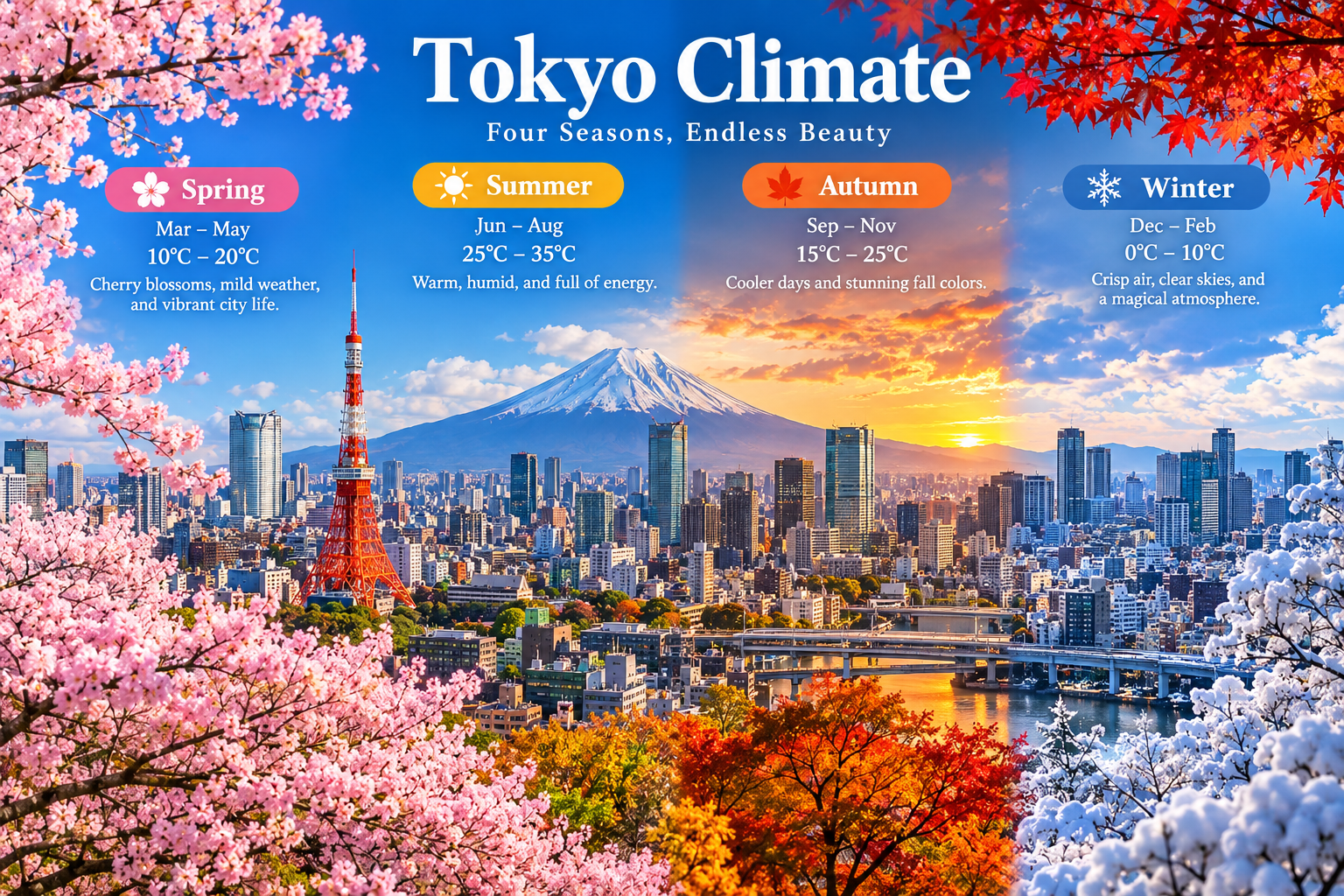
The city experiences four recognisable seasons:
- Spring
- Summer
- Autumn
- Winter
However, the transition between seasons is not always gradual. Tokyo can move quickly from comfortable spring weather into warm, humid conditions, while autumn can shift from mild sunshine to cool, wet weather.
Tokyo’s climate is commonly described as humid subtropical, although its seasonal characteristics are strongly influenced by Japan’s monsoon system and surrounding ocean.
The result is a city with:
- Mild winters compared with many northern cities
- Hot summers
- High summer humidity
- A distinct rainy season
- Heavy rainfall during parts of autumn
- Occasional snow
- Typhoon-related weather risks
- Increasing concerns about extreme heat
The Japan Meteorological Agency’s long-term observations show that Tokyo’s average temperatures have increased over time, making modern Tokyo somewhat different from the climate many older travel guides describe.
Tokyo Climate at a Glance
A useful way to understand Tokyo’s weather is to look at average temperature and rainfall together rather than temperature alone.
| Month | Average Temperature | Normal Rainfall | General Conditions |
|---|---|---|---|
| January | 5.4°C | 59.7 mm | Cool and relatively dry |
| February | 6.1°C | 56.5 mm | Cool, occasional rain |
| March | 9.4°C | 116.0 mm | Mild but changeable |
| April | 14.3°C | 133.7 mm | Mild spring |
| May | 18.8°C | 139.7 mm | Warm and generally pleasant |
| June | 21.9°C | 167.8 mm | Warm, humid, rainy |
| July | 25.7°C | 156.2 mm | Hot and humid |
| August | 26.9°C | 154.7 mm | Very warm and humid |
| September | 23.3°C | 224.9 mm | Warm, wet, typhoon potential |
| October | 18.0°C | 234.8 mm | Mild but often wet |
| November | 12.5°C | 96.3 mm | Cool and increasingly dry |
| December | 7.7°C | 57.9 mm | Cool and relatively dry |
These figures come from Japan Meteorological Agency 1991–2020 climate normals.
One of the most important observations is that Tokyo’s wettest period is not necessarily the middle of summer. September and October have particularly high normal precipitation, while January, February and December are much drier.
Tokyo Climate in January
January is one of Tokyo’s coolest months and is generally among the drier periods of the year.
The normal mean temperature is approximately 5.4°C, with normal precipitation of around 59.7 mm.
Mornings and evenings can feel distinctly cold, particularly when wind is present. However, Tokyo’s winter is not comparable with the severe winters experienced in northern Japan.
Snow can occur, but significant snow accumulation in central Tokyo is relatively uncommon compared with colder parts of Japan.
What January Feels Like
January usually brings:
- Cool mornings
- Cold evenings
- Relatively low rainfall
- Periods of clear skies
- Occasional cold winds
- Shorter daylight hours
For sightseeing, January can be rewarding because the lower rainfall can make outdoor exploration easier.
The main challenge is not usually rain but cold exposure when spending many hours outside.
A traveller might leave a warm hotel in the morning, walk through Asakusa, visit Ueno, explore Akihabara and continue to Shibuya without returning indoors for several hours. Even moderate winter temperatures can feel colder after prolonged exposure.
What to Wear in January
A practical winter outfit includes:
- Warm jacket or coat
- Sweater or fleece
- Long trousers
- Comfortable closed shoes
- Light scarf
- Gloves for particularly cold days
Layering is more useful than relying on one extremely heavy garment because restaurants, shops, trains and department stores are normally heated.
Tokyo Climate in February
February remains cool but gradually moves toward spring.
The average February temperature is approximately 6.1°C, with normal precipitation around 56.5 mm.
February is still a winter month, but the city can occasionally experience pleasant sunny afternoons.
Is February a Good Month for Tokyo?
February can work well for travellers who prefer cooler weather and want to avoid the heat of summer.
Advantages include:
- Relatively low rainfall
- Comfortable conditions for walking when sunny
- Winter atmosphere
- Fewer heat-related problems
- Good conditions for museums and indoor attractions
The disadvantage is that some travellers may find mornings and evenings cold.
If your trip includes long outdoor days, bring layers rather than assuming Tokyo will feel warm simply because it is not a northern Japanese destination.
Tokyo Climate in March
March is a transitional month.
The normal mean temperature rises to approximately 9.4°C, while rainfall increases to around 116 mm.
The most important characteristic of March is variability.
You can experience:
- Cold mornings
- Mild afternoons
- Rainy periods
- Stronger winds
- Rapid temperature changes
- Early signs of spring
This is one reason March travel requires flexible packing.
Tokyo Weather in Early and Late March
Early March can still feel like winter.
By late March, spring becomes much more noticeable, although the exact timing of seasonal changes varies from year to year.
Travellers interested in cherry blossoms should understand that climate averages cannot guarantee a specific blossom date. Flowering depends on temperatures during the preceding weeks.
Tokyo Climate in April
April is one of Tokyo’s most comfortable months for general sightseeing.
The 1991–2020 normal mean temperature is approximately 14.3°C, with normal precipitation of about 133.7 mm.
The weather is generally mild, but rain remains possible.
Why April Is Popular
April combines:
- Mild temperatures
- Spring scenery
- Longer daylight
- Comfortable walking conditions
- Vibrant parks and gardens
- Strong seasonal atmosphere
However, popularity also means that major attractions can become busy.
If your priority is outdoor exploration, April can offer a strong balance between temperature and sightseeing comfort.
Tokyo Climate in May
May is often one of the most pleasant periods of the year.
Tokyo’s normal mean temperature is approximately 18.8°C, while normal precipitation is about 139.7 mm.
The weather is warm without normally reaching the oppressive conditions of midsummer.
Why May Works Well for Tourism
May is suitable for:
- Walking tours
- Parks
- Gardens
- Neighbourhood exploration
- Day trips
- Outdoor photography
- Cycling
- Shopping districts
A light jacket can still be useful, particularly in the evening.
For many international visitors, May provides an easier physical environment for exploring Tokyo than July or August.
Tokyo Climate in June
June marks a major transition toward Tokyo’s humid summer.
The normal mean temperature is approximately 21.9°C, while normal precipitation rises to around 167.8 mm.
June is strongly associated with Japan’s rainy season, commonly called tsuyu.
What Is the Rainy Season in Tokyo?
The rainy season is not necessarily a continuous period of rain every day.
Instead, visitors may experience:
- Cloudy conditions
- Intermittent rain
- Humidity
- Sudden showers
- Wet streets
- Periods of sunshine between rain events
This distinction matters.
A rainy-season trip does not mean that you will spend your entire holiday indoors. It means you should build flexibility into your daily schedule.
How to Travel During Tokyo’s Rainy Season
Carry:
- Compact umbrella
- Water-resistant footwear
- Quick-drying clothing
- Small waterproof bag
- Phone protection
- Extra socks
A useful strategy is to place indoor attractions strategically into your itinerary.
For example, a rainy afternoon can become an opportunity to explore museums, department stores, observation facilities, shopping complexes or covered commercial streets.
Tokyo Climate in July
July is hot, humid and often uncomfortable for travellers who are not accustomed to East Asian summer conditions.
Tokyo’s normal mean temperature is approximately 25.7°C, with normal rainfall around 156.2 mm.
The key word is humidity.
Why Tokyo Summer Can Feel Hotter Than the Temperature Suggests
Air temperature alone does not tell you how hot Tokyo feels.
High humidity reduces the effectiveness of sweat evaporation. As a result, the body can have more difficulty cooling itself.
A temperature that looks manageable on a weather app can therefore feel significantly more exhausting after walking for several hours.
Summer Travel Strategy
During July:
- Start outdoor sightseeing early
- Take breaks during the hottest part of the afternoon
- Drink water regularly
- Use shade whenever available
- Choose breathable clothing
- Avoid unnecessarily long walking routes
- Use public transport strategically
- Plan indoor attractions during the afternoon
This is especially important for older travellers, young children and anyone sensitive to heat.
Tokyo Climate in August
August is normally Tokyo’s warmest month.
The 1991–2020 climate normal mean temperature is approximately 26.9°C, while normal rainfall is around 154.7 mm.
However, the average temperature does not fully communicate the experience of August.
Tokyo can experience very hot days, high humidity and uncomfortable nighttime conditions.
Japan Meteorological Agency observations also show a long-term increase in Tokyo’s average temperatures and changes in the frequency of hot-weather indicators.
Is August Too Hot for Tokyo?
Not necessarily, but August requires planning.
Travellers who tolerate heat well can still enjoy Tokyo, particularly by combining early-morning sightseeing with indoor activities later in the day.
August also offers summer festivals, seasonal food, fireworks and other cultural experiences.
The important difference is between visiting Tokyo in August and trying to explore Tokyo continuously on foot during August afternoons.
The first can be enjoyable.
The second can become exhausting.
Tokyo Climate in September
September is an important weather month because temperatures begin to decline from their summer peak, but rainfall remains high.
The normal mean temperature is approximately 23.3°C, while normal precipitation is around 224.9 mm.
That makes September one of Tokyo’s wettest months.
September Rain and Typhoon Considerations
September falls within a period when tropical cyclones can affect Japan.
The Japan Meteorological Agency’s tropical cyclone climatology shows that tropical cyclones occur in the western North Pacific throughout the year, with substantially greater activity during the warmer months.
A typhoon does not mean that an entire Tokyo holiday will be cancelled.
However, it can result in:
- Heavy rain
- Strong winds
- Transport disruption
- Delayed trains
- Flight disruption
- Temporary attraction closures
- Dangerous outdoor conditions
The best approach is to monitor official weather information rather than relying solely on a long-range forecast.
Tokyo Climate in October
October is often associated with pleasant autumn conditions, but Tokyo’s climate statistics reveal an important detail: October is also one of the wettest months of the year.
The normal mean temperature is approximately 18.0°C, while normal precipitation is about 234.8 mm, the highest monthly normal in the JMA table.
This is one of the most useful facts for travellers planning an autumn visit.
October can deliver excellent sightseeing weather, but you should not assume every October day will be dry.
Why October Remains Attractive
When conditions are favourable, October provides:
- Comfortable temperatures
- Cooler evenings
- Autumn atmosphere
- Good walking conditions
- Less oppressive humidity than summer
- Excellent conditions for neighbourhood exploration
The best strategy is to combine flexible outdoor plans with indoor alternatives.
Tokyo Climate in November
November brings noticeably cooler weather.
Tokyo’s normal mean temperature falls to approximately 12.5°C, while normal precipitation decreases to about 96.3 mm.
The reduction in rainfall can make November attractive for travellers who prefer cooler and more predictable conditions.
What November Feels Like
November often provides:
- Cool mornings
- Mild afternoons
- Crisp evenings
- Autumn colours
- Lower humidity
- Comfortable sightseeing
Layered clothing works well because temperatures can vary substantially between morning and afternoon.
Tokyo Climate in December
December marks the return to a cooler and relatively dry winter pattern.
The normal mean temperature is approximately 7.7°C, with normal rainfall around 57.9 mm.
December is particularly interesting because Tokyo combines winter weather with a lively seasonal atmosphere.
Illuminations, shopping districts, New Year preparations and winter food give the city a distinctive character.
Is December Cold in Tokyo?
Yes, but generally manageable with appropriate clothing.
For visitors from tropical or very warm climates, December can feel genuinely cold.
For travellers from colder parts of North America or Europe, Tokyo’s winter may feel relatively moderate.
Tokyo Rainfall: What Travellers Should Know
Rain is one of the most misunderstood parts of Tokyo’s climate.
Tokyo receives precipitation throughout the year, but rainfall varies significantly by month.
According to JMA normals, annual precipitation is approximately 1,598.2 mm. September and October are especially wet, while January, February and December are considerably drier.
Tokyo’s Wettest Months
The normal precipitation figures identify:
- September: 224.9 mm
- October: 234.8 mm
- June: 167.8 mm
- July: 156.2 mm
- August: 154.7 mm
These figures do not mean rain will fall continuously.
Monthly rainfall can be concentrated into a smaller number of heavy events rather than evenly distributed drizzle.
Tokyo’s Drier Months
The relatively drier months include:
- January
- February
- December
- November
This makes winter attractive to travellers whose priority is outdoor sightseeing with less rainfall.
Tokyo Humidity Explained
Humidity is one of the defining characteristics of Tokyo’s summer climate.
JMA monthly observations show that relative humidity is particularly high during the summer and early autumn period.
Why Humidity Matters More Than Temperature
Imagine walking 15,000 steps through Tokyo.
At a moderate temperature with low humidity, your body can often cool itself effectively through evaporation.
At high humidity, evaporation becomes less efficient.
The result can be:
- Heavier sweating
- Greater fatigue
- Sticky clothing
- Poorer sleep
- Increased need for water
- Greater heat stress
This is why a traveller planning a Tokyo summer trip should research humidity and heat, not just the temperature forecast.
Tokyo Climate and Typhoons
Typhoons are a natural part of Japan’s broader climate system.
Tokyo is not hit by every typhoon that approaches Japan, because storm tracks vary.
Nevertheless, tropical cyclones can produce significant rainfall and wind impacts in the Tokyo region.
What to Do During a Typhoon
If a typhoon affects Tokyo during your trip:
- Check official weather information.
- Follow local safety instructions.
- Avoid unnecessary outdoor travel.
- Check railway and airport operating information.
- Keep your accommodation stocked with essentials.
- Allow extra time if transport resumes.
- Do not assume that a train or flight will operate normally.
A flexible itinerary is particularly valuable during September and October.
Tokyo Climate and Snow
Tokyo can receive snow, but snow is not a defining feature of its winter climate.
Snowfall events can be disruptive because a city designed around dense transport networks can be affected when roads, railways and pedestrian areas become icy or snow-covered.
However, visitors should not pack as if they are travelling to a heavy-snow destination unless their itinerary also includes colder mountainous regions.
Should You Pack Snow Boots for Tokyo?
For most ordinary Tokyo trips, specialised snow boots are unnecessary.
Warm, comfortable and weather-resistant shoes are generally more practical.
If your trip combines Tokyo with destinations in the Japanese Alps, Hokkaido or other snowy areas, your footwear requirements will be different.
Tokyo Climate and the Four Seasons
One of the biggest attractions of Tokyo is the contrast between its seasons.
Spring in Tokyo
Spring is associated with:
- Cherry blossoms
- Mild temperatures
- Gardens
- Parks
- Fresh greenery
- Seasonal foods
The weather can still be unpredictable, so layers and a compact rain jacket are useful.
Summer in Tokyo
Summer brings:
- Heat
- High humidity
- Rain
- Festivals
- Fireworks
- Longer daylight
- Lush vegetation
Summer is culturally vibrant but physically demanding.
Autumn in Tokyo
Autumn generally brings:
- Cooler temperatures
- Changing foliage
- Comfortable walking conditions
- Seasonal cuisine
- Shorter days
- Periods of heavy rain
October can be wet, so autumn should not automatically be equated with dry weather.
Winter in Tokyo
Winter brings:
- Cool temperatures
- Lower rainfall
- Clearer days
- Winter illuminations
- Seasonal foods
- Shorter daylight
Winter can be an excellent period for travellers who prefer cool conditions.
Best Time to Visit Tokyo Based on Climate
There is no single perfect month for every traveller.
Best for Comfortable Walking
April, May and November can be particularly attractive for people who want to spend long periods outdoors without summer heat.
Best for Lower Rainfall
January, February and December have relatively low normal precipitation compared with the wetter months.
Best for Summer Experiences
July and August offer classic Japanese summer experiences, but visitors should be prepared for heat and humidity.
Best for Autumn Atmosphere
November can offer a strong combination of cooler weather and autumn scenery.
Best for Travellers Who Dislike Heat
Winter and shoulder-season travel are generally easier than July and August.
Tokyo Climate for Families With Children
Families should pay particular attention to heat, rain and walking distances.
A child may tolerate a temperature differently from an adult, particularly during long outdoor sightseeing days.
Family Travel During Summer
Families visiting Tokyo in July or August can improve comfort by:
- Starting early
- Taking regular indoor breaks
- Carrying water
- Choosing breathable clothing
- Avoiding excessive midday walking
- Planning shorter attraction clusters
Indoor attractions can become part of the itinerary rather than merely a backup plan.
Family Travel During Rainy Weather
Rain does not have to ruin a Tokyo holiday.
Good rainy-day options include:
- Museums
- Aquariums
- Shopping centres
- Covered markets
- Department stores
- Cultural attractions
- Indoor observation facilities
The key is to build your itinerary around Tokyo’s infrastructure instead of fighting the weather.
Tokyo Climate for Older Travellers
Older travellers may benefit from avoiding the most intense summer heat.
Long walks, crowded trains and humid conditions can collectively create physical strain.
A better strategy is to divide sightseeing into shorter sections.
For example, rather than spending an entire afternoon walking through multiple neighbourhoods, choose one district, explore it slowly, take an indoor break and continue later.
Comfort should be treated as part of itinerary planning rather than an afterthought.
Tokyo Climate for Photographers
Tokyo’s climate can actually create photographic opportunities throughout the year.
Spring Photography
Spring offers:
- Cherry blossoms
- Soft greenery
- Garden scenes
- Morning light
Summer Photography
Summer can provide:
- Dramatic clouds
- Wet streets
- Vibrant greenery
- Night-time city scenes
Autumn Photography
Autumn provides:
- Warm foliage colours
- Lower-angle sunlight
- Seasonal gardens
- Atmospheric streets
Winter Photography
Winter can offer:
- Clearer skies
- Illuminations
- Crisp city views
- Reduced atmospheric haze on some days
Rain can also create reflections around Tokyo’s dense urban streets.
Tokyo Climate for Business Travellers
Business travellers often have less flexibility than tourists.
For this audience, climate planning means choosing clothing and schedules that work across indoor and outdoor environments.
Tokyo’s offices, hotels, trains and restaurants can have very different indoor temperatures from the outdoor environment.
Layering is therefore practical throughout the year.
Summer business travel can be especially challenging because formal clothing combined with outdoor humidity can become uncomfortable quickly.
Tokyo Climate for Budget Travellers
Climate can indirectly affect travel costs.
In hot or rainy weather, travellers may spend more money on:
- Cafés
- Indoor attractions
- Taxis
- Convenience-store purchases
- Umbrellas
- Extra clothing
- Last-minute itinerary changes
A climate-aware budget can reduce unnecessary spending.
For example, carrying a reusable rain jacket and water bottle can be more economical than repeatedly purchasing replacements.
What to Pack for Tokyo Climate
The ideal packing list depends on the month.
Spring Packing List
Consider:
- Light jacket
- Long-sleeve shirts
- Comfortable trousers
- Walking shoes
- Compact umbrella
- Light layers
Summer Packing List
Consider:
- Breathable shirts
- Lightweight trousers or shorts
- Comfortable walking shoes
- Sun protection
- Hat
- Compact umbrella
- Reusable water bottle
- Small towel
Autumn Packing List
Consider:
- Light jacket
- Sweater
- Long trousers
- Comfortable shoes
- Rain layer
- Compact umbrella
Winter Packing List
Consider:
- Warm coat
- Sweater
- Thermal layers
- Scarf
- Gloves
- Warm socks
- Comfortable waterproof shoes
Ten Brands for Tokyo’s Changing Climate
Tokyo’s four-season climate makes clothing and outdoor equipment important for travellers. The following brands represent different approaches to rain protection, layering, outdoor clothing, footwear and urban travel.
These are not rankings; each brand serves different needs and budgets.
| Brand | Best Known For | Tokyo Climate Use | Strength | Potential Limitation |
|---|---|---|---|---|
| Uniqlo | Everyday clothing and layers | Spring, autumn, winter, summer basics | Accessible layering | Limited technical performance in some products |
| GU | Affordable fashion | Mild seasons and casual travel | Budget-friendly | Less technical outdoor protection |
| Montbell | Lightweight outdoor gear | Rain, hiking, cold weather | Strong technical focus | Some products are more specialised |
| The North Face | Outdoor clothing | Rain, cold and variable weather | Broad technical range | Premium pricing on some items |
| Columbia | Outdoor apparel | Rain and changing temperatures | Practical weather protection | Some urban pieces may feel more outdoors-oriented |
| Patagonia | Outdoor layers | Cool and wet conditions | Durable outdoor clothing | Often higher-priced |
| Arc’teryx | Technical outdoor apparel | Rain, wind and cold | Technical construction | Premium price |
| Nike | Sportswear | Warm-weather walking and casual travel | Comfortable athletic options | Not primarily a rainwear specialist |
| Adidas | Sportswear | Summer and casual sightseeing | Lightweight options | Weather protection varies by product |
| ASICS | Walking and running footwear | Long urban walking days | Footwear-oriented expertise | Less focused on full weather systems |
Choosing a Brand for Tokyo Summer
For summer, prioritise:
- Breathability
- Lightweight construction
- Moisture management
- Comfortable footwear
- Easy washing
- Quick drying
A fashionable heavy garment may look good in photographs but become uncomfortable after several hours in humid conditions.
Choosing a Brand for Tokyo Rain
Rain protection should focus on:
- Water resistance
- Packability
- Breathability
- Comfortable footwear
- Hood design
- Drying speed
A small umbrella is still useful because Tokyo’s rain can arrive suddenly.
Choosing a Brand for Tokyo Winter
Winter clothing should prioritise:
- Layering
- Wind protection
- Warmth
- Mobility
- Comfortable footwear
There is no requirement to buy expensive technical clothing for an ordinary city trip. A practical layered wardrobe can work extremely well.
How Climate Should Change Your Tokyo Itinerary
One of the biggest mistakes travellers make is creating an itinerary first and checking the climate second.
The better approach is the reverse.
Build Outdoor Activities Around Comfortable Hours
During hot months, outdoor activities are often more comfortable earlier in the day.
For example:
Morning: temple, garden or neighbourhood walk
Midday: museum, shopping centre or indoor attraction
Late afternoon: café or indoor cultural attraction
Evening: city exploration
This approach can make a summer itinerary significantly more comfortable.
Keep a Weather Backup
Every day should have at least one alternative.
If your plan is:
“Outdoor garden all afternoon”
your backup could be:
“Garden in the morning + museum and shopping in the afternoon.”
This small change creates much greater flexibility.
Common Tokyo Climate Mistakes
Mistake 1: Looking Only at Temperature
A forecast of 28°C might sound manageable.
But if humidity is very high, the experience can be much more exhausting.
Mistake 2: Assuming Autumn Means Dry Weather
Tokyo’s climate normals show that September and October receive substantial precipitation.
Always check rainfall probability.
Mistake 3: Overpacking Winter Clothing
Tokyo winters are cool, but travellers do not normally need expedition-level winter equipment.
Layering is more flexible.
Mistake 4: Underestimating Summer Heat
Visitors sometimes arrive expecting a normal warm summer and discover that long walks are considerably harder than anticipated.
Mistake 5: Ignoring Typhoon Forecasts
A long-range weather application may not provide the complete context needed during a tropical cyclone.
During potentially severe weather, official Japanese weather information should take priority.
Mistake 6: Planning Every Day Outdoors
Tokyo has outstanding indoor attractions.
A climate-smart itinerary uses them strategically.
Pros and Cons of Tokyo’s Climate
Advantages of Tokyo’s Climate
Tokyo’s climate offers several benefits:
- Four recognisable seasons
- Mild winter compared with colder destinations
- Beautiful spring scenery
- Strong autumn atmosphere
- Long summer daylight
- Rich seasonal culture
- Plenty of indoor alternatives
- Generally good transport infrastructure for weather flexibility
Challenges of Tokyo’s Climate
The main challenges include:
- High summer humidity
- Hot summer temperatures
- Rainy-season conditions
- Heavy rainfall in some autumn months
- Typhoon-related disruption
- Occasional winter cold
- Sudden weather changes
- Heat stress during prolonged walking
The important point is that these challenges are manageable when travellers plan according to the season.
Climate Change and the Future of Tokyo Weather
Tokyo’s climate is not static.
The Japan Meteorological Agency reports that Tokyo has experienced a long-term increase in average temperature, including increases across annual and seasonal averages.
This has important implications for tourism.
Increasing Heat Risk
Warmer conditions can mean:
- More hot days
- Greater heat stress
- Increased demand for cooling
- More difficult summer sightseeing
- Greater importance of early-morning activities
Travellers planning future Tokyo trips should increasingly consider heat as a central itinerary factor.
Changing Rainfall Patterns
Climate change does not simply mean “more rain” or “less rain.”
Rainfall can become more variable, with periods of intense precipitation creating challenges for cities.
Tokyo’s existing rainfall pattern already includes significant seasonal variation.
Future planning therefore needs to consider both average climate and extreme weather.
Future Travel Planning Tokyo climate
Over the coming years, climate-conscious Tokyo tourism is likely to place greater emphasis on:
- Heat-aware itineraries
- Weather-responsive travel apps
- Indoor-outdoor attraction combinations
- Lightweight technical clothing
- Better hydration planning
- More flexible reservations
- Real-time weather monitoring
The Japan Meteorological Agency has continued updating its regional climate-change information, including observations and future projections for the Kanto region.
Tokyo Climate and Sustainable Tourism
Climate-aware travel can also support more sustainable tourism.
Instead of automatically using taxis during difficult weather, travellers can combine public transport with shorter walking routes.
Instead of purchasing disposable items whenever rain begins, carrying a reusable rain jacket or compact umbrella can reduce waste.
Instead of overusing air-conditioned indoor spaces simply because the itinerary is poorly planned, travellers can schedule outdoor activities during more comfortable periods.
The objective is not to avoid Tokyo’s climate.
It is to work with it.
How to Read a Tokyo Weather Forecast
A useful Tokyo weather forecast should be interpreted using several measurements.
Temperature Tokyo climate
Look at both:
- Daily high
- Daily low
The high tells you what afternoon conditions may feel like.
The low matters for early mornings and evenings.
Rain Probability Tokyo climate
Rain probability can help determine whether you need waterproof equipment.
But probability does not necessarily tell you how much rain will fall.
Humidity Tokyo climate
Humidity is particularly important during June, July and August.
Wind Tokyo climate
Wind can change how cool or hot a temperature feels.
It is especially relevant during winter and approaching storms.
Weather Warnings Tokyo climate
During severe weather, warnings and official advisories matter more than ordinary hourly forecasts.
Tokyo Climate by Traveller Type
For First-Time Visitors Tokyo climate
Spring and autumn are often easier periods for first-time visitors who want balanced conditions.
For Photographers Tokyo climate
Every season offers different visual opportunities.
Rainy summer streets and winter city lights can be as interesting as spring blossoms.
For Families Tokyo climate
Prioritise heat management, short walking periods and indoor alternatives.
For Seniors Tokyo climate
Cooler months may be more physically comfortable, especially for extensive walking.
For Backpackers Tokyo climate
Flexible itineraries and lightweight layers provide excellent versatility.
For Business Travellers Tokyo climate
Layering is particularly useful because outdoor temperatures can contrast sharply with indoor environments.
For Luxury Travellers Tokyo climate
Climate can be incorporated into the itinerary through hotel facilities, seasonal dining, private transportation and flexible indoor experiences.
For Budget Travellers Tokyo climate
Packing appropriately can reduce unplanned spending caused by weather.
A Month-by-Month Tokyo Climate Strategy
January Tokyo climate
Focus on winter sightseeing, indoor attractions and illuminated city areas. Wear warm layers and take advantage of relatively low rainfall.
February Tokyo climate
Use similar winter strategies, while watching for occasional rain or snow events.
March Tokyo climate
Carry layers because conditions can change quickly.
April Tokyo climate
Prioritise gardens, parks and neighbourhood walks while keeping rain protection available.
May Tokyo climate
Take advantage of comfortable temperatures for outdoor exploration.
June Tokyo climate
Expect humidity and rain. Build indoor alternatives into your itinerary.
July Tokyo climate
Avoid excessive midday walking and plan around heat.
August Tokyo climate
Treat heat management as an essential part of travel planning.
September Tokyo climate
Monitor rainfall and tropical cyclone information closely.
October Tokyo climate
Enjoy cooler temperatures when conditions are favourable, but carry rain protection because rainfall normals are high.
November Tokyo climate
Use layered clothing and take advantage of cooler, generally more comfortable sightseeing conditions.
December Tokyo climate
Prepare for cool weather and enjoy winter attractions while using the relatively dry climate to your advantage.
Practical Tokyo Climate Checklist
Before travelling, check:
- Expected temperature
- Rain probability
- Humidity
- Wind
- Severe weather warnings
- Seasonal conditions
- Clothing requirements
- Footwear
- Indoor alternatives
- Transport conditions
A small amount of preparation can prevent weather from becoming the main problem of your holiday.
FAQs
What type of climate does Tokyo have?
Tokyo has a humid subtropical climate with four distinct seasons. Winters are generally cool and comparatively dry, while summers are hot and humid. Rainfall is distributed throughout the year but becomes particularly high during the rainy season and parts of early autumn.
What is the average temperature in Tokyo?
According to the Japan Meteorological Agency’s 1991–2020 normals, Tokyo’s mean monthly temperature ranges from approximately 5.4°C in January to 26.9°C in August.
What is the hottest month in Tokyo?
August has the highest normal mean temperature at approximately 26.9°C. July is also very warm, with a normal mean temperature of approximately 25.7°C.
What is the coldest month in Tokyo?
January is normally the coldest month, with a mean temperature of approximately 5.4°C.
Does it rain a lot in Tokyo?
Tokyo receives substantial precipitation over the year. The 1991–2020 normal annual precipitation is approximately 1,598.2 mm. September and October are especially wet months.
When is Tokyo’s rainy season?
The rainy season generally occurs around June and July, although its exact timing varies from year to year. Rain can also be significant in September and October.
Does Tokyo get typhoons?
Yes. Tokyo can be affected by tropical cyclones and their associated rain and winds, particularly during the warmer part of the year. Japan Meteorological Agency tropical cyclone climatology shows that cyclone activity varies substantially by month and year.
Does Tokyo get snow?
Tokyo can receive snow during winter, but significant snow is not a normal everyday feature of the city’s climate. Winter precipitation is generally much lower than the rainfall seen in September and October.
Is Tokyo humid?
Yes. Humidity can be especially high during June, July, August and September. JMA historical statistics demonstrate substantially elevated relative humidity during the warmer and wetter part of the year.
Is Tokyo too hot in summer?
Tokyo’s summer can be challenging because heat combines with high humidity. July and August are particularly important months for heat-conscious planning.
What should I wear in Tokyo in summer?
Choose lightweight and breathable clothing. Comfortable walking shoes, sun protection, a compact umbrella and a reusable water bottle are useful.
What should I wear in Tokyo in winter?
Use layers such as a warm jacket, sweater, long trousers and comfortable shoes. A scarf and gloves can be useful during particularly cold periods.
What month has the most rain in Tokyo?
Based on the 1991–2020 JMA normal values, October has the highest normal monthly precipitation at approximately 234.8 mm, followed by September at approximately 224.9 mm.
Is April a good month to visit Tokyo?
April is generally attractive for visitors because temperatures are mild and spring scenery is prominent. However, it can also be busy, and rainfall is possible.
Is May a good month to visit Tokyo?
May can be an excellent month for outdoor sightseeing because temperatures are generally comfortable and summer heat has not fully arrived.
Is November a good month to visit Tokyo?
November is often appealing for travellers who prefer cooler conditions. Rainfall is lower than in September and October according to the climate normals, while autumn scenery can add another attraction.
Which months are best for avoiding Tokyo heat?
Travellers who dislike heat should generally consider cooler periods such as late autumn, winter and early spring. The exact choice depends on whether they prioritise warmth, rainfall or seasonal scenery.
Can I visit Tokyo during the rainy season?
Yes. Rainy-season travel can still be enjoyable. The key is to carry appropriate rain protection and create an itinerary with indoor alternatives.
Does Tokyo’s climate change during the year?
Absolutely. Tokyo shifts from cool and comparatively dry winter conditions to mild spring, humid rainy-season weather, hot summer and wetter early autumn before returning to cooler conditions.
Is Tokyo getting hotter?
Long-term JMA analysis indicates that Tokyo’s annual and seasonal average temperatures have increased.
Will Tokyo’s climate affect sightseeing?
Yes. Temperature, humidity and rainfall can strongly affect how comfortable it is to walk long distances. A climate-aware itinerary can make sightseeing significantly easier.
Conclusion
Tokyo’s climate is one of the most important factors to understand before planning a trip because the city changes dramatically throughout the year. Winter is generally cool and comparatively dry, spring brings mild temperatures and seasonal colour, summer becomes hot and humid, and autumn combines comfortable temperatures with periods of substantial rainfall. The official 1991–2020 climate normals show how large these differences are, with average monthly temperatures ranging from approximately 5.4°C in January to 26.9°C in August and annual precipitation of around 1,598 mm.