
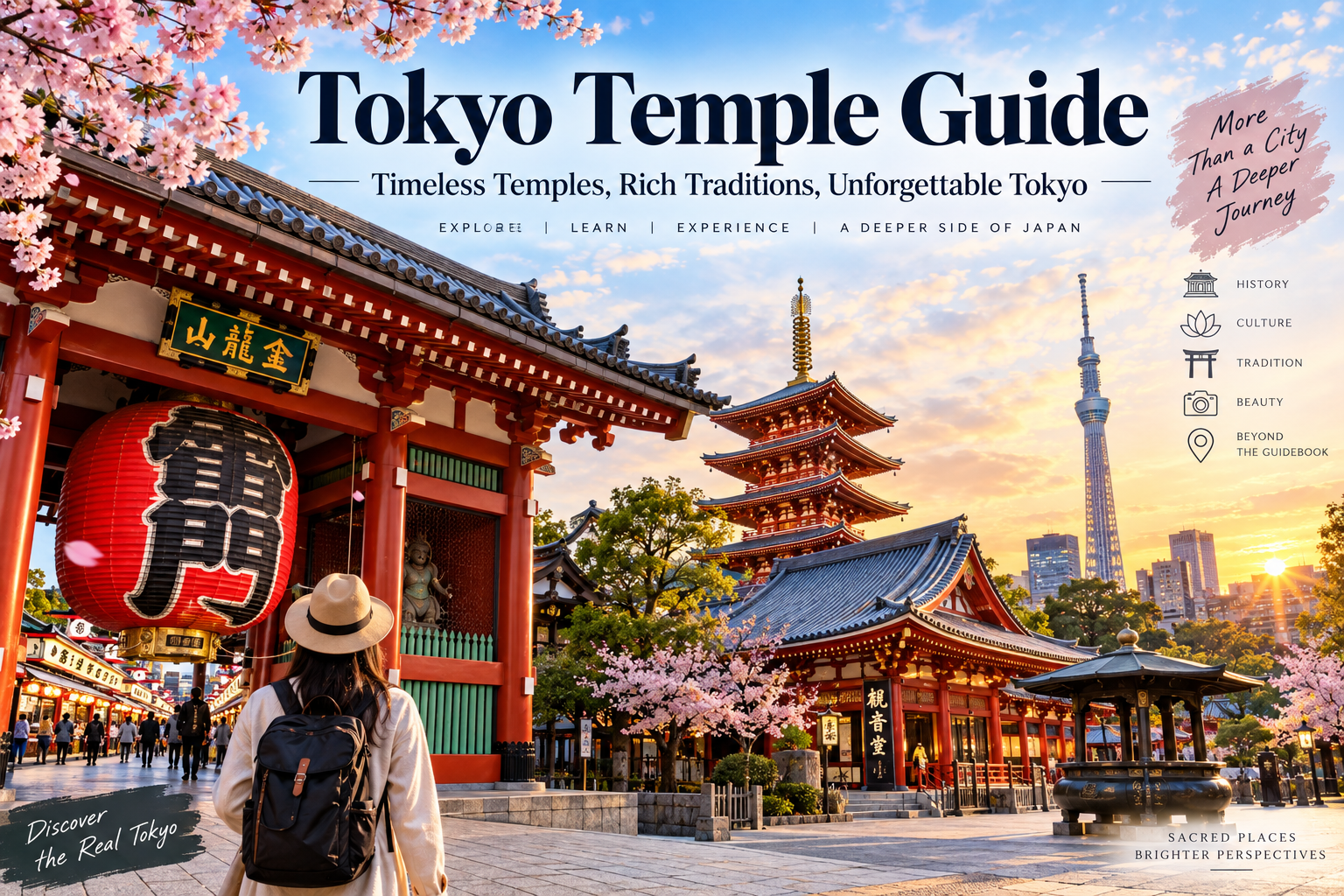
Tokyo Temple Guide: 15 Must-Visit Temples, Sacred Traditions, Etiquette
A good Tokyo temple guide should take you beyond famous photographs and explain what makes each temple historically, culturally and architecturally different. From the iconic Sensoji in Asakusa and historic Zojoji beside Tokyo Tower to quieter temples such as Gotokuji, Jindaiji and Sengakuji, Tokyo offers remarkable opportunities to experience Japanese Buddhist heritage within a modern metropolitan environment Tokyo Train Tips
Understanding Temples and Shrines in Tokyo
One of the first things international visitors should understand is that a temple and a shrine are not the same thing.
What is a Japanese temple?
A Buddhist temple is generally associated with Buddhism.
Japanese Buddhist temples may contain:
- Buddha images
- Buddhist halls
- Pagodas
- Incense burners
- Cemetery or memorial areas
- Buddhist gardens
- Sutras
- Religious statues
- Monastic facilities
Sensoji and Zojoji are examples of Buddhist temples.
What is a Japanese shrine?
A Shinto shrine is associated with Japan’s indigenous Shinto tradition.
Shrines commonly feature:
- Torii gates
- Shinto purification areas
- Shimenawa ropes
- Offerings
- Shrine buildings
- Ema plaques
- Omamori
- Shinto priests and shrine maidens
Meiji Jingu and Kanda Myojin are shrines, not temples. Official Tokyo tourism material lists Meiji Jingu separately as a Shinto shrine and Sensoji and Zojoji as temples.
Why visitors sometimes confuse them
Japanese religious history includes long periods of interaction between Buddhism and Shinto.
For travelers, the easiest approach is not to worry about memorizing every theological distinction before arriving.
Instead, learn the basic visual difference:
Torii = shrine
Buddhist gate = temple
There are exceptions and historical complexities, but this simple distinction is useful for first-time visitors.
Why Tokyo Has So Many Historic Temples
Tokyo was historically known as Edo.
During the Edo period, the city grew into a major political and cultural center under the Tokugawa shogunate.
Religious institutions became deeply connected to neighborhoods, communities, political authorities and everyday life.
This historical development helps explain why temples are distributed throughout Tokyo rather than concentrated in one isolated historic district.
Official Tokyo tourism information describes the city’s historical sites as places where the history of Edo continues to exist alongside modern high-rise buildings.
Temples survived despite repeated disasters
Tokyo’s history has included earthquakes, fires, wars and rapid redevelopment.
As a result, not every building standing today is original.
This is important when visiting historic temples.
A temple can be historically authentic even when individual buildings have been reconstructed.
Sensoji is an excellent example. JNTO explains that the temple has been rebuilt many times throughout its long history.
Zojoji provides another example. JNTO notes that many of its buildings were reconstructed after wartime destruction, while the Sangedatsumon gate survived and remains an Important Cultural Property.
Sensoji Temple: The Essential Starting Point
If someone asks for the first temple to visit in Tokyo, Sensoji is an obvious place to begin.
Located in Asakusa, Sensoji is widely regarded as Tokyo’s oldest temple and is one of the city’s most visited historic attractions. Official tourism sources describe it as a major destination where visitors can experience an Edo-era atmosphere.
The story behind Sensoji
According to tradition, two fishermen discovered a statue of Kannon in the Sumida River in 628.
The story became the foundation of Sensoji’s religious identity.
The temple was subsequently developed around the sacred statue, and its history became deeply connected with Asakusa.
Whether you approach the story as religious tradition, historical folklore or cultural heritage, it provides an important introduction to how legends can shape Japanese places.
Kaminarimon Gate
The first major landmark many visitors encounter is Kaminarimon, commonly translated as the Thunder Gate.
The enormous red lantern has become one of the most recognizable images of Tokyo.
JNTO notes that the lantern weighs approximately 700 kilograms and is almost four meters high.
The gate is guarded by figures associated with wind and thunder.
Nakamise-dori
After passing through Kaminarimon, visitors enter Nakamise-dori.
This approximately 250-meter-long shopping street leads toward the temple complex.
Traditional snacks, souvenirs, crafts and other products line the approach.
This is an important part of the Sensoji experience because it demonstrates how religion and commerce have historically coexisted around major pilgrimage destinations.
Hozomon Gate
Further ahead is Hozomon, the second major gate.
It leads into the main temple grounds.
The visual transition is striking.
The busy shopping street gives way to a more explicitly religious environment containing the pagoda, main hall and other structures.
Sensoji Main Hall
The main hall is dedicated to Kannon, the Buddhist figure associated with compassion.
Visitors may enter respectfully and observe worshippers paying their respects.
The best approach is to slow down rather than immediately begin taking photographs.
Sensoji for photographers
Sensoji is particularly rewarding for photography because there are several visual layers:
- Kaminarimon
- Nakamise-dori
- Hozomon
- Five-story pagoda
- Main hall
- Incense burner
- Traditional architecture
- Street scenes
- Seasonal decorations
Early morning can be especially attractive for visitors who want a quieter atmosphere.
GO TOKYO specifically recommends early visits to Sensoji and other temples and shrines for travelers seeking quieter morning experiences.
Zojoji Temple: Old Tokyo Beneath Tokyo Tower
Zojoji provides perhaps one of the most dramatic visual contrasts in Tokyo.
On one side is a historic Buddhist temple.
Behind it rises Tokyo Tower.
This is old and modern Tokyo appearing in the same frame.
Why Zojoji matters historically
Zojoji has a strong connection with the Tokugawa family.
JNTO explains that Tokugawa Ieyasu moved the temple to its current location in 1598 and that the temple became an important center for the Jodo sect.
Several Tokugawa leaders are buried at the site.
Sangedatsumon Gate
The large red Sangedatsumon gate is particularly important.
According to JNTO, it dates to 1622 and survived fires, earthquakes and wars.
It is designated an Important Cultural Property.
The Tokugawa mausoleum
Behind the main temple complex is the Tokugawa mausoleum area.
The site contains the graves of six Tokugawa rulers who became shoguns.
For history enthusiasts, this makes Zojoji much more than a scenic temple.
It provides a direct connection with the political history of Edo Japan.
Zojoji and Tokyo Tower
The contrast between temple architecture and Tokyo Tower has become one of the city’s most recognizable compositions.
It is also a useful reminder that Tokyo doesn’t necessarily divide its history into separate zones.
The ancient, early-modern and contemporary city often occupy the same landscape.
Gotokuji Temple: The Temple Associated With Maneki-neko
Gotokuji is particularly interesting for travelers fascinated by Japanese symbolism.
The temple is strongly associated with the maneki-neko, the beckoning cat figure commonly found in shops and businesses around Japan.
Why Gotokuji attracts visitors
Visitors often come specifically because of the temple’s connection with the lucky cat tradition.
Rows of cat figures create a visually distinctive scene.
For travelers interested in Japanese popular culture, symbolism and souvenirs, Gotokuji offers a different experience from Sensoji.
Beyond the famous cats
One mistake is to visit Gotokuji only to photograph the cat statues.
The temple itself has a history and religious environment worth experiencing.
Take time to observe:
- Temple buildings
- Grounds
- Trees
- Stonework
- Religious objects
- Seasonal scenery
The best temple visits combine the famous attraction with the wider cultural setting.
Jindaiji Temple: A Historic Escape From Central Tokyo
Jindaiji Temple provides a completely different atmosphere.
Located in Chofu, it is surrounded by greenery and has a more traditional, local feeling than the major tourist destinations in central Tokyo.
Why Jindaiji is special
Jindaiji is one of the historic temples highlighted by Tokyo tourism authorities and is frequently included in educational and cultural itineraries.
The surrounding area is also associated with soba restaurants and traditional streets.
This makes it easy to combine cultural sightseeing with local food.
Jindaiji for travelers who dislike crowds
If you have already visited Sensoji and want something more relaxed, Jindaiji can provide a useful contrast.
Instead of enormous crowds moving through a major tourist corridor, the experience feels more intimate.
Sengakuji Temple: A Powerful Samurai History
Sengakuji is particularly important for travelers interested in samurai history.
The temple is associated with the famous story of the Forty-seven Ronin.
Why the Forty-seven Ronin story matters
The story has become one of Japan’s most enduring historical and cultural narratives.
It concerns loyalty, duty, revenge and the samurai code.
The temple contains the graves associated with the story.
A different kind of temple visit
Sengakuji is less about spectacular architecture and more about historical meaning.
This is a valuable lesson when building a Tokyo temple itinerary.
Not every temple needs to be visually enormous to be culturally significant.
Tennoji Temple: A Quiet Stop Near Yanaka
Yanaka is one of Tokyo’s most atmospheric historic neighborhoods.
Tennoji Temple is part of this broader environment.
Why combine Tennoji with Yanaka?
Yanaka is known for:
- Traditional streets
- Cemeteries
- Temples
- Small shops
- Independent businesses
- Residential neighborhoods
- Historic atmosphere
A temple visit here becomes part of a larger walking experience.
Instead of traveling from one isolated attraction to another, you can explore the neighborhood on foot.
Kaneiji Temple Area: Ueno’s Religious History
The Ueno area contains a fascinating mixture of museums, parks, temples and historical sites.
Kaneiji played an important role in the history of Edo.
Although today’s Ueno landscape is much smaller than the enormous temple complex that existed historically, its legacy remains visible in the area.
Why Ueno works well for history lovers
A temple-focused day can be combined with:
- Ueno Park
- Museums
- Traditional streets
- Cultural institutions
- Other historic religious sites
This creates a broader historical understanding of Tokyo.
Hosen-in and Smaller Neighborhood Temples
Tokyo contains many smaller Buddhist temples that rarely appear on international travel lists.
This is where repeat visitors can discover a more intimate side of the city.
Why smaller temples matter
A small neighborhood temple may not have:
- A famous gate
- A huge lantern
- A globally recognized photograph
- Millions of annual visitors
But it may still function as an important part of local community life.
The hidden-gem principle
When visiting smaller temples, remember that you are more likely to encounter an active religious community.
That means discretion becomes even more important.
Avoid treating every religious object as a photo prop.
Tokyo Temple Architecture Explained
One of the most rewarding ways to improve your temple visits is to learn how to read the architecture.
Gates
Temple gates can mark a transition between ordinary space and sacred space.
Some are enormous and elaborate.
Others are modest wooden structures.
Main halls
The main hall generally houses important Buddhist images or serves religious functions.
Different Buddhist traditions use different terminology and architectural arrangements.
Pagodas
Pagodas developed from Buddhist architectural traditions and historically served as structures associated with Buddhist relics and symbolism.
The five-story pagoda at Sensoji is one of Tokyo’s most recognizable examples.
Incense burners
Incense is an important part of many Buddhist temple environments.
Visitors may observe worshippers using incense before entering or approaching religious buildings.
The smoke and scent also contribute strongly to the atmosphere of traditional temple grounds.
Temple gardens
Gardens can provide spaces for contemplation.
They may incorporate:
- Rocks
- Water
- Moss
- Trees
- Bridges
- Gravel
- Carefully arranged vegetation
A garden should not necessarily be judged like a European formal garden.
Its visual language is often based on balance, suggestion and controlled simplicity.
Tokyo Temple Etiquette for First-Time Visitors
Knowing basic etiquette can make the experience more comfortable.
Dress respectfully
There is generally no universal temple uniform requirement for ordinary visitors.
However, modest and respectful clothing is appropriate.
When visiting religious buildings, avoid unnecessarily revealing clothing and behave quietly.
Keep your voice down
Temples can be busy, but they remain religious environments.
Avoid shouting or loud conversations near worship areas.
Photography requires awareness
Photography may be allowed in many outdoor areas, but restrictions can apply to specific buildings or objects.
Always follow posted instructions.
If photography is prohibited, don’t assume you can take a quick picture because nobody is watching.
Don’t touch religious objects unnecessarily
A statue, rope, gate or decorative object may have religious significance.
Look rather than touch unless interaction is clearly permitted.
Follow local instructions Tokyo temple guide
Rules vary between sites.
A famous temple does not necessarily have the same rules as a small neighborhood temple.
How to Pray at a Buddhist Temple
Visitors often ask whether there is a correct way to pray at a Japanese Buddhist temple.
Practices can vary according to temple tradition.
A respectful basic approach Tokyo temple guide
A simple approach is:
- Enter respectfully.
- Observe what local worshippers are doing.
- Follow posted instructions.
- Make an offering if appropriate.
- Bow or otherwise pay your respects according to the site’s customs.
- Avoid blocking other worshippers.
The most important principle is respect rather than performing a ritual perfectly for social media.
Temple and Shrine Etiquette Are Not Identical
This is one of the most common areas of confusion.
Buddhist temples Tokyo temple guide
Visitors may encounter incense, Buddhist statues and temple halls.
Shinto shrines Tokyo temple guide
Visitors may encounter torii gates and purification fountains.
Meiji Jingu and Kanda Myojin are examples of Shinto shrines rather than Buddhist temples.
Why the distinction matters Tokyo temple guide
Using the correct terminology demonstrates cultural awareness.
If you publish travel content about Tokyo, this distinction also improves factual accuracy and helps readers understand what they are seeing.
Meiji Jingu: Include It, But Call It a Shrine
No Tokyo cultural guide is complete without discussing Meiji Jingu, even though it is not a temple.
Located near Harajuku, Meiji Jingu is surrounded by a large forest and is one of Tokyo’s most important Shinto sites.
GO TOKYO describes its forest as containing approximately 100,000 trees donated from around Japan.
Why temple travelers should visit Meiji Jingu
It provides a useful comparison.
After visiting Sensoji, the different atmosphere of a Shinto shrine becomes easier to appreciate.
This allows travelers to understand that Tokyo’s religious heritage is broader than Buddhism alone.
Kanda Myojin: Tradition Meets Modern Tokyo
Kanda Myojin is another shrine rather than a temple.
Its location near Akihabara creates a particularly unusual cultural combination.
JNTO notes that the shrine has a history stretching back approximately 1,300 years and has become popular among anime fans because of its proximity to Akihabara.
Why Kanda Myojin is culturally fascinating
It demonstrates that traditional religious institutions can exist alongside contemporary Japanese popular culture.
This is a valuable theme for understanding modern Tokyo.
Tradition in Japan is not necessarily frozen in the past.
It continues to interact with contemporary communities.
Best Tokyo Temples for History Lovers
History enthusiasts should consider:
- Sensoji
- Zojoji
- Sengakuji
- Kaneiji
- Jindaiji
Why these temples stand out Tokyo temple guide
Each represents a different layer of Tokyo history.
Sensoji connects strongly with Asakusa and the long religious history of the city.
Zojoji connects with the Tokugawa political order.
Sengakuji connects with the samurai-era story of the Forty-seven Ronin.
Jindaiji offers a quieter historical atmosphere outside central Tokyo.
Best Tokyo Temples for First-Time Visitors
For a first trip, consider:
Sensoji Tokyo temple guide
Best for iconic Tokyo imagery and Edo atmosphere.
Zojoji Tokyo temple guide
Best for combining history with Tokyo Tower.
Jindaiji Tokyo temple guide
Best for a calmer traditional atmosphere.
Gotokuji Tokyo temple guide
Best for maneki-neko symbolism.
Sengakuji Tokyo temple guide
Best for samurai history.
This isn’t a ranking. Each temple answers a different travel interest.
Best Tokyo Temples for Families
Families often benefit from temples where there are additional things to explore nearby.
Sensoji and Asakusa
Asakusa provides:
- Temple architecture
- Shopping
- Snacks
- Traditional streets
- River access
- Views toward Tokyo Skytree
JNTO highlights the surrounding traditional shopping streets and attractions as part of the Asakusa experience.
Zojoji and Tokyo Tower
The combination gives children and adults different things to appreciate.
Adults may be interested in history and architecture, while younger visitors may enjoy Tokyo Tower.
Best Tokyo Temples for Couples
Couples may prefer temples where the visit can be combined with neighborhood exploration.
Sensoji and Asakusa
Explore the temple before walking through Asakusa.
Zojoji and Shiba Park
The temple’s location near Tokyo Tower makes it easy to create a broader sightseeing route.
Jindaiji
A quieter environment may suit travelers looking for a slower day.
Best Tokyo Temples for Solo Travelers
Solo travelers can benefit from visiting early.
GO TOKYO specifically highlights temples and shrines such as Sensoji and Meiji Jingu as suitable for quiet morning visits.
Why mornings work
Early visits can provide:
- Fewer people
- Softer light
- Cooler temperatures
- More peaceful surroundings
- Better opportunities for observation
The experience becomes less about checking an attraction off a list and more about actually being present.
Best Tokyo Temples for Photographers
Sensoji Tokyo temple guide
Ideal for architecture and street photography.
Zojoji Tokyo temple guide
Ideal for old-meets-new compositions.
Gotokuji Tokyo temple guide
Ideal for repetitive patterns and cultural details.
Jindaiji Tokyo temple guide
Ideal for greenery and traditional atmosphere.
Sengakuji Tokyo temple guide
Ideal for historical and architectural storytelling.
Best Tokyo Temples for Autumn Tokyo temple guide
Autumn is especially beautiful around temple gardens and wooded grounds.
Look for:
- Maple leaves
- Ginkgo trees
- Moss
- Stone lanterns
- Wooden buildings
- Morning mist
- Seasonal illumination where officially offered
Don’t assume every temple reaches peak color simultaneously.
Microclimates and tree species can change the timing.
Best Tokyo Temples in Spring
Spring brings fresh greenery and flowers.
However, temple visits during cherry blossom season can become extremely busy.
The hidden downside of cherry blossom season
A photograph showing an empty temple courtyard can create unrealistic expectations.
Popular Tokyo sites can become crowded during major seasonal events.
If tranquility is your priority, consider visiting outside the most famous flowering periods or arriving early.
Tokyo Temples in Rain
Rain can actually improve the atmosphere of certain temple districts.
Wet stone, darker wooden structures and reflections can create a beautiful visual environment.
GO TOKYO specifically recommends Meiji Jingu as one cultural option during lighter rain and notes that rain can reduce crowds.
What to bring Tokyo temple guide
For rainy temple visits:
- Compact umbrella
- Waterproof outer layer
- Comfortable shoes
- Protective bag for electronics
- Small towel
- Waterproof phone protection
Tokyo Temple Guide for Budget Travelers
Many temple grounds can be visited without expensive admission, although specific halls, gardens, museums or special exhibitions may charge fees.
GO TOKYO identifies temples and shrines as part of Tokyo’s free and affordable cultural experiences.
How to keep temple sightseeing affordable Tokyo temple guide
Use public transportation.
Walk between nearby attractions.
Combine temples with neighborhood exploration.
Eat at local restaurants rather than tourist-focused establishments around major attractions.
Check official websites for current admission information.
Tokyo Temple Guide for Luxury Travelers
Luxury travelers can approach temples differently.
Instead of rushing through five sites in one morning, spend more time understanding one or two locations.
A slower temple itinerary might include
- Private cultural guidance
- Traditional dining
- Garden visits
- Neighborhood walking
- Craft experiences
- Carefully planned photography
- Temple-related cultural experiences where officially available
GO TOKYO also highlights temple stays, known as shukubo, as one way to explore Buddhist traditions in Tokyo.
Temple Stays and Buddhist Cultural Experiences
Some travelers want more than sightseeing.
They want participation.
Temple stays can provide a more immersive perspective on Buddhist culture.
What makes a temple stay different?
Depending on the location and program, experiences may include:
- Meditation
- Vegetarian Buddhist cuisine
- Morning activities
- Quiet accommodation
- Exposure to temple routines
Availability and participation requirements vary, so always confirm directly with the temple or official tourism source before making plans.
Tokyo Temple Guide for Food Lovers
Temples themselves are not primarily food attractions, but many temple districts have strong culinary traditions.
Sensoji and Asakusa Tokyo temple guide
Asakusa is especially useful for visitors who want to combine temple sightseeing with traditional snacks and local restaurants.
Jindaiji Tokyo temple guide
Jindaiji is strongly associated with soba.
This makes it a particularly natural temple-and-food destination.
Why temple districts developed food cultures
Religious sites historically attracted visitors.
Where people gather, food businesses develop.
That relationship can still be seen in many temple neighborhoods.
Ten Travel and Outdoor Brands to Consider for Temple Visits
The requested brand comparison is best understood as a travel-equipment reference, rather than a ranking. Most temple sightseeing does not require specialist equipment, but comfortable footwear, bags and weather protection can make a long Tokyo cultural itinerary considerably easier.
| Brand | Main strength | Useful for Tokyo temple visits | Best suited to |
|---|---|---|---|
| Uniqlo | Everyday clothing and layers | Lightweight clothing and seasonal layers | General travelers |
| MUJI | Minimalist travel goods | Simple bags, organizers and travel accessories | Minimalist travelers |
| Montbell | Outdoor equipment | Lightweight rainwear and walking gear | Travelers combining temples and hiking |
| The North Face | Outdoor apparel | Weather protection and daypacks | Active travelers |
| Patagonia | Outdoor clothing | Layers and rain protection | Outdoor-conscious travelers |
| Salomon | Walking and trail footwear | Comfortable footwear for long walking days | Active walkers |
| Merrell | Walking/hiking shoes | Supportive footwear | Temple + neighborhood explorers |
| Osprey | Backpacks | Daypacks and travel storage | Long sightseeing days |
| KEEN | Outdoor footwear | Comfortable walking shoes | Casual outdoor travelers |
| Columbia | Outdoor clothing | Jackets and versatile travel layers | General outdoor travelers |
Why footwear matters Tokyo temple guide
Tokyo temple sightseeing often involves much more walking than visitors expect.
A day that begins at Sensoji may continue through Asakusa, Ueno, Akihabara or another neighborhood.
Comfortable footwear can therefore be more important than expensive clothing.
Tokyo Temple Guide: Planning a One-Day Temple Route
A carefully designed route can reduce unnecessary travel.
Morning: Sensoji Tokyo temple guide
Start in Asakusa.
Explore Kaminarimon, Nakamise-dori and the temple grounds.
Late morning: Asakusa neighborhood
Walk around nearby historic streets.
Afternoon: Zojoji Tokyo temple guide
Travel toward Zojoji.
Explore the temple and surrounding area.
Evening: Tokyo Tower area Tokyo temple guide
Finish with the modern Tokyo skyline.
This creates a powerful historical progression:
Edo-era heritage → Buddhist culture → modern Tokyo
Tokyo Temple Guide: A Two-Day Cultural Itinerary
A two-day plan provides more breathing room.
Day one Tokyo temple guide
Visit:
- Sensoji
- Asakusa
- Nearby historic areas
Day two Tokyo temple guide
Visit:
- Zojoji
- Sengakuji
- Another smaller temple or cultural district
This approach avoids the common mistake of trying to visit every famous temple in one day.
Tokyo Temple Guide: Three-Day Cultural Itinerary
For travelers with more time:
Day one Tokyo temple guide
Explore Asakusa and Sensoji.
Day two Tokyo temple guide
Explore Zojoji, Shiba Park and nearby historical sites.
Day three Tokyo temple guide
Choose a quieter destination such as Jindaiji or Gotokuji.
This creates variety instead of repeating the same type of tourist experience.
Common Mistakes When Visiting Tokyo Temples
Mistake 1: Treating every religious building as a tourist attraction
Remember that these are active religious places.
Mistake 2: Confusing temples and shrines
Sensoji is a temple.
Meiji Jingu is a shrine.
Kanda Myojin is a shrine.
Mistake 3: Visiting only for photographs
Take time to understand what you are seeing.
Mistake 4: Ignoring opening hours
Some temple buildings, museums and gardens have separate schedules.
GO TOKYO’s current temple listings specifically advise checking information beforehand because conditions can change.
Mistake 5: Assuming every temple is free
Some areas or special exhibitions may charge admission.
Mistake 6: Visiting only at midday
Morning can offer a calmer experience.
Mistake 7: Forgetting local neighborhoods
A temple is often best understood within the district around it.
How to Photograph Tokyo Temples Respectfully
Photography is one of the major reasons international travelers visit Japanese temples.
But photography should never overwhelm the religious environment.
Photograph architecture
Focus on:
- Rooflines
- Gates
- Lanterns
- Wooden details
- Stone paths
- Gardens
- Pagodas
Photograph atmosphere
Instead of only taking front-facing building photographs, capture:
- Morning light
- Incense smoke
- Rain reflections
- Seasonal foliage
- Shadows
- Doorways
- Quiet pathways
Don’t photograph everything
Sometimes putting the camera away produces the strongest travel memory.
Tokyo Temples and Sustainable Tourism
Tourism brings economic benefits to historic districts, but high visitor numbers can also create pressure.
Popular temples must balance:
- Religious activity
- Local residents
- Tourism
- Conservation
- Waste management
- Visitor safety
- Cultural preservation
How travelers can help
Visitors can:
- Follow signs
- Avoid restricted areas
- Keep noise down
- Dispose of waste properly
- Support legitimate local businesses
- Avoid damaging structures
- Respect photography restrictions
- Avoid blocking worshippers
Small actions become significant when millions of people visit.
Tokyo Temple Guide and Accessibility
Accessibility varies considerably.
Major tourist attractions may have more visitor infrastructure than small historic temples.
Before visiting, check
- Entrance routes
- Steps
- Elevators
- Restrooms
- Seating
- Terrain
- Crowds
- Accessible transport
Tokyo’s official tourist information centers provide practical information for visitors and currently operate at locations including the Tokyo Metropolitan Government Building, Busta Shinjuku, Haneda Airport, Keisei Ueno, Yaesu and Tama.
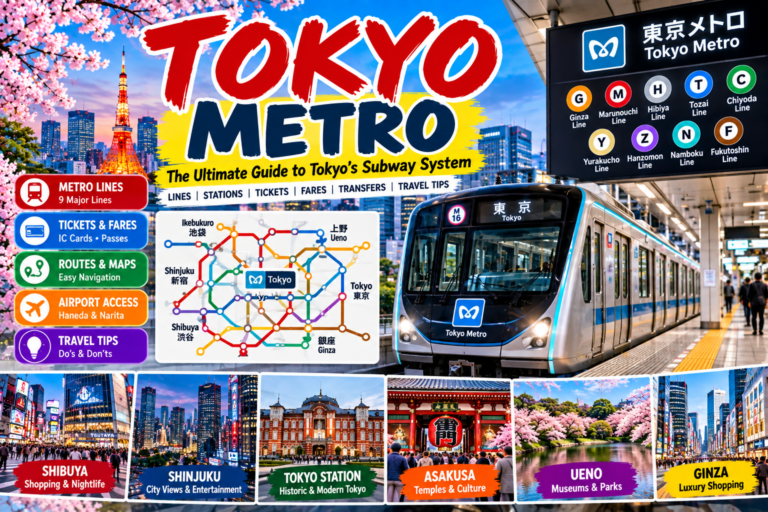
Tokyo Temples and Public Transportation
Tokyo’s rail network makes many major temple districts accessible.
Sensoji
The temple is approximately a five-minute walk from several Asakusa-area stations, according to JNTO.
Zojoji
Zojoji can be reached from several subway stations and is approximately a 10-minute walk from Hamamatsucho Station according to JNTO.
Kanda Myojin
Although it is a shrine rather than a temple, Kanda Myojin is particularly convenient for visitors exploring Akihabara and nearby areas. JNTO describes it as approximately a five-minute walk from Ochanomizu or Suehirocho stations.
Tokyo Temple Guide for First-Time Japan Visitors
If Japan is completely new to you, don’t try to learn every Buddhist and Shinto practice before your trip.
Start with a few principles:
Observe before acting
Watch what local visitors do.
Follow signs
Official instructions exist for a reason.
Keep religious spaces calm
Your behavior contributes to the atmosphere.
Ask when uncertain
If a particular practice is unclear, seek information from official staff or a tourist information center.
Don’t worry about being perfect
Respectful curiosity is more important than knowing every detail.
Tokyo Temple Guide for Repeat Visitors
Repeat visitors should move beyond the most famous locations.
Explore neighborhood temples
Walk through Yanaka.
Visit Jindaiji.
Explore Gotokuji.
Look for smaller Buddhist temples in residential districts.
Why this works
The more familiar you become with Tokyo, the more interesting its quieter religious sites can become.
The city starts to feel less like a collection of attractions and more like a living cultural landscape.
Hidden Lessons Tokyo Temples Teach Travelers
The most valuable part of a temple visit may not be the building.
History is layered
A temple can contain evidence of several different periods.
Cities evolve without completely erasing the past
Zojoji beside Tokyo Tower is an obvious example.
Tradition can coexist with modern culture
Kanda Myojin’s relationship with Akihabara demonstrates this particularly well.
Religious places remain part of everyday life Tokyo temple guide
Temples are not simply museums.
They continue to serve communities.
Future Trends in Tokyo Temple Tourism
Tokyo temple tourism is likely to evolve as travelers increasingly seek meaningful cultural experiences rather than simply collecting famous attractions.
More demand for immersive experiences Tokyo temple guide
Travelers increasingly want to understand:
- Religion
- Food
- Craft
- Architecture
- History
- Local neighborhoods
rather than simply photograph landmarks.
More multilingual information Tokyo temple guide
International tourism requires clearer explanations of etiquette, history and visitor rules.
Tokyo’s official tourism infrastructure already provides multilingual visitor information and tourist information centers.
Greater emphasis on responsible tourism Tokyo temple guide
As visitor numbers remain significant, cultural preservation and respectful behavior will become increasingly important.
Digital discovery will continue growing Tokyo temple guide
Travelers will increasingly discover temples through:
- Search engines
- Travel blogs
- Maps
- Social media
- Digital guides
- AI travel planning
This makes accurate, respectful travel information more important than ever.
How to Build a Better Tokyo Temple Guide for Searchers
For travelers researching Tokyo temples online, broad queries are only the beginning.
People increasingly search with specific needs.
Tokyo temple guide for beginners
Explain etiquette, transport and what to expect.
Tokyo temple guide for families
Focus on accessibility, nearby attractions and walking requirements.
Tokyo temple guide for couples
Emphasize atmosphere, gardens and neighborhood experiences.
Tokyo temple guide for photographers
Discuss architecture, seasonal light and photography restrictions.
Tokyo temple guide without crowds
Explain early-morning and weekday strategies.
Tokyo temple guide near Tokyo Station
Focus on temples reachable without lengthy travel.
Tokyo temple guide near Shibuya
Include practical routes toward western and central cultural sites.
Tokyo temple guide for history lovers
Prioritize Sensoji, Zojoji, Sengakuji and other historically significant locations.
Tokyo temple guide for autumn
Focus on seasonal foliage and quieter temple environments.
Tokyo temple guide for rainy days
Highlight temples and shrines that remain atmospheric in wet weather.
Pros and Cons of Visiting Tokyo temple guide
Advantages Tokyo temple guide
- Rich history
- Strong architectural variety
- Easy integration into sightseeing itineraries
- Many locations accessible by public transportation
- Excellent seasonal scenery
- Opportunities for cultural learning
- Suitable for different budgets
- Strong photography opportunities
- Connections with Japanese history
- Options ranging from famous landmarks to quiet neighborhood temples
Challenges Tokyo temple guide
- Famous temples can become crowded
- Some visitors may misunderstand religious etiquette
- Opening hours vary
- Some facilities may charge separate fees
- Not every site is equally accessible
- Popular seasonal periods can be busy
- Some smaller sites have limited English information
- Photography restrictions can apply
The solution is not to avoid popular temples.
Instead, plan intelligently.
Visit major sites early, research smaller locations beforehand and give yourself enough time to actually experience each place.
FAQs
What is the best temple to visit in Tokyo?
There is no single temple that suits every traveler. Sensoji is an excellent starting point for first-time visitors because of its history, architecture, Asakusa setting and accessibility. Zojoji is particularly interesting for travelers who want Tokugawa history and the dramatic Tokyo Tower backdrop.
What is the most famous temple in Tokyo?
Sensoji in Asakusa is one of Tokyo’s most famous temples and is described by official tourism sources as Tokyo’s oldest temple.
How old is Sensoji Temple?
According to its traditional origin story, Sensoji dates back to 628, when a Kannon statue was reportedly discovered in the Sumida River.
Is Sensoji free to visit?
The temple grounds can generally be visited without an entrance fee, although specific attractions or special facilities may have separate charges. Always check current official information before visiting.
What should I wear to a Tokyo temple?
Comfortable and respectful clothing is appropriate. There is generally no need for formal clothing for ordinary sightseeing, but visitors should avoid unnecessarily revealing attire and behave respectfully.
Can I take photographs inside Tokyo temples?
Photography rules vary. Outdoor areas may permit photography while specific halls, religious objects or exhibitions may prohibit it. Always follow posted signs and instructions.
Is Meiji Jingu a temple?
No. Meiji Jingu is a Shinto shrine. It is worth including in a Tokyo religious-site itinerary because it provides a useful comparison with Buddhist temples such as Sensoji and Zojoji.
Is Kanda Myojin a temple?
No. Kanda Myojin is a Shinto shrine located near Akihabara.
What is the difference between a shrine and a temple?
A Buddhist temple is associated with Buddhism, while a Shinto shrine is associated with Shinto. Temples often contain Buddhist statues and halls, while shrines commonly feature torii gates and Shinto ritual spaces.
What is the best time to visit Sensoji?
Early morning is a strong option for visitors who want a quieter atmosphere. GO TOKYO specifically recommends early visits to Sensoji and other major temples and shrines.
How long should I spend at Sensoji?
A quick visit can take around an hour, but travelers interested in photography, history, shopping and Asakusa can easily spend several hours in the broader area.
Is Zojoji worth visiting?
Zojoji is particularly valuable for visitors interested in Japanese history because of its Tokugawa connections. Its location beside Tokyo Tower also creates one of Tokyo’s strongest old-and-new visual contrasts.
Can I visit Tokyo temples with children?
Yes. Major temple areas such as Sensoji can be combined with family-friendly attractions and neighborhoods. Choose routes according to children’s walking ability and allow regular breaks.
Which Tokyo temple is associated with lucky cats?
Gotokuji is strongly associated with the maneki-neko, or beckoning cat, tradition and attracts visitors interested in this distinctive Japanese symbol.
Which Tokyo temple is associated with the Forty-seven Ronin?
Sengakuji is associated with the famous Forty-seven Ronin story and their graves.
Which Tokyo temple is best for history lovers?
Sensoji, Zojoji and Sengakuji each offer different historical perspectives. Sensoji provides long religious and Asakusa history, Zojoji connects with the Tokugawa shogunate, and Sengakuji connects with the Forty-seven Ronin tradition.
Can I visit Tokyo temples during rain?
Yes. Light rain can create atmospheric conditions around wooden buildings, gardens and stone pathways. However, visitors should use appropriate rain protection and be careful on wet surfaces.
Are Tokyo temples open every day?
Many major temples welcome visitors throughout the year, but individual buildings, museums, gardens and special areas can have different schedules. Check the official website before your visit. GO TOKYO’s current temple information specifically recommends checking in advance because circumstances can change.
Are Tokyo temples crowded?
The most famous temples can be very crowded, particularly during weekends, holidays and popular seasonal periods. Early mornings and weekdays generally provide a calmer experience.
Can I visit multiple temples in one day?
Yes, but quality is often better than quantity. Two or three well-planned locations can provide a more meaningful experience than rushing through six or seven.
Are Tokyo temples suitable for solo travelers?
Yes. Temple districts can be particularly enjoyable for solo travelers because they allow flexible pacing and quiet observation.
Are Tokyo temples suitable for photographers?
Yes, but photography should always respect religious rules and worshippers. Sensoji, Zojoji and several smaller temple districts provide excellent architectural and seasonal photography opportunities.
Is Tokyo temple sightseeing expensive?
It does not have to be. Many temple grounds can be visited inexpensively, and Tokyo tourism authorities include temples and shrines among the city’s free and affordable cultural experiences.
Can I combine temples with shopping?
Absolutely. Sensoji is one of the best examples because Nakamise-dori connects the Kaminarimon entrance with the temple complex and contains many shops and food stalls.
Can I combine a temple visit with Tokyo Tower?
Yes. Zojoji is located directly in the Tokyo Tower area and provides a particularly convenient combination of historic and modern Tokyo attractions.
What is the best Tokyo temple for a quiet experience?
Smaller neighborhood temples generally provide a quieter atmosphere than major attractions such as Sensoji. Jindaiji and temple areas around Yanaka can be useful options for travelers seeking a slower cultural experience.
Conclusion
Tokyo’s temples reveal a side of the capital that can easily disappear behind its futuristic skyline. Sensoji introduces visitors to the historic atmosphere of Asakusa. Zojoji connects Buddhist heritage with the Tokugawa shogunate and the modern silhouette of Tokyo Tower. Gotokuji introduces the cultural symbolism of the maneki-neko. Jindaiji provides a greener, slower atmosphere, while Sengakuji opens a window into one of Japan’s most enduring samurai stories. But the most important lesson is that Tokyo’s temples should not be treated as a checklist.



2 Comments