Tokyo Quarters: 20 Amazing Districts to Explore, Where to Stay & What to See
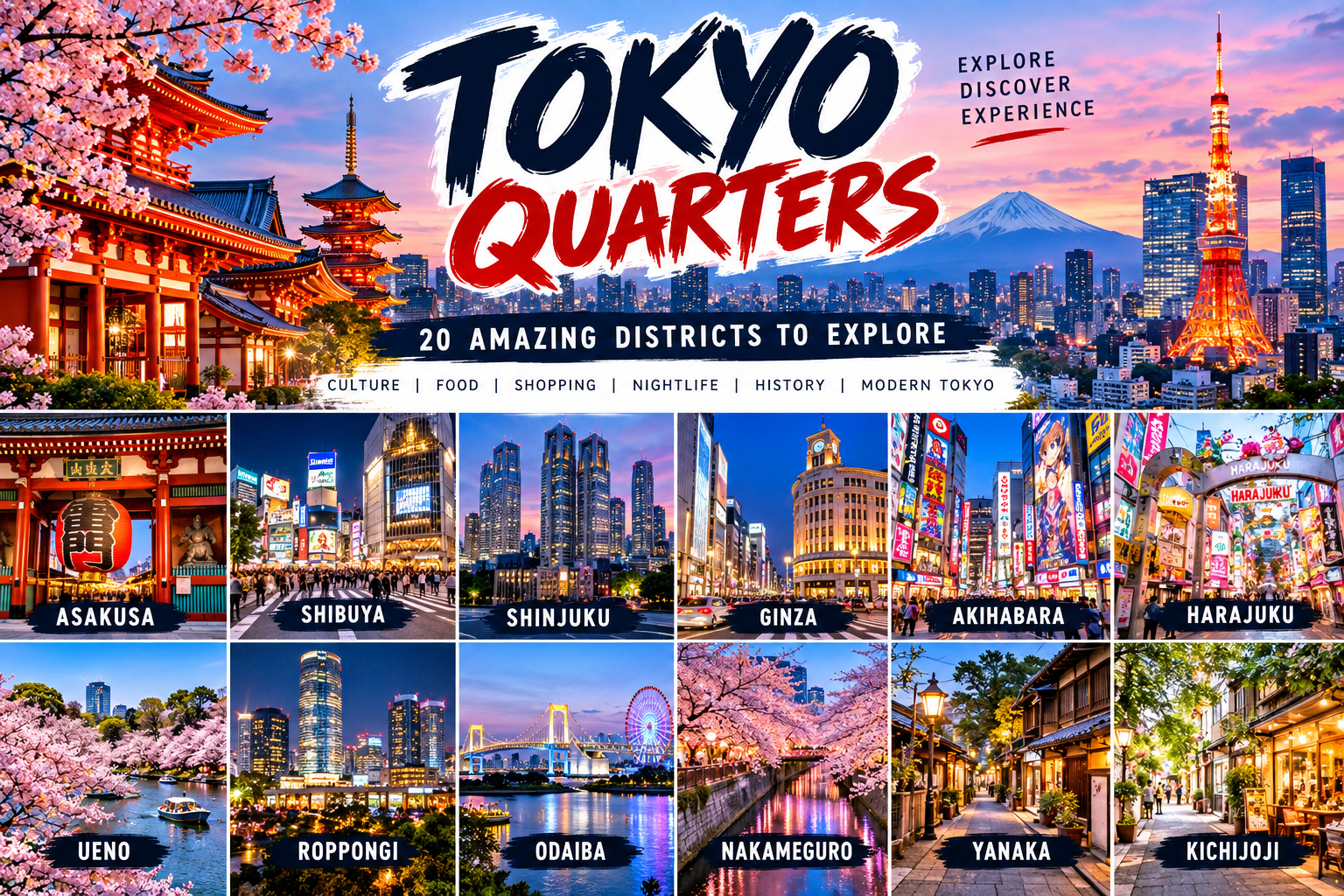
Have you ever looked at a map of Tokyo and wondered how one city can contain so many completely different worlds? Tokyo quarters are the neighborhoods and districts that give the capital its distinctive character, from historic Asakusa and traditional Ueno to energetic Shibuya, sophisticated Ginza, futuristic Odaiba, and peaceful Yanaka. Understanding these areas makes it much easier to plan where to stay, what to visit, where to eat, and how to experience Tokyo beyond the most famous attractions. Tokyo is often described as a single enormous city, but that description can be misleading Tokyo Airports
Understanding Tokyo Quarters
The phrase “Tokyo quarters” can be used broadly to describe different parts of the city. Tokyo does not have one official administrative system called “quarters” in the same way some cities use boroughs or quarters.
Instead, Tokyo includes 23 special wards, along with numerous neighborhoods and districts within those wards.
For travelers, neighborhood identity is often more useful than administrative boundaries.
Tokyo Wards vs Tokyo Neighborhoods
The 23 special wards include areas such as:
- Shinjuku
- Shibuya
- Taito
- Chiyoda
- Chuo
- Minato
- Bunkyo
- Toshima
- Meguro
- Setagaya
- Sumida
- Koto
- Shinagawa
- Nakano
- Suginami
- Nerima
- Itabashi
- Kita
- Arakawa
- Adachi
- Katsushika
- Edogawa
- Ota
Inside these wards are famous neighborhoods such as Ginza, Asakusa, Akihabara, Harajuku, Shibuya, Ueno, Yanaka, Kichijoji, Shimokitazawa, and many others.
Why Neighborhoods Matter More to Tourists
A traveler usually does not say, “I want to explore Chuo Ward.”
Instead, they might say:
- “I want to explore Ginza.”
- “I want to see Akihabara.”
- “I want to visit Asakusa.”
- “I want to experience Shibuya.”
- “I want traditional Tokyo.”
This neighborhood-level approach makes Tokyo easier to understand.
Why Tokyo Quarters Are So Different
Tokyo’s neighborhoods developed at different times and for different purposes.
Some areas grew around temples and historic roads. Others developed around railway stations. Some became commercial centers, while others became residential communities.
Modern Tokyo therefore combines several layers of history.
The Historic Layer
Neighborhoods such as Asakusa, Ueno, Yanaka, and parts of Nihombashi retain strong connections to older Tokyo.
Visitors can find:
- Traditional temples
- Shrines
- Old shopping streets
- Historic architecture
- Traditional crafts
- Long-established restaurants
The Modern Layer
Shibuya, Shinjuku, Roppongi, and Odaiba represent another side of Tokyo.
They are associated with:
- Skyscrapers
- Digital technology
- Fashion
- Entertainment
- Contemporary architecture
- Nightlife
- Large commercial developments
The Residential Layer
Neighborhoods such as Kichijoji, Koenji, Jiyugaoka, and Nakameguro show how ordinary Tokyo life can feel outside the biggest tourist centers.
These districts often combine:
- Small cafes
- Independent stores
- Residential streets
- Local restaurants
- Parks
- Boutique businesses
That combination is one of the most rewarding ways to experience Tokyo.
Shibuya
Shibuya is one of the most recognizable Tokyo quarters in the world.
The district is famous for its enormous pedestrian crossing, fashion culture, youth-oriented entertainment, restaurants, department stores, music venues, and constantly changing cityscape.
What Makes Shibuya Special?
Shibuya represents energetic modern Tokyo.
The district is especially popular with:
- First-time visitors
- Young travelers
- Fashion enthusiasts
- Photographers
- Nightlife visitors
- Pop-culture fans
The area around Shibuya Station has undergone major redevelopment, creating new commercial and observation spaces alongside older streets.
Things to See in Shibuya
Popular attractions and experiences include:
- Shibuya Scramble Crossing
- Hachiko area
- Shibuya Center-Gai
- Shibuya Sky
- Miyashita Park
- Cat Street
- Nonbei Yokocho
- Independent fashion stores
- Cafes and restaurants
Who Should Stay in Shibuya?
Shibuya works particularly well for travelers who want to be close to shopping, entertainment, restaurants, and nightlife.
It may be less suitable for visitors seeking a quiet traditional atmosphere.
Shinjuku
Shinjuku is another major Tokyo quarter and one of the city’s most important transportation and commercial centers.
The area can feel like several neighborhoods combined into one.
West Shinjuku
West Shinjuku is dominated by skyscrapers and large office buildings.
Visitors can find:
- Tokyo Metropolitan Government Building
- Major hotels
- Department stores
- Restaurants
- Observation opportunities
- Large transport connections
East Shinjuku
East Shinjuku offers a more entertainment-oriented environment.
The area contains:
- Shopping
- Restaurants
- Bars
- Entertainment venues
- Kabukicho
- Golden Gai
Shinjuku Gyoen
One of Tokyo’s most famous gardens is located close to Shinjuku’s urban core.
It provides an important contrast to the surrounding skyscrapers.
Who Should Stay in Shinjuku?
Shinjuku is useful for travelers who want:
- Excellent transport
- Nightlife
- Shopping
- Restaurants
- Hotels at different price levels
- Easy access to other parts of Tokyo
Its intensity can be overwhelming for visitors who prefer quieter neighborhoods.
Asakusa
Asakusa is one of the most important traditional Tokyo quarters.
The district is strongly associated with Senso-ji Temple, Nakamise shopping street, traditional architecture, festivals, and the atmosphere of older Tokyo.
Senso-ji
Senso-ji is one of Tokyo’s best-known Buddhist temples.
The Kaminarimon Gate and Nakamise shopping street create a dramatic entrance toward the temple complex.
Nakamise
Nakamise is a traditional shopping street where visitors can browse:
- Souvenirs
- Traditional crafts
- Snacks
- Sweets
- Clothing
- Japanese-style gifts
Asakusa After Dark
Many visitors leave Asakusa after visiting Senso-ji during the day.
However, the neighborhood can be particularly atmospheric in the evening when crowds become smaller and illuminated temple buildings create a different mood.
Who Should Visit Asakusa?
Asakusa is particularly suitable for:
- First-time visitors
- History lovers
- Families
- Cultural travelers
- Photographers
- Travelers interested in traditional Japan
Ueno
Ueno combines culture, museums, parks, shopping, and everyday Tokyo life.
Ueno Park
Ueno Park is one of the area’s major attractions.
The surrounding cultural institutions make Ueno particularly attractive for visitors who want to spend several hours exploring museums.
Museums in Ueno
The area is associated with several major cultural institutions, including:
- Tokyo National Museum
- National Museum of Nature and Science
- National Museum of Western Art
- Tokyo Metropolitan Art Museum
Ameyoko
Ameyoko provides a completely different experience.
The lively shopping area is filled with stores, food stalls, restaurants, and street-level activity.
Who Should Explore Ueno?
Ueno is especially useful for:
- Museum lovers
- Budget travelers
- Families
- Food enthusiasts
- Travelers interested in old Tokyo
- Visitors who want strong transportation connections
Ginza
Ginza represents another side of Tokyo.
Known for luxury shopping, department stores, premium restaurants, galleries, and elegant streets, Ginza has a more polished atmosphere than many other Tokyo quarters.
Why Ginza Is Famous
Ginza developed into a major commercial and luxury district.
Today, visitors can find international and Japanese brands alongside:
- Fine dining
- Department stores
- Jewelry stores
- Art galleries
- Cafes
- Traditional businesses
Weekend Pedestrian Streets
Certain streets can become particularly pleasant for walking during pedestrian-focused periods.
This changes the relationship between people and the normally traffic-heavy urban environment.
Who Should Visit Ginza?
Ginza is ideal for travelers interested in:
- Luxury shopping
- Architecture
- Fine dining
- High-end Japanese brands
- Elegant city experiences
It may be less attractive to budget travelers looking primarily for inexpensive entertainment.
Akihabara
Akihabara is one of Tokyo’s most recognizable districts for electronics and Japanese pop culture.
It has become globally associated with:
- Anime
- Manga
- Gaming
- Electronics
- Collectibles
- Character merchandise
- Hobby culture
Beyond Anime
Akihabara’s identity has evolved considerably.
The district still has specialist stores, but it also contains offices, restaurants, cafes, electronics retailers, and everyday businesses.
Who Should Visit Akihabara?
Akihabara is especially appealing to:
- Anime fans
- Manga readers
- Gamers
- Electronics enthusiasts
- Collectors
- Pop-culture travelers
Visitors who are not interested in these subjects may find other Tokyo quarters more rewarding.
Harajuku
Harajuku is closely associated with youth fashion, creative culture, and Takeshita Street.
Takeshita Street
Takeshita Street is one of the area’s most famous pedestrian shopping streets.
Visitors can find:
- Fashion stores
- Dessert shops
- Character merchandise
- Accessories
- Youth-oriented retail
Omotesando
Nearby Omotesando presents a different atmosphere.
Its broad, tree-lined avenue is associated with sophisticated architecture, international brands, designer stores, and cafes.
The contrast between Harajuku and Omotesando demonstrates how dramatically Tokyo’s neighborhoods can change within a short walking distance.
Roppongi
Roppongi is known for nightlife, international restaurants, art institutions, and modern urban development.
Roppongi Hills
Roppongi Hills is a major mixed-use development with:
- Shopping
- Restaurants
- Offices
- Art spaces
- Observation opportunities
Tokyo Midtown
Tokyo Midtown is another major complex combining commercial, cultural, and business uses.
Who Should Visit Roppongi?
Roppongi can suit:
- Art lovers
- International travelers
- Nightlife visitors
- Architecture enthusiasts
- Luxury travelers
Odaiba
Odaiba is one of Tokyo’s most unusual districts.
Built on reclaimed land in Tokyo Bay, it features wide spaces, modern buildings, waterfront views, entertainment, and family attractions.
Why Odaiba Feels Different
Compared with older Tokyo neighborhoods, Odaiba feels spacious and planned.
Visitors can enjoy:
- Waterfront walks
- Shopping centers
- Digital attractions
- Museums
- Family entertainment
- Tokyo Bay views
Who Should Visit Odaiba?
Odaiba is especially attractive for:
- Families
- Photographers
- Technology enthusiasts
- Architecture lovers
- Travelers seeking waterfront scenery
Marunouchi
Marunouchi is located near Tokyo Station and forms one of the city’s major business districts.
Its streets combine modern office architecture with carefully designed public spaces.
Tokyo Station
Tokyo Station itself is one of the city’s major landmarks.
The historic red-brick facade provides an architectural contrast to the surrounding skyscrapers.
Marunouchi for Travelers
Visitors can explore:
- Tokyo Station
- Marunouchi streets
- Marunouchi commercial facilities
- Imperial Palace surroundings
- Restaurants
- Cafes
Marunouchi is particularly convenient for travelers using Tokyo Station as a transport hub.
Nihombashi
Nihombashi is one of Tokyo’s historically important commercial areas.
The neighborhood has long connections to trade, finance, traditional businesses, food, and transportation.
Traditional and Modern Nihombashi
The district demonstrates how old businesses can exist alongside modern developments.
Visitors interested in Japanese craftsmanship, traditional food companies, and historical Tokyo may find the area especially interesting.
Yanaka
Yanaka offers one of the strongest contrasts with modern Tokyo.
The neighborhood retained many characteristics of older residential Tokyo despite the city’s rapid modernization.
Why Yanaka Is Special
Visitors can discover:
- Narrow streets
- Small temples
- Traditional houses
- Local cafes
- Independent shops
- Cemeteries
- Craft businesses
Yanaka is not necessarily about one spectacular landmark.
Its appeal comes from the atmosphere created by many small details.
Yanaka for Slow Travel
If your goal is to experience Tokyo at a slower pace, Yanaka can be particularly rewarding.
Walk without a strict schedule.
Stop at small shops.
Explore side streets.
Visit a temple.
Have coffee at a neighborhood cafe.
This is Tokyo experienced as a community rather than a checklist.
Kagurazaka
Kagurazaka is a fascinating district where traditional Japanese atmosphere intersects with international influences.
Historically associated with entertainment and geisha culture, the neighborhood now contains restaurants, cafes, shops, shrines, and narrow lanes.
Why Visit Kagurazaka?
The district is ideal for travelers who want something between:
- Traditional Tokyo
- Contemporary dining
- Residential atmosphere
- Cultural exploration
Its sloping streets and small lanes make walking particularly enjoyable.
Shimokitazawa
Shimokitazawa is famous for independent culture.
The neighborhood is associated with:
- Vintage clothing
- Independent music
- Small theaters
- Cafes
- Secondhand shops
- Creative businesses
Shimokitazawa for Younger Travelers
Travelers interested in Tokyo’s alternative cultural scene may prefer Shimokitazawa over major commercial districts.
It offers a more intimate environment where small businesses and creative venues play a major role.
Nakameguro
Nakameguro is best known for the Meguro River and its attractive combination of residential streets, cafes, restaurants, boutiques, and creative businesses.
Spring in Nakameguro
During cherry blossom season, the river area becomes particularly popular.
The combination of water, trees, bridges, cafes, and narrow streets creates a distinctive urban landscape.
Beyond Cherry Blossoms
Nakameguro is worth visiting outside spring as well.
Its cafes, restaurants, shops, and neighborhood atmosphere make it a useful year-round destination.
Daikanyama
Daikanyama has a sophisticated but relatively relaxed character.
The area is associated with:
- Design
- Fashion
- Independent bookstores
- Cafes
- Architecture
- Boutique shopping
It can be a good choice for travelers who want something more peaceful than Shibuya while remaining close to central Tokyo.
Ebisu
Ebisu combines restaurants, bars, cafes, offices, residential streets, and entertainment.
The neighborhood is particularly attractive for travelers interested in food.
Ebisu at Night
Ebisu becomes lively in the evening without necessarily feeling as overwhelming as some larger nightlife districts.
Small restaurants and izakaya create opportunities for exploring Japanese food culture.
Kichijoji
Kichijoji is frequently associated with relaxed residential Tokyo and Inokashira Park.
Inokashira Park
The park provides:
- Walking paths
- Green spaces
- Pond scenery
- Seasonal views
- Relaxation areas
Why Kichijoji Matters
Kichijoji demonstrates that Tokyo is not simply skyscrapers and crowded stations.
It offers a more neighborhood-oriented version of city life.
Travelers who want to understand how residents experience Tokyo may find this particularly valuable.
Koenji
Koenji is associated with music, vintage fashion, independent shops, nightlife, and local culture.
Koenji’s Character
Compared with Ginza or Omotesando, Koenji feels less polished and more independent.
That is part of its appeal.
Visitors can explore:
- Vintage clothing stores
- Record shops
- Small bars
- Live music venues
- Local restaurants
- Independent cafes
Jiyugaoka
Jiyugaoka has a reputation for stylish cafes, sweets shops, boutiques, and a relaxed neighborhood environment.
It can be appealing to travelers who enjoy:
- Cafe culture
- Fashion
- Interior design
- Local shopping
- Slow exploration
Tokyo Quarters for Different Types of Travelers
Choosing a neighborhood becomes easier when you identify your travel style.
Tokyo Quarters for First-Time Visitors
First-time visitors often benefit from areas with strong transportation and many attractions.
Shinjuku, Shibuya, Ueno, Asakusa, and Tokyo Station areas can provide different but convenient bases.
Tokyo Quarters for Families
Families may appreciate neighborhoods with parks, museums, spacious attractions, and relatively straightforward transportation.
Ueno, Odaiba, Asakusa, and Kichijoji can all offer family-oriented experiences.
Tokyo Quarters for Couples
Couples may enjoy:
- Nakameguro
- Daikanyama
- Ginza
- Ebisu
- Kagurazaka
These areas offer restaurants, cafes, evening walks, and attractive urban scenery.
Tokyo Quarters for Solo Travelers
Solo travelers may enjoy Shinjuku, Shibuya, Ueno, Shimokitazawa, and Koenji because there are many activities that do not require a group.
Tokyo Quarters for Budget Travelers
Budget-conscious travelers should consider areas where accommodation, restaurants, and everyday services can be more varied in price.
Ueno, Asakusa, and some residential neighborhoods can provide useful options.
Tokyo Quarters for Luxury Travelers
Ginza, Marunouchi, Roppongi, and upscale parts of Shibuya offer luxury hotels, restaurants, shopping, and premium experiences.
Tokyo Quarters for History Lovers
Asakusa, Yanaka, Ueno, Nihombashi, and Kagurazaka offer particularly strong historical and cultural connections.
Tokyo Quarters for Anime and Gaming Fans
Akihabara and parts of Ikebukuro are important destinations for Japanese pop culture.
Tokyo Quarters for Food Lovers
Food-focused travelers can explore almost every Tokyo quarter, but neighborhoods such as Shinjuku, Ebisu, Ginza, Ueno, Kagurazaka, and Nakameguro provide especially diverse dining experiences.
Ikebukuro
Ikebukuro deserves attention because it is one of Tokyo’s major commercial and entertainment hubs.
The area includes:
- Large department stores
- Restaurants
- Shopping
- Entertainment
- Anime and manga-related businesses
- Major railway connections
Ikebukuro vs Shinjuku
Both districts are major transport and entertainment centers.
Shinjuku often feels more corporate and enormous, while Ikebukuro has its own mix of shopping, entertainment, residential communities, and pop culture.
Tokyo Quarters and Transportation
Tokyo’s neighborhoods are closely connected by an extensive railway network.
This means travelers do not necessarily need to stay directly beside every attraction.
Why Train Stations Matter
A neighborhood’s station can influence:
- Travel time
- Accommodation prices
- Ease of airport access
- Number of train connections
- Convenience for day trips
Avoiding the Biggest Transportation Mistake
Do not choose accommodation solely because a hotel appears inexpensive.
Check the total travel time to the places you actually want to visit.
A cheaper hotel far from your daily destinations can cost you time and transportation money.
How to Choose Where to Stay in Tokyo
Start with your itinerary.
If you plan to spend most of your time in traditional Tokyo, staying near Asakusa or Ueno can make sense.
If nightlife and modern entertainment are priorities, Shinjuku or Shibuya may be more convenient.
If luxury shopping and fine dining matter most, Ginza can be attractive.
If you want a quieter experience, consider neighborhoods such as Yanaka, Kichijoji, Daikanyama, or Jiyugaoka.
Consider the Airport
Airport access matters particularly when carrying luggage.
Tokyo has two major airports:
- Haneda Airport
- Narita International Airport
Your neighborhood can affect how easy your arrival and departure become.
Tokyo Quarters and Food Culture
One of the biggest mistakes travelers make is thinking of Tokyo food as a citywide category.
Food culture is strongly neighborhood-based.
Traditional Food Neighborhoods
Historic districts often contain long-established restaurants and food businesses.
Modern Food Neighborhoods
Areas such as Shibuya, Ebisu, and Nakameguro offer contemporary restaurants and creative dining.
Luxury Food
Ginza and Marunouchi provide numerous premium dining experiences.
Casual Food
Ueno, Shinjuku, Ikebukuro, and neighborhood shopping streets can provide extensive casual choices.
Tokyo Quarters for Shopping
Shopping experiences also differ dramatically.
Luxury Shopping
Visit:
- Ginza
- Omotesando
- Marunouchi
- Roppongi
Youth Fashion
Explore:
- Shibuya
- Harajuku
- Shimokitazawa
Electronics and Pop Culture
Visit:
- Akihabara
- Ikebukuro
Traditional Goods
Explore:
- Asakusa
- Nihombashi
- Ueno
Tokyo Quarters for Nightlife
Tokyo nightlife is not limited to one district.
Shinjuku Nightlife
Known for dense entertainment streets, restaurants, bars, and late-night activity.
Shibuya Nightlife
Associated with clubs, music, bars, restaurants, and younger crowds.
Roppongi Nightlife
Has a long association with international nightlife and upscale entertainment.
Ebisu Nightlife
More neighborhood-oriented, with restaurants, bars, and izakaya.
Koenji Nightlife
Known for independent music and alternative culture.
Tokyo Quarters for Parks and Green Spaces
Despite its density, Tokyo contains many important green spaces.
Visitors can combine urban exploration with:
- Ueno Park
- Shinjuku Gyoen
- Inokashira Park
- Yoyogi Park
- Imperial Palace gardens and surroundings
- Smaller neighborhood parks
These spaces are essential to understanding how Tokyo balances density with public greenery.
Tokyo Quarters During Cherry Blossom Season
Spring changes the character of many neighborhoods.
Popular areas can become extremely busy.
Popular Cherry Blossom Areas
Travelers often seek:
- Nakameguro
- Ueno
- Shinjuku Gyoen
- Chidorigafuchi
- Sumida River area
How to Avoid Crowds
Visit early.
Travel on weekdays when possible.
Explore less-famous neighborhood parks.
Do not build your entire itinerary around one famous blossom location.
Tokyo Quarters During Autumn
Autumn brings a different visual character.
Parks and tree-lined streets become attractive for seasonal walks.
This is an excellent time to explore quieter neighborhoods.
Tokyo Quarters During Winter
Winter can make Tokyo feel cleaner and more spacious because certain outdoor tourist locations are less crowded.
Illuminations, department-store displays, gardens, and cozy restaurants can make urban exploration especially enjoyable.
Tokyo Quarters During Summer
Summer is hot and humid, so itinerary design becomes important.
Plan outdoor sightseeing for mornings and evenings.
Use museums, department stores, cafes, and indoor attractions during the hottest part of the afternoon.
Common Mistakes When Exploring Tokyo Quarters
Trying to See Everything in One Day
Tokyo is too large for this approach.
Choose two or three connected areas rather than crossing the entire city repeatedly.
Staying Only in Tourist Centers
Major districts are worth visiting, but smaller neighborhoods often reveal more about everyday Tokyo.
Ignoring Travel Time
A location that looks close on a map may require complicated transfers.
Visiting Only During Peak Hours
Popular districts can become dramatically more crowded during weekends and evenings.
Treating Every Neighborhood as the Same
Each quarter has a different identity.
Researching the atmosphere can improve your trip significantly.
How to Explore Tokyo Quarters Like a Local
You do not need to become an expert to experience neighborhood Tokyo.
Try a simple approach.
Start at a Station
Choose one station.
Walk Away From the Main Road
The most interesting streets may be one or two blocks away.
Find a Local Shopping Street
Look for small businesses rather than only major chains.
Visit a Neighborhood Cafe
Spend time observing everyday life.
Explore a Shrine or Temple
Even small religious sites can reveal the history of a neighborhood.
Walk Without a Fixed Destination
Some of Tokyo’s best experiences happen when you stop following a checklist.
10 Tokyo Quarters Compared
| Tokyo Quarter | Main Character | Best Known For | Best For | Atmosphere |
|---|---|---|---|---|
| Shibuya | Modern and energetic | Crossing, fashion, entertainment | Young travelers | High-energy |
| Shinjuku | Huge urban center | Skyscrapers, nightlife, shopping | First-time visitors | Very busy |
| Asakusa | Traditional | Senso-ji, old Tokyo | Culture lovers | Historic |
| Ueno | Cultural and local | Museums, park, Ameyoko | Families and culture | Lively |
| Ginza | Luxury | Shopping and fine dining | Luxury travelers | Sophisticated |
| Akihabara | Pop culture | Anime, gaming, electronics | Hobbyists | Unique |
| Harajuku | Youth culture | Fashion and Takeshita Street | Fashion travelers | Creative |
| Roppongi | International | Art, nightlife, modern development | Nightlife and art | Cosmopolitan |
| Yanaka | Historic residential | Temples, old streets | Slow travelers | Peaceful |
| Odaiba | Waterfront modern | Bay views, entertainment | Families | Spacious |
Pros and Cons of Exploring Different Tokyo Quarters
Advantages Tokyo quarters
Exploring Tokyo neighborhood by neighborhood allows you to:
- Experience different sides of the city
- Reduce unnecessary travel
- Discover local businesses
- Find less-crowded attractions
- Match accommodation to your interests
- Understand Tokyo’s history
- Experience different food cultures
- Create more flexible itineraries
Challenges Tokyo quarters
Tokyo’s neighborhood diversity can also create challenges.
You may encounter:
- Large crowds
- Complex train stations
- Different closing times
- Long walking distances
- Seasonal congestion
- Higher prices in premium districts
- Difficulty deciding where to spend limited time
The solution is not to see everything.
The solution is to choose neighborhoods strategically.
A Three-Day Tokyo Quarters Itinerary
Day One: Traditional Tokyo
Start in Asakusa.
Explore Senso-ji and nearby streets.
Continue toward Ueno.
Spend the afternoon exploring Ueno Park and a museum.
Finish the evening around the local restaurants and shopping streets.
Day Two: Modern Tokyo
Start in Shibuya.
Walk through the major shopping areas.
Continue toward Harajuku.
Walk along Omotesando.
Finish in Shinjuku for dinner and evening exploration.
Day Three: Alternative Tokyo
Start in Shimokitazawa.
Explore independent shops and cafes.
Continue toward Daikanyama or Nakameguro.
Spend the evening in Ebisu.
This itinerary creates three different impressions of Tokyo without trying to cover every attraction.
A Seven-Day Tokyo Quarters Strategy
For a longer trip, divide Tokyo into geographic and cultural clusters.
Day One Tokyo quarters
Asakusa and Ueno.
Day Two Tokyo quarters
Shibuya and Harajuku.
Day Three Tokyo quarters
Shinjuku and Yoyogi.
Day Four Tokyo quarters
Ginza, Tokyo Station, Marunouchi, and Nihombashi.
Day Five Tokyo quarters
Akihabara and Ikebukuro.
Day Six Tokyo quarters
Nakameguro, Daikanyama, and Ebisu.
Day Seven Tokyo quarters
Yanaka, Kagurazaka, or another quieter neighborhood.
This allows travelers to experience both famous attractions and less-touristed areas.
Future Trends in Tokyo Quarters
Tokyo’s neighborhoods continue to evolve.
Railway redevelopment, tourism, changing consumer habits, remote work, new commercial spaces, and demographic changes are influencing the city’s urban landscape.
Station-Centered Redevelopment Tokyo quarters
Major stations are becoming increasingly complex mixed-use environments.
Future developments are likely to combine:
- Offices
- Hotels
- Retail
- Restaurants
- Public spaces
- Cultural venues
- Transportation
Greater Interest in Local Tourism Tokyo quarters
Travelers are increasingly interested in neighborhoods rather than simply famous landmarks.
This benefits smaller districts because visitors may spend more time exploring local cafes, shops, markets, and cultural sites.
Digital Discovery Tokyo quarters
Travelers increasingly discover neighborhoods through maps, social platforms, short-form videos, travel blogs, and online recommendations.
This can bring attention to places that previously received fewer international visitors.
The Challenge of Overtourism Tokyo quarters
Popular neighborhoods can experience intense visitor pressure.
Future tourism management will likely focus more on:
- Crowd distribution
- Visitor etiquette
- Local community needs
- Public transportation pressure
- Sustainable tourism
Preservation of Local Identity Tokyo quarters
One of Tokyo’s biggest challenges will be balancing redevelopment with neighborhood character.
Historic streets and small businesses can easily disappear if development becomes too uniform.
For travelers, this means today’s neighborhood experiences may not remain exactly the same forever.
Practical Tips for Exploring Tokyo Quarters
Group Nearby Areas Together Tokyo quarters
Avoid traveling across the city unnecessarily.
Use Major Stations as Starting Points Tokyo quarters
Stations provide convenient reference points.
Wear Comfortable Shoes Tokyo quarters
Tokyo sightseeing often involves more walking than visitors expect.
Carry a Portable Battery Tokyo quarters
Navigation, translation, tickets, and maps can consume phone battery.
Travel Light Tokyo quarters
Large railway stations can be difficult to navigate with heavy luggage.
Explore Side Streets Tokyo quarters
The most memorable neighborhood experiences are often away from the main tourist road.
Learn a Few Japanese Words Tokyo quarters
Simple expressions can make everyday interactions easier and more pleasant.
Respect Residential Areas Tokyo quarters
Remember that Tokyo neighborhoods are homes, not outdoor theme parks.
Keep noise low, avoid blocking entrances, and respect local residents.
FAQs
What are Tokyo quarters?
Tokyo quarters generally refers to the city’s various districts, neighborhoods, and local areas. Tokyo contains 23 special wards and many famous neighborhoods within them.
Which Tokyo quarter is best for first-time visitors?
There is no single answer because it depends on your priorities. Shinjuku, Shibuya, Asakusa, Ueno, and the Tokyo Station area each provide different combinations of transportation, attractions, food, and accommodation.
Which Tokyo quarter is best for traditional Japan?
Asakusa and Yanaka are particularly useful for travelers interested in historic streets, temples, shrines, traditional shops, and older neighborhood architecture.
Which Tokyo quarter is best for nightlife?
Shinjuku, Shibuya, Roppongi, Ebisu, and Koenji all offer different nightlife experiences.
Which Tokyo quarter is best for shopping?
Ginza is associated with luxury shopping, while Shibuya, Harajuku, Omotesando, Akihabara, and Ueno offer different shopping styles.
Which Tokyo quarter is best for anime?
Akihabara is one of Tokyo’s most famous anime, manga, gaming, and electronics districts. Ikebukuro also has an important pop-culture scene.
Is Asakusa better than Shibuya?
These districts provide very different experiences rather than being direct alternatives. Asakusa emphasizes traditional Tokyo, while Shibuya represents modern entertainment, fashion, and urban culture.
Is Shinjuku a good area to stay?
Shinjuku can be convenient because of its transportation connections, hotels, restaurants, shopping, and entertainment. Travelers who prefer quieter surroundings may prefer another neighborhood.
Is Tokyo safe for tourists?
Tokyo is generally considered a highly organized destination for international travelers, but visitors should still use normal travel precautions and respect local rules.
How many Tokyo quarters should I visit in one day?
For most travelers, two or three nearby districts can provide a comfortable day. Trying to visit many distant neighborhoods can result in spending too much time on transportation.
What is the quietest Tokyo quarter?
Tokyo contains many quiet neighborhoods, but Yanaka, parts of Kichijoji, Daikanyama, Jiyugaoka, and residential streets away from major stations can provide a calmer atmosphere.
Which Tokyo quarter is best for families?
Ueno, Asakusa, Odaiba, and Kichijoji can all work well for families, depending on the children’s interests and the specific itinerary.
Which Tokyo quarter is best for couples?
Nakameguro, Daikanyama, Ebisu, Ginza, and Kagurazaka offer combinations of restaurants, cafes, shopping, architecture, and evening walks that can work well for couples.
Which Tokyo quarter is best for budget travelers?
Travelers should compare accommodation and food prices across neighborhoods rather than assuming one district is always cheapest. Ueno, Asakusa, and some residential areas can offer a wider range of budget-oriented choices.
Can I explore Tokyo quarters on foot?
Yes, but not the entire city in one walk. Walking between nearby districts can be an excellent way to understand Tokyo, while trains are more practical for longer distances.
Are Tokyo neighborhoods open at night?
Some districts remain active late into the night, particularly Shinjuku and Shibuya, while quieter residential areas become much calmer.
What is the best Tokyo quarter for food?
Tokyo’s food culture is spread throughout the city. Shinjuku, Ginza, Ebisu, Ueno, Kagurazaka, and many smaller neighborhoods offer extensive dining choices.
Which Tokyo quarter has the most traditional atmosphere?
Asakusa is one of the most accessible traditional districts for international visitors, while Yanaka provides a quieter residential interpretation of historic Tokyo.
Should I stay in one Tokyo quarter for my entire trip?
You can, particularly if your accommodation has convenient transport connections. However, choosing a base that matches your itinerary can reduce travel time.
What is the difference between a Tokyo ward and a neighborhood?
A ward is an administrative division, while a neighborhood is generally a smaller local area with its own identity. Travelers usually interact more directly with neighborhoods than administrative boundaries.
Is Tokyo only skyscrapers and crowded streets?
No. Tokyo contains historic neighborhoods, quiet residential streets, parks, waterways, temples, shrines, traditional shops, gardens, and small local communities alongside its famous modern districts.
Conclusion
Tokyo quarters are the key to understanding the city beyond its famous landmarks. Tokyo is not one uniform urban environment; it is a collection of neighborhoods with different histories, personalities, food cultures, architectural styles, shopping experiences, and daily rhythms. A visit to Shibuya reveals energetic modern Tokyo, while Asakusa introduces a more traditional atmosphere. Shinjuku demonstrates the scale of the modern metropolis, Ginza highlights luxury and refinement, Akihabara showcases pop culture, and Yanaka offers a slower glimpse of historic residential Tokyo. Neighborhoods such as Shimokitazawa, Nakameguro, Daikanyama, Koenji, and Kichijoji show another side of the city built around independent businesses, creativity, parks, cafes, and local life.