
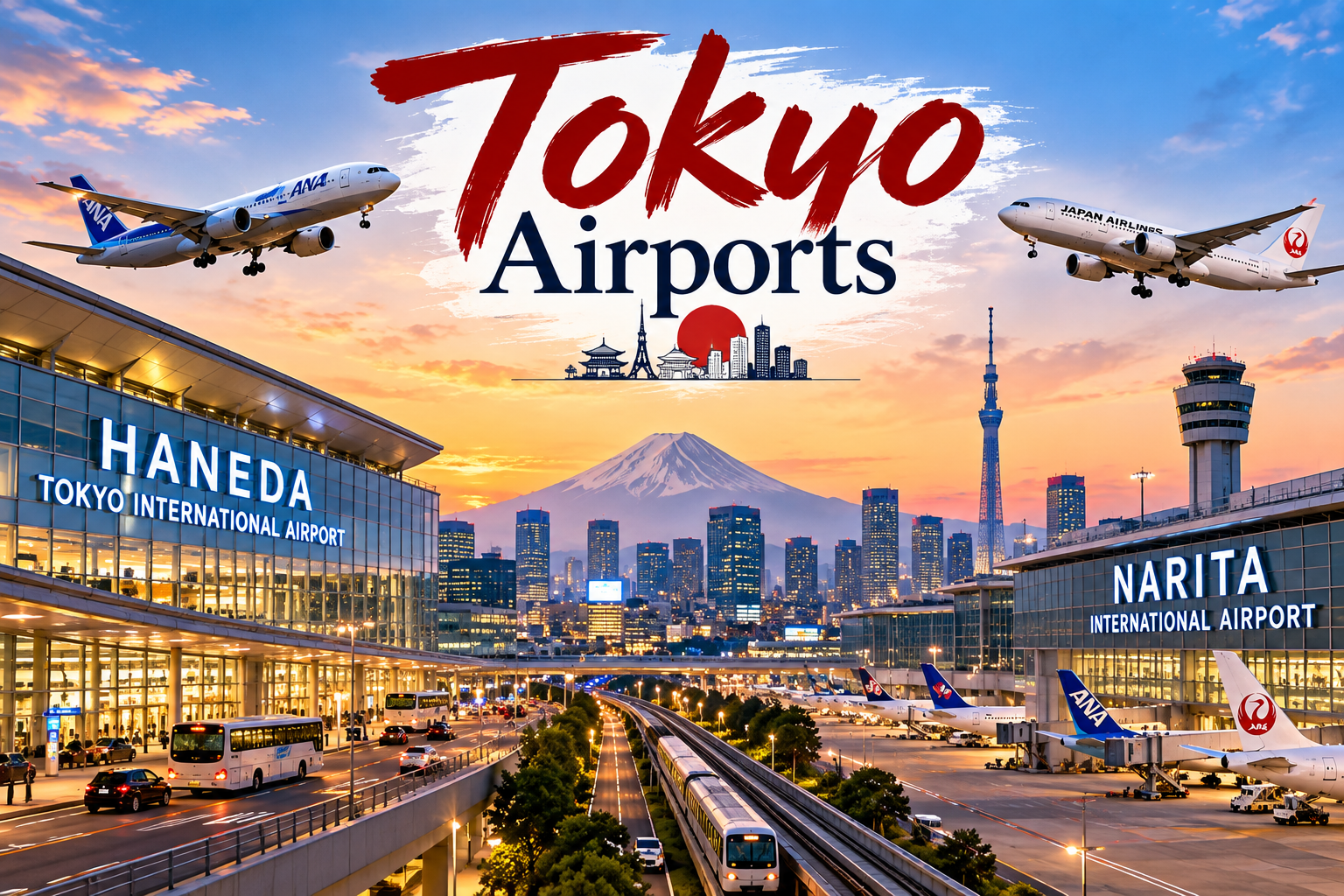
Tokyo Airports: Complete Guide to Haneda & Narita
Flying to Tokyo for the first time? One of the first decisions you will face is simple but important: Should you fly into Haneda or Narita Airport? Tokyo is primarily served by two major international airports—Haneda Airport (HND) and Narita International Airport (NRT)—and choosing the right one can affect your arrival time, transportation costs, hotel transfer and overall travel experience. Haneda Airport is closer to central Tokyo and is often the most convenient choice for travelers staying in the city Tokyo Accessibility
What Are the Main Tokyo Airports?
When travelers search for Tokyo airports, they are usually referring to two major airports.
Haneda Airport
Tokyo International Airport, commonly known as Haneda Airport, uses the airport code HND.
Haneda is located in Ota City, Tokyo, relatively close to the central urban districts.
The airport operates three passenger terminals and handles both domestic and international services. Terminal 3 is the main international terminal, while Terminals 1 and 2 are primarily associated with domestic operations, although international services also operate from Terminal 2.
Haneda’s central location is one of its biggest advantages.
From the airport, travelers can connect to Tokyo by:
- Keikyu railway
- Tokyo Monorail
- Airport buses
- Taxis
- Private transfers
- Rental cars
Official Tokyo tourism information describes Haneda as centrally located and notes that many major Tokyo neighborhoods can be reached within an hour.
Narita International Airport
Narita International Airport, commonly called Narita Airport, uses the airport code NRT.
Despite its name and its association with Tokyo, Narita Airport is actually located in Narita City, Chiba Prefecture, outside Tokyo.
Narita has three passenger terminals and handles a large amount of international traffic, along with domestic services.
The airport is connected to Tokyo through several transportation options, including:
- JR Narita Express
- Keisei Skyliner
- Other railway services
- Airport buses
- Taxis
- Private transfers
- Rental cars
Narita is approximately 50–60 kilometers from central Tokyo, depending on the point of comparison. Official Tokyo tourism information notes that the journey to central Tokyo can take around an hour depending on the transportation method.
Haneda vs Narita: The Basic Difference
The easiest way to understand Tokyo airports is to think about their roles.
Haneda = proximity and convenience
Narita = international gateway and extensive long-haul connectivity
That does not mean Haneda is only for domestic flights or that Narita is only for international flights. Both airports serve domestic and international travelers.
Instead, the distinction is about location, airline schedules, route availability and the type of journey you are making.
| Feature | Haneda Airport | Narita International Airport |
|---|---|---|
| Airport code | HND | NRT |
| Location | Tokyo | Chiba Prefecture |
| Distance from central Tokyo | Relatively close | Approximately 50–60 km |
| Terminals | 3 | 3 |
| Domestic flights | Extensive | Available |
| International flights | Extensive | Extensive |
| City access | Very convenient | Longer but well connected |
| Major rail options | Keikyu, Tokyo Monorail | Narita Express, Skyliner and others |
| Airport buses | Yes | Yes |
| Best-known advantage | Proximity to Tokyo | International connectivity |
| Good for | Tokyo city stays and connections | Long-haul and international itineraries |
The important point is that flight availability should come before airport preference.
If your preferred airline or route operates from Narita at a much better time or price, the extra transfer may be worthwhile.
Why Tokyo Has Two Major Airports
Tokyo’s aviation system developed over many decades.
Haneda has a long history as Tokyo’s primary airport and expanded its international role significantly after the opening of its international terminal in 2010.
Narita opened in 1978 and became an important international gateway for the Tokyo metropolitan region.
The two-airport system allows Tokyo to accommodate enormous demand from both domestic and international aviation.
It also gives airlines and passengers greater flexibility.
A traveler might fly internationally into Narita, connect to another destination through Haneda, or use Haneda for a domestic flight within Japan.
This flexibility is useful, but it also creates one potential problem:
Passengers must pay attention to the airport listed on every flight segment.
A ticket itinerary involving HND and NRT is not the same as a simple airport transfer inside one airport.
Haneda Airport Terminals Explained
Haneda has three passenger terminals.
Haneda Terminal 1
Terminal 1 is primarily associated with domestic operations.
Japan Airlines and other carriers operate services from the domestic terminal system.
The terminal includes:
- Check-in facilities
- Departure areas
- Restaurants
- Shops
- Observation facilities
- Transportation connections
- Passenger services
Haneda Terminal 2
Terminal 2 is also strongly associated with domestic aviation and is an important base for ANA domestic services.
It includes:
- Domestic check-in
- Restaurants
- Retail
- Lounges
- Observation areas
- Transportation connections
International flights can also operate from Terminal 2, so passengers should not assume that every international flight departs from Terminal 3.
Haneda Terminal 3
Terminal 3 is the main international passenger terminal and is one of the most recognizable parts of Haneda Airport.
The terminal offers:
- International check-in
- Immigration
- Restaurants
- Shopping
- Duty-free stores
- Lounges
- Currency exchange
- Tourist information
- Observation facilities
- Japanese cultural-themed areas
One of the distinctive features of Terminal 3 is its Edo-themed shopping and dining area, designed to evoke the atmosphere of historic Tokyo.
Moving Between Haneda Terminals
Travelers sometimes worry about changing terminals at Haneda.
Fortunately, the airport provides several ways to move between terminals.
These include:
- Free shuttle buses
- Keikyu Line
- Tokyo Monorail
- Underground connections between Terminals 1 and 2
- Transfer buses for connecting passengers
The airport currently publishes free shuttle-bus services connecting all three terminals, with frequent operation during much of the day.
However, passengers connecting between flights should always allow sufficient time.
A terminal transfer is not the same as walking between gates.
You may need to:
- Leave the aircraft.
- Follow transfer signs.
- Collect baggage if required.
- Pass immigration or security if required.
- Travel to another terminal.
- Check in again if necessary.
- Clear security.
- Reach your new gate.
Narita Airport Terminals Explained
Narita Airport also has three passenger terminals.
Narita Terminal 1
Terminal 1 is divided into North and South Wings around a central building.
It handles many major international airlines and alliance carriers.
The terminal includes:
- International check-in
- Immigration
- Security
- Restaurants
- Shopping
- Lounges
- Currency exchange
- Transportation services
- Observation facilities
Narita Terminal 2
Terminal 2 is another major international terminal.
It serves several large airlines, including Japan Airlines and other international carriers.
The terminal contains:
- Check-in counters
- Departure facilities
- Immigration
- Restaurants
- Shops
- Lounges
- Railway access
Narita Terminal 3
Terminal 3 is strongly associated with low-cost carriers.
Its design and facilities differ from the larger traditional terminal buildings.
Travelers using budget airlines should pay particular attention to Terminal 3 because the walking and transfer arrangements can differ from Terminals 1 and 2.
Narita Airport confirms that it operates three terminals and that the correct terminal depends on the airline.
Moving Between Narita Terminals
Narita provides shuttle buses between terminals.
Current airport information gives approximate shuttle travel times of around 14 minutes between Terminals 1 and 3, around 3 minutes between Terminals 3 and 2, and around 10 minutes between Terminals 2 and 1, although road conditions can affect the journey.
There is also a walking corridor between Terminals 2 and 3.
This is particularly useful for travelers using low-cost airlines.
Before moving between terminals, check your airline’s current terminal information rather than relying on an old itinerary or online forum post.
How to Get From Haneda Airport to Central Tokyo
Haneda is relatively close to the city center, which is why many visitors appreciate arriving there.
Haneda to Tokyo Station Tokyo airports
There are several possible routes.
One common option uses the Tokyo Monorail toward Hamamatsucho, followed by a connection to central Tokyo.
Another option uses the Keikyu Line toward Shinagawa and then onward transportation.
Official Tokyo tourism information lists a travel time of about 13 minutes from Haneda Terminal 3 to Hamamatsucho on the Tokyo Monorail in the shortest listed service, followed by approximately seven minutes to Tokyo Station on the Yamanote Line.
Actual journey time depends on waiting and transfer time.
Haneda to Shinjuku Tokyo airports
Shinjuku is one of Tokyo’s busiest tourist and business districts.
Travelers can use rail services or airport buses.
Airport limousine buses may be particularly convenient if you have heavy luggage and your hotel is served by the route.
Haneda to Shibuya Tokyo airports
Shibuya can be reached using rail connections.
For travelers with minimal luggage, trains are usually straightforward.
For families or groups with several large suitcases, a bus or taxi may provide a more comfortable journey.
Haneda to Asakusa Tokyo airports
The Keikyu/Toei network can provide convenient connections toward Asakusa.
This can be useful for travelers staying near traditional Tokyo attractions.
How to Get From Narita Airport to Central Tokyo
Narita requires a longer journey than Haneda, but transportation is well developed.
Narita Express Tokyo airports
The Narita Express, operated by JR East, connects Narita Airport with major Tokyo destinations including Tokyo, Shinagawa, Shibuya and Shinjuku.
Official Tokyo tourism information lists approximately 60 minutes to Tokyo Station and approximately 90 minutes to Shinjuku, although actual travel time depends on the service and destination.
For travelers staying near major JR stations, this can be a very convenient option.
Keisei Skyliner Tokyo airports
The Keisei Skyliner connects Narita Airport with the Ueno and Nippori areas.
The official Tokyo tourism guide lists approximately 45 minutes from Narita Airport to Ueno Station on the Skyliner.
This can be particularly useful if your hotel is in:
- Ueno
- Nippori
- Asakusa
- Northern Tokyo
Airport Bus Tokyo airports
Airport buses can be useful when you have substantial luggage.
Some services connect Narita Airport with:
- Tokyo Station
- Ginza
- Shinjuku
- Hotels
- Major transport hubs
The advantage is that you do not need to navigate several railway transfers with heavy bags.
Haneda Airport vs Narita Airport for First-Time Visitors
For a first-time visitor staying in central Tokyo, the main consideration is usually convenience.
Haneda’s proximity can reduce the time between landing and reaching your hotel.
However, first-time travelers should not automatically reject Narita.
Narita offers excellent transportation and may have:
- Better flight schedules
- Better fares
- More suitable long-haul routes
- Better airline availability
- Convenient direct trains to your neighborhood
The best approach is to compare the entire journey, not just the flight price.
A $50 cheaper flight may not be cheaper overall if it requires expensive transfers, inconvenient timing or a hotel change.
Which Tokyo Airport Is Better for Families?
Families have different priorities from solo travelers.
Parents may value:
- Fewer transfers
- Shorter airport journeys
- Easy luggage handling
- Stroller accessibility
- Family facilities
- Hotel bus connections
- Predictable travel times
Haneda can be especially convenient for families staying in central Tokyo because of its location.
Narita can still work very well when a direct airport bus serves the family hotel.
A family with two adults and children may find a direct bus much easier than changing trains with multiple suitcases.
Tokyo Airports for Solo Travelers
Solo travelers can often take advantage of Tokyo’s extensive rail system.
If you are comfortable navigating trains, both airports are manageable.
Your hotel location becomes the most important factor.
For example:
- Shinjuku → consider direct or convenient airport connections
- Ueno → Narita’s Skyliner can be attractive
- Tokyo Station → both airports offer practical options
- Shinagawa → Haneda has strong rail connections
- Asakusa → both airports can be connected by rail
Solo travelers should also consider arrival time.
A very late arrival can change which transportation option is most practical.
Tokyo Airports for Business Travelers
Business travelers usually care about time.
For a meeting in central Tokyo, Haneda can reduce the ground-transfer burden.
But corporate travelers may choose Narita because their preferred international airline operates a more convenient route there.
Business travelers should consider:
- Meeting location
- Flight arrival time
- Departure time
- Hotel location
- Luggage
- Airport lounge access
- Wi-Fi
- Ground transportation
- Connection risk
If your meeting begins shortly after an international arrival, building in extra time is essential.
Airports are not the place to plan an itinerary with zero margin.
Tokyo Airports for Older Travelers
Older travelers may want to minimize walking and complicated transfers.
When comparing airports, consider:
- Elevator availability
- Escalators
- Seating
- Accessible toilets
- Wheelchair support
- Airport buses
- Hotel transfers
- Number of train changes
Haneda and Narita both provide accessibility-related services.
Haneda currently lists barrier-free facilities, special assistance reservations, accessible toilets, assistance-dog facilities and other support services.
Narita also publishes accessibility information for rail, bus and taxi transportation.
Travelers who require assistance should contact their airline before travel rather than waiting until arrival.
Tokyo Airports for Travelers With Disabilities
Accessibility planning is easier when done before departure.
Contact:
- Your airline
- Airport assistance services
- Hotel
- Ground transportation provider
Explain your specific requirements.
For example, “I need assistance” is less useful than explaining whether you need:
- Wheelchair assistance
- Help transferring
- Assistance with stairs
- Visual guidance
- Hearing support
- Accessible transportation
- Accessible hotel facilities
Haneda provides dedicated information for passengers requiring special assistance, while airport transportation providers also publish accessibility information.
Tokyo Airports for Budget Travelers
Budget travelers should compare the total cost of getting from the airport to the hotel.
Do not compare only airfare.
Consider:
Airfare + airport transfer + baggage + meals + possible hotel transport
A slightly more expensive flight into Haneda may be competitive when compared with a cheaper flight into Narita that requires a longer transfer.
Narita also has budget-friendly transport options.
The official Tokyo tourism guide currently lists the TYO-NRT airport bus at approximately ¥1,500 for certain standard daytime journeys to Tokyo Station, while noting higher pricing for late-night and early-morning services.
Prices and schedules can change, so confirm before departure.
Tokyo Airports for Luxury Travelers
Luxury travelers may prioritize convenience rather than price.
Options include:
- Private airport transfers
- Chauffeur services
- Premium taxis
- Hotel limousine services
- First-class lounges
- Airline lounges
- Premium rail services
Haneda’s shorter distance from central Tokyo can be particularly attractive when time is more important than transport cost.
Narita can also offer a premium arrival experience through private transfers and first-class airline services.
Tokyo Airports for Travelers With Heavy Luggage
Luggage changes the transportation decision.
A solo traveler with a backpack has many options.
A family with four suitcases has fewer.
Before selecting a train, check:
- Elevator availability
- Platform layout
- Number of transfers
- Luggage space
- Walking distance
Airport buses can sometimes be the easiest solution.
A direct bus from the airport to a hotel may take longer than an express train but eliminate several stressful transfers.
Tokyo Airports for Connecting Flights
Connecting flights require special attention.
The first question is:
Are both flights at the same airport?
If both flights use Haneda, the connection may be relatively straightforward.
If both use Narita, the same applies.
But if the itinerary requires:
Narita → Haneda
or:
Haneda → Narita
you need to plan a substantial airport transfer.
Official Tokyo tourism information currently estimates approximately 75–120 minutes for travel between Haneda and Narita, depending on the transportation method.
That figure is transportation time, not necessarily the total connection time.
You must also account for:
- Immigration
- Baggage collection
- Customs
- Terminal movement
- Check-in
- Security
- Delays
- Traffic
- Airline minimum connection requirements
A self-created airport transfer should therefore have a generous time buffer.
Haneda to Narita Airport
Travelers can move between the airports by:
- Direct limousine bus
- Keikyu/Keisei rail services
- Other rail combinations
- Taxi
- Private transfer
The direct train can be convenient because it avoids changing vehicles.
However, not every service operates in exactly the same way throughout the day.
Always verify the current departure information before travel.
Narita to Haneda Airport
The same principle applies in the opposite direction.
Narita’s Access Express network can provide a rail connection toward Haneda, while limousine buses also operate between the airports.
The official Tokyo tourism guide currently lists approximately 85 minutes for the limousine bus and approximately 120 minutes for the Access Express journey from Narita to Haneda.
These are useful planning estimates, not guarantees.
Traffic and operational conditions can affect travel time.
Ten Major Airline Brands to Know at Tokyo Airports
Tokyo airports serve a wide range of Japanese and international airlines. The following table is not a ranking; it is a practical reference for travelers comparing airline options.
| Airline Brand Tokyo airports | Tokyo Airport Presence Tokyo airports | Typical Relevance | Useful For Tokyo airports |
|---|---|---|---|
| Japan Airlines (JAL) | Haneda & Narita | Major Japanese carrier | Domestic and international travel |
| ANA | Haneda & Narita | Major Japanese carrier | Domestic and international connections |
| Delta Air Lines | Haneda & Narita operations | Major U.S. carrier | North American connections |
| United Airlines | Haneda & Narita operations | Major U.S. carrier | U.S. connections |
| American Airlines | Haneda and Tokyo network | U.S. network | North American travelers |
| Emirates | Haneda/Narita network | Gulf-based long-haul carrier | Middle East and connecting routes |
| Qatar Airways | Haneda/Narita network | Gulf-based international carrier | Middle East and global connections |
| Singapore Airlines | Haneda/Narita network | Southeast Asian hub carrier | Southeast Asia and onward travel |
| Cathay Pacific | Haneda/Narita network | Hong Kong-based carrier | Hong Kong and regional connections |
| Air Canada | Haneda/Narita network | Canadian carrier | Canada and North American connections |
Airline operations and terminal assignments can change. Haneda’s current airline directory lists carriers including JAL, ANA, Air Canada, American Airlines, Cathay Pacific, Delta, Emirates, Qatar Airways, Singapore Airlines and United Airlines.
Narita also maintains a current airline directory with terminal information. For example, the airport currently lists ANA at Terminal 1, JAL at Terminal 2, Delta at Terminal 1 and United at Terminal 1.
The key lesson is simple:
Never rely on the airline name alone to determine the terminal. Check the current airport and airline information for your specific flight.
Tokyo Airports and Airline Lounges
Airport lounges can make a significant difference during long international journeys.
Facilities vary by airline, ticket class, frequent-flyer status and lounge membership.
Haneda currently lists airline lounges associated with carriers including JAL, ANA, Cathay Pacific and Delta.
Narita also provides multiple airline and independent lounge options.
For example, Narita currently lists JAL and Emirates lounges in Terminal 2, along with other lounge facilities.
Before assuming lounge access, verify:
- Airline
- Cabin class
- Frequent-flyer status
- Operating carrier
- Terminal
- Lounge opening hours
- Guest rules
Airport Shopping in Tokyo
Tokyo’s airports are more than transportation facilities.
Travelers can find:
- Japanese snacks
- Souvenirs
- Cosmetics
- Electronics
- Character merchandise
- Fashion
- Duty-free goods
- Traditional crafts
- Food gifts
Haneda Terminal 3 has an especially strong emphasis on Japanese-themed shopping and dining.
Narita also has extensive retail facilities across its terminals.
However, airport shopping should not replace exploring Tokyo itself.
If you have time in the city, local shopping districts often provide a broader experience.
Food at Tokyo Airports
Japanese airports offer a surprisingly broad selection of food.
Depending on the terminal, travelers can find:
- Sushi
- Ramen
- Tempura
- Japanese curry
- Udon
- Soba
- Rice bowls
- Bakery items
- Convenience foods
- International cuisine
- Coffee
- Desserts
If your flight departs early, check restaurant opening hours.
For late-night travelers, food availability can be more limited.
This is particularly important when traveling with children or passengers with dietary requirements.
Prayer and Quiet Facilities Tokyo airports
International travelers have different cultural and religious needs.
Haneda provides services for international visitors, including prayer-room facilities and tourist information.
Travelers with specific religious, dietary or accessibility requirements should investigate the airport facilities before departure.
This is one of those small pieces of preparation that can make a long international journey considerably easier.
Wi-Fi and Connectivity at Tokyo Airports
Staying connected is important after landing.
Airport facilities provide options for:
- Wi-Fi
- SIM cards
- eSIM setup
- Pocket Wi-Fi
- Charging
- Tourist information
Haneda currently lists Wi-Fi-related and visitor services, while airport tourist information facilities can also assist international visitors.
For travelers using an eSIM, installing and activating it before landing can reduce stress.
However, keep your primary SIM or eSIM active until you know the new connection works.
Currency Exchange at Tokyo Airports
Both major Tokyo airports provide currency exchange services.
However, travelers should think carefully about how much cash they need.
Japan has become increasingly convenient for card and digital payments, but cash remains useful in some smaller businesses and local situations.
A practical strategy is to arrive with enough yen for:
- Airport transportation
- Food
- Small purchases
- Emergency expenses
Avoid exchanging your entire travel budget immediately unless you have a specific reason.
Tokyo Airport ATMs
ATMs are widely available at major Japanese airports.
International travelers should check whether their bank charges:
- Foreign transaction fees
- ATM fees
- Currency conversion charges
Your card network may also apply its own fees.
It is useful to carry at least two payment methods in case one card fails.
Airport Tourist Information
Tourist information centers can be valuable for first-time visitors.
Tokyo’s metropolitan tourist information network includes a location at Haneda Airport Terminal 3, and the Tokyo Metropolitan Government also provides multilingual tourist support at several locations.
This can be particularly useful for travelers who need:
- Transportation information
- Maps
- Attraction information
- Directions
- Accessibility assistance
- General travel guidance
Tokyo Airports for International Visitors
International visitors should prepare for several steps after landing.
The typical sequence may include:
- Arrival at the airport.
- Immigration procedures.
- Baggage collection.
- Customs.
- Transportation.
- Hotel check-in.
The exact process depends on your nationality, immigration requirements, flight type and travel circumstances.
Do not assume that your airport arrival time equals the time you will reach your hotel.
A flight landing at 7:00 AM may still mean arriving at the hotel considerably later.
How Early Should You Arrive at Tokyo Airports?
The ideal airport arrival time depends on:
- International or domestic flight
- Airline
- Airport
- Baggage
- Check-in method
- Security conditions
- Immigration
- Holiday periods
International flights generally require more preparation than domestic flights.
If you have checked luggage, do not plan your journey based on the minimum possible processing time.
Give yourself a comfortable buffer.
The cost of arriving early is usually a coffee and some waiting.
The cost of arriving late can be much greater.
Tokyo Airport Travel During Peak Seasons
Tokyo becomes especially busy around major Japanese travel periods and international holiday seasons.
Potentially busy periods include:
- New Year
- Golden Week
- Obon
- Cherry blossom season
- Summer holidays
- Major international events
- Christmas and New Year travel
- School holidays
During busy periods:
- Airport trains can become crowded.
- Hotel prices can rise.
- Airport buses may sell out.
- Security lines may be longer.
- Domestic flights can be heavily booked.
Reserve important transportation when appropriate.
Tokyo Airports During Bad Weather
Weather can affect aviation.
Tokyo can experience:
- Heavy rain
- Strong winds
- Typhoons
- Snow
- Thunderstorms
Typhoons are particularly important during certain seasons.
If severe weather is forecast, check:
- Airline alerts
- Airport flight status
- Train operations
- Bus operations
- Hotel cancellation policies
Do not rely solely on social media posts.
The official airport and airline websites should be your primary sources for operational updates.
Common Tokyo Airport Mistakes
Booking the Wrong Tokyo Airport
Always check whether your flight is HND or NRT.
The letters matter.
Assuming Haneda and Narita Are Nearby Tokyo airports
They are connected, but they are separate airports.
Do not treat them as different terminals of the same airport.
Ignoring the Terminal Tokyo airports
Airports have multiple terminals.
Check your airline and flight number.
Underestimating Transfer Time Tokyo airports
Airport transfers involve more than vehicle travel.
Include:
- Baggage
- Immigration
- Walking
- Check-in
- Security
- Delays
Choosing the Cheapest Flight Automatically
A cheaper flight is not necessarily the cheaper trip.
Calculate total travel cost.
Arriving Too Late Tokyo airports
International travel requires a safety margin.
Forgetting Luggage Tokyo airports
Heavy luggage can change the best transportation option.
Not Checking Late-Night Transportation Tokyo airports
Some rail services have limited operating hours.
If your flight lands late, investigate night buses, taxis or hotel transfer options.
How to Choose Between Haneda and Narita
Use this simple decision framework.
Choose Haneda When Tokyo airports
Haneda may make sense when:
- Your hotel is in central Tokyo.
- Your preferred flight operates there.
- You want a shorter airport transfer.
- You are arriving after a long international flight.
- You have children or heavy luggage.
- You have an early Tokyo meeting.
- You value convenience.
Consider Narita When Tokyo airports
Narita may make sense when:
- Your preferred international flight operates there.
- The airfare is substantially better.
- The schedule is more convenient.
- You are using a low-cost carrier.
- You are traveling to an area well served by Narita rail.
- You are continuing to another destination with a convenient connection.
The decision should be based on the complete itinerary.
A Practical Tokyo Airport Decision Formula
A useful way to compare flights is:
Total Travel Cost = Airfare + Airport Transfer + Baggage Cost + Ground Time + Convenience
This prevents travelers from choosing flights based only on the ticket price.
For example:
Flight A:
- Cheaper airfare
- Narita
- Long transfer
- Late arrival
Flight B:
- Slightly higher airfare
- Haneda
- Short transfer
- Better arrival time
The second option may provide better overall travel efficiency even if its airfare is higher.
Tokyo Airports for Travelers Staying in Shinjuku
Shinjuku is one of Tokyo’s major hotel and entertainment districts.
Both airports are practical, but the journey differs.
From Haneda, travelers can use rail or airport buses.
From Narita, the Narita Express provides direct access to Shinjuku on relevant services.
The important question is not simply which airport is closer.
It is:
Which airport gives you the simplest door-to-door journey at your arrival time?
Tokyo Airports for Travelers Staying in Shibuya
Shibuya travelers can use rail connections from both airports.
Haneda is geographically closer, while Narita offers direct rail options on relevant services.
Travelers with minimal luggage may find trains straightforward.
Those with multiple bags may prefer an airport bus or private transfer.
Tokyo Airports for Travelers Staying in Tokyo Station
Tokyo Station is connected to both airports.
Haneda provides quick rail access through the city’s southern transport network.
Narita offers the Narita Express and other connections.
This makes Tokyo Station one of the easier destinations from either airport.
Tokyo Airports for Travelers Staying in Ueno
Ueno is particularly relevant for Narita arrivals because of the Keisei Skyliner connection to Ueno.
Travelers staying near Ueno, Nippori or nearby neighborhoods should compare this route against alternatives before choosing their airport.
Tokyo Airports for Travelers Going to Asakusa
Asakusa is another destination where rail connections can be useful.
Travelers should compare airport services according to their exact hotel location rather than assuming the nearest major station is the final destination.
A hotel can be several blocks from the station, and luggage changes the practical difficulty of that final walk.
Tokyo Airports for Travelers Continuing to Mount Fuji
If Tokyo is only the beginning of your journey, airport selection becomes more complicated.
You may want to continue toward:
- Mount Fuji
- Hakone
- Yokohama
- Nikko
- Kyoto
- Osaka
- Nagoya
- Other Japanese cities
In these situations, look at the entire route.
Sometimes an airport with a slightly longer Tokyo transfer can still make sense if it provides a better onward connection.
Tokyo Airports and Domestic Connections
Haneda is an important domestic aviation hub.
Travelers continuing to destinations such as:
- Sapporo
- Osaka
- Fukuoka
- Hiroshima
- Okinawa
- Nagasaki
- Other Japanese cities
may find numerous domestic flight options.
Narita also serves domestic flights, including services from low-cost carriers.
If you are booking separate international and domestic tickets, check whether they use the same airport.
Tokyo Airport Self-Transfer Risks
A self-transfer means you have separate tickets rather than one protected itinerary.
This can be risky.
Suppose your international flight arrives late and your domestic ticket is separate.
You may need to:
- Collect baggage
- Clear immigration
- Check in again
- Transfer terminals
- Clear security
- Reach the domestic gate
If the first flight is delayed, the second airline may not be obligated to accommodate you.
A longer buffer is therefore essential.
Tokyo Airport Accessibility for Families With Strollers
Parents traveling with babies should consider:
- Elevator routes
- Baby-care rooms
- Nursing facilities
- Stroller availability
- Family toilets
- Luggage carts
Airport layouts can be large.
Do not underestimate walking distances between gates and transportation areas.
Tokyo Airports and Japan Rail Passes
Some airport rail services connect with JR networks.
However, not every airport transportation service is operated by JR.
The Japan Rail Pass should therefore not be treated as a universal airport-transfer ticket.
Before boarding, check:
- Operator
- Route
- Pass validity
- Seat reservation requirements
- Additional fees
Narita Express services operated by JR East are particularly relevant to travelers considering rail travel into Tokyo.
Suica and PASMO at Tokyo Airports
Transportation IC cards such as Suica and PASMO can make urban transportation much easier.
Travelers can use compatible IC cards across many rail, subway and retail systems.
However, airport travel involves different operators, ticket types and services, so passengers should check the current purchasing and charging options at their arrival terminal.
The official Tokyo tourism guide notes that Suica and PASMO can be used for relevant transportation journeys from Narita and that smartphone versions can also be used at automated ticket barriers where supported.
Taxi Travel From Tokyo Airports
Taxis are the easiest option conceptually.
You land.
You collect your luggage.
You enter the taxi.
You give the destination.
The disadvantage is cost.
For individuals, taxis can be expensive compared with rail.
For groups, however, the calculation changes.
A family of four with several bags may value convenience enough to justify the expense.
Haneda’s shorter distance from central Tokyo can make taxi travel more practical than from Narita, although the exact fare depends on destination, traffic, tolls and service type.
Private Airport Transfers Tokyo airports
Private transfers can be useful for:
- Families
- Luxury travelers
- Business travelers
- Travelers with mobility needs
- Groups
- Late-night arrivals
- Travelers with extensive luggage
The advantage is predictability.
A driver can meet you and take you directly to your accommodation.
The disadvantage is price.
Always verify cancellation policies and pickup procedures before booking.
Airport Buses vs Trains
Advantages of Airport Buses Tokyo airports
- Luggage-friendly
- Direct to some hotels
- Fewer transfers
- Comfortable seating
- Useful for families
Disadvantages of Airport Buses Tokyo airports
- Traffic can cause delays
- Timetables may be less frequent
- Some destinations have limited service
Advantages of Trains Tokyo airports
- Generally predictable
- Frequent services
- Often fast
- Good connections to major stations
Disadvantages of Trains Tokyo airports
- Transfers
- Stairs or platform changes
- Crowding
- More difficult with multiple suitcases
There is no universal winner.
Choose based on your specific hotel and luggage situation.
The Best Tokyo Airport Strategy for First-Time Travelers
First-time visitors often benefit from simplicity.
A practical strategy is:
- Confirm HND or NRT.
- Confirm the terminal.
- Check your arrival time.
- Locate your hotel.
- Identify two transport options.
- Save the route offline.
- Keep some yen available.
- Have your hotel address accessible in Japanese.
- Allow extra time.
- Check airport information on the day of travel.
This small amount of preparation can eliminate many common arrival problems.
Tokyo Airport Tips for International Travelers
Before leaving your home country:
- Check your passport validity.
- Confirm entry requirements.
- Confirm your flight number.
- Download your airline app.
- Save your hotel address.
- Prepare payment methods.
- Check baggage allowance.
- Download offline maps.
- Install an eSIM if needed.
- Check airport terminal information.
- Save emergency contacts.
Tokyo Airport Tips for Business Travelers
Business travelers should:
- Choose flights based on meeting schedules.
- Avoid extremely tight connections.
- Consider airport transfer time.
- Book airport transfers when useful.
- Keep business clothing accessible.
- Check lounge availability.
- Keep essential documents in hand luggage.
- Consider arriving a day early for critical meetings.
Tokyo Airport Tips for Families
Families should:
- Pack snacks.
- Keep children’s essentials in carry-on bags.
- Use luggage carts.
- Check baby-care facilities.
- Allow additional transfer time.
- Avoid unnecessary train changes.
- Check hotel airport bus routes.
- Keep children’s medication accessible.
Tokyo Airport Tips for Solo Travelers
Solo travelers should:
- Keep valuables secure.
- Save the hotel address.
- Keep your phone charged.
- Have a backup payment method.
- Check late-night transportation.
- Avoid overly complicated connections after a long flight.
Tokyo Airport Tips for Seniors
Older travelers should:
- Request airline assistance in advance if needed.
- Check elevator routes.
- Consider direct transportation.
- Avoid unnecessary transfers.
- Allow generous connection time.
- Keep medication in hand luggage.
- Confirm accessibility at the hotel.
Tokyo Airports and Sustainability
Air travel has an environmental cost, and travelers increasingly consider sustainability when planning trips.
One practical strategy is to avoid unnecessary domestic flights when a convenient rail alternative exists.
For example, the shinkansen can connect Tokyo with several major Japanese cities.
For long-distance international travel, however, flying remains the practical option for many visitors.
Once in Japan, travelers can reduce ground transportation impact by using:
- Railways
- Subways
- Buses
- Walking
- Shared transportation
The Tokyo airport system also benefits from extensive public transportation connectivity, reducing dependence on private cars.
Future Trends for Tokyo Airports
Tokyo’s airport system will continue evolving alongside international tourism.
More Digital Airport Services Tokyo airports
Travelers can expect increasing use of:
- Mobile boarding passes
- Automated check-in
- Digital navigation
- Biometric processing
- Airport apps
- Real-time transportation information
Haneda already promotes its official airport app and navigation services for flight, facility and map information.
More Seamless Multimodal Travel Tokyo airports
The future airport experience is increasingly about connecting:
Plane → train → hotel → destination
rather than treating the airport as a standalone facility.
Greater Accessibility Tokyo airports
Airport operators are increasingly emphasizing accessible facilities and assistance.
This benefits:
- Older travelers
- Wheelchair users
- Families
- Passengers with hidden disabilities
- Travelers requiring additional support
More International Connectivity Tokyo airports
Tokyo remains one of Asia’s major global aviation markets.
As international tourism develops, travelers can expect continued competition among airlines and routes.
However, specific routes and schedules change regularly.
Smarter Airport Navigation Tokyo airports
Large airports can be confusing.
Digital navigation, real-time maps and mobile airport guides should increasingly reduce the stress of finding:
- Gates
- Restaurants
- Lounges
- Immigration
- Transportation
- Baggage claim
Tokyo Airports and the Future of Travel Planning
The biggest change may not happen inside the airport.
It may happen before travelers arrive.
Modern travelers increasingly compare entire journeys rather than simply searching for the cheapest flight.
A future travel search might consider:
- Flight price
- Airport
- Ground transportation
- Hotel location
- Travel time
- Luggage
- Accessibility
- Carbon impact
- Connection reliability
- Arrival time
This is a more useful approach than simply asking:
“Which flight is cheapest?”
The better question is:
“Which itinerary gets me where I need to be with the least unnecessary friction?”
Pros and Cons of Haneda Airport
Advantages of Haneda Tokyo airports
Haneda’s main strengths include its proximity to Tokyo, strong domestic network, international services, rail connections and convenient access to major urban areas.
For travelers staying in central Tokyo, the shorter ground journey can be especially valuable after a long flight.
Potential Disadvantages of Haneda Tokyo airports
Haneda can still become busy, and terminal arrangements can be confusing for passengers unfamiliar with the airport.
Flight availability may also determine whether Haneda is practical for your itinerary.
Some flights that match your preferred destination, airline or schedule may operate from Narita instead.
Pros and Cons of Narita Airport
Advantages of Narita
Narita has extensive international operations and strong connections to Tokyo.
Its major rail links make it relatively straightforward to reach central areas.
The airport also provides a broad range of international airlines and low-cost carrier services.
Potential Disadvantages of Narita
The main drawback for travelers staying in central Tokyo is distance.
The airport is considerably farther from central Tokyo than Haneda.
Travelers should therefore budget additional time and transportation costs.
How Tokyo Airports Compare With Other Japanese Airports
Tokyo is not the only gateway to Japan.
Travelers can also consider:
- Kansai International Airport
- Chubu Centrair International Airport
- Fukuoka Airport
- New Chitose Airport
- Naha Airport
If your itinerary focuses on Kyoto and Osaka, Kansai International Airport may be more logical.
If you are exploring Hokkaido, New Chitose may be more convenient.
If you are traveling around Kyushu, Fukuoka can be a useful gateway.
The smartest airport is therefore determined by your itinerary, not simply the city name on the ticket.
Tokyo Airports for a Tokyo-Kyoto-Osaka Trip
For a classic Tokyo-Kyoto-Osaka itinerary, flying into either Tokyo airport can work.
A common strategy is:
Fly into Tokyo → explore Tokyo → take the shinkansen to Kyoto → continue to Osaka → fly home
Another strategy is:
Fly into Tokyo → explore Tokyo → travel to Kyoto and Osaka → return to Tokyo → fly home
An open-jaw itinerary can sometimes reduce unnecessary backtracking.
For example:
Home → Tokyo
then:
Osaka → Home
can potentially save a return journey to Tokyo, depending on airfare and flight availability.
Tokyo Airports for a Japan Honeymoon
Couples planning a honeymoon should prioritize comfort.
Consider:
- Haneda arrival
- Private transfer
- Comfortable hotel
- Minimal train changes
- Premium rail where useful
- Luggage delivery
- Flexible itinerary
Japan offers excellent luggage-delivery services, which can reduce the burden of carrying suitcases through multiple stations.
This can be especially valuable when traveling between Tokyo, Kyoto and Osaka.
Tokyo Airports for Backpackers
Backpackers may prioritize:
- Low fares
- Public transportation
- Hostels
- Flexible schedules
- Low-cost airlines
Narita can be attractive for some low-cost carrier itineraries.
However, always calculate the complete cost of getting into Tokyo.
A cheap ticket can lose its advantage if the airport transfer is expensive or inconvenient.
Tokyo Airports for Luxury Holidays
Luxury travelers may prioritize:
- Haneda
- Private transfers
- Chauffeur services
- Premium airline lounges
- Five-star hotels
- Luggage assistance
- Personalized arrival services
The airport is the first impression of a luxury trip.
Reducing unnecessary waiting and transfers can be worth the additional expense.
Tokyo Airports for Short Trips
If you are visiting Tokyo for only two or three days, airport location becomes especially important.
A shorter trip means every hour matters.
A closer airport can potentially give you more usable time in the city.
For a weekend trip, compare:
Flight arrival time + airport transfer + hotel check-in
rather than looking only at flight duration.
Tokyo Airports for Long Stays
For a one- or two-week Japan trip, the airport transfer becomes a smaller part of the overall experience.
If Narita provides a much better airfare or route, the longer transfer may be less important.
This is a good example of why airport selection depends on trip length.
Quick Tokyo Airport Comparison
| Traveler Type | Airport Consideration |
|---|---|
| First-time Tokyo visitor | Compare Haneda convenience with flight availability |
| Family | Consider shorter transfer and direct bus options |
| Solo traveler | Rail access may be especially convenient |
| Business traveler | Minimize total door-to-door travel time |
| Luxury traveler | Consider private transfer and lounge access |
| Budget traveler | Compare total cost rather than airfare |
| Senior traveler | Prioritize accessibility and fewer transfers |
| Heavy luggage | Consider direct airport bus |
| Long-haul traveler | Compare airline, route and arrival time |
| Domestic connection | Check whether both flights use the same airport |
| Low-cost traveler | Check Narita Terminal 3 and transfer costs |
| Short-stay visitor | Airport proximity can have greater value |
FAQs
How many airports serve Tokyo?
Tokyo’s two primary airports for commercial passenger travel are Haneda Airport (HND) and Narita International Airport (NRT). Haneda is inside Tokyo, while Narita is in neighboring Chiba Prefecture.
Which airport is closest to Tokyo?
Haneda Airport is much closer to central Tokyo than Narita Airport. Haneda is located in Ota City, while Narita is approximately 50–60 kilometers from central Tokyo.
Is Haneda or Narita better for Tokyo?
The answer depends on your flight, hotel, budget and schedule. Haneda is generally more convenient for reaching central Tokyo, while Narita offers extensive international connectivity and strong transportation links.
Is Haneda Airport international?
Yes. Haneda handles both domestic and international flights.
Is Narita Airport in Tokyo?
No. Narita International Airport is located in Narita City, Chiba Prefecture, although it serves the greater Tokyo metropolitan area.
How far is Haneda Airport from central Tokyo?
Haneda is relatively close to central Tokyo. Depending on your destination and transportation method, many major neighborhoods can be reached within an hour.
How far is Narita Airport from Tokyo?
Narita Airport is approximately 50–60 kilometers from central Tokyo. The journey commonly takes around an hour or more depending on the destination and transportation method.
How do I get from Haneda Airport to Tokyo Station?
You can use the Tokyo Monorail with a connection or the Keikyu network with onward rail connections. Airport buses and taxis are also available.
How do I get from Narita Airport to Tokyo Station?
The JR Narita Express provides a direct rail connection to Tokyo Station on relevant services. Airport buses and other railway services are also available.
How do I get from Narita Airport to Shinjuku?
The Narita Express offers direct services to Shinjuku on relevant trains. Airport buses are another possible option.
How do I get from Haneda Airport to Shinjuku?
Travelers can use rail connections or airport buses. The best option depends on luggage, arrival time and hotel location.
Can I travel directly between Haneda and Narita airports?
Yes. Direct bus and rail services connect the two airports, although journey times vary.
How long does Haneda to Narita take?
Current Tokyo tourism information gives a general range of approximately 75–120 minutes depending on transportation. Travelers should allow additional time for baggage, immigration, check-in and possible delays.
Which Tokyo airport is best for international flights?
Both Haneda and Narita operate international flights. The best airport depends on the airline, destination, schedule and airfare.
Which Tokyo airport is best for domestic flights?
Haneda has an extensive domestic network, while Narita also operates domestic services. Check your specific route and airline before booking.
Does Haneda have three terminals?
Yes. Haneda Airport has Terminals 1, 2 and 3.
Does Narita have three terminals?
Yes. Narita Airport has Terminals 1, 2 and 3.
Which terminal is international at Haneda?
Terminal 3 is the primary international terminal, although international services can also operate from Terminal 2.
Which terminal is used by low-cost airlines at Narita?
Many low-cost carriers use Terminal 3, although travelers should always verify the terminal for their particular airline and flight.
Can I transfer between Haneda terminals?
Yes. Haneda provides free shuttle buses and other transfer options between terminals.
Can I transfer between Narita terminals?
Yes. Narita provides shuttle buses between terminals, and there is also a walking connection between Terminals 2 and 3.
Do Tokyo airports have restaurants?
Yes. Both Haneda and Narita offer numerous restaurants, cafés and food outlets.
Do Tokyo airports have lounges?
Yes. Both airports have airline lounges and other lounge facilities. Access depends on the airline, ticket, membership and eligibility.
Do Tokyo airports have currency exchange?
Yes. Currency exchange services are available at both major airports.
Do Tokyo airports have Wi-Fi?
Yes. Both airports provide connectivity services for travelers.
Can I buy a SIM card at Tokyo airports?
Yes. International travelers can find SIM, connectivity and related services at the airports, although availability and pricing vary.
Can I use an IC card in Tokyo?
Transportation IC cards such as Suica and PASMO are widely useful throughout Tokyo and other parts of Japan. Specific airport transportation arrangements vary by operator.
Is Tokyo airport transportation expensive?
Costs vary by airport, destination and transportation type. Trains and buses are generally more economical than taxis or private transfers.
Is Narita Airport difficult to reach?
No. Narita is farther from central Tokyo, but it has strong railway and bus connections.
Is Haneda Airport easier for first-time visitors?
Many first-time visitors appreciate Haneda’s proximity to Tokyo, but the best choice still depends on flight availability and hotel location.
Should I take a taxi from Haneda Airport?
A taxi can be convenient, especially for families, groups, travelers with heavy luggage or late-night arrivals. Compare the cost with rail and bus options.
Should I take a taxi from Narita Airport?
A taxi provides door-to-door convenience but can be considerably more expensive than trains or buses. It may make more sense for groups or travelers prioritizing convenience.
Can I use the Japan Rail Pass from Narita Airport?
Eligible Japan Rail Pass holders can use certain JR services, including the Narita Express, subject to the current rules of their pass.
How early should I arrive at a Tokyo airport?
Your ideal arrival time depends on whether your flight is domestic or international, your airline, baggage, travel period and airport. Always follow your airline’s recommended check-in time and allow additional time during busy periods.
What happens if my flight lands late at night?
Transportation options may be more limited late at night. Check the final train and bus services before traveling, and consider a taxi or pre-booked transfer if necessary.
Which Tokyo airport is best for families?
Haneda can be convenient because of its proximity to central Tokyo, but Narita can also work well when a direct airport bus serves your hotel.
Which Tokyo airport is best for business travelers?
Haneda can be convenient for central Tokyo meetings because of its location. However, the most suitable airport depends on your airline and business schedule.
Which Tokyo airport is best for budget travelers?
Neither airport is automatically the cheapest. Compare airfare, baggage charges and transportation costs before deciding.
Can I sleep at Tokyo airports?
Airport facilities and operating arrangements vary. Travelers planning an overnight stay should check the current terminal operating hours and available facilities before relying on the airport as overnight accommodation.
Should I stay near Haneda Airport before an early flight?
It can be a practical option, particularly for very early departures. Whether it is worthwhile depends on your flight time, hotel location and transportation availability.
Should I stay near Narita Airport before an early flight?
For very early Narita departures, staying near the airport can reduce morning travel stress and provide additional schedule protection.
What should I do if I have a long layover in Tokyo?
If your layover is long enough and immigration requirements allow it, you may be able to visit Tokyo. However, always calculate airport processing and return time carefully.
Can I visit Tokyo during a Narita layover?
Potentially, but only if you have enough time and meet the relevant entry requirements. A short layover is usually better spent at or near the airport.
Can I visit Tokyo during a Haneda layover?
Haneda’s proximity makes a city visit more practical than from Narita for some longer layovers, but you should still allow substantial time for immigration, transportation and returning to the airport.
Conclusion
Tokyo airports are an important part of planning a Japan trip, and understanding the difference between Haneda Airport and Narita International Airport can make your journey considerably smoother. Haneda’s location close to Tokyo makes it particularly convenient for travelers staying in central neighborhoods, while Narita remains a major international gateway with extensive airline choices and reliable rail and bus connections. The right airport ultimately depends on your airline, destination, arrival time, luggage, budget and onward itinerary rather than a simple rule that one airport is always better than the other.



One Comment