Tokyo Rivers: 15 Amazing Rivers, Scenic Cruises, Hidden Waterfronts & Complete Visitor Guide
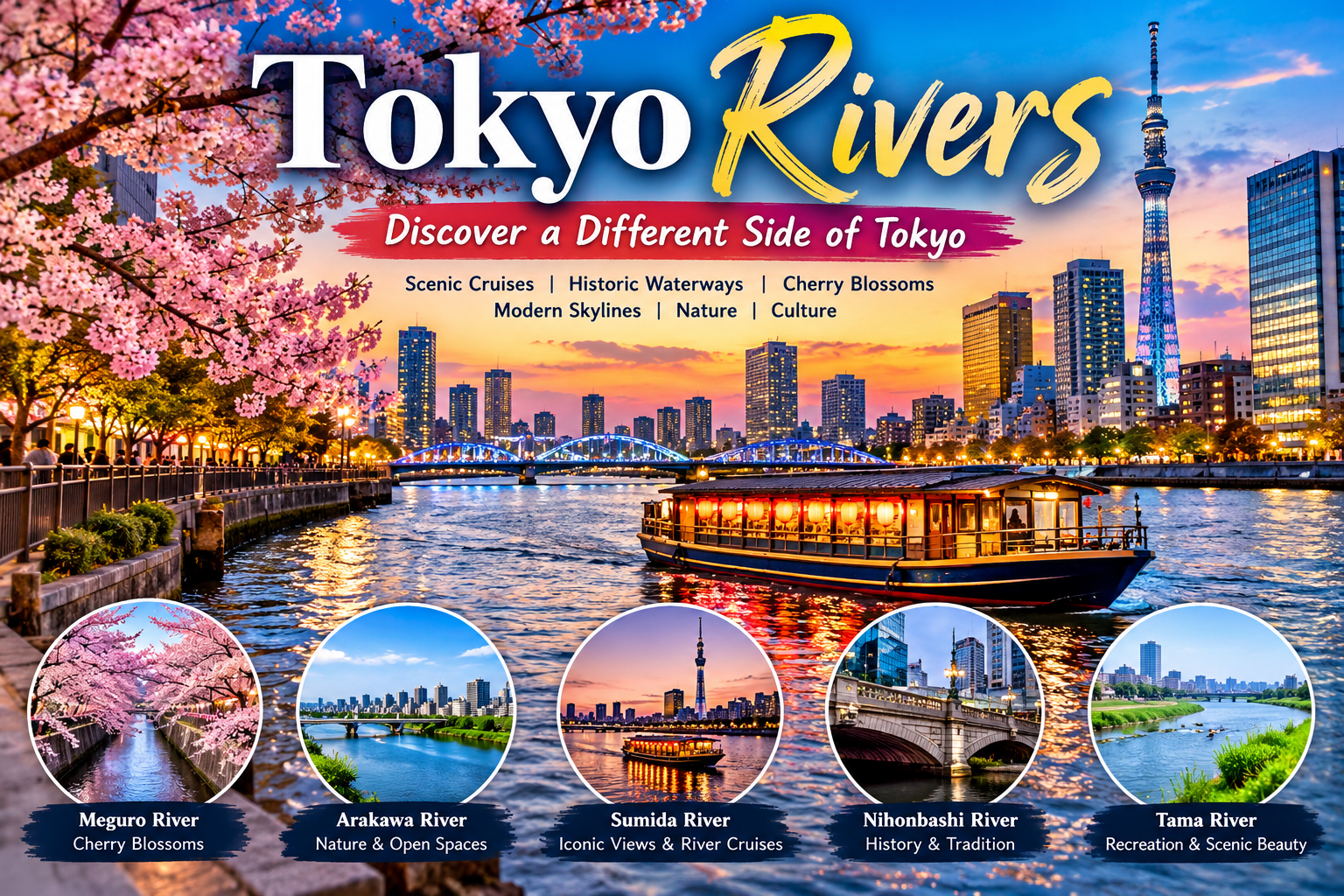
Tokyo rivers reveal a quieter and more historic side of the Japanese capital, connecting traditional neighborhoods, modern landmarks, gardens, bridges, waterfront districts, and some of the city’s most memorable sightseeing experiences. The Sumida River is the best-known river for visitors, but the Kanda, Nihonbashi, Meguro, Arakawa, Tama, and several smaller waterways offer very different ways to understand Tokyo Tokyo Metro
Understanding Tokyo’s River System
Tokyo does not have just one important river.
The metropolitan area contains a complex network of rivers, canals, waterways, tidal channels, and waterfront areas. Some rivers flow toward Tokyo Bay, while others connect with larger river systems outside central Tokyo.
For travelers, it is useful to think about Tokyo’s waterways in several broad groups.
The Sumida River
The Sumida River is the most recognizable river for international visitors.
It flows through eastern Tokyo and is closely associated with Asakusa, bridges, Sumida Park, Tokyo Skytree views, and waterfront sightseeing.
The river is particularly popular because it combines sightseeing with transportation.
A visitor can spend the morning at Senso-ji, walk toward the river, board a water bus, and continue toward Hamarikyu Gardens, Hinode, Odaiba, or other waterfront destinations.
This makes the Sumida River more than a scenic attraction.
It can also become part of an itinerary.
The Kanda River
The Kanda River offers a completely different atmosphere.
It begins at Inokashira Pond in Mitaka and runs through western and central Tokyo before eventually joining the Sumida River. Tokyo Metropolitan Government information lists its length at approximately 24.6 kilometers.
The river passes through densely developed parts of the city, making it an interesting example of how Tokyo integrates waterways into an enormous urban environment.
The Kanda River is especially valuable for travelers interested in local neighborhoods rather than major tourist landmarks.
It also has an important environmental story.
Tokyo authorities note that water quality has improved significantly compared with earlier periods and that ayu fish can now be seen migrating upstream.
The Nihonbashi River
The Nihonbashi River is much shorter, but its historical importance is enormous.
It branches from the Kanda River near Suidobashi and flows through areas including Kanda, Otemachi, and Nihonbashi before joining the Sumida River.
The river passes through one of Tokyo’s most historically important commercial districts.
Travelers interested in Edo history, traditional commerce, architecture, bridges, and the evolution of Tokyo’s financial center will find the Nihonbashi River particularly fascinating.
The Meguro River
The Meguro River is one of Tokyo’s most famous seasonal waterways.
Its greatest tourist appeal comes during cherry blossom season.
The river passes through fashionable neighborhoods such as Nakameguro, where restaurants, cafes, boutiques, residential streets, and riverside walking routes create a completely different atmosphere from the broad Sumida waterfront.
During spring, cherry trees transform sections of the river into one of Tokyo’s most photographed landscapes.
The Arakawa River
The Arakawa is one of the major waterways associated with Tokyo’s flood-management infrastructure.
It is broader and more open than many of the rivers flowing through central Tokyo.
Its surrounding landscapes can feel surprisingly spacious compared with the dense urban environment nearby.
The Arakawa is also associated with cycling, recreation, sports grounds, parks, and large-scale riverside spaces.
The Tama River
The Tama River forms part of the broader western Tokyo landscape.
It runs through areas that feel less intensely urban than central Tokyo and eventually reaches Tokyo Bay.
The Tama River is popular for recreational activities including cycling, walking, running, fishing, and riverside leisure.
For travelers who want to experience a more relaxed side of metropolitan Tokyo, sections of the Tama River can be worth exploring.
Why Rivers Are So Important to Tokyo’s History
To understand Tokyo rivers, it helps to understand Edo.
Tokyo was once called Edo, and its growth was closely connected with water.
Rivers as Transportation Routes
Before modern railways and highways transformed transportation, waterways provided efficient ways to move heavy goods.
Boats could transport materials that would have been difficult to move through narrow streets.
Rice, timber, seafood, construction materials, and other goods moved through Tokyo’s waterways.
This helped waterfront districts become commercial centers.
Rivers and Edo Commerce
The Nihonbashi area became particularly important because of its connection to commerce and transportation.
The river network supported markets, warehouses, wholesalers, merchants, and craftsmen.
The waterways were essentially part of the city’s economic infrastructure.
Bridges as Urban Landmarks
Bridges became important because they connected neighborhoods divided by rivers.
Some bridges developed into recognizable landmarks.
Today, bridges are still among the most interesting things to observe during a Tokyo river cruise.
Instead of seeing a bridge only from street level, passengers can view its structure from underneath and from the river itself.
This provides a much better sense of scale.
The Best Tokyo Rivers for Tourists
Not every river offers the same experience.
Your choice should depend on what you want to see.
Best River for First-Time Visitors: Sumida River
If you only have time for one Tokyo river experience, the Sumida River is an obvious place to begin.
It combines:
- Asakusa
- Senso-ji
- Tokyo Skytree views
- Historic bridges
- Sumida Park
- Hamarikyu Gardens
- Hinode Pier
- Odaiba connections
- Tokyo Bay scenery
The river is especially convenient for visitors who want sightseeing and transportation in one experience.
Best River for Cherry Blossoms: Meguro River
The Meguro River is especially attractive in spring.
The combination of cherry trees, restaurants, bridges, residential streets, and evening illumination creates a distinctly urban Japanese atmosphere.
However, the popularity of the area means it can become extremely crowded during peak blossom periods.
Best River for History: Nihonbashi River
Choose the Nihonbashi River if your interest is historical Tokyo.
The surrounding area contains layers of Edo-period history, commercial development, modern financial architecture, and important bridges.
Best River for Local Atmosphere: Kanda River
The Kanda River can be more rewarding for travelers who want to explore beyond the major tourist attractions.
Its route passes through numerous neighborhoods and demonstrates how waterways coexist with Tokyo’s dense urban fabric.
Best River for Open Space: Arakawa River
The Arakawa is a strong option for travelers interested in walking, cycling, parks, photography, and large riverside landscapes.
Tokyo River Cruises: The Most Convenient Way to Explore
A river cruise can be one of the easiest ways to see several parts of Tokyo without navigating complicated streets.
The official Tokyo tourism guide currently highlights water buses operating around the Sumida River and Tokyo Bay, including connections involving Asakusa, Hamarikyu, Hinode, Odaiba, and Toyosu.
Tokyo Water Buses
Water buses are particularly useful because they combine sightseeing and transportation.
Instead of treating the boat as a separate attraction, you can use it to move between destinations.
For example:
Asakusa → Sumida River → Hamarikyu → Hinode → Tokyo waterfront
This can turn transportation into part of your sightseeing itinerary.
Sightseeing Cruises
Dedicated sightseeing cruises are different from transportation-oriented water buses.
They are usually designed around the view rather than simply getting you from point A to point B.
These cruises may emphasize:
- Tokyo skyline views
- Bridges
- Historic districts
- Photography
- Sunset scenery
- Night illumination
- Seasonal events
Dinner Cruises
Dinner cruises offer a more formal river experience.
Tokyo’s waterways become particularly attractive after sunset because illuminated bridges and buildings reflect on the water.
Dinner cruises are often designed as special occasions rather than simple transportation.
Yakatabune Cruises
Yakatabune are traditional Japanese pleasure boats.
They are strongly associated with Tokyo’s waterfront culture and provide a different atmosphere from modern water buses.
Depending on the service, passengers may experience Japanese food, traditional seating, entertainment, and views of Tokyo’s illuminated waterfront.
For international visitors looking for a cultural experience, a yakatabune can provide an interesting connection between traditional Japanese leisure and modern Tokyo.
The Best Tokyo River Cruise Routes
Asakusa to Hinode Pier
This is one of the classic routes.
The journey provides views of bridges, riverside buildings, and Tokyo landmarks.
The route is particularly convenient if you are combining Asakusa sightseeing with the waterfront.
Asakusa to Hamarikyu Gardens
This route combines a historic temple district with one of Tokyo’s famous traditional gardens.
It can work particularly well as a half-day itinerary.
Start at Senso-ji and Asakusa, take the boat, then visit Hamarikyu Gardens.
Asakusa to Odaiba
This route provides a stronger contrast between historic and futuristic Tokyo.
You can begin around Asakusa and finish near the modern waterfront.
Odaiba offers shopping, entertainment, open spaces, and views toward Rainbow Bridge.
Nihonbashi River Cruises
Nihonbashi cruises offer something different.
Rather than focusing only on large waterfront scenery, these experiences can reveal Tokyo’s historic urban waterways and bridges.
Meguro River Cruises
Meguro River cruises are particularly associated with cherry blossom season.
Seasonal availability varies, so travelers should always check the operator’s current schedule before planning a trip around a specific departure.
Tokyo Rivers in Every Season
One of the most overlooked aspects of Tokyo river tourism is how dramatically the experience changes throughout the year.
Tokyo Rivers in Spring
Spring is one of the most popular seasons for river sightseeing.
Cherry blossoms transform several waterways and riverside parks.
The Meguro River and Sumida River are particularly famous for spring scenery.
Tokyo Cruise has also operated dedicated cherry blossom cruises along the Sumida River.
For 2026, its cherry blossom service was scheduled from March 20 through April 5, subject to blossom conditions.
Tokyo Rivers in Summer
Summer brings a different atmosphere.
Longer daylight hours make afternoon cruises attractive, while evening river experiences provide relief from the heat of the city.
Fireworks are another major attraction.
River cruises can provide special perspectives on Tokyo’s summer fireworks events.
Tokyo Rivers in Autumn
Autumn is excellent for travelers who prefer comfortable temperatures and seasonal colors.
The riverbanks become less dominated by spring crowds, while gardens and waterfront parks develop warmer seasonal tones.
Tokyo Rivers in Winter
Winter offers some of the clearest urban views.
The absence of dense summer humidity can make distant skyline structures appear sharper.
Evening cruises can also feel especially atmospheric during the colder months.
The key is to dress appropriately because temperatures on an exposed boat can feel colder than on city streets.
Tokyo Rivers for Photography
Tokyo rivers provide an unusual photography advantage.
The city skyline becomes the background rather than the subject itself.
Photographing Bridges
Bridges are among the strongest river photography subjects.
Try photographing:
- From underneath the bridge
- Along the riverbank
- From a moving boat
- During blue hour
- After sunset
- With reflections in the water
Photographing Tokyo Skytree
The Sumida River provides numerous opportunities to photograph Tokyo Skytree.
Different sections of the river produce different compositions.
The best approach is not simply to photograph the tower directly.
Use:
- Bridges
- Boats
- Trees
- Riverside buildings
- Reflections
to create layers in the image.
Night Photography
Night river photography can be particularly impressive.
Reduce unnecessary movement, stabilize your camera, and avoid using excessive zoom.
If shooting from a moving boat, use a faster shutter speed than you would from a stationary riverbank.
Tokyo Rivers for Families
Families can enjoy river experiences because they offer sightseeing without requiring constant walking.
A child who might become tired after several hours of city sightseeing may enjoy sitting on a boat and watching Tokyo pass by.
Why Families Like River Cruises
River cruises provide:
- Seating
- Open views
- A change of pace
- Shorter walking periods
- Landmark sightseeing
- Interesting boats
- Photo opportunities
For families with young children, check the operator’s rules regarding strollers, boarding, accessibility, and weather cancellations.
Tokyo Rivers for Couples
For couples, Tokyo’s rivers offer several possibilities.
A daytime water bus can be casual and inexpensive.
A sunset cruise can be more romantic.
A dinner cruise creates a formal evening.
A private boat creates a more exclusive experience.
The best choice depends on the purpose of the trip rather than simply choosing the most expensive option.
Tokyo Rivers for Solo Travelers
Solo travelers can benefit from river experiences because they allow sightseeing without requiring a complicated schedule.
A regular water bus can be especially convenient.
You can sit, take photographs, listen to music, and watch the city.
There is no need to coordinate multiple people.
Tokyo Rivers for Senior Travelers
River cruises can also be useful for travelers who want to reduce walking.
However, accessibility varies between vessels and piers.
Before booking, check:
- Boarding arrangements
- Stairs
- Seating
- Restrooms
- Wheelchair access
- Weather policies
- Walking distance from stations
Tokyo Rivers for Budget Travelers
You do not necessarily need an expensive dinner cruise to enjoy Tokyo’s waterways.
A regular water bus can provide many of the same visual benefits at a much lower cost.
This is one of the smartest ways to incorporate river sightseeing into a budget Tokyo itinerary.
Instead of booking a cruise solely for entertainment, use a water bus as transportation between sightseeing areas.
Tokyo Rivers for Luxury Travelers
Luxury travelers have more specialized options.
These may include:
- Private charters
- Gourmet cruises
- Premium dinner cruises
- Private sightseeing boats
- Specialty food experiences
- Waterfront dining
Tokyo Waterways, for example, has developed specialty experiences that combine river cruising with food and drinks.
Its WATERWAYS III vessel has been used for experiences involving a boat bar and an Edomae sushi collaboration.
This reflects a broader trend in Tokyo river tourism: the boat itself is becoming part of the dining experience.
Ten Tokyo River Cruise Brands and Operators Compared
The word “brand” can mean slightly different things in Tokyo’s river-tourism market. Some names are established operators, while others represent specific cruise services or specialized experiences.
| Operator / Service | Main Experience | Key Areas | Experience Style | Suitable For |
|---|---|---|---|---|
| Tokyo Cruise | Water buses & sightseeing | Asakusa, Hinode, Odaiba, Toyosu | Practical + sightseeing | First-time visitors |
| Urban Launch | Regular boats & sightseeing | Asakusa, Toyosu, Sumida area | Casual | Independent travelers |
| Tokyo Waterways | River cruises & specialty experiences | Nihonbashi, Sumida, Meguro | Boutique | Couples & food lovers |
| Tokyo Mizube Line | River sightseeing | Tokyo waterways | Educational + scenic | Families & explorers |
| The Cruise Club Tokyo | Dining cruises | Tokyo Bay | Premium dining | Couples & luxury travelers |
| Symphony Tokyo Bay Cruise | Large-scale dining cruises | Tokyo Bay | Formal | Special occasions |
| Tokyo Water Taxi | Private transfers | Tokyo waterfront | Private | Small groups |
| Yakatabune services | Traditional houseboats | Sumida & Tokyo Bay | Traditional Japanese | Cultural travelers |
| ZEAL | Private sightseeing cruises | Tokyo waterfront | Private & flexible | Groups |
| Have Fun Nihonbashi e-LINER | Electric boat experience | Nihonbashi–Toyosu | Modern + sustainable | Eco-conscious travelers |
Tokyo Cruise
Tokyo Cruise is one of the best-known names in Tokyo’s water-bus network.
Its official information lists routes connecting areas including Asakusa, Hamarikyu, Hinode, Odaiba, and Toyosu.
The operator also operates distinctive vessels such as Hotaluna and Himiko.
Urban Launch
Urban Launch provides regular boat services linking areas such as Asakusa and Toyosu, along with sightseeing services.
Its current operating schedule should be checked before travel because service frequency can change.
Tokyo Waterways
Tokyo Waterways focuses strongly on specialized river experiences.
Its offerings include shared cruises, private experiences, seasonal cruises, and food-oriented concepts.
The company has also promoted the Boat Bar Tokyo and sushi-focused experiences.
Tokyo Mizube Line
Tokyo Mizube Line has been associated with sightseeing along Tokyo’s waterways.
It is particularly relevant to travelers interested in understanding Tokyo’s river network rather than simply traveling between two major tourist attractions.
Availability can change as vessels and services are updated.
The Cruise Club Tokyo
The Cruise Club Tokyo offers a more sophisticated waterfront dining experience.
Its Lady Crystal cruise ship operates alongside its waterfront restaurant concept.
This type of experience is better suited to travelers looking for an evening event rather than simple transportation.
Symphony Tokyo Bay Cruise
Symphony is associated with Tokyo Bay dining cruises.
The emphasis is on the experience of dining while viewing the Tokyo waterfront.
Tokyo Water Taxi Tokyo rivers
Water taxis offer a more flexible approach.
Rather than following a standard sightseeing route, private services can potentially provide point-to-point transportation or chartered experiences.
Yakatabune Tokyo rivers
Yakatabune is not one single company but a category of traditional Japanese pleasure boats.
Different operators offer different routes, menus, and styles.
The experience is particularly valuable for visitors who want to combine Tokyo sightseeing with Japanese dining culture.
ZEAL Tokyo rivers
ZEAL offers private and charter-oriented cruise experiences.
Private boats can be useful for groups, corporate events, celebrations, and travelers who want greater control over the itinerary.
Have Fun Nihonbashi e-LINER
One of the most interesting recent developments is the emergence of electric boat transportation.
In 2026, GO TOKYO highlighted Have Fun Nihonbashi e-LINER as a fully electric boat experience connecting Nihonbashi and Toyosu.
This illustrates how Tokyo’s waterways may increasingly become part of sustainable urban mobility rather than only tourism.
What Makes Tokyo’s Rivers Different From Other World Cities?
Many major cities have rivers.
London has the Thames.
Paris has the Seine.
New York has the Hudson and East River.
Bangkok has the Chao Phraya.
Yet Tokyo’s river environment has a distinctive characteristic.
The waterways are deeply integrated into an extremely dense modern metropolis.
A boat journey can move past:
- Historic temples
- Edo-era bridges
- Modern skyscrapers
- Railways
- Residential districts
- Traditional restaurants
- Shopping areas
- Artificial islands
- Parks
- Major infrastructure
all within a relatively short journey.
This creates an unusually compressed visual history.
The Hidden Relationship Between Tokyo Rivers and Flood Control
River tourism is only one part of the story.
Tokyo’s waterways also perform a critical infrastructure function.
The city has experienced major flooding throughout its history.
Urban development increased the importance of managing heavy rainfall, river levels, storm surges, and drainage.
Why Flood Control Matters Tokyo rivers
Tokyo’s rivers pass through areas containing millions of residents, businesses, transportation networks, and critical infrastructure.
Flood-control systems therefore protect much more than individual properties.
They protect the functioning of the metropolitan region.
Kanda River Flood Management Tokyo rivers
Tokyo Metropolitan Government describes the Kanda River basin as an important part of protecting the capital from flooding.
Measures include river-channel improvements, excavation, and regulating facilities.
The Kanda River basin has historically experienced significant flooding.
In 2025, Tokyo announced a new phase of river-related works involving another section of the Kanda River.
This demonstrates that Tokyo’s rivers remain active infrastructure projects rather than static historical features.
Environmental Recovery and Tokyo Rivers
Tokyo’s rivers have not always been environmentally healthy.
Rapid urbanization created significant pressure on waterways.
However, environmental improvements have changed several rivers.
The Kanda River is a useful example.
Tokyo’s official river information notes improvements in water quality and the return of ayu migration.
This is important because river tourism is strongest when waterways function not merely as infrastructure but as attractive urban environments.
Tokyo Rivers and Sustainable Tourism
Sustainability is becoming increasingly important in urban tourism.
River transportation can potentially provide an alternative way to move between waterfront districts while also reducing the need for some road-based journeys.
The arrival of electric boat services adds another dimension.
The development of electric river mobility suggests that Tokyo may increasingly treat waterways as part of its broader transportation ecosystem.
This could eventually include:
- Electric sightseeing boats
- Cleaner propulsion
- More efficient vessels
- Waterfront mobility hubs
- Integrated transport tickets
- Better connections between neighborhoods
- More environmentally conscious tourism
How to Plan a Tokyo River Day
A river experience works best when combined with nearby attractions.
Sample Half-Day Itinerary Tokyo rivers
Start in Asakusa.
Visit Senso-ji in the morning.
Walk toward the Sumida River.
Take a water bus toward Hamarikyu or Hinode.
Explore the waterfront.
Continue toward Ginza or another central district.
This itinerary works because the river becomes the connection between different sightseeing areas.
Sample Full-Day River Itinerary Tokyo rivers
Start with Asakusa.
Explore Senso-ji and surrounding streets.
Have lunch near the river.
Take a Sumida River cruise.
Visit Hamarikyu Gardens.
Continue toward Tokyo Bay.
Finish the afternoon in Odaiba.
Stay for sunset and return after dark.
This creates a full day without spending the entire day on transportation.
Best Time of Day for Tokyo River Cruises
Morning Tokyo rivers
Morning cruises are generally suitable for travelers who want:
- Clearer daylight
- Photography
- Lower temperatures in warmer seasons
- A relaxed start
Afternoon Tokyo rivers
Afternoon cruises provide stronger daytime visibility.
They are particularly good for first-time visitors because you can clearly see architectural details.
Sunset Tokyo rivers
Sunset can be one of the most attractive times to travel.
The city changes rapidly as daylight disappears.
Night Tokyo rivers
Night cruises emphasize Tokyo’s illuminated skyline.
The experience is less about identifying individual buildings and more about atmosphere.
What to Bring on a Tokyo River Cruise
You do not need much.
Consider bringing:
- Comfortable clothing
- A light jacket
- Camera or smartphone
- Portable charger
- Sunglasses
- Water
- Small bag
- Weather protection
For longer cruises, check whether food and drinks are included.
Tokyo River Cruise Photography Tips
Use Reflections Tokyo rivers
Water naturally creates reflections.
Try composing your image so the skyline occupies only part of the frame.
Photograph Bridges From Below Tokyo rivers
A bridge looks completely different when viewed from a boat.
Look upward before the boat passes underneath.
Shoot During Blue Hour Tokyo rivers
Blue hour occurs shortly after sunset.
This can be an ideal period because the sky retains some color while city lights become visible.
Avoid Shooting Only Famous Landmarks Tokyo rivers
Some of the most interesting river photographs contain no famous landmark.
Look for:
- Local bridges
- Boats
- Apartment buildings
- Reflections
- Riverside trees
- Cyclists
- Railway lines
These details often create more authentic travel photography.
Common Mistakes When Visiting Tokyo Rivers
Mistake 1: Treating Every River as the Same Tokyo rivers
The Sumida, Meguro, Kanda, Nihonbashi, Arakawa, and Tama rivers offer very different experiences.
Choose according to your interests.
Mistake 2: Booking Without Checking the Route Tokyo rivers
A cruise may sound attractive, but the actual route determines what you will see.
Always examine:
- Departure point
- Arrival point
- Duration
- Stops
- Direction
- Seasonal changes
Mistake 3: Ignoring Weather Tokyo rivers
Tokyo’s weather can affect river services.
Operators may modify or cancel services because of adverse weather or marine conditions.
Check the operator’s operating status on the day of travel.
Mistake 4: Assuming All Boats Have the Same Facilities Tokyo rivers
Vessels vary.
Some have:
- Indoor seating
- Outdoor decks
- Toilets
- Food
- Drinks
- Accessibility features
Others are much simpler.
Mistake 5: Planning Around Cherry Blossoms Without Flexibility Tokyo rivers
Cherry blossom timing changes every year.
If your entire itinerary depends on peak blossoms, you risk missing the best period.
Build flexibility into your schedule.
Pros and Cons of Exploring Tokyo Rivers
Advantages Tokyo rivers
Tokyo river tourism offers several advantages.
Different perspective: You see the city from a completely different angle.
Efficient sightseeing: Some water buses connect major tourist areas.
Photography: Bridges, reflections, skylines, and seasonal landscapes create excellent photo opportunities.
Relaxation: Sitting on a boat can provide a break from crowded streets.
Historical context: Rivers reveal the connection between modern Tokyo and Edo.
Seasonal experiences: Cherry blossoms, fireworks, autumn scenery, and night views change throughout the year.
Family friendly: Many travelers can enjoy river cruises without extensive walking.
Disadvantages Tokyo rivers
There are also limitations.
Weather dependence: Some services can be affected by weather.
Limited frequency: Certain routes operate only at specific times.
Seasonal crowds: Popular spring services can become busy.
Accessibility differences: Not every vessel or pier provides identical accessibility.
Route limitations: A boat may not take you exactly where you want to go.
The solution is simple: research the route before booking.
Tokyo Rivers for Different Traveler Profiles
For First-Time Tokyo Visitors Tokyo rivers
Choose the Sumida River.
It provides the broadest combination of major landmarks, transportation, and sightseeing.
For Photographers Tokyo rivers
Consider Sumida, Meguro, and Nihonbashi.
Each provides different visual opportunities.
For Families Tokyo rivers
Choose a shorter sightseeing cruise or water-bus journey.
Avoid overly long experiences if children become restless.
For Couples Tokyo rivers
Consider sunset, evening, gourmet, or private cruises.
For History Lovers Tokyo rivers
Explore Nihonbashi and Kanda.
For Architecture Lovers Tokyo rivers
Focus on bridges and waterfront redevelopment.
For Eco-Conscious Travelers Tokyo rivers
Look for newer electric boat experiences and transportation-oriented river services.
For Luxury Travelers Tokyo rivers
Consider private charters and dining cruises.
Tokyo Rivers and Local Food
Food is increasingly becoming part of the river tourism experience.
Traditional yakatabune cruises have long connected food and waterways.
Newer operators are experimenting with more contemporary concepts.
Tokyo Waterways, for example, has promoted boat-bar and sushi experiences, showing how river tourism can move beyond sightseeing into experiential dining.
This trend is significant.
Instead of simply selling a boat ride, operators are increasingly selling a complete experience:
food + scenery + architecture + atmosphere + transportation.
The Future of Tokyo River Tourism
Tokyo’s river tourism is likely to evolve in several directions.
More Electric Boats
Electric mobility is already appearing in Tokyo’s waterfront transport ecosystem.
The introduction of electric boat services such as the Nihonbashi–Toyosu e-LINER demonstrates that the technology is moving from concept toward real visitor experiences.
More Boutique Experiences
Large sightseeing boats will continue to serve mass tourism.
At the same time, smaller operators can create specialized experiences.
These may include:
- Sushi cruises
- Boat bars
- Private photography cruises
- Architecture tours
- Cultural tours
- Premium sunset cruises
More Waterfront Tourism
Tokyo continues to develop waterfront districts.
As public spaces, restaurants, cultural facilities, and transportation connections improve, rivers can become more central to the visitor experience.
Greater Integration With Public Transportation
The biggest opportunity may be integrating boats more effectively with Tokyo’s rail and road networks.
A traveler could potentially use:
train → boat → walking → train
as one seamless sightseeing journey.
This would make waterways more useful beyond tourism.
More Environmental Focus
Water quality, habitat, flood management, and sustainable transportation will likely become increasingly important parts of Tokyo’s waterfront strategy.
The Tokyo Bay water-environment plan updated in 2025 includes measures related to water quality, ecological habitat, cleanup, monitoring, and environmental improvement.
Practical Tokyo River Planning Checklist
Before your trip, check the following.
Before Booking
- Confirm the departure pier.
- Check the route.
- Check the duration.
- Confirm the fare.
- Check operating dates.
- Review weather policies.
- Check accessibility.
- Confirm whether reservations are required.
On the Day
Arrive early.
Keep your ticket or booking information accessible.
Dress according to the weather.
Keep your camera ready.
Check the operator’s same-day operating status.
For Photography
Bring a charged phone or camera.
Carry a portable power bank.
Use a faster shutter speed on moving boats.
Look for reflections.
Photograph bridges before and after passing underneath.
How to Choose the Right Tokyo River Experience
If you are confused by the number of choices, use this simple approach.
Choose Sumida River for classic Tokyo sightseeing.
Choose Meguro River for cherry blossoms.
Choose Nihonbashi River for history and architecture.
Choose Kanda River for urban exploration.
Choose Arakawa for open riverside scenery.
Choose Tama River for recreation and a more relaxed environment.
Choose a water bus for practical sightseeing transportation.
Choose a yakatabune for traditional Japanese atmosphere.
Choose a dinner cruise for a special evening.
Choose a private boat for flexibility.
Choose an electric boat experience if sustainable mobility interests you.
FAQs
What is the most famous river in Tokyo?
The Sumida River is probably the most famous river among international visitors because of its location near Asakusa, Tokyo Skytree, historic bridges, Sumida Park, and major water-bus routes.
What are the main rivers in Tokyo?
Important rivers and waterways associated with Tokyo include the Sumida River, Kanda River, Nihonbashi River, Meguro River, Arakawa River, Tama River, and numerous smaller rivers and canals.
Can tourists take a boat on the Sumida River?
Yes. Several water-bus and sightseeing services operate around the Sumida River, although routes and schedules vary by operator and season.
How long is a Sumida River cruise?
The duration depends on the route. The Sumida River Line between Asakusa and Hinode via Hamarikyu is approximately 40 minutes according to Tokyo’s official tourism information.
Can I travel from Asakusa by boat?
Yes. Asakusa is one of Tokyo’s major river transportation points.
Depending on the service and schedule, boats can connect Asakusa with locations such as Hamarikyu, Hinode, Odaiba, and Toyosu.
Is a Tokyo river cruise worth doing?
A river cruise can add a different perspective to a Tokyo itinerary because many major landmarks, bridges, waterfront districts, and urban landscapes look different from the water.
Whether it fits your trip depends on your interests, available time, budget, and weather.
Which Tokyo river is best for cherry blossoms?
The Meguro River is particularly famous for cherry blossoms, while the Sumida River also provides well-known spring scenery around Sumida Park and nearby riverside areas.
Can I see Tokyo Skytree from a river?
Yes. The Sumida River provides several views toward Tokyo Skytree.
Are Tokyo river cruises available at night?
Yes. Various operators offer evening or night experiences, although schedules differ by service and season.
Are Tokyo river cruises suitable for children?
Many are suitable for families, but parents should check individual vessel policies, boarding arrangements, seating, and duration before booking.
Can I take a river cruise in winter?
Yes, although operating schedules vary.
Winter cruises can provide clear skyline views, but passengers should prepare for colder temperatures.
Are Tokyo river cruises expensive?
Not necessarily.
Regular water buses can be considerably more affordable than premium dining or private cruises.
Do I need to reserve a Tokyo river cruise?
Some services accept walk-up passengers, while special cruises, dinner cruises, seasonal services, and private experiences often require advance reservations.
Can I eat on a Tokyo river cruise?
Some cruises include meals or food services.
Dinner cruises and yakatabune are particularly associated with dining.
What is a yakatabune?
A yakatabune is a traditional Japanese pleasure boat associated with dining and entertainment on waterways.
They provide a more traditional experience than modern water buses.
Are Tokyo rivers clean?
Water quality varies between waterways, but Tokyo has implemented environmental improvement measures, and some rivers have experienced significant improvements over time.
The Kanda River is one example where official information notes improved water quality and the return of ayu migration.
What is the best time to take a Tokyo river cruise?
There is no single best time.
Spring is excellent for cherry blossoms, summer offers fireworks and long evenings, autumn provides comfortable weather and seasonal scenery, while winter can offer crisp views.
What should I wear on a river cruise?
Wear comfortable clothing appropriate for the season.
Even during warmer months, an evening boat ride can feel cooler than walking through the city.
Can I take photographs during a Tokyo river cruise?
Yes, photography is one of the major attractions.
Bridges, Tokyo Skytree, waterfront architecture, reflections, sunsets, and night scenery all provide excellent opportunities.
Is Tokyo river tourism environmentally friendly?
The answer depends on the vessel and propulsion system.
Tokyo is beginning to introduce newer electric boat mobility, while broader environmental programs focus on water quality, ecosystems, cleanup, and monitoring.
What is the best river for Tokyo history?
The Nihonbashi and Kanda waterways are particularly interesting for travelers who want to understand Tokyo’s commercial and urban history.
Can a river cruise replace Tokyo train travel?
Usually not completely.
Trains remain much faster and more extensive for moving around Tokyo.
However, river services can be useful for specific waterfront journeys while turning transportation into a sightseeing experience.
Are river cruises accessible to wheelchair users?
Accessibility varies by vessel and pier.
Travelers requiring accessible facilities should contact the operator before booking.
Can I take a private boat in Tokyo?
Yes. Several operators offer charter or private cruise options.
Private cruises can be useful for celebrations, groups, photography, corporate events, and customized itineraries.
Conclusion
Tokyo’s rivers offer a fascinating way to experience the city beyond its famous streets, shopping districts, temples, and skyscrapers. From the historic Sumida River and Nihonbashi River to the scenic Meguro River and spacious Tama and Arakawa riversides, each waterway reveals a different part of Tokyo’s history, culture, nature, and modern urban life. A river cruise can make your Tokyo trip more memorable by combining sightseeing, transportation, photography, and relaxation in one experience. Whether you are visiting during cherry blossom season, enjoying an evening cruise, exploring historic waterways, or simply looking for a quieter perspective of the city, Tokyo’s rivers provide plenty of opportunities to discover something new.