
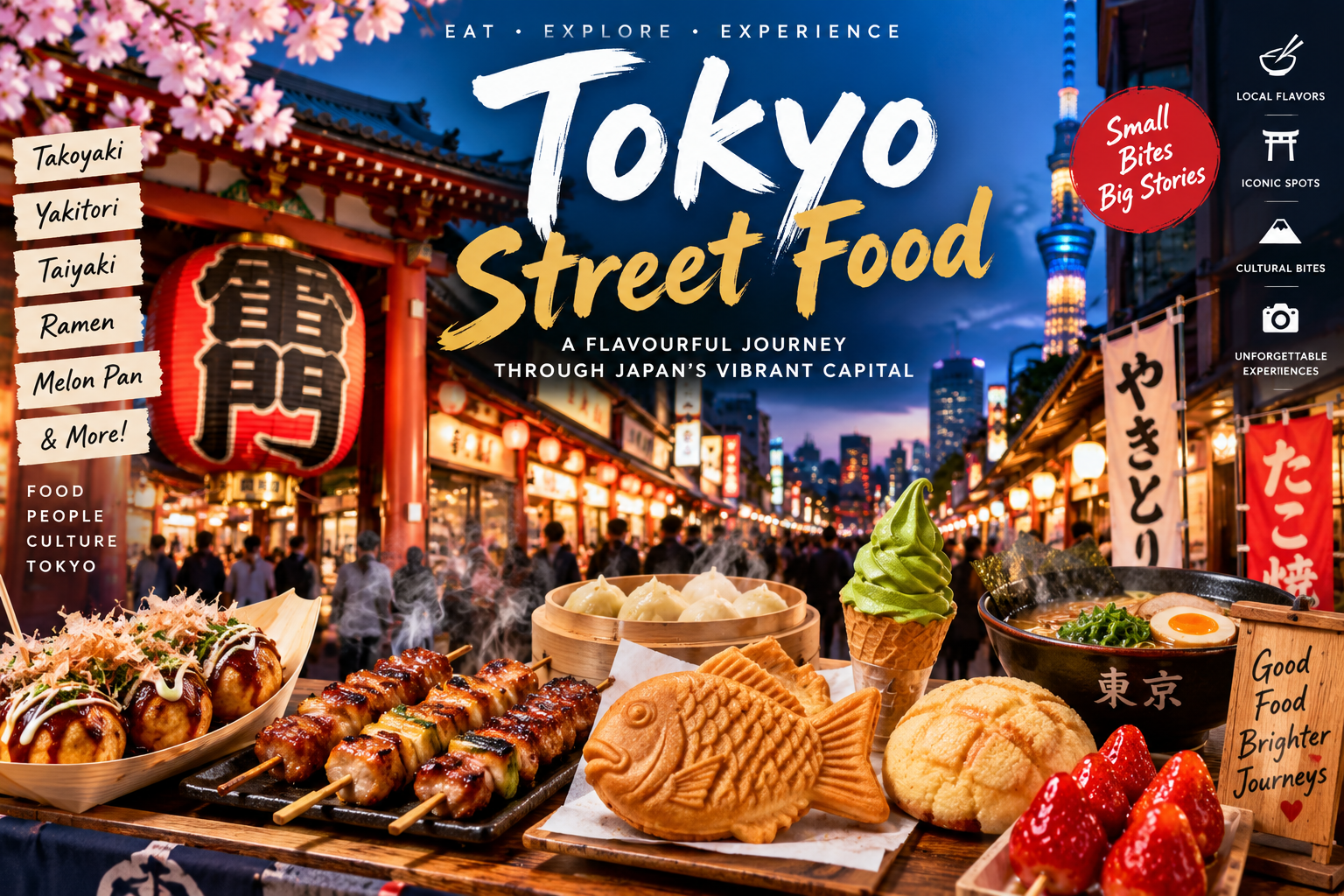
Tokyo Street Food: The Ultimate Guide to 25 Must-Try Foods, Markets, Hidden Gems and Local Flavors
Tokyo street food offers a fascinating introduction to Japanese food culture, from hot takoyaki and grilled yakitori to sweet taiyaki, ningyoyaki, senbei and freshly prepared market specialties. The best places to explore Tokyo street food include Asakusa, Tsukiji Outer Market, Harajuku, Ameyoko, local shopping streets, festival stalls and traditional neighborhoods where food is closely connected to everyday Japanese life Tokyo Sightseeing
What Makes Tokyo Street Food Different?
Tokyo’s food culture has been shaped by centuries of history, migration, seasonal ingredients, regional Japanese cuisine and modern consumer trends.
The result is an enormous culinary landscape.
JNTO describes Tokyo as a major food destination where travelers can experience everything from sushi and ramen to yakitori, takoyaki, tempura, soba, udon and many other Japanese foods.
Tokyo street food is connected to everyday life
Many foods that travelers describe as street food have deeper roots.
They may have developed as:
- Festival foods
- Quick meals
- Snacks for workers
- Market foods
- Neighborhood specialties
- Children’s treats
- Foods associated with particular districts
This is why eating in Tokyo can sometimes feel like exploring the city’s history one bite at a time.
Tokyo is not limited to one street-food style
There is no single “Tokyo street food.”
Instead, you will encounter several categories:
- Grilled foods
- Fried foods
- Seafood
- Rice-based snacks
- Noodle dishes
- Savory pancakes
- Japanese sweets
- Festival foods
- Market specialties
- Modern fusion snacks
This diversity makes Tokyo particularly rewarding for travelers who enjoy food exploration.
The History Behind Tokyo Street Food
To understand Tokyo’s street food, it helps to understand the city’s history as Edo.
During the Edo period, Tokyo developed into a major urban center.
Large populations created demand for affordable, convenient food.
People needed meals that could be prepared relatively quickly and consumed around busy commercial districts.
The rise of urban food culture
Tokyo’s historic “shitamachi” neighborhoods provide an important window into this development.
JNTO describes Tokyo’s downtown shitamachi areas as places where travelers can encounter the working-class culture of old Edo and local delicacies connected to the city’s fishing-village history.
This history is particularly visible in foods such as monjayaki.
Monjayaki and the working-class city
Monjayaki is strongly associated with Tokyo’s downtown neighborhoods.
It resembles okonomiyaki but has a much thinner, more liquid batter because it contains substantially more dashi.
JNTO identifies Tsukishima as one of the most important places to experience monjayaki.
The dish demonstrates how Tokyo’s food traditions developed from simple ingredients into distinctive local cuisine.
Best Tokyo Street Food You Should Try
There are dozens of foods worth trying, but some provide particularly good introductions to Tokyo’s culinary culture.
Takoyaki
Takoyaki is one of Japan’s most recognizable street foods.
These round batter-based snacks are typically cooked with pieces of octopus inside and finished with sauces and toppings.
Why takoyaki is popular
Takoyaki works particularly well as street food because it is:
- Small
- Portable
- Hot
- Flavorful
- Relatively inexpensive
- Easy to share
JNTO lists takoyaki among Japan’s classic street-food choices.
Be careful with the temperature
Freshly cooked takoyaki can be extremely hot inside.
The outside may appear manageable while the center remains almost molten.
Take a small bite first rather than eating the entire piece immediately.
Tokyo versus Osaka takoyaki
Takoyaki is strongly associated with Osaka, but it is widely available in Tokyo.
This is one of the interesting aspects of Tokyo street food: the city does not only offer foods that originated in Tokyo.
You can explore specialties from across Japan without leaving the capital.
Yakitori
Yakitori is grilled chicken served on skewers.
It is one of the most important foods to understand if you want to explore Japanese casual dining.
Why yakitori works as street food
The format is simple:
- Meat
- Skewer
- Charcoal or grill
- Sauce or salt
- Quick cooking
But the variety can be enormous.
Different chicken parts can have different textures and flavors.
Where to experience yakitori
You may encounter yakitori around:
- Festivals
- Food stalls
- Izakaya districts
- Station neighborhoods
- Traditional shopping streets
- Casual restaurants
JNTO specifically identifies yakitori as one of Japan’s classic street-food experiences.
Taiyaki
Taiyaki is a fish-shaped Japanese cake traditionally filled with sweet red bean paste.
The distinctive shape is part of its appeal.
Popular taiyaki fillings
Depending on the shop, you may find:
- Red bean paste
- Custard
- Chocolate
- Cheese
- Sweet potato
- Seasonal fillings
Why taiyaki is perfect for travelers
It is:
- Easy to carry
- Affordable
- Sweet
- Filling
- Visually distinctive
For first-time visitors, taiyaki is one of the easiest Tokyo street foods to understand.
Ningyoyaki
Ningyoyaki is particularly associated with Asakusa.
These small cakes are traditionally shaped like dolls, animals or famous local figures and often contain sweet red bean paste.
JNTO highlights ningyoyaki as one of the traditional foods available along Nakamise-dori near Sensoji.
Why ningyoyaki matters
Ningyoyaki is more than a sweet snack.
Its shapes connect the food with the neighborhood and its traditional identity.
This is a recurring theme in Tokyo street food.
Food often doubles as a cultural souvenir.
Senbei
Senbei are Japanese rice crackers.
They can be:
- Salty
- Soy-sauce flavored
- Sweet
- Seaweed-covered
- Sesame-flavored
- Grilled
Freshly grilled senbei
Freshly grilled senbei can have a different texture from packaged supermarket versions.
The combination of crispness, aroma and soy sauce creates a simple but memorable snack.
Nakamise-dori is one location where visitors can find freshly toasted senbei.
Melon Pan
Despite its name, melon pan generally does not taste like melon.
It is a sweet bread with a crisp cookie-like exterior.
Why tourists love it
The contrast between the crunchy surface and soft interior makes it an easy introduction to Japanese bakery culture.
In Asakusa and other tourist districts, oversized or specialty versions can also be found.
JNTO lists melon pan among the street-food choices available around Nakamise-dori.
Japanese Croquettes
Croquettes, often called korokke, are another convenient snack.
They may contain:
- Potato
- Ground meat
- Seafood
- Vegetables
- Cream-based fillings
They are usually breaded and fried.
Why korokke is useful for budget travelers
A freshly fried croquette can be inexpensive compared with a full restaurant meal.
It also allows travelers to sample different fillings without committing to a large dish.
Karaage
Karaage is Japanese-style fried chicken.
Although not exclusive to Tokyo, it is widely available in the capital.
What makes Japanese fried chicken distinctive?
The chicken is generally marinated before being coated and fried.
The result can be juicy inside and crisp outside.
Karaage works especially well for travelers who want familiar flavors with a Japanese twist.
Yakisoba
Yakisoba is fried noodles prepared with vegetables, meat or other ingredients and a savory sauce.
It is particularly common at festivals.
JNTO identifies yakisoba as one of the classic foods served at Japanese matsuri.
Why yakisoba is associated with festivals
Large flat griddles allow vendors to prepare substantial quantities quickly.
The aroma spreads across festival grounds, making it part of the sensory experience.
Okonomiyaki
Okonomiyaki is often described as a Japanese savory pancake.
Tokyo offers versions influenced by different regional traditions.
Tokyo’s relationship with okonomiyaki
Tokyo is not the origin of every form of okonomiyaki, but visitors can find the dish throughout the city.
JNTO’s guide explains that Tokyo’s monjayaki is different from the more substantial okonomiyaki associated with Osaka and Hiroshima.
Why try monjayaki instead?
If you want something specifically connected with Tokyo, monjayaki is arguably the more geographically distinctive choice.
Monjayaki
Monjayaki deserves special attention because it is one of Tokyo’s defining local foods.
What is monjayaki?
It is a savory mixture made using ingredients such as:
- Flour
- Dashi
- Cabbage
- Seafood
- Meat
- Cheese
- Mochi
- Other toppings
The batter is much more liquid than conventional okonomiyaki.
JNTO describes its texture as similar to melted cheese.
Where to eat monjayaki
Tsukishima’s Monja Street is one of the best-known destinations.
JNTO describes Tsukishima as a major center for monjayaki and notes that the dish is often cooked and eaten directly from a hot griddle using a small metal spatula.
Why monjayaki is an experience
It is interactive.
You don’t simply receive a finished plate.
The cooking process becomes part of the meal.
That makes it particularly good for:
- Families
- Couples
- Friends
- Food-focused travelers
Tamagoyaki
Tamagoyaki is Japanese rolled omelet.
It is made by repeatedly cooking and rolling layers of egg.
Why Tsukiji is famous for tamagoyaki
Tsukiji Outer Market has several shops specializing in Japanese food products.
GO TOKYO specifically highlights Tsukiji Yamachou, established in 1949, for its freshly cooked tamagoyaki served on sticks.
Sweet or savory?
Tokyo-style tamagoyaki can have a noticeably sweet flavor depending on the recipe.
This can surprise visitors expecting an ordinary omelet.
Seafood Street Food
Tokyo’s relationship with the sea has influenced its cuisine for centuries.
The city’s seafood culture remains particularly visible around markets.
Tsukiji Outer Market
Tsukiji Outer Market is one of Tokyo’s most important food destinations.
The former wholesale fish market moved to Toyosu in 2018, but the outer market remains active.
GO TOKYO currently describes the area as having approximately 460 shops.
What you can find at Tsukiji
Depending on the shop and season, visitors can encounter:
- Sushi
- Sashimi
- Grilled seafood
- Tamagoyaki
- Seafood rice bowls
- Dried seafood
- Japanese seasonings
- Kitchenware
- Snacks
Why visit early?
Tsukiji is fundamentally a morning-oriented food destination.
GO TOKYO recommends visiting between approximately 9 a.m. and 1 p.m. when the market is most lively, while noting that many shops close before evening.
Sushi at Tsukiji
Sushi is technically more accurately described as market or casual food rather than traditional street food.
However, it belongs in a Tokyo food guide because of its deep connection with the city’s food culture.
Edomae sushi
Edomae sushi developed in Edo and has a strong relationship with Tokyo Bay.
JNTO explains that Edomae refers to the area in front of Edo Castle and the fish caught around Tokyo Bay. Traditional preservation and preparation methods included salting, vinegar pickling, steaming, boiling and marinating.
This is an excellent example of how Tokyo’s food history evolved from practical needs.
Ameyoko Market Food
Ameyoko in Ueno is another important food-oriented destination.
The area has a lively market atmosphere and offers a mixture of Japanese and international food.
Why Ameyoko is different
Unlike the strongly traditional atmosphere of Asakusa, Ameyoko feels more like a bustling urban marketplace.
You can find:
- Seafood
- Snacks
- Fruit
- Sweets
- Grilled foods
- Restaurants
- International flavors
Best for adventurous eaters
Ameyoko works particularly well for travelers who enjoy browsing rather than following a strict restaurant itinerary.
Harajuku Street Food
Harajuku is famous for fashion, youth culture and colorful sweets.
GO TOKYO identifies Takeshita Street as a major destination for young fashion and specifically highlights crepes and other food experiences in the area.
Japanese crepes
Harajuku-style crepes are often filled with combinations such as:
- Fresh fruit
- Cream
- Ice cream
- Custard
- Chocolate
- Cheesecake
- Sweet sauces
They are designed to be visually attractive as well as tasty.
Why Harajuku food is different
Harajuku demonstrates the modern side of Tokyo’s food culture.
Traditional Japanese dishes are important, but Tokyo’s food scene constantly incorporates international influences and new presentation styles.
GO TOKYO describes Tokyo as a city where traditional cuisine and modern culinary trends coexist.
Shibuya Street Food
Shibuya is another major destination for contemporary food.
The district combines:
- Japanese chains
- Independent restaurants
- Dessert shops
- Food halls
- International cuisine
- Trend-focused concepts
GO TOKYO describes Shibuya as a gourmet destination alongside its role as a fashion and entertainment center.
What to look for in Shibuya
Rather than searching only for traditional stalls, explore:
- Department-store food floors
- Small dessert stores
- Casual Japanese restaurants
- Street-facing snack shops
- Trend-driven food concepts
Shibuya is particularly useful if you want to understand where Tokyo’s food culture is heading.
Asakusa Street Food
Asakusa is one of the strongest destinations for traditional Tokyo food experiences.
The combination of Sensoji, Nakamise-dori and surrounding streets creates a natural food itinerary.
What to try in Asakusa
Consider:
- Ningyoyaki
- Senbei
- Melon pan
- Croquettes
- Traditional sweets
- Matcha desserts
- Tempura
- Soba
- Casual Japanese dishes
JNTO specifically identifies ningyoyaki, senbei, croquettes, melon pan and matcha ice cream around Nakamise-dori.
Why Asakusa works so well
Food is integrated into the sightseeing experience.
You don’t have to choose between culture and food.
The two exist together.
Tsukishima Street Food
Tsukishima is particularly famous for monjayaki.
What makes Tsukishima special?
The neighborhood has developed a concentration of monjayaki restaurants.
JNTO identifies Monja Street as the key place to experience this Tokyo specialty.
Best for
Tsukishima is especially suitable for:
- Food enthusiasts
- Couples
- Families
- Repeat Tokyo visitors
- Travelers interested in local cuisine
Festival Street Food in Tokyo
Tokyo’s matsuri provide some of the most authentic street-food atmospheres.
Common festival foods
You may encounter:
- Yakitori
- Yakisoba
- Takoyaki
- Grilled seafood
- Corn
- Candied fruit
- Sweet snacks
- Festival drinks
JNTO specifically lists yakitori, yakisoba and takoyaki among common matsuri foods.
Why festival food tastes different
Part of the experience is environmental.
You are not simply eating food.
You are surrounded by:
- Lanterns
- Music
- Crowds
- Traditional clothing
- Decorations
- Seasonal celebrations
That context changes how the food feels.
Japanese Street Sweets
Tokyo is exceptionally strong in dessert culture.
Popular options
Look for:
- Taiyaki
- Ningyoyaki
- Dorayaki
- Dango
- Matcha desserts
- Japanese crepes
- Soft serve
- Daifuku
- Sweet bean pastries
- Melon pan
Seasonal desserts
Many Japanese sweets change according to the season.
Spring may bring sakura-flavored products.
Summer often emphasizes refreshing flavors.
Autumn brings chestnut and sweet-potato products.
Winter introduces richer desserts and seasonal limited editions.
This seasonal approach is one of the defining characteristics of Japanese food culture.
Dango
Dango are small rice-flour dumplings served on skewers.
They can be prepared with different sauces and toppings.
Why dango is worth trying
It provides a simple introduction to traditional Japanese confectionery.
The texture is often more important than the sweetness.
Some travelers expecting soft Western desserts are surprised by the chewy consistency.
Matcha Soft Serve
Matcha soft serve has become a popular tourist food throughout Tokyo.
Where to find it
It is particularly common in:
- Asakusa
- Ueno
- Harajuku
- Ginza
- Traditional shopping streets
Why matcha works so well
The slightly bitter tea flavor balances the sweetness of ice cream.
For travelers who find very sweet desserts overwhelming, matcha can provide a more balanced option.
Street Food for Vegetarian Travelers
Tokyo’s food scene is increasingly accommodating to different dietary preferences.
GO TOKYO currently provides dedicated information for vegetarian, vegan and Muslim travelers and explains that Tokyo offers diverse culinary options.
What vegetarians should know
Not every apparently vegetarian Japanese snack is vegetarian.
Ingredients such as:
- Dashi
- Fish flakes
- Meat-based sauces
- Gelatin
can appear in unexpected places.
Practical strategy
Ask specifically about ingredients rather than assuming.
A dish containing vegetables is not automatically vegetarian.
Tokyo Street Food for Muslim Travelers
Tokyo has become more accessible for Muslim visitors, with increasing halal and Muslim-friendly options.
GO TOKYO currently maintains dedicated guidance covering Muslim cuisine and dietary considerations.
Important distinction
“Muslim-friendly” and “halal-certified” are not necessarily identical.
Travelers with strict dietary requirements should verify:
- Certification
- Ingredients
- Cooking equipment
- Cross-contamination policies
before ordering.
Tokyo Street Food for Families
Families often prefer foods that can be shared.
Good options may include:
- Takoyaki
- Yakisoba
- Taiyaki
- Croquettes
- Crepes
- Dango
- Melon pan
Family strategy
Rather than buying a large amount of one dish, purchase several small items and share them.
This allows children and adults to discover different flavors without wasting food.
Tokyo Street Food for Solo Travelers
Solo travelers have one major advantage.
You can stop whenever something smells interesting.
Best approach
Choose small portions.
Try one item.
Walk a little.
Try another.
This creates a natural food tour without requiring a reservation.
Tokyo Street Food for Couples
Food markets and shopping streets can be excellent date experiences.
Good combinations
Try:
Asakusa + Sensoji + traditional sweets
or
Tsukishima + monjayaki
or
Harajuku + crepes + Takeshita Street
These combinations allow food to become part of a broader neighborhood experience.
Tokyo Street Food for Budget Travelers
Street food can help reduce the cost of eating in Tokyo, but it is not always automatically cheap.
Tourist-focused desserts and specialty items can sometimes cost more than expected.
Budget strategy
Look for:
- Local shopping arcades
- Neighborhood bakeries
- Supermarket food
- Department-store food halls
- Traditional snack shops
- Small local restaurants
Don’t judge value only by portion size
A small snack can provide more cultural value than a large generic meal if it introduces you to a local tradition.
Tokyo Street Food for First-Time Visitors
If you have never visited Tokyo, avoid trying to eat everything in one day.
Instead, build a simple progression.
First experience
Start with Asakusa.
Try:
- Ningyoyaki
- Senbei
- Melon pan
- Croquette
Then explore Sensoji.
Second experience
Visit Tsukiji in the morning.
Try:
- Tamagoyaki
- Seafood
- Sushi
- Rice bowls
Third experience
Visit Harajuku.
Try:
- Japanese crepes
- Matcha dessert
- Modern sweets
This gives you three completely different perspectives on Tokyo food culture.
Tokyo Street Food Without Walking While Eating
This deserves its own section because it is an important cultural point.
Visitors sometimes assume Japanese street food means eating continuously while walking.
That is not always appropriate.
Why eating while walking can be discouraged
Crowded streets create problems with:
- Litter
- Spills
- Crowding
- Hygiene
- Accident risks
- Blocking other visitors
Tsukiji Outer Market explicitly asks visitors not to eat while walking and instead recommends eating at designated areas or near the shop where food was purchased.
The better approach
Buy food.
Step aside.
Eat respectfully.
Dispose of your waste properly.
Then continue exploring.
Tokyo Street Food Etiquette
Don’t block narrow pathways
Tokyo markets can contain very narrow alleys.
Stand to one side when stopping.
Don’t leave rubbish behind
Use designated bins or return waste to the vendor where appropriate.
Follow photography rules
Some vendors may not want detailed photographs of preparation areas.
Respect queues
Japanese food culture generally places strong emphasis on orderly queuing.
Don’t assume you can step ahead because you are only buying one item.
Avoid touching food
Unless the vendor invites you to handle something, don’t touch products.
How to Order Tokyo Street Food
Ordering is usually easier than beginners expect.
Pointing is acceptable
If there is a menu display, pointing at the item you want is often practical.
Learn a few Japanese expressions
“One please” and “thank you” can make interactions smoother.
Carry some cash
Electronic payments are increasingly common, but not every small vendor accepts every payment method.
GO TOKYO specifically notes that many Tsukiji Outer Market stores remain cash-only.
How Much Does Tokyo Street Food Cost?
Prices vary considerably depending on the food, neighborhood, season and vendor.
A simple snack can be relatively inexpensive, while premium seafood, specialty desserts or tourist-focused creations can cost substantially more.
A realistic food budget
Instead of setting one fixed street-food price, create three categories:
Budget snack: one small item.
Moderate tasting: several snacks during a neighborhood walk.
Food-focused day: multiple markets, meals, desserts and specialty dishes.
This approach is more useful because Tokyo street food ranges from inexpensive traditional snacks to premium market seafood.
How to Find Authentic Tokyo Street Food
The word “authentic” is frequently misused in travel content.
A food isn’t automatically authentic because it looks old-fashioned.
Better indicators
Look for:
- Long-established local businesses
- Regional specialties
- Foods with documented local histories
- Neighborhood-focused shops
- Traditional preparation techniques
- Busy local customer bases
Avoid the “Instagram test”
A food can be extremely photogenic and still have little connection with traditional Tokyo cuisine.
The best approach is to ask:
What is this food? Where did it come from? Why is it associated with this neighborhood?
That turns eating into cultural research.
Ten Food Brands and Chains to Know in Tokyo
The following comparison is intended as a practical reference rather than a ranking. Availability and menus can change, so travelers should verify current locations and offerings before visiting.
| Brand | Food focus | Useful for | Style | What to look for |
|---|---|---|---|---|
| Gindaco | Takoyaki | Quick snack | Casual | Hot octopus balls |
| Tenya | Tempura | Budget-friendly meal | Casual chain | Tempura rice bowls |
| Yoshinoya | Gyudon | Fast Japanese meal | Casual chain | Beef bowls |
| Matsuya | Gyudon and set meals | Budget travelers | Casual chain | Rice bowls and set meals |
| Sukiya | Gyudon | Quick meals | Casual chain | Beef bowls and variations |
| Marugame Udon | Udon | Families and casual dining | Fast casual | Fresh udon and tempura |
| CoCo Ichibanya | Japanese curry | Familiar casual food | Casual chain | Customizable curry |
| Mister Donut Japan | Japanese-style donuts | Dessert/snack | Casual | Seasonal donut flavors |
| Beard Papa’s | Cream puffs | Sweet snack | Dessert chain | Fresh cream-filled pastries |
| Ginza Cozy Corner | Japanese cakes and sweets | Dessert lovers | Bakery/dessert | Japanese-style cakes |
How to use the brand comparison
Chains are useful when you need predictability, clear menus and quick meals.
Independent stalls are often better when your priority is discovering local specialties.
A balanced Tokyo food trip can include both.
Tokyo Street Food Versus Restaurant Dining
Street food has several advantages.
Advantages
- Convenient
- Often affordable
- Easy to sample
- Strong neighborhood connection
- Excellent for food exploration
- Good for short breaks
- Wide range of flavors
Disadvantages
- Limited seating
- Menus may not always be multilingual
- Dietary information may be limited
- Some foods are seasonal
- Queues can be long
- Some markets have strict eating rules
- Quality varies between vendors
Restaurant dining provides more comfort and sometimes greater menu transparency.
The strongest Tokyo food itinerary often combines both.
Tokyo Street Food and Seasonal Eating
Seasonality is central to Japanese food culture.
Spring
Look for:
- Sakura sweets
- Strawberry desserts
- Seasonal wagashi
- Fresh vegetables
Summer
Look for:
- Kakigori
- Cold noodles
- Fresh fruit
- Summer festival foods
Autumn
Look for:
- Sweet potato
- Chestnut
- Pumpkin
- Mushroom-based foods
- Seasonal fish
Winter
Look for:
- Warm grilled foods
- Oden
- Hot soups
- Rich desserts
- Seasonal festival foods
This seasonal approach means Tokyo street food can feel different depending on when you visit.
Tokyo Street Food in Winter
Cold weather makes hot food particularly appealing.
Good winter choices
- Takoyaki
- Yakitori
- Oden
- Hot sweet drinks
- Freshly grilled snacks
- Warm taiyaki
Why winter changes the experience
Steam, charcoal smoke and warm food create a completely different atmosphere from summer.
Winter can also mean fewer tourists in some areas, although holiday periods remain busy.
Tokyo Street Food in Summer
Summer street food is strongly connected with festivals.
Good choices
- Kakigori
- Yakisoba
- Takoyaki
- Grilled corn
- Yakitori
- Cold desserts
Hydration matters
Tokyo summers can be hot and humid.
A food-focused walking itinerary should include regular breaks and water.
Tokyo Street Food During Festivals
Festivals are among the best times to experience classic Japanese street-food culture.
Why matsuri food feels special
Food stalls become temporary neighborhoods.
You may see dozens of vendors preparing food simultaneously.
The result is a sensory environment involving:
- Smoke
- Sound
- Lanterns
- Music
- Crowds
- Seasonal decorations
- Grilling aromas
JNTO describes yakitori, yakisoba and takoyaki as common matsuri foods.
Common Tokyo Street Food Mistakes
Mistake 1: Eating only viral foods
Social media can make one dessert look like the entire Tokyo food scene.
It isn’t.
Mistake 2: Ignoring local specialties
If you are in Tsukishima, try monjayaki.
If you are in Asakusa, explore traditional snacks.
If you are in Tsukiji, explore seafood and market foods.
Mistake 3: Eating too much at the first stop
Tokyo rewards sampling.
Small portions allow you to try more.
Mistake 4: Assuming every food stall accepts cards
Carry a payment backup.
Mistake 5: Ignoring allergies
Ask about ingredients.
Mistake 6: Eating while walking where it is discouraged
Follow local rules.
Mistake 7: Visiting markets too late
Some traditional markets operate primarily in the morning.
Tsukiji is a particularly clear example. GO TOKYO says the market is most lively from around 9 a.m. to 1 p.m., while many shops close before evening.
Tokyo Street Food Safety Tips
Food safety should always be taken seriously while traveling.
Choose busy vendors
A busy stall can indicate strong turnover, although popularity alone does not guarantee safety.
Look at food handling
Observe whether food is:
- Properly cooked
- Stored appropriately
- Protected from unnecessary contamination
Be cautious with allergies
Japanese cuisine can contain ingredients that are not obvious from the dish’s appearance.
Common concerns may include:
- Seafood
- Soy
- Wheat
- Sesame
- Egg
- Dairy
- Fish-based stock
Don’t assume “vegetarian” means fish-free
Dashi may contain fish ingredients.
Ask specifically.
Tokyo Street Food and Food Allergies
Travelers with severe allergies should prepare before arriving.
Useful preparation
Write down your allergies in Japanese.
Carry the information in printed and digital form.
Research restaurants and vendors in advance.
Ask questions before ordering.
Why preparation matters
Small street stalls may not have detailed allergen documentation.
This is one area where restaurant dining can sometimes provide more communication options.
Tokyo Street Food and Dietary Restrictions
Tokyo has become increasingly diverse.
GO TOKYO currently provides dedicated information about vegetarian, vegan and Muslim dining in the city.
Vegetarian travelers
Research ingredients carefully.
Vegan travelers
Look for dedicated vegan establishments when strict avoidance is required.
Muslim travelers
Check halal certification or detailed ingredient information when necessary.
Gluten-free travelers
Wheat appears in many Japanese foods, including soy sauce and batter-based snacks.
Never assume a rice-based food is automatically gluten-free.
A Perfect Tokyo Street Food Day
Here is a practical example.
Morning: Tsukiji
Arrive early.
Explore the market.
Try:
- Tamagoyaki
- Seafood
- Sushi
- A small rice bowl
Late morning: Ginza
Walk toward Ginza.
Take a break.
Afternoon: Asakusa
Visit Sensoji.
Explore Nakamise-dori.
Try:
- Ningyoyaki
- Senbei
- Melon pan
- Matcha dessert
Evening: Ueno or another neighborhood
Explore a local dining district.
Finish with yakitori or another casual Japanese meal.
This itinerary combines three different food environments without requiring a formal food tour.
A Tokyo Street Food Itinerary for Families
Morning
Visit Asakusa.
Midday
Share several small snacks.
Afternoon
Explore another nearby attraction.
Evening
Choose a casual restaurant with seating.
The advantage is flexibility.
Children can try small portions without committing to unfamiliar large dishes.
A Tokyo Street Food Itinerary for Couples
Morning
Tsukiji.
Afternoon
Ginza and surrounding areas.
Evening
Tsukishima for monjayaki.
This creates a strong food-focused day with different textures and experiences.
A Tokyo Street Food Itinerary for Solo Travelers
Morning
Tsukiji.
Afternoon
Asakusa.
Evening
Explore a station neighborhood or izakaya area.
The advantage is that solo travelers can stop whenever they want.
A Tokyo Street Food Itinerary for Repeat Visitors
Skip the most famous places for one day.
Explore:
- Local shopping streets
- Neighborhood bakeries
- Small temples
- Residential districts
- Regional Japanese food shops
- Independent dessert stores
The objective is to experience Tokyo as a living city rather than as a collection of tourist attractions.
How Social Media Has Changed Tokyo Street Food
Instagram, TikTok and YouTube have changed food tourism.
A single visually dramatic dessert can suddenly attract enormous attention.
Positive effects
Social media can:
- Help small businesses gain attention
- Introduce international travelers to Japanese foods
- Encourage culinary exploration
- Preserve visual records of changing food trends
Negative effects
It can also create:
- Long queues
- Overcrowding
- Food waste
- Unrealistic expectations
- Pressure on local neighborhoods
The smarter approach
Use social media for discovery.
Use official tourism information for practical planning.
Use local observation for the final decision.
The Future of Tokyo Street Food
Tokyo’s food culture will continue to evolve.
Traditional foods are unlikely to disappear, but the way travelers discover and consume them is changing.
Traditional food will become more accessible
More menus and signs are likely to include multilingual information.
Digital payments will continue expanding
Cash remains useful, especially at small businesses, but electronic payments are increasingly common across Tokyo.
Dietary diversity will grow
Tokyo’s tourism authorities are already providing dedicated information for vegetarian, vegan and Muslim travelers.
Sustainable food tourism will become more important
Travelers are increasingly interested in:
- Local ingredients
- Seasonal food
- Small producers
- Reduced waste
- Traditional cooking
- Responsible tourism
Convenience will continue influencing food
Tokyo has always been good at making food convenient.
Future street-food trends will likely combine Japanese traditions with modern presentation, technology and changing dietary preferences.
Pros and Cons of Tokyo Street Food
Advantages of Tokyo street food
Tokyo street food offers extraordinary variety in small portions, making it easy to sample different flavors without committing to expensive full meals. It is also closely connected to neighborhoods, festivals, markets and Japanese traditions, allowing travelers to experience food as part of the city’s culture rather than as an isolated restaurant activity.
Disadvantages of Tokyo street food
The biggest challenges are inconsistency, crowds, limited seating, language barriers and dietary uncertainty. Some famous food areas can become extremely busy, and some markets have specific rules about where visitors should eat. Tsukiji Outer Market, for example, specifically asks visitors not to eat while walking.
The answer is preparation rather than avoidance.
Research the neighborhood, understand local etiquette, carry appropriate payment methods and choose foods according to your dietary requirements.
Tokyo Street Food Search Modifiers for Different Travelers
Search intent around Tokyo street food is highly diverse.
Tokyo street food for beginners
Focus on easy-to-understand foods such as takoyaki, taiyaki, yakitori, melon pan and ningyoyaki.
Tokyo street food for families
Prioritize Asakusa, markets and food streets where several small foods can be shared.
Tokyo street food for couples
Consider Tsukishima, Asakusa and Harajuku for interactive and visually appealing food experiences.
Tokyo street food for solo travelers
Look for small portions and neighborhoods where you can explore at your own pace.
Tokyo street food for budget travelers
Compare traditional snacks, bakeries, markets and casual chains rather than assuming every tourist stall is inexpensive.
Tokyo street food for vegetarians
Research ingredients carefully and verify dashi and sauces.
Tokyo street food for Muslim travelers
Check halal certification and ingredient information.
Tokyo street food for photographers
Explore Asakusa, Harajuku, markets and festivals for strong visual environments.
Tokyo street food without crowds
Visit popular areas early on weekdays and consider less-famous neighborhood shopping streets.
Tokyo street food near train stations
Station neighborhoods are useful for travelers with limited time because they combine transportation and food access.
Tokyo Street Food: What Most Travel Guides Miss
The biggest mistake in many Tokyo food guides is treating street food as a list.
A better way to understand Tokyo is through food geography.
Asakusa represents tradition and tourism
The food around Sensoji demonstrates how religion, commerce and tourism can exist together.
Tsukiji represents market culture
The outer market continues to function as a major food destination even after the wholesale fish market moved to Toyosu.
Tsukishima represents local Tokyo cuisine
Monjayaki provides a direct connection to shitamachi food culture.
Harajuku represents youth-driven food trends
Crepes and colorful desserts demonstrate how Tokyo’s food culture adapts to contemporary tastes.
Shibuya represents modern culinary experimentation
Its restaurants and food businesses reflect Tokyo’s position as a global city.
This geographic approach makes your food itinerary much more meaningful.
How to Eat Tokyo Street Food Like a Respectful Traveler
The goal isn’t to imitate locals perfectly.
It is to understand the environment.
Buy only what you intend to eat.
Avoid creating unnecessary waste.
Stand aside rather than blocking pedestrian traffic.
Follow the vendor’s instructions.
Respect queues.
Don’t photograph people without permission.
Don’t enter restricted areas.
Don’t touch food displays unnecessarily.
And when a neighborhood asks visitors not to eat while walking, simply stop and eat where appropriate.
This behavior is especially important because Tokyo’s most popular food districts are often shared by residents, workers and tourists.
FAQs
What is the most popular street food in Tokyo?
There is no single food that represents all of Tokyo, but takoyaki, yakitori, taiyaki, ningyoyaki, senbei and other Japanese snacks are widely available. JNTO lists foods including yakitori, takoyaki, taiyaki, ramen, okonomiyaki and other casual dishes among Japan’s street-food experiences.
What street food is Tokyo famous for?
Tokyo is particularly associated with foods such as monjayaki, Edomae sushi, yakitori and numerous traditional snacks. JNTO identifies monjayaki as a Tokyo local specialty with strong connections to the Tsukishima area.
Where is the best place for Tokyo street food?
Different neighborhoods are better for different foods. Asakusa is excellent for traditional sweets and snacks, Tsukiji for market food and seafood, Tsukishima for monjayaki, and Harajuku for modern sweets and crepes.
Is Tsukiji still worth visiting for food?
Yes. The wholesale fish market moved to Toyosu in 2018, but Tsukiji Outer Market remains a major food destination. GO TOKYO currently describes the market as having approximately 460 shops.
What should I eat at Tsukiji Outer Market?
Options include seafood, sushi, tamagoyaki, seafood rice bowls and other market specialties. GO TOKYO specifically highlights freshly prepared tamagoyaki and seafood dishes.
Can I eat while walking in Tokyo?
It depends on the location. Some areas permit it, while others discourage or prohibit it. Tsukiji Outer Market specifically asks visitors to eat at designated areas or near the shop where they purchased the food rather than walking while eating.
What is monjayaki?
Monjayaki is a Tokyo-style savory griddle dish made with a relatively liquid batter containing dashi and ingredients such as cabbage, seafood, meat, cheese or mochi. It is strongly associated with Tsukishima.
Is monjayaki the same as okonomiyaki?
No. They are related but have significant differences. Monjayaki uses much more dashi, resulting in a thinner, more liquid texture, while conventional okonomiyaki is much thicker.
Is Tokyo street food expensive?
Tokyo street food ranges from inexpensive snacks to premium seafood and specialty desserts. Budget travelers can keep costs manageable by sampling smaller portions and mixing street food with supermarkets, bakeries and casual restaurants.
What is the cheapest Tokyo street food?
Prices change by location and vendor, so there is no single cheapest option. Simple snacks such as senbei, small sweets, croquettes and some bakery items can be relatively affordable.
What is the best Tokyo street food for children?
Taiyaki, melon pan, crepes, croquettes and takoyaki are popular choices because they are relatively easy to share and sample in small quantities.
What is the best Tokyo street food for vegetarians?
Vegetarian options exist, but ingredients should be verified carefully. Fish-based dashi can appear in foods that otherwise contain vegetables. Tokyo’s official tourism authority provides dedicated information for vegetarian and vegan travelers.
Does Tokyo have halal street food?
Tokyo has increasingly diverse Muslim-friendly and halal dining options. However, travelers requiring strict halal standards should verify certification and preparation methods rather than assuming a food is halal because it contains no obvious pork or alcohol.
What is the best area for Tokyo street food at night?
The answer depends on what you want to eat. Traditional markets such as Tsukiji are primarily daytime destinations, while station neighborhoods, izakaya districts and entertainment areas offer more evening-oriented food experiences.
Is Harajuku good for street food?
Yes. Harajuku is particularly known for modern sweets, crepes and youth-oriented food trends. GO TOKYO specifically highlights Takeshita Street and its crepes and food culture.
Is Asakusa good for street food?
Yes. Asakusa is one of Tokyo’s strongest areas for traditional snacks, particularly around Nakamise-dori and Sensoji. JNTO identifies ningyoyaki, senbei, croquettes, melon pan and matcha ice cream among the food choices available in the area.
What is ningyoyaki?
Ningyoyaki are small Japanese cakes traditionally filled with sweet red bean paste and shaped like dolls, animals or local landmarks. They are particularly associated with Asakusa.
What is taiyaki?
Taiyaki is a fish-shaped Japanese cake traditionally filled with sweet red bean paste. Modern versions can contain custard, chocolate, cheese and other fillings.
What is yakitori?
Yakitori is grilled chicken served on skewers. Different chicken cuts can be used, and the skewers may be seasoned with salt or a savory-sweet sauce.
What is Japanese street food at festivals?
Japanese festivals commonly feature foods such as yakitori, yakisoba, takoyaki, grilled seafood and sweets. JNTO identifies yakitori, yakisoba and takoyaki as common matsuri foods.
Should I visit Tokyo street-food markets in the morning?
For markets such as Tsukiji, yes. GO TOKYO recommends Tsukiji Outer Market between approximately 9 a.m. and 1 p.m. when the area is most lively, although individual businesses have different schedules.
Do Tokyo street-food vendors accept credit cards?
Payment methods vary. Many businesses accept electronic payments, but smaller vendors may still be cash-only. GO TOKYO specifically advises visitors to bring cash when visiting Tsukiji Outer Market.
What Japanese street food should a first-time visitor try?
A good introductory selection would be takoyaki, yakitori, taiyaki, ningyoyaki, senbei and monjayaki. These provide different textures, flavors and cooking styles.
What Tokyo street food is best for photography?
Harajuku crepes, colorful desserts, Asakusa snacks, festival food and traditional market displays can all be visually appealing. However, always prioritize the vendor’s rules and other customers over getting a photograph.
Can I find Tokyo street food near Tokyo Station?
Yes. Tokyo Station and surrounding areas contain numerous food halls, restaurants, bakeries and specialty food shops. However, if your goal is specifically traditional street-food culture, districts such as Asakusa, Tsukiji and Tsukishima provide stronger neighborhood identities.
Is Tokyo street food safe?
Tokyo has a highly developed food culture, but travelers should still use normal food-safety precautions, particularly around allergies and unfamiliar ingredients. Choose reputable vendors, observe food-handling practices and ask questions when necessary.
What should I avoid when eating Tokyo street food?
Avoid ignoring dietary restrictions, blocking crowded pathways, touching food without permission, violating photography rules, leaving rubbish behind or assuming that every food market allows eating while walking.
How many Tokyo street foods can I try in one day?
There is no ideal number. A better strategy is to sample several small portions rather than eating large meals at every stop. This allows you to experience greater variety without becoming uncomfortably full.
Is Tokyo street food authentic?
Tokyo has both traditional and modern street-food experiences. Rather than using “authentic” as a simple label, investigate the history of the food, its connection to the neighborhood and how it is traditionally prepared.
What is the most traditional Tokyo street food?
There is no single answer, but monjayaki has a particularly strong connection with Tokyo’s shitamachi culture, while Edomae sushi represents another important culinary tradition rooted in historic Edo.
What makes Tokyo a great food destination?
Tokyo combines traditional Japanese food, regional specialties from across Japan, international cuisine, modern food trends, markets and neighborhood culinary traditions. JNTO describes Tokyo as a major food destination with an exceptionally broad range of Japanese and international food experiences.
Conclusion
Tokyo street food is more than a quick meal—it is one of the easiest ways to experience the city’s everyday culture, local traditions, and diverse flavours. From hot takoyaki and grilled yakitori to sweet taiyaki, ningyoyaki, melon pan, and fresh market treats, every neighbourhood offers something different to discover. For first-time visitors, areas such as Asakusa, Tsukiji, Harajuku, Shibuya, and Tsukishima provide excellent opportunities to explore Tokyo’s food culture. Tsukiji is ideal for seafood and market snacks, Asakusa is known for traditional treats around Nakamise-dori, Harajuku is popular for creative sweets and crepes, while Tsukishima is closely associated with Tokyo-style monjayaki.


2 Comments