Tokyo Art: The Ultimate Guide to Traditional, Contemporary & Digital Art
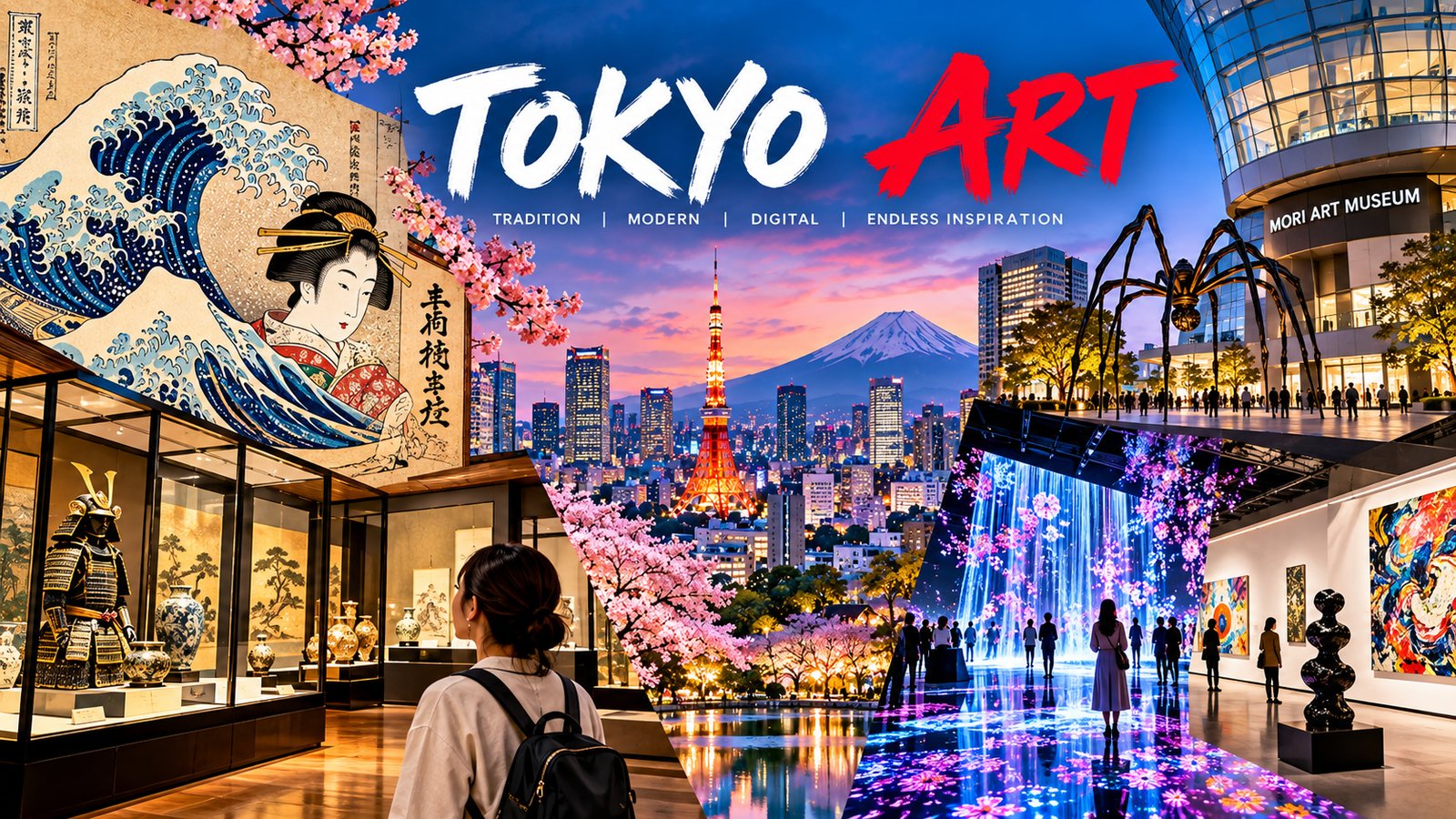
Tokyo art is a remarkably diverse creative world that connects traditional Japanese culture with contemporary galleries, major museums, public art, design, photography, manga, and digital experiences. From the Tokyo National Museum and Nezu Museum to Roppongi galleries and immersive digital spaces, visitors can experience completely different forms of creativity within the same city. Tokyo does not have one single art district or one definition of what Japanese art should be. Instead, art is distributed throughout the city. You can spend a morning studying historical paintings and calligraphy in Ueno, discover contemporary installations in Roppongi, browse independent galleries in Ginza or Kiyosumi-Shirakawa, explore ukiyo-e in Sumida, and finish the day inside a technology-driven digital artwork Tokyo Exploration
Understanding Tokyo Art
Tokyo art is best understood as an ecosystem rather than a single movement.
The city’s creative culture has developed through several overlapping traditions:
- Traditional Japanese painting
- Ukiyo-e woodblock printing
- Calligraphy
- Ceramics
- Lacquerware
- Textiles
- Sculpture
- Photography
- Modern Japanese painting
- Western-style Japanese art
- Contemporary art
- Manga and illustration
- Anime-related visual culture
- Graphic design
- Architecture
- Installation art
- Performance art
- Digital art
- Interactive experiences
- Public art
Some of these traditions are hundreds of years old, while others are products of the digital age.
The fascinating part is that they do not necessarily compete with one another.
Instead, Tokyo often allows them to exist side by side.
A traditional Japanese screen painting may be displayed in one building while an artist across the city creates an interactive installation using projection, sensors and software.
This contrast is central to understanding Tokyo’s creative identity.
A Brief History of Art in Tokyo
Tokyo was historically known as Edo before the Meiji Restoration of 1868.
During the Edo period, the city became a major centre of popular culture, entertainment and commerce. The development of ukiyo-e was particularly important because woodblock prints made visual art more accessible to a broader urban audience.
Artists represented actors, landscapes, beautiful women, everyday life and popular entertainment.
Katsushika Hokusai became one of the most internationally recognised Japanese artists, with works such as The Great Wave off Kanagawa eventually influencing artists and designers outside Japan.
The legacy of ukiyo-e remains important to modern Tokyo.
Today, visitors can explore this tradition in specialist museums and collections, including the Sumida Hokusai Museum.
But Tokyo’s artistic history did not stop with ukiyo-e.
From Edo Culture to Modern Japanese Art
The Meiji period introduced major political, economic and cultural changes.
Japanese artists increasingly encountered Western artistic techniques and ideas. Painting, sculpture, photography, architecture and design changed significantly.
Japan developed its own approaches to Western-style painting while continuing traditional forms.
This created a fascinating duality.
Artists could study European techniques while remaining connected to Japanese aesthetics.
That relationship between outside influence and local identity remains visible in contemporary Tokyo.
Modern Japanese artists frequently combine international ideas with distinctly Japanese approaches to materials, space, nature, technology and social themes.
Traditional Japanese Art in Tokyo
For travellers interested in historical Japanese art, Tokyo offers an unusually broad range of experiences.
Traditional art is not limited to paintings.
It includes:
- Ink painting
- Folding screens
- Scrolls
- Calligraphy
- Ceramics
- Lacquer
- Metalwork
- Textiles
- Sculpture
- Buddhist art
- Decorative arts
- Armour
- Wood and bamboo crafts
- Ukiyo-e
- Traditional architecture
The Tokyo National Museum is one of the most important places to begin.
Its collection covers paintings, calligraphy, sculpture, decorative arts and archaeology, and its online collection allows visitors to explore works by artist, region, period and genre.
Tokyo National Museum
Located in Ueno Park, the Tokyo National Museum provides an excellent introduction to Japanese art and cultural history.
Instead of focusing on one artistic period, the museum allows visitors to see how Japanese visual culture developed across centuries.
A first-time visitor should avoid trying to see everything.
The collection is too broad for that.
A better strategy is to select a theme.
For example:
- Japanese painting
- Buddhist sculpture
- Calligraphy
- Ceramics
- Decorative arts
- Samurai-related objects
- Archaeology
Spend more time with fewer objects.
Look at the material.
Notice the composition.
Consider how the artwork was used.
Ask why the object was created.
That approach can transform a museum visit from passive sightseeing into a meaningful cultural experience.
Nezu Museum
The Nezu Museum in Aoyama offers another perspective on traditional Asian art.
Its collection includes more than 7,600 objects, including National Treasures and Important Cultural Properties. Its collection areas include calligraphy, painting, sculpture, ceramics, lacquer, textiles, metalwork and archaeological objects.
The museum is also known for its garden.
That matters because Japanese art is often difficult to separate completely from ideas about nature, seasons, space and atmosphere.
The garden can therefore become part of the artistic experience.
Rather than rushing through galleries, visitors can move between indoor artworks and outdoor scenery.
This is particularly rewarding for travellers interested in Japanese aesthetics.
Ukiyo-e and Hokusai
Ukiyo-e is one of the most recognisable forms of Japanese visual culture.
The prints are famous for their bold compositions, expressive lines, distinctive colour relationships and scenes of everyday life.
They also helped shape perceptions of Japan overseas.
Hokusai is perhaps the best-known name associated with the tradition.
The Sumida Hokusai Museum provides a natural stop for travellers interested in his work and legacy.
A useful way to approach ukiyo-e is not simply to admire the image.
Look at:
- Line quality
- Colour blocks
- Perspective
- Human gestures
- Landscape composition
- Printing techniques
- Social context
- The relationship between commercial culture and art
This makes ukiyo-e much more interesting than treating it simply as an old-fashioned form of Japanese decoration.
Contemporary Art in Tokyo
Tokyo’s contemporary art scene is enormous.
There is no single contemporary Tokyo style.
Instead, artists work across:
- Painting
- Sculpture
- Photography
- Video
- Installation
- Performance
- Sound
- Digital media
- Artificial intelligence
- Interactive technology
- Architecture
- Social practice
Some exhibitions are highly conceptual.
Others are visually spectacular.
Some ask difficult political or social questions.
Others explore identity, memory, nature, technology or everyday life.
The official Tokyo tourism guide highlights the Mori Art Museum and The National Art Center, Tokyo among major destinations for contemporary and international exhibitions.
Mori Art Museum
The Mori Art Museum in Roppongi is one of Tokyo’s major contemporary art destinations.
Its exhibitions frequently connect Japanese and international artistic practices.
Its programme also demonstrates how contemporary art increasingly overlaps with technology, architecture and social issues.
For example, the museum has previously presented exhibitions exploring AI, robotics, cities and the future of human life, demonstrating how contemporary art can engage directly with technological change.
In 2026, the museum’s programme includes exhibitions such as Ron Mueck and a major upcoming retrospective of Mariko Mori.
This illustrates another important characteristic of Tokyo art:
Contemporary art in Tokyo is not isolated from the city’s technological identity.
Technology can become the subject, medium and environment of an artwork.
The National Art Center, Tokyo
The National Art Center, Tokyo in Roppongi has a different model.
Rather than functioning primarily around a traditional permanent collection, it hosts a changing programme of exhibitions.
Its 2026 programme includes major international exhibitions alongside exhibitions organised by Japanese artist associations.
This makes the museum particularly useful for travellers who want to see what is happening in Tokyo’s exhibition culture during a specific visit.
The key lesson is simple:
Always check current exhibitions before travelling.
Tokyo’s museum landscape changes constantly.
Tokyo Metropolitan Art Museum
Another important institution is the Tokyo Metropolitan Art Museum in Ueno.
The museum has a particularly interesting history.
It opened in 1926 and is celebrating its 100th anniversary in 2026. The museum describes itself as Japan’s first public art museum.
Its role extends beyond major international exhibitions.
The museum provides space for numerous artist associations and groups. According to the museum, around 270 groups hold exhibitions there each year.
This gives visitors an opportunity to see a side of Japanese art that can be missed by international travellers who focus only on famous museums.
There is a difference between seeing internationally celebrated artists and seeing the broader culture of people actively making and exhibiting art.
Both matter.
Artizon Museum
The Artizon Museum in Kyobashi offers another valuable perspective.
Its collection contains about 3,000 works belonging to the Ishibashi Foundation.
The collection spans antique art, Impressionism, modern Japanese Western-style painting, 20th-century art, contemporary art, design and artist portraits.
This makes the museum particularly interesting for visitors who want to understand relationships between Japanese and Western art.
It also demonstrates how Tokyo’s museums can tell interconnected stories rather than isolated national narratives.
Digital Art and the New Tokyo Experience
One of the biggest changes in Tokyo’s art scene is the growth of immersive and digital art.
The best-known example is teamLab.
teamLab Borderless at Azabudai Hills describes itself as a permanent digital art museum where artworks move between spaces rather than remaining confined to conventional rooms.
This changes the traditional relationship between viewer and artwork.
In a conventional gallery, you generally stand in front of an artwork.
In an immersive digital environment, you may walk through it.
The artwork may respond to movement.
Light may change.
Sound may shift.
A digital environment may continue across several rooms.
The visitor becomes part of the experience.
Why Digital Art Matters
Digital art is sometimes dismissed as entertainment because it can be highly visual and popular on social media.
That is too simplistic.
Interactive art raises serious questions about:
- Human perception
- Technology
- Space
- Participation
- Artificial environments
- Digital identity
- Data
- Nature
- Machine creativity
Tokyo is an especially interesting place to experience this development because the city’s technological infrastructure and design culture create an environment where technology-based art feels culturally natural.
Art and Architecture in Tokyo
Architecture is another important part of Tokyo art.
Some museums are themselves artistic experiences.
Consider the contrast between:
- Historic museum buildings
- Minimalist galleries
- Contemporary glass structures
- High-rise cultural spaces
- Converted warehouses
- Small independent galleries
- Traditional Japanese buildings
The architecture affects how visitors perceive art.
A small gallery creates intimacy.
A large white exhibition hall creates distance and scale.
A traditional garden creates a connection between art and nature.
A skyscraper gallery changes the relationship between art and the city.
This is one reason an art itinerary should not focus only on individual artworks.
The spaces matter too.
Roppongi: Tokyo’s Contemporary Art Hub
Roppongi is one of the most convenient areas for visitors interested in contemporary art.
The area includes:
- Mori Art Museum
- The National Art Center, Tokyo
- Tokyo Midtown
- Suntory Museum of Art
- 21_21 Design Sight
- Tokyo Midtown Design Hub
- Public artworks
- Commercial galleries
The official Tokyo travel guide identifies Roppongi as an important concentration of art and design institutions.
This creates an opportunity to build a compact art day.
A possible route could be:
- Start at The National Art Center, Tokyo.
- Walk towards Roppongi Hills.
- Visit Mori Art Museum.
- Explore public art around Roppongi.
- Continue towards Tokyo Midtown.
- Visit another museum or gallery.
- Finish with a city view or evening meal.
The advantage is efficiency.
You can experience different types of art without spending the entire day travelling across Tokyo.
Ueno: History, Museums and Traditional Art
Ueno offers a very different experience.
It is one of the best areas for visitors who want historical collections.
The area includes major cultural institutions and museums around Ueno Park.
An art-focused Ueno day can combine:
- Tokyo National Museum
- Tokyo Metropolitan Art Museum
- Other cultural institutions
- Park landscapes
- Nearby traditional neighbourhoods
This area is particularly suitable for beginners because it provides historical context before visitors move into more experimental contemporary art.
Ginza: Galleries, Luxury and Art Commerce
Ginza is famous for shopping and luxury brands, but it also has a long connection with galleries and the commercial side of art.
This makes Ginza useful for visitors interested in the relationship between:
- Art
- Collectors
- Design
- Luxury
- Photography
- Fashion
- Commercial galleries
The experience is different from visiting a national museum.
Instead of seeing objects selected primarily for historical preservation, visitors may encounter art within a commercial environment.
This offers a useful lesson:
Art is not only a cultural product. It can also be part of a city’s creative economy.
Kiyosumi-Shirakawa and Independent Galleries
Kiyosumi-Shirakawa has developed a reputation for contemporary art and creative spaces.
The area is particularly interesting for travellers who want something less formal than major museums.
Small galleries can introduce emerging artists, experimental work and specialised exhibitions.
The experience is often more intimate.
You may find yourself standing alone with an artwork rather than moving through crowded blockbuster exhibitions.
For experienced art travellers, this can be one of the most rewarding aspects of Tokyo.
Tennoz and Warehouse Art
Tennoz Isle provides another example of how Tokyo repurposes urban spaces for creative activity.
The official Tokyo tourism guide highlights Terrada Art Complex, where galleries operate in a warehouse-style environment.
This is significant because Tokyo has repeatedly adapted existing urban infrastructure to new creative uses.
Old industrial spaces can become galleries.
Commercial developments can include public art.
Hotels can become art destinations.
Technology buildings can contain exhibition spaces.
The boundary between cultural venue and urban environment becomes increasingly fluid.
Art Hotels in Tokyo
Tokyo also offers hotels where art is part of the guest experience.
Some properties feature artist-designed rooms, galleries, exhibitions or curated collections.
This creates an interesting alternative for travellers who do not want art to exist only inside museums.
The official Tokyo tourism guide highlights art-focused hotel experiences and mentions artist-designed rooms at properties including Park Hotel Tokyo and Palace Hotel Chiyoda, as well as the artist-oriented BnA Hotel concept.
For art lovers, choosing an art-oriented hotel can extend the experience beyond daytime museum visits.
Tokyo Art for Beginners
If you are new to art, Tokyo can initially feel overwhelming.
There are too many museums.
Too many exhibitions.
Too many styles.
Too many neighbourhoods.
The solution is not to see everything.
Choose a theme.
Option 1: Japanese Traditional Art
Focus on:
- Tokyo National Museum
- Nezu Museum
- Ukiyo-e
- Japanese gardens
- Traditional crafts
Option 2: Contemporary Art
Focus on:
- Mori Art Museum
- National Art Center
- Contemporary galleries
- Roppongi
Option 3: Digital Art
Focus on:
- teamLab
- Interactive installations
- Digital exhibitions
- Technology-driven creative spaces
Option 4: Japanese Popular Visual Culture
Focus on:
- Manga
- Anime
- Illustration
- Character design
- Graphic design
- Pop culture
Option 5: Photography and Design
Explore:
- Photography galleries
- Design museums
- Architecture
- Fashion
- Commercial art districts
Choosing one theme prevents information overload.
Tokyo Art for Families
Art does not have to be a serious adult-only activity.
Families can choose interactive exhibitions, visually engaging museums, workshops and spaces where children can participate.
Digital art can be especially appealing to younger visitors because it often allows movement and interaction.
Traditional museums can also work well if parents turn the visit into a visual discovery game.
Ask children:
- Which artwork would you hang at home?
- Which colour appears most often?
- Can you find an animal?
- Which sculpture looks most unusual?
- What do you think the artist wanted people to notice?
These questions transform museum viewing into participation.
Tokyo Art for Students
Students can use Tokyo as an informal classroom.
A useful approach is to compare different periods.
For example:
Edo → Meiji → modern → contemporary → digital
Ask how the representation of:
- People
- Nature
- Cities
- Technology
- Religion
- Everyday life
changes across time.
This creates a stronger understanding of Japanese culture than simply collecting photographs of famous artworks.
Tokyo Art for Photographers
Tokyo is particularly rewarding for photographers.
The city offers:
- Neon streets
- Traditional architecture
- Museums
- Public sculptures
- Urban textures
- Galleries
- Gardens
- Industrial spaces
- Fashion districts
- Street scenes
- Contemporary architecture
However, photographers should always follow museum rules.
Some exhibitions prohibit photography.
Others allow photographs but restrict flash.
Some installations may have specific restrictions.
Check the venue’s current rules rather than assuming.
Tokyo Art for Architecture Lovers
Architecture and art overlap heavily in Tokyo.
Visitors interested in architecture should pay attention to museum buildings, galleries, cultural complexes and public spaces.
Rather than asking only:
“Which artwork is here?”
Ask:
“How was the building designed to make me experience the artwork?”
This question can reveal another layer of Tokyo’s cultural landscape.
Tokyo Art for Older Travellers
An art-focused itinerary can be adapted for travellers who prefer a slower pace.
Instead of visiting three museums in one day, choose one major institution and allow time for:
- Seating
- Cafés
- Gardens
- Lunch
- Nearby attractions
- Short walking distances
Ueno and Roppongi can both support slower itineraries when attractions are grouped geographically.
The goal is not maximum museum count.
The goal is meaningful experience.
Tokyo Art for Travellers with Disabilities
Accessibility varies by venue, exhibition and facility.
Travellers should check individual museum accessibility information before visiting, especially when mobility, sensory or communication requirements are important.
Large institutions often have dedicated accessibility services, but facilities can differ.
When planning an art day, consider:
- Step-free entrances
- Elevators
- Accessible toilets
- Seating
- Wheelchair policies
- Exhibition layouts
- Quiet spaces
- Assistance services
- Accessible transport
Planning ahead can make a significant difference.
Tokyo Art for Budget Travellers
Tokyo art does not always require expensive tickets.
Many galleries are free.
Some museums offer discounted admission.
Some exhibitions have free areas or public programmes.
The official Tokyo tourism guide recommends checking museum and gallery schedules and notes that many galleries may have free admission days. It also highlights the Tokyo Museum Grutto Pass, which can provide admission or discounts at participating cultural facilities.
A budget-friendly art strategy is therefore:
- Choose one paid museum.
- Add free galleries nearby.
- Explore public art.
- Visit a creative neighbourhood.
- Use free exhibitions where available.
How to Plan a Tokyo Art Day
A successful art day needs breathing room.
Do not schedule every minute.
Morning
Choose a major museum.
Spend two to three hours rather than rushing through every gallery.
Lunch
Eat nearby rather than travelling across the city.
Afternoon
Visit one smaller museum or gallery.
Evening
Explore public art, architecture or an art-oriented neighbourhood.
Night
Finish with photography, city views, a creative café or a cultural performance.
This rhythm is more sustainable than trying to visit five museums.
A Three-Day Tokyo Art Itinerary
Day One: Traditional Japanese Art
Begin in Ueno.
Visit the Tokyo National Museum.
Explore Japanese paintings, sculpture, calligraphy and decorative arts.
Walk through Ueno Park.
Continue towards a traditional cultural area if time permits.
Day Two: Contemporary Art
Spend the day in Roppongi.
Visit The National Art Center, Tokyo.
Explore Mori Art Museum.
Continue through Tokyo Midtown and nearby public art spaces.
Day Three: Digital and Independent Art
Visit teamLab Borderless.
Explore contemporary galleries in another creative neighbourhood.
Finish with architecture, photography or design.
This itinerary gives travellers three different interpretations of Tokyo art.
How to Appreciate Japanese Art Without Being an Expert
You do not need specialist vocabulary.
Use five questions.
What am I looking at?
Identify the subject.
What material was used?
Is it:
- Ink?
- Wood?
- Metal?
- Ceramic?
- Textile?
- Photography?
- Digital projection?
How does it make me feel?
Your reaction matters.
Why might the artist have made it?
Consider the historical and cultural context.
What would change if I saw it somewhere else?
This final question is particularly useful in Tokyo because context is often part of the artistic experience.
Common Mistakes When Exploring Tokyo Art
Trying to Visit Too Many Museums
Tokyo is enormous.
Trying to visit six museums in one day usually produces exhaustion rather than appreciation.
Solution: Choose one major museum and one or two smaller experiences.
Ignoring Exhibition Dates
Temporary exhibitions can end quickly.
Solution: Check official museum schedules before travelling.
This is particularly important in 2026 because several institutions have major anniversary and temporary exhibitions.
Assuming Every Museum Is Traditional
Tokyo’s art scene includes digital, contemporary, design and experimental work.
Solution: Mix historical and contemporary experiences.
Photographing Everything
Photography is not always permitted.
Solution: Follow the specific museum’s rules.
Judging Art Too Quickly
Contemporary art can be confusing.
An artwork that looks simple may have a complex conceptual background.
Solution: Read the exhibition description before deciding what you think.
Visiting Only Famous Museums
Major museums are important, but small galleries can reveal emerging artists and local creative communities.
Solution: Add at least one independent gallery to your itinerary.
Pros and Cons of Tokyo’s Art Scene
Advantages Tokyo art
- Exceptional variety
- Strong traditional art collections
- Major contemporary institutions
- World-class temporary exhibitions
- Extensive gallery ecosystem
- Digital and immersive art
- Strong design culture
- Connections between art and technology
- Art experiences across many neighbourhoods
- Options for different budgets
Challenges Tokyo art
- The city is geographically huge
- Popular exhibitions can become crowded
- Temporary exhibitions require planning
- Language can occasionally be a barrier
- Some galleries have limited English information
- Museum opening days vary
- Visitors can experience cultural overload
- Digital art experiences may feel very different from conventional museum visits
The challenges are manageable when the itinerary is planned around a clear theme.
Ten Tokyo Art Brands and Institutions Compared
The following comparison focuses on major names and institutions that represent different parts of Tokyo’s art ecosystem rather than suggesting that one is universally better than another.
| Art Institution / Brand Tokyo art | Main Focus Tokyo art | Best For Tokyo art | Style Tokyo art | Location / Area |
|---|---|---|---|---|
| Tokyo National Museum | Japanese and Asian art | History and traditional art | Classical | Ueno |
| Mori Art Museum | Contemporary art | Modern and international exhibitions | Contemporary | Roppongi |
| The National Art Center, Tokyo | Temporary exhibitions | Major exhibitions | Diverse | Roppongi |
| Tokyo Metropolitan Art Museum | Exhibitions and public art activity | Broad cultural programme | Diverse | Ueno |
| Nezu Museum | Japanese and Asian art | Traditional art and garden | Classical | Aoyama |
| Artizon Museum | Western, Japanese modern and contemporary art | Art history and comparison | Modern / contemporary | Kyobashi |
| Sumida Hokusai Museum | Hokusai and ukiyo-e | Japanese print culture | Traditional | Sumida |
| teamLab Borderless | Digital and immersive art | Interactive experiences | Digital | Azabudai Hills |
| Suntory Museum of Art | Japanese art and design | Decorative and cultural arts | Traditional / modern | Roppongi |
| 21_21 Design Sight | Design and creative thinking | Design enthusiasts | Experimental | Tokyo Midtown |
The table demonstrates an important point: Tokyo art is not one market or one style.
A visitor interested in Japanese history may prefer a traditional museum, while a technology enthusiast may be more interested in immersive digital art.
The Economic Side of Tokyo Art
Art is also part of Tokyo’s creative economy.
Museums employ curators, educators, designers, conservators and administrators.
Galleries connect artists with collectors.
Auction houses create commercial markets.
Art fairs bring together international participants.
Design intersects with fashion, architecture, advertising and technology.
Hotels use art as part of their identity.
Retail districts incorporate public installations.
Tourism creates demand for exhibitions, cultural experiences, workshops and creative products.
This means art contributes to Tokyo not only culturally but economically.
Art Fairs and Major Events Tokyo art
Tokyo’s art calendar includes exhibitions, fairs, festivals and cultural events.
Art Fair Tokyo is one of the city’s established international art events.
Roppongi Art Night is another example of art moving outside conventional museum spaces, with installations, performances and other forms of creative activity. The Tokyo tourism guide lists both among the city’s major art-related events.
These events show how Tokyo can transform ordinary urban environments into temporary cultural spaces.
A street can become a gallery.
A public square can become a performance area.
A building façade can become part of an installation.
This temporary quality is one of the most exciting elements of the city’s art scene.
The Relationship Between Tokyo art and Technology
Tokyo’s technology culture has increasingly influenced artistic production.
Artists can now use:
- Artificial intelligence
- Projection mapping
- Sensors
- Virtual reality
- Augmented reality
- Robotics
- Motion tracking
- Generative systems
- Digital sound
- Real-time data
But the important question is not whether technology looks impressive.
The more interesting question is:
What can technology allow an artist to communicate that traditional materials cannot?
That distinction separates technological spectacle from meaningful digital art.
Artificial Intelligence and Tokyo Art
AI is likely to become an increasingly important topic in the art world.
It can affect:
- Image creation
- Animation
- Music
- Exhibition design
- Archiving
- Restoration
- Research
- Curation
- Audience interaction
However, AI also raises difficult questions.
Who owns an AI-generated image?
How should training data be handled?
What is the role of the human artist?
Can an algorithm be considered creative?
How should museums preserve digital artworks?
Tokyo’s broader technology ecosystem makes it a natural environment for these discussions.
The Future of Immersive Tokyo art
Immersive experiences are likely to continue developing.
The next generation may combine:
- Spatial computing
- AI
- Real-time environments
- Wearable technology
- Interactive architecture
- Personalised content
- Haptic experiences
The challenge will be maintaining artistic substance.
If every exhibition becomes a visual spectacle, audiences may eventually demand deeper narratives.
The most successful future experiences may therefore combine technological innovation with strong artistic concepts.
Sustainability and Tokyo art
Environmental issues are also becoming increasingly relevant.
Museums and galleries must consider:
- Energy consumption
- Transportation
- Exhibition construction
- Packaging
- Climate control
- Materials
- Waste
- Digital infrastructure
Artists themselves increasingly explore environmental themes.
Tokyo’s relationship with nature is especially interesting because the city is intensely urban but also deeply connected to seasonal change, gardens, water, forests and traditional ideas of landscape.
This tension offers a rich subject for contemporary artists.
Tokyo art Ageing and Japanese Society
Japan’s ageing population creates another important artistic context.
Artists can explore:
- Memory
- Family
- Longevity
- Care
- Changing communities
- Identity
- Intergenerational relationships
Museums can also become places for social connection.
The Tokyo Metropolitan Art Museum’s art communication programmes illustrate how museums can encourage people of different ages and backgrounds to experience art together rather than simply viewing objects individually.
This is an important shift.
The museum becomes not only a container for artworks but also a social space.
Tokyo Art and Global Influence
Tokyo’s art scene is increasingly international.
Major museums host international exhibitions.
Japanese artists exhibit overseas.
International artists appear in Tokyo.
Collectors participate in global markets.
Digital platforms allow Tokyo-based artists to reach audiences around the world.
The result is a two-way exchange.
Tokyo absorbs global artistic influences while continuing to produce distinctly Japanese interpretations.
The upcoming Mariko Mori retrospective at Mori Art Museum, for example, is being organised in collaboration with the Solomon R. Guggenheim Foundation and will examine more than three decades of her work across photography, video, drawing, sculpture and interactive installation.
Why Tokyo Art Is Different From a Typical Museum Trip
A conventional museum trip can feel like entering a building, viewing objects and leaving.
Tokyo encourages something broader.
You can experience art:
- In a museum
- In a gallery
- In a garden
- In a hotel
- In a shopping district
- In a warehouse
- In a railway station
- On a building
- Through digital technology
- During a festival
- In everyday design
That is why exploring Tokyo art is better understood as exploring the city itself.
How to Build a Personal Tokyo Art Map
One useful strategy is to divide Tokyo into artistic zones.
Ueno Tokyo art
Best for:
- Museums
- Traditional Japanese art
- Cultural history
- Major collections
Roppongi Tokyo art
Best for:
- Contemporary art
- International exhibitions
- Design
- Public art
Aoyama Tokyo art
Best for:
- Traditional Asian art
- Architecture
- Design
- Galleries
Ginza Tokyo art
Best for:
- Commercial galleries
- Luxury
- Art commerce
- Design
Sumida Tokyo art
Best for:
- Hokusai
- Ukiyo-e
- Traditional culture
Kiyosumi-Shirakawa Tokyo art
Best for:
- Contemporary galleries
- Creative spaces
- Independent art
Azabudai Hills Tokyo art
Best for:
- Digital art
- Contemporary urban development
- Immersive experiences
Future Trends in Tokyo Art
AI-Assisted Creativity Tokyo art
Artists will increasingly experiment with AI as a tool rather than simply treating it as an automated replacement for creative work.
Immersive Museums Tokyo art
Digital environments will continue to change expectations about what a museum experience can be.
Art and Architecture Integration Tokyo art
New developments will increasingly combine offices, retail, public spaces, gardens and cultural experiences.
More Interactive Exhibitions Tokyo art
Audiences increasingly expect participation rather than passive observation.
International Collaboration Tokyo art
Tokyo institutions will continue working with overseas museums and artists.
Digital Preservation Tokyo art
Museums will face increasingly complex questions about preserving software-based and interactive artworks.
Greater Social Participation Tokyo art
Museums are likely to expand educational and community programmes.
Sustainable Exhibition Design Tokyo art
Environmental considerations will become increasingly important in how exhibitions are produced and operated.
What the Future Could Mean for Visitors Tokyo art
The future Tokyo art visitor may not simply buy a ticket and walk through galleries.
Instead, they may receive a personalised cultural route based on interests.
An AI guide could explain an artwork in multiple languages.
Digital layers could reveal historical information over physical architecture.
Visitors could interact with exhibitions using smartphones or wearable devices.
A museum could become part gallery, part classroom, part research centre and part immersive environment.
The challenge will be ensuring that technology enhances art rather than replacing meaningful human engagement.
The Most Important Lesson About Tokyo Art
The biggest mistake is assuming that Tokyo art can be understood through a list of famous museums.
It cannot.
The real story is the relationship between different creative traditions.
Ukiyo-e influenced international visual culture.
Traditional craftsmanship continues to influence contemporary design.
Architecture interacts with art.
Technology creates new artistic possibilities.
Museums preserve history while galleries support emerging voices.
Public spaces become temporary exhibitions.
Hotels integrate artists into hospitality.
Digital art turns the visitor into a participant.
All of these elements form Tokyo’s creative identity.
FAQs
What is Tokyo best known for in art?
Tokyo is known for a broad range of artistic traditions, including Japanese painting, ukiyo-e, calligraphy, ceramics, contemporary art, photography, design, manga, digital art and immersive installations.
What is the best art museum in Tokyo?
There is no single museum that suits every visitor. The Tokyo National Museum is particularly valuable for traditional Japanese and Asian art, while the Mori Art Museum and The National Art Center, Tokyo are important destinations for contemporary and temporary exhibitions.
Where can I see traditional Japanese art in Tokyo?
Good places to explore traditional Japanese art include the Tokyo National Museum, Nezu Museum and Sumida Hokusai Museum. These institutions provide different perspectives on Japanese painting, decorative arts, calligraphy, ukiyo-e and related cultural traditions.
Where can I see contemporary art in Tokyo?
Roppongi is one of the most convenient areas for contemporary art. Visitors can explore institutions such as Mori Art Museum, The National Art Center, Tokyo and other nearby galleries and design spaces.
Is Tokyo good for contemporary art?
Yes. Tokyo has a diverse contemporary-art ecosystem that includes major museums, commercial galleries, independent spaces, temporary exhibitions, installations, photography, performance and digital art.
Where can I see Hokusai’s art in Tokyo?
The Sumida Hokusai Museum is dedicated to the life and work of Katsushika Hokusai and is one of the most relevant destinations in Tokyo for visitors interested in the famous ukiyo-e artist.
What is digital art like in Tokyo?
Tokyo’s digital-art scene can be highly immersive and interactive. Experiences such as teamLab Borderless use digital technology, light, sound and interactive environments to create artworks that visitors can move through and experience rather than simply observe.
Is Tokyo art suitable for families?
Yes. Families can choose museums with educational programmes, interactive exhibitions, workshops and immersive digital experiences. Younger children may particularly enjoy exhibitions where movement and interaction are part of the experience.
Is Tokyo art expensive?
It depends on the venue. Major temporary exhibitions generally require admission, while many smaller galleries may be free. Visitors can also find discounted museum programmes and cultural passes, depending on current availability.
How many days do I need to explore Tokyo’s art scene?
A dedicated art itinerary can be created in two or three days, but art lovers could easily spend much longer exploring Tokyo. A two-day trip could focus on traditional collections and contemporary art, while a third day could be dedicated to digital art, independent galleries or design.
What is the best area in Tokyo for art galleries?
Roppongi is one of the strongest choices for visitors seeking major contemporary institutions. Ginza, Aoyama, Kiyosumi-Shirakawa and Tennoz also offer different gallery and creative experiences.
Can I take photographs inside Tokyo museums?
Photography policies vary by museum and exhibition. Some areas permit photography while others prohibit it. Visitors should always check the rules displayed at the venue before taking photographs.
Does Tokyo have free art galleries?
Yes. Tokyo has numerous commercial and independent galleries where admission may be free. These can be a useful way to discover emerging artists and smaller exhibitions without the cost of a major museum ticket.
Is Tokyo art accessible for wheelchair users?
Accessibility varies between venues, but many major museums provide accessibility facilities such as elevators, accessible toilets and step-free routes. Travellers with specific requirements should check the individual museum’s current accessibility information before visiting.
What should beginners see first in Tokyo’s art scene?
Beginners can start with the Tokyo National Museum for historical context, then explore Roppongi for contemporary art and finish with an immersive digital-art experience. This provides a useful introduction to three very different sides of Tokyo’s creative culture.
Conclusion
Tokyo art is much more than a collection of museums and galleries. It is a living part of the city, connecting centuries-old Japanese traditions with contemporary creativity, design, technology, architecture, photography, manga, and immersive digital experiences. From the historic collections of the Tokyo National Museum to the contemporary exhibitions of Roppongi, the Hokusai tradition in Sumida, the peaceful setting of Nezu Museum, and the interactive world of digital art, Tokyo offers an extraordinary range of creative experiences. The most rewarding approach is to explore Tokyo art according to your interests rather than trying to see everything in one trip. History enthusiasts can focus on traditional Japanese art, while contemporary-art visitors can explore Roppongi and independent galleries.



One Comment