
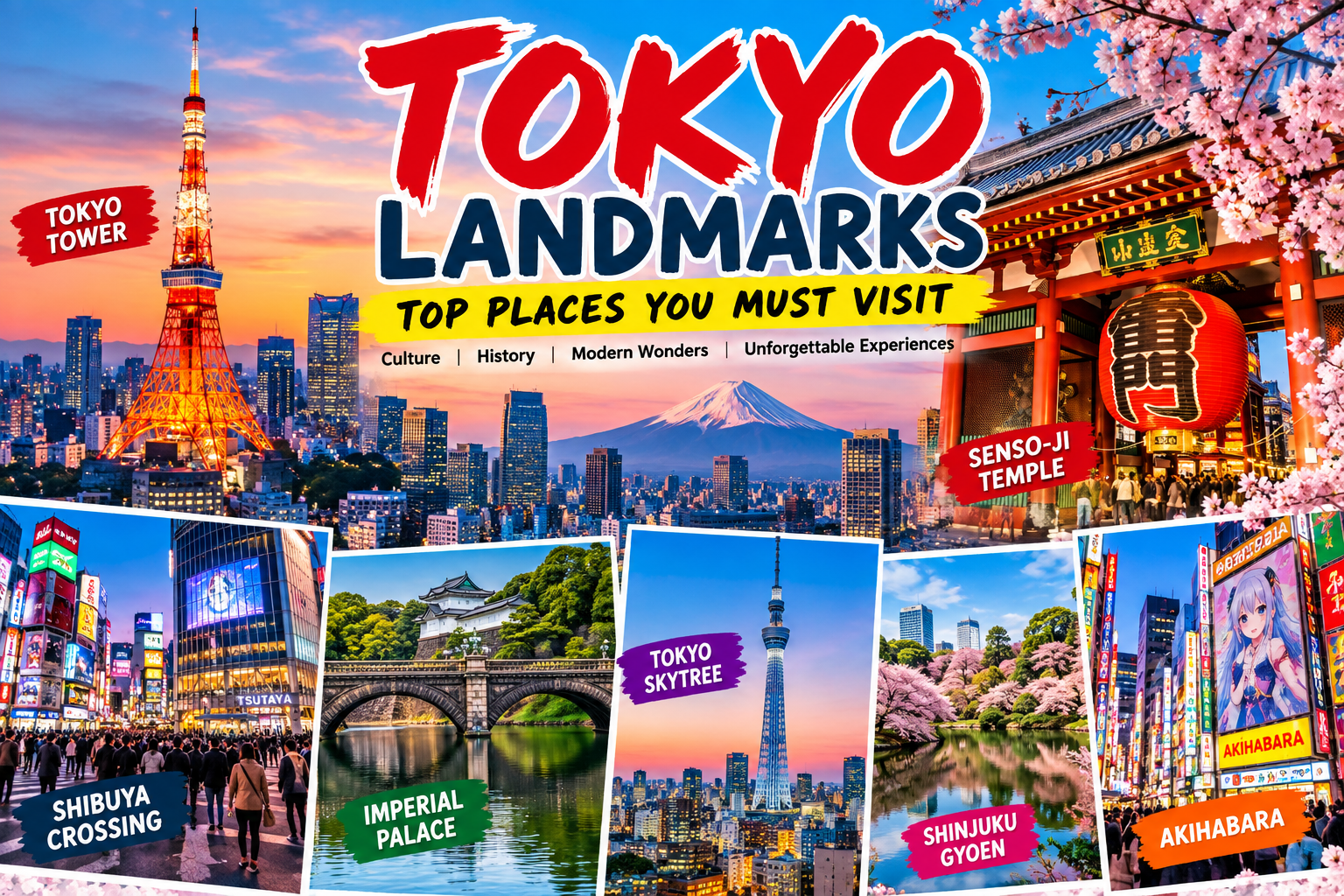
Tokyo Landmarks: 25+ Iconic Places You Should See in Tokyo
Tokyo landmarks are much more than famous photo locations; they tell the story of how Edo developed into one of the world’s great modern cities. From Senso-ji and Meiji Jingu to Tokyo Tower, TOKYO SKYTREE, Shibuya Scramble Crossing, Tokyo Station, the Imperial Palace and Rainbow Bridge, the city’s landmarks reveal a fascinating combination of history, religion, architecture, technology, entertainment and everyday urban life Tokyo Art
What Counts as a Tokyo Landmark?
A landmark does not necessarily have to be the tallest building, oldest temple or most photographed location.
In Tokyo, a landmark can be:
- A historic religious site
- A palace or garden
- An architectural masterpiece
- A major transportation structure
- A famous intersection
- A tower or observation deck
- A waterfront structure
- A museum or cultural institution
- A neighborhood symbol
- A place strongly associated with Tokyo’s identity
This broader definition is important because some of Tokyo’s most memorable landmarks are not conventional monuments.
Shibuya Scramble Crossing, for example, is essentially a busy urban intersection, yet it has become one of the world’s most recognizable images of Tokyo. GO TOKYO describes it as an iconic landmark where more than 1,000 people can cross the intersection at a time.
Similarly, Tokyo Station is both a working transportation hub and an architectural landmark. Its red-brick Marunouchi building was originally completed in 1914 and restored to its historic appearance in 2012.
Why Tokyo Has So Many Famous Landmarks
Tokyo’s landmark landscape is the result of several historical layers.
The city developed from Edo, the political center of the Tokugawa shogunate, into the capital of modern Japan. Industrialization, modernization, earthquakes, war, reconstruction, economic growth and technological development repeatedly changed its appearance.
As a result, today’s Tokyo contains:
- Edo-period gardens
- Historic Buddhist temples
- Shinto shrines
- Imperial-era architecture
- Early 20th-century railway architecture
- Postwar towers
- Modern skyscrapers
- Contemporary cultural districts
- Waterfront developments
- Technology-focused attractions
This layering is one of the best ways to understand Tokyo.
Instead of thinking about the city as a collection of unrelated attractions, consider each landmark as a chapter in Tokyo’s development.
The Best-Known Tokyo Landmarks
Senso-ji Temple
Senso-ji in Asakusa is one of Tokyo’s most important historic landmarks and is officially described as the oldest temple in Tokyo. Its history is traditionally traced to 628, when a statue of Kannon was discovered in the Sumida River.
The approach to Senso-ji is one of the most recognizable traditional scenes in the city.
The Kaminarimon Gate provides a dramatic entrance, followed by Nakamise shopping street and the temple’s main structures.
For first-time visitors, Senso-ji offers something particularly valuable: a concentrated introduction to traditional Tokyo.
You can experience:
- Buddhist architecture
- Traditional souvenir shops
- Japanese food stalls
- Temple rituals
- Seasonal festivals
- Historic streets
- Photography opportunities
- Asakusa’s older urban atmosphere
Senso-ji is also an excellent starting point for exploring the surrounding Asakusa district.
Rather than visiting the temple quickly, walk through the surrounding streets and look at how traditional architecture, small businesses and modern Tokyo coexist.
Tokyo Skytree
TOKYO SKYTREE is one of the defining symbols of modern Tokyo.
The tower reaches 634 meters, and its official materials identify it as the world’s tallest freestanding broadcasting tower.
The observation experience is particularly impressive because visitors can view Tokyo from extremely high above the ground.
The Tembo Deck is around 350 meters above ground, while the Tembo Galleria rises toward 450 meters. The highest visitor point, Sorakara Point, is approximately 451.2 meters high.
One of the most interesting details about TOKYO SKYTREE is that its height was not selected randomly.
The number 634 can be associated with the Japanese reading “Musashi,” referencing the historic Musashi region that covered areas including parts of present-day Tokyo, Saitama and Kanagawa.
This makes the tower more than a giant observation structure.
It connects modern engineering with regional history.
Tokyo Tower
Tokyo Tower is one of the city’s most recognizable landmarks and remains an important symbol of postwar Tokyo.
The tower is 333 meters high, and its observation facilities provide elevated views across central Tokyo. The official Tokyo Tower site currently lists its Main Deck at 150 meters and its Top Deck experience at 250 meters.
Tokyo Tower and TOKYO SKYTREE are sometimes treated as competitors, but they offer different experiences.
Tokyo Tower feels strongly connected to Tokyo’s postwar history and classic skyline imagery.
TOKYO SKYTREE represents a newer generation of Tokyo architecture and technology.
For travelers who have enough time, experiencing both can help explain how Tokyo’s skyline has evolved.
Meiji Jingu
Meiji Jingu provides one of the strongest contrasts between Tokyo’s urban intensity and its quieter cultural spaces.
The shrine was established in 1920 and is dedicated to Emperor Meiji and Empress Shoken. Its surrounding forest covers approximately 70 hectares.
One of the most fascinating aspects is that the forest is man-made.
Approximately 100,000 trees were donated from around Japan during the shrine’s creation, with the forest planned as a self-regenerating ecosystem. The official shrine information describes approximately 234 varieties of trees in the forest today.
This makes Meiji Jingu especially interesting for visitors interested in:
- Japanese religion
- Landscape design
- Urban ecology
- Japanese history
- Photography
- Quiet walks
- Traditional architecture
The transition from Harajuku’s energetic streets into the forest is part of the experience.
Shibuya Scramble Crossing
Shibuya Scramble Crossing represents a completely different side of Tokyo.
Instead of ancient architecture, its attraction comes from movement, scale and urban culture.
The crossing became internationally recognizable through movies, music videos, travel photography and social media. GO TOKYO notes that more than 1,000 people can cross during a single movement of the pedestrian signals.
The crossing is free, easy to reach and particularly impressive during busy periods.
However, simply crossing the road is only part of the experience.
Spend time exploring:
- Shibuya Center-Gai
- Hachiko Statue
- Shibuya Station
- Shibuya Scramble Square
- SHIBUYA SKY
- Side streets
- Cafés and restaurants
- Fashion stores
The area represents contemporary Japanese youth culture, fashion, music and entertainment.
Tokyo Station
Tokyo Station is one of the most useful landmarks for travelers because it combines architecture, history and transportation.
The Marunouchi Station Building is famous for its red-brick exterior and restored domes. The original design dates from 1914, while restoration work returned the building toward its historic appearance in 2012.
The station is also strategically positioned close to:
- Imperial Palace
- Marunouchi
- Ginza
- Nihonbashi
- Marunouchi Naka-dori
- KITTE
- Tokyo International Forum
That makes Tokyo Station an excellent base for a walking itinerary.
A traveler can photograph the station, walk toward the Imperial Palace, explore Marunouchi, have lunch and continue toward Ginza without needing complicated transportation.
Imperial Palace and East Gardens
The Imperial Palace occupies an important historical position in central Tokyo.
The East Gardens provide visitors with access to parts of the former Edo Castle area and offer an opportunity to see remnants of the city’s feudal past.
The official Imperial Household Agency information explains that the East Gardens were developed between 1961 and 1968 and opened to the public in 1968.
The gardens include historical features such as:
- Edo Castle foundations
- Defensive structures
- Guardhouses
- Gates
- Traditional gardens
- Ponds
- Seasonal flowers
- Historic landscape features
The location is particularly impressive because it sits in the middle of modern Tokyo.
Hamarikyu Gardens
Hamarikyu Gardens is another place where Tokyo’s historical and modern identities meet.
The garden originated as a feudal and imperial retreat and was opened to the public in 1946. One of its unusual characteristics is its seawater pond, whose water level changes with the tide.
The central pond and Nakajima teahouse provide a completely different visual experience from Tokyo’s skyscraper districts.
Hamarikyu is particularly suitable for travelers who want:
- A slower sightseeing experience
- Japanese gardens
- Photography
- Seasonal flowers
- Matcha experiences
- Historic Tokyo
- A break from crowded streets
Tokyo Metropolitan Government Building
The Tokyo Metropolitan Government Building is one of the most useful free viewpoints in Tokyo.
Its observatories are approximately 202 meters high, and admission is free according to the Tokyo Metropolitan Government. There are north and south observatories, although opening arrangements can change.
This makes the building particularly useful for budget-conscious travelers.
From the observation level, visitors can look across the enormous urban landscape of Tokyo and, under suitable conditions, identify distant landmarks and mountains.
It also provides an important architectural perspective on Shinjuku’s skyscraper district.
Rainbow Bridge
Rainbow Bridge is one of Tokyo Bay’s defining structures.
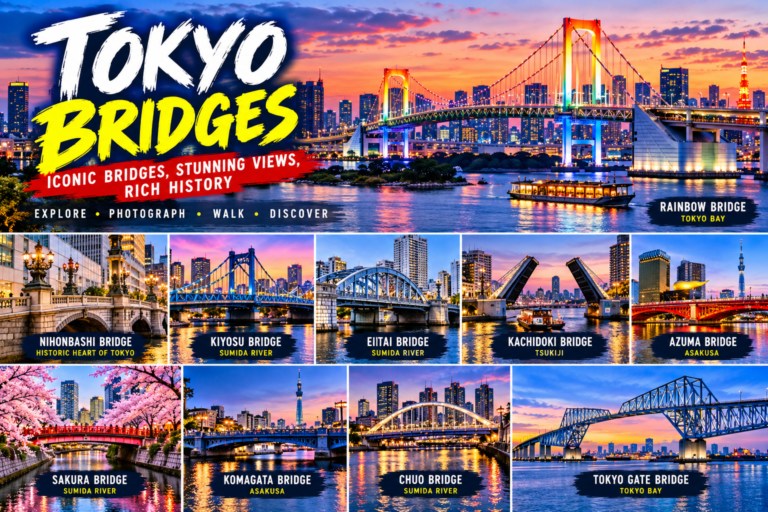
The bridge opened in 1993 and connects the Tokyo mainland with Odaiba. GO TOKYO notes that pedestrians can cross via the Rainbow Promenade, while the bridge becomes especially striking at night when illuminated.
One of the best ways to appreciate Rainbow Bridge is not necessarily to stand directly underneath it.
Consider viewing it from:
- Odaiba
- A waterfront restaurant
- A cruise
- Yurikamome
- A pedestrian route
- Tokyo Bay viewpoints
The changing perspective makes the bridge feel different during the day and evening.
More Tokyo Landmarks Worth Exploring
Tokyo National Museum
Located in Ueno Park, the Tokyo National Museum is one of the city’s most important cultural landmarks.
GO TOKYO describes it as Japan’s oldest museum, with a collection exceeding 120,000 items and including 89 National Treasures.
The museum is particularly valuable for travelers who want context rather than simply photographs.
Its collections cover areas including:
- Buddhist art
- Samurai culture
- Japanese paintings
- Ceramics
- Textiles
- Sculpture
- Decorative arts
- Archaeological material
Instead of seeing it merely as another museum, think of it as a place where many of Tokyo’s historic stories become easier to understand.
Odaiba
Odaiba represents Tokyo’s relationship with reclaimed land, technology and waterfront development.
The area was originally created in Tokyo Bay during the Edo period as a defensive installation. Today it is a major entertainment and leisure district.
Its attractions include:
- Rainbow Bridge
- Waterfront parks
- Shopping
- Museums
- Entertainment
- Yurikamome views
- Cruises
- Modern architecture
The contrast between Odaiba and Asakusa is particularly useful for understanding Tokyo’s transformation.
GO TOKYO currently highlights Odaiba’s combination of modern architecture, entertainment and waterfront experiences.
Hachiko Statue
The Hachiko Statue is a small landmark with an unusually large cultural presence.
Hachiko became famous for returning to Shibuya Station to wait for his owner. The story became associated with loyalty, and the statue remains a popular meeting point
The statue can be visited together with Shibuya Scramble Crossing because the two attractions are extremely close.
SHIBUYA SKY
SHIBUYA SKY offers a contemporary way to understand Shibuya.
The observation experience is directly connected to Shibuya Station and provides views over the scramble crossing and wider Tokyo skyline. GO TOKYO notes that visitors can potentially identify landmarks such as Tokyo Tower and TOKYO SKYTREE from the observation area, depending on visibility
Weather matters here.
Strong winds and poor weather can affect rooftop access, so travelers should consider checking conditions before committing to a specific visit.
Tokyo Landmarks by Historical Period
Ancient and Traditional Tokyo
Travelers interested in traditional culture should focus on:
- Senso-ji
- Meiji Jingu
- Asakusa
- Imperial Palace East Gardens
- Hamarikyu Gardens
- Tokyo National Museum
These places help explain religion, imperial history, Edo culture and Japanese aesthetics.
Early Modern Tokyo
For architecture and modernization, consider:
- Tokyo Station
- Marunouchi
- Nihonbashi
- Ginza
- Historic commercial districts
Tokyo Station is particularly important because its architecture reflects Japan’s early modern railway and urban development.
Postwar Tokyo
For postwar development, Tokyo Tower is essential.
Completed in 1958, the tower became one of the most recognizable elements of Tokyo’s skyline and remains an active observation attraction today.
Contemporary Tokyo
For modern Tokyo, explore:
- TOKYO SKYTREE
- Shibuya Scramble Crossing
- SHIBUYA SKY
- Odaiba
- Rainbow Bridge
- Contemporary skyscraper districts
These locations demonstrate Tokyo’s modern identity through technology, commerce, architecture and popular culture.
Tokyo Landmarks for First-Time Visitors
First-time visitors often make one major mistake: trying to visit too many landmarks in different parts of the city on the same day.
Tokyo is enormous.
The official Tokyo guide divides the metropolitan area into numerous distinct neighborhoods, including Asakusa, Ueno, Shibuya, Shinjuku, Ginza, Tokyo Station, Odaiba and many others.
A better approach is to group landmarks geographically.
One-Day Tokyo Landmark Route
A practical first-day route could be:
- Asakusa
- Senso-ji
- Sumida River
- TOKYO SKYTREE
- Tokyo Station
- Marunouchi
- Tokyo Metropolitan Government Building or Shibuya
This is ambitious, so travelers should adjust it according to opening times, walking speed and energy.
Two-Day Tokyo Landmark Route
For two days, separate the city into eastern and western Tokyo.
Day One: Traditional and historic Tokyo
- Asakusa
- Senso-ji
- TOKYO SKYTREE
- Ueno
- Tokyo National Museum
Day Two: Modern Tokyo
- Meiji Jingu
- Harajuku
- Shibuya
- Shibuya Scramble Crossing
- SHIBUYA SKY
- Tokyo Tower
This approach reduces unnecessary cross-city travel.
Three-Day Tokyo Landmark Route
With three days, add:
- Tokyo Station
- Imperial Palace East Gardens
- Hamarikyu Gardens
- Odaiba
- Rainbow Bridge
- Ginza
This creates a much more balanced introduction to Tokyo.
Tokyo Landmarks for Families
Families should consider landmarks where the attraction itself is only part of the experience.
Family-Friendly Historic Experiences
Senso-ji and Asakusa offer easy opportunities to combine sightseeing with food and shopping.
Family-Friendly Skyline Experiences
TOKYO SKYTREE can be combined with the surrounding Tokyo Skytree Town area, making it easier to build a longer family outing.
Family-Friendly Waterfront Experiences
Odaiba is particularly useful because the area combines open spaces, waterfront scenery, entertainment and museums.
Family-Friendly Cultural Experiences
Tokyo National Museum can work well for older children who are interested in history, art and Japanese culture.
Tokyo Landmarks for Couples
Tokyo’s landmarks can also be incorporated into slower itineraries.
A couple might combine:
- Hamarikyu Gardens
- Tokyo Station
- Marunouchi
- Tokyo Tower
- Odaiba
- Rainbow Bridge
- Evening skyline views
Waterfront areas can be especially attractive around sunset.
The Sumida River and Tokyo Bay provide different perspectives on the skyline, and official Tokyo tourism information highlights waterbus routes connecting places such as Asakusa, Hamarikyu and Odaiba.
Tokyo Landmarks for Photographers
Best Architecture Subjects
Tokyo Station is particularly strong for architectural photography because of its red-brick exterior, restored domes and surrounding skyscrapers.
Best Human-Scale Photography
Shibuya Scramble Crossing provides constantly changing compositions.
Best Traditional Photography
Senso-ji and Asakusa offer:
- Gates
- Lanterns
- Temple roofs
- Street scenes
- Traditional shops
- Seasonal decorations
Best Skyline Photography
TOKYO SKYTREE, Tokyo Tower and SHIBUYA SKY provide different perspectives.
Best Waterfront Photography
Rainbow Bridge and Odaiba work particularly well around sunset and after dark.
Tokyo Landmarks for History Lovers
History-focused travelers should avoid treating Tokyo as purely futuristic.
The city has deep historical layers.
Senso-ji provides a connection to Buddhist tradition. The Imperial Palace area preserves elements of the former Edo Castle landscape. Hamarikyu demonstrates how gardens were connected to political and elite life. Tokyo National Museum provides broader historical context. Meiji Jingu represents a very different chapter of modern Japanese history.
Together, these sites provide a more complete historical picture than any single attraction.
Tokyo Landmarks for Architecture Lovers
Tokyo is particularly rewarding for architecture enthusiasts.
Traditional Architecture
Explore:
- Senso-ji
- Meiji Jingu
- Imperial Palace gardens
- Historic garden structures
Historic Western-Influenced Architecture
Explore:
- Tokyo Station
- Marunouchi
- Mitsubishi Ichigokan area
Modern Architecture
Explore:
- TOKYO SKYTREE
- Shibuya Scramble Square
- Tokyo Metropolitan Government Building
- Odaiba
- Tokyo International Forum
Tokyo’s architectural story is essentially a visual timeline of modernization.
Tokyo Landmarks for Budget Travelers
A major advantage of Tokyo sightseeing is that some memorable experiences are inexpensive or free.
Examples include:
- Shibuya Scramble Crossing
- Hachiko Statue
- Meiji Jingu grounds
- Walking around Tokyo Station
- Many neighborhood streets
- Selected public gardens and parks
- Tokyo Metropolitan Government observatories
The Tokyo Metropolitan Government observatories are officially listed as free. A budget traveler can therefore build an impressive Tokyo itinerary without paying an entrance fee at every stop.
Tokyo Landmarks for Luxury Travelers
Luxury travelers can build a different style of landmark itinerary.
Combine:
- Tokyo Tower
- Ginza
- Marunouchi
- Private dining
- High-rise restaurants
- Tokyo Bay cruises
- Premium hotel viewpoints
- Exclusive cultural experiences
The advantage is not necessarily seeing more landmarks.
It is experiencing familiar landmarks from a different perspective.
Tokyo Landmarks for Senior Travelers
Senior travelers should pay particular attention to:
- Walking distances
- Elevators
- Seating
- Restrooms
- Weather
- Crowds
- Station transfers
Large Tokyo stations can involve substantial walking even when the train journey itself is short.
Planning one major landmark cluster per half-day can make sightseeing more comfortable.
Tokyo Landmarks for Travelers With Limited Time
If you only have one day, avoid attempting to cover the entire city.
Instead, choose one geographic corridor.
Eastern Tokyo Option
Senso-ji → Asakusa → Sumida River → TOKYO SKYTREE
Central Tokyo Option
Tokyo Station → Imperial Palace area → Marunouchi → Ginza
Western Tokyo Option
Meiji Jingu → Harajuku → Shibuya → Shibuya Scramble Crossing → SHIBUYA SKY
Waterfront Option
Odaiba → Rainbow Bridge → Tokyo Bay
This approach creates a coherent experience rather than a checklist.
The 10 Landmark Brands and Attractions Comparison
The word “brand” can be useful in tourism because some landmarks have become recognizable destination brands in their own right. The following comparison focuses on ten major Tokyo landmark experiences rather than ranking them.
| Landmark | Area | Main Appeal | Historical / Modern Character | Best For | Typical Visit Style |
|---|---|---|---|---|---|
| Senso-ji | Asakusa | Temple, traditional streets | Historic | Culture, families, first-timers | Walking |
| TOKYO SKYTREE | Sumida | Skyline views | Modern | Photography, views | Observation |
| Tokyo Tower | Minato | Classic skyline | Postwar modern | Photography, couples | Observation |
| Meiji Jingu | Harajuku/Yoyogi | Shrine and forest | Traditional/modern-era | Culture, nature | Walking |
| Shibuya Scramble Crossing | Shibuya | Urban energy | Contemporary | First-timers, photography | Short visit |
| Tokyo Station | Marunouchi | Architecture and transport | Historic/modern | Architecture, first-timers | Walking |
| Imperial Palace East Gardens | Chiyoda | Edo Castle history and gardens | Historic | History, gardens | Walking |
| Hamarikyu Gardens | Shiodome | Edo garden and waterfront | Historic | Relaxation, photography | Walking |
| Tokyo Metropolitan Government Building | Shinjuku | Free city views | Modern | Budget travelers | Observation |
| Rainbow Bridge | Tokyo Bay | Waterfront skyline | Modern | Night photography, couples | Walking/viewing |
These attractions are not interchangeable. A traveler interested in history may value Senso-ji and the Imperial Palace area for completely different reasons from someone interested in skyline photography.
Comparing Tokyo Skyline Experiences
TOKYO SKYTREE Versus Tokyo Tower
TOKYO SKYTREE is 634 meters tall, while Tokyo Tower is 333 meters. Their observation experiences are therefore physically different.
Tokyo Tower provides a classic central-Tokyo perspective.
TOKYO SKYTREE provides a much higher viewpoint and an enormous visual field.
The choice depends on what you want from the experience rather than which structure is “better.”
SHIBUYA SKY Versus Tokyo Metropolitan Government Building
SHIBUYA SKY is directly connected to the contemporary Shibuya experience and overlooks the famous crossing.
The Tokyo Metropolitan Government Building offers free observation decks around 202 meters high.
For budget travelers, the latter can be particularly useful.
For travelers already exploring Shibuya, SHIBUYA SKY integrates more naturally into the neighborhood experience.
How to Photograph Tokyo Landmarks
Photograph Early in the Morning
Morning can reduce crowds around traditional landmarks.
Senso-ji is especially different before the surrounding streets become busy.
Use Blue Hour
Blue hour can be excellent for:
- Tokyo Tower
- Tokyo Station
- Rainbow Bridge
- Shibuya
- TOKYO SKYTREE
The sky retains some natural color while artificial lighting becomes visible.
Photograph From Multiple Angles
Do not photograph a landmark only from the obvious viewpoint.
For example, Tokyo Station becomes more interesting when photographed with the Marunouchi skyline behind it.
Rainbow Bridge changes dramatically depending on whether you photograph it from Odaiba, the water or a distant viewpoint.
Include People
Tokyo’s scale becomes easier to understand when people are included in the frame.
Shibuya is an obvious example.
How to Plan Tokyo Landmarks Around Weather
Weather can significantly change the experience.
Clear Weather
Prioritize:
- Observation decks
- Tokyo Tower
- TOKYO SKYTREE
- SHIBUYA SKY
- Waterfront photography
Rainy Weather
Prioritize:
- Tokyo Station
- Tokyo National Museum
- Shopping areas
- Covered commercial districts
- Museums
- Indoor attractions around major stations
Hot Weather
Schedule outdoor gardens and temples early in the morning.
Use indoor attractions during the hottest part of the afternoon.
Autumn
Gardens and forested areas can become particularly attractive.
GO TOKYO’s current seasonal information highlights autumn leaves and multiple viewing locations across Tokyo.
How to Avoid Crowds at Tokyo Landmarks
Crowds are one of the biggest practical challenges.
A famous landmark may feel completely different at 8 a.m. compared with midday.
Use the following strategy:
- Visit popular temples early.
- Book observation experiences when reservations are available.
- Avoid unnecessary weekend transfers.
- Visit secondary viewpoints.
- Explore side streets after seeing the main attraction.
- Use neighborhood clusters.
- Leave flexibility in your itinerary.
Do not assume that the busiest landmark is necessarily the most enjoyable part of the neighborhood.
Often, the surrounding streets provide the stronger travel experience.
Tokyo Landmarks and Public Transportation
Tokyo’s rail network is one reason so many landmarks can be visited efficiently.
However, efficient transportation does not mean zero walking.
A five-minute train journey can be followed by a fifteen-minute station transfer.
Large stations such as Shibuya and Tokyo can be complex.
GO TOKYO specifically advises visitors exploring Shibuya Station to follow color-coded signs and allow extra time for transfers.
The best approach is to think in terms of neighborhood clusters, not individual attractions.
Tokyo Landmarks by Neighborhood
Asakusa
Best for:
- Senso-ji
- Traditional streets
- Sumida River
- Tokyo Skytree views
Shibuya
Best for:
- Scramble Crossing
- Hachiko
- SHIBUYA SKY
- Fashion
- Contemporary culture
Harajuku and Yoyogi
Best for:
- Meiji Jingu
- Forest
- Youth culture
- Fashion
Marunouchi
Best for:
- Tokyo Station
- Imperial Palace
- Architecture
- Business district scenery
Shinjuku
Best for:
- Tokyo Metropolitan Government Building
- Skyscrapers
- Entertainment
- Nightlife
Tokyo Bay and Odaiba
Best for:
- Rainbow Bridge
- Waterfront scenery
- Museums
- Modern architecture
- Evening views
New and Emerging Tokyo Landmarks
Tokyo’s landmark landscape is not finished.
The city continues to develop new cultural spaces, transport-oriented districts and urban experiences.
GO TOKYO reported in 2026 that OIMACHI TRACKS and MoN Takanawa opened as new destinations in southern Tokyo, reflecting the continuing transformation of station-connected areas into mixed cultural, dining, hotel and lifestyle destinations.
This is important for understanding the future of Tokyo tourism.
The next generation of landmarks may not simply be towers or monuments.
They may be:
- Cultural complexes
- Station districts
- Waterfront developments
- Immersive attractions
- Architecture-led public spaces
- Technology-enhanced mobility experiences
Tokyo Landmarks and Next-Generation Mobility
Transportation itself is becoming part of Tokyo’s tourism experience.
GO TOKYO highlighted new 2026 mobility experiences including electric waterfront transport and Toyota’s e-Palette-related experiences in Odaiba
This points toward a broader trend.
In the future, visitors may increasingly experience Tokyo landmarks while moving between them, rather than simply arriving at a destination and taking photographs.
Water buses already offer a useful example. Routes connect areas such as Asakusa, Hamarikyu and Odaiba while providing views of landmarks from the river.
The Future of Tokyo Landmarks
More Experiences Instead of Static Monuments
Future landmark development is likely to emphasize experiences.
A tower may include:
- Digital exhibitions
- Seasonal events
- Interactive displays
- Food experiences
- Nighttime programming
This is already visible at major Tokyo attractions.
More Station-Centered Destinations
Tokyo’s rail infrastructure has historically shaped the city, and new developments continue to integrate transportation with shopping, hospitality, culture and public space.
Greater Waterfront Tourism
Tokyo Bay offers substantial opportunities for sightseeing.
Odaiba already demonstrates how reclaimed land can become a major tourism district, while waterbus services connect different parts of the city.
More Technology-Enhanced Tourism
Tokyo’s future landmarks will likely incorporate more:
- Digital navigation
- Interactive exhibitions
- Immersive experiences
- Smart mobility
- Multilingual visitor information
- Reservation systems
The challenge will be preserving authenticity while adopting new technology.
Common Mistakes When Visiting Tokyo Landmarks
Trying to See Everything in One Day
Tokyo’s size makes this unrealistic for most visitors.
Choose clusters.
Ignoring Opening Times
Some landmarks have seasonal schedules or weather-related closures.
Check official information before leaving.
Visiting Every Observation Deck
You do not need to pay for every skyline experience.
Choose based on your itinerary and preferred viewpoint.
Forgetting the Neighborhood
The landmark is often only the beginning.
Asakusa, Shibuya, Marunouchi and Odaiba all reward exploration beyond the headline attraction.
Treating Religious Sites Like Theme Parks
Senso-ji and Meiji Jingu are functioning religious and cultural spaces.
Visitors should observe local etiquette, avoid blocking worshippers and follow photography restrictions where posted.
Ignoring Weather
Outdoor observation decks can be affected by wind, rain and visibility.
SHIBUYA SKY, for example, warns that the rooftop may close in poor weather or strong winds
Pros and Cons of Visiting Famous Tokyo Landmarks
Advantages
Tokyo’s major landmarks offer enormous variety.
You can combine:
- History
- Architecture
- Religion
- Technology
- Food
- Photography
- Shopping
- Nature
- Entertainment
- City views
Many major landmarks are also accessible by rail.
Another advantage is that famous attractions are often surrounded by interesting neighborhoods.
Challenges
The main challenges include:
- Crowds
- Long walking distances
- Complex stations
- Weather
- Advance reservations
- Seasonal opening changes
- Tourist congestion
- Limited time
The solution is not to avoid famous landmarks.
Instead, plan them more intelligently.
A Practical Tokyo Landmark Planning Formula
Use this simple formula:
One major landmark + one neighborhood + one meal + one flexible activity.
For example:
Senso-ji + Asakusa + Japanese lunch + Sumida River walk
Or:
Meiji Jingu + Harajuku + lunch + Shibuya
Or:
Tokyo Station + Marunouchi + lunch + Imperial Palace area
This produces a much more relaxed day.
How Long Should You Spend at Tokyo Landmarks?
There is no universal answer, but approximate planning can help.
Short Visit
Allow roughly:
- 30–60 minutes for Shibuya Scramble Crossing
- 30–60 minutes for Hachiko and surrounding Shibuya
- 60–90 minutes for Tokyo Station architecture
Medium Visit
Allow approximately:
- 1.5–2.5 hours for Senso-ji and Asakusa
- 2–3 hours for a major observation experience
- 2–3 hours for a garden and surrounding area
Long Visit
Allocate half a day or more for:
- Tokyo National Museum
- Odaiba
- Large neighborhood explorations
- Multi-attraction cultural districts
These are planning guidelines rather than fixed rules.
Tokyo Landmark Etiquette
At Temples and Shrines Tokyo landmarks
Be respectful of worshippers.
Follow posted instructions regarding:
- Photography
- Entry
- Purification
- Offerings
- Restricted areas
At Crowded Crossings Tokyo landmarks
Do not stop in the middle of pedestrian flows to take photographs.
At Observation Decks Tokyo landmarks
Avoid blocking windows for long periods.
On Public Transportation Tokyo landmarks
Keep voices low and follow local etiquette.
In Residential Areas Tokyo landmarks
Remember that Tokyo’s tourist neighborhoods are also real communities.
Respect residents, avoid obstructing entrances and be mindful when photographing people.
Lesser-Discussed Perspectives on Tokyo Landmarks
Tokyo’s Landmarks Are Often About Movement Tokyo landmarks
One of the city’s defining characteristics is movement.
Trains move through stations.
People cross Shibuya.
Boats travel beneath bridges.
Elevators move visitors hundreds of meters upward.
This means Tokyo’s landmarks often become most interesting when you experience them in motion.
Landmarks Are Often Better as Clusters Tokyo landmarks
Senso-ji is not just a temple.
It is part of Asakusa.
Tokyo Station is not just a building.
It is part of Marunouchi.
Rainbow Bridge is not just a bridge.
It is part of Tokyo Bay and Odaiba.
This neighborhood perspective creates richer travel memories.
Free Landmarks Can Be Extremely Valuable Tokyo landmarks
Some of Tokyo’s most recognizable experiences cost nothing.
Shibuya Crossing, Hachiko, Meiji Jingu’s grounds and many urban streets can be explored without paying admission.
The Tokyo Metropolitan Government observatories provide another major free viewpoint.
Tokyo Landmarks for Different Traveler Problems
If You Have a Very Small Budget Tokyo landmarks Tokyo landmarks
Focus on:
- Shibuya Crossing
- Hachiko
- Meiji Jingu
- Tokyo Station
- Neighborhood walks
- Tokyo Metropolitan Government Building observatory
If You Hate Crowds Tokyo landmarks
Try:
- Early Senso-ji
- Gardens
- Residential neighborhood walks
- Less popular observation viewpoints
- Weekday sightseeing
If You Love History Tokyo landmarks
Prioritize:
- Senso-ji
- Imperial Palace East Gardens
- Hamarikyu Gardens
- Tokyo National Museum
- Meiji Jingu
If You Love Modern Architecture Tokyo landmarks
Prioritize:
- TOKYO SKYTREE
- Tokyo Metropolitan Government Building
- SHIBUYA SKY
- Tokyo Station and Marunouchi
- Odaiba
- Rainbow Bridge
If You Have Children Tokyo landmarks
Consider:
- TOKYO SKYTREE
- Odaiba
- Asakusa
- Tokyo National Museum
- Waterfront attractions
A Sample Seven-Day Tokyo Landmark Itinerary
Day One: Asakusa and Tokyo Skytree Tokyo landmarks
Begin at Senso-ji.
Explore Nakamise and nearby streets before walking toward the Sumida River.
Continue toward TOKYO SKYTREE.
Finish with an evening view of the illuminated skyline.
Day Two: Shibuya and Harajuku Tokyo landmarks
Start at Meiji Jingu.
Walk toward Harajuku.
Continue to Shibuya.
Visit Hachiko and experience Shibuya Scramble Crossing.
Finish at SHIBUYA SKY if weather conditions are favorable.
Day Three: Tokyo Station and Imperial Palace Tokyo landmarks
Start at Tokyo Station.
Explore the Marunouchi architecture.
Walk toward the Imperial Palace area.
Visit the East Gardens when open.
Finish around Ginza or Marunouchi.
Day Four: Ueno and Cultural Tokyo Tokyo landmarks
Spend substantial time at Tokyo National Museum.
Explore Ueno Park.
Continue through surrounding neighborhoods.
Day Five: Tokyo Tower and Hamarikyu Tokyo landmarks
Visit Hamarikyu Gardens.
Explore Shiodome.
Continue toward Tokyo Tower.
Finish in the surrounding Minato area.
Day Six: Odaiba and Rainbow Bridge Tokyo landmarks
Take the Yurikamome or another suitable route toward Odaiba.
Explore the waterfront.
Visit selected museums or entertainment venues.
Watch the skyline around sunset.
Day Seven: Flexible Landmark Day Tokyo landmarks
Keep the final day flexible.
Return to a favorite neighborhood.
Visit landmarks you missed.
Shop for souvenirs.
Use weather conditions to choose the best outdoor activity.
FAQs
What are the most famous Tokyo landmarks?
Some of the most internationally recognized Tokyo landmarks include Senso-ji, TOKYO SKYTREE, Tokyo Tower, Meiji Jingu, Shibuya Scramble Crossing, Tokyo Station, the Imperial Palace area, Hamarikyu Gardens, Tokyo Metropolitan Government Building and Rainbow Bridge. GO TOKYO’s official attractions guide includes many of these locations among Tokyo’s major sightseeing experiences.
What is the oldest landmark in Tokyo?
Senso-ji is widely described by its official temple information as Tokyo’s oldest temple, with its traditional history beginning in 628
What is the tallest landmark in Tokyo?
TOKYO SKYTREE reaches 634 meters and is officially described as the world’s tallest freestanding broadcasting tower.
Is Tokyo Tower taller than TOKYO SKYTREE?
No. Tokyo Tower is 333 meters high, while TOKYO SKYTREE reaches 634 meters.
Which Tokyo landmark is best for traditional culture?
Senso-ji and Meiji Jingu are two particularly important choices, although they represent different religious and historical traditions.
Senso-ji is a Buddhist temple in Asakusa, while Meiji Jingu is a Shinto shrine established in 1920
Is Shibuya Crossing really a Tokyo landmark?
Yes. GO TOKYO officially categorizes Shibuya Scramble Crossing as a landmark and describes it as an iconic Tokyo experience.
Can I visit Tokyo landmarks for free?
Yes. Several major experiences are free or can be enjoyed without an admission ticket, including Shibuya Crossing, Hachiko Statue and the Tokyo Metropolitan Government Building observatories. Meiji Jingu’s shrine grounds can also be visited without the type of admission charge associated with paid attractions.
Which Tokyo landmark is best for photography?
It depends on the style of photography.
For traditional scenes, consider Senso-ji.
For skyline photography, consider TOKYO SKYTREE or Tokyo Tower.
For street photography, Shibuya is particularly productive.
For waterfront photography, try Rainbow Bridge and Odaiba.
Can I see Tokyo landmarks without using taxis?
Yes. Tokyo’s rail network, walking routes and waterbus services make many landmark clusters accessible without relying on taxis. Official Tokyo tourism information also highlights water routes connecting areas including Asakusa, Hamarikyu and Odaiba.
What is the best Tokyo landmark for sunset?
There is no single universally ideal location because weather, season and viewing direction matter.
Potential options include Tokyo Tower, TOKYO SKYTREE, SHIBUYA SKY, Odaiba and Rainbow Bridge viewpoints.
Is Tokyo Station worth visiting if I am not taking a train?
Yes. The Marunouchi Station Building itself is a significant architectural landmark, and the surrounding Marunouchi district contains additional attractions
Is the Imperial Palace open to tourists?
Access varies by area. The East Gardens are a public visitor area, while the palace itself has different access arrangements. Always check official Imperial Household Agency information before planning a visit. The East Gardens have been open to the public since 1968.
How many Tokyo landmarks can I visit in one day?
A realistic number depends on their location and how much time you want at each site.
Three to five closely grouped experiences can be reasonable.
Trying to cross the entire city repeatedly can turn sightseeing into transportation rather than exploration
Conclusion
Tokyo landmarks offer far more than famous photo opportunities—they provide a visual journey through Japan’s history, culture, architecture, technology, and modern urban life. From the traditional atmosphere of Senso-ji and Meiji Jingu to the futuristic heights of TOKYO SKYTREE, the energy of Shibuya Crossing, the historic character of Tokyo Station, and the waterfront beauty of Rainbow Bridge, every landmark reveals a different side of the city. The best way to explore Tokyo is to group attractions by neighborhood, allow enough time to experience the surrounding streets, and choose landmarks according to your interests rather than trying to see everything in a single day.


2 Comments