Tokyo Waterfronts: The Ultimate Guide to Bayside Districts, Rivers, Parks, Cruises and Hidden Views
Tokyo is often introduced through neon streets, ancient temples, crowded railway stations, shopping districts, and skyscrapers. But there is another side of the city that deserves just as much attention: its extraordinary relationship with water. Tokyo waterfronts combine rivers, canals, harbours, islands, bridges, parks, promenades, cultural attractions, restaurants, and modern architecture into some of the city’s most diverse sightseeing environments. From the historic Sumida River to the futuristic Tokyo Bay districts, the waterfront offers travellers a different way to understand Tokyo Tokyo Bakeries
What Are Tokyo Waterfronts?
Tokyo waterfronts include the areas surrounding Tokyo Bay, major rivers, canals, harbours, islands, and developed waterside districts throughout the metropolitan area.
The most important waterways and waterfront environments include:
- Tokyo Bay
- Sumida River
- Arakawa River
- Edogawa River
- Kyu-Nakagawa River
- Nihonbashi River
- Kamejima River
- Onagi River
- Tokyo Port
- Odaiba
- Toyosu
- Harumi
- Ariake
- Hinode
- Takeshiba
- Tennozu
- Shibaura
- Asakusa riverside
- Tokyo Gate Bridge area
These locations do not all feel the same.
A traveller walking along the Sumida River near Asakusa may encounter traditional Tokyo, historic temples, sightseeing boats, and views of Tokyo Skytree.
Meanwhile, a walk around Toyosu can feel dramatically different, with modern residential towers, contemporary architecture, landscaped public spaces, commercial developments, and broad views across Tokyo Bay.
Why Tokyo’s Waterfront Matters
Tokyo’s relationship with water is much older than its modern skyline.
The city historically depended on rivers and coastal access for transportation, fishing, commerce, industry, and food distribution.
As Tokyo expanded, waterways became deeply integrated into its urban structure.
Some waterways were modified, reclaimed, redirected, or surrounded by infrastructure. Land reclamation created new districts and enlarged the city’s usable territory.
This process is especially visible around Tokyo Bay.
Water as Transportation
Before modern highways and railways transformed Tokyo, waterways were an important transportation network.
Boats could move people and goods through the city while avoiding crowded roads.
Today, water transportation is no longer the primary method of moving around Tokyo, but sightseeing boats and water buses preserve part of that relationship.
Water as Industry
Tokyo’s waterfront historically supported warehouses, docks, factories and distribution facilities.
Industrial activity helped shape areas such as the port and bay districts.
Many former industrial areas have since been transformed into mixed-use neighbourhoods.
Water as Public Space
One of the most interesting modern developments is the transformation of waterfront land into public recreational space.
Today, visitors can find:
- Walking paths
- Parks
- Observation areas
- Cycling routes
- Restaurants
- Shopping centres
- Cultural venues
- Event spaces
- Waterfront plazas
This transition from industrial waterfront to public waterfront is one of Tokyo’s most important urban stories.
Tokyo Bay and the Modern Waterfront
Tokyo Bay is the geographical centre of much of the modern waterfront experience.
The bay connects Tokyo with a much larger maritime environment while also providing the setting for major urban development.
From the visitor’s perspective, Tokyo Bay creates a sense of openness that can be difficult to find in central Tokyo.
The dense city suddenly appears to have breathing room.
Why Tokyo Bay Looks Different From Central Tokyo
Central Tokyo is dominated by:
- Narrow streets
- Tall buildings
- Rail infrastructure
- Commercial districts
- Dense pedestrian activity
The waterfront introduces:
- Wide horizons
- Open sky
- Larger public spaces
- Bridges
- Boats
- Broad roads
- Modern architecture
- Long-distance views
This difference makes the waterfront particularly valuable for photographers and travellers who want a break from Tokyo’s density.
Sumida River Waterfront
The Sumida River is one of the most important waterways for visitors.
It flows through some of Tokyo’s most recognisable areas and provides a fascinating connection between historic neighbourhoods and modern city architecture.
Asakusa and the Sumida River
Asakusa is one of the most accessible places to experience the river.
Visitors can combine:
- Senso-ji
- Nakamise shopping street
- Sumida Park
- Riverside walking
- Tokyo Skytree views
- Boat rides
- Traditional neighbourhood exploration
This combination makes the area particularly effective for first-time visitors.
Instead of treating the river as a separate attraction, use it as a natural extension of an Asakusa itinerary.
Sumida Park
Sumida Park provides green space along the river and is especially attractive during spring.
Cherry blossom season can transform the riverside into one of Tokyo’s most memorable walking environments.
But the park is not only about spring.
Different seasons produce different experiences:
- Spring brings blossoms
- Summer brings lush greenery
- Autumn brings changing foliage
- Winter provides clearer open views
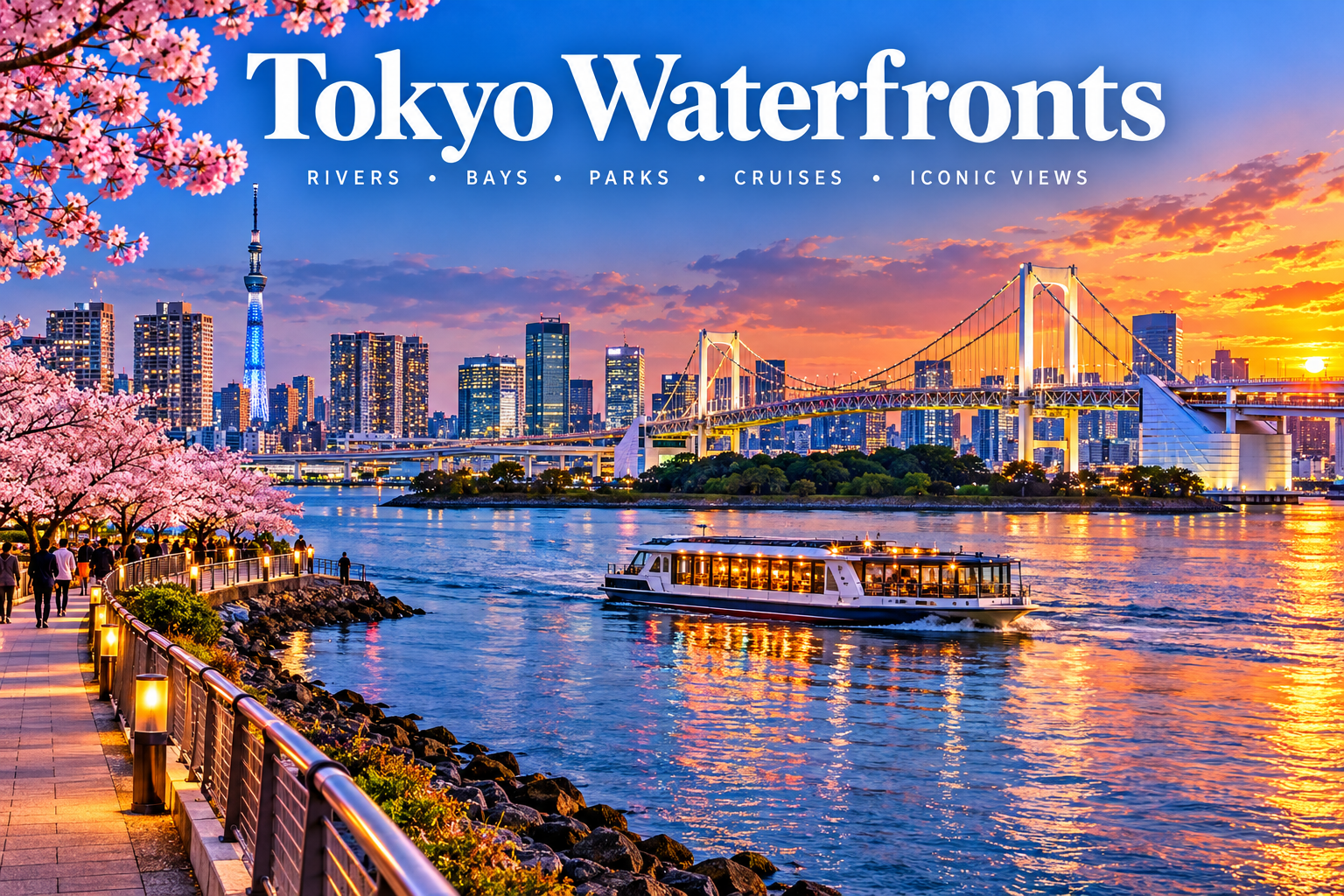
Tokyo Skytree From the Waterfront
The river area also provides excellent perspectives toward Tokyo Skytree.
One advantage of photographing from the waterfront is the combination of:
water + skyline + tower + open sky.
This composition can feel much less crowded than photographing the tower from immediately underneath it.
Odaiba Waterfront
Odaiba is one of Tokyo’s most recognisable modern waterfront districts.
Located on an artificial island in Tokyo Bay, Odaiba is known for broad public spaces, entertainment, shopping, architecture and views across the water.
What Makes Odaiba Different?
Odaiba feels less like traditional Tokyo and more like a vision of the city’s future.
Visitors encounter:
- Wide promenades
- Large commercial facilities
- Waterfront parks
- Modern buildings
- Rainbow Bridge views
- Entertainment attractions
- Open harbour scenery
The district is particularly suitable for travellers who want photographs with a contemporary Tokyo atmosphere.
Odaiba Seaside Park
Odaiba Seaside Park provides an unusual urban beach environment.
The area offers views toward the city and Rainbow Bridge while giving visitors space to sit and relax.
It is especially appealing around sunset.
Rainbow Bridge Views
Rainbow Bridge is one of the defining visual elements of Tokyo Bay.
During the day, the bridge provides a strong architectural subject.
At night, illumination transforms the view.
Photographers should consider returning at different times because the same waterfront can look completely different under morning, sunset and nighttime conditions.
Toyosu Waterfront
Toyosu has become one of the most important modern waterfront districts in Tokyo.
The area combines residential development, commercial facilities, public spaces and access to Tokyo Bay.
Toyosu’s Changing Identity
Toyosu demonstrates how Tokyo’s waterfront continues to evolve.
A district once strongly associated with industrial and wholesale activity has developed into a modern urban neighbourhood.
This transformation is important because it shows that waterfronts are not fixed landscapes.
They can change significantly over decades.
Toyosu for Families
Toyosu is useful for families because it offers a combination of:
- Open spaces
- Shopping
- Restaurants
- Waterfront walks
- Entertainment
- Easy access to other bay districts
Families can combine an indoor attraction with an outdoor waterfront walk without needing to cross the entire city.
Harumi Waterfront
Harumi sits within Tokyo’s central bay area and is surrounded by modern urban development.
Its broad streets and open views create a very different atmosphere from older central neighbourhoods.
Why Harumi Is Interesting
Harumi provides views of:
- Tokyo Bay
- High-rise residential towers
- Bridges
- Waterfront parks
- Modern city architecture
The area is particularly interesting for people who enjoy urban design and contemporary architecture.
Ariake Waterfront
Ariake is another major bay-area district.
It is associated with large-scale event and exhibition facilities, modern buildings and broad urban spaces.
Ariake for Event Visitors
If you are attending an exhibition, sporting event or large-scale event in the bay area, Ariake can be incorporated into a wider waterfront itinerary.
Instead of travelling directly back to central Tokyo after an event, visitors can explore nearby public spaces and waterfront areas.
This creates a more complete experience of the district.
Takeshiba Waterfront
Takeshiba is one of the most strategically located waterfront areas because it sits close to central Tokyo while directly facing the bay.
The area has experienced significant redevelopment and offers modern public spaces, offices, restaurants and access to the water.
Takeshiba and Island Travel
Takeshiba is also associated with ferry and island connections.
This gives the district a special role: it can function both as a destination and as a gateway.
Travellers planning journeys to Tokyo’s offshore islands may encounter Takeshiba as part of their route.
Hinode Pier Waterfront
Hinode Pier is another useful point for understanding Tokyo’s relationship with water transportation.
Sightseeing boats and water buses connect parts of the waterfront, making the pier more than just a place to look at the bay.
Why Use a Water Bus?
A water bus can provide:
- Different skyline views
- Less walking
- A relaxing travel experience
- Photography opportunities
- A different perspective on bridges
- Access between waterfront districts
For tourists, the journey itself becomes part of the attraction.
Tennozu Isle Waterfront
Tennozu Isle provides another example of waterfront redevelopment.
The area combines:
- Offices
- Residential buildings
- Restaurants
- Canals
- Art
- Public spaces
- Modern architecture
Its canals create a calmer atmosphere than many central Tokyo districts.
Tennozu for Photography
The combination of water reflections and modern buildings makes Tennozu particularly interesting during:
- Early morning
- Blue hour
- Sunset
- Night
Photographers can experiment with reflections, architectural symmetry and long exposures.
Shibaura Waterfront
Shibaura is characterised by canals, bridges, warehouses, residential towers and modern development.
It is less associated with traditional tourism than Asakusa or Odaiba, which is exactly what makes it interesting.
Exploring Lesser-Known Waterfronts
Travellers who have already visited Tokyo’s major attractions may appreciate Shibaura because it reveals a quieter side of the metropolitan waterfront.
Rather than searching for a single landmark, the experience comes from observing everyday urban life.
Nihonbashi Waterfront
The Nihonbashi area provides an important connection between Tokyo’s commercial history and its waterways.
The Nihonbashi River runs through a densely developed central part of the city.
Why Nihonbashi Matters
Historically, Nihonbashi developed as a major commercial centre.
Today, the surrounding district combines:
- Historic buildings
- Department stores
- Restaurants
- Financial institutions
- Modern redevelopment
- River infrastructure
It demonstrates how Tokyo can preserve historical identity while undergoing constant redevelopment.
Kameido and Eastern Tokyo Waterfronts
Eastern Tokyo contains numerous rivers and canals that receive less international attention than Tokyo Bay.
These areas can offer a different perspective on the city.
Instead of spectacular skyscraper panoramas, travellers may discover:
- Local parks
- Residential neighbourhoods
- Small bridges
- Community spaces
- Riverside paths
- Everyday Tokyo life
These locations are especially useful for repeat visitors.
Tokyo Waterfront Parks
Tokyo’s waterfront parks are among the best places to slow down.
Why Waterfront Parks Are Different
A conventional urban park may be surrounded by buildings.
A waterfront park can provide:
- Open horizon
- Water reflections
- Breeze
- Longer views
- Birdlife
- Boats
- Bridges
- Skyline scenery
This creates a psychological sense of space.
Best Activities in Waterfront Parks
Depending on the location, visitors can:
- Walk
- Jog
- Cycle
- Photograph
- Picnic
- Watch boats
- Enjoy sunsets
- Read
- Rest between attractions
Tokyo Waterfront Promenades
A promenade is one of the simplest ways to experience the waterfront.
Unlike a major attraction, a promenade does not require an entrance ticket or a fixed schedule.
You can walk for ten minutes or two hours.
Why Promenades Work for Tourists
Promenades are particularly valuable because they allow visitors to experience the city at their own pace.
You can stop for:
- Photography
- Coffee
- Food
- Architecture
- People-watching
The journey becomes the attraction.
Tokyo Waterfront Cruises
A cruise provides one of the easiest ways to understand the geography of Tokyo’s waterfront.
From the water, familiar buildings appear differently.
Bridges become much more dramatic.
Skyscrapers appear as part of a larger skyline.
Daytime Cruises
Daytime cruises are useful for:
- First-time visitors
- Families
- Photographers
- Travellers with limited walking ability
The broad daylight also makes it easier to identify landmarks.
Sunset Cruises
Sunset is one of the most visually appealing times to travel along Tokyo’s waterfront.
The combination of:
- Warm light
- Reflective water
- City skyline
- Bridges
- Changing sky
can produce memorable photographs.
Night Cruises
Night cruises provide a completely different experience.
Tokyo’s illuminated skyline becomes the main attraction.
Night cruises are particularly useful for visitors who want to see the city’s architecture without walking long distances.
Tokyo Waterfront Bridges
Bridges are among the most photographed structures around Tokyo Bay.
They are functional infrastructure, but they also become visual landmarks.
Rainbow Bridge
Rainbow Bridge is perhaps the most recognisable.
Its scale becomes easier to appreciate when viewed from:
- Odaiba
- Waterfront parks
- Boats
- Other bay viewpoints
Tokyo Gate Bridge
Tokyo Gate Bridge has a dramatic structural appearance and provides a different architectural experience from Rainbow Bridge.
The surrounding waterfront landscape can feel more open and industrial.
Why Bridges Matter to Photography
Bridges provide:
- Leading lines
- Symmetry
- Scale
- Reflections
- Strong geometric shapes
For photographers, they are often more useful than traditional monuments because they can be photographed from many angles.
Tokyo Waterfront at Sunrise
Sunrise is an underrated time to explore the waterfront.
The biggest advantage is not simply the light.
It is the atmosphere.
The waterfront can be noticeably calmer before the busiest part of the day begins.
Why Sunrise Works
Early morning offers:
- Softer light
- Fewer people
- Reflections
- Cooler temperatures
- Quiet promenades
- Stronger sense of space
Summer travellers can also use early morning to avoid the most uncomfortable heat.
Tokyo Waterfront at Sunset
Sunset is perhaps the most popular time for waterfront photography.
However, popular viewpoints can become crowded.
A better strategy is to arrive early and identify several possible angles.
Look for:
- Bridge silhouettes
- Reflections
- Skyline layers
- Boats
- Cloud formations
- Open horizons
Do not focus exclusively on the famous landmark.
Sometimes the strongest photograph is created by placing the landmark on one side of the frame and allowing the sky and water to occupy the rest.
Tokyo Waterfront at Night
Tokyo’s waterfront changes dramatically after dark.
Illuminated buildings and bridges create reflections across the water.
Night Photography Tips
Use:
- Stable surfaces
- Low ISO when possible
- Appropriate shutter speed
- Manual focus when autofocus struggles
- Lens cleaning before shooting
- Multiple exposures if necessary
For smartphone photographers, night mode can help, but keeping the device steady remains important.
Tokyo Waterfronts for Families
Waterfront districts can be excellent family destinations because many offer open space after long periods in crowded streets.
Best Family-Friendly Activities
Families can:
- Ride sightseeing boats
- Visit parks
- Walk promenades
- Watch bridges
- Explore shopping areas
- Visit indoor attractions
- Have waterfront meals
Managing Children Near Water
Waterfront environments require normal safety awareness.
Children should remain supervised around:
- Piers
- Railings
- Boat terminals
- Slippery surfaces
- Open shoreline areas
The waterfront is relaxing, but it is still an active urban environment.
Tokyo Waterfronts for Couples
Couples can use the waterfront for slower-paced experiences.
A simple evening can include:
- Arrive before sunset.
- Walk along the promenade.
- Find a scenic viewpoint.
- Watch the skyline change.
- Have dinner nearby.
- Continue walking after dark.
The waterfront can therefore become an alternative to Tokyo’s busier nightlife districts.
Tokyo Waterfronts for Solo Travellers
Solo travellers can enjoy the waterfront without needing to follow a fixed itinerary.
Walking is particularly easy because many waterfront areas naturally create linear routes.
You can start at one station, explore the water, stop at a café and continue toward another district.
This flexibility makes waterfront exploration ideal for travellers who enjoy spontaneous sightseeing.
Tokyo Waterfronts for Senior Travellers
Waterfront areas can be useful for senior travellers because some promenades are relatively flat.
However, distances can be deceptive.
A map may make two waterfront attractions look close together, but broad roads, large developments and limited crossing points can increase actual walking time.
Senior-Friendly Strategy
Use:
- Public transport
- Water buses
- Short walking sections
- Frequent rest stops
- Indoor attractions
- Comfortable footwear
Avoid turning every waterfront visit into a full-day walking challenge.
Tokyo Waterfronts for Photographers
The waterfront may be one of Tokyo’s most versatile photography environments.
Architectural Photography
Focus on:
- Bridges
- Towers
- Skyscrapers
- Ferries
- Waterfront buildings
Landscape Photography
Use:
- Water
- Sky
- Reflections
- Trees
- Open horizons
Street Photography
Observe:
- Commuters
- Cyclists
- Fishermen
- Boat passengers
- Families
- Runners
The result is a combination of urban and natural elements.
Tokyo Waterfronts for Food Lovers
Food is another major reason to explore waterfront districts.
Modern bay districts contain restaurants ranging from casual cafés to more sophisticated dining environments.
Waterfront Dining
A waterfront meal can be especially enjoyable around:
- Sunset
- Early evening
- Clear winter days
But the best restaurant choice depends on whether you prioritise:
- View
- Food quality
- Budget
- Atmosphere
- Accessibility
A beautiful view does not automatically mean the best meal, so consider these factors separately.
Tokyo Waterfronts for Architecture Lovers
Tokyo’s waterfront is essentially an open-air study in urban development.
You can see:
- Historic structures
- Industrial architecture
- Contemporary towers
- Bridges
- Large public facilities
- Reclaimed land development
The contrast between old and new is particularly interesting.
Old Tokyo Meets New Tokyo
Asakusa’s historic atmosphere can be contrasted with Odaiba’s futuristic environment.
Nihonbashi’s commercial history can be contrasted with newer bay-area developments.
This comparison helps visitors understand how Tokyo has evolved.
Tokyo Waterfronts and Land Reclamation
Land reclamation is fundamental to understanding many Tokyo Bay districts.
As the city developed, land was created and reshaped for industrial, commercial, residential and infrastructure purposes.
This explains why some waterfront districts feel very different from older parts of Tokyo.
Why Reclaimed Land Matters
It affects:
- Street layout
- Building scale
- Transport networks
- Waterfront access
- Public space
- Development patterns
Modern Tokyo’s waterfront is therefore not simply natural coastline.
It is also a product of decades of engineering and urban planning.
Tokyo Waterfronts and Urban Resilience
Waterfront development brings opportunities but also challenges.
Cities built beside rivers and bays must consider:
- Flooding
- Storm surges
- Heavy rainfall
- Coastal hazards
- Infrastructure resilience
- Emergency access
Tokyo has invested heavily in flood-control infrastructure and disaster preparedness because water is both an asset and a potential hazard.
The Waterfront’s Double Identity
Water provides:
Beauty + transportation + recreation + economic activity
But also requires:
Protection + engineering + planning + preparedness
This tension will remain important as Tokyo continues to develop.
Common Mistakes When Visiting Tokyo Waterfronts
Mistake 1: Visiting Only Odaiba
Odaiba is excellent, but it represents only one part of Tokyo’s waterfront.
Explore the Sumida River, Nihonbashi, Toyosu, Tennozu and other areas for a more complete picture.
Mistake 2: Treating Every Waterfront as a Full-Day Destination
Some waterfront areas are best experienced in two or three hours.
Combine them with nearby attractions.
Mistake 3: Ignoring Weather
Waterfront areas can feel significantly windier than dense city streets.
Check conditions before planning long outdoor walks.
Mistake 4: Underestimating Distance
Modern waterfront districts can be geographically large.
A location that looks close on a map may require considerable walking.
Mistake 5: Arriving After Sunset
If photography is your priority, arriving before sunset provides more opportunities.
You can photograph daylight, golden hour, blue hour and nighttime illumination during the same visit.
Mistake 6: Focusing Only on Famous Landmarks
Some of Tokyo’s most interesting waterfront experiences come from ordinary canals, bridges and neighbourhood paths.
How to Plan a Tokyo Waterfront Day
A simple waterfront day might look like this:
Morning
Start in Asakusa and explore the Sumida River.
Visit nearby historic attractions before the streets become busy.
Midday
Take a boat or use public transportation toward another waterfront district.
Have lunch near the bay.
Afternoon
Explore a park, shopping area or cultural attraction.
Sunset
Choose a waterfront viewpoint for photography.
Evening
Enjoy dinner and a night walk.
This approach combines history, transportation, architecture, food and scenery without making the itinerary unnecessarily complicated.
How to Plan a Tokyo Waterfront Photography Day
Photographers can create a more deliberate route.
First Location Tokyo waterfronts
Choose a historic river environment such as Asakusa.
Second Location Tokyo waterfronts
Move toward a modern district such as Odaiba or Toyosu.
Third Location Tokyo waterfronts
Finish near a bridge or open bay viewpoint.
This creates a visual story:
historic Tokyo → modern Tokyo → futuristic Tokyo.
Tokyo Waterfronts During Different Seasons
Spring Waterfronts
Spring brings:
- Cherry blossoms
- Comfortable temperatures
- Fresh greenery
- Soft light
Riverside parks become particularly attractive.
Summer Waterfronts
Summer provides:
- Lush vegetation
- Long daylight
- Festivals
- Sunset opportunities
However, heat and humidity should be taken seriously.
Autumn Waterfronts
Autumn provides:
- Cooler temperatures
- Foliage
- Comfortable walking
- Dramatic sunsets
Winter Waterfronts
Winter often provides:
- Crisp air
- Clearer-looking skies
- Lower humidity
- Excellent nighttime illumination
The waterfront can feel particularly spacious during winter.
Tokyo Waterfronts and Public Transportation
One of Tokyo’s biggest advantages is the ability to combine rail, walking and water transportation.
Rail Plus Walking Tokyo waterfronts
This is often the simplest method.
Travel close to the waterfront, then explore on foot.
Water Plus Rail Tokyo waterfronts
A sightseeing boat can become the connection between two destinations.
This eliminates some walking while adding an attraction to the journey.
Why Multimodal Travel Works Tokyo waterfronts
Instead of thinking:
“How do I get from A to B?”
think:
“How can the journey itself become part of the Tokyo experience?”
This mindset is particularly useful around the waterfront.
Ten Brands Useful for Tokyo Waterfront Travel
The following brands cover different travel needs rather than representing a ranking.
| Brand | Category | Useful for Waterfront Travel | Main Strength | Consideration |
|---|---|---|---|---|
| Uniqlo | Clothing | Layering and everyday travel | Versatile basics | Less specialised technical gear |
| Montbell | Outdoor gear | Rain, wind and walking | Lightweight technical equipment | Some items are specialised |
| The North Face | Outdoor clothing | Variable weather | Broad outdoor range | Some products can be expensive |
| Columbia | Outdoor clothing | Rain and changing weather | Practical protection | Outdoor styling may not suit everyone |
| Patagonia | Outdoor clothing | Layers and wet conditions | Durable outdoor apparel | Premium pricing |
| Arc’teryx | Technical clothing | Rain and wind | Advanced technical construction | High price point |
| ASICS | Footwear | Long urban walks | Walking and running expertise | Less focus on fashion |
| Nike | Footwear and sportswear | Casual walking | Comfortable athletic designs | Not a specialist rainwear brand |
| Adidas | Sportswear | Everyday sightseeing | Lightweight options | Weather resistance varies |
| GU | Fashion | Budget travel clothing | Affordable casual wear | Limited technical weather protection |
The most important consideration is not the logo.
For waterfront travel, prioritise comfort, weather resistance, walking support, lightweight layers and packability.
Pros and Cons of Exploring Tokyo Waterfronts
Advantages Tokyo waterfronts
Tokyo waterfronts offer:
- Open views
- Excellent photography
- Less visual density
- Modern architecture
- Historic rivers
- Parks
- Cruises
- Family activities
- Waterfront dining
- Relaxing walks
- Sunset experiences
- Seasonal scenery
Disadvantages Tokyo waterfronts
Potential challenges include:
- Large distances
- Strong wind
- Limited shade in some areas
- Heat during summer
- Rain exposure
- Fewer attractions in some quieter districts
- Transport gaps between certain locations
- Crowds at major viewpoints
The solution is not to avoid the waterfront.
It is to choose the right district for your interests.
Hidden Opportunities Most Visitors Miss
Waterfronts Are Excellent for Slow Travel Tokyo waterfronts
Tokyo can become exhausting when every hour is scheduled around attractions.
Waterfront walks create breathing room.
You can sit beside the water without needing to “do” anything.
The Waterfront Reveals Tokyo’s Scale Tokyo waterfronts
From the centre of a dense neighbourhood, Tokyo can feel almost endless.
From the bay, the city becomes easier to understand as a connected metropolitan landscape.
Bridges Are Navigation Tools Tokyo waterfronts
Bridges are not just photography subjects.
They can help you understand where different districts sit relative to each other.
Water Changes the City’s Sound Tokyo waterfronts
Dense Tokyo is full of:
- Trains
- Traffic
- Pedestrians
- Signals
- Commercial activity
Near the water, the soundscape can become noticeably different.
This sensory change is part of the experience.
Future Trends in Tokyo Waterfront Development
Tokyo’s waterfront will continue to evolve.
Several long-term trends are likely to influence the visitor experience.
More Mixed-Use Waterfronts
Former industrial spaces are increasingly being integrated with:
- Housing
- Offices
- Restaurants
- Parks
- Cultural facilities
- Public spaces
This creates neighbourhoods that remain active beyond working hours.
Greater Public Waterfront Access
Urban planners increasingly recognise that waterfronts should not exist only for industry.
Public access can improve:
- Recreation
- Tourism
- Community activity
- Walking
- Cycling
- Quality of life
More Waterfront Events
Large public spaces provide suitable environments for:
- Festivals
- Sports
- Cultural events
- Exhibitions
- Seasonal activities
Greater Climate Resilience Tokyo waterfronts
Future waterfront planning will increasingly have to balance attractive public spaces with flood and disaster resilience.
The best waterfronts of the future are likely to combine beauty, accessibility and safety.
How Tokyo Waterfronts Could Change Tourism
The waterfront has the potential to distribute tourists more widely across the city.
Instead of concentrating visitors around a handful of famous districts, waterfront development can encourage exploration of less crowded areas.
This is particularly important as Tokyo continues to attract international visitors.
From Landmark Tourism to District Tourism
Traditional tourism often works like this:
Visit landmark → take photograph → leave.
Waterfront tourism can work differently:
Explore district → walk → eat → photograph → ride boat → discover another area.
This creates a deeper relationship with the city.
Practical Tokyo Waterfront Checklist
Before leaving your hotel, consider:
- Comfortable walking shoes
- Water bottle
- Portable charger
- Weather-appropriate clothing
- Compact umbrella
- Sun protection
- Camera or smartphone
- Small bag
- Transport card
- Offline map
- Weather forecast
During summer, add extra attention to hydration and heat protection.
During winter, prepare for wind.
During rainy periods, waterproof protection becomes more important.
Best Tokyo Waterfront Experiences by Interest
Best for History Tokyo waterfronts
Sumida River and Asakusa provide a strong combination of historic Tokyo and waterfront scenery.
Best for Modern Architecture Tokyo waterfronts
Odaiba, Toyosu, Ariake and surrounding bay districts provide contemporary urban landscapes.
Best for Skyline Views Tokyo waterfronts
Tokyo Bay waterfront viewpoints offer broad perspectives that are difficult to obtain from dense central streets.
Best for Families Tokyo waterfronts
Odaiba and Toyosu provide combinations of open spaces, entertainment and indoor facilities.
Best for Photography Tokyo waterfronts
Rainbow Bridge, Sumida River, Tokyo Skytree river views and bay sunsets provide strong compositions.
Best for Quiet Exploration Tokyo waterfronts
Tennozu, Shibaura and lesser-known eastern Tokyo waterways can provide a calmer experience.
Best for Boat Experiences Tokyo Waterfronts
The Sumida River and Tokyo Bay provide several opportunities to experience Tokyo from the water.
FAQs
What are the main Tokyo waterfront areas?
Major waterfront areas include Odaiba, Toyosu, Harumi, Ariake, Takeshiba, Hinode, Tennozu, Shibaura, Asakusa along the Sumida River and various Tokyo Bay districts.
Is Tokyo good for waterfront sightseeing?
Yes. Tokyo has an extensive network of rivers, canals and bayfront districts offering parks, promenades, bridges, cruises, restaurants and skyline views.
What is the most famous Tokyo waterfront?
Odaiba and the Tokyo Bay area are among the most recognisable modern waterfront destinations, while the Sumida River around Asakusa is one of the best-known historic waterfront environments.
Can you walk along the Tokyo waterfront?
Yes. Many waterfront districts have promenades, parks and pedestrian paths. However, distances can be considerable, so combining walking with public transportation is often more practical.
Is Odaiba worth visiting?
Odaiba can be particularly worthwhile for visitors interested in modern architecture, Tokyo Bay views, bridges, entertainment, shopping and spacious waterfront areas.
Can you see Tokyo Skytree from the waterfront?
Yes. The Sumida River area around Asakusa provides several opportunities to see and photograph Tokyo Skytree.
Can you take a boat around Tokyo?
Yes. Tokyo offers sightseeing boats and water transportation connecting various river and bay areas. A boat journey can provide a different perspective on the skyline and bridges.
What is the best time to visit Tokyo waterfronts?
Sunset is particularly attractive for photography, while early morning is excellent for quieter walks and softer light. The best time also depends on the season and your tolerance for heat.
Are Tokyo waterfronts good for families?
Yes. Many waterfront areas provide parks, open spaces, shopping, entertainment and indoor attractions, making them useful for family itineraries.
Are Tokyo waterfronts suitable for elderly travellers?
Many waterfront areas can work well for older visitors because some promenades are relatively flat. However, distances can be large, so transportation and rest breaks should be planned.
What should I wear when visiting Tokyo waterfronts?
Wear comfortable walking shoes and weather-appropriate layers. Waterfronts can be windier than surrounding streets, while summer conditions can be hot and humid.
Is Tokyo waterfront photography good at night?
Yes. Illuminated bridges, skyscrapers and reflections can create excellent nighttime compositions.
Can you see Rainbow Bridge from Odaiba?
Yes. Odaiba is one of the well-known areas for views toward Rainbow Bridge.
What is special about Tokyo Bay?
Tokyo Bay combines natural maritime geography with extensive human-made infrastructure, port activity, reclaimed land, parks, bridges, modern districts and transportation networks.
Are Tokyo waterfronts crowded?
Major destinations can become crowded, particularly on weekends, holidays, sunset periods and during major events. Less-famous canals and riverside districts can provide quieter alternatives.
Are Tokyo waterfronts expensive?
They do not have to be. Walking through public parks and promenades can be free, while optional costs may include cruises, restaurants, attractions and transportation.
Can I visit Tokyo waterfronts in winter?
Yes. Winter can be an excellent period for waterfront sightseeing because cooler temperatures and relatively dry conditions can make walking comfortable. Dress warmly because wind can make the waterfront feel colder.
Can I visit Tokyo waterfronts during rainy weather?
Yes, but waterproof clothing or an umbrella is useful. It is also smart to combine outdoor waterfront walks with nearby indoor attractions.
Are Tokyo waterfronts safe?
Tokyo is generally considered a safe major international city, but visitors should use normal precautions around piers, roads, railways and open water. Children should be supervised near waterfront edges.
Are Tokyo waterfronts suitable for photographers?
Absolutely. The combination of water, bridges, architecture, skyline, reflections and changing light makes the waterfront one of Tokyo’s most versatile photography environments.
What is the best waterfront for first-time visitors?
The Sumida River around Asakusa provides a particularly useful introduction because visitors can combine traditional Tokyo attractions, river scenery and Tokyo Skytree views.
What is the best waterfront for modern Tokyo?
Odaiba, Toyosu and other Tokyo Bay districts showcase contemporary Tokyo through modern architecture, large public spaces, bridges and reclaimed-land development.
What is the quietest Tokyo waterfront?
There is no single permanently quiet waterfront because crowds change by day and season. Less-touristy canals and riverside neighbourhoods away from major landmarks generally provide a calmer atmosphere.
Conclusion
Tokyo waterfronts reveal a side of the city that is easy to overlook when a trip is built entirely around temples, shopping streets and skyscraper districts. The city’s rivers, canals and bay areas tell a much broader story about how Tokyo developed, traded, transported goods, created new land, built infrastructure and eventually transformed former industrial spaces into parks, residential districts, cultural destinations and public recreational areas.