
Tokyo Plazas: 15+ Amazing Public Squares & Urban Spaces to Explore
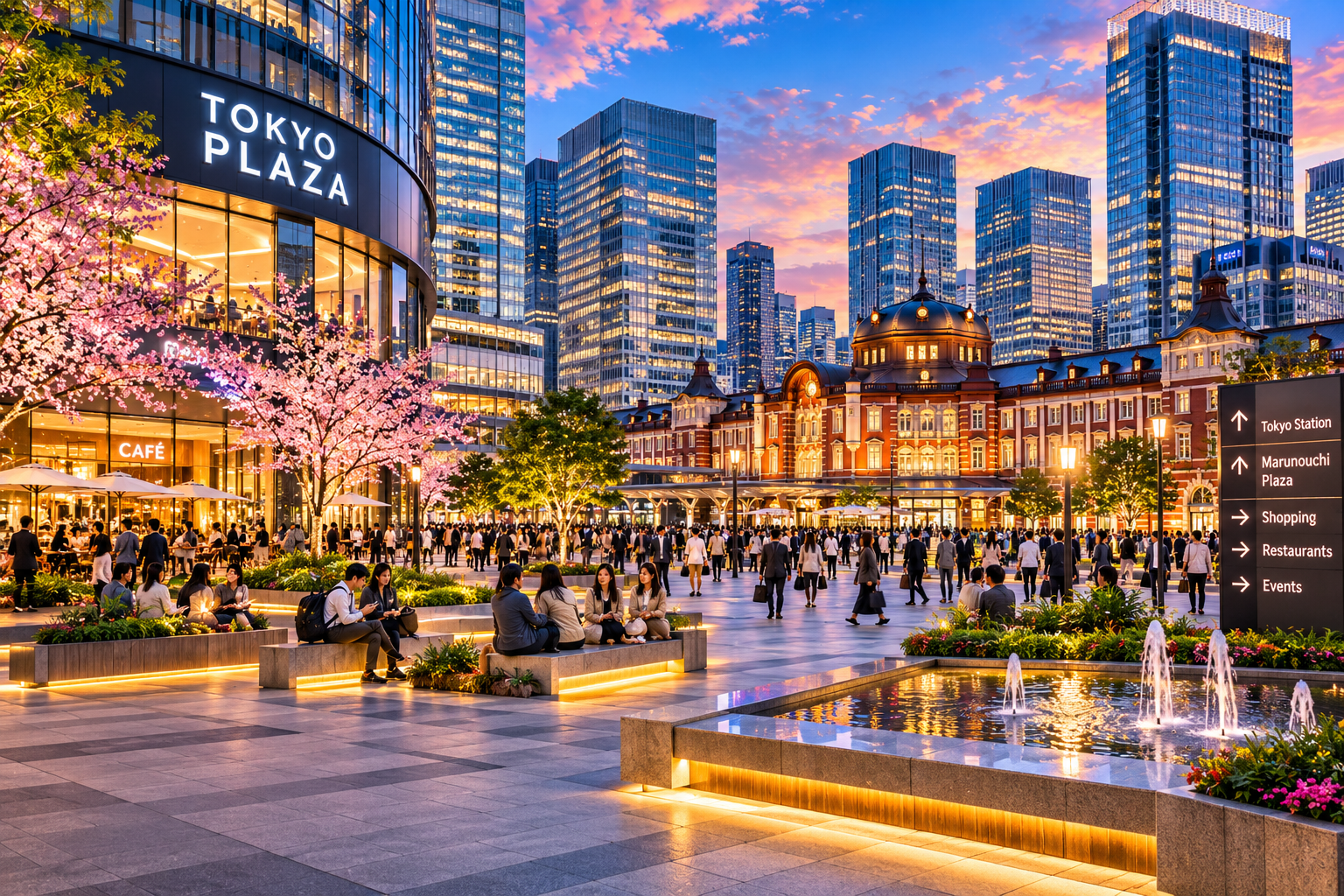
Have you ever wondered where Tokyo’s enormous crowds actually go when they are not inside trains, department stores, restaurants, or offices? Tokyo plazas are some of the city’s most fascinating public spaces, bringing together pedestrians, architecture, shopping, food, events, culture, greenery, and everyday Japanese urban life. From the energetic spaces around Shibuya Station to elegant Marunouchi squares and large-scale contemporary developments, Tokyo plazas offer travelers a different way to experience the city—by slowing down and watching Tokyo happen around them. Tokyo is famous for its streets rather than traditional European-style squares. In many parts of the city, however, the function of a plaza exists even when the space is not always called a “plaza” in English Tokyo Bicycles
What Is a Tokyo Plaza?
Understanding the Japanese Urban Plaza
The word “plaza” can mean different things depending on the context.
In Tokyo, a plaza may be:
- A station square
- A pedestrian gathering area
- An outdoor space beside a commercial complex
- A landscaped public square
- A privately owned public space
- An event area
- A civic gathering place
- A rooftop or elevated urban terrace
- A forecourt connecting buildings and transportation
- A redesigned road or pedestrian corridor
This creates a broader definition of Tokyo plazas than visitors might expect.
Tokyo Does Not Always Follow the European Square Model
Traditional European cities often have recognizable central squares surrounded by buildings.
Tokyo developed differently.
Its urban structure is heavily influenced by railway stations, commercial corridors, neighborhood streets, temples, shrines, rivers, waterways, hills, and redevelopment districts.
As a result, Tokyo’s public gathering spaces are often fragmented across a wider urban environment.
Instead of one enormous central square, you might find several smaller gathering spaces connected by pedestrian routes.
This is one of the reasons Tokyo is particularly interesting to explore on foot.
Why Tokyo Plazas Matter to the City
Plazas Are More Than Empty Space
A successful plaza does not simply provide an area without buildings.
It creates opportunities for people to:
- Meet friends
- Rest
- Eat
- Shop
- Watch street activity
- Attend events
- Take photographs
- Wait for transportation
- Enjoy public art
- Socialize
- Experience architecture
- Navigate between neighborhoods
The best Tokyo plazas perform several of these functions simultaneously.
Plazas Help Connect Different Parts of Tokyo
Urban redevelopment increasingly treats public space as part of a larger pedestrian network.
For example, Tokyo’s plans for areas such as Nishishinjuku emphasize comfortable walking environments, attractive staying spaces, pedestrian circulation, and connections between roads and surrounding developments.
This represents a broader shift in urban design.
The objective is not simply to move people from one building to another.
It is increasingly about making the journey itself enjoyable.
The Most Famous Tokyo Plazas and Public Squares
Shibuya’s Hachiko Square
Hachiko Square is one of the most recognizable meeting spaces in Tokyo.
Located immediately outside Shibuya Station, it is closely associated with the famous Hachiko statue and the surrounding Shibuya Crossing.
The area is compact, intensely urban, and almost always full of movement.
The Japan National Tourism Organization describes the Hachiko area as a small public square commonly used as a meeting point. Shibuya itself is one of Tokyo’s major centers for youth culture, fashion, nightlife, entertainment, and contemporary urban life.
The real attraction is not necessarily the physical design of the square.
It is the human activity.
People wait.
Friends meet.
Tourists photograph Hachiko.
Commuters move toward different train lines.
Advertising screens illuminate the surrounding buildings.
Pedestrian traffic flows toward the crossing.
This makes Hachiko Square an outstanding place for people-watching.
Shibuya Scramble Area
Although Shibuya Scramble Crossing is technically an intersection rather than a traditional plaza, the surrounding pedestrian spaces operate as one of Tokyo’s greatest public gathering environments.
The area represents a different concept of urban space.
Movement itself becomes the spectacle.
At each signal change, large numbers of pedestrians move simultaneously in different directions. GO TOKYO describes the crossing as one of Shibuya’s defining experiences.
For photographers, the surrounding elevated viewpoints are particularly valuable.
For first-time visitors, the experience is almost mandatory.
For people who dislike crowds, however, the area can be overwhelming.
Marunouchi Public Spaces
Marunouchi offers a completely different atmosphere.
Near Tokyo Station, the architecture becomes more formal, corporate, and carefully landscaped.
Public spaces around Marunouchi often emphasize:
- Business activity
- Luxury retail
- Architecture
- Seasonal decorations
- Outdoor seating
- Pedestrian circulation
- Events
- Dining
This is a good example of how Tokyo plazas can function as extensions of commercial districts.
During weekdays, office workers dominate.
On weekends, tourists, shoppers, families, and photographers become more visible.
Tokyo Station Marunouchi Area
The Tokyo Station area is one of the strongest examples of architecture and public space working together.
The historic station facade creates a dramatic backdrop for pedestrian spaces and surrounding streets.
For photographers, the area is particularly effective around sunrise, sunset, and after dark.
The combination of historic brick architecture, modern towers, wide streets, and carefully designed public spaces creates an unusually layered Tokyo scene.
Tokyo Midtown and Roppongi Public Spaces
Tokyo Midtown Plaza Areas
Roppongi is known internationally for art, nightlife, restaurants, and luxury developments.
Tokyo Midtown adds another dimension through landscaped public areas and pedestrian-friendly open spaces.
The environment is more polished and curated than a traditional neighborhood street.
It works particularly well for:
- Business travelers
- Architecture enthusiasts
- Families
- Art visitors
- Shoppers
- Photographers
Roppongi Hills Public Spaces
Roppongi Hills combines offices, residences, restaurants, retail, entertainment, art, and outdoor spaces.
Its public areas demonstrate the modern Tokyo model of mixed-use urban development.
Rather than separating commercial and public functions, the development integrates them.
This creates spaces where people can shop, dine, sit, photograph buildings, and attend events without needing to travel between completely separate districts.
Shinjuku Plazas and Pedestrian Spaces
Shinjuku Station Area
Shinjuku is one of the most intense urban environments in Tokyo.
Its public spaces are shaped heavily by transportation.
Millions of journeys begin, end, or pass through the wider district.
The result is a constantly changing human landscape.
A Shinjuku plaza experience is less about quiet relaxation and more about observing urban intensity.
Shinjuku Southern Terrace
Shinjuku Southern Terrace provides a more relaxed pedestrian experience than the busiest parts of the station district.
Its combination of walkways, greenery, restaurants, commercial buildings, and open areas makes it useful for visitors who want a break from the density of Shinjuku Station.
It demonstrates an important principle in urban design:
A plaza does not have to be huge to be successful.
A smaller, comfortable space can sometimes be more enjoyable than a monumental square.
Shinjuku Central Park Connections
Shinjuku Central Park is not a plaza in the narrow sense, but the spaces around it demonstrate how Tokyo combines parks, pedestrian routes, civic buildings, and open areas.
The broader Nishishinjuku area is currently part of a long-term effort to create more attractive walking and gathering spaces. Tokyo’s official redevelopment guidance specifically discusses comfortable staying areas, pedestrian circulation, and stronger relationships between roads and surrounding blocks.
Ginza Plazas and Pedestrian Spaces
Ginza’s Urban Character
Ginza represents a different version of Tokyo public space.
Instead of large traditional squares, the district is characterized by wide streets, luxury storefronts, department stores, galleries, restaurants, and pedestrian-oriented areas.
During pedestrian-friendly periods and events, the street itself can begin functioning like a giant linear plaza.
Why Ginza Is Great for People-Watching
Ginza attracts an unusual mixture of:
- Luxury shoppers
- Office workers
- International tourists
- Local residents
- Photographers
- Restaurant visitors
- Architecture enthusiasts
This makes it particularly interesting for travelers who want to understand Tokyo’s relationship between commerce and public life.
Omotesando and Harajuku Urban Spaces
Omotesando’s Architectural Plazas
Omotesando is famous for fashion and architecture.
Many flagship stores are designed as architectural attractions themselves.
The spaces immediately outside and between these buildings create informal gathering areas.
For architecture enthusiasts, Omotesando is almost an outdoor design exhibition.
Harajuku’s Youth-Oriented Public Spaces
Harajuku has a more energetic and youthful atmosphere.
Small public areas, pedestrian streets, station forecourts, and commercial entrances often become informal meeting points.
This is particularly useful for travelers interested in Japanese fashion and contemporary youth culture.
Odaiba Public Spaces
Waterfront Plazas
Odaiba offers something that many central Tokyo districts cannot provide:
Space.
The waterfront environment creates broad pedestrian areas, open views, modern architecture, bridges, and large event spaces.
This makes Odaiba particularly attractive to:
- Families
- Photographers
- Couples
- Architecture enthusiasts
- Sunset viewers
Why Waterfront Plazas Feel Different
Water changes the psychology of urban space.
A city can feel less compressed when there is an unobstructed horizon.
Odaiba’s waterfront spaces therefore provide a useful contrast to Shibuya or Shinjuku.
Instead of crowds and vertical buildings dominating every view, visitors can experience sky, water, bridges, and open landscapes.
Toyosu and Newer Urban Spaces
Modern Waterfront Development
Toyosu demonstrates another side of Tokyo’s urban transformation.
Former industrial and logistics environments have been incorporated into modern residential, commercial, recreational, and waterfront development.
The public spaces here often feel newer and more planned than older central districts.
Who Will Enjoy Toyosu?
Toyosu can work particularly well for:
- Families
- Architecture enthusiasts
- Waterfront photographers
- Travelers interested in modern Tokyo
- Visitors looking for less traditional urban scenery
Jingu Gaien and the Future of Large Urban Plazas
A Major Example of Urban Transformation
The Jingu Gaien area provides an important example of how Tokyo is thinking about large-scale public space.
Tokyo’s official information on the redevelopment describes a planned central plaza of approximately 1.5 hectares between the baseball and rugby stadiums, as well as additional open lawn areas and pedestrian connections.
The plan also emphasizes barrier-free connections and pedestrian movement.
This is significant because modern plazas are increasingly expected to perform several roles simultaneously.
They should be:
- Attractive
- Accessible
- Flexible
- Safe
- Walkable
- Useful during events
- Valuable during emergencies
- Connected to surrounding neighborhoods
Plazas as Disaster-Preparedness Infrastructure
This is one of the most overlooked aspects of Tokyo plazas.
A large open space can become important during emergencies.
Tokyo’s Jingu Gaien redevelopment information specifically identifies the central plaza as contributing to disaster preparedness and its role as a wide-area evacuation site.
This means a plaza is not necessarily just a leisure destination.
It can also be part of the city’s resilience infrastructure.
Tokyo Plazas and Urban Redevelopment
The Shift Toward Walkable Tokyo
Tokyo’s recent planning increasingly emphasizes pedestrian networks and comfortable public spaces.
This reflects a broader global trend toward walkable cities.
The objective is to make urban environments more pleasant for people who are walking, sitting, meeting, and spending time outdoors.
Public Space as a Development Tool
Modern redevelopment often uses public space to connect buildings.
A developer might construct:
- Offices
- Apartments
- Hotels
- Shops
- Restaurants
But without attractive public areas, the development can feel like a collection of isolated buildings.
A plaza helps turn those buildings into a district.
The Rise of Privately Managed Public Spaces
Some Tokyo plazas are not traditional municipal squares.
They may be incorporated into privately developed complexes while remaining accessible to the public.
This creates advantages and disadvantages.
Private management can provide:
- Better maintenance
- Landscaping
- Programming
- Events
- Security
- Design consistency
But it can also create questions about who controls the space and how freely it can be used.
Ten Major Tokyo Plaza Destinations Compared
| Tokyo Plaza / Public Space | Area | Atmosphere | Best For | Crowds | Photography | Family Friendly |
|---|---|---|---|---|---|---|
| Hachiko Square | Shibuya | Energetic | First-time visitors | Very high | Excellent | Moderate |
| Shibuya Scramble area | Shibuya | Fast-paced | People-watching | Very high | Excellent | Moderate |
| Marunouchi public spaces | Marunouchi | Elegant | Architecture and shopping | Moderate | Excellent | High |
| Tokyo Station area | Marunouchi | Historic-modern | Photography | High | Excellent | High |
| Tokyo Midtown | Roppongi | Contemporary | Design and dining | Moderate | Very good | High |
| Roppongi Hills | Roppongi | Upscale | Art and city views | Moderate-high | Excellent | High |
| Shinjuku Southern Terrace | Shinjuku | Relaxed | Dining and walking | Moderate | Very good | High |
| Ginza pedestrian spaces | Ginza | Luxury | Shopping and people-watching | High | Excellent | High |
| Odaiba waterfront spaces | Odaiba | Open and scenic | Families and sunsets | Moderate | Excellent | Excellent |
| Toyosu waterfront areas | Toyosu | Modern and spacious | Contemporary Tokyo | Moderate | Very good | Excellent |
The Best Tokyo Plazas for Different Travelers
Tokyo Plazas for First-Time Visitors
First-time travelers should prioritize spaces that immediately communicate Tokyo’s identity.
Hachiko Square and the Shibuya area are obvious choices because they combine transportation, advertising, shopping, architecture, and pedestrian activity.
Tokyo Station’s Marunouchi area provides the opposite experience: more formal, historic, and elegant.
Visiting both creates a useful introduction to Tokyo’s urban contrasts.
Tokyo Plazas for Families
Families generally benefit from larger and less congested spaces.
Odaiba and Toyosu can be particularly comfortable because they provide more breathing room.
Waterfront environments also give children more visual variety than a dense commercial district.
Tokyo Plazas for Photographers
Photographers should consider:
- Tokyo Station
- Marunouchi
- Shibuya
- Roppongi
- Odaiba
- Ginza
Each offers a different visual language.
Tokyo Station provides historic architecture.
Shibuya provides movement.
Roppongi provides modern architecture.
Odaiba provides water and skyline views.
Tokyo Plazas for Architecture Lovers
Architecture enthusiasts should explore Marunouchi, Roppongi, Omotesando, Shibuya, and newer waterfront districts.
Do not photograph only famous buildings.
Pay attention to the spaces between them.
The relationship between a building entrance, pavement, seating, trees, lighting, and pedestrians can reveal more about contemporary urban design than a facade alone.
Tokyo Plazas for Older Travelers
Travelers who prefer less intense environments may want to avoid spending extended periods in the busiest Shibuya and Shinjuku areas.
Look for:
- Seating
- Shade
- Accessible paths
- Nearby cafés
- Restrooms
- Short walking distances
Marunouchi, Tokyo Midtown, Odaiba, and selected landscaped commercial areas can provide a more manageable experience.
Tokyo Plazas for Business Travelers
Business travelers often pass through Tokyo plazas without realizing their potential.
A public space near your hotel or meeting location can become an excellent place to:
- Take a break
- Have coffee
- Meet colleagues
- Walk between meetings
- Photograph the city
- Reset mentally
This is one reason public space matters economically as well as socially.
Best Times to Visit Tokyo Plazas
Early Morning
Early morning is ideal for travelers who want photographs with fewer people.
Tokyo Station and Marunouchi can be particularly attractive before the business day reaches full intensity.
Midday
Midday is ideal for experiencing the city at full speed.
Shibuya and Ginza become especially energetic.
However, photography becomes more difficult because of crowds.
Late Afternoon
Late afternoon can provide a balance between activity and attractive light.
It is one of the best times for architecture photography.
Evening
Tokyo plazas become dramatically different after dark.
Lighting, signage, illuminated buildings, restaurants, and passing crowds create a completely different visual atmosphere.
Shibuya is particularly famous for this transformation.
Tokyo Plazas for Photography
Use Leading Lines
Tokyo is full of lines:
- Roads
- Buildings
- Railings
- Pavements
- Bridges
- Crosswalks
Use these lines to guide the viewer toward your main subject.
Photograph People Without Losing Context
A common mistake is photographing crowds without showing the environment.
Try wider compositions that include:
- People
- Buildings
- Signs
- Streets
- Trees
- Public art
This creates a stronger sense of place.
Shoot at Blue Hour
The period after sunset can be particularly effective.
The sky retains some color while artificial lighting becomes visible.
Tokyo’s modern architecture looks especially dramatic under these conditions.
How to Explore Tokyo Plazas on Foot
Choose a District Rather Than a Single Plaza
Instead of traveling across Tokyo for one public square, build a walking route.
For example:
Tokyo Station → Marunouchi → Ginza
This allows you to experience multiple forms of urban public space.
Another route might be:
Shibuya → Omotesando → Harajuku
This combines major pedestrian environments with fashion, architecture, and retail streets.
Spend Time Instead of Collecting Locations
The purpose of exploring plazas is not necessarily to visit as many as possible.
Spend twenty or thirty minutes in a space.
Observe how the atmosphere changes.
A plaza at 8 AM can feel completely different from the same plaza at 7 PM.
What to Do at Tokyo Plazas
People-Watch
People-watching is one of the easiest ways to understand a city.
Observe:
- How people move
- Where they stop
- Where they meet
- How long they stay
- How different age groups use the space
Enjoy Seasonal Events
Tokyo’s public spaces frequently host seasonal decorations, exhibitions, cultural programs, markets, and other activities.
Check current local information before visiting because event schedules change.
Have a Coffee Break
A café overlooking a public space can provide one of the easiest ways to appreciate Tokyo’s urban rhythm.
Instead of rushing between attractions, sit and observe.
Photograph Architecture
Plazas are excellent locations for understanding buildings in context.
A skyscraper photographed from a plaza can look very different from the same building viewed from a distant street.
Common Mistakes When Visiting Tokyo Plazas
Mistake 1: Assuming Every Plaza Is a Tourist Attraction
Many public spaces are primarily designed for local residents and workers.
Solution: Behave like a respectful visitor rather than treating every location as an attraction.
Mistake 2: Visiting Only at Peak Hours
Large crowds can make some spaces difficult to appreciate.
Solution: Visit important locations twice if possible—once in the morning and once at night.
Mistake 3: Ignoring Nearby Streets
A plaza rarely exists in isolation.
Solution: Walk at least a few blocks around it.
The surrounding streets often reveal the real character of the neighborhood.
Mistake 4: Forgetting Weather
Outdoor spaces are highly dependent on weather.
Rain can transform a plaza into a reflective photographic environment, but extreme heat can make long visits uncomfortable.
Mistake 5: Treating Public Space Like a Private Event Venue
Some plazas have rules regarding commercial photography, events, bicycles, food, performances, or equipment.
Always follow posted regulations.
Challenges Facing Tokyo Plazas
Overcrowding
Famous areas can become victims of their own success.
Shibuya is an obvious example.
Its popularity creates energy but can also make comfortable lingering difficult.
Heat
Large paved surfaces can become uncomfortable during hot weather.
Trees, shade, water features, and covered areas therefore matter increasingly in plaza design.
Accessibility
Modern Tokyo redevelopment increasingly emphasizes barrier-free pedestrian connections.
This is important because public spaces should work for:
- Wheelchair users
- Older people
- Parents with strollers
- Travelers carrying luggage
- People with temporary mobility limitations
Tokyo’s redevelopment policies increasingly incorporate accessibility and pedestrian network improvements.
Commercialization
A plaza surrounded by retail can be vibrant, but there is a risk that public space becomes primarily a tool for commercial consumption.
The most successful spaces usually provide reasons to stay even when visitors are not buying anything.
Pros and Cons of Tokyo Plazas
Advantages
Tokyo plazas provide several important benefits:
- Excellent people-watching
- Easy access
- Strong photography opportunities
- Architectural diversity
- Shopping nearby
- Restaurants and cafés
- Event spaces
- Convenient transportation connections
- Family-friendly options
- Opportunities to rest between attractions
- Insight into everyday Japanese urban life
Disadvantages
There are also limitations:
- Some areas are extremely crowded.
- Seating can be limited.
- Outdoor spaces are affected by weather.
- Certain locations are highly commercialized.
- Some spaces feel more like transit zones than relaxing plazas.
- Rules may limit certain activities.
- The most famous areas can become overwhelming during peak periods.
The Difference Between Public Squares and Tokyo Plazas
Traditional Public Squares
A traditional public square generally has a strong civic or historical identity.
It may be surrounded by government buildings, churches, monuments, or historic architecture.
Contemporary Tokyo Plazas
Tokyo’s newer public spaces often combine:
- Commercial buildings
- Transportation
- Offices
- Residential towers
- Restaurants
- Landscaping
- Public art
- Event areas
Their identity is therefore more multifunctional.
Why This Difference Matters
Visitors searching for “Tokyo plazas” should understand this distinction.
If you expect one enormous historic square, Tokyo may initially seem to lack plazas.
If you understand the broader Japanese urban model, you will begin noticing them everywhere.
Tokyo Plazas and Sustainability
Greenery Is Becoming More Important
Modern public-space planning increasingly incorporates trees, planting, gardens, green roofs, and other landscape features.
Tokyo’s park management policies also emphasize long-term management and the different roles of individual parks rather than treating all green spaces identically.
Green Plazas Can Improve Comfort
Trees provide:
- Shade
- Visual relief
- Habitat
- Seasonal interest
- Cooler microclimates
- A more pleasant pedestrian experience
The difference between a completely paved square and a shaded, landscaped plaza can be substantial during summer.
Water and Cooling
Water elements can also influence how a space feels.
Fountains and reflective pools may contribute to visual cooling even when their physical temperature effect is limited.
Tokyo Plazas and Japanese Culture
The Importance of Waiting
Tokyo’s plazas often function as meeting points.
People frequently arrange to meet near a recognizable landmark, station exit, statue, or building.
This makes plazas part of the city’s social geography.
The Culture of Shared Space
A successful public space allows many different activities to occur simultaneously without one group completely dominating the environment.
Office workers can eat lunch.
Tourists can take photographs.
Children can walk around.
Older residents can sit.
Commuters can pass through.
This shared-use quality is one of the most interesting aspects of Tokyo plazas.
Tokyo Plazas for Digital Nomads and Remote Workers
Why Plazas Can Provide a Mental Break
Remote workers and digital professionals can spend hours inside cafés and coworking spaces.
A nearby plaza offers a simple way to change environment.
Even a ten-minute outdoor walk can break up a long workday.
Choosing a Good Work Break Plaza
Look for:
- Seating
- Wi-Fi nearby
- Cafés
- Shade
- Restrooms
- Convenient transportation
- Low traffic noise
Marunouchi, Roppongi, Shibuya, and newer waterfront districts can offer useful combinations of these features.
Tokyo Plazas for Couples
Romantic Evening Atmospheres
Tokyo’s plazas can be surprisingly romantic after dark.
Illuminated buildings, trees, water, bridges, and restaurant terraces can create a relaxed atmosphere.
Odaiba is particularly attractive for couples interested in waterfront views.
Marunouchi is better suited to couples who enjoy architecture, dining, and sophisticated city scenery.
Tokyo Plazas for Solo Travelers
Why Plazas Are Comfortable for Solo Exploration
Solo travelers sometimes feel pressure to constantly visit attractions.
Plazas provide permission to stop.
You can sit, photograph, read, observe people, or simply rest without needing a specific activity.
This makes public spaces particularly valuable during long trips.
The Future of Tokyo Plazas
More Walkable Urban Districts
Tokyo’s redevelopment trajectory points toward greater emphasis on pedestrian connections and comfortable public spaces.
The Nishishinjuku redevelopment guidance, for example, specifically seeks more walkable urban environments and stronger connections between roads and surrounding development.
Larger Flexible Spaces
Future plazas are likely to support multiple uses rather than having one fixed purpose.
A space could function as:
- A daily seating area
- A weekend event venue
- A festival location
- An emergency gathering area
- A cultural venue
- A pedestrian connection
Better Accessibility
Barrier-free design is likely to become increasingly important.
Future plazas will need to work for wider groups of users rather than assuming everyone can walk, climb stairs, or navigate uneven surfaces easily.
More Green Infrastructure
Urban greenery will probably become increasingly valuable as cities address heat, environmental quality, and the need for attractive public spaces.
Smarter Public Spaces
Technology may also influence future plazas.
Potential developments include:
- Digital event information
- Smart lighting
- Environmental sensors
- Crowd management
- Interactive public art
- Real-time transportation information
The challenge will be using technology without turning public spaces into overly controlled digital environments.
How Tokyo Plazas Could Change Tourism
From Sightseeing to Urban Experience
Traditional tourism often focuses on attractions.
A traveler visits a temple, photographs it, and moves on.
Plaza-based tourism encourages a different approach.
You experience:
- Architecture
- People
- Movement
- Food
- Public art
- Weather
- Street culture
- Local behavior
This can produce a deeper understanding of Tokyo.
The Rise of Slow Urban Tourism
Slow tourism does not necessarily mean traveling slowly between cities.
It can mean spending more time in individual neighborhoods.
A traveler might spend an afternoon exploring one district instead of crossing Tokyo repeatedly.
This approach reduces transportation fatigue and creates more opportunities for spontaneous discoveries.
A One-Day Tokyo Plaza Itinerary
Morning: Tokyo Station and Marunouchi
Begin around Tokyo Station.
Explore the historic architecture and surrounding public spaces.
Walk through Marunouchi and stop for breakfast or coffee.
Late Morning: Ginza
Continue toward Ginza.
Explore the major commercial streets, department stores, architecture, and pedestrian areas.
Afternoon: Roppongi
Move toward Roppongi.
Explore Tokyo Midtown and nearby public spaces.
Add an art museum if time permits.
Evening: Shibuya
Finish in Shibuya.
Visit Hachiko Square.
Experience the surrounding pedestrian environment.
Watch Shibuya Crossing after dark.
This itinerary provides three very different versions of Tokyo public space in one day.
A Family-Friendly Tokyo Plaza Itinerary
Morning: Marunouchi
Start with Tokyo Station and nearby open spaces.
Afternoon: Odaiba
Move toward the waterfront.
Give children time to walk rather than scheduling every minute.
Evening: Shibuya
If the children are comfortable with crowds, finish with a short Shibuya visit.
Otherwise, choose a quieter neighborhood for dinner.
A Photography-Focused Tokyo Plaza Itinerary
Sunrise: Tokyo Station
Photograph the station facade and surrounding architecture before the area becomes extremely busy.
Afternoon: Ginza and Omotesando
Focus on architectural details, storefronts, streetscapes, and people.
Sunset: Odaiba
Use the waterfront for broader compositions.
Night: Shibuya
Finish with urban night photography.
How to Photograph Tokyo Plazas Respectfully
Avoid Blocking Pedestrian Traffic
This is particularly important in busy areas.
Do not stand in the middle of pedestrian flows while setting up a tripod.
Respect Private Property
Not every attractive space is unrestricted public property.
Some commercial developments have photography rules.
Do Not Photograph People Intrusively
Street photography is culturally and legally nuanced.
Avoid intrusive close-ups of strangers, especially children, and respect requests not to be photographed.
What Most Tokyo Plaza Guides Miss
The Best Plaza May Not Be Famous
One of the biggest mistakes in travel content is assuming popularity equals quality.
Some of Tokyo’s most enjoyable public spaces are not famous internationally.
They may be located beside:
- A local station
- A neighborhood library
- A community center
- A small park
- A residential redevelopment
- A shopping street
These spaces can provide a more authentic experience because they are primarily used by residents.
Watch How People Use the Space
The physical design tells only half the story.
Observe how residents actually use the plaza.
Are people sitting?
Are children playing?
Are office workers eating?
Are older residents gathering?
Are events taking place?
The answer tells you whether the space is functioning successfully.
The Edges Matter as Much as the Center
A plaza’s surrounding edges are extremely important.
Restaurants, cafés, shops, trees, benches, arcades, building entrances, and transparent storefronts can make a public space feel alive.
A large empty center surrounded by blank walls may be far less enjoyable than a smaller plaza with active edges.
Practical Tips for Visiting Tokyo Plazas
Wear Comfortable Shoes
Tokyo is easier to understand on foot.
You may cover far more distance than expected.
Carry a Small Umbrella
Weather can change quickly, and outdoor public spaces provide limited shelter.
Visit the Same Plaza Twice Tokyo Plazas
A morning visit and evening visit can feel like two completely different experiences.
Use Public Transportation Strategically Tokyo Plazas
Choose a district and explore it on foot rather than repeatedly crossing the city.
Check Event Information Tokyo Plazas
Public spaces may host temporary exhibitions, markets, performances, seasonal installations, and festivals.
Keep Your Belongings Secure Tokyo Plazas
Crowded urban environments require ordinary travel awareness.
Respect Local Rules Tokyo Plazas
Signs regarding seating, smoking, photography, bicycles, events, food, and access should be followed.
FAQs
What are the best Tokyo plazas to visit?
Some of the most useful public-space experiences include Hachiko Square and the wider Shibuya pedestrian area, Marunouchi around Tokyo Station, Tokyo Midtown and Roppongi Hills, Ginza’s pedestrian spaces, Shinjuku Southern Terrace, and Odaiba’s waterfront areas.
Does Tokyo have traditional public squares?
Tokyo has public squares and gathering spaces, but many differ from the large historic European square model. Station plazas, commercial open spaces, pedestrian streets, landscaped areas, and waterfront spaces often perform similar functions.
What is the most famous plaza in Tokyo?
Hachiko Square in Shibuya is among the city’s most recognizable public meeting spaces because of its location beside Shibuya Station and the famous Hachiko statue.
Is Shibuya Crossing a plaza?
Shibuya Crossing is technically an intersection rather than a conventional plaza. However, the surrounding pedestrian areas function as a major public gathering environment.
What is the best Tokyo plaza for photography?
Tokyo Station and Marunouchi are excellent for architecture, Shibuya is ideal for crowds and urban movement, and Odaiba offers waterfront and skyline compositions.
Are Tokyo plazas free to visit?
Many public squares and outdoor urban spaces are freely accessible. However, specific facilities, events, exhibitions, observation areas, or commercial attractions nearby may charge admission.
Are Tokyo plazas good for families?
Yes. Larger and more spacious areas such as Odaiba and Toyosu can be particularly comfortable for families, while busy Shibuya areas require more attention to children because of crowds.
When should I visit Tokyo plazas?
Early morning is excellent for quieter photography. Afternoon is useful for experiencing normal city activity, while evening is ideal for illuminated architecture and nightlife atmospheres.
Are Tokyo plazas crowded?
Some are extremely crowded, particularly around major railway stations. Others are considerably quieter. Crowd levels vary by location, weekday, weekend, season, weather, and time of day.
Can I sit in Tokyo plazas?
Many public spaces provide places to sit, although availability varies. Some commercial plazas have designed seating areas, while heavily trafficked areas may have limited seating.
Can I eat in Tokyo plazas?
Rules differ by location. Some spaces encourage outdoor dining or contain cafés and restaurants, while others restrict food consumption or commercial activities.
Are Tokyo plazas wheelchair accessible?
Many newer developments emphasize barrier-free pedestrian connections and accessibility. However, conditions vary between older and newer areas, so travelers with specific accessibility requirements should check the exact route in advance.
What Tokyo plaza is best for couples?
Odaiba is attractive for couples who enjoy waterfront scenery, while Marunouchi offers sophisticated architecture, restaurants, and evening city views.
What Tokyo plaza is best for solo travelers?
Marunouchi, Tokyo Station, Ginza, and Roppongi offer many opportunities for solo travelers to sit, walk, photograph architecture, visit cafés, and people-watch.
What Tokyo plaza is best for young travelers?
Shibuya is particularly relevant for travelers interested in contemporary fashion, entertainment, youth culture, music, and urban nightlife. Official Tokyo tourism information describes Shibuya as a major center of contemporary Japanese culture.
Are Tokyo plazas good for architecture lovers?
Absolutely. Marunouchi, Ginza, Roppongi, Omotesando, Shibuya, and newer waterfront districts provide very different examples of Tokyo architecture and urban planning.
Are Tokyo plazas changing?
Yes. Tokyo continues to undertake redevelopment projects that emphasize pedestrian networks, open spaces, accessibility, greenery, gathering areas, and mixed-use urban environments.
Will Tokyo build more public plazas?
Tokyo’s current redevelopment and public-space planning indicate continued attention to pedestrian environments, open spaces, and gathering areas. The exact number and design of future plazas will depend on individual projects and planning decisions.
Why are plazas important in Tokyo?
Plazas provide places for people to meet, rest, walk, attend events, experience architecture, and interact with the city. They can also support pedestrian connectivity and, in some cases, disaster preparedness.
Conclusion
Tokyo plazas reveal a side of the city that can easily be missed when a trip is built entirely around famous attractions. A plaza may not have the historical importance of a temple or the visual fame of Tokyo Tower, yet it can tell you something equally valuable: how Tokyo’s people actually use their city. The most interesting thing about Tokyo’s public spaces is their diversity. Hachiko Square is intensely crowded and energetic. Marunouchi feels sophisticated and architectural. Ginza blends commerce and pedestrian life. Roppongi combines art, offices, restaurants, and modern design. Odaiba opens the city toward the waterfront. Toyosu shows how newer developments are creating different forms of public space.

3 Comments