
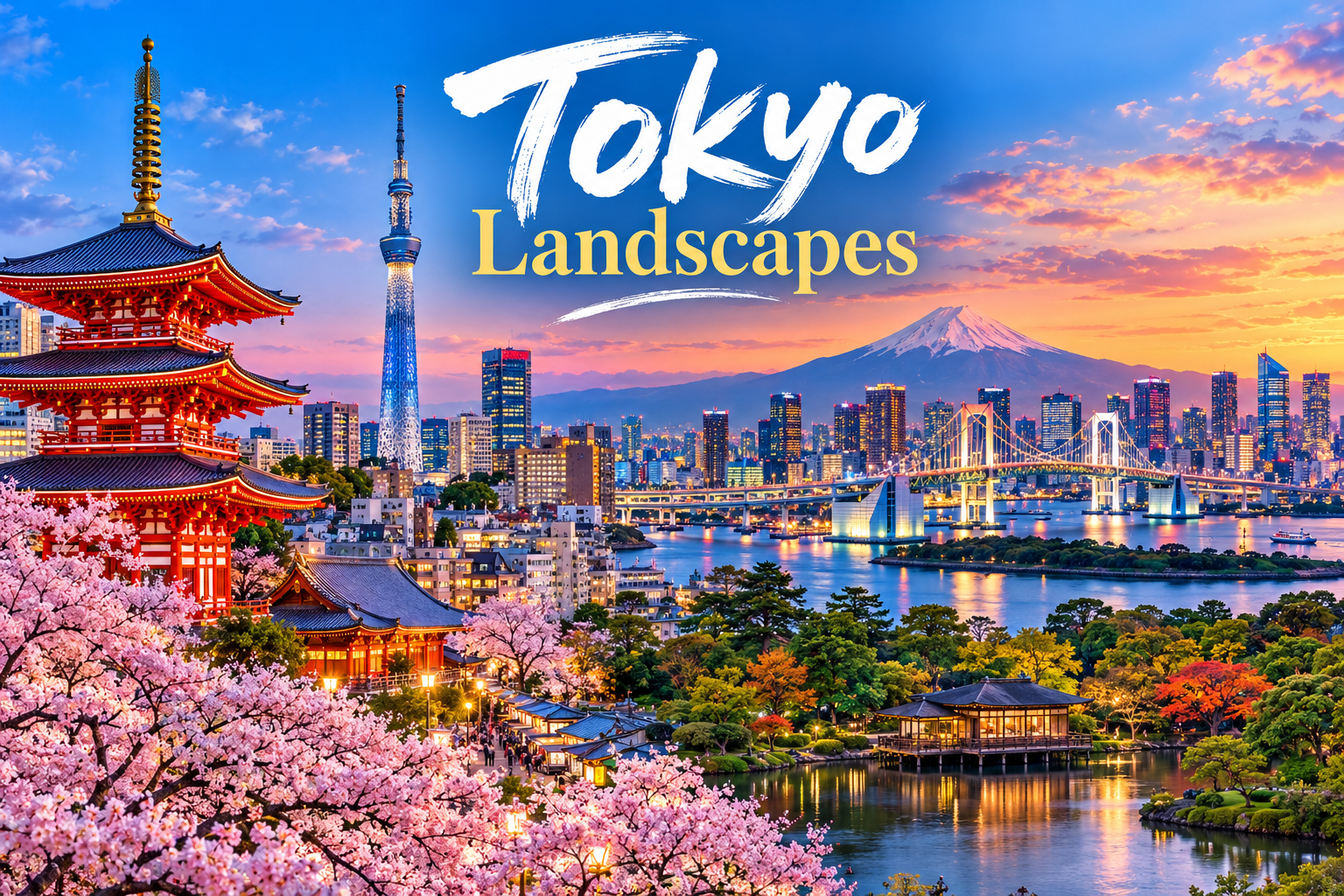
Tokyo Landscapes: 25 Breathtaking Views, Hidden Nature Spots & Urban Scenes to Discover
Imagine standing in the middle of one of the world’s busiest cities. Trains are moving beneath you, skyscrapers stretch toward the horizon, neon signs illuminate the streets, and millions of people are going about their daily lives. Then, only a short journey away, you find a quiet forest, a traditional Japanese garden, a mountain trail, a riverbank, or an island surrounded by blue water. Tokyo landscapes are far more diverse than the city’s famous skyscrapers suggest. The capital combines futuristic skylines, historic gardens, rivers, mountains, forests, coastlines, islands, temples, traditional neighborhoods, and carefully designed urban spaces into one extraordinary visual environment Tokyo Plazas
Understanding the Tokyo Landscape
Tokyo Is More Than a Dense Megacity
Tokyo is one of the world’s great metropolitan areas, but describing it simply as a city of concrete and skyscrapers misses an important part of its character.
Green spaces are woven throughout the urban environment. Parks, shrine forests, landscaped gardens, tree-lined streets, river corridors, waterfront districts, and suburban natural areas create visual breaks between dense neighborhoods.
This creates an interesting rhythm.
You can walk through a commercial district filled with billboards and traffic and suddenly enter a quiet temple compound.
You can leave a busy station and reach a peaceful garden within minutes.
You can travel from central Tokyo toward the western side of the metropolitan area and eventually encounter forests, valleys, rivers, and mountain scenery.
That dramatic transition is one of the defining characteristics of Tokyo landscapes.
The Influence of Edo and Japanese Garden Design
Modern Tokyo developed from Edo, and historical landscape traditions remain visible throughout the city.
Japanese garden design often emphasizes carefully composed relationships between water, rocks, trees, bridges, paths, buildings, and borrowed scenery.
Rather than trying to make every element look artificial or symmetrical, traditional gardens frequently create the impression of natural landscapes while carefully controlling what visitors see.
This philosophy helps explain why a relatively small garden can feel visually expansive.
A pond may reflect trees and buildings.
A bridge may create a foreground.
A carefully positioned pine tree may frame distant architecture.
A winding path may reveal a new scene gradually instead of presenting everything at once.
For travelers interested in landscape photography, these principles are useful because they encourage observation rather than simply taking pictures of famous objects.
The Main Types of Tokyo Landscapes
Urban Skylines
The Tokyo skyline is perhaps the city’s most recognizable landscape.
From elevated viewpoints, you can see layers of buildings stretching across the metropolitan area. During the day, the skyline can appear remarkably expansive. Around sunset, warm light can transform the buildings. After dark, thousands of illuminated windows create an entirely different atmosphere.
The best skyline photographs often include multiple layers:
- Foreground architecture
- Mid-distance neighborhoods
- Major landmarks
- Distant skyscrapers
- Mountains or sky on the horizon
Instead of photographing a single tower, consider capturing the relationship between the tower and the city surrounding it.
Traditional Landscapes
Tokyo’s traditional landscapes are found around temples, shrines, old neighborhoods, gardens, historic streets, and waterways.
Asakusa is an obvious example, but traditional scenery can also be discovered in quieter areas.
Look for:
- Wooden buildings
- Stone pathways
- Temple gates
- Lanterns
- Traditional gardens
- Narrow streets
- Small bridges
- Seasonal trees
- Historic waterways
These locations can provide a visual contrast to Tokyo’s modern skyline.
Garden Landscapes
Tokyo’s gardens demonstrate a different approach to landscape design.
Instead of overwhelming visitors with scale, gardens often encourage slower observation.
A pond may become the central visual feature. A pavilion may frame the water. Trees may partially conceal buildings. Paths may create changing perspectives.
Some gardens are especially attractive during spring and autumn, while others have year-round visual appeal.
Waterfront Landscapes
Tokyo Bay and the city’s rivers create another major category of scenery.
Water adds reflections, open space, changing light, bridges, boats, and atmospheric depth.
Waterfront locations can be particularly effective around sunrise and sunset.
The contrast between modern architecture and water is also a recurring theme in Tokyo photography.
Mountain Landscapes
Western Tokyo is dramatically different from central Tokyo.
The wider metropolitan region includes mountainous areas, forests, valleys, rivers, and hiking trails.
Mount Takao is one of the most accessible examples for visitors who want a mountain experience without planning a remote expedition.
Other areas around western Tokyo provide deeper nature experiences for travelers with more time.
Island Landscapes
Tokyo’s geographical identity also extends to islands.
The Izu Islands and Ogasawara Islands introduce landscapes that are very different from the dense central districts.
Depending on the island, visitors may encounter beaches, volcanic terrain, forests, marine environments, cliffs, and star-filled skies.
This broader understanding of Tokyo is important: the Tokyo metropolitan area is geographically much more diverse than central Tokyo alone suggests.
25 Incredible Tokyo Landscapes to Experience
Tokyo Skytree and the Metropolitan Skyline
Tokyo Skytree provides one of the clearest examples of Tokyo’s enormous scale.
From a high observation deck, the city changes from a collection of individual streets into a vast urban landscape.
The experience is particularly interesting because you can see how different districts form layers across the horizon.
On clear days, distant mountains can become visible.
For photographers, a long lens can compress the skyline and create dense layers of architecture, while a wide-angle lens can emphasize the enormous scale of the metropolitan area.
Tokyo Metropolitan Government Building View
The Tokyo Metropolitan Government Building offers another elevated perspective over the city.
One particularly useful feature for travelers is that its observatories are free, although operating conditions can change and weather may affect access.
The observation area reaches approximately 202 meters, providing a broad view across central Tokyo.
This viewpoint is especially interesting for budget travelers because it demonstrates that spectacular Tokyo landscapes do not always require expensive admission tickets.
Tokyo Tower and the Surrounding City
Tokyo Tower is not only a landmark to photograph; it can also become a visual anchor within a wider landscape.
Try photographing it from nearby streets, parks, elevated viewpoints, or areas where buildings frame the tower.
The contrast between the orange-and-white tower and surrounding modern architecture can create particularly recognizable Tokyo imagery.
Hamarikyu Gardens
Hamarikyu Gardens offers an unusual relationship between traditional Japanese garden design and modern skyscrapers.
This creates one of Tokyo’s most distinctive visual contrasts.
A pond, trees, historic structures, and contemporary towers can appear within the same composition.
For visitors interested in the relationship between old and new Tokyo, this is an especially valuable landscape.
Meiji Jingu Forest
The forest surrounding Meiji Jingu provides a powerful example of how greenery can create separation from the surrounding city.
A visitor can be close to Harajuku and other intensely urban neighborhoods yet experience an atmosphere that feels remarkably different.
The landscape demonstrates that Tokyo’s natural character does not always require traveling far from the center.
Yoyogi Park
Yoyogi Park provides open space, large trees, walking routes, and seasonal scenery.
It can be particularly interesting for visitors who want to observe Tokyo residents rather than only photograph monuments.
People exercising, walking, cycling, relaxing, and meeting friends become part of the landscape.
This is an important point about urban landscape photography: human activity can make a photograph feel more connected to the city.
Meiji Jingu Gaien
Meiji Jingu Gaien is particularly known for its tree-lined scenery.
The rows of ginkgo trees become especially striking during autumn.
The combination of symmetrical trees, pathways, and architecture creates a naturally strong photographic composition.
Autumn is an especially attractive season for this landscape, although exact foliage timing changes each year.
Imperial Palace Area
The Imperial Palace area combines historic architecture, stone walls, open spaces, greenery, and modern buildings.
Rather than treating it as a single attraction, think of the area as a collection of landscape compositions.
Stone walls can create strong foregrounds.
Trees provide natural framing.
Modern buildings can appear beyond historic structures.
The result is a visual representation of Tokyo’s layered history.
Sumida River
The Sumida River is one of the city’s most useful landscape corridors.
Bridges provide repeated viewpoints, while boats and riverside buildings add movement.
At night, illuminated structures can create reflections on the water.
During the day, the river provides a sense of openness within a dense metropolitan environment.
Rainbow Bridge and Tokyo Bay
Rainbow Bridge is one of Tokyo’s most recognizable waterfront structures.
From Odaiba and surrounding waterfront areas, the bridge becomes part of a broad composition involving water, skyline, ships, and artificial islands.
Evening is especially attractive when the surrounding city begins to illuminate.
Odaiba
Odaiba demonstrates how reclaimed waterfront land can create a distinctive modern landscape.
Wide spaces, futuristic buildings, water, bridges, and open horizons make the area feel very different from central Tokyo.
It can be particularly suitable for travelers who enjoy architectural photography.
Shibuya Skyline
Shibuya is usually associated with crowds and neon, but its landscape is also about verticality.
Buildings rise around streets, signs overlap, and pedestrian movement creates layers.
Modern observation areas can provide a completely different perspective, allowing visitors to see the famous district from above.
Shinjuku at Night
Shinjuku is a classic urban nightscape.
The combination of illuminated signs, elevated rail infrastructure, streets, towers, and pedestrian movement creates a dense visual environment.
For photographers, the challenge is not finding something to photograph but deciding what to exclude.
Tokyo Station and Marunouchi
Tokyo Station provides an architectural landscape where historic red-brick architecture meets modern commercial buildings.
The surrounding Marunouchi district is particularly interesting because streets, office towers, landscaped areas, and the station create a polished urban environment.
Ginza Streetscape
Ginza represents another form of Tokyo landscape.
Instead of nature or mountains, the landscape is created by architecture, streets, signage, storefronts, pedestrians, and carefully maintained public spaces.
This is useful for understanding the concept of urban landscape photography.
A landscape does not necessarily need trees or mountains.
A city street can be a landscape when viewed as a complete visual environment.
Rikugien Garden
Rikugien is associated with traditional Japanese garden aesthetics and carefully composed scenery.
The garden rewards slow walking.
Rather than rushing from one attraction to another, visitors can stop at viewpoints and observe how water, vegetation, paths, and structures interact.
Koishikawa Korakuen
Koishikawa Korakuen offers another opportunity to experience traditional garden design within Tokyo.
Its scenery demonstrates the importance of seasonal change.
The same location can appear completely different in spring, summer, autumn, and winter.
Ueno Park
Ueno Park combines greenery, cultural institutions, ponds, pathways, and historical attractions.
It is particularly useful for travelers who want a mixture of nature and culture.
During seasonal periods, the trees become major components of the landscape.
Inokashira Park
Inokashira Park in the Kichijoji area offers a more relaxed landscape experience.
The pond provides a visual center while surrounding trees create changing scenery throughout the year.
The area is also useful for travelers who want to combine nature with neighborhood exploration.
Mount Takao
Mount Takao is one of the most accessible mountain landscapes associated with Tokyo.
The mountain offers forest scenery, hiking opportunities, changing seasonal colors, and elevated views.
It is an excellent reminder that Tokyo can provide genuine outdoor experiences beyond the central districts.
Okutama
Okutama offers a much more natural landscape.
Mountains, rivers, forests, valleys, and hiking trails replace the skyscrapers and dense streets of central Tokyo.
Travelers with additional time can use this area to experience the broader natural environment of the Tokyo region.
Akigawa Valley
Valley landscapes offer something that central Tokyo cannot: depth created naturally by terrain.
Trees, cliffs, water, and changing elevations create strong compositions.
The area can be particularly appealing during autumn.
Tokyo’s Agricultural and Green Spaces
A less-discussed part of Tokyo’s landscape is its remaining agricultural land and community greenery.
These areas are important because they demonstrate that Tokyo is not entirely urbanized.
Small farms, allotments, tree corridors, and local green spaces contribute to the city’s environmental character.
Tokyo Islands
Tokyo’s islands provide perhaps the greatest contrast with the central city.
Instead of skyscrapers, visitors can encounter ocean horizons, beaches, volcanic scenery, forests, cliffs, and marine ecosystems.
For anyone researching Tokyo landscapes in depth, the islands should not be overlooked.
Tokyo Landscapes by Season
Spring Landscapes
Spring transforms Tokyo’s parks, riversides, gardens, and streets.
Cherry blossoms are the obvious attraction, but the best landscape photographs often go beyond simply photographing a cherry tree.
Try including:
- A river
- A bridge
- A temple
- A city skyline
- Pedestrians
- Reflections
- Traditional architecture
The combination tells a stronger story.
Spring can also be extremely busy, so early mornings can provide a more peaceful experience.
Summer Landscapes
Summer brings intense greenery.
Trees become fuller, gardens become vibrant, and waterfront areas become attractive alternatives to dense city streets.
Summer also introduces humidity and strong sunlight.
Early morning and late afternoon are generally more comfortable for outdoor exploration than the hottest part of the day.
Tokyo’s official tourism guidance specifically recommends planning outdoor activities around the heat during summer.
Autumn Landscapes
Autumn is one of the strongest seasons for Tokyo landscape photography.
Ginkgo trees turn yellow, maples develop red and orange tones, and cooler weather can create more comfortable walking conditions.
Popular locations can become crowded, so timing matters.
Weekday mornings are often more practical for photographers who want fewer people in the frame.
Winter Landscapes
Winter provides a different visual character.
Bare branches can reveal garden structures that are hidden during summer.
Clearer atmospheric conditions can also improve distant views.
This is particularly useful for photographers hoping to see Mount Fuji from Tokyo.
Tokyo tourism information notes that cooler winter conditions can be favorable for seeing Mount Fuji from elevated locations.
Best Tokyo Landscapes for Photography
Use Layers Instead of Single Subjects
One of the biggest mistakes beginners make is photographing only the main landmark.
Instead, create layers.
For example:
Foreground: tree or railing.
Middle ground: street or traditional building.
Background: skyscraper or tower.
Horizon: sky or mountain.
This makes the image feel deeper.
Look for Reflections
Water, glass, polished surfaces, and wet streets can all create reflections.
Tokyo is particularly useful for this because the city contains both extensive waterways and modern architecture.
Rain can therefore become an opportunity rather than a problem.
Photograph During Blue Hour
Blue hour occurs around the period after sunset when the sky retains deep blue tones while artificial lights begin to dominate.
This can produce a balanced exposure between sky and architecture.
Tokyo’s illuminated skyline is especially effective during this period.
Try Sunrise Instead of Only Sunset
Sunset is popular because people naturally think of it as a dramatic time for photography.
Sunrise has one major advantage: fewer people.
Popular parks, bridges, streets, and viewpoints can look completely different early in the morning.
Use Weather Creatively
Clouds can add drama.
Fog can simplify a composition.
Rain can create reflections.
Clear skies can reveal distant mountains.
Snow, when it occurs, can transform familiar streets into completely different landscapes.
The important lesson is that there is no single “perfect” Tokyo weather.
Tokyo Landscapes for Different Types of Travelers
Tokyo Landscapes for First-Time Visitors
First-time visitors should combine famous urban viewpoints with at least one traditional garden and one natural area.
A balanced itinerary might include:
- Tokyo Skytree
- Asakusa
- Hamarikyu Gardens
- Shibuya
- Meiji Jingu
- Odaiba
This provides several completely different visual environments.
Tokyo Landscapes for Families
Families may prefer spacious parks, waterfront areas, gardens, and locations with easy walking routes.
A landscape itinerary can also provide a break from crowded shopping districts.
Tokyo Landscapes for Photographers
Photographers should focus less on the number of attractions visited and more on lighting conditions.
One location photographed at sunrise, midday, blue hour, and night can produce four completely different results.
Tokyo Landscapes for Couples
Waterfront sunsets, garden walks, observation decks, illuminated bridges, and quiet parks can provide more intimate scenery.
Tokyo Landscapes for Budget Travelers
Not every impressive landscape requires a ticket.
Public parks, streets, riverbanks, neighborhood viewpoints, and certain observation facilities can provide excellent scenery at little or no cost.
The Tokyo Metropolitan Government’s observatories, for example, have historically provided free access to their views, subject to operating conditions.
Tokyo Landscapes for Older Travelers
Choose gardens, observation areas, accessible waterfront promenades, and attractions with good public transportation.
A landscape itinerary does not need to involve long hikes.
Tokyo Landscapes for Solo Travelers
Solo travelers can benefit from early morning walks, photography routes, gardens, riverside paths, and observation decks.
These environments make it easy to explore at an individual pace.
How to Plan a Tokyo Landscape Photography Day
Start Before Sunrise
Begin near your first outdoor location.
Early morning provides softer light and fewer people.
Visit a Garden During Morning Light
Gardens often look particularly atmospheric when sunlight passes through trees.
Move Toward a Waterfront
Midday can be useful for architectural and waterfront compositions.
Explore a Neighborhood in the Afternoon
Use the afternoon for streets, architecture, cafés, and local scenes.
Finish at an Observation Deck
End the day above the city.
The progression from daylight to sunset to night can provide a natural visual conclusion.
How to Photograph Tokyo Landscapes With a Smartphone
Clean the Lens
This sounds obvious, but fingerprints can dramatically reduce image clarity.
Avoid Excessive Digital Zoom
Move physically closer when possible.
For distant landscapes, use the phone’s optical zoom rather than extreme digital enlargement.
Lock Exposure
Bright signs and dark streets can confuse automatic exposure.
Use exposure controls when photographing night scenes.
Use Reflections
Look for glass, puddles, water, and polished surfaces.
Shoot Vertical and Horizontal
Vertical images work well for towers and narrow streets.
Horizontal compositions work well for skylines and waterfronts.
Do Not Overprocess
Tokyo already has strong colors.
Excessive saturation can make photographs look artificial.
Natural contrast usually produces a more timeless result.
Common Mistakes When Exploring Tokyo Landscapes
Mistake 1: Only Visiting Famous Landmarks
Famous locations are useful, but they do not represent the entire city.
Solution: combine major attractions with one lesser-known park, garden, river, or neighborhood.
Mistake 2: Ignoring Weather
Some travelers cancel landscape photography because of clouds.
Solution: adapt your subject.
Cloudy weather is excellent for gardens and architecture.
Rain is useful for reflections.
Clear weather is useful for distant views.
Mistake 3: Arriving at the Wrong Time
A beautiful location can look ordinary under harsh midday sunlight.
Solution: research sunrise, sunset, opening hours, and seasonal timing.
Mistake 4: Forgetting Crowds
Popular Tokyo locations can become extremely busy.
Solution: visit early on weekdays where practical.
Mistake 5: Treating Nature as Background Decoration
Tokyo’s parks and gardens are not simply green spaces between attractions.
They often have historical, cultural, ecological, and design significance.
Spend time observing them.
Mistake 6: Ignoring Local Etiquette
Photography should not interfere with residents or other visitors.
Avoid blocking pathways.
Do not enter restricted areas.
Be cautious when photographing people.
Tokyo’s official responsible-travel guidance also emphasizes respecting privacy and asking permission before photographing people.
Responsible Travel and Tokyo Landscapes
Keep Parks Clean
Tokyo has a strong culture of public cleanliness.
Visitors should carry waste when appropriate and use designated disposal facilities.
Protect Vegetation
Do not walk through planted areas simply to obtain a photograph.
Stay on designated paths.
Respect Quiet Places
Shrines, temples, gardens, and residential neighborhoods are not merely photo sets.
They are functioning cultural and community spaces.
Avoid Blocking Popular Viewpoints
If a location is crowded, take your photograph and allow others to enjoy the view.
Travel More Sustainably
Using public transportation, walking where practical, supporting local businesses, and avoiding unnecessary waste can reduce the impact of sightseeing.
Sustainable tourism has become an increasingly important part of Tokyo’s visitor strategy, with environmental conservation, community welfare, and economic sustainability identified as important principles.
Pros and Cons of Exploring Tokyo Landscapes
Advantages
Exceptional variety: Urban, traditional, natural, coastal, mountain, and island scenery can all be experienced within the wider Tokyo metropolitan area.
Excellent transportation: Many major landscape locations can be reached without renting a car.
Four-season appeal: Spring blossoms, summer greenery, autumn foliage, and winter views provide changing scenery.
Photography opportunities: Architecture, people, nature, water, and light create almost unlimited subjects.
Cultural depth: Landscapes often connect directly to Japanese history and traditions.
Different budgets: Travelers can combine free public spaces with paid observation decks and attractions.
Disadvantages
Crowds: Popular locations can become very busy.
Weather variability: Rain, heat, humidity, and cloud cover can affect outdoor plans.
Large geographic area: Tokyo’s broader natural landscapes may require substantial travel time.
Seasonal timing: Cherry blossoms and autumn foliage have relatively short peak periods.
Urban complexity: Finding a quiet landscape in central Tokyo sometimes requires planning.
10 Brands and Platforms for Tokyo Landscape Photography
The word “brands” can be interpreted in several ways when planning a landscape-focused Tokyo trip. For photographers and visual travelers, camera and imaging brands are particularly relevant because equipment choices can influence how you capture Tokyo’s skyline, gardens, streets, and natural scenery.
The following comparison focuses on well-known photography brands and the types of Tokyo landscape work they are commonly suited to.
| Brand | Best Suited To | Strength for Tokyo Landscapes | Typical Use |
|---|---|---|---|
| Sony | Hybrid photography | Strong autofocus and compact full-frame options | City, night, travel |
| Canon | Landscape and travel photography | Broad lens ecosystem | Gardens, architecture, people |
| Nikon | Detailed landscape work | Strong image quality and lens selection | Skylines, mountains |
| Fujifilm | Street and travel photography | Compact bodies and distinctive color profiles | Neighborhoods, gardens |
| Panasonic Lumix | Video and hybrid work | Strong video-oriented systems | Travel films, landscapes |
| OM System | Lightweight outdoor photography | Portable equipment | Hiking, parks, mountains |
| Leica | Premium photography | Compact premium systems and lenses | Street and architectural work |
| Ricoh | Street photography | Extremely portable cameras | Tokyo neighborhoods |
| GoPro | Action and outdoor scenes | Small, rugged cameras | Hiking, cycling, waterfront |
| DJI | Aerial and travel imaging | Compact aerial and stabilization products | Selected outdoor landscapes |
The correct choice depends more on the photographer than the logo on the camera.
A traveler walking through Shinjuku may prioritize a compact camera.
A mountain hiker may prioritize weight and weather resistance.
A professional landscape photographer may prioritize dynamic range and lenses.
A family traveler may simply prefer a smartphone.
The Future of Tokyo Landscapes
More Digital Landscape Experiences
Technology is increasingly becoming part of the visitor experience.
Digital maps, multilingual guides, projection mapping, interactive information, and location-based experiences can help travelers understand landscapes rather than simply photograph them.
Tokyo’s official tourism resources are already expanding digital and multilingual visitor information.
Greater Interest in Sustainable Tourism
As international tourism grows, protecting parks, gardens, waterfronts, mountains, and neighborhoods will become increasingly important.
The future of Tokyo tourism is unlikely to be defined only by attracting more visitors.
It will also involve managing how visitors move through popular places.
More Interest in Lesser-Known Areas
Travelers increasingly want experiences beyond the standard checklist.
This creates opportunities for neighborhoods, smaller gardens, local parks, regional hiking areas, and Tokyo’s islands.
Instead of concentrating every visitor around a handful of famous attractions, tourism can distribute attention across a broader geographic area.
Nature as Part of Urban Wellbeing
Green spaces are increasingly recognized as important components of urban life.
Parks and gardens provide recreation, visual relief, shade, social space, and connections with nature.
This makes Tokyo landscapes relevant not only to tourists but also to the people who live in the city.
Changing Photography Trends
Social media has made visually distinctive locations extremely popular.
However, future landscape photography may increasingly move toward storytelling.
Instead of simply photographing an iconic landmark, travelers may document:
- How a neighborhood changes through the day
- The relationship between old and new architecture
- Seasonal transformations
- People interacting with public spaces
- The relationship between Tokyo and its rivers
- The transition from city to mountain
- The changing character of Tokyo after dark
These stories can create more meaningful travel content.
Pairing Tokyo Landscape Keywords With Traveler Intent
For SEO publishers, “Tokyo landscapes” can be expanded naturally through demographic and problem-solving modifiers.
Demographic Modifiers
Useful combinations include:
- Tokyo landscapes for families
- Tokyo landscapes for couples
- Tokyo landscapes for photographers
- Tokyo landscapes for solo travelers
- Tokyo landscapes for seniors
- Tokyo landscapes for students
- Tokyo landscapes for first-time visitors
- Tokyo landscapes for nature lovers
Problem-Solving Modifiers
Search intent can also be addressed through questions such as:
- Best Tokyo landscapes for photography
- Tokyo landscapes without crowds
- Tokyo landscapes free to visit
- Tokyo landscapes near train stations
- Tokyo landscapes for sunrise
- Tokyo landscapes for sunset
- Tokyo landscapes in winter
- Tokyo landscapes during autumn
- Tokyo landscapes for rainy days
- Tokyo landscapes with Mount Fuji views
- Tokyo landscapes accessible by public transport
- Tokyo landscapes for smartphone photography
These combinations help a content strategy move beyond a single broad keyword.
How to Build a Tokyo Landscapes Itinerary
One-Day Landscape Itinerary
For a short visit, choose locations that provide contrasting scenery.
Morning:
Start with Meiji Jingu and surrounding greenery.
Late morning:
Continue toward a traditional district such as Asakusa.
Afternoon:
Explore the Sumida River area.
Evening:
Finish with an elevated skyline view.
This itinerary provides forest, traditional architecture, water, and modern city scenery.
Two-Day Landscape Itinerary
Day one can focus on central Tokyo:
- Meiji Jingu
- Yoyogi Park
- Shibuya
- Imperial Palace area
- Marunouchi
- Tokyo Tower
Day two can focus on eastern and waterfront Tokyo:
- Asakusa
- Sumida River
- Tokyo Skytree
- Odaiba
- Tokyo Bay
Three-Day Landscape Itinerary
Add a natural day.
Consider:
- Mount Takao
- Okutama
- A western Tokyo garden
- A riverside area
This creates a much more complete understanding of Tokyo.
Longer Trip
Travelers staying longer can explore Tokyo’s islands or devote more time to western Tokyo.
This is where the definition of “Tokyo landscapes” becomes particularly interesting.
The city is not just a dense metropolitan center.
It is also a gateway to mountains, forests, rivers, and ocean environments.
FAQs
What are Tokyo landscapes?
Tokyo landscapes include the city’s urban skylines, historic districts, Japanese gardens, parks, rivers, waterfronts, mountains, forests, islands, streets, temples, and architectural environments.
What is the most famous Tokyo landscape?
Tokyo’s skyline is probably the most internationally recognizable landscape, particularly when landmarks such as Tokyo Tower or Tokyo Skytree appear alongside the city’s dense urban environment.
Where can I see natural landscapes in Tokyo?
Natural scenery can be found in parks, gardens, western Tokyo’s mountains and valleys, riverside areas, waterfront locations, and Tokyo’s islands.
Are there mountains in Tokyo?
Yes. The broader Tokyo metropolitan area includes mountainous regions. Mount Takao is one of the most accessible mountain destinations for visitors.
Can I photograph Tokyo landscapes with a smartphone?
Absolutely. A modern smartphone can capture excellent cityscapes, gardens, streets, waterfronts, and daylight mountain scenes.
Good composition and timing often matter more than expensive equipment.
What is the best season for Tokyo landscapes?
Every season has something different.
Spring is famous for blossoms, summer for lush greenery, autumn for foliage, and winter for clearer views and a more minimalist landscape character.
What is the best time of day for Tokyo landscape photography?
Sunrise, late afternoon, sunset, and blue hour are generally especially useful.
However, the best time depends on the subject.
Gardens can look beautiful in morning light, while city skylines often work particularly well around sunset and after dark.
Can I see Mount Fuji from Tokyo?
Yes, Mount Fuji can sometimes be seen from elevated viewpoints and other suitable locations in Tokyo, particularly under favorable atmospheric conditions.
Winter and other periods of clearer air can provide better opportunities.
Is Tokyo good for landscape photography?
Yes. Tokyo is unusually versatile for landscape photography because it combines architecture, nature, water, mountains, gardens, traditional structures, and dense urban environments.
What are the best Tokyo landscapes for beginners?
Beginners can start with easily accessible locations such as parks, gardens, waterfronts, observation decks, and major urban districts.
This provides many subjects without requiring advanced hiking or photography skills.
Where can I photograph Tokyo without spending much money?
Public parks, streets, riversides, certain gardens, neighborhood areas, and free observation facilities can provide excellent opportunities.
Are Tokyo landscapes crowded?
Some famous locations can become extremely crowded, particularly during cherry blossom and autumn foliage seasons.
Early morning and weekday visits can help.
What should I carry for a Tokyo landscape photography day?
A practical setup includes:
- Smartphone or camera
- Extra battery or power bank
- Comfortable shoes
- Water
- Weather protection
- Small bag
- Lens cloth
- Portable storage if needed
Should I use a wide-angle lens for Tokyo landscapes?
A wide-angle lens is useful for large skylines, gardens, architecture, and waterfront scenes.
However, a telephoto lens can be equally valuable for compressing skyscrapers or isolating distant subjects.
Can rainy weather improve Tokyo landscape photography?
Yes.
Rain can create reflections, darker atmospheric tones, glowing signs, and unusual street scenes.
Instead of automatically cancelling a photography outing, consider changing the subject.
Are Tokyo gardens worth visiting?
Yes. Gardens provide an opportunity to see Japanese landscape design, seasonal vegetation, water features, architecture, and historical elements in a relatively compact area.
Is Tokyo only an urban landscape?
No.
This is one of the biggest misconceptions about Tokyo.
The broader metropolitan area includes mountains, forests, rivers, islands, beaches, gardens, agricultural areas, and other natural environments.
Conclusion
Tokyo landscapes tell a much bigger story than the famous image of a crowded street beneath neon lights. The city’s real visual character comes from the interaction between modern architecture and historic environments, dense neighborhoods and open parks, rivers and skyscrapers, traditional gardens and futuristic buildings, mountains and metropolitan infrastructure. The most rewarding way to explore Tokyo is therefore not to search for one single “best” landscape. Instead, experience the contrasts. Start with the skyline. Walk through a historic neighborhood.



2 Comments