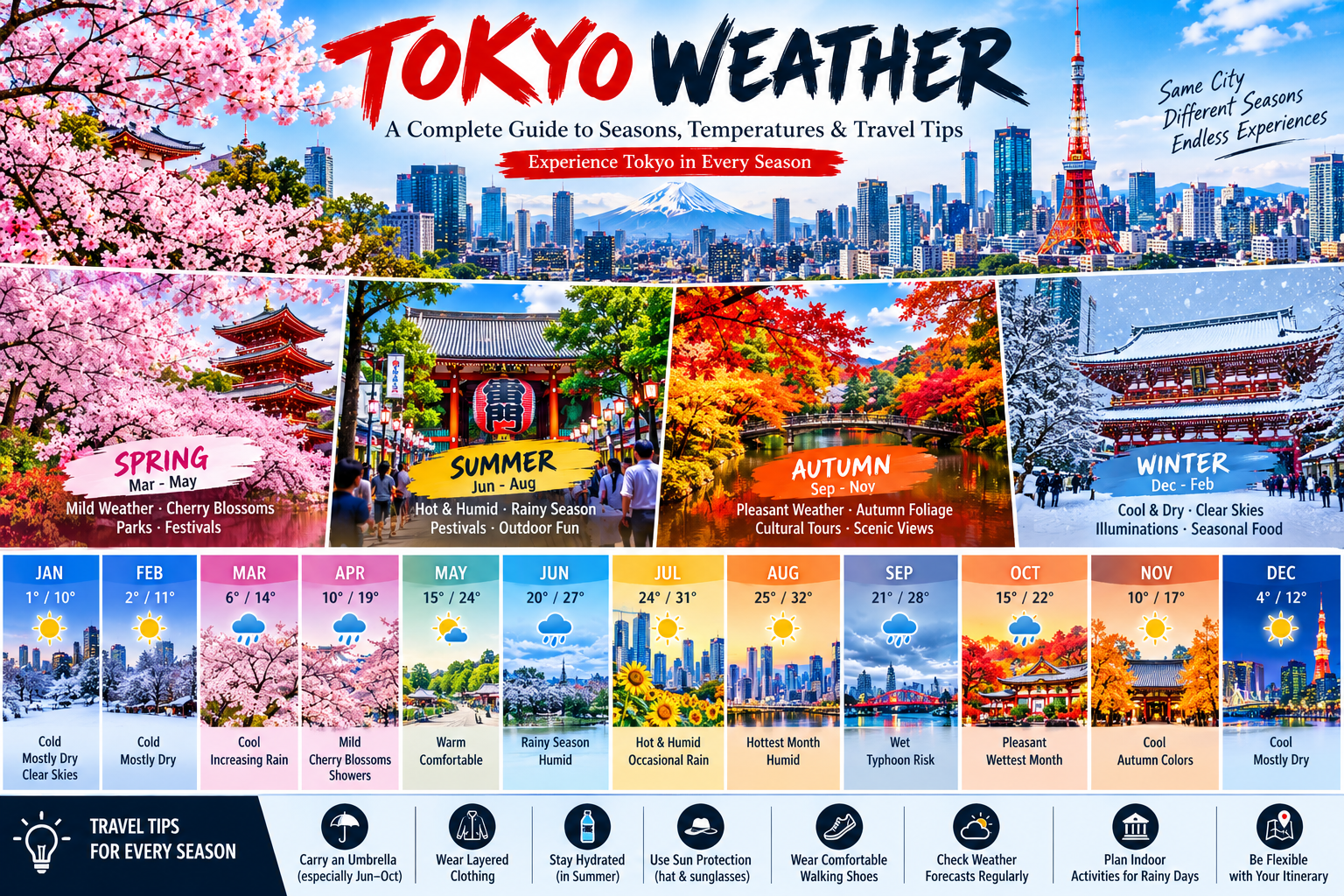
Tokyo Weather: The Ultimate Month-by-Month Guide to Seasons, Temperatures, Rain, Humidity & What to Pack
Have you ever planned a Tokyo trip around cherry blossoms, autumn colors, or summer festivals only to discover that the weather can be completely different from what you expected? Tokyo has a humid subtropical climate with four recognizable seasons, but its weather changes considerably throughout the year. Winters are generally cool and relatively dry, spring becomes milder with increasing rainfall, early summer brings the Baiu rainy season, summer is hot and humid, and September and October are among Tokyo’s wettest months Tokyo Ryokans
Understanding Tokyo Weather and Climate
Tokyo’s Climate at a Glance
Tokyo sits on the Pacific side of Japan’s main island of Honshu in the Kanto region.
Its location influences the city in several ways.
The Pacific Ocean contributes moisture and moderates temperatures, while seasonal weather systems, monsoon-related patterns, and tropical cyclones can produce substantial changes during the year.
Tokyo also has a huge urban environment.
Buildings, roads, transportation infrastructure, concrete surfaces, and dense development can influence how hot the city feels, particularly during summer.
The result is a climate with noticeable seasonal differences.
Tokyo Weather by Season
A simplified overview looks like this:
| Season | Months | General Conditions |
|---|---|---|
| Winter | December–February | Cool, often dry and bright |
| Spring | March–May | Mild, changeable, increasingly wet |
| Summer | June–August | Hot, humid, rainy at first |
| Autumn | September–November | Warm at first, then increasingly cool |
These descriptions are broad averages rather than guarantees.
A particular week can be warmer, colder, wetter, or drier than the normal.
Why Climate Normals Matter
Weather changes every day, while climate normals describe typical conditions over a long period.
The Japan Meteorological Agency’s 1991–2020 normals are based on a 30-year period and are used as a standard reference for Tokyo’s climate.
This distinction is important for travelers.
If the average temperature for a month is 20°C, that does not mean every afternoon will be exactly 20°C.
Instead, it gives you a useful baseline for planning clothing, activities, and expectations.
Tokyo Weather Month by Month
Tokyo Weather in January
January is one of Tokyo’s coldest months.
The JMA climate normal gives January an average temperature of 5.4°C, with average precipitation of about 59.7 mm. The average daily high is around 9.8°C, while the average daily low is around 1.2°C.
January can therefore feel quite cold, particularly in the early morning and evening.
However, Tokyo winter is often relatively dry compared with the wetter months later in the year.
For travelers accustomed to tropical or subtropical climates, January may feel significantly colder than expected.
What to Wear in January
Consider:
- Warm coat
- Sweater or fleece
- Long trousers
- Comfortable closed shoes
- Warm socks
- Scarf
- Gloves for colder days
- Layers that can be removed indoors
The most useful strategy is layering.
Restaurants, shopping centers, trains, and hotels can feel much warmer than outdoor streets.
Tokyo Weather in February
February remains cold but gradually moves toward spring.
The JMA normal for February is 6.1°C, with average precipitation of 56.5 mm. The average daily maximum is around 10.9°C, while the average minimum is around 2.1°C
February can provide excellent conditions for travelers who prefer cooler weather.
You can walk extensively without dealing with summer humidity.
However, cold mornings remain common.
February Packing Advice
Bring:
- Medium or heavy coat
- Warm layers
- Long trousers
- Comfortable walking shoes
- Compact umbrella
- Gloves if you are sensitive to cold
Snow can occur in Tokyo, but substantial snow is not the normal winter experience.
Tokyo Weather in March
March represents a significant transition.
The average temperature rises to 9.4°C, while precipitation increases to around 116.0 mm.
This is one of the reasons March can feel unpredictable.
You may experience cool mornings, pleasant afternoons, rain, wind, and occasional cold spells within the same trip.
Why March Is Popular
March attracts travelers interested in:
- Early spring scenery
- Cultural attractions
- Comfortable sightseeing
- Seasonal food
- Parks and gardens
The weather is generally more manageable for extensive walking than the summer months.
Tokyo Weather in April
April is one of Tokyo’s classic spring months.
The climate normal is 14.3°C, with approximately 133.7 mm of precipitation.
The temperature is generally comfortable, but visitors should not assume that every day will be warm and sunny.
Rain and cooler periods are possible.
What to Wear in April
A practical approach includes:
- Light jacket
- Long-sleeve shirts
- Trousers
- Comfortable walking shoes
- Compact umbrella
- Light sweater for evenings
Layering is particularly useful because afternoon temperatures can feel very different from morning temperatures.
Tokyo Weather in May
May is generally warmer and increasingly summery.
Tokyo’s average May temperature is 18.8°C, with average precipitation of approximately 139.7 mm.
This can be an excellent month for sightseeing because the intense summer heat has generally not arrived yet.
May is especially suitable for travelers planning long walking days.
May Travel Advantages
Visitors can comfortably combine:
- Parks
- Temples
- Neighborhood walks
- Shopping
- Outdoor photography
- Day trips
A light jacket is still useful for cooler mornings and evenings.
Tokyo Weather in June
June marks the beginning of a wetter and more humid period.
Tokyo’s June climate normal is 21.9°C, with average precipitation around 167.8 mm.
Japan’s rainy season, known as Baiu, generally affects the Kanto/Koshin region from around early June to around the middle or later part of July, although exact dates vary from year to year. JMA gives climatological reference dates for the region of around June 7 for onset and July 19 for withdrawal.
These are not fixed dates.
A rainy season can begin earlier or later in a particular year.
What June Feels Like
Tokyo in June can be:
- Humid
- Cloudy
- Wet
- Warm
- Occasionally sunny
- Comfortable between rain events
Rain does not necessarily mean that every day is a washout.
Many days feature periods of rain separated by dry conditions.
June Packing List
Bring:
- Compact umbrella
- Waterproof or water-resistant footwear
- Quick-drying clothing
- Lightweight layers
- Breathable shirts
- Small waterproof bag for electronics
Tokyo Weather in July
July is when Tokyo begins to feel distinctly hot and humid.
The climate normal is 25.7°C, with approximately 156.2 mm of precipitation.
The early part of July can still be influenced by the rainy season, while later July often becomes hotter and more summery.
JMA describes the summer period in Japan as increasingly hot, with Pacific high-pressure conditions becoming influential later in summer.
Why July Can Feel Hotter Than the Number Suggests
Temperature alone does not describe Tokyo’s summer comfort.
Humidity can make the same temperature feel substantially more exhausting.
A traveler walking several kilometers through dense urban streets may notice this more than someone spending much of the day indoors.
July Travel Strategy
Plan outdoor activities:
- Earlier in the morning
- Later in the afternoon
- Around shaded areas
- With regular indoor breaks
Museums, department stores, cafés, and indoor attractions can become valuable parts of a summer itinerary.
Tokyo Weather in August
August is typically Tokyo’s warmest month by average temperature.
The JMA climate normal is 26.9°C, with average precipitation around 154.7 mm.
However, monthly averages hide the intensity of individual hot days.
Tokyo can experience very high temperatures during summer heat events.
August and Humidity
August is not simply “hot.”
It can be:
- Hot
- Humid
- Sunny
- Stormy
- Physically demanding for walkers
A traveler from a cooler climate may need several days to adjust.
August Clothing
Choose:
- Breathable shirts
- Lightweight trousers or shorts
- Comfortable sandals or walking shoes
- Sun protection
- Hat
- Sunglasses
- Reusable water bottle
A portable towel can also be surprisingly useful.
Tokyo Weather in September
September is an interesting transition month.
Tokyo’s average temperature falls to 23.3°C, but precipitation rises sharply to approximately 224.9 mm, according to JMA normals.
September is therefore one of the months when travelers should pay close attention to weather forecasts.
It may still feel like summer early in the month, while later periods can begin feeling more autumnal.
September Rain and Tropical Cyclones
September can be influenced by tropical cyclones and the autumn rain front.
JMA notes that September has historically been an important month for heavy rain associated with the autumnal rain front and tropical cyclones.
That does not mean a September trip will necessarily be stormy.
It means flexibility is especially valuable.
Tokyo Weather in October
October has a climate normal of 18.0°C, but it is also Tokyo’s wettest month in the 1991–2020 precipitation normals, at approximately 234.8 mm.
This combination creates an important travel lesson:
A month can have comfortable temperatures and still be relatively wet.
October can offer pleasant sightseeing conditions between rain events.
JMA notes that October often experiences periods of clearer weather associated with passing high-pressure systems.
October Packing Advice
Bring:
- Light jacket
- Long-sleeve shirts
- Comfortable trousers
- Walking shoes
- Compact umbrella
- Light waterproof layer
Tokyo Weather in November
November is cooler and generally drier than September and October.
Tokyo’s average November temperature is 12.5°C, with approximately 96.3 mm of precipitation.
The month can be particularly attractive for travelers who enjoy autumn scenery.
Why November Can Be Comfortable
November often combines:
- Cool temperatures
- Lower humidity than summer
- Autumn foliage
- Comfortable walking
- Fewer heat-related concerns
Packing layers is still recommended because mornings and evenings can be noticeably cooler.
Tokyo Weather in December
December brings the beginning of winter conditions.
Tokyo’s average temperature is 7.7°C, with precipitation around 57.9 mm.
Compared with September and October, December is much drier.
This can make winter sightseeing comfortable for people who prefer crisp weather.
December Packing Advice
Bring:
- Warm coat
- Sweater
- Long trousers
- Closed walking shoes
- Warm socks
- Scarf
- Optional gloves
Tokyo Weather by Season
Tokyo Weather in Spring
Spring runs broadly from March through May.
Temperatures rise quickly during this period.
March can still be cool, April becomes milder, and May often feels comfortably warm.
Spring is also a season of change.
Weather systems move through the region, meaning temperatures and rainfall can fluctuate over short periods.
Spring Advantages
Spring can be excellent for:
- Walking
- Gardens
- Parks
- Photography
- Cultural sightseeing
- Outdoor cafés
- Day trips
Spring Challenges
The main challenge is unpredictability.
A traveler packing only warm-weather clothes may struggle during a cold spell, while someone packing heavy winter clothing may be uncomfortable on warmer afternoons.
Layering solves much of the problem.
Tokyo Weather in Summer
Summer is Tokyo’s most demanding season for many travelers.
June is wetter and increasingly humid, while July and August can be hot and humid.
JMA describes the broader Japanese summer as a period when temperatures frequently exceed 30°C, with very hot conditions possible.
Summer Advantages
Summer also has benefits:
- Long daylight hours
- Festivals
- Outdoor events
- Green parks
- Lively neighborhoods
- Seasonal food
- Fireworks in the broader region
Summer Challenges
Visitors need to manage:
- Heat
- Humidity
- Dehydration
- Sudden rain
- Thunderstorms
- Typhoon-related disruptions
Tokyo Weather in Autumn
Autumn begins with lingering warmth and gradually transitions toward cooler weather.
September can remain hot, while October and November increasingly feel autumnal.
JMA notes that September precipitation is influenced by the autumn rain front and tropical cyclones, while October often sees more refreshing conditions associated with high-pressure systems
Autumn Advantages
Autumn can be excellent for:
- Walking
- Photography
- Parks
- Gardens
- Food tourism
- Day trips
- Cultural sightseeing
Tokyo Weather in Winter
Winter is generally cooler and comparatively dry.
December, January, and February have much lower precipitation normals than September and October.
This makes winter useful for travelers who do not mind cold temperatures but want fewer rainy days.
Winter Advantages
- Crisp air
- Lower humidity
- Many clear days
- Comfortable city exploration with warm clothing
- Seasonal illuminations
- Winter food
Winter Challenges
- Cold mornings
- Shorter daylight
- Cold evenings
- Occasional snow or icy conditions
Tokyo Rainy Season: What Travelers Should Know
What Is Baiu?
Baiu is Japan’s traditional rainy season.
It occurs as a seasonal front influences the country.
For the Kanto/Koshin region, JMA’s 1991–2020 climatological reference places the onset around June 7 and withdrawal around July 19.
The dates are approximate rather than fixed.
Does Rainy Season Mean Rain Every Day?
No.
This is one of the most common misunderstandings.
A rainy season does not mean continuous rain from morning to night for weeks.
You may experience:
- Light rain
- Cloudy periods
- Short heavy showers
- Dry intervals
- Humid conditions
- Occasional sunny days
How to Enjoy Tokyo During Rain
Rain can actually create opportunities.
Plan indoor attractions such as:
- Museums
- Department stores
- Shopping centers
- Aquariums
- Cafés
- Covered markets
- Cultural centers
Then move outdoors when conditions improve.
Tokyo Weather and Typhoon Season
When Are Typhoons Most Relevant?
Japan’s typhoon season can affect travel from summer into autumn.
JMA’s long-term statistics show that tropical cyclones affecting Japan are particularly concentrated from July through October, although systems can occur outside this period.
This does not mean Tokyo experiences a major typhoon every year during a visitor’s trip.
It means travelers should understand the possibility.
What Can a Typhoon Affect?
A significant tropical cyclone can affect:
- Flights
- Rail services
- Local transportation
- Outdoor attractions
- Ferry services
- Parks
- Events
- Business opening hours
The important point is not to panic.
Instead, monitor official weather and transportation information when a significant storm approaches.
What Should Travelers Do?
If a typhoon is forecast to affect Tokyo:
- Check official warnings.
- Check your airline.
- Check train operating information.
- Avoid unnecessary outdoor travel during severe conditions.
- Follow local instructions.
- Keep food and water available at your accommodation.
- Allow extra time for airport journeys after conditions improve.
Tokyo Weather and Humidity
Why Humidity Matters
Humidity is one of the biggest differences between Tokyo’s summer weather and a simple temperature forecast.
Suppose your phone says 31°C.
That number does not tell you how comfortable a three-hour walking tour will feel.
High humidity reduces the body’s ability to cool itself through evaporation.
As a result, walking through a crowded urban environment can feel considerably more exhausting.
How to Handle Humid Weather
Try:
- Drinking water regularly
- Taking indoor breaks
- Wearing breathable clothing
- Using shade
- Planning shorter walking segments
- Avoiding unnecessary midday exertion
Tokyo Weather and Snow
Does It Snow in Tokyo?
Snow can occur in Tokyo, but significant snowfall is not the city’s normal winter pattern.
Most winter precipitation is rain or occurs under conditions that do not necessarily produce lasting snow.
When substantial snow does occur, its impact can be greater than visitors expect because Tokyo is a huge metropolitan area with extensive rail and road networks.
What Happens When Snow Falls?
Potential impacts include:
- Train delays
- Reduced road traffic
- Slippery sidewalks
- Flight disruptions
- Event cancellations
For a traveler, the best approach is to remain flexible rather than assuming a snow forecast automatically means disaster.
Tokyo Weather and Outdoor Sightseeing
Walking in Tokyo
Tokyo is an excellent city for walking, but weather can strongly influence the experience.
In summer, a route that looks easy on a map can become tiring because of heat and humidity.
In winter, the same route may feel refreshing.
Parks and Gardens
Tokyo’s parks and gardens can be particularly rewarding in mild weather.
Examples include:
- Shinjuku Gyoen
- Ueno Park
- Hamarikyu Gardens
- Koishikawa Korakuen
- Imperial Palace East Gardens
- Inokashira Park
Weather and Photography
Cloudy weather is not automatically bad for photography.
Overcast conditions can produce:
- Softer light
- Lower contrast
- Richer colors
- Fewer harsh shadows
Rain can also create reflections on Tokyo’s streets.
A wet Shibuya crossing at night can produce a completely different visual experience from a bright afternoon.
Tokyo Weather for Different Types of Travelers
Tokyo Weather for Families
Families should plan around comfort rather than simply sightseeing density.
During hot months:
- Start earlier.
- Schedule indoor attractions during the hottest hours.
- Carry water.
- Take regular breaks.
- Avoid overly ambitious walking routes.
During rainy periods:
- Keep backup indoor attractions available.
Tokyo Weather for Couples
Couples can take advantage of flexible schedules.
A rainy afternoon can become an opportunity for:
- Cafés
- Museums
- Department stores
- Dining
- Indoor cultural attractions
Clear evenings can then be used for neighborhood walks.
Tokyo Weather for Senior Travelers
Comfort and pacing become particularly important.
Choose:
- Convenient transport
- Shorter walking segments
- Accommodation near stations
- Indoor rest opportunities
- Flexible itineraries
Weather forecasts should be checked daily.
Tokyo Weather for Photographers
Photographers should not automatically avoid rain or clouds.
Different conditions provide different opportunities.
Sunny weather: strong colors and shadows.
Cloudy weather: soft light.
Rain: reflections and atmosphere.
Winter: clearer visibility on suitable days.
Autumn: foliage and softer light.
Tokyo Weather for Budget Travelers
Weather can affect budgets indirectly.
Rain may encourage visitors to spend more time in shopping centers, while hot weather can increase demand for drinks and indoor breaks.
Planning free attractions around the weather can help control spending.
What to Pack for Tokyo Weather
Year-Round Essentials
Regardless of season, consider carrying:
- Comfortable walking shoes
- Portable phone charger
- Compact umbrella
- Small day bag
- Water bottle
- Weatherproof phone protection
Spring Packing
Bring:
- Layers
- Light jacket
- Long-sleeve shirts
- Compact umbrella
- Comfortable walking shoes
Summer Packing
Bring:
- Breathable clothing
- Sun protection
- Hat
- Sunglasses
- Water bottle
- Compact rain protection
Autumn Packing
Bring:
- Light jacket
- Layers
- Comfortable shoes
- Compact umbrella
Winter Packing
Bring:
- Warm coat
- Sweater
- Long trousers
- Warm socks
- Scarf
- Gloves if needed
Tokyo Weather Forecasting: 10 Brands and Services Compared
Weather information can come from official meteorological agencies, specialist forecasting companies, mobile platforms, and general technology services.
The table below is a feature comparison rather than a ranking. Availability and features can change by country, device, and subscription.
| Weather Brand / Service | Main Strength | Useful for Tokyo Travelers | Rain Information | Alerts / Warnings | Best Use |
|---|---|---|---|---|---|
| Japan Meteorological Agency | Official Japanese meteorological information | Very high | Yes | Yes | Official warnings and forecasts |
| Weathernews | Japan-focused weather service | Very high | Advanced radar | Yes | Local rain and travel planning |
| AccuWeather | International forecasting | High | Yes | Yes | Familiar global interface |
| The Weather Channel | International weather information | High | Yes | Yes | General planning |
| Windy | Weather maps and models | High | Radar/model maps | Weather layers | Wind, rain and storm visualization |
| Meteoblue | Detailed forecast modeling | High | Yes | Varies | Forecast detail |
| Yr | International forecast service | Useful | Yes | Varies | Simple forecast comparison |
| Apple Weather | Integrated mobile weather | High | Yes, depending on region | Yes | Quick daily checks |
| Google Weather | Easy-access forecast | High | Basic forecast | Varies | Fast itinerary checks |
| Weather Underground | Local weather-oriented information | Useful | Yes | Varies | Local conditions and observations |
Japan Meteorological Agency
The Japan Meteorological Agency (JMA) is Japan’s national meteorological authority.
For visitors, its value is especially important when dealing with severe weather, typhoons, warnings, and official meteorological information.
JMA also provides Tokyo climate normals, making it particularly useful for understanding historical climate patterns rather than only short-term forecasts.
Weathernews
Weathernews is a major Japan-focused weather service.
Its current service includes highly localized forecasts, precipitation radar, alerts, and weather information designed for real-world movement. Weathernews says its global service provides detailed precipitation radar and location-based notifications, while its Japanese service includes high-resolution precipitation information.
AccuWeather
AccuWeather is useful for travelers who already use its international forecasting system.
Its main advantage is familiarity for international users who want Tokyo weather displayed alongside forecasts for other destinations.
The Weather Channel
The Weather Channel provides internationally accessible weather information and can be useful for travelers who want a familiar global weather interface.
Windy
Windy is particularly useful for visualizing weather systems.
Travelers who want to understand wind, rain patterns, pressure systems, or larger storm movements may find map-based weather information helpful.
Meteoblue
Meteoblue provides detailed forecast information and model-based weather data.
It can be useful for travelers who want more than a simple “sunny/rainy” symbol.
Yr
Yr offers weather forecasts for locations worldwide.
Its relatively straightforward presentation can make it useful for travelers comparing conditions across multiple destinations.
Apple Weather
Apple Weather can be convenient because it integrates into supported Apple devices.
Its biggest advantage for many travelers is speed: you can check the forecast without opening a separate service.
Google Weather
Google Weather is useful for quick searches and itinerary checks.
It is particularly convenient when you want a fast overview rather than extensive meteorological detail.
Weather Underground
Weather Underground can be useful for travelers interested in localized weather information and observation-oriented data.
How to Read a Tokyo Weather Forecast Correctly
Don’t Look Only at the Temperature
A useful Tokyo weather check should include:
- Temperature
- Precipitation probability
- Rain amount
- Humidity
- Wind
- UV conditions
- Severe weather alerts
- Hourly forecast
Look at the Hourly Forecast
An hourly forecast can completely change your itinerary.
For example:
If rain is expected from 2 PM to 5 PM, you could move a garden visit to the morning and schedule a museum during the afternoon.
This is much more useful than simply seeing “rain” for the entire day.
Watch the Trend
A seven-day forecast is useful for broad planning.
However, shorter-range forecasts generally become more useful as the travel date approaches.
For important outdoor activities, recheck conditions closer to the event.
Common Tokyo Weather Mistakes and Solutions
Mistake 1: Packing Based on Average Temperature Alone
An average does not tell you everything.
Solution: Check the forecast for your actual travel dates and prepare layers.
Mistake 2: Ignoring Humidity
A 30°C day with high humidity can feel far more demanding than the number suggests.
Solution: Plan breaks and wear breathable clothing.
Mistake 3: Assuming Rain Means an Entire Day Is Lost
Tokyo has thousands of indoor attractions.
Solution: Build a rainy-day alternative into every major sightseeing day.
Mistake 4: Ignoring September and October Rain
Travelers sometimes associate autumn only with comfortable temperatures.
But JMA’s normals show that September and October are Tokyo’s wettest months by average precipitation.
Solution: Carry rain protection and maintain itinerary flexibility.
Mistake 5: Treating a Typhoon Forecast Like an Ordinary Rain Forecast
A tropical cyclone can affect transportation and outdoor safety much more significantly than ordinary rain.
Solution: Monitor official warnings and transportation updates.
Mistake 6: Overpacking
Travelers sometimes pack heavy clothing for every possible condition.
Solution: Use layers and select versatile pieces.
Pros and Cons of Visiting Tokyo in Different Weather Conditions
Traveling During Cool Weather
Pros:
- Comfortable walking
- Lower humidity
- Easier long sightseeing days
- Good conditions for urban exploration
Cons:
- Cold mornings
- Shorter daylight in winter
- Need for warm clothing
Traveling During Hot Weather
Pros:
- Long daylight
- Summer events
- Vibrant atmosphere
- Green parks
Cons:
- Humidity
- Heat fatigue
- Sudden rain
- Greater need for hydration
Traveling During Rainy Periods
Pros:
- Atmospheric photography
- Green landscapes
- Some attractions may feel calmer during rain
Cons:
- Wet walking
- Reduced outdoor comfort
- Need for itinerary flexibility
Traveling During Autumn
Pros:
- Cooling temperatures
- Seasonal scenery
- Good walking conditions during favorable periods
Cons:
- September and October can be wet
- Tropical cyclone impacts are possible
Practical Tokyo Weather Planning Strategy
One Week Before Your Trip
Check:
- Monthly climate expectations
- Seven-day forecast
- Rain probability
- Temperature range
- Major weather systems
Do not overreact to one forecast model.
Three Days Before Your Trip
Start making specific decisions.
For example:
Sunny day: gardens, neighborhoods, outdoor viewpoints.
Rainy day: museums, shopping, cafés, indoor attractions.
Very hot day: early morning sightseeing followed by indoor attractions.
The Night Before Each Day Tokyo weather
Look at:
- Hourly rain
- Temperature
- Wind
- Humidity
- Alerts
Then adjust the next day’s itinerary.
How Weather Can Improve Your Tokyo Experience
Rain Can Create Better Photography Tokyo weather
Rain can turn ordinary streets into reflective surfaces.
Neon signs, umbrellas, station entrances, and wet pavement can produce memorable images.
Cloudy Days Can Be Comfortable Tokyo weather
Cloud cover can reduce harsh sunlight.
For photographers and walkers, this can sometimes be more comfortable than a bright summer afternoon.
Winter Can Reveal a Different Tokyo
Winter’s lower humidity can create a crisp urban atmosphere.
It is also a good time to explore indoor attractions without feeling that you are missing a summer day outdoors.
Future Trends in Tokyo Weather Planning
More Hyperlocal Forecasting Tokyo weather
Weather services are increasingly focusing on neighborhood-level and short-term forecasting.
This matters in Tokyo because a visitor’s daily plans often depend on precise timing.
A forecast that says “rain today” is much less useful than information showing when a rain band is expected to reach your neighborhood.
Better Rain Radar Tokyo weather
High-resolution precipitation radar is becoming increasingly important for urban travelers.
Weathernews, for example, currently promotes high-resolution rain radar and short-interval precipitation movement forecasts as part of its service.
AI-Assisted Travel Planning Tokyo weather
Weather services are also incorporating AI-based assistance.
Weathernews currently describes an AI weather agent designed to answer questions about weather differences and clothing for travelers
The broader implication is important.
Future travel planning will increasingly combine:
weather + location + transportation + activities + personal preferences
rather than treating weather as a separate piece of information.
Climate Variability and Travel Planning Tokyo weather
Historical averages remain extremely useful, but travelers should not assume that every year will behave exactly like the 1991–2020 average.
Climate normals provide a baseline, not a promise.
For that reason, the most practical strategy is to combine:
- Historical climate data
- Current forecasts
- Official warnings
- Local radar
- Flexible itinerary planning
Tokyo Weather for Different Problems and Needs
If You Hate Rain Tokyo weather
Consider travel periods with historically lower precipitation, particularly winter, while recognizing that weather can vary from year to year.
If You Hate Cold Tokyo weather
Avoid the coldest part of winter and consider late spring or early autumn, while checking actual forecasts.
If You Hate Humidity Tokyo weather
Summer may be challenging.
Spring and autumn can provide more comfortable alternatives, although rainy periods remain possible.
If You Want Clear Walking Weather
Look for periods with mild temperatures and lower humidity, but avoid treating any month as guaranteed.
If You Want Seasonal Scenery Tokyo weather
Spring and autumn are particularly attractive because of their changing landscapes.
If You Want Lower Weather-Related Disruption Tokyo weather
Winter often has less precipitation than September and October according to Tokyo’s climate normals, although cold weather and occasional snow-related disruptions remain possible
Tokyo Weather and Popular Attractions
Tokyo Disneyland and Outdoor Theme Parks Tokyo weather
Weather can significantly affect outdoor theme-park days.
Hot weather requires more breaks, while rain can alter outdoor experiences.
Check the forecast before deciding what to prioritize.
Shibuya and Shinjuku Tokyo weather
These areas contain many indoor options.
That makes them useful during rainy or very hot days.
Asakusa Tokyo weather
Asakusa can be beautiful in different weather conditions, but much of the experience involves walking outdoors.
A rainy-day backup is useful.
Tokyo Skytree and Observation Decks
Visibility matters.
A cloudy or rainy day may offer limited distant views, so travelers with flexible schedules can consider moving observation-deck visits to a clearer day.
Tokyo Gardens Tokyo weather
Gardens are strongly weather-dependent.
Spring and autumn can be particularly rewarding, while heavy rain may reduce the comfort of walking.
FAQs
What is the weather like in Tokyo?
Tokyo has four distinct seasons. Winters are generally cool and comparatively dry, spring is mild and changeable, summer is hot and humid, and autumn gradually becomes cooler while September and October can be quite wet.
What is the best month for Tokyo weather?
There is no universally best month because travelers have different preferences. Mild spring and autumn periods are often attractive for walking, while winter can appeal to travelers who prefer cooler, drier conditions.
What is the hottest month in Tokyo?
August has the highest average monthly temperature in the JMA 1991–2020 normals, at 26.9°C.
What is the coldest month in Tokyo?
January has the lowest average monthly temperature in the same climate normals, at 5.4°C.
Does Tokyo have a rainy season?
Yes. Tokyo is affected by the Baiu rainy season, generally beginning around early June and continuing into July, although exact timing changes from year to year.
Does it rain a lot in Tokyo?
Tokyo receives precipitation throughout the year, but rainfall varies considerably by month. The 1991–2020 normals show particularly high average precipitation in September and October.
Is Tokyo humid?
Tokyo can be quite humid, particularly from late spring through summer and into early autumn. Humidity is one reason summer temperatures can feel more difficult during long outdoor walks.
Does Tokyo get typhoons?
Tokyo can be affected by tropical cyclones and their associated rain and wind. JMA statistics show that Japan’s tropical cyclone activity affecting the country is concentrated particularly from July through October.
Is Tokyo cold in winter?
Tokyo winters can feel cold, especially in the morning and evening. January’s climate normal is 5.4°C, with an average daily minimum around 1.2°C.
Does Tokyo get snow?
Snow can occur, but substantial snowfall is not a normal feature of Tokyo’s winter climate. When snow does occur, however, transportation can be affected.
Is Tokyo hot in summer?
Yes. July and August are particularly warm, and high humidity can make outdoor sightseeing feel considerably more strenuous.
What should I wear in Tokyo during summer?
Lightweight, breathable clothing is generally practical. Sun protection, comfortable footwear, and rain protection are also useful.
What should I wear in Tokyo during winter?
A warm coat, layers, long trousers, comfortable shoes, and accessories such as a scarf or gloves can be useful.
Is October rainy in Tokyo?
October has historically high precipitation in Tokyo. The JMA 1991–2020 normal is approximately 234.8 mm, making it the wettest month in that climate dataset
Is September rainy in Tokyo?
September is also relatively wet, with a JMA normal of approximately 224.9 mm. Tropical cyclones and the autumn rain front can contribute to rainfall during this period.
Is March a good month to visit Tokyo?
March can be an attractive month for travelers who enjoy the transition into spring, but temperatures and rainfall can vary. Layered clothing is a sensible choice.
Is April warm in Tokyo?
April is generally mild, with a climate-normal mean temperature of 14.3°C. However, individual days can be cooler or warmer.
Is May hot in Tokyo?
May is generally warm rather than intensely hot, with an average temperature of 18.8°C in the JMA climate normals
Is June a good month to visit Tokyo?
June can work well for travelers who are prepared for humidity and rain. It is important to account for the Baiu rainy season.
Can rain ruin a Tokyo vacation?
Usually, it does not have to. Tokyo has extensive indoor attractions, shopping areas, museums, cafés, restaurants, and covered spaces, making it possible to reorganize your itinerary around wet weather.
Should I carry an umbrella in Tokyo?
A compact umbrella can be useful, especially during wetter months. Travelers should also consider a lightweight rain jacket if they expect to spend long periods outdoors.
How accurate are Tokyo weather forecasts?
Forecast accuracy depends on the forecast horizon and weather situation. Short-term forecasts can be more useful for specific activity planning, while longer-range forecasts should be treated as general guidance rather than certainty.
Which weather service is useful for Tokyo travelers?
Japan Meteorological Agency information is particularly important for official warnings and meteorological information, while services such as Weathernews provide highly localized forecast and precipitation features.
Should I change my Tokyo itinerary because of rain?
If rain is expected to be significant, it can be smart to move outdoor activities to clearer periods and use museums, shopping, cafés, and other indoor attractions during wet periods.
Conclusion
Tokyo weather is part of the city’s character. The same streets can look completely different under summer sunshine, autumn rain, winter skies, or spring clouds. The most important lesson is that Tokyo does not have one single type of weather. Its climate changes substantially from January through December, and even within a season, conditions can vary. The JMA’s long-term climate normals provide a useful baseline: Tokyo averages 5.4°C in January, 14.3°C in April, 21.9°C in June, 26.9°C in August, 23.3°C in September, 18.0°C in October, and 7.7°C in December. Precipitation is comparatively low in winter and notably higher in September and October.