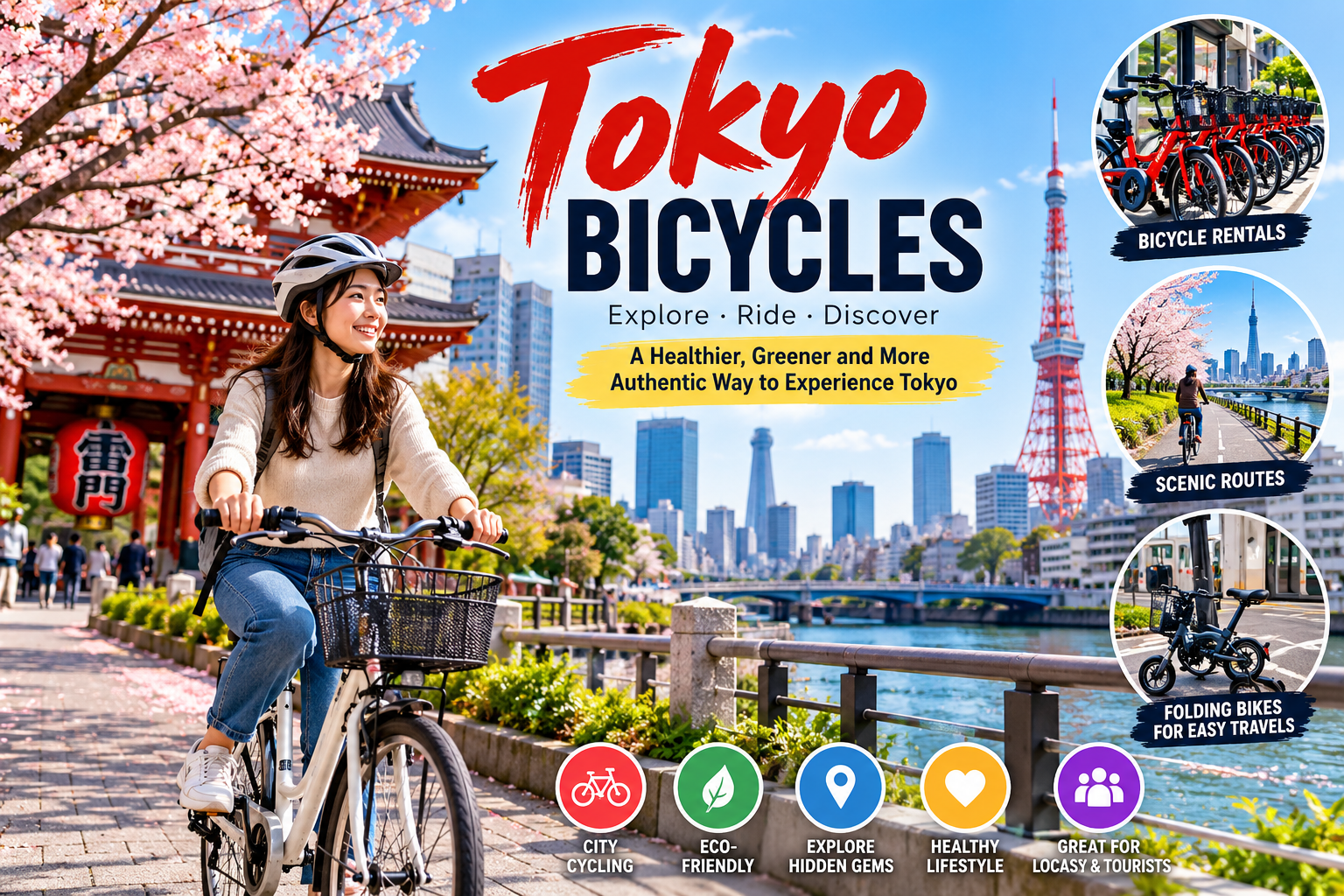
Tokyo Bicycles: The Ultimate 2026 Guide to Cycling, Bike Types, Rules, Routes & Best Brands
Tokyo is a city of trains, buses, taxis, and pedestrians—but there is another way to experience it that can make familiar streets feel completely different. Tokyo bicycles offer an efficient, flexible, and highly personal way to explore neighborhoods, riversides, shopping streets, parks, and quieter residential areas. Whether you are a tourist looking for a rental, a resident commuting to work, a student traveling across town, or a cycling enthusiast planning a longer ride, choosing the right bicycle and understanding Tokyo’s cycling rules can make the experience significantly easier and safer Tokyo Onsens
Why Tokyo Bicycles Are Becoming an Important Part of City Life
Tokyo can look overwhelming on a map.
The city stretches across an enormous metropolitan area, and two destinations that appear close together may be separated by railway lines, major roads, rivers, commercial districts, or residential neighborhoods.
The train network solves much of Tokyo’s transportation challenge, but bicycles provide something trains cannot: door-to-door flexibility.
A bicycle can take you from a station to a neighborhood café, from a shopping street to a riverside path, or from a residential district to a park without requiring another transfer.
That flexibility is one reason bicycles fit Tokyo particularly well.
Tokyo is also a city of short-distance discoveries. A train may take you rapidly from Shibuya to another major station, but cycling allows you to notice smaller streets, traditional houses, local bakeries, independent shops, temples, parks, canals, and neighborhood businesses along the way.
Official Tokyo tourism information specifically highlights waterfront cycling, including routes around the Sumida River, Tokyo Bay, and the Edogawa area.
What Makes Cycling in Tokyo Different
Cycling in Tokyo is not exactly the same as cycling in a suburban environment.
You may encounter:
- Busy intersections
- Narrow streets
- Pedestrians
- Parked bicycles
- Delivery vehicles
- Taxis
- Buses
- Railway crossings
- Traffic signals
- One-way roads
- Shared urban spaces
- Waterfront paths
- Residential streets
- Steep or gently rising roads depending on the neighborhood
This means the ideal Tokyo bicycle is not necessarily the fastest bicycle.
For many riders, control, visibility, comfort, practicality, braking, storage, and maneuverability are more important than maximum speed.
That is one of the most important principles to remember when choosing a bicycle for Tokyo.
Understanding the Tokyo Bicycle Culture
Bicycles are not simply recreational equipment in Tokyo.
For many people, a bicycle can function as a practical everyday vehicle.
A person might cycle:
- From home to the station
- From the station to work
- To a supermarket
- To school
- To a local restaurant
- To a childcare facility
- To a neighborhood shopping area
- To a park
- Along a river
- Between nearby railway stations
This creates several different bicycle cultures within the same city.
One rider may need a practical basket-equipped city bicycle.
Another may want an electric-assist bicycle for hills and longer journeys.
A tourist may prefer a lightweight rental.
A cycling enthusiast may choose a road bike.
A commuter living in a small apartment may prioritize a folding bicycle.
Understanding the rider is therefore more important than simply asking, “What is the best Tokyo bicycle?”
There is no single best bicycle for everyone.
Tokyo Bicycle Types Explained
City Bicycles
Traditional city bicycles are among the most practical choices for everyday urban transportation.
They generally emphasize:
- Upright riding position
- Easy handling
- Comfort
- Practical accessories
- Baskets
- Fenders
- Everyday tires
- Simple gearing
- Easy mounting and dismounting
They are particularly suitable for:
- Shopping
- Short commutes
- Neighborhood travel
- Students
- Casual riders
- Everyday errands
The upright riding position also gives riders a useful view of their surroundings.
Electric-Assist Bicycles
Electric-assist bicycles are especially interesting for Tokyo because they can reduce physical effort without turning the bicycle into a motorcycle.
Japan’s established electric-assist category includes bicycles where the motor assists the rider while the rider pedals. Yamaha, for example, describes its PAS system as providing motor assistance to the rider’s pedaling rather than operating independently.
Modern electric-assist bicycles can be useful for:
- Hills
- Longer commutes
- Carrying groceries
- Family transportation
- Older riders
- Riders who want to reduce physical effort
- Frequent stop-and-go journeys
Yamaha’s 2026 PAS range includes models aimed at shopping, commuting, school transportation, family use, compact riding, three-wheel applications, and business use.
Panasonic likewise offers electric-assist models including family-oriented bicycles with child-seat configurations.
Folding Bicycles
Folding bicycles solve a different Tokyo problem: space.
Tokyo homes and apartments can be compact, and some riders need a bicycle that can be stored more easily.
A folding bicycle can also be useful for riders who combine cycling with other forms of transportation, although riders should always check the rules of the particular train operator before attempting to take a bicycle onto a train.
Folding bicycles are particularly attractive to:
- Apartment residents
- Multimodal commuters
- Travelers
- Business users
- People with limited storage space
Road Bicycles
Road bikes are designed for efficiency and speed.
They are generally more appropriate for riders who already have cycling experience and want to travel longer distances.
A road bicycle can be excellent for longer routes along rivers and metropolitan outskirts, but its aggressive riding position and performance-oriented setup may not be necessary for ordinary sightseeing.
Hybrid Bicycles
Hybrid bicycles combine characteristics of road and city bicycles.
They can be a strong middle-ground choice for riders who want:
- Moderate speed
- Comfortable handling
- Longer-distance capability
- Flat handlebars
- Everyday practicality
For many recreational cyclists, a hybrid bicycle may make more sense than a pure road bike.
Mini-Velo and Small-Wheel Bicycles
Small-wheel bicycles can be extremely interesting in dense urban environments.
Their compact dimensions can make them easier to maneuver and store, while some models provide surprisingly capable urban performance.
They are particularly attractive to riders who value:
- Maneuverability
- Compact storage
- Urban handling
- Style
- Short and medium-distance riding
Choosing a Tokyo Bicycle Based on Your Purpose
For Tourists
Tourists should prioritize:
- Comfort
- Simple operation
- Correct bicycle size
- Reliable brakes
- Lights
- Easy navigation
- Secure parking
- Rental availability
A lightweight city or hybrid bicycle is often more practical for sightseeing than a performance road bike.
For Students
Students often need affordability, reliability, storage, and practicality.
A bicycle with:
- Basket
- Simple gears
- Good lights
- Strong lock
- Comfortable saddle
- Fenders
can be particularly useful.
For Office Commuters
Commuters should consider:
- Distance
- Hills
- Weather
- Clothing
- Storage
- Shower availability
- Parking
- Theft protection
- Battery charging if using an e-bike
An electric-assist bicycle may be particularly useful when the commute involves hills or frequent stops.
For Families
Family cycling requires a different approach.
The bicycle needs to prioritize stability, braking, visibility, child-seat compatibility, and overall load capacity.
Panasonic and Yamaha both maintain family-focused electric-assist models designed around child transportation
For Older Riders
Comfort and confidence should generally take priority over speed.
Important characteristics include:
- Easy mounting
- Stable geometry
- Comfortable riding position
- Strong braking
- Good lighting
- Appropriate frame height
- Electric assistance where useful
A smaller-wheel bicycle can sometimes be easier to handle, but individual fit matters more than wheel size alone.
Tokyo Bicycle Routes and Areas Worth Exploring
Sumida River Cycling
The Sumida River provides an opportunity to experience Tokyo from a different perspective.
Instead of moving through dense traffic continuously, riders can incorporate riverside areas into their journey.
This type of ride can be particularly enjoyable for visitors who want a slower experience.
Tokyo Bay Waterfront Cycling
Tokyo Bay offers a very different landscape.
Water, open spaces, modern architecture, bridges, parks, and large-scale infrastructure create a contrast with older neighborhoods.
GO TOKYO specifically recommends cycling around Tokyo’s waterfront and highlights locations such as Wakasu Seaside Park
Edogawa Cycling
The Edogawa area is particularly interesting for cyclists looking for longer, more open riding.
The official Tokyo tourism guide describes the wider Edogawa cycling course as approximately 60 km, while also pointing out shorter Tokyo-area options around Mizumoto Park and Shibamata.
This makes the area suitable for both recreational cyclists and riders who do not want to commit to a full long-distance route.
Shibamata
Shibamata provides a useful example of how bicycles can connect transportation and tourism.
Rather than simply traveling to a major attraction and leaving, cycling lets you experience surrounding residential streets and local scenery.
Kiyosumi-Shirakawa
Kiyosumi-Shirakawa is particularly attractive for slower urban exploration.
It combines:
- Cafés
- Warehouses
- Waterways
- Residential streets
- Contemporary businesses
- Traditional Tokyo atmosphere
Tokyobike currently operates rental services in Kiyosumi-Shirakawa and several other Tokyo neighborhoods.
Yanaka
Yanaka provides another type of cycling experience.
Its atmosphere is different from Tokyo’s major commercial districts, making it appealing for riders who want to see older neighborhood character.
However, riders should remember that quiet streets can still contain pedestrians and narrow sections.
Nakameguro
Cycling around Nakameguro can be attractive for food, cafés, architecture, and neighborhood exploration.
It is better approached as a relaxed urban ride rather than a speed-focused cycling route.
Tokyo Bicycle Rules You Should Know
This is one of the most important sections of the entire guide.
Tokyo bicycles are legally treated as vehicles under Japanese traffic law.
The Metropolitan Police Department states that bicycles are classified as light vehicles and that, where a sidewalk and roadway are separated, riding on the roadway is generally the rule. Cyclists should travel on the left side.
Ride on the Left
Japan drives on the left, and bicycles follow the relevant roadway traffic rules.
When riding on the road, cyclists should keep to the left.
This is particularly important for visitors coming from countries where right-side cycling or driving is normal.
Sidewalk Riding Is an Exception
Cyclists should not automatically assume that every sidewalk is a bicycle path.
Certain conditions allow standard bicycles to use sidewalks, including locations with appropriate signs or markings, but pedestrian priority remains essential.
If you are permitted to ride on a sidewalk, you should behave like a guest in pedestrian space.
Slow down.
Give pedestrians priority.
Be prepared to stop.
Stop at Signals
Cyclists must obey traffic signals.
Do not assume that an empty intersection means you can proceed.
Tokyo’s dense urban environment makes predictable behavior especially important.
Use Lights at Night
The National Police Agency specifically instructs bicycle riders to use lights at night.
This is not simply about helping the cyclist see.
A light also helps drivers, pedestrians, and other cyclists recognize that a bicycle is approaching.
Do Not Cycle Under the Influence
Cycling under the influence of alcohol is prohibited.
This is an important rule for tourists because the relaxed atmosphere of an evening in Tokyo does not change traffic law.
Helmet Use
Since April 1, 2023, helmet use for all bicycle riders has been an effort obligation in Japan. The National Police Agency also recommends helmet use for all bicycle users.
The NPA reports that, for the five-year period from 2021 through 2025, among bicycle accident fatalities and serious injuries involving primarily head injuries, the proportion involving riders who were not wearing helmets was about 1.7 times that of those wearing helmets.
The 2026 Blue-Ticket System
One of the biggest changes affecting Tokyo bicycles occurred in 2026.
From April 1, 2026, Japan’s traffic infraction notification system, commonly called the “blue ticket” system, began applying to bicycles for certain violations.
This does not mean that every minor bicycle mistake automatically results in a fine.
The National Police Agency explains that guidance and warnings remain the basic response in many situations, while dangerous or malicious violations can lead to enforcement
For anyone cycling in Tokyo in 2026, the practical message is simple:
Know the rules before you ride.
Why the 2026 Rule Changes Matter
Tokyo’s bicycle environment has become more structured.
The Tokyo government states that bicycle-related accidents account for roughly 46% of all traffic accidents in Tokyo in recent years and notes that more than 70% of bicycle-related accidents involved some violation on the bicycle side.
These figures help explain why the city is emphasizing education and safer riding.
The change is not merely about penalties.
It is also about establishing a predictable relationship between:
- Cyclists
- Pedestrians
- Cars
- Buses
- Motorcycles
- Delivery vehicles
Predictability is one of the foundations of safe urban mobility.
Electric Bicycles in Tokyo
Electric bicycles deserve special attention because “e-bike” can mean different things in different countries.
A Japanese electric-assist bicycle is generally designed to assist pedaling rather than replace it.
Yamaha states that PAS assistance operates when the rider pedals and that assistance stops at speeds above the relevant 24 km/h threshold for its PAS system.
That distinction matters.
Electric Assist vs Electric Motorcycle
A pedal-assist bicycle is not automatically equivalent to a motorized bicycle or moped.
Japan has separate legal classifications for different electrically powered vehicles.
Tokyo authorities specifically warn that pedal-equipped electric motorcycles can fall into motor-vehicle categories even when the rider uses the pedals without the motor, depending on the vehicle’s characteristics.
Therefore, buyers should not judge legality purely by appearance.
Why E-Bikes Work Well for Some Tokyo Riders
Electric assistance can be particularly useful when:
- Carrying groceries
- Transporting children
- Riding longer distances
- Climbing hills
- Riding in hot weather
- Returning home after a long day
- Reducing physical strain
The Battery Question
Battery capacity should not be the only purchasing factor.
Consider:
- Claimed range
- Your average trip length
- Temperature
- Rider weight
- Cargo weight
- Terrain
- Assist mode
- Battery age
- Replacement cost
- Charging location
A rider who travels 5 km per day has very different requirements from someone traveling 25 km daily.
Bicycle Parking in Tokyo
One of the most overlooked parts of cycling is parking.
Finding a bicycle parking location is not the same thing as finding a place where a bicycle can physically fit.
Tokyo has designated bicycle parking areas around many railway stations and commercial districts.
The important lesson is:
Do not assume you can simply leave your bicycle outside your destination.
Unauthorized parking can cause inconvenience and may lead to removal.
For visitors, this means bicycle parking should be considered before starting the ride.
For residents, it means choosing a home and commute route with realistic parking arrangements.
Bicycle Theft and Security
A bicycle that is easy to ride can also be easy to steal if it is poorly secured.
Security becomes particularly important for:
- Expensive road bikes
- Folding bicycles
- E-bikes
- Lightweight hybrids
- Imported bicycles
- Custom bicycles
Use a Good Lock
A strong lock is an important first layer of protection.
For expensive bicycles, some riders use more than one locking method.
Record Your Bicycle Information
Keep records of:
- Frame number
- Model
- Brand
- Purchase information
- Photographs
- Accessories
This information can be useful if the bicycle is lost or stolen.
Don’t Leave Valuable Accessories Unattended
Lights, bags, computers, pumps, and other removable equipment should be secured or removed when appropriate.
Tokyo Bicycle Registration
Japan has a bicycle registration system, and owners should understand the applicable registration requirements when purchasing or owning a bicycle.
For travelers renting bicycles, the rental provider normally handles the ownership-related side of the bicycle.
For residents purchasing bicycles, registration should be part of the ownership process.
How to Choose the Correct Bicycle Size
A common mistake is buying a bicycle based only on appearance.
A beautiful bicycle that does not fit correctly can become uncomfortable quickly.
Important factors include:
- Rider height
- Inseam
- Reach
- Frame size
- Saddle height
- Handlebar position
- Riding style
- Flexibility
- Intended distance
Why Fit Matters in Tokyo
Urban riding involves frequent:
- Stops
- Starts
- Turns
- Intersections
- Mounting
- Dismounting
- Low-speed maneuvers
Therefore, being able to comfortably control the bicycle at low speed is extremely important.
Tokyo Bicycle Tires
Tire choice influences comfort, speed, puncture resistance, and handling.
Narrow Performance Tires
These may suit experienced cyclists who prioritize speed and efficiency.
Wider Urban Tires
These can provide greater comfort over uneven pavement and urban surfaces.
Puncture-Resistant Tires
For commuters, puncture protection can be more valuable than a small reduction in rolling resistance.
A commuter who arrives late because of a flat tire will probably appreciate reliability more than theoretical speed.
Bicycle Gears for Tokyo
A bicycle does not necessarily need a huge number of gears.
For ordinary city riding, a moderate gearing range can be sufficient.
More important questions include:
- Are the gears easy to shift?
- Are they maintained?
- Does the rider understand how to use them?
- Is there enough low gearing for hills?
- Is the system reliable?
For an electric-assist bicycle, motor assistance changes the importance of gearing because the rider can rely on the motor for some additional support.
Brakes Matter More Than Speed
Urban cyclists frequently encounter sudden changes.
A pedestrian may step toward a crossing.
A car may turn.
A bus may stop.
Another bicycle may emerge from a side street.
Good brakes and proper brake maintenance therefore deserve significant attention.
For a bicycle used daily in Tokyo, braking performance should be considered a core safety feature rather than a technical detail.
Bicycle Maintenance in Tokyo
Regular maintenance can prevent small problems from becoming expensive repairs.
Check Tire Pressure
Underinflated tires can:
- Increase rolling resistance
- Reduce handling quality
- Increase puncture risk
- Make riding feel unnecessarily difficult
Inspect Brakes
Check for:
- Weak braking
- Unusual noises
- Worn pads
- Cable problems
- Disc rotor issues where applicable
Lubricate the Chain
A dry or dirty chain can create unnecessary wear.
Check Lights
Night riding requires functioning lights.
Inspect Bolts and Accessories
Baskets, racks, mudguards, and child seats should be checked periodically.
Tokyo Bicycle Riding in Rain
Rain changes cycling conditions considerably.
Wet roads can reduce grip and braking performance.
Visibility can also deteriorate.
Rain can create:
- Slippery surfaces
- Reduced visibility
- Puddles
- More traffic congestion
- Increased stopping distance
If you ride in wet conditions, reduce speed and increase following distance.
Rain Gear
For regular commuters, proper rain gear can be more useful than an inexpensive disposable solution.
Consider:
- Waterproof jacket
- Waterproof trousers
- Shoe protection
- Waterproof bag cover
- Clear visibility
- Breathable materials
Cycling During Tokyo’s Hot Weather
Tokyo summers can be hot and humid.
Cyclists should plan around:
- Hydration
- Sun exposure
- Clothing
- Rest
- Battery temperature
- Reduced physical performance
Electric-assist bicycles can reduce physical strain, but they do not eliminate the effects of heat.
A rider can still become dehydrated while using an e-bike.
Tokyo Bicycles for Different Demographics
Tokyo Bicycles for Families
Family riders should prioritize stability and practical carrying capacity.
Useful features may include:
- Child seats
- Strong frame
- Stable wheels
- Powerful brakes
- Electric assistance
- Large rear rack
- Front basket
- Protective accessories
Tokyo Bicycles for Students
Students often benefit from:
- Affordable pricing
- Low maintenance
- Strong lock
- Basket
- Good lights
- Comfortable geometry
Tokyo Bicycles for Office Workers
Commuters may benefit from:
- Hybrid bikes
- Electric-assist bicycles
- Folding bicycles
- Comfortable city bikes
The best option depends on commute length and whether the rider must combine cycling with trains.
Tokyo Bicycles for Seniors
The priority should generally be stability, confidence, easy handling, and suitable frame geometry.
Electric assistance can reduce effort, but the bicycle must still feel predictable and controllable.
Tokyo Bicycles for Tourists
Tourists should generally avoid unnecessarily complicated equipment.
A reliable rental bicycle with:
- Comfortable seat
- Proper brakes
- Lights
- Correct size
- Simple gears
may be more enjoyable than an expensive performance bicycle.
Tokyo Bicycles for Cycling Enthusiasts
Enthusiasts can look toward:
- Road bikes
- Performance hybrids
- Gravel bikes
- Lightweight e-bikes
- Folding performance bikes
Longer riverside and metropolitan routes can provide a much more challenging cycling experience.
Ten Bicycle Brands to Consider for Tokyo
The following brands represent different approaches to urban cycling. They should not be treated as a universal ranking because the best choice depends on rider needs, availability, budget, servicing, and intended use.
| Brand | Main Strength | Tokyo Use Case | Typical Bicycle Types | Electric Options | Best For |
|---|---|---|---|---|---|
| Panasonic | Practical Japanese e-bikes | Family and commuting | City, family, e-bike | Yes | Families and commuters |
| Yamaha | Mature electric-assist range | Daily transportation | City, family, e-bike | Yes | Everyday riders |
| Bridgestone | Japanese urban practicality | Commuting and daily use | City, utility, e-bike | Yes | Practical riders |
| TOKYOBIKE | Urban lifestyle design | Neighborhood exploration | City, small-wheel, rental | Selected options | Tourists and lifestyle riders |
| Giant | Broad international range | Fitness and commuting | Hybrid, road, city, e-bike | Yes | Versatile cyclists |
| Trek | Broad performance range | Commuting and recreation | Hybrid, road, e-bike | Yes | Performance-minded commuters |
| Specialized | Premium urban and e-bike focus | Fitness and commuting | City, hybrid, e-bike | Yes | Premium riders |
| Brompton | Folding design | Small apartments and multimodal travel | Folding | Yes | Train-plus-bike commuters |
| Cannondale | Performance and urban versatility | Fitness and commuting | Hybrid, road, e-bike | Yes | Active urban cyclists |
| Merida | Performance-oriented variety | Fitness and longer rides | Hybrid, road, e-bike | Yes | Recreational cyclists |
Panasonic Tokyo bicycles
Panasonic is particularly relevant to Tokyo because of its extensive electric-assist bicycle presence.
Its Japanese lineup includes family-oriented models, including child-seat configurations, and the company also provides support services around electric-assist bicycle
For families, the practical ecosystem can be as important as the bicycle itself.
Yamaha Tokyo bicycles
Yamaha’s PAS range is one of the major Japanese electric-assist bicycle families.
The current lineup includes everyday-use models, family bicycles, school and commuting models, compact bicycles, three-wheel bicycles, business-oriented bicycles, and sportier YPJ models.
Yamaha is therefore not limited to one type of rider.
Bridgestone Tokyo bicycles
Bridgestone has a long-standing presence in Japanese bicycles and is associated with practical urban transportation.
Its relevance to Tokyo comes from the importance of everyday bicycles rather than only sports cycling.
TOKYOBIKE Tokyo bicycles
TOKYOBIKE is particularly interesting because its identity is directly connected with urban exploration.
Its rental service currently operates in multiple Tokyo neighborhoods, including Kiyosumi-Shirakawa, Yanaka, Nakameguro, and other locations.
The brand’s concept emphasizes experiencing the city through cycling rather than simply moving rapidly from one destination to another.
Giant Tokyo bicycles
Giant offers a broad range of bicycles, making it relevant to riders who want a hybrid, road, or e-bike platform.
Its appeal is particularly strong for riders who want a bicycle that can function both inside and outside central Tokyo.
Trek Tokyo bicycles
Trek covers a wide range of cycling categories.
For Tokyo users, its hybrid and e-bike categories can be more relevant to everyday urban riding than specialized race-oriented equipment.
Specialized Tokyo bicycles
Specialized’s Japanese city-bike range currently includes conventional city bicycles and multiple e-bike families, including Turbo Como and Turbo Vado lines.
This makes the brand relevant to riders who want a more performance-focused urban bicycle.
Brompton Tokyo bicycles
Brompton is particularly well suited to the space constraints of dense cities.
Its folding design is valuable for riders who need to store their bicycle at home or combine cycling with public transportation.
Cannondale Tokyo bicycles
Cannondale offers road, hybrid, urban, and electric models.
It can be attractive to riders who want a sportier bicycle but still expect practical urban use.
Merida Tokyo bicycles
Merida has a strong performance heritage and offers bicycles suited to recreational and fitness cycling.
For Tokyo riders, its hybrid and performance categories may be particularly relevant for longer rides.
Tokyo Bicycle Brand Comparison by Rider Type
| Rider Type | Suitable Brand Categories | What to Prioritize |
|---|---|---|
| Tourist | TOKYOBIKE, city-bike rental brands | Comfort and simplicity |
| Student | Japanese city-bike brands | Price and reliability |
| Family | Panasonic, Yamaha, Bridgestone | Stability and child carrying |
| Office commuter | Yamaha, Panasonic, Giant, Trek | Efficiency and comfort |
| Fitness cyclist | Giant, Trek, Specialized, Cannondale, Merida | Performance |
| Apartment resident | Brompton, compact city bikes | Storage |
| Senior rider | Panasonic, Yamaha, Bridgestone | Stability and assistance |
| Long-distance rider | Giant, Trek, Specialized, Cannondale, Merida | Fit and efficiency |
| Lifestyle cyclist | TOKYOBIKE | Design and urban experience |
| E-bike commuter | Yamaha, Panasonic, Specialized | Motor system and battery |
What Most Articles About Tokyo Bicycles Get Wrong
Many bicycle guides focus almost entirely on bicycle specifications.
But Tokyo cycling is not simply a product-selection problem.
It is an urban systems problem.
The bicycle interacts with:
- Traffic
- Pedestrians
- Railway stations
- Parking
- Weather
- Housing
- Shopping
- Work
- Tourism
- Regulations
- Infrastructure
A technically excellent bicycle can still be the wrong choice if you have nowhere secure to store it.
A lightweight road bike can be fast but inconvenient if your commute involves frequent low-speed riding.
A powerful electric-assist bicycle can be comfortable but unnecessarily expensive for someone riding only two kilometers on flat roads.
The best bicycle is the one that fits the complete transportation system around the rider.
Common Tokyo Bicycle Mistakes
Mistake 1: Choosing Based Only on Appearance
A bicycle can look fantastic and still be uncomfortable.
Solution: Test the fit before buying.
Mistake 2: Ignoring Parking Tokyo bicycles
People sometimes buy a bicycle first and think about parking later.
Solution: Identify where you will legally and securely park it before purchasing.
Mistake 3: Assuming Sidewalks Are Bicycle Lanes
This is particularly common among visitors.
Solution: Learn the rules and understand when sidewalk cycling is permitted.
Mistake 4: Riding Too Fast in Crowded Areas Tokyo bicycles
Urban cycling is not a race.
Solution: Adjust speed to the environment.
Mistake 5: Ignoring Night Visibility Tokyo bicycles
A cyclist may see the road clearly while remaining difficult for others to see.
Solution: Use proper lights and reflective elements.
Mistake 6: Buying Too Much Bicycle
Some riders buy equipment designed for distances they rarely travel.
Solution: Match the bicycle to actual usage.
Mistake 7: Ignoring Battery Replacement Costs Tokyo bicycles
E-bikes are not simply bicycles with batteries.
The battery is a major component of the system.
Solution: Consider long-term ownership costs before purchasing.
Mistake 8: Using a Phone While Riding Tokyo bicycles
Distracted riding reduces awareness.
The National Police Agency specifically includes cellphone use while riding among violations that can attract enforcement under the newer system.
Solution: Stop safely before interacting with your phone.
Pros of Cycling in Tokyo
Flexibility Tokyo bicycles
A bicycle can take you directly to your destination.
Neighborhood Exploration Tokyo bicycles
Cycling exposes you to streets and locations you might never see from a train.
Potential Time Savings Tokyo bicycles
For short and medium journeys, a bicycle can sometimes avoid transfers and station walking.
Exercise Tokyo bicycles
Cycling naturally incorporates physical activity into transportation.
Lower Transportation Cost Tokyo bicycles
Once you own a bicycle, many short journeys have relatively low marginal transportation costs.
Environmental Benefits Tokyo bicycles
Replacing some motorized trips with cycling can reduce transportation-related emissions.
Cons of Cycling in Tokyo
Weather Tokyo bicycles
Heat, humidity, rain, and seasonal conditions affect cycling.
Traffic Tokyo bicycles
Some roads can be intimidating for inexperienced cyclists.
Parking Tokyo bicycles
Finding appropriate bicycle parking can require planning.
Theft Tokyo bicycles
Expensive bicycles need appropriate security.
Maintenance Tokyo bicycles
Bicycles require regular attention.
Traffic Rules Tokyo bicycles
Visitors unfamiliar with Japanese traffic rules need to learn them before riding.
Limited Suitability for Very Long Cross-City Trips
For some journeys, trains remain more practical.
How to Plan a Tokyo Bicycle Day
A successful bicycle day starts before you leave.
Step 1: Choose Your Area Tokyo bicycles
Don’t try to cover all of Tokyo in one ride.
Pick a theme.
For example:
- Riverside Tokyo
- Old Tokyo
- Tokyo cafés
- Parks
- Waterfront
- Architecture
- Neighborhood shopping
- Traditional districts
Step 2: Select the Right Bicycle
Match the bicycle to the route.
Step 3: Check Weather Tokyo bicycles
Tokyo weather can change the experience dramatically.
Step 4: Identify Parking Tokyo bicycles
Know where you can leave the bicycle.
Step 5: Carry Essentials Tokyo bicycles
Useful items may include:
- Phone
- Identification
- Water
- Small repair kit
- Lock
- Portable battery
- Rain protection
- Helmet
- Cash or payment method
Step 6: Leave Extra Time Tokyo bicycles
Don’t plan a bicycle itinerary with train-like precision.
One of the advantages of cycling is being able to stop.
A Sample Tokyo Bicycle Itinerary
A relaxed route could begin in a neighborhood such as Kiyosumi-Shirakawa.
Start with breakfast or coffee.
Then cycle through nearby streets and waterways.
Continue toward the Sumida River.
Stop for photographs.
Explore a quieter neighborhood.
Take a break for lunch.
Continue toward a park or riverside area.
Finish the day near a major railway station or another neighborhood with convenient transportation.
This kind of itinerary demonstrates why bicycles can be so useful for Tokyo tourism.
The goal is not to visit the maximum number of attractions.
The goal is to experience the city between the attractions.
Tokyo Bicycle Tourism vs Train Tourism
Trains are extremely efficient for moving between major areas.
Bicycles are better at exploring what lies between those major areas.
A train journey might show you:
Station → station
A bicycle journey can show you:
Station → side street → temple → café → river → park → shopping street → station
That difference is why bicycle tourism can feel more personal.
Bicycle Rentals in Tokyo
Visitors who do not want to purchase a bicycle can rent one.
Tokyobike currently offers one-day bicycle rentals and operates rental locations in several Tokyo neighborhoods.
Rental bicycles can be particularly useful for:
- First-time cyclists
- Tourists
- Short trips
- Trial rides
- Travelers who do not want to transport a bicycle internationally
What to Check Before Renting
Ask or confirm:
- Rental duration
- Deposit requirements
- Identification requirements
- Helmet availability
- Lock availability
- Lights
- Insurance arrangements
- Return location
- Late-return rules
- Weather policy
- Bicycle condition
Tokyo Bicycles and Accessibility
Cycling can increase mobility for people who find some forms of transportation physically demanding.
Electric-assist systems can reduce the effort needed for hills and longer distances.
However, accessibility is personal.
A bicycle should be evaluated for:
- Frame height
- Balance
- Reach
- Weight
- Starting and stopping
- Brake operation
- Step-through design
- Motor assistance
- Storage
A test ride is particularly valuable.
Tokyo Bicycle Safety for Beginners
Beginners should spend their first rides practicing:
- Starting smoothly
- Stopping
- Turning
- Looking behind safely
- Signaling
- Changing gears
- Riding at low speed
- Navigating intersections
Don’t begin with a complicated 50-kilometer ride.
Start locally.
Learn the bicycle.
Learn the streets.
Then gradually expand.
The Psychology of Urban Cycling Tokyo bicycles
One overlooked advantage of bicycles is that they change the rider’s perception of distance.
Walking can make two neighborhoods feel far apart.
Driving can make them feel like places seen through glass.
Public transportation can make the trip feel like a sequence of stations.
Cycling creates a continuous connection between places.
You see the transition.
You notice when the architecture changes.
You notice when commercial streets become residential.
You notice a small shrine behind a wall.
You notice a local bakery opening for the morning.
That is one reason cycling can be more than transportation.
It can become a way of understanding Tokyo.
Tokyo Bicycles and the Future of Urban Mobility
Tokyo’s bicycle future is likely to involve a combination of traditional bicycles, electric-assist models, shared bicycles, improved infrastructure, better safety education, and increasingly sophisticated mobility planning.
The 2026 blue-ticket system is one indication that authorities are placing greater emphasis on cyclist behavior and traffic safety.
More Electric Assistance
Electric-assist bicycles are likely to remain important because they address one of the biggest barriers to cycling: physical effort.
More Family-Oriented Bicycles
Japanese manufacturers already offer extensive child-transport and family models, indicating the importance of bicycles in everyday household mobility.
Smarter Urban Bicycles
Future bicycles are likely to incorporate more:
- Integrated lights
- Electronic systems
- Anti-theft technology
- Navigation
- Battery management
- Connected features
More Multimodal Transportation Tokyo bicycles
The combination of:
Bike + train + bike
is particularly attractive in a metropolitan environment.
Folding bicycles can play an important role in this area.
Better Safety Awareness Tokyo bicycles
The combination of updated regulations, education, infrastructure, and technology could make cycling more predictable for everyone sharing Tokyo’s streets.
What Tokyo Bicycle Buyers Should Consider in 2026
Before purchasing, ask yourself these questions:
How Far Will I Ride?
Under 5 km daily?
A city bike may be sufficient.
10–20 km?
Consider a hybrid or e-bike.
Long recreational distances?
Consider a performance-oriented bicycle.
Where Will I Store It?
This can eliminate certain options immediately.
Do I Need Electric Assistance?
Don’t buy an e-bike simply because it is fashionable.
Buy one if the assistance solves a genuine problem.
What Is My Maintenance Budget?
A bicycle is not a one-time purchase.
Budget for:
- Tires
- Tubes
- Brake pads
- Chain
- Service
- Battery replacement where applicable
- Locks
- Lights
How Important Is Portability?
If you live in a small apartment or combine cycling with trains, portability may be more valuable than large wheels.
The Best Tokyo Bicycle for Different Budgets
Entry-Level Budget Tokyo bicycles
Look for:
- Simple city bicycle
- Reliable brakes
- Lights
- Lock
- Comfortable saddle
- Basic gears
Avoid paying for features you do not need.
Mid-Range Budget Tokyo bicycles
Consider:
- Better hybrid
- Better city bicycle
- Entry-level e-bike
- Folding bicycle
- Better components
Premium Budget Tokyo bicycles
Consider:
- Premium e-bike
- High-end hybrid
- Performance road bike
- Premium folding bicycle
- Lightweight urban bicycle
At this level, fit and after-sales support become increasingly important.
Tokyo Bicycle Accessories That Actually Matter
Helmet Tokyo bicycles
One of the most important safety purchases.
Lock Tokyo bicycles
Essential for urban ownership.
Lights Tokyo bicycles
Important for visibility and required for night riding.
Bell Tokyo bicyclesTokyo bicycles
Useful where appropriate and required by applicable bicycle equipment rules.
Rear Rack Tokyo bicycles
Useful for commuters and shoppers.
Basket Tokyo bicycles
Excellent for everyday errands.
Fenders Tokyo bicycles
Extremely useful in rainy conditions.
Repair Kit Tokyo bicycles
Useful for longer rides.
Pump Tokyo bicycles
A practical addition for regular cyclists.
Tokyo Bicycle Packing List for Tourists
A simple cycling day might require:
- Comfortable clothing
- Helmet
- Water
- Phone
- Portable charger
- Small wallet
- Lock
- Rain layer
- Small backpack
- Route information
Avoid carrying unnecessary heavy equipment.
How to Make Tokyo Cycling More Enjoyable
The best cycling experience is rarely the one where you rush.
Instead:
- Start early
- Avoid unnecessary traffic
- Explore quieter neighborhoods
- Stop frequently
- Drink water
- Take photographs
- Respect pedestrians
- Park properly
- Follow traffic rules
- Keep your bicycle maintained
The city becomes much more interesting when you stop treating the bicycle as merely a transportation device.
FAQs
Are bicycles good for exploring Tokyo?
Yes. Bicycles can be especially useful for exploring neighborhoods, riversides, parks, waterfront areas, and locations that are inconvenient to reach directly by train. Tokyo’s official tourism guide specifically highlights waterfront and Edogawa cycling opportunities.
Can tourists ride bicycles in Tokyo?
Yes, tourists can cycle in Tokyo, but they should understand Japanese traffic rules, use appropriate equipment, and park bicycles in designated or permitted locations.
Do bicycles drive on the left in Tokyo?
Yes. Where bicycles are riding on the roadway, they generally travel on the left side.
Can bicycles ride on sidewalks in Tokyo?
Sidewalk riding is an exception rather than the general rule. Certain sidewalks permit standard bicycle traffic, but cyclists must give priority to pedestrians.
Is a bicycle helmet required in Tokyo?
Helmet use for bicycle riders has been an effort obligation throughout Japan since April 1, 2023. The National Police Agency recommends helmet use for all bicycle users.
What changed for bicycles in Japan in 2026?
From April 1, 2026, the traffic violation notification system known as the blue-ticket system began applying to bicycles for certain violations.
Are electric bicycles allowed in Tokyo?
Japan permits qualifying electric-assist bicycles, but different electrically powered vehicles can fall under different legal classifications. Riders should confirm that the particular vehicle meets the applicable bicycle requirements.
Are electric bicycles useful in Tokyo?
They can be very useful for commuting, family transportation, shopping, hills, and longer rides because pedal assistance reduces physical effort.
What is the best bicycle for Tokyo tourists?
A comfortable city, hybrid, or rental bicycle is generally practical for casual sightseeing. The right choice depends on distance, fitness, route, and riding experience.
What is the best bicycle for Tokyo commuting?
It depends on the commute. A city bicycle can work well for short journeys, while a hybrid or electric-assist bicycle may be more appropriate for longer or hillier routes.
Are folding bicycles useful in Tokyo?
Yes. Their compact design can be particularly useful for apartment storage and multimodal travel.
Is Tokyo suitable for road cycling?
Yes, particularly around rivers, waterfronts, and outer metropolitan areas. Road cycling is more suitable for experienced riders who understand urban traffic and route planning.
Where can you cycle near Tokyo rivers?
The Sumida River and Edogawa areas offer cycling opportunities, with the official Tokyo tourism guide highlighting both
Is cycling expensive in Tokyo?
It can be relatively affordable once you own a bicycle, but the total cost includes purchase, maintenance, parking, security, accessories, and potentially battery replacement for e-bikes.
Do Tokyo bicycles need lights at night?
Bicycles should use lights at night. The National Police Agency explicitly lists nighttime lighting as one of the basic bicycle safety rules
Can you drink alcohol and ride a bicycle in Tokyo?
No. Bicycle riding under the influence of alcohol is prohibited.
What should beginners practice before cycling around Tokyo?
Beginners should practice braking, starting, turning, signaling, gear changes, low-speed control, and safe intersection behavior before attempting longer urban rides.
Are Tokyo bicycles suitable for families?
Yes. Japanese manufacturers offer family-oriented bicycles, including electric-assist models designed around child transportation.
Which is more useful in Tokyo, a bicycle or train?
They solve different problems. Trains are highly efficient for longer cross-city travel, while bicycles are particularly useful for short and medium journeys and neighborhood exploration.
What should I check before renting a bicycle?
Check bicycle size, brakes, tires, lights, lock, helmet availability, rental duration, return requirements, parking rules, and insurance arrangements.
Conclusion
Tokyo bicycles offer one of the most flexible and rewarding ways to experience Japan’s capital. From practical city bikes and electric-assist models to folding bikes, hybrids, and road bicycles, there is an option for almost every type of rider. The right choice depends on your purpose, distance, comfort, budget, storage space, and cycling experience. For tourists, a comfortable rental bicycle can turn an ordinary sightseeing day into a neighborhood adventure. For commuters and families, electric-assist bicycles can make everyday journeys easier, while folding bicycles can solve storage and multimodal transportation challenges. Experienced cyclists can explore longer riverside and waterfront routes around Tokyo and its surrounding areas

One Comment