Tokyo Language: The Complete Guide to Japanese in Tokyo, Essential Phrases, Dialects, Culture & Communication
Have you ever arrived in Tokyo and wondered whether you need to learn an entirely different language just to order food, use the train, or ask for directions? The primary language spoken in Tokyo is Japanese, specifically Standard Japanese, which is widely understood throughout Japan and is the most useful form of Japanese for travelers, students, and international residents. Tokyo also has its own informal expressions, youth slang, professional vocabulary, and multicultural influences, so understanding the “Tokyo language” means learning not only Japanese words but also pronunciation, writing systems, politeness, context, and local communication habits. Tokyo is one of the world’s most international cities, but Japanese remains the foundation of everyday communication Tokyo Nature
What Is the Tokyo Language?
Japanese Is the Main Language of Tokyo
The primary language of Tokyo is Japanese.
The variety generally used in formal communication is based on Standard Japanese, commonly called hyōjungo in Japanese linguistic terminology.
Standard Japanese is based historically on the speech of the Tokyo region and is used widely in education, broadcasting, government, business, and national media.
This means that someone learning Standard Japanese is learning a variety that is highly practical for Tokyo.
Is Tokyo Japanese a Separate Language?
No.
Tokyo does not have a completely separate language from the rest of Japan.
A visitor may hear local expressions, slang, pronunciation differences, and conversational styles, but these are varieties and registers within Japanese rather than a separate “Tokyo language.”
This distinction is important for beginners.
You do not need to learn “Tokyo Japanese” as a separate language before visiting the city.
Learning Standard Japanese gives you a strong foundation.
Why People Sometimes Call It Tokyo Language
The phrase “Tokyo language” can refer to several different things:
- Japanese spoken in Tokyo
- Standard Japanese
- Tokyo slang
- Youth expressions
- Business Japanese
- Japanese used by international communities
- Japanese writing found around Tokyo
- Local pronunciation and conversational habits
Therefore, the exact meaning depends on context.
For travelers, “Tokyo language” usually means the Japanese language as it is used in everyday life in Tokyo.
The History Behind Tokyo Japanese
From Edo to Modern Tokyo
Tokyo was historically known as Edo.
During the Edo period, the city became one of Japan’s largest urban centers.
The speech associated with Edo developed its own characteristics, while regional dialects existed throughout Japan.
When Japan underwent major political and social transformation during the Meiji period, Tokyo became the national capital and an increasingly important center of government, education, media, and commerce.
The city’s linguistic influence grew alongside its political importance.
Tokyo and Standard Japanese
Modern Standard Japanese developed through complex historical processes rather than being simply an artificial language.
Tokyo speech became particularly influential because the capital concentrated national institutions.
Schools taught standardized forms.
Broadcast media promoted widely understood pronunciation.
Government and business adopted formal language conventions.
As a result, Tokyo became closely associated with the Japanese variety that many learners encounter in textbooks.
Japanese Writing in Tokyo
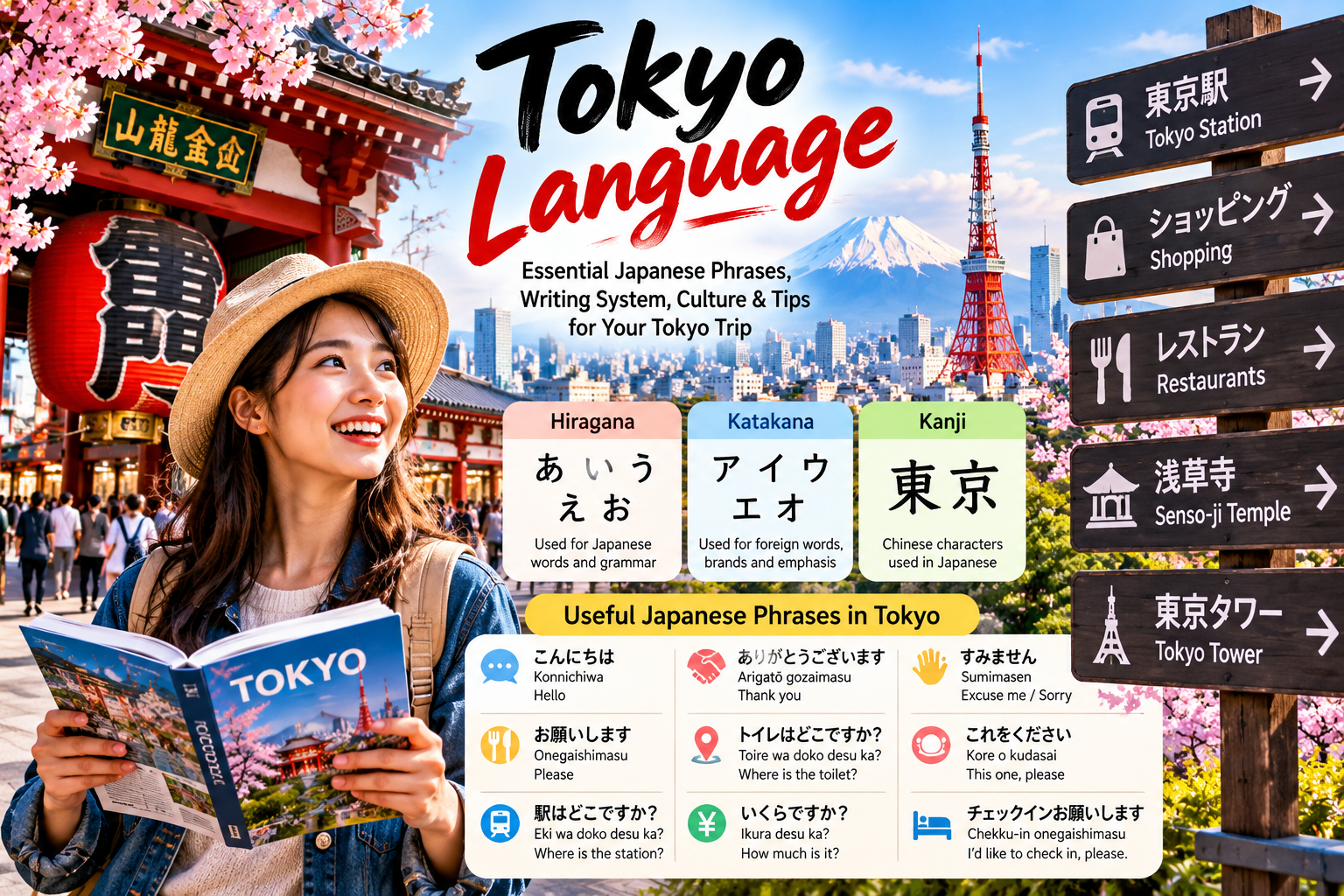
Hiragana
Hiragana is one of the three major writing systems used in Japanese.
It is commonly used for:
- Grammatical endings
- Function words
- Native Japanese words
- Children’s writing
- Words where kanji is difficult or unnecessary
Beginners should learn hiragana early because it provides the foundation for reading basic Japanese.
Katakana
Katakana is another Japanese syllabary.
It is frequently used for:
- Foreign loanwords
- Foreign names
- Brand names
- Onomatopoeia
- Technical terminology
- Emphasis
Tokyo visitors will encounter katakana constantly.
Words for hotels, cafés, technology, fashion, menus, and international products often contain katakana.
Kanji
Kanji are characters originally associated with Chinese writing and adapted into Japanese.
They are essential for advanced Japanese literacy.
Tokyo street signs, restaurant menus, train stations, newspapers, websites, government documents, and advertisements can contain large amounts of kanji.
A beginner may initially find kanji intimidating.
However, learning the most common characters gradually can dramatically improve navigation around Tokyo.
Romaji
Romaji means writing Japanese using the Latin alphabet.
Travelers frequently encounter romaji on:
- Railway signs
- Tourist maps
- Airport information
- Websites
- Product packaging
- Street signs
Romaji is useful for beginners, but relying on it indefinitely can slow Japanese reading development.
Japanese Pronunciation for Tokyo Visitors
Japanese Vowels
Japanese pronunciation is generally more regular than English spelling.
The basic vowel system contains five primary vowels.
Learners should practice vowel length carefully because a short and long vowel can distinguish words.
Japanese Rhythm
Japanese pronunciation is often described in terms of morae rather than English-style stressed syllables.
This can create difficulties for English speakers.
A learner may know the correct vocabulary but still be difficult to understand if the rhythm is heavily influenced by English.
Long Vowels
Long vowels matter.
Changing vowel length can change meaning.
This is particularly important when ordering food, reading names, or communicating unfamiliar words.
Double Consonants
Japanese sometimes uses a small っ in hiragana or katakana to indicate a doubled consonant.
The sound requires a brief pause before the consonant.
Learning this feature helps improve pronunciation accuracy.
Essential Tokyo Japanese Phrases for Travelers
Greetings
Some of the most useful Japanese expressions include:
Ohayō gozaimasu — Good morning.
Konnichiwa — Hello / good afternoon.
Konbanwa — Good evening.
Oyasumi nasai — Good night.
A traveler does not need dozens of greetings.
Learning a few correctly and using them naturally is much more valuable.
Thanking People
Arigatō gozaimasu is one of the most useful expressions a visitor can learn.
It is a polite way of saying thank you.
You will have many opportunities to use it:
- Restaurants
- Hotels
- Shops
- Train stations
- Taxis
- Tourist attractions
Saying Sorry
Sumimasen is extremely useful.
Depending on context, it can communicate:
- Excuse me
- Sorry
- I apologize
- May I get your attention?
It is particularly useful when approaching someone for assistance.
Asking for Help
A simple phrase followed by a question can be enough.
For example:
Sumimasen. Eki wa doko desu ka?
This means:
“Excuse me. Where is the station?”
The exact pronunciation and grammar can improve with study, but even beginner-level Japanese can help establish communication.
Asking Whether Someone Speaks English
A useful phrase is:
Eigo o hanashimasu ka?
This asks whether someone speaks English.
However, travelers should not assume that every Japanese person should be able to communicate in English.
A more respectful approach is to ask politely and be prepared to use translation tools or gestures.
Useful Japanese for Restaurants in Tokyo
Ordering Food
One of the most useful expressions is:
Kore o kudasai.
This means approximately:
“I’ll have this, please.”
Pointing to a menu item while saying the phrase can make ordering easier.
Asking for the Bill
You may hear or use:
O-kaikei onegaishimasu.
This is a practical restaurant phrase for requesting the bill.
Saying You Do Not Understand
A useful expression is:
Wakarimasen.
It means that you do not understand.
If you want to be more specific, you can explain that you do not understand Japanese.
The important thing is not to panic.
Tokyo’s restaurants vary greatly in their level of international accessibility.
Japanese for Tokyo Transportation
Asking About Stations
Tokyo’s railway network can initially feel complicated.
Useful words include:
- Eki — station
- Densha — train
- Chikatetsu — subway
- Iriguchi — entrance
- Deguchi — exit
- Kippu — ticket
- Noriba — platform / boarding area
Learning transportation vocabulary can make navigating Tokyo significantly easier.
Train Announcements
Tokyo’s major railway and subway systems commonly provide information in multiple languages, especially on major routes.
However, Japanese remains central to announcements and signage.
Recognizing common station vocabulary can help you understand information faster.
Useful Station Words
Deguchi means exit.
Iriguchi means entrance.
Kaisatsu refers to the ticket gate area.
Norikae means transfer or changing trains.
These words become extremely valuable when navigating a major station.
Tokyo Japanese for Shopping
Asking the Price
A useful question is:
Ikura desu ka?
It means:
“How much is it?”
Paying
Useful vocabulary includes:
- Genkin — cash
- Kādo — card
- Kaado de — by card
- Okane — money
- Otsuri — change
Japan has traditionally had a strong cash culture, although cashless payment has expanded significantly.
Convenience Stores
Tokyo convenience stores are excellent environments for practicing simple Japanese.
You can practice:
- Greetings
- Payment vocabulary
- Bag-related questions
- Receipt vocabulary
- Food names
Employees often use standardized polite expressions, making convenience stores useful for language learners.
Understanding Japanese Politeness
Why Politeness Matters
Japanese communication strongly distinguishes levels of formality.
A phrase appropriate between close friends may sound too casual when used with a stranger.
This is one of the biggest challenges for English-speaking beginners.
Polite Japanese
The desu/masu style is a practical starting point for travelers.
It is generally safer to use polite language with strangers than to immediately adopt casual speech.
Casual Japanese
Friends and people with close relationships often use casual Japanese.
You may hear sentence endings and expressions that are not normally taught in beginner travel courses.
This is especially common among younger people.
Honorific Japanese
Japanese also has honorific and humble language, commonly associated with keigo.
Business professionals may encounter it frequently.
Service workers may also use highly polite language when speaking with customers.
Beginners do not need to master keigo before visiting Tokyo.
However, understanding that Japanese politeness exists on multiple levels helps explain why the language can sound very different depending on the situation.
Tokyo Slang and Youth Language
Why Tokyo Slang Changes Quickly
Youth language evolves rapidly.
New expressions can become popular through:
- Social media
- Television
- Music
- Gaming
- Fashion
- Online communities
- Influencers
Then they may disappear or change meaning.
This creates a challenge for websites and language guides.
A slang expression that was popular several years ago may sound dated today.
Should Tourists Use Japanese Slang?
Usually, beginners should not deliberately imitate slang immediately.
You may recognize slang without needing to use it.
Using polite standard Japanese is generally more useful and less risky.
Internet Japanese
Tokyo’s younger population participates in broader Japanese internet culture.
You may encounter:
- Abbreviations
- Informal spellings
- Emoji
- English-derived expressions
- Katakana terminology
- Platform-specific vocabulary
Online language can differ substantially from textbook Japanese.
Tokyo Dialect and Regional Japanese
Is There a Tokyo Dialect?
Historically, Tokyo and the surrounding Kanto region have had local speech varieties.
However, modern Tokyo is highly diverse.
Standard Japanese dominates many formal situations.
Kansai Japanese in Tokyo
You may occasionally hear Kansai dialects in Tokyo because people from Osaka, Kyoto, Kobe, and surrounding areas live and work in the capital.
Japanese television has also made Kansai speech familiar to many people outside the region.
Why Dialect Awareness Helps
Recognizing dialect differences can prevent confusion.
You may hear a word or sentence that sounds unfamiliar despite knowing its Standard Japanese equivalent.
This does not necessarily mean the speaker is speaking a completely different language.
Tokyo Language for International Residents
Tokyo Is Linguistically Diverse
Tokyo has residents from many countries.
Consequently, languages other than Japanese are part of everyday life in certain neighborhoods, workplaces, schools, restaurants, and international communities.
English is particularly visible in international business and tourism.
Chinese, Korean, Vietnamese, Filipino languages, and many other languages are also represented within Tokyo’s international population.
Japanese Remains the Key Integration Language
For international residents, learning Japanese can improve:
- Employment opportunities
- Administrative communication
- Healthcare communication
- Social integration
- Housing interactions
- Community participation
- Everyday independence
The level required depends heavily on the person’s lifestyle and profession.
Business Japanese in Tokyo
Why Business Japanese Is Different
Professional Japanese requires more than vocabulary.
Communication depends on:
- Formality
- Hierarchy
- Relationship
- Industry
- Context
- Timing
- Appropriate phrasing
A sentence that is grammatically correct may still sound inappropriate in a professional environment.
Email Japanese
Business emails often use conventional expressions that are more formal than casual conversation.
International professionals working in Tokyo should learn common business templates rather than translating English sentences word-for-word.
Meetings
Meetings may involve indirect expressions.
Japanese communication can sometimes communicate disagreement or uncertainty without using a direct “no.”
Understanding context is therefore important.
Japanese Body Language and Communication Style
Bowing
Bowing is an important aspect of Japanese etiquette.
The depth and duration can vary depending on context.
Visitors do not need to perfect every type of bow.
A respectful response and awareness of the situation are usually more important than technical perfection.
Silence
Silence is not necessarily uncomfortable in Japanese communication.
It can provide time for consideration and may communicate attentiveness.
English speakers sometimes feel compelled to fill every silence.
In Japan, that is not always necessary.
Indirect Communication
Japanese speakers may sometimes phrase disagreement indirectly.
Expressions such as “that may be difficult” can communicate significant reservations depending on context.
Learning these communication patterns is valuable for professionals and long-term visitors.
English in Tokyo
Can You Survive Tokyo With English?
Yes, especially as a tourist.
Major transport hubs, hotels, tourist attractions, international restaurants, and many commercial areas provide English support.
However, relying entirely on English can make some situations harder.
Where English Is More Common
You are more likely to encounter English support in:
- Airports
- Major railway stations
- International hotels
- Tourist attractions
- Large department stores
- Major shopping districts
- International businesses
Where Japanese Is More Important
Japanese becomes more valuable in:
- Residential neighborhoods
- Small restaurants
- Local businesses
- Administrative offices
- Traditional shops
- Rural areas
- Conversations with older residents
This is why learning basic Japanese remains worthwhile.
Translation Apps and Tokyo Language
Why Translation Technology Helps
Modern translation tools have changed travel communication.
Visitors can use smartphone translation for:
- Menus
- Signs
- Train information
- Conversations
- Addresses
- Medical communication
- Shopping
Why Technology Is Not Perfect
Machine translation can misunderstand context.
Japanese is particularly sensitive to omitted subjects and contextual meaning.
A short Japanese sentence may have multiple possible interpretations depending on the situation.
Best Practice
Use technology as a communication bridge rather than a replacement for human interaction.
Try speaking simple Japanese first, then use translation if needed.
This often creates a more natural interaction.
How to Learn Tokyo Japanese Before Your Trip
Start With Hiragana
Do not spend months memorizing advanced grammar before learning the basic script.
Hiragana gives you an immediate foundation.
Learn Survival Vocabulary
Focus on words you will actually see.
Learn terms for:
- Entrance
- Exit
- Station
- Train
- Toilet
- Food
- Water
- Price
- Open
- Closed
- Today
- Tomorrow
- Left
- Right
Learn Complete Phrases
Memorizing isolated vocabulary is useful, but phrases are more practical for travel.
For example, learning a complete polite request is easier to use than knowing five individual vocabulary words without knowing how to combine them.
Practice Listening
Tokyo Japanese can sound fast to beginners.
Train announcements, convenience-store interactions, restaurant conversations, and YouTube videos can provide useful listening practice.
Practice Speaking
You do not need perfect pronunciation.
The goal is understandable communication.
Speak slowly and confidently.
A 30-Day Tokyo Japanese Study Plan
Days 1–5: Basic Sounds Tokyo language
Practice Japanese vowels and pronunciation.
Learn basic greetings.
Days 6–10: Hiragana Tokyo language
Learn the basic hiragana characters.
Practice reading simple words.
Days 11–15: Travel Vocabulary Tokyo language
Study:
- Stations
- Directions
- Food
- Shopping
- Hotels
- Numbers
Days 16–20: Useful Sentences Tokyo language
Practice complete phrases.
Focus on situations you expect to encounter.
Days 21–25: Listening Tokyo language
Watch Japanese travel videos and listen to everyday conversations.
Do not worry about understanding every word.
Days 26–30: Simulation Tokyo language
Practice complete scenarios:
- Ordering food
- Checking into a hotel
- Asking for directions
- Buying something
- Asking for help
- Navigating a station
This type of simulation can be more useful than simply memorizing hundreds of vocabulary items.
Common Mistakes English Speakers Make With Tokyo Language
Mistake 1: Speaking Too Fast
English speakers often carry English rhythm into Japanese.
Solution: Slow down and pronounce each mora clearly.
Mistake 2: Overusing Casual Japanese
Learning slang from anime or social media can create awkward situations.
Solution: Start with polite Standard Japanese.
Mistake 3: Relying Completely on Romaji
Romaji makes Japanese appear easier initially but can become a barrier.
Solution: Learn hiragana and katakana early.
Mistake 4: Translating English Word-for-Word
Japanese sentence structure differs substantially from English.
Solution: Learn Japanese expressions as complete patterns.
Mistake 5: Expecting One Japanese Word to Have One English Equivalent
Many Japanese expressions change meaning depending on context.
Solution: Study examples and situations rather than dictionary definitions alone.
Japanese Numbers for Tokyo Travelers
Basic Numbers Tokyo language
Numbers become important for:
- Prices
- Train platforms
- Hotel rooms
- Addresses
- Times
- Restaurant orders
Start with basic numbers and gradually learn larger numbers.
Why Numbers Can Be Difficult Tokyo language
Japanese counters vary depending on what is being counted.
For example, people, flat objects, machines, animals, and long objects can use different counters.
Travelers do not need to master every counter.
Focus on the most common situations first.
Tokyo Addresses and Language
Why Addresses Can Be Confusing Tokyo language
Japanese addresses do not always follow the same street-number structure familiar to visitors from Western countries.
Tokyo addresses often rely on administrative divisions and building identifiers.
This is why showing an address on your phone can be easier than attempting to pronounce a complicated destination.
Useful Strategy Tokyo language
Keep important addresses saved in Japanese characters.
This is particularly useful when:
- Taking a taxi
- Asking for directions
- Finding a hotel
- Meeting someone
- Visiting a small restaurant
Japanese Language in Tokyo Restaurants
Menu Vocabulary Tokyo language
Common words include:
- Mizu — water
- Ocha — tea
- Gohan — rice/meal
- Niku — meat
- Sakana — fish
- Yasai — vegetables
- Tori — chicken
- Buta — pork
- Gyū — beef
Learning food vocabulary can make menus much easier to understand.
Food Allergies Tokyo language
Travelers with allergies should prepare precise Japanese descriptions in advance.
This is one area where translation technology should be used carefully.
Do not rely on a vague translation if a serious allergy is involved.
Japanese Etiquette Beyond Vocabulary
Saying Thank You Frequently Tokyo language
Japanese culture places significant importance on expressing appreciation.
Using arigatō gozaimasu appropriately is one of the simplest ways to demonstrate respect.
Avoiding Excessive Volume Tokyo language
Tokyo is a dense city.
Keeping your voice moderate, particularly on trains and in enclosed public spaces, is generally appreciated.
Phone Etiquette Tokyo language
Train etiquette commonly emphasizes quiet behavior.
Visitors should observe local expectations rather than assuming that all public spaces work like those in their home country.
Ten Popular Language-Learning Brands Compared
| Brand Tokyo language | Main Strength Tokyo language | Japanese Support Tokyo language | Best For | Learning Style | Beginner Friendly |
|---|---|---|---|---|---|
| Duolingo | Gamified practice | Yes | Casual learners | Short interactive lessons | Excellent |
| Rosetta Stone | Immersion approach | Yes | Structured learners | Image-based immersion | Good |
| Pimsleur | Speaking and listening | Yes | Travelers | Audio-focused | Excellent |
| Babbel | Structured language courses | Japanese availability varies by market | General learners | Guided lessons | Good |
| Busuu | Community learning | Japanese support varies | Social learners | Lessons + community | Good |
| LingQ | Reading and listening | Yes | Intermediate learners | Authentic content | Moderate |
| Rocket Languages | Structured study | Japanese course | Serious self-learners | Lessons + practice | Good |
| JapanesePod101 | Japanese-specific resources | Yes | Japanese learners | Audio/video | Excellent |
| WaniKani | Kanji and vocabulary | Japanese-specific | Literacy learners | Spaced repetition | Moderate |
| Bunpro | Japanese grammar | Japanese-specific | Grammar learners | Grammar + spaced repetition | Moderate |
The right platform depends on the learner’s objective.
Someone preparing for a two-week Tokyo trip may benefit more from speaking and listening practice than from an intensive kanji program.
A long-term student, by contrast, may need grammar, kanji, reading, writing, and extensive listening.
Tokyo Language for Different Demographics
Tokyo Japanese for Tourists
Tourists should focus on survival communication.
Priorities include:
- Greetings
- Thanking people
- Asking for directions
- Ordering food
- Numbers
- Transportation
- Emergencies
- Shopping
Tokyo Japanese for Students
Students should develop all four major skills:
- Listening
- Speaking
- Reading
- Writing
They should also learn appropriate academic vocabulary.
Tokyo Japanese for Professionals
Professionals need greater emphasis on:
- Business vocabulary
- Formal speech
- Email conventions
- Meetings
- Presentations
- Networking
- Industry terminology
Tokyo Japanese for Families Tokyo language
Parents traveling with children should prioritize practical phrases for:
- Restaurants
- Transportation
- Toilets
- Hospitals
- Hotels
- Lost children
- Shopping
Tokyo Japanese for Older Travelers Tokyo language
Older travelers may benefit from learning fewer phrases but practicing them thoroughly.
A small phrasebook, translation app, and saved Japanese addresses can provide additional confidence.
Tokyo Japanese for Digital Nomads Tokyo language
Digital workers should learn vocabulary related to:
- Internet
- Payments
- Coworking
- Accommodation
- Transportation
- Mobile connectivity
- Business communication
Pros and Cons of Learning Japanese for Tokyo
Advantages Tokyo language
Learning Japanese provides significant benefits.
Better communication: Even basic phrases can make everyday situations easier.
Cultural understanding: Language reveals concepts that translation alone may miss.
Greater independence: You become less dependent on English-language infrastructure.
Social connection: Local speakers often appreciate sincere attempts to use Japanese.
Improved navigation: Understanding common signs and station vocabulary can reduce confusion.
Long-term value: Japanese knowledge remains useful beyond a single Tokyo trip.
Disadvantages Tokyo language
There are also challenges.
Writing takes time: Japanese uses multiple writing systems.
Grammar differs from English: Sentence structure can initially feel unfamiliar.
Politeness is complex: Different social situations require different levels of formality.
Listening can be difficult: Natural Japanese may sound much faster than textbook recordings.
Slang changes quickly: Informal language can become outdated.
The solution is not to learn everything.
The solution is to learn according to your purpose.
The Future of Tokyo Language
AI Translation Tokyo language
Artificial intelligence is likely to make real-time translation increasingly capable.
Travelers may eventually communicate across language barriers with much less friction.
However, technology is unlikely to eliminate the value of language learning entirely.
Communication is about more than transferring words.
Tone, respect, humor, context, and social relationships are difficult to reduce to literal translation.
More Multilingual Tokyo
As Tokyo continues to attract international residents, students, workers, and tourists, multilingual communication will remain increasingly important.
English will continue to play a major international role, while other languages will remain important within Tokyo’s diverse communities.
Japanese Will Remain Central Tokyo language
Despite advances in translation technology, Japanese will remain the dominant language of daily life.
Visitors who learn Japanese therefore gain something that translation technology cannot completely replicate: direct participation in the linguistic environment.
Digital Japanese Will Continue Changing Tokyo language
Social media and online communities will continue creating new vocabulary.
Future learners will need to distinguish:
- Formal Japanese
- Everyday Japanese
- Youth slang
- Internet language
- Business Japanese
- Regional expressions
This makes contextual learning increasingly important.
How Tokyo Language Reflects Tokyo Culture
A Language of Context Tokyo language
Japanese often leaves information unstated when context makes it obvious.
For learners accustomed to English, this can initially feel incomplete.
But it reflects a broader communication pattern in which shared context can carry substantial meaning.
A Language of Relationships Tokyo language
The choice of words can reflect the relationship between speakers.
The way someone speaks to:
- A close friend
- A customer
- A manager
- A stranger
- A teacher
- A child
may differ considerably.
This is why Japanese language learning and Japanese cultural learning are closely connected.
The Most Effective Way to Learn Tokyo Japanese
Combine Three Approaches Tokyo language
The most effective strategy for many learners is a combination of:
Structured study: Learn grammar and vocabulary.
Real Japanese: Listen to native speakers.
Practical simulation: Practice situations you will actually encounter.
For example, instead of studying the word for “restaurant” alone, practice an entire restaurant interaction.
This creates usable language rather than isolated knowledge.
Focus on High-Frequency Language Tokyo language
A traveler does not need 5,000 words before visiting Tokyo.
A carefully selected vocabulary of common words and phrases can cover many everyday situations.
Start with what you will actually use.
Build Confidence Before Complexity Tokyo language
It is better to say ten phrases confidently than to memorize one hundred phrases that you cannot pronounce or recall.
Language learning is cumulative.
Small successes build motivation.
A Tokyo Language Survival Checklist
Before visiting Tokyo, try to learn:
- Hello
- Good morning
- Thank you
- Excuse me
- Sorry
- Please
- Yes
- No
- I don’t understand
- How much?
- Where is the station?
- Where is the toilet?
- This one, please
- The bill, please
- Do you speak English?
- Help
- Train
- Station
- Exit
- Entrance
- Left
- Right
- Today
- Tomorrow
Also save important destinations in Japanese characters on your phone.
FAQs
What language is spoken in Tokyo?
Japanese is the main language spoken in Tokyo. Standard Japanese is widely used in education, business, government, broadcasting, and everyday formal communication.
Is Tokyo language different from Japanese?
No. Tokyo does not have a completely separate language. The phrase “Tokyo language” generally refers to Japanese as spoken and used in Tokyo, including local expressions, slang, and communication styles.
Do people in Tokyo speak English?
Some people do, particularly in international businesses, major hotels, tourist areas, airports, and transportation hubs. However, English ability varies considerably, so learning basic Japanese remains useful.
Do I need Japanese to visit Tokyo?
No. You can visit Tokyo without speaking Japanese, particularly if you use translation tools and stay in major tourist areas. However, basic Japanese can make your trip easier and more enjoyable.
What Japanese should I learn before visiting Tokyo?
Start with greetings, thanks, apologies, directions, transportation, numbers, restaurant phrases, shopping vocabulary, and emergency expressions.
Is Tokyo Japanese easy to learn?
Basic travel Japanese can be learned relatively quickly. Becoming fluent is considerably more challenging because Japanese has different grammar, writing systems, politeness levels, and contextual communication patterns.
Should I learn hiragana before visiting Tokyo?
If you have enough preparation time, yes. Hiragana helps you recognize basic Japanese and provides a foundation for further study.
Do I need to learn kanji for a Tokyo trip?
You do not need advanced kanji knowledge for a short trip. However, recognizing common characters can make transportation, menus, signs, and navigation easier.
What is the most useful Japanese phrase in Tokyo?
There is no single phrase that solves every situation, but sumimasen and arigatō gozaimasu are exceptionally useful because they can be used frequently and politely.
Is Japanese spoken the same way throughout Japan?
No. Japan has numerous regional dialects and speech varieties. Standard Japanese is widely understood, while local dialects differ in vocabulary, pronunciation, grammar, and intonation.
Does Tokyo have its own accent?
Tokyo and surrounding areas have historically had local speech patterns, but modern Tokyo is strongly associated with Standard Japanese. Individual accents and regional influences remain present.
Is Japanese pronunciation difficult for English speakers?
Japanese pronunciation has features that can be easier than English spelling but also has challenges involving vowel length, rhythm, pitch, and sounds that do not map neatly onto English.
What is romaji?
Romaji is Japanese written using Latin letters. It is commonly used on signs and by beginners but should not completely replace learning Japanese scripts.
What are hiragana and katakana?
Hiragana and katakana are Japanese syllabaries. Hiragana is widely used for grammatical elements and native Japanese words, while katakana is commonly used for foreign loanwords and other specific purposes.
Why does Japanese have kanji?
Kanji became part of Japanese writing through historical interaction with Chinese writing. Japanese combines kanji with hiragana and katakana to represent different parts of language.
Is Japanese polite in Tokyo?
Japanese has extensive systems of politeness, but this does not mean every sentence is formally polite. Speech changes according to relationships and circumstances.
Should tourists use Japanese slang?
Beginners generally benefit more from polite Standard Japanese. Slang can be understood as part of listening practice, but deliberately using unfamiliar slang can create awkward situations.
Is JapanesePod101 good for Tokyo language?
JapanesePod101 provides Japanese-focused audio and video learning resources. It can be useful for travelers and learners who want exposure to listening and everyday expressions.
Is WaniKani useful for learning Japanese?
WaniKani is particularly focused on kanji and vocabulary. It may be useful for learners who intend to develop Japanese reading ability rather than simply learn travel phrases.
Is Pimsleur useful for Tokyo travelers?
Pimsleur’s audio-focused approach can be useful for travelers who prioritize speaking and listening practice, particularly when they have limited study time.
Will AI translation replace Japanese learning?
AI translation can reduce many practical language barriers, but it does not completely replace cultural knowledge, interpersonal communication, pronunciation practice, or the ability to understand Japanese directly.
What is the best way to learn Japanese for a Tokyo trip?
Combine practical phrase study, pronunciation practice, listening exercises, basic script recognition, and realistic travel simulations. Focus on the situations you expect to encounter rather than attempting to master the entire language before departure.
Conclusion
Learning the Tokyo language is ultimately about much more than memorizing Japanese vocabulary. Tokyo is a city where language, etiquette, technology, business, transportation, food, culture, and social relationships intersect constantly. For a tourist, a handful of polite expressions can transform an interaction. For a student, Japanese opens access to education and culture. For a professional, language skills can improve workplace communication and relationships. For an international resident, Japanese can make everyday life considerably more independent. The most practical approach is to begin with Standard Japanese, learn hiragana and katakana gradually, develop useful phrases, practice listening, and then explore the informal expressions and cultural context that make Tokyo’s communication style distinctive.


2 Comments