Tokyo Information: The Ultimate 2026 Travel Guide to Japan’s Extraordinary Capital
What comes to mind when you hear Tokyo: neon lights, bullet trains, sushi, ancient temples, crowded crossings, anime, technology, or quiet Japanese gardens? The surprising answer is that Tokyo is all of these things at once. Tokyo information is most useful when it goes beyond a list of attractions and explains how the city actually works, from transportation and neighborhoods to Japanese etiquette, weather, food, costs, safety and everyday life. For international visitors, understanding these practical details before arrival can make Tokyo easier to navigate, more affordable to explore and far more rewarding Tokyo Language
Understanding Tokyo Before You Visit
Tokyo is the capital of Japan and the country’s principal political, economic, cultural and transportation center.
It is also much larger and more diverse than the image many first-time visitors have in mind.
Tokyo Is More Than One City Center
One of the most important things to understand about Tokyo is that it does not have one obvious downtown comparable to a traditional European city.
Instead, Tokyo has numerous major centers.
Shinjuku, Shibuya, Tokyo Station, Ginza, Ueno, Ikebukuro, Asakusa and other districts each perform different roles.
This structure is one reason Tokyo can feel confusing initially.
It is better to think of Tokyo as a network of interconnected neighborhoods rather than one central tourist zone.
Tokyo’s Population
The Tokyo Metropolis had a resident population of 14,077,552 people as of January 1, 2026, according to the Tokyo Metropolitan Government’s resident-registration statistics. The figure included more than 783,000 foreign residents.
That figure refers to the Tokyo Metropolis, not simply the central urban districts that international tourists commonly call “Tokyo.”
This distinction matters because the metropolitan area extends well beyond the most famous sightseeing neighborhoods.
Why Tokyo Feels So Dense
Tokyo combines high population density with an exceptionally extensive transportation network.
Instead of every person needing a car, enormous numbers of residents use trains, subways, buses, bicycles and walking routes.
The result is a city where a street can be intensely urban while a quiet residential neighborhood may be only minutes away.
Tokyo Geography and Layout
Understanding Tokyo’s geography makes travel much easier.
Eastern Tokyo
Eastern Tokyo contains areas associated with traditional culture and historic Tokyo.
Important areas include:
- Asakusa
- Ueno
- Akihabara
- Ryogoku
- Tokyo Station
- Ginza
Visitors interested in history, traditional architecture, museums and food often spend considerable time here.
Western Tokyo
Western Tokyo is strongly associated with modern urban culture.
Major districts include:
- Shinjuku
- Shibuya
- Harajuku
- Omotesando
- Nakano
- Kichijoji
These areas are particularly attractive to travelers interested in shopping, fashion, nightlife, entertainment and contemporary culture.
Southern Tokyo
Southern areas include destinations such as:
- Roppongi
- Shinagawa
- Odaiba
- Tokyo Bay
This part of Tokyo combines business districts, museums, waterfront development and entertainment.
Northern Tokyo
Northern neighborhoods can provide a somewhat different atmosphere from the busiest tourist centers.
Visitors willing to explore beyond the standard itinerary may find quieter streets, traditional shops, local restaurants and residential areas.
Tokyo Transportation Information
Transportation is one of the most important subjects in any Tokyo information guide.
The good news is that Tokyo’s public transportation system is extensive and increasingly accessible to international visitors.
GO TOKYO describes the city as having a comprehensive transportation network involving trains, subways, buses, taxis, bicycles and water transportation.
Tokyo Metro
Tokyo Metro operates a major subway network across the city.
The official Tokyo tourism guide notes that Tokyo Metro operates nine lines covering approximately 195 kilometers and 180 stations. The wider Tokyo subway network has more than 280 stations when Tokyo Metro and Toei Transportation are considered together.
This makes the subway one of the most practical ways to explore Tokyo.
Toei Subway
Toei Transportation operates another important subway network.
Travelers should understand that Tokyo Metro and Toei Subway are different operators even though their networks connect.
This is why a particular subway ticket may not cover every journey.
JR East
JR East operates many important railway routes throughout Tokyo and eastern Japan.
Major Tokyo tourist routes can involve JR services, including lines connecting neighborhoods such as Shinjuku, Shibuya, Ueno and Tokyo.
Private Railway Lines
Tokyo also has numerous private railway operators.
These become especially important when traveling toward suburban areas and destinations outside central Tokyo.
Buses
Buses are useful when a train station is not conveniently located near your destination.
They can also be useful for travelers staying outside the busiest central districts.
Taxis
Tokyo taxis are known for cleanliness and professional service.
GO TOKYO notes that many taxis now use English signage, although travelers may still find it helpful to have their destination written in Japanese.
Taxi fares are metered, and airport journeys may have fixed-fare options depending on the service and destination zone.
Bicycles
Cycling can be an enjoyable way to explore selected areas.
It is particularly useful when you want to experience Tokyo at street level rather than moving exclusively underground.
Water Transportation
Tokyo’s rivers and waterfront areas also support sightseeing boats and waterbuses.
This is a useful reminder that Tokyo transportation is not limited to roads and railways.
Tokyo Airports Information
Most international visitors arrive through either Haneda or Narita.
Haneda Airport
Haneda is the closer airport to central Tokyo and is particularly convenient for travelers whose accommodation is near central Tokyo.
The airport has strong rail and bus connections.
GO TOKYO notes that travelers arriving at Haneda can use several transportation options, including trains and limousine buses.
Narita International Airport
Narita is located in neighboring Chiba Prefecture rather than central Tokyo.
It is farther from the city, but it has extensive railway and bus connections.
Travel time depends heavily on your destination and the service you choose.
Which Airport Is Better?
There is no universal answer.
Haneda is geographically closer to Tokyo.
Narita handles many international routes and can offer useful flight choices.
When comparing flights, calculate the total journey rather than looking only at airfare.
A cheaper flight into Narita may involve additional transportation time and expense.
Tokyo Neighborhood Information
Tokyo becomes much easier to understand when you think in terms of neighborhoods.
Shibuya
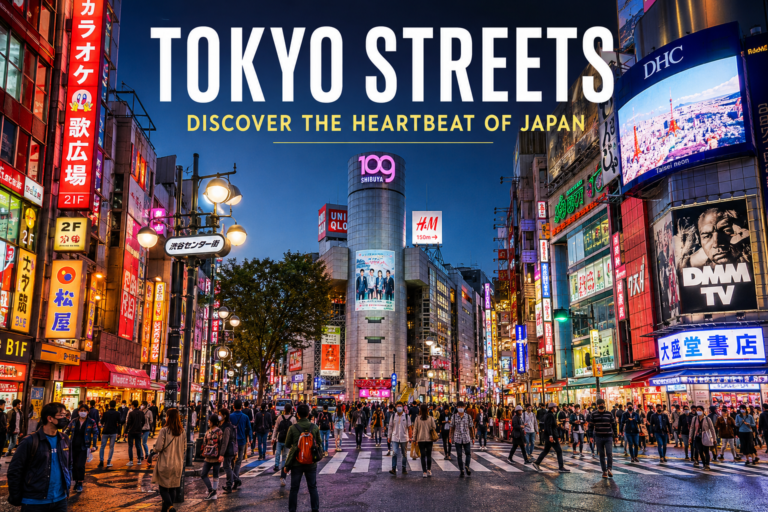
Shibuya is one of the most recognizable modern districts.
It is associated with:
- Shibuya Crossing
- Fashion
- Shopping
- Youth culture
- Restaurants
- Nightlife
- Contemporary architecture
It is particularly popular with younger travelers and first-time visitors.
Shinjuku
Shinjuku is one of Tokyo’s major transportation and commercial centers.
It combines:
- Skyscrapers
- Department stores
- Restaurants
- Entertainment
- Nightlife
- Business districts
- Parks
Shinjuku Station itself is famous for its enormous scale and complexity.
Asakusa
Asakusa provides a strong connection with traditional Tokyo.
It is associated with:
- Senso-ji
- Kaminarimon
- Nakamise
- Traditional shops
- Street food
- Historic atmosphere
It is particularly suitable for first-time visitors who want to see a more traditional side of Tokyo.
Harajuku
Harajuku is associated with fashion, youth culture and shopping.
It also provides access to Meiji Jingu and nearby green spaces.
Ginza
Ginza is known for:
- Luxury shopping
- Department stores
- Fine dining
- High-end brands
- Elegant streets
- Contemporary architecture
It can appeal to travelers interested in premium shopping and dining.
Ueno
Ueno combines transportation, museums, parks, markets and cultural attractions.
It can be particularly useful for travelers interested in history and museums.
Akihabara
Akihabara is strongly associated with:
- Electronics
- Gaming
- Anime
- Manga
- Collectibles
- Japanese pop culture
Its identity has evolved over time, but it remains an important destination for technology and entertainment enthusiasts.
Odaiba
Odaiba is a waterfront district known for modern architecture, entertainment and views across Tokyo Bay.
It provides a different visual experience from the dense urban core.
Roppongi
Roppongi is associated with:
- Art
- International dining
- Nightlife
- Luxury developments
- Museums
It can be particularly appealing to travelers looking for a more international atmosphere.
Tokyo Weather and Climate Information
Tokyo has four distinct seasons, and the travel experience can change dramatically throughout the year.
Spring in Tokyo
Spring is one of the most popular periods for international visitors.
Cherry blossoms are the major attraction.
However, timing varies from year to year.
Spring can also be crowded, especially around famous cherry-blossom locations.
Summer in Tokyo
Summer is generally hot and humid.
Travelers should prepare for:
- High temperatures
- Humidity
- Strong sunlight
- Sudden rain
- Heavy tourist demand around some events
Light clothing, hydration and regular breaks become important.
Autumn in Tokyo
Autumn is often attractive because temperatures become more comfortable and foliage develops across parks and gardens.
The season is especially appealing to travelers who prefer outdoor sightseeing.
Winter in Tokyo
Winter can be cold but often provides clearer conditions than the hotter months.
Winter illumination events can add a different atmosphere to the city.
Rainy Season
Japan’s rainy season can influence travel plans.
Outdoor activities may need flexibility.
A good Tokyo itinerary should always include indoor alternatives.
Typhoons and Severe Weather
Weather can occasionally disrupt flights, trains and outdoor activities.
GO TOKYO specifically advises visitors to monitor weather, transportation and public safety information during periods when typhoons or heavy rain may affect the Kanto region.
Best Time to Visit Tokyo
There is no single best month for everyone.
Best for Cherry Blossoms
Spring is the obvious choice for travelers whose primary objective is seeing cherry blossoms.
Best for Comfortable Walking
Autumn can be attractive for travelers who expect to spend long periods walking.
Best for Winter Atmosphere
Winter can provide illumination events and a different urban atmosphere.
Best for Lower Crowds
Traveling outside the most popular holiday and seasonal periods can sometimes provide a calmer experience.
However, hotel prices and visitor numbers fluctuate considerably according to dates, events and demand.
Tokyo Food Information
Food is one of Tokyo’s greatest attractions.
Tokyo’s culinary identity is much broader than sushi.
Sushi
Tokyo is famous for sushi, including traditional styles associated with Edo-era food culture.
Visitors can find everything from casual conveyor-belt restaurants to highly specialized sushi counters.
Ramen
Ramen comes in many styles.
You may encounter different broths, noodles, toppings and regional influences.
Tempura
Tempura is another important part of Japanese cuisine.
The quality of ingredients and technique can make a major difference.
Yakitori
Yakitori consists of grilled skewered ingredients, commonly associated with casual Japanese dining.
It can be a good choice for travelers wanting a relaxed evening meal.
Soba
Soba noodles can be served hot or cold and are especially suitable for travelers looking for a lighter meal.
Udon
Udon uses thick wheat noodles and appears in numerous regional and restaurant styles.
Convenience Store Food
Japanese convenience stores are worth exploring.
Travelers can find:
- Rice balls
- Sandwiches
- Desserts
- Drinks
- Prepared meals
- Snacks
They are particularly useful for budget-conscious travelers.
Tokyo Dining Etiquette
Japanese dining etiquette can be unfamiliar to international visitors.
Chopsticks
Avoid pointing at people with chopsticks.
Do not leave chopsticks standing vertically in a bowl of rice, as this resembles a funeral-related ritual.
Slurping
Slurping noodles is not generally treated in the same way as some Western dining etiquette.
Tipping
Japan is not generally a tipping culture.
GO TOKYO specifically identifies no-tipping culture as part of its responsible-travel guidance.
Restaurant Rules
Some small restaurants have specific ordering procedures.
Observe what local customers do if instructions are unclear.
Tokyo Money Information
Japan uses the Japanese yen.
Cash
Although electronic payment has become increasingly common, travelers should not assume that every small establishment accepts every international payment method.
Keeping some cash available remains practical.
Credit and Debit Cards
Major cards are widely accepted in many hotels, department stores, chain restaurants and larger businesses.
However, smaller businesses can differ.
IC Cards
Transportation IC cards can simplify travel and may also be useful for certain small purchases.
Exchange Rates
International travelers should check the current exchange rate before departure.
Avoid assuming that a historical exchange rate still applies.
Tokyo Accommodation Information
Tokyo accommodation ranges from budget hostels to luxury hotels.
Hotels Near Tokyo Station
Useful for:
- Business travelers
- Rail connections
- Day trips
- Travelers arriving or departing by Shinkansen
Hotels in Shinjuku
Useful for:
- Nightlife
- Shopping
- Transportation
- First-time visitors
Hotels in Shibuya
Useful for:
- Shopping
- Youth culture
- Nightlife
- Modern Tokyo experiences
Accommodation in Asakusa
Useful for:
- Traditional atmosphere
- Budget-conscious travelers
- Cultural sightseeing
Ryokan
A ryokan provides a more traditional Japanese accommodation experience.
Not every traveler needs one, but spending one night in traditional accommodation can add cultural depth to a longer Japan trip.
Tokyo Information for Budget Travelers
Tokyo can be expensive, but it does not require a luxury budget.
Save Money on Food
Try:
- Convenience stores
- Casual ramen restaurants
- Local noodle shops
- Set meals
- Supermarket prepared foods
Save Money on Attractions
Tokyo has many free or inexpensive experiences.
Walking through neighborhoods, visiting certain parks and exploring public areas can provide hours of entertainment without major admission costs.
Save Money on Transportation
Avoid automatically purchasing expensive unlimited passes.
Calculate how much transportation you actually expect to use.
Save Money on Accommodation
Staying slightly outside the most expensive tourist districts can reduce accommodation costs while still providing good rail access.
Tokyo Information for Luxury Travelers
Luxury travel in Tokyo can include:
- High-end hotels
- Michelin-recognized dining
- Private guides
- Premium shopping
- Private airport transfers
- Traditional cultural experiences
- High-end spas
- Exclusive culinary experiences
The advantage of Tokyo luxury travel is that the city offers both modern and traditional premium experiences.
Tokyo Information for Families
Family travel requires careful planning.
Keep Travel Distances Reasonable
Tokyo’s transportation system is efficient, but large stations can involve substantial walking.
Plan Around Children
Do not schedule five major attractions in one day simply because they are geographically close.
Children need breaks.
Consider Interactive Experiences
Museums, aquariums, themed attractions and hands-on cultural experiences can work better for younger travelers than long historical tours.
Tokyo Information for Solo Travelers
Tokyo is well suited to solo exploration.
Many restaurants have counter seating, making eating alone relatively comfortable.
Solo travelers can also join:
- Food tours
- Walking tours
- Cultural workshops
- Photography tours
- Small-group excursions
This combines independent travel with social interaction.
Tokyo Information for Couples
Couples can combine major sightseeing with slower experiences.
Ideas include:
- Japanese gardens
- Evening city views
- Food tours
- River cruises
- Traditional tea experiences
- Photography walks
- Neighborhood exploration
The best romantic experiences are not necessarily expensive.
Tokyo Information for Senior Travelers
Senior visitors should consider:
- Station walking distances
- Stairs
- Weather
- Rest opportunities
- Tour duration
- Hotel location
- Accessibility
A hotel directly beside a major station can sometimes be more valuable than a slightly cheaper hotel requiring multiple transfers.
Tokyo Information for Travelers With Disabilities
Accessibility has improved considerably, but travelers should still research individual stations, attractions and accommodation.
Large stations can be complicated even when elevators and accessible routes exist.
Before booking, verify:
- Step-free access
- Elevator availability
- Accessible bathrooms
- Room dimensions
- Entrance arrangements
- Tour accessibility
Do not assume that accessibility at one station or attraction means every part of the journey will be equally accessible.
Tokyo Internet and Connectivity Information
Staying connected makes Tokyo easier to navigate.
Travelers can consider:
- eSIM
- Physical SIM
- Pocket Wi-Fi
- International roaming
Why Mobile Data Matters
A reliable connection helps with:
- Maps
- Train directions
- Translation
- Restaurant searches
- Digital tickets
- Emergency information
- Reservations
Download important information before leaving the airport in case your connection is temporarily unavailable.
Language Information for Tokyo
Japanese is the primary language.
English is common in major tourist areas, hotels and transportation environments, but visitors should not expect everyone to speak fluent English.
Useful Japanese Expressions
A few expressions can make interactions more comfortable:
- Hello
- Thank you
- Excuse me
- Please
- Yes
- No
- Where is…?
Even simple attempts at Japanese can be appreciated.
Translation Apps
Translation technology has become increasingly useful.
However, translation tools should complement rather than replace respectful communication.
Tokyo Customs and Etiquette
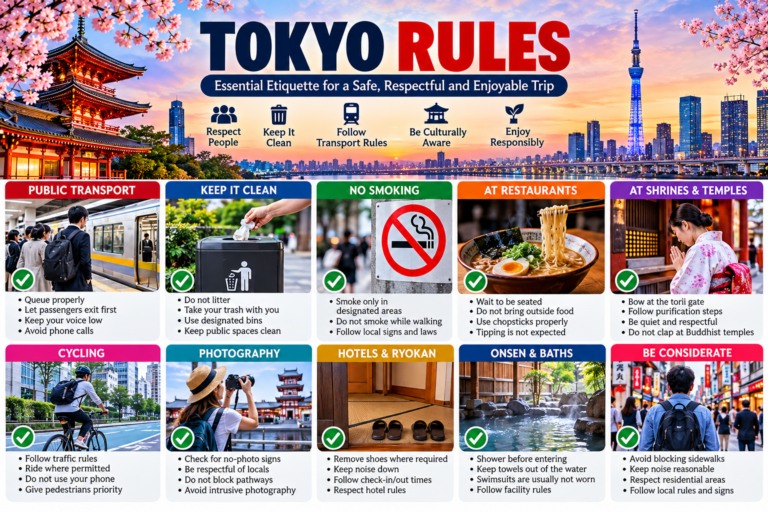
Understanding Japanese social behavior can significantly improve the travel experience.
Queueing
Japanese people generally follow orderly queues.
Do not push ahead.
Public Transportation
Keep voices relatively quiet on trains.
Avoid blocking doors.
Move toward the center of the carriage when possible.
Escalators
Follow local signs and station instructions.
Trash
Public trash bins can be less common than international visitors expect.
Carry a small bag for your rubbish until you find an appropriate disposal point.
Smoking
Smoking rules can be stricter than visitors expect.
Follow designated smoking areas and local regulations.
Temples and Shrines
Treat religious sites respectfully.
Observe signs regarding photography, entry and behavior.
Tokyo Safety Information
Tokyo is widely regarded as a safe destination, but travelers should still use normal precautions.
GO TOKYO advises visitors to follow local laws and social rules and notes that tourists can be targeted by scams despite Japan’s strong safety reputation.
Protect Your Belongings
Keep passports, cash and important documents secure.
Nightlife Precautions
Be cautious around unfamiliar nightlife establishments and unsolicited offers.
Natural Disasters
Japan is exposed to earthquakes, typhoons and other natural hazards.
Travelers should know how to receive emergency information.
Emergency Information
Keep your accommodation address available in both English and Japanese if possible.
Tokyo Earthquake Information
Japan’s geography means earthquake preparedness is part of everyday life.
Visitors should not panic if they experience a small earthquake.
Instead:
- Follow official instructions
- Stay away from unstable objects
- Avoid elevators during emergencies
- Check transportation updates
- Follow hotel staff instructions
The Tokyo tourism authority provides disaster-preparedness information and promotes an app available in multiple languages.
Tokyo Visa and Entry Information
Visa requirements depend on nationality and immigration rules.
Some visitors can enter Japan for short tourist stays without obtaining a visa in advance, while travelers from other countries must apply.
GO TOKYO advises visitors to follow official Japanese visa and immigration guidance because requirements differ according to nationality.
Passport Requirements
Check passport validity requirements before travel.
Customs Declarations
Japan has customs rules concerning goods entering the country.
Travelers can use the Visit Japan Web system for relevant immigration and customs procedures.
Tokyo Shopping Information
Tokyo is a major shopping destination.
Electronics
Akihabara remains strongly associated with electronics and technology.
Fashion
Shibuya, Harajuku, Ginza and other districts provide very different fashion experiences.
Traditional Products
Visitors can find:
- Ceramics
- Fans
- Textiles
- Stationery
- Crafts
- Kitchen products
Souvenirs
Consider buying products you can realistically transport home.
Japanese stationery, food products, small crafts and household goods can make practical souvenirs.
Tokyo Technology Information
Tokyo’s technology image is well deserved, but the city is not simply a futuristic science-fiction environment.
It combines advanced infrastructure with traditional systems.
You may encounter:
- Cashless payment
- Digital ticketing
- Smart transportation
- Automated systems
- Robotics
- Traditional paper-based procedures
This mixture of old and new is one of Tokyo’s defining characteristics.
Tokyo Information for First-Time Visitors
First-time visitors should resist the temptation to see everything.
Start With Three or Four Neighborhoods
For a short trip, focus on areas that represent different sides of Tokyo.
For example:
- Asakusa for traditional Tokyo
- Shibuya for modern Tokyo
- Shinjuku for metropolitan Tokyo
- Ueno for museums and culture
Leave Room for Discovery
Do not fill every hour.
Tokyo’s smaller streets are often where unexpected discoveries happen.
Tokyo Information for Returning Visitors
Repeat visitors should explore beyond the standard tourist circuit.
Consider:
- Koenji
- Nakano
- Kichijoji
- Yanaka
- Shimokitazawa
- Daikanyama
- Kagurazaka
These neighborhoods can provide a different perspective on Tokyo.
Tokyo Day Trips
Tokyo is also a gateway to surrounding destinations.
Depending on the season and transportation arrangements, travelers may consider:
- Nikko
- Kamakura
- Yokohama
- Hakone
- Kawaguchiko
- Mount Fuji-area destinations
- Other regional cities
Tokyo’s position as a transportation hub makes longer Japan itineraries practical.
GO TOKYO notes that travelers can use Shinkansen, express trains, local trains and buses to reach other Japanese cities.
Ten Major Tokyo Travel and Transportation Brands to Know
The following comparison is designed to help travelers understand the ecosystem around Tokyo rather than rank companies.
| Brand | Main Role | Best For | What Travelers Should Know |
|---|---|---|---|
| JR East | Railway | Tokyo and eastern Japan | Important for many rail journeys and regional travel |
| Tokyo Metro | Subway | Central Tokyo | Major subway operator with extensive city coverage |
| Toei Transportation | Subway and buses | Tokyo travel | Operates a separate subway network and other services |
| Keisei | Railway | Narita access and eastern Tokyo | Important for airport and regional connections |
| Keikyu | Railway | Haneda access | Useful for Haneda and southern Tokyo connections |
| JAL | Airline | Domestic and international flights | Major Japanese airline |
| ANA | Airline | Domestic and international flights | Major Japanese airline |
| Airport Limousine Bus | Airport transfer | Airport-to-hotel journeys | Useful when travelers prefer road transport |
| Toyota Rent a Car | Car rental | Regional trips | More relevant outside central Tokyo |
| Nippon Rent-A-Car | Car rental | Flexible driving | Useful for travelers exploring beyond rail networks |
The official Tokyo tourism guide specifically identifies JR East, Shinkansen, subway networks, local railways, buses, taxis, cars, bicycles and water transportation as major ways of getting around Tokyo.
Tokyo Information for Business Travelers
Tokyo is one of Asia’s major business centers.
Business travelers should prioritize hotel location.
Stay Near Your Meetings
A hotel near a convenient station can save significant time.
Understand Rush Hours
Major stations can become extremely busy during commuting periods.
Business Dining
Business dining can range from casual izakaya restaurants to sophisticated Japanese and international restaurants.
Carry Your Hotel Details
A Japanese-language address can be useful when taking taxis.
Tokyo Information for Digital Nomads
Longer-stay travelers should research:
- Internet quality
- Accommodation workspace
- Cafes
- Coworking facilities
- Visa restrictions
- Cost of longer-term accommodation
A tourist trip and a long-term stay are not the same thing, so immigration and visa rules should be checked carefully.
Tokyo Information for Photographers
Tokyo provides almost endless photographic subjects.
Best Themes
Consider photographing:
- Neon streets
- Traditional temples
- Modern architecture
- Train stations
- Tokyo Bay
- Gardens
- Seasonal flowers
- Local neighborhoods
Be Respectful
Do not photograph people in sensitive situations without permission.
Follow signs at temples, museums and private properties.
Tokyo Information for Nightlife
Tokyo nightlife varies considerably by neighborhood.
Shinjuku
Known for entertainment, restaurants and illuminated streets.
Shibuya
More contemporary and youth-oriented.
Roppongi
Has a strong international nightlife presence.
Traditional Izakaya Areas
Smaller neighborhood establishments can offer a more local dining atmosphere.
Visitors should always verify prices before ordering at unfamiliar venues and avoid unsolicited invitations from people approaching tourists.
Tokyo Information for Shopping Travelers
Shopping can become a major part of a Tokyo itinerary.
Plan by category.
Fashion
Explore districts according to your preferred style and budget.
Electronics
Compare prices and warranties before purchasing expensive technology.
Traditional Crafts
Look for established specialty shops and department-store craft sections.
Beauty Products
Japan has a large beauty and cosmetics market, but travelers should check ingredient and import rules if purchasing significant quantities.
Tokyo Information About Sustainability
Tokyo tourism is increasingly emphasizing responsible travel.
Visitors can contribute by:
- Using public transportation
- Avoiding unnecessary disposable items
- Supporting local businesses
- Respecting residential neighborhoods
- Following waste-disposal rules
- Avoiding overcrowded areas when alternatives exist
GO TOKYO’s responsible-travel guidance emphasizes respecting local laws and social rules while supporting local businesses, traditional crafts and food culture.
Overtourism and Tokyo’s Future
Japan’s record international visitor numbers demonstrate the scale of current tourism growth.
JNTO reported that international arrivals exceeded 40 million for the first time in 2025.
That growth creates opportunities but also challenges.
Popular attractions can become crowded.
Residential neighborhoods can experience pressure from visitors.
Transportation systems can become more congested at peak times.
What Travelers Can Do
Travelers can reduce pressure by:
- Visiting popular attractions early
- Exploring less famous neighborhoods
- Traveling outside peak seasons
- Using public transportation responsibly
- Respecting residential areas
- Spending money at local businesses
Future Trends in Tokyo Tourism
Tokyo’s tourism environment is likely to continue changing.
More Multilingual Services
Tokyo is expanding multilingual information and signage.
The official tourism guide notes that multilingual signage is increasingly available across the city’s transportation system.
Digital Travel
Travelers are increasingly using:
- Mobile tickets
- eSIMs
- Translation apps
- Digital maps
- Online reservations
- Smartphone payments
Neighborhood Tourism
As famous attractions become increasingly crowded, visitors are likely to become more interested in lesser-known neighborhoods.
Food Tourism
Food is likely to remain a major reason people visit Tokyo.
The opportunity extends beyond famous sushi restaurants toward local noodles, markets, bakeries, cafés and regional Japanese cuisine.
Cultural Experiences
Hands-on experiences such as tea ceremonies, crafts, cooking and traditional arts can provide greater value than simply taking photographs.
Regional Connections
Tokyo will continue to serve as a gateway to other parts of Japan.
The growing international tourism market is also encouraging greater interest in destinations beyond the country’s most famous cities. JNTO has highlighted regional tourism as one of its major priorities.
Practical Tokyo Information Checklist
Before flying to Tokyo, confirm the following.
Before Departure
- Passport validity
- Visa requirements
- Flights
- Accommodation
- Travel insurance
- Airport transfer
- Mobile data
- Payment cards
- Some Japanese yen
- Important reservations
- Weather forecast
On Arrival
- Activate your SIM or eSIM
- Confirm airport transportation
- Save your hotel address
- Obtain your transportation payment method
- Download essential maps
- Confirm check-in procedures
During Your Trip
- Check weather
- Monitor transportation
- Respect local etiquette
- Keep valuables secure
- Allow extra time for large stations
- Stay hydrated
- Avoid overloading your itinerary
Common Tokyo Travel Mistakes and Solutions
Mistake: Staying Too Far From a Station Tokyo information
Solution: Choose accommodation based on transportation convenience rather than price alone.
Mistake: Trying to Visit Too Many Districts in One Day Tokyo information
Solution: Group attractions geographically.
Mistake: Assuming All Trains Work With One Ticket Tokyo information
Solution: Check the operator and route before purchasing passes.
Mistake: Ignoring Walking Distance Tokyo information
Solution: Remember that transfers inside major stations can involve substantial walking.
Mistake: Planning Only Famous Attractions Tokyo information
Solution: Reserve time for ordinary neighborhoods, markets, cafés and local streets.
Mistake: Traveling Without Weather Flexibility Tokyo information
Solution: Have indoor alternatives.
Mistake: Ignoring Japanese Etiquette Tokyo information
Solution: Learn basic public-transport, dining and religious-site etiquette before arriving.
Mistake: Treating Tokyo Like a Car City Tokyo information
Solution: Use trains and subways for most central sightseeing.
The official Tokyo tourism guide notes that renting a car is generally unnecessary for visitors staying centrally, although it can make sense for larger groups or trips outside the city.
Pros and Cons of Visiting Tokyo
Advantages of Tokyo information
Tokyo offers:
- Exceptional public transportation
- Huge food variety
- Diverse neighborhoods
- Strong cultural heritage
- Modern infrastructure
- Extensive shopping
- World-class museums
- Family-friendly attractions
- Excellent day-trip connections
- Experiences for almost every budget
Challenges of Tokyo information
Visitors may encounter:
- Crowded stations
- Large walking distances
- Language barriers in some situations
- High accommodation costs during peak periods
- Complex transportation networks
- Seasonal heat and humidity
- Crowded famous attractions
- Natural-disaster risks
The important point is that most challenges can be managed with preparation.
How Many Days Do You Need in Tokyo?
Two Days Tokyo information
Two days can cover major highlights but will feel fast.
Three Days Tokyo information
Three days provides a reasonable introduction to major neighborhoods.
Four to Five Days Tokyo information
This is a much more comfortable timeframe for first-time visitors.
Seven Days Tokyo information
A week allows travelers to explore deeper, take day trips and experience Tokyo beyond the major tourist circuit.
Longer Stays Tokyo information
Longer visits make it possible to explore neighborhoods that most short-term tourists never see.
A Sample Tokyo Information-Based Itinerary
Day One: Traditional Tokyo information
Begin in Asakusa.
Explore the temple area, traditional streets and local food.
Continue toward Ueno if time allows.
Day Two: Modern Tokyo information
Explore Shibuya and Harajuku.
Walk through major shopping streets and visit Meiji Jingu.
Day Three: Shinjuku Tokyo information
Explore Shinjuku during the day and return in the evening for its illuminated streets and restaurants.
Day Four: Culture Tokyo information
Choose museums, gardens, a cultural experience or a food tour.
Day Five: Flexible Tokyo information
Use the day to revisit your favorite neighborhood or explore somewhere less touristy.
Day Six: Day Trip Tokyo information
Choose a destination outside central Tokyo.
Day Seven: Shopping and Departure Preparation Tokyo information
Keep your final day flexible for shopping, food and airport logistics.
The Most Important Tokyo Information to Remember
Tokyo rewards travelers who prepare without overplanning.
The city is complex enough that basic knowledge makes a significant difference, but it is also organized enough that visitors can become comfortable surprisingly quickly.
You do not need to memorize every train line.
You do not need to speak fluent Japanese.
You do not need to visit every famous attraction.
Instead, understand the basic structure:
Choose a convenient neighborhood, use public transportation, respect local customs, plan geographically, allow flexibility and remain curious.
That approach turns Tokyo from an intimidating megacity into a collection of neighborhoods waiting to be explored.
FAQs
What is Tokyo best known for?
Tokyo is known for its combination of traditional Japanese culture and modern urban life. Major attractions include temples, shrines, shopping districts, technology centers, museums, food markets, gardens, skyscrapers and entertainment districts.
Is Tokyo expensive to visit?
Tokyo can be expensive, particularly for accommodation and premium dining, but travelers can also visit on a moderate budget by using public transportation, casual restaurants, convenience stores, affordable attractions and strategically located accommodation.
Is Tokyo safe for tourists?
Tokyo is widely regarded as a safe destination, but tourists should still use normal precautions, protect valuables and remain alert to scams and unfamiliar nightlife offers. GO TOKYO also recommends following local laws and social rules.
What currency is used in Tokyo?
The Japanese yen is the currency used throughout Tokyo and Japan.
Do I need cash in Tokyo?
Not necessarily for every purchase, but keeping some Japanese yen is practical because payment methods vary between businesses.
Is English spoken in Tokyo?
English is commonly encountered in major tourist areas, hotels, transportation systems and international businesses. However, visitors may encounter situations where Japanese is the primary language.
What is the best way to get around Tokyo?
For most central sightseeing, trains and subways are the most practical options. Buses, taxis, bicycles and water transportation can also be useful depending on the destination.
Do I need a car in Tokyo?
Usually not if you are staying in central Tokyo. The public transportation system is extensive. A rental car can become more useful for larger groups or trips outside the city.
Which airport is better for Tokyo, Haneda or Narita?
Haneda is closer to central Tokyo, while Narita is farther away but serves many international flights. Compare flight schedules, prices and total transportation time rather than choosing solely based on airport distance.
How long should I stay in Tokyo?
Three days can provide a basic introduction, four to five days offers a more comfortable first visit, and a week allows deeper exploration and a potential day trip.
What are the best areas to stay in Tokyo?
Shinjuku, Shibuya, Tokyo Station, Ginza, Ueno and Asakusa are among the areas travelers commonly consider. The best location depends on budget, interests and planned activities.
Is Tokyo good for families?
Yes. Tokyo offers museums, parks, aquariums, interactive attractions, shopping, food experiences and entertainment suitable for different ages.
Is Tokyo good for solo travelers?
Yes. Tokyo is particularly convenient for independent travelers because of its transportation network and the large number of restaurants and attractions suitable for individual visitors.
What should I know about Tokyo trains?
Tokyo has multiple railway operators. JR, Tokyo Metro, Toei and private railway companies operate different services, so a ticket valid on one network may not automatically cover another.
Are Tokyo trains difficult for foreigners?
They can initially look complicated because the network is extensive, but color-coded maps, station numbering, multilingual signage and smartphone navigation make the system much easier to use.
What should I eat in Tokyo?
Popular choices include sushi, ramen, tempura, yakitori, soba, udon, Japanese curry, wagashi and numerous regional Japanese dishes.
Do restaurants in Tokyo accept credit cards?
Many do, particularly larger restaurants, hotels and department stores, but smaller establishments can differ. Carrying some cash is sensible.
Is tipping expected in Tokyo?
Japan generally does not have a standard tipping culture. GO TOKYO specifically includes no-tipping culture in its responsible-travel guidance.
What should I wear in Tokyo?
Wear according to the season and plan for considerable walking. Comfortable shoes are particularly important because even train journeys can involve substantial walking through large stations.
When is the best time to visit Tokyo?
Spring and autumn are particularly popular, but every season offers something different. Your ideal time depends on whether you prioritize cherry blossoms, comfortable temperatures, summer events, winter illuminations or lower seasonal demand.
Does Tokyo get earthquakes?
Japan is seismically active, so earthquakes can occur. Travelers should familiarize themselves with basic emergency procedures and follow official instructions during an event.
Can I take day trips from Tokyo?
Yes. Tokyo is an important transportation hub, making destinations such as Nikko, Kamakura, Yokohama, Hakone and the Mount Fuji area accessible depending on the route and season.
What are the biggest mistakes first-time visitors make in Tokyo?
Common mistakes include trying to visit too many neighborhoods in one day, staying far from transportation, misunderstanding railway operators, ignoring walking distances, overplanning meals and attractions, and failing to leave time for unexpected discoveries.
Is Tokyo suitable for older travelers?
Yes, but itinerary design matters. Consider hotel location, elevator access, walking distance, station complexity, weather and opportunities to rest.
Is Tokyo suitable for wheelchair users?
Many modern facilities and transportation services provide accessibility features, but accessibility varies by station, attraction and accommodation. Individual routes should be checked in advance.
What is the most important Tokyo travel tip?
Do not try to experience all of Tokyo at once. Choose a few neighborhoods, explore them properly, use public transportation intelligently, respect local customs and leave enough time to enjoy the city rather than rushing between attractions.
Conclusion
Tokyo is much more than a destination built around famous landmarks. It is a vast metropolitan environment where ancient traditions, modern technology, food culture, fashion, business, entertainment and ordinary neighborhood life exist side by side. For first-time visitors, the transportation system may initially seem complicated, but the network becomes easier once you understand the difference between JR, Tokyo Metro, Toei and private railways. Airports such as Haneda and Narita provide strong connections, while trains, buses, taxis, bicycles and water transportation give travelers multiple ways to explore the city.