
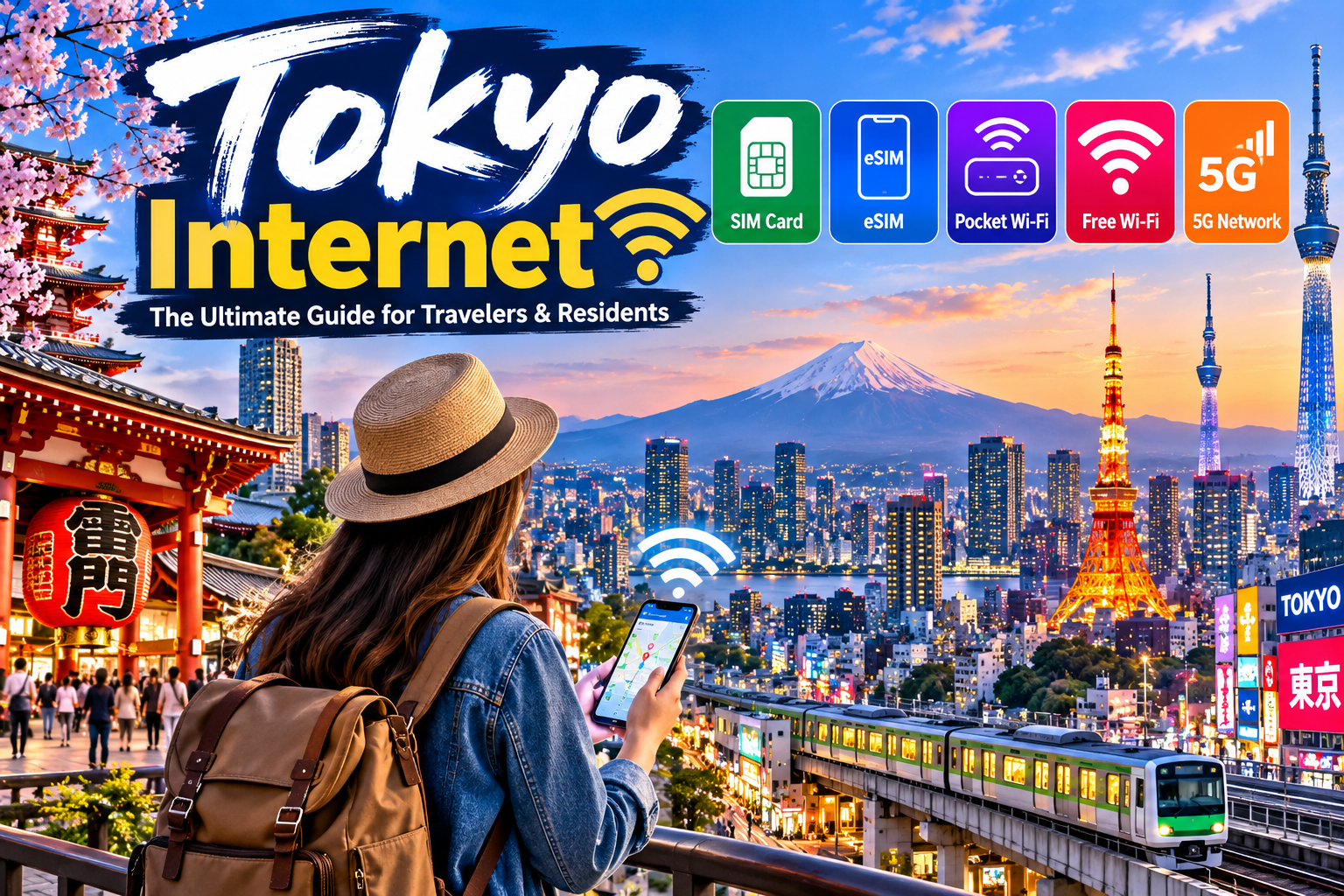
Tokyo Internet: The Ultimate 2026 Guide to Wi-Fi, SIM Cards, eSIM, 5G & Staying Connected
Have you ever arrived in Tokyo, stepped off the plane, opened your phone to check a train route, and suddenly wondered whether your mobile internet would actually work? Tokyo internet is generally highly developed, with travelers able to choose from 5G and 4G mobile networks, eSIMs, physical SIM cards, pocket Wi-Fi, hotel Wi-Fi, and thousands of public Wi-Fi locations. The best option depends on whether you are visiting for a few days, staying for several weeks, working remotely, or living in Tokyo permanently. For a first-time visitor, internet access in Tokyo is more than a convenience. It can become an essential part of navigating the city Tokyo Language
Understanding Tokyo Internet
Why Internet Access Matters So Much in Tokyo
Tokyo is a city where digital connectivity can simplify almost every part of a trip.
Consider a typical day.
You wake up in Shinjuku and want to visit Asakusa. You check a map. You compare train routes. You identify the correct platform. After arriving, you use your phone to translate a sign. You search for a restaurant. You check opening hours. You use a digital ticket. Later, you upload photographs and message family members.
Without internet, none of these activities becomes impossible, but many become less convenient.
This is why having reliable Tokyo internet should be treated as part of travel planning rather than something to solve after arrival.
Is Internet in Tokyo Fast?
Tokyo has mature mobile and fixed-line telecommunications infrastructure.
4G remains widely used, while 5G networks are increasingly important in dense urban environments.
However, the presence of a 5G symbol does not automatically mean you will experience maximum possible speeds.
Actual performance can depend on:
- Your device
- Your SIM or eSIM
- Network operator
- Frequency bands
- Location
- Indoor coverage
- Network congestion
- Building construction
- Weather and physical obstructions
- Your plan’s restrictions
SoftBank, for example, describes 5G as offering higher capacity, lower latency and faster communication than conventional 4G, while noting that particular high-frequency 5G bands are available only in limited areas.
For ordinary tourism, consistent connectivity is generally more important than chasing the highest theoretical speed.
Tokyo Internet Options at a Glance
eSIM
An eSIM is a digital SIM profile that can be installed directly on a compatible phone.
It is particularly convenient for international visitors because there is no physical SIM card to remove.
Advantages include:
- Quick activation
- No physical card
- Easy installation before departure
- Dual-SIM possibilities on compatible phones
- Convenient for short trips
The biggest requirement is compatibility.
Your phone must support eSIM functionality and generally needs to be unlocked for the relevant service.
Physical Travel SIM
A travel SIM is a physical Japanese or Japan-focused SIM card.
It can be useful when:
- Your phone does not support eSIM
- You prefer physical installation
- You want a dedicated travel data plan
- You are comfortable changing SIM cards
Tokyo’s official tourism information says travel SIMs can be purchased before travel or locally, including through airports, convenience stores, vending machines and major electronics retailers. It notes that prices vary by plan.
Pocket Wi-Fi
Pocket Wi-Fi is a small portable router that connects to a mobile network and creates a private Wi-Fi connection.
Instead of putting a SIM in every phone, multiple devices can connect to the same router.
This can be useful for:
- Families
- Couples
- Groups
- Travelers carrying tablets
- Laptops
- Multiple smartphones
The downside is that someone has to carry and recharge the device.
Hotel Wi-Fi
Most modern hotels and many accommodations provide Wi-Fi.
Hotel internet is convenient for:
- Video calls
- Streaming
- Uploading photographs
- Laptop work
- Downloading large files
However, hotel Wi-Fi should not necessarily be your only connection.
You may need internet while traveling between locations.
Public Wi-Fi
Tokyo has an extensive public Wi-Fi ecosystem.
Official tourism information lists airport Wi-Fi, railway Wi-Fi, Tokyo FREE Wi-Fi, area-specific services and commercial hotspot networks.
Public Wi-Fi is particularly useful as a backup.
It is less suitable as your only connection if you need continuous navigation throughout the day.
Tokyo Free Wi-Fi
Tokyo FREE Wi-Fi
Tokyo FREE Wi-Fi is provided at various government facilities, tourist locations, parks, gardens, cultural facilities, office buildings and other designated areas.
The official service uses the SSID TOKYO_FREE_Wi-Fi.
This makes it useful for travelers who want to reduce mobile data usage.
However, public Wi-Fi coverage is not continuous.
You should not assume that because a station or attraction has Wi-Fi, you will have uninterrupted connectivity throughout your entire journey.
Haneda Airport Wi-Fi
Haneda Airport provides free Wi-Fi in Terminals 1, 2 and 3.
The official tourism guide identifies the network as HANEDA-FREE-WIFI and states that registration is not required.
This can be particularly helpful immediately after landing.
You can use airport connectivity to:
- Contact your hotel
- Download transport information
- Activate an eSIM
- Message family
- Check reservations
- Arrange transportation
Narita Airport Wi-Fi
Narita Airport also provides free Wi-Fi.
The official tourism guide lists FreeWiFi-NARITA as the relevant network.
This makes either major Tokyo-area international gateway useful as a first connectivity point.
Internet at Tokyo Train Stations
JR East Wi-Fi
The official Tokyo tourism Wi-Fi guide identifies JR EAST FREE Wi-Fi at major JR East stations, including stations on the Yamanote Line and major Shinkansen stations.
This can be helpful when you are:
- Checking train schedules
- Looking for station exits
- Translating information
- Contacting accommodation
- Purchasing digital services
Private Railway Wi-Fi
Various private railway operators also provide Wi-Fi.
Examples listed by Tokyo’s tourism authority include:
- Tobu
- Keio
- Keisei
- Seibu
Coverage differs by operator and location.
Why Station Wi-Fi Is Not Enough
A common mistake is to assume railway Wi-Fi will keep you connected throughout an entire journey.
Public Wi-Fi is typically tied to specific locations.
Once you leave the station or move outside the hotspot area, your connection can disappear.
For this reason, a travel eSIM or SIM remains the more reliable primary solution for most visitors.
Tokyo Internet for Tourists
Best Option for a Short Trip
For a traveler staying three to seven days, an eSIM is often one of the simplest approaches if the phone supports it.
You can arrange connectivity before leaving home.
Then, after landing, you can switch on the travel line and begin using mobile data.
Best Option for a Two-Week Trip
For a longer stay, compare:
- eSIM
- Travel SIM
- Pocket Wi-Fi
- Local prepaid options
The right choice depends on data requirements.
Someone using maps, messaging and occasional social media needs far less capacity than someone uploading 4K video every evening.
Best Option for Families
Pocket Wi-Fi can be attractive when several people need internet.
One device can provide a shared connection for several compatible devices.
However, the group needs to remain reasonably close to the router.
If family members separate, the person carrying the pocket Wi-Fi effectively controls the connection.
Best Option for Remote Workers
Remote workers should prioritize stability over headline speed.
Consider:
- eSIM or local mobile data
- Hotel Wi-Fi
- A backup connection
- Laptop compatibility
- Video conferencing reliability
- Upload speeds
- Data limits
A person working from Tokyo should ideally have two connectivity methods.
For example, hotel Wi-Fi can serve as the primary connection while mobile data provides backup.
Tokyo Internet for Business Travelers
Why Business Travelers Need a Backup Tokyo internet
Missing an email is inconvenient.
Missing a video meeting because hotel Wi-Fi stopped working is much more serious.
Business travelers should consider mobile connectivity a redundancy system.
A practical setup can be:
Primary: hotel or office Wi-Fi.
Backup: mobile eSIM or SIM.
Emergency: public Wi-Fi.
This three-layer approach reduces the chance of being completely offline.
Video Conferencing in Tokyo
Video conferencing requires more than basic web browsing.
A connection can be fast enough for maps but unstable for video calls.
Before an important meeting, test:
- Upload speed
- Download speed
- Latency
- Connection stability
- Microphone
- Camera
- VPN compatibility if required
A few minutes of preparation can prevent a major problem.
Tokyo Internet for Digital Nomads
Choosing Connectivity for Long Stays Tokyo internet
Digital nomads have different requirements from tourists.
A digital nomad may need:
- Large data allowance
- Hotspot capability
- Laptop connectivity
- Stable video calls
- Cloud storage
- VPN use
- Large file uploads
- Online meetings
- Continuous access
A short tourist eSIM may not be designed for this workload.
Don’t Judge a Plan by Data Alone Tokyo internet
Two plans can advertise large data allowances while providing very different experiences.
Look beyond the headline number.
Check:
- Whether hotspot use is permitted
- Whether speeds are reduced after a threshold
- Whether video traffic is restricted
- Whether the plan supports tethering
- Network used
- Validity period
- Activation requirements
Tokyo Internet for Students
Connectivity for International Students Tokyo internet
Students staying in Tokyo for months rather than days should investigate longer-term mobile plans.
The priorities may include:
- Affordable monthly cost
- Sufficient data
- Calling capability
- SMS
- Payment options
- Contract requirements
- Identity verification
- Japanese-language support
The cheapest plan is not necessarily the most convenient for someone who needs reliable service every day.
Internet for University Work Tokyo internet
Students should consider how much data their coursework requires.
Online lectures, cloud documents, video calls and file downloads can consume substantially more data than ordinary messaging.
A reliable home broadband connection may therefore be worthwhile for long-term accommodation.
Tokyo Internet for Families
Connecting Multiple Devices Tokyo internet
Modern families may travel with:
- Smartphones
- Tablets
- Smartwatches
- Cameras
- Laptops
- Gaming devices
A pocket Wi-Fi system can simplify connectivity because several devices can use one internet source.
An eSIM is more convenient when individual family members need independent connectivity.
What Happens When the Family Splits Up?
This is one of the biggest disadvantages of shared pocket Wi-Fi.
Imagine two parents and children visiting a shopping district.
One person carries the router.
The family separates.
Anyone who moves away may lose connectivity.
For this reason, families with older children or teenagers may prefer separate eSIMs.
Tokyo Internet for Solo Travelers
Why eSIM Is Convenient for Solo Travel
Solo travelers do not need to share a router.
An eSIM gives the traveler direct access to mobile data.
This can make navigation easier because the connection remains available while walking between stations, restaurants and attractions.
Tokyo Internet for Photographers
Uploading Travel Photos Tokyo internet
Tokyo is a paradise for photographers.
But modern cameras can create enormous files.
RAW photographs and 4K or 8K video can quickly fill cloud storage.
Travelers who back up content while traveling should consider upload speed as carefully as download speed.
Cloud Backup Strategy Tokyo internet
A practical approach is:
- Photograph during the day.
- Transfer files to your laptop or storage device.
- Back up important files.
- Upload selected files overnight.
- Keep at least two copies of irreplaceable photographs.
Internet connectivity is useful, but it should not be your only backup.
Tokyo Internet and Public Wi-Fi Security
Why Public Wi-Fi Requires Caution Tokyo internet
Public Wi-Fi can be convenient, but you should avoid treating an unknown network as completely private.
When using public Wi-Fi:
- Avoid entering highly sensitive information unnecessarily.
- Check the exact network name.
- Use secure websites.
- Keep your operating system updated.
- Use strong account passwords.
- Enable multi-factor authentication.
- Consider a trusted VPN when appropriate.
Watch Out for Fake Hotspots Tokyo internet
A network name that looks official is not automatically proof of authenticity.
When connecting in a station, airport or hotel, confirm the network name through official signage or staff.
This simple step can reduce the risk of connecting to a malicious imitation.
Tokyo Internet and VPN Use
When Might You Need a VPN?
Travelers sometimes use VPNs to access services from their home country or to improve privacy on unfamiliar networks.
A VPN can also be useful for remote workers whose companies require secure connections.
However, VPN performance depends on:
- VPN provider
- Server location
- Network congestion
- Encryption overhead
- Mobile network
- Wi-Fi quality
A VPN should therefore be tested before an important business trip.
Tokyo Internet and Streaming
Watching Video Tokyo internet
Streaming video consumes significantly more data than ordinary messaging.
A traveler watching several hours of high-resolution video every day should consider a generous data plan or reliable Wi-Fi.
Download Before Leaving the Hotel Tokyo internet
One useful strategy is to download:
- Movies
- Music
- Podcasts
- Offline maps
- Travel guides
before leaving your accommodation.
This reduces dependence on mobile data during sightseeing.
Tokyo Internet and Navigation
Why Offline Maps Still Matter Tokyo internet
Even with excellent Tokyo internet, offline maps are useful.
Mobile connections can fail.
Battery levels can drop.
Crowded locations can make connectivity unpredictable.
Downloading essential maps before exploring gives you an additional layer of protection.
Save Important Addresses Tokyo internet
Before leaving your hotel, save:
- Hotel name
- Hotel address
- Nearest station
- Emergency contact information
- Flight details
- Train information
- Important reservations
Screenshots can be useful when you know you will need information later.
Tokyo Internet at Hotels
Hotel Wi-Fi Quality Varies Tokyo internet
A luxury hotel can have excellent internet.
A small accommodation can also have excellent internet.
Conversely, a property that advertises Wi-Fi may have a connection that becomes slow during peak hours.
Reviews can sometimes reveal useful information about real-world performance.
Ask About Wi-Fi Before Booking Tokyo internet
For remote workers, ask:
- Is Wi-Fi available in every room?
- Is it included?
- Is there a data limit?
- Is the connection suitable for video calls?
- Are there Ethernet connections?
- Is Wi-Fi available in common areas?
Tokyo Internet at Cafés
Café Wi-Fi Tokyo internet
Many cafés provide Wi-Fi, making them useful for short work sessions.
Tokyo’s official tourism information lists Wi-Fi services at various commercial locations, including Starbucks locations and other businesses.
However, policies vary.
Some locations may limit access or require registration.
Café Etiquette Tokyo internet
If you plan to work from a café:
- Purchase something.
- Avoid occupying a table for excessive periods during busy hours.
- Keep calls quiet.
- Use headphones.
- Do not spread equipment across multiple seats.
Internet access should be combined with consideration for the business and other customers.
Tokyo Internet Speeds: What Actually Matters?
Download Speed Tokyo internet
Download speed affects:
- Video streaming
- File downloads
- App updates
- Website loading
- Cloud synchronization
Upload Speed Tokyo internet
Upload speed becomes important for:
- Video calls
- Cloud backups
- Social media uploads
- Sending large files
- Live streaming
Latency Tokyo internet
Latency describes the responsiveness of the connection.
Low latency is especially useful for:
- Video calls
- Online gaming
- Remote desktop work
- Interactive applications
Stability Tokyo internet
For travelers, stability can be more important than peak speed.
A stable 4G connection can be more useful than an unstable connection that occasionally reaches a much higher speed.
5G Internet in Tokyo
Why Tokyo Is Important for 5G Tokyo internet
Tokyo is a dense metropolitan environment where high-capacity mobile networks can be especially valuable.
Large crowds, office districts, transport hubs and major events create heavy demand.
Japanese operators continue to develop 5G networks and technologies.
In September 2026, NTT DOCOMO, KDDI, SoftBank and Rakuten Mobile announced a joint study aimed at expanding areas where 5G millimeter-wave technology can be used. The companies noted that millimeter-wave can provide high-speed, high-capacity communication but is more affected by physical obstructions.
5G Does Not Mean Unlimited Speed Tokyo internet
This distinction matters.
Your phone may display 5G while your actual experience varies considerably.
Indoor environments can also affect high-frequency signals.
The most useful approach is to choose a provider with strong practical coverage for the places you expect to visit.
Ten Major Brands and Tokyo Internet Options Compared
The following table compares well-known Japanese mobile brands and services from the perspective of connectivity, travel suitability and typical use cases.
| Brand / Service | Main Type | Best For | Key Strength | Important Consideration |
|---|---|---|---|---|
| NTT DOCOMO | Mobile network | Broad mobile use | Major nationwide network | Plans and eligibility vary |
| au | Mobile network | Travelers and residents | Established network infrastructure | Check specific plan terms |
| SoftBank | Mobile network | Urban users | Strong urban presence and Wi-Fi ecosystem | Coverage varies by location |
| Rakuten Mobile | Mobile network | Data-focused users | Expanding 4G/5G network | Coverage should be checked for your destinations |
| ahamo | Mobile service | Data-conscious users | Simplified mobile offering | Eligibility and plan conditions matter |
| povo | Mobile service | Flexible users | Modular approach | Users need to manage options carefully |
| UQ mobile | Mobile service | Value-focused users | Associated with KDDI network | Plan details differ |
| Y!mobile | Mobile service | Value-focused users | SoftBank ecosystem | Check current allowances |
| LINEMO | Mobile service | Smartphone users | Digital-first approach | Designed around specific plan structures |
| IIJmio | MVNO | Cost-conscious residents | Flexible SIM options | Network performance depends on underlying network |
This table should be treated as a planning framework rather than a permanent ranking. Japanese mobile plans change regularly, and eligibility, pricing, data allowances and promotions can change over time.
Comparing Tokyo Internet by User Type
Best Tokyo Internet for Tourists
Tourists generally benefit from simplicity.
A travel eSIM is attractive because it can be installed before departure.
A physical SIM is a good alternative for incompatible phones.
Pocket Wi-Fi works particularly well for groups.
Best Tokyo Internet for Families
Families should consider whether everyone needs individual connectivity.
If everyone stays together, pocket Wi-Fi can be convenient.
If people frequently separate, individual SIMs or eSIMs become more practical.
Best Tokyo Internet for Business Travelers
Business travelers should prioritize:
- Reliability
- Hotspot capability
- Stable upload speeds
- Backup connectivity
- Business support
Best Tokyo Internet for Students Tokyo internet
Students staying long-term should investigate monthly mobile plans and home broadband rather than relying exclusively on short-term tourist products.
Best Tokyo Internet for Digital Nomads Tokyo internet
Digital nomads should prioritize:
- High data allowance
- Stable connectivity
- Tethering
- Upload speeds
- Backup connections
- Long-term value
How to Choose the Right Tokyo Internet Plan
Step 1: Determine Your Trip Length Tokyo internet
A three-day trip requires a different strategy from a six-month stay.
Step 2: Estimate Data Usage Tokyo internet
Light use:
- Maps
- Messaging
- Occasional browsing
Moderate use:
- Social media
- Video
- Frequent navigation
- Photo uploads
Heavy use:
- Streaming
- Video calls
- Cloud backup
- Remote work
- Large downloads
Step 3: Check Your Phone Tokyo internet
Before buying an eSIM or SIM, check:
- eSIM compatibility
- SIM-lock status
- Supported network bands
- Dual-SIM support
- Hotspot functionality
Step 4: Decide Whether You Need Calls Tokyo internet
Many travel data plans are primarily designed for internet access.
If you require a Japanese telephone number or conventional calling, your requirements may be different.
Step 5: Check Hotspot Rules Tokyo internet
Do not assume that every mobile data plan permits unlimited tethering.
If you plan to connect a laptop, verify this before purchasing.
Step 6: Have a Backup Tokyo internet
Even excellent networks can experience problems.
Save important information offline.
Common Tokyo Internet Problems
Problem: eSIM Will Not Activate Tokyo internet
Possible causes include:
- Device incompatibility
- SIM lock
- Incorrect installation
- Roaming configuration
- Incorrect APN settings
- Provider activation requirements
Solution:
Install the eSIM before traveling when possible, follow the provider’s instructions carefully, and keep your original SIM available until you confirm the travel line works.
Problem: 5G Is Not Appearing Tokyo internet
Possible causes include:
- Device compatibility
- Network selection
- Location
- Indoor signal conditions
- Plan limitations
- Temporary network conditions
Solution:
Try automatic network selection, move outdoors or to another location, restart the device, and check the provider’s configuration instructions.
Problem: Internet Is Slow in a Crowded Area
Large stations, events and tourist attractions can generate substantial network demand.
Solution:
Move away from the densest crowd where practical or use an alternative connection.
Problem: Pocket Wi-Fi Battery Dies Tokyo internet
This is a classic problem.
Solution:
Carry a power bank and charge the router overnight.
Problem: Public Wi-Fi Requires Registration Tokyo internet
Some networks require email or social account registration.
Solution:
Complete registration before you urgently need internet.
Problem: Hotel Wi-Fi Is Slow Tokyo internet
Solution:
Use mobile data as a backup, work during less congested hours, or ask the hotel whether another network or wired connection is available.
Advantages of Tokyo Internet
Excellent Connectivity Choices Tokyo internet
Visitors can choose from several technologies rather than depending on one system.
Strong Mobile Infrastructure Tokyo internet
Tokyo’s mobile network environment supports modern smartphone use, including expanding 5G services.
Large Public Wi-Fi Ecosystem Tokyo internet
Airports, stations, attractions and other locations offer free Wi-Fi services.
Convenient eSIM Technology Tokyo internet
Compatible phones can activate an eSIM without handling a physical card.
Useful for International Travelers Tokyo internet
Maps, translation tools, transport applications and travel information become much easier to use.
Excellent for Remote Work Tokyo internet
With the right setup, Tokyo can support travelers who need to work online.
Disadvantages of Tokyo Internet
Too Many Choices Tokyo internet
Having numerous options can actually make planning confusing.
Public Wi-Fi Is Not Continuous Tokyo internet
A public hotspot cannot replace mobile data for travelers who need constant access.
Some Plans Have Restrictions Tokyo internet
Data limits, tethering rules, speed reductions and validity periods vary.
Device Compatibility Matters Tokyo internet
Not every phone supports every SIM or eSIM technology.
Connectivity Costs Add Up Tokyo internet
Travelers who need high data usage may spend considerably more than someone using only basic maps and messaging.
Tokyo Internet and Privacy
Keep Your Accounts Secure Tokyo internet
Travelers should use:
- Strong passwords
- Multi-factor authentication
- Updated operating systems
- Device encryption where available
- Screen locks
Avoid Sensitive Activity on Unknown Networks Tokyo internet
When possible, use trusted mobile data or a secure network for particularly sensitive tasks.
Don’t Automatically Trust Every Wi-Fi Network Tokyo internet
A familiar-looking network name is not sufficient proof of authenticity.
Tokyo Internet and Smart Travel
Use Internet Before Leaving Your Hotel Tokyo internet
Download:
- Maps
- Train information
- Tickets
- Reservations
- Translation tools
- Entertainment
This reduces pressure on your connection later.
Screenshot Important Information Tokyo internet
Screenshots can be useful for:
- Hotel addresses
- Train tickets
- Reservations
- Confirmation numbers
- Meeting locations
Carry a Power Bank Tokyo internet
A smartphone without battery is effectively offline even if Tokyo has excellent internet.
This is one of the simplest but most overlooked travel tips.
Tokyo Internet for Specific Problems
Tokyo Internet for Navigation Problems
Use an eSIM or mobile SIM rather than depending entirely on station Wi-Fi.
Tokyo Internet for Translation Problems
Download offline language resources before leaving your hotel.
Tokyo Internet for Remote Work Problems
Use two independent connectivity sources.
Tokyo Internet for Large File Uploads
Use stable hotel or office broadband whenever possible.
Tokyo Internet for Families
Consider whether shared pocket Wi-Fi or independent eSIMs make more sense.
Tokyo Internet for Long-Term Residents
Investigate local monthly mobile service and fixed broadband.
Tokyo Internet and Home Broadband
Mobile Internet vs Home Internet
Mobile internet is excellent for mobility.
Home broadband is better suited to:
- Multiple people
- Smart TVs
- Large downloads
- Gaming
- Cloud backups
- Heavy work
- Multiple computers
A Tokyo resident who uses several devices every day may benefit from both.
Fiber Internet
Fiber broadband can provide high-capacity fixed connectivity.
It is particularly attractive for homes where several people simultaneously stream, work and download.
Availability and installation requirements depend on the property.
Future Trends in Tokyo Internet
Expansion of 5G Tokyo internet
5G infrastructure will continue to develop, particularly in high-demand urban environments.
The September 2026 agreement among Japan’s four major mobile operators to study broader millimeter-wave use demonstrates ongoing industry interest in expanding high-capacity 5G applications.
More Advanced Network Sharing Tokyo internet
As operators explore ways to use infrastructure more efficiently, consumers may benefit from better high-capacity coverage in selected locations.
Greater eSIM Adoption Tokyo internet
eSIM technology is likely to become increasingly normal for international travelers.
The ability to arrange connectivity before boarding a flight removes one of the traditional problems associated with arriving in a foreign country without mobile service.
More Connected Tourism Tokyo internet
Travel information, digital tickets, translation tools, maps and real-time transportation services will continue becoming more integrated.
Better Public Wi-Fi Tokyo internet
Tokyo already provides public Wi-Fi across numerous categories of locations, and continued improvements could make public connectivity more useful as a backup service.
Internet Will Become Less Visible
The most interesting future development may be that travelers stop thinking about connectivity altogether.
Instead of searching for Wi-Fi, visitors may simply expect their devices to remain connected everywhere.
That transition is already underway.
Tokyo Internet Trends for Travelers
eSIM Before Arrival
Travelers increasingly want to land with connectivity already configured.
Multi-SIM Smartphones
Dual-SIM phones make it easier to retain a home number while using Japanese mobile data.
AI Travel Tools
Internet connectivity will become even more important as AI-powered translation, trip planning and real-time travel assistants become more common.
Cloud-Based Travel
Tickets, reservations, maps, photos and travel documents increasingly exist online.
This makes connectivity a core travel requirement.
Connected Cameras
Modern cameras can transfer photographs to smartphones or cloud services.
This creates new demands for reliable mobile data.
Tokyo Internet for Different Demographics
Tokyo Internet for First-Time Visitors
Prioritize simplicity.
A preconfigured eSIM plus offline maps is a strong starting point.
Tokyo Internet for Senior Travelers
Choose an option that is easy to activate and troubleshoot.
Avoid unnecessarily complicated plans.
Tokyo Internet for Families
Consider the number of devices and whether the group stays together.
Tokyo Internet for Students
Look at monthly value rather than short-term tourist pricing.
Tokyo Internet for Professionals
Prioritize stability, upload speed and redundancy.
Tokyo Internet for Photographers
Consider upload capacity and cloud backup.
Tokyo Internet for Content Creators
Large video files make high-capacity internet particularly valuable.
Tokyo Internet for Budget Travelers
Use public Wi-Fi strategically while maintaining a small mobile-data backup.
FAQs
Is internet free in Tokyo?
Free Wi-Fi is available in many airports, train stations, tourist facilities, parks, gardens, museums and other locations. However, coverage is not universal, so relying only on free Wi-Fi is not recommended for most travelers.
Is Tokyo internet fast?
Tokyo generally has strong mobile and fixed-line internet infrastructure. Actual speed depends on your network, device, location, plan and congestion.
Is Wi-Fi available at Tokyo airports?
Yes. Haneda and Narita airports provide free Wi-Fi services for travelers.
Does Tokyo have 5G?
Yes. Major Japanese mobile operators operate 5G networks, and network development continues.
Should I use an eSIM in Tokyo?
An eSIM can be an excellent choice for travelers with compatible, unlocked smartphones because it can be installed without replacing a physical SIM.
Is a physical SIM better than an eSIM?
Neither is universally better. eSIM is convenient, while a physical SIM can be useful for devices without eSIM support.
Is pocket Wi-Fi worth it in Tokyo?
Pocket Wi-Fi can be useful for families, couples and groups sharing several devices. It is less convenient if group members frequently separate.
Can I use my home SIM in Tokyo?
Possibly. Your home carrier must support international roaming, and roaming charges can vary substantially.
Does Tokyo have free public Wi-Fi?
Yes. Tokyo has several public Wi-Fi services, including Tokyo FREE Wi-Fi and transport-related networks.
Can I use Wi-Fi on Tokyo trains?
Some railway operators and stations provide Wi-Fi. Coverage varies by operator, station and service.
Is Tokyo internet safe?
The underlying network infrastructure is highly developed, but users should still take normal precautions when using public Wi-Fi.
Do I need a VPN in Tokyo?
A VPN is not necessarily required for ordinary travel, but some travelers use one for privacy or remote-work requirements.
Can I work remotely using Tokyo internet?
Yes. Tokyo can support remote work, but professionals should ideally maintain both a primary and backup connection.
How much internet data do I need in Tokyo?
Light travelers may use relatively little data if they rely heavily on hotel and public Wi-Fi. Heavy users who stream video, upload photographs or work remotely need substantially more.
Can I use Google Maps in Tokyo?
Yes. Internet access makes navigation significantly easier, although downloading offline maps can provide useful backup.
Does Tokyo internet work underground?
Mobile connectivity can vary in underground environments. Some railway and subway areas have connectivity, but travelers should not assume uninterrupted service everywhere.
Can I use WhatsApp in Tokyo?
Internet-based messaging applications can generally be used when you have an active internet connection, although the availability and behavior of specific services can change by location and network.
Can I use my iPhone in Tokyo?
Yes, provided the device is compatible with the relevant Japanese network technology and is not restricted by a carrier lock. eSIM support can make setup particularly convenient on compatible models.
Can Android phones use Tokyo internet?
Yes. Compatible Android devices can use Japanese mobile networks through suitable SIMs, eSIMs or roaming.
Is hotel Wi-Fi enough for a Tokyo trip?
For basic browsing and evening use, it may be sufficient. For continuous navigation outside the hotel, mobile data is much more useful.
What is the best backup for Tokyo internet?
A practical backup is mobile data plus access to public Wi-Fi. Travelers should also keep important addresses, tickets and reservations available offline.
Conclusion
Tokyo internet is no longer something travelers need to worry about in the way they might have in the past. The city offers a broad ecosystem of mobile networks, 5G, eSIMs, physical SIM cards, pocket Wi-Fi, hotel connections and public Wi-Fi, giving visitors considerable flexibility. The key is choosing the technology that matches your trip rather than assuming one solution is perfect for everyone. For a short international visit, an eSIM can provide a simple way to arrive connected. A physical travel SIM remains useful for compatible unlocked phones without convenient eSIM support. Families and groups may prefer pocket Wi-Fi when everyone stays together



One Comment