Tokyo Rules: 50+ Essential Rules, Manners and Etiquette Every Visitor Should Know
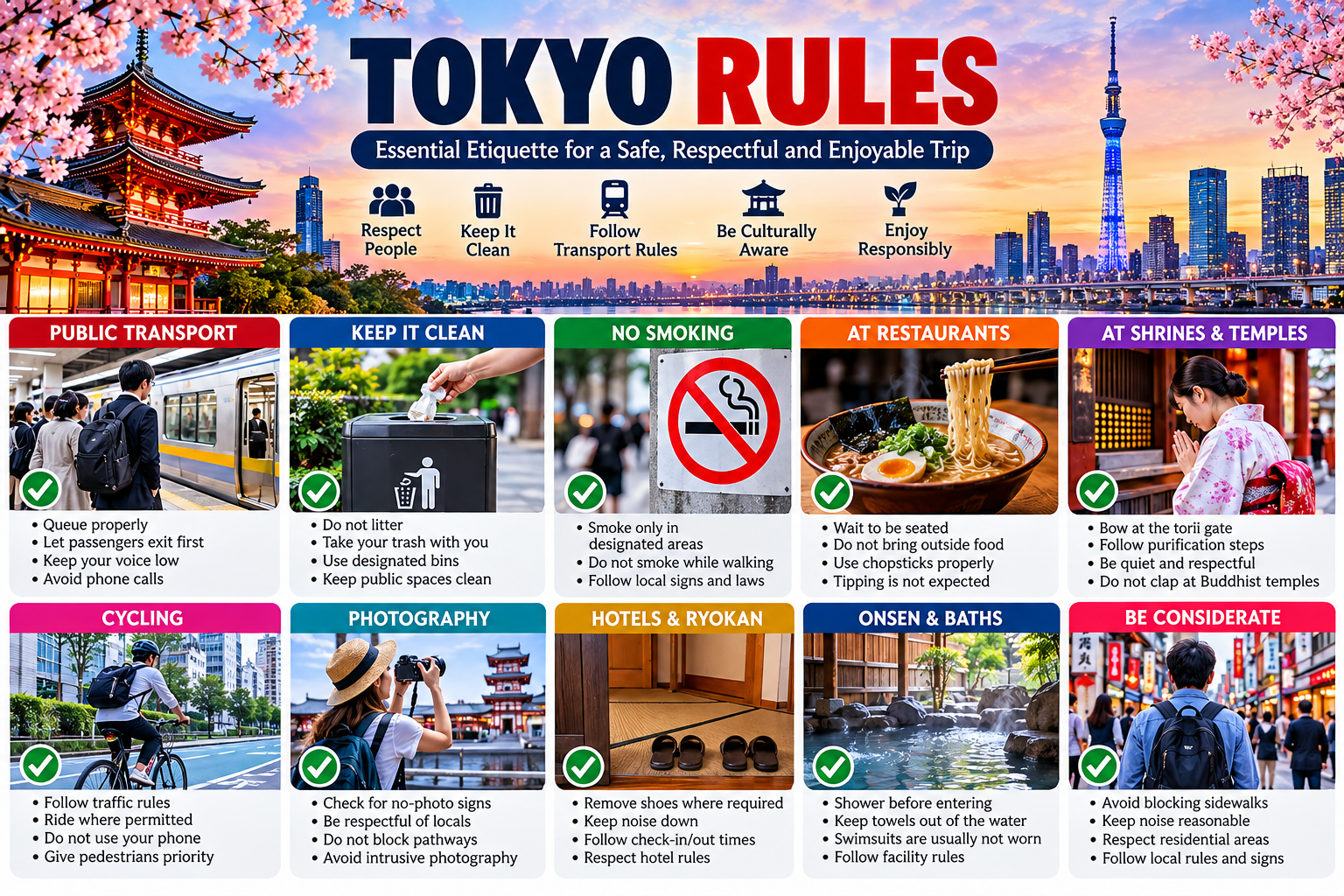
Have you ever wondered why Tokyo can function so smoothly despite being one of the world’s busiest metropolitan areas? The answer is partly its remarkable infrastructure, but it is also the everyday behaviour of millions of people who follow a combination of formal laws, transport regulations, cultural customs, and unwritten social rules. Tokyo rules are a combination of Japanese laws, local regulations, transportation requirements, cultural etiquette, and social expectations that help visitors travel respectfully and comfortably. The most important principles are simple: respect other people, queue properly, keep public spaces clean, follow transport instructions, observe local rules, and avoid behaviour that inconveniences others Tokyo Viewpoints
What Are Tokyo Rules?
Tokyo rules can be divided into several broad categories.
Legal Rules
These are requirements established through Japanese national law or local regulations.
Examples can include:
- Traffic regulations
- Smoking restrictions
- Identification requirements
- Bicycle rules
- Public safety regulations
- Certain photography restrictions
- Rules concerning specific facilities
These should be taken seriously because claiming that you did not know the rule generally does not eliminate legal responsibility. Japan’s official tourism guidance specifically advises visitors to research applicable local laws.
Transportation Rules
Tokyo’s trains and buses operate through a highly organised system.
Visitors are expected to:
- Queue
- Allow passengers to exit first
- Avoid blocking doors
- Keep voices low
- Manage luggage carefully
- Respect priority seating
- Follow station signs
Tokyo Metro specifically asks passengers to manage smartphones, luggage and boarding behaviour carefully and to give priority seats to people who need them.
Cultural Etiquette
These are behaviours rooted in Japanese social customs.
Examples include:
- Removing shoes where required
- Bowing or acknowledging others politely
- Avoiding loud conversations
- Respecting temples and shrines
- Handling chopsticks appropriately
- Waiting your turn
- Keeping public spaces clean
Unwritten Social Rules
These are perhaps the most important rules for understanding Tokyo.
They are not necessarily written on signs.
Instead, they are based on the principle of not causing inconvenience to others.
Japan’s national tourism guidance describes consideration for others as a central part of travelling responsibly and refers to the cultural concept of omoiyari, broadly meaning consideration and thoughtfulness toward others.
The Golden Rule of Tokyo Etiquette
If you remember only one principle, remember this:
Do not unnecessarily inconvenience the people around you.
This simple idea explains many Tokyo rules.
Why do people avoid loud phone calls on trains?
Because the conversation affects everyone nearby.
Why do people queue?
Because cutting ahead inconveniences others.
Why are backpacks moved off shoulders on crowded trains?
Because they can hit other passengers or occupy unnecessary space.
Why are visitors asked to take rubbish with them?
Because public spaces are expected to remain clean.
Why are people careful around temples and shrines?
Because these are functioning cultural and religious spaces, not simply photo backgrounds.
Once you understand this underlying principle, many Tokyo rules become much easier to remember.
Tokyo Rules for Public Transportation
Tokyo’s public transportation system is one of the world’s most extensive urban networks.
It includes:
- Tokyo Metro
- Toei Subway
- JR lines
- Private railway companies
- Buses
- Water transportation
- Airport connections
The system works partly because passengers cooperate with established manners.
Queue Before Boarding
One of the first Tokyo rules visitors notice is orderly queuing.
Platform markings often show where passengers should stand.
Stand behind the appropriate line and wait for the train.
When the train arrives, allow passengers to leave before entering.
This sounds obvious, but during busy periods it becomes particularly important.
Do Not Block the Train Doors
Standing directly in the doorway after entering makes it difficult for other passengers to board.
Tokyo Metro recommends moving further inside the carriage rather than remaining near the door unnecessarily.
If you are travelling with a large suitcase, this becomes even more important.
Keep Your Voice Low
Normal conversation is not prohibited.
However, loud conversations can be considered inconsiderate.
The same principle applies to:
- Videos
- Music
- Games
- Social media
- Speakerphone conversations
Use headphones and keep the volume low enough that people around you cannot hear it.
Avoid Phone Calls on Trains
Talking on a mobile phone inside Tokyo trains is generally discouraged.
Tokyo Metro asks passengers to keep phones on silent mode and refrain from talking on them while riding.
If you need to make an important call, wait until you leave the train or use a suitable area.
Manage Your Backpack
A backpack can take up more space than you realise.
On crowded trains:
- Hold it in front of you
- Place it on an overhead rack where appropriate
- Keep it close to your body
- Avoid swinging it around
Tokyo Metro specifically recommends putting backpacks or large luggage on the overhead rack or holding them so they do not obstruct others.
Respect Priority Seats
Priority seats are intended for passengers who may need them, including elderly people, people with disabilities, people with infants and expectant mothers.
Tokyo Metro specifically asks passengers to give these seats to people who need them.
Even if a priority seat is empty, consider whether someone who needs it may board at the next station.
Understand Women-Only Cars
Some Japanese railway systems operate women-only cars during specified periods, often around busy morning commuting hours.
Tokyo Metro identifies women-only cars as part of its morning rush-hour system.
Always check the signs and information displayed at the station and train.
Let Passengers Exit First
A common mistake is trying to board as soon as train doors open.
Instead:
- Stand to the side.
- Allow passengers to exit.
- Wait for the path to clear.
- Board in an orderly manner.
This is one of the simplest ways to avoid causing congestion.
Tokyo Rules for Stations
Tokyo stations can be overwhelming for first-time visitors.
They may contain:
- Multiple platforms
- Several operators
- Underground shopping areas
- Restaurants
- Connecting passages
- Multiple exits
Follow Floor Markings
Many stations use floor markings to direct passengers.
These can indicate:
- Queue positions
- Walking directions
- Platform areas
- Transfer routes
- Boarding locations
Do not assume every station works exactly like the transport system in your home country.
Do Not Stop Suddenly
One of the most frustrating behaviours in a busy station is stopping directly in the middle of a pedestrian flow.
If you need to:
- Check Google Maps
- Read a station map
- Change your route
- Search for a train
Move to the side first.
This creates space for people who are walking behind you.
Keep Suitcases Under Control
Large suitcases can become difficult in crowded stations.
When possible:
- Keep them beside you
- Avoid dragging them across crowded walking lanes
- Use elevators when necessary
- Leave enough space for other passengers
For longer journeys, luggage delivery or storage services can sometimes be more convenient than carrying large bags through complex stations.
Tokyo Rules for Buses
Buses have their own procedures.
The exact boarding and payment method varies by bus type.
Japan’s official tourism guidance notes that some buses use IC cards while others may require cash, and visitors should check the system used by the particular bus.
Check Where to Board
Do not assume every bus uses the same door.
Depending on the route and operator, passengers may:
- Board at the front
- Board at the rear
- Pay when entering
- Pay when leaving
Follow signs and observe other passengers.
Prepare Your Fare
If paying cash, have your money ready.
If using an IC card, make sure it has sufficient balance.
This avoids slowing down the boarding process.
Avoid Loud Conversations
The same principle used on trains applies to buses.
Keep your voice low and avoid phone calls where possible.
Tokyo Rules for Walking
Tokyo’s sidewalks can become extremely busy.
Follow Pedestrian Signals
Traffic signals should be followed even when the road looks empty.
Avoid crossing simply because no vehicles appear nearby.
Stay Aware of Bicycle Traffic
Tokyo has many cyclists.
Pedestrians should pay attention to:
- Bicycle lanes
- Shared paths
- Driveways
- Station exits
Cyclists are also subject to road rules.
Tokyo Metropolitan Police provide specific bicycle safety guidance, including rules about road positioning and prohibited behaviour.
Do Not Block Sidewalks
Avoid standing in groups across the full width of a pavement.
This is especially important around:
- Stations
- Restaurants
- Tourist attractions
- Shopping streets
If you need to take a photograph or consult a map, move to the side.
Tokyo Rules for Cycling
Cycling in Tokyo can be an excellent way to explore neighbourhoods.
However, cycling is not simply an informal activity without rules.
Follow Road Rules
Tokyo’s official guidance states that bicycles generally travel on the road and should follow applicable traffic rules.
Visitors should learn the current rules before renting a bicycle.
Avoid Riding on Crowded Sidewalks
Sidewalk cycling is restricted and permitted only in specific circumstances.
Where cycling on a sidewalk is permitted, pedestrians have priority and cyclists must proceed carefully.
Do Not Use Your Phone While Cycling
Using a mobile phone while cycling can be dangerous and is subject to enforcement under Japanese traffic rules.
Tokyo Metropolitan Police specifically provide guidance on the issue.
Do Not Assume Rental Bicycles Are Exempt
Renting a bicycle does not remove your responsibility to follow road rules.
Before starting:
- Check the bicycle
- Understand the controls
- Identify parking areas
- Learn the route
- Check current regulations
Tokyo Rules for Smoking
Smoking is one of the areas where visitors should be especially careful.
Smoke Only Where Permitted
Smoking restrictions apply across many Tokyo locations.
Tokyo’s official tourism guidance states that smoking on streets, in parks and other outdoor areas is restricted in most areas, while designated smoking areas may be available.
Japan’s national tourism guidance likewise advises travellers to use designated smoking areas and not smoke while walking.
Do Not Smoke While Walking
Walking and smoking can violate local rules and can create a safety and cleanliness problem.
Look for a designated smoking area instead.
Do Not Throw Cigarette Butts on the Ground
This is both disrespectful and potentially subject to local enforcement.
Use an appropriate ashtray or designated facility.
Tokyo Rules for Eating and Drinking
Food is a major part of the Tokyo experience, but eating etiquette varies depending on the setting.
Avoid Eating While Walking in Busy Areas
Japan’s national tourism guidance notes that eating and drinking while walking is generally discouraged.
There are exceptions and changing local practices, but sitting down to eat is usually the safer choice.
Do Not Bring Outside Food Into Shops
Some shops and restaurants prohibit outside food and drinks.
Japan’s official etiquette guidance advises visitors to check the rules of the establishment rather than assuming outside food is acceptable.
Eating on Trains
Eating and drinking etiquette depends on the type of train.
On long-distance trains, food may be completely normal.
On crowded commuter trains, eating can be considered inappropriate.
Japan’s tourism guidance specifically distinguishes between settings such as commuter trains and long-distance services.
Tokyo Restaurant Rules
Wait to Be Seated
If a restaurant has a queue, follow the system.
Some restaurants use:
- Numbered tickets
- Waiting lists
- Digital queues
- Staff-managed lines
Do not simply sit at an empty table unless instructed.
Do Not Rush Staff
Japanese restaurant service can operate differently from restaurants in other countries.
Staff may not constantly check on you.
This is not necessarily poor service.
The restaurant may simply expect customers to request assistance when needed.
Understand Ordering Systems
Some restaurants use:
- Vending machines
- Touchscreens
- QR ordering
- Counter ordering
- Ticket systems
If you are confused, ask.
A simple “sumimasen” can be useful when requesting assistance.
Tokyo Rules for Chopsticks
Chopstick etiquette is one of the areas where small details matter.
Do Not Stick Chopsticks Upright in Rice
Avoid placing chopsticks vertically into a bowl of rice.
This resembles a ritual associated with funerals and is therefore considered inappropriate at the dining table.
Do Not Pass Food Chopstick to Chopstick
Avoid transferring food directly from one pair of chopsticks to another.
This also has funeral-related associations.
Do Not Point With Chopsticks
Use your hand or another appropriate gesture rather than pointing at people with chopsticks.
Do Not Play With Chopsticks
Avoid:
- Drumming
- Waving
- Toying
- Tapping bowls unnecessarily
The basic principle is simple: treat dining utensils as tools rather than toys.
Tokyo Rules for Ramen and Noodles
Visitors sometimes worry excessively about whether they are “eating correctly.”
Japan’s official tourism guidance explains that slurping noodles is accepted and culturally normal, but visitors are not required to slurp if they do not want to.
So the practical rule is:
Eat comfortably and respectfully.
Do not make fun of another person’s eating style, and do not feel pressured to imitate every local behaviour perfectly.
Tokyo Rules for Tipping
Japan does not have the same tipping culture found in countries such as the United States.
In ordinary restaurants, cafés and many services, leaving a tip is generally unnecessary.
Tokyo’s official responsible-travel guidance specifically mentions Japan’s no-tipping culture.
What Should You Do Instead?
Simply:
- Pay the requested amount
- Say thank you
- Leave the establishment respectfully
Do not create an awkward situation by insisting that staff accept a tip.
Tokyo Rules for Convenience Stores
Convenience stores are an essential part of Tokyo travel.
You will find:
- Food
- Drinks
- ATMs
- Toiletries
- Tickets
- Travel necessities
Do Not Create Congestion
If you are choosing products, try not to block aisles.
At the checkout:
- Wait your turn.
- Have your payment ready.
- Follow staff instructions.
- Move away from the register when finished.
Dispose of Food Properly
Some convenience stores provide seating or designated areas.
Use them where available instead of eating in crowded pedestrian spaces.
Tokyo Rules for Shopping
Queue at the Checkout
Japanese shopping environments are generally orderly.
Wait for the person ahead of you.
Do not push toward the counter.
Ask Before Taking Photographs
Not every shop permits photography.
Some stores may have:
- No-photo signs
- Restricted areas
- Photography restrictions for products
Always follow posted instructions.
Japan’s official tourism FAQ specifically advises visitors to respect signs prohibiting photography.
Handle Products Carefully
Do not unnecessarily open packaging or handle delicate merchandise.
If you need assistance, ask staff.
Tokyo Rules for Shrines
Shrines are religious spaces, not merely tourist attractions.
Bow at the Torii
At a Shinto shrine, a light bow before passing through the torii gate is a respectful custom.
Tokyo’s official tourism guide recommends this practice.
Do Not Walk Directly Through the Centre
The centre of the shrine approach is traditionally associated with the deity.
Visitors are encouraged to walk to one side instead.
Purify Before Worship
Where a purification fountain is provided:
- Take the ladle.
- Rinse one hand.
- Rinse the other.
- Follow the facility’s customary procedure.
- Return the ladle appropriately.
Do not place the ladle directly against your mouth.
Shrine Prayer Etiquette
A common Shinto worship sequence includes:
- Two bows
- Two claps
- Prayer
- One final bow
Tokyo’s official tourism guidance describes this basic sequence.
Tokyo Rules for Buddhist Temples
Shrines and temples are not interchangeable.
Do Not Clap at a Buddhist Temple
The clapping ritual associated with Shinto shrine worship is not used in the same way at Buddhist temples.
Tokyo’s official tourism guide specifically advises visitors not to clap at temples.
Respect the Main Hall
Keep your voice low and observe signs concerning:
- Photography
- Shoes
- Entry
- Offerings
Remember that people may be visiting for religious reasons.
Tokyo Rules for Photography
Tokyo is a dream destination for photographers, but photography should be respectful.
Check Signs
Some locations prohibit photography.
Others restrict:
- Flash
- Tripods
- Video
- Specific rooms
- People photography
Avoid Blocking People
Do not stand in a narrow passage for an extended period to capture a photograph.
Move aside after taking your shot.
Be Careful With Geisha and Local Residents
Do not chase people for photographs.
A person walking through a neighbourhood is not automatically a tourist attraction.
Ask permission where appropriate.
Respect Private Property
Do not enter private buildings, gardens, homes or restricted spaces for a better photograph.
Tokyo Rules for Public Displays of Affection
Japanese social culture generally uses less physical contact in everyday public interactions than many Western cultures.
Japan’s official tourism guidance recommends paying attention to the behaviour of people around you and being mindful of the local level of intimacy.
Holding hands is not inherently forbidden, but highly demonstrative public affection may attract unwanted attention.
The safest approach is simple moderation.
Tokyo Rules for Queuing
Queueing is one of the most visible social rules in Tokyo.
People queue for:
- Trains
- Buses
- Restaurants
- Shops
- Attractions
- Elevators
- Escalators
Never Cut the Line
Even if you are in a hurry, cutting ahead inconveniences everyone behind you.
If you accidentally join the wrong line, ask before changing positions.
Follow Floor Markings
Many Tokyo locations have markings showing exactly where to wait.
These markings are part of the city’s operational design.
Tokyo Rules for Escalators
Escalator etiquette can vary by location and situation.
In many places, people stand on one side to allow others to pass.
However, local guidance and safety campaigns increasingly encourage people to stand rather than walk on escalators in certain circumstances.
Best Approach
Follow the signs and observe the local practice.
Do not block the entire escalator.
At the same time, avoid assuming that walking on an escalator is always expected.
Tokyo Rules for Trash
One of the first things international visitors notice is that public rubbish bins can be less common than expected.
Carry Your Trash
If you cannot find an appropriate bin, keep your rubbish with you until you find one.
Japan’s tourism guidance specifically encourages visitors to take responsibility for their waste and notes that rubbish separation requirements can vary by location.
Separate Recyclables
Depending on the facility, you may see separate containers for:
- PET bottles
- Cans
- Glass
- Combustible waste
- Other materials
Follow the labels.
Tokyo Rules for Hotels
Check In and Out on Time
Hotels operate according to reservation schedules.
If you need a late checkout, ask in advance.
Keep Noise Down
Hotel corridors can transmit sound.
Avoid:
- Loud conversations
- Music
- Slamming doors
- Excessive noise late at night
Follow Shoe Rules
Traditional accommodation may have stricter shoe-removal requirements.
A ryokan may provide:
- Entrance slippers
- Indoor slippers
- Toilet slippers
- Tatami areas
Do not assume one pair of slippers is suitable everywhere.
Tokyo Rules for Ryokan
A ryokan provides a more traditional Japanese accommodation experience.
Remove Shoes
Shoes are generally removed at the entrance.
Respect Tatami
Avoid wearing ordinary outdoor shoes on tatami flooring.
Follow Yukata Instructions
Yukata may be worn inside the property and, depending on the establishment, possibly in designated areas outside the room.
When uncertain, ask staff.
Japan’s official tourism guidance explains that ryokan etiquette can differ from conventional Western hotels and recommends asking staff when unsure.
Tokyo Rules for Onsen and Sento
Public baths have their own rules.
Shower Before Entering the Bath
The bath is for soaking, not washing.
Wash your body before entering.
Keep Towels Out of the Bath
Do not place your towel in the shared bathwater.
You can place it on your head or somewhere safely outside the water.
Tie Up Long Hair
Long hair should not be allowed to enter the bathwater.
Swimsuits Are Usually Not Used
Tokyo’s official tourism guidance states that swimsuits are generally not worn in public baths unless the facility specifies otherwise.
Tattoo Policies
Some bath facilities restrict tattooed guests.
Policies vary by facility, so check before visiting.
Tokyo Rules for Public Behaviour
Avoid Loudness
Tokyo’s dense environment makes noise more noticeable.
Keep your voice controlled in:
- Trains
- Stations
- Restaurants
- Hotels
- Museums
- Residential neighbourhoods
Avoid Blocking Pathways
This applies almost everywhere.
If you are:
- Checking your phone
- Waiting for friends
- Taking photographs
- Rearranging luggage
move to the side.
Respect Residential Areas
A tourist neighbourhood can still be someone’s home.
Avoid:
- Entering private property
- Excessive noise
- Leaving rubbish
- Blocking entrances
- Photographing residents without consideration
Tokyo Rules for Alcohol in Public
Japan’s rules around drinking in public differ from those in many countries.
Japan’s official tourism guidance notes that drinking outdoors is not generally prohibited by national law and can be part of cultural activities such as cherry-blossom gatherings.
However, this does not mean that public drinking should be treated as an invitation to behave loudly or disruptively.
Local restrictions and event rules can apply.
The better rule is:
If you drink outdoors, remain respectful, clean up afterwards and follow local instructions.
Tokyo Rules for Language
You do not need fluent Japanese to visit Tokyo.
English is commonly available in major tourist areas, airports and transportation systems, although smaller establishments may have limited English support.
Useful Words
Learning a few Japanese expressions can make interactions easier.
Useful examples include:
- Sumimasen — excuse me / sorry
- Arigato gozaimasu — thank you
- Onegaishimasu — please
- Konnichiwa — hello
- Daijobu desu — it’s okay / no thank you, depending on context
The goal is not perfect pronunciation.
The effort itself can demonstrate courtesy.
Tokyo Rules for Personal Space
Crowded Tokyo trains make personal space difficult.
Outside rush hour, however, visitors should still be aware of physical proximity.
Avoid:
- Unnecessary touching
- Pushing
- Standing extremely close when space is available
Japan’s tourism guidance notes that everyday interactions generally involve less physical contact than some other cultures.
Tokyo Rules for Luggage
Large luggage can create problems in crowded areas.
Avoid Blocking Entrances
Do not leave suitcases:
- In station corridors
- In front of train doors
- In restaurant entrances
- Across narrow sidewalks
Consider Luggage Storage
Coin lockers and luggage services can make travel easier.
If you have several hours before check-in, storing luggage may allow you to explore without carrying heavy bags.
Tokyo Rules for Taxis
Tokyo taxis operate differently from taxis in many other countries.
Wait for the Driver
Do not open the door aggressively.
Many Japanese taxis have automatic doors operated by the driver.
Do Not Slam the Door
Allow the driver to operate it.
Prepare the Destination
Having the address written in Japanese or displayed on your phone can make communication easier.
Tokyo Rules for Hotels and Restaurants: Reservations
Reservations are treated seriously.
If you make a reservation:
- Arrive on time.
- Contact the business if you are delayed.
- Cancel where possible if you cannot attend.
Japan’s official etiquette guidance specifically notes that punctuality extends to reservations and recommends contacting establishments if you are running late.
Tokyo Rules for Business Travellers
Business etiquette can be more formal than tourist etiquette.
Be Punctual
Arriving late can be viewed as disrespectful.
Exchange Business Cards Carefully
When conducting formal business, business cards are generally treated respectfully.
Use both hands when appropriate and take a moment to look at the card before putting it away.
Dress Appropriately
Professional environments may have expectations different from casual tourism.
When attending a formal meeting, research the organisation’s culture beforehand.
Tokyo Rules for Families With Children
Tokyo is highly suitable for families, but parents should teach children a few simple rules.
Teach Children to Queue
Explain that queues should be respected.
Keep Noise Under Control
Children do not need to be silent, but parents should intervene when behaviour becomes disruptive.
Supervise Children on Trains
Busy platforms require particular attention.
Keep children away from platform edges and follow safety markings.
Tokyo Rules for Senior Travellers
Senior travellers may find Tokyo’s public transportation efficient but physically demanding.
Use Priority Seating Appropriately
If you need a priority seat, use it.
If you do not need one and another passenger clearly does, offering the seat is considerate.
Avoid Rush Hour When Possible
Rush hour can make trains extremely crowded.
Travelling outside peak periods may be more comfortable.
Tokyo Rules for Muslim Travellers
Tokyo offers increasing access to halal and Muslim-friendly services, but availability varies.
Check Food Ingredients
Do not assume a restaurant is halal simply because it does not serve pork visibly.
Ask about:
- Pork
- Alcohol
- Cooking ingredients
- Shared cooking equipment
Respect Religious Spaces
When visiting temples or shrines, follow the site’s visitor rules while maintaining your own religious practices appropriately.
Japan’s official tourism FAQ notes that halal options can be limited depending on the location, so advance planning is useful.
Tokyo Rules for Vegetarian and Vegan Travellers
Vegetarian and vegan travellers should also plan ahead.
Japanese dishes can contain ingredients that are not obvious from their appearance.
Check:
- Dashi
- Fish stock
- Meat extracts
- Sauces
- Cooking oils
Communicate dietary requirements clearly.
Tokyo Rules for Solo Travellers
Solo travel makes it easier to follow your own schedule, but social awareness remains important.
Avoid Blocking Shared Spaces
Do not occupy large tables or seats unnecessarily when the establishment is crowded.
Be Respectful in Small Restaurants
Some small restaurants have limited seating.
Eat efficiently without rushing.
Tokyo Rules for Tour Groups
Large groups create additional challenges.
Do Not Spread Across Sidewalks
Stay together without occupying the entire pathway.
Avoid Group Stopping
If the guide needs to explain something, move to an area where the group will not block pedestrians.
This is particularly important around popular tourist locations.
Ten Brands and Services Visitors Should Understand
Because “Tokyo rules” affect transportation, payments, connectivity and everyday travel, these ten major brands and services are particularly relevant to understanding how visitors move around Tokyo.
| Brand or Service | Category | Main Use | Why It Matters for Visitors | Practical Consideration |
|---|---|---|---|---|
| JR East | Railway | Regional and urban rail | Important for many Tokyo journeys | Check the correct line and platform |
| Tokyo Metro | Subway | Central Tokyo travel | Extensive subway network | Follow platform and carriage etiquette |
| Toei Subway | Subway | Tokyo metropolitan transport | Connects many major districts | Different operator from Tokyo Metro |
| Suica | IC Card | Transport and payments | Convenient for eligible travel and purchases | Check current availability and acceptance |
| PASMO | IC Card | Transport and payments | Useful across participating transport systems | Confirm current issuance/usage conditions |
| TOICA | IC Card | Regional rail/payment network | May be encountered during wider Japan travel | Check where it is accepted |
| GO | Taxi service | Taxi booking | Useful when public transport is inconvenient | Confirm pickup and destination |
| LUUP | Micromobility | Bicycle/e-scooter-style mobility | Useful for short urban journeys where available | Follow current traffic and parking rules |
| Tokyo Disney Resort | Attraction | Family entertainment | Major destination with its own visitor rules | Check attraction-specific requirements |
| Tokyo Skytree | Observation/tourism | City views | Major Tokyo landmark | Follow photography and facility rules |
The important point is that brands do not replace rules.
A Suica card does not mean you can ignore station etiquette. A bicycle-sharing service does not exempt riders from traffic regulations. A taxi app does not eliminate the need for basic courtesy.
Comparing Tokyo’s Main Transportation Options
| Transport | Best For | Advantages | Challenges | Key Rule |
|---|---|---|---|---|
| Subway | Central Tokyo | Fast and extensive | Can be crowded | Queue and keep voices low |
| JR trains | Major city routes | Extensive network | Complex stations | Check platform carefully |
| Bus | Local areas | Flexible routes | Traffic delays | Follow boarding/payment instructions |
| Taxi | Short or difficult routes | Door-to-door | More expensive | Provide destination clearly |
| Bicycle | Short-distance exploration | Flexible and enjoyable | Traffic rules apply | Follow road regulations |
| Walking | Neighbourhood exploration | Free and immersive | Long distances | Keep pathways clear |
| Water transport | Sightseeing | Scenic | Limited routes | Follow pier instructions |
Common Tokyo Rules Mistakes
Mistake 1: Treating Etiquette as Optional
Some visitors think etiquette is merely decorative.
It is not.
Small behaviours influence how comfortable shared spaces remain.
Mistake 2: Assuming Silence Is Required Everywhere
Tokyo is not a silent city.
People talk, laugh and socialise.
The expectation is generally about appropriate volume, especially in shared transportation.
Mistake 3: Thinking Every Rule Is a Law
Not everything is legally prohibited.
Some behaviours are simply considered rude or inconsiderate.
Understanding this distinction reduces unnecessary anxiety.
Mistake 4: Copying Every Local Behaviour
You do not need to perfectly imitate Japanese people.
Instead, learn the basic principles and observe the environment.
Mistake 5: Ignoring Signs
Signs are extremely useful.
When a sign says:
- No photography
- No entry
- No smoking
- Remove shoes
- Reserved
- Priority
- Keep quiet
follow it.
How to Learn Tokyo Rules Quickly
You do not need to memorise fifty rules before your trip.
Start with ten.
The Ten Rules to Remember
- Queue properly.
- Let people exit trains before boarding.
- Keep your voice low on public transport.
- Avoid phone calls on trains.
- Manage your luggage carefully.
- Give priority seats to people who need them.
- Carry your rubbish until you find the appropriate disposal point.
- Smoke only in designated areas.
- Respect temples, shrines and private property.
- When uncertain, observe signs and ask politely.
These ten principles will prevent most common etiquette mistakes.
Tokyo Rules for First-Time Visitors
First-time visitors should focus on practical rather than complicated etiquette.
Before Leaving Your Hotel
Check:
- Weather
- Transport route
- Attraction opening time
- Reservation
- Payment options
At the Station
Look for:
- Line colour
- Platform number
- Exit number
- Direction
- Queue markings
At the Attraction
Read:
- Photography rules
- Entry requirements
- Shoe requirements
- Food restrictions
- Restricted areas
At the Restaurant
Check:
- Ordering system
- Seating procedure
- Payment process
- Dietary information
This simple routine can dramatically reduce confusion.
Tokyo Rules for International Tourists
International visitors do not need perfect cultural knowledge.
Japanese tourism authorities themselves emphasise that visitors should use common sense, observe their surroundings and ask when uncertain.
This is an important message.
You are a visitor.
Mistakes can happen.
The goal is not perfection.
The goal is respectful behaviour and willingness to adapt.
The Difference Between Tokyo Rules and Japanese Rules
Not every rule is unique to Tokyo.
Some are national Japanese laws or widely observed customs.
Others are Tokyo-specific local regulations.
National Rules
Examples can include:
- Traffic regulations
- Identification requirements
- Certain smoking restrictions
- General public safety requirements
Tokyo-Specific Rules
Tokyo’s individual wards and municipalities can establish additional local restrictions.
Smoking rules are a particularly good example.
This means visitors should not assume that one rule applies identically everywhere in the country.
Why Tokyo Rules Matter for Sustainable Tourism
Tourism can place pressure on popular destinations.
More visitors mean:
- More waste
- More crowded transport
- Greater demand for accommodation
- More pressure on historic neighbourhoods
- Increased noise
- More congestion
Tokyo’s official responsible-travel guidance highlights sustainable tourism and asks visitors to understand local culture, follow laws and social rules, and act responsibly.
Responsible Tourism Is Not Complicated
You can contribute simply by:
- Carrying your rubbish
- Staying on marked paths
- Respecting residents
- Using public transport responsibly
- Following photography restrictions
- Avoiding excessive noise
- Supporting local businesses
- Following attraction rules
Future Trends in Tokyo Rules
Tokyo’s rules and visitor guidance will continue to evolve as tourism changes.
More Digital Travel Instructions Tokyo rules
Visitors increasingly encounter:
- QR codes
- Digital tickets
- Electronic reservations
- Multilingual signage
- Smartphone-based information
This will make some aspects of travel easier but may require visitors to remain attentive to digital instructions.
More Responsible Tourism Policies Tokyo rules
As international tourism increases, Tokyo is likely to place continued emphasis on:
- Crowd management
- Waste reduction
- Local community welfare
- Sustainable transportation
- Cultural preservation
Greater Attention to Tourist Behaviour Tokyo rules
Popular neighbourhoods may increasingly use:
- Timed entry
- Visitor restrictions
- Photography rules
- Queue systems
- Crowd-control measures
The underlying goal is to protect both residents and visitor experiences.
More Multilingual Guidance Tokyo rules
Tokyo already provides extensive multilingual tourist information, and visitor guidance is likely to become even more accessible.
This is particularly helpful for international travellers who are unfamiliar with Japanese customs.
Pros and Cons of Tokyo’s Rules
Advantages Tokyo rules
Tokyo’s etiquette culture provides several benefits:
- Cleaner public spaces
- Efficient transportation
- Reduced unnecessary noise
- Orderly queues
- Better pedestrian flow
- Respect for cultural sites
- More predictable public behaviour
- Greater consideration for other people
Potential Challenges Tokyo rules
Visitors may initially find:
- Some rules unfamiliar
- Smoking restrictions confusing
- Transport etiquette different
- Restaurant procedures unusual
- Photography limitations unexpected
- Shoe-removal customs unfamiliar
- Trash disposal less convenient
These challenges become much easier once you understand the principle behind them.
The Most Important Tokyo Rule: Observe First
One of the most useful pieces of advice for first-time visitors is:
Observe before acting.
Walk into a restaurant and look at what other customers are doing.
Arrive at a train platform and see where people queue.
Enter a temple and watch how visitors behave.
Visit a traditional accommodation and check where people remove their shoes.
This does not mean blindly copying every person.
It means using the environment to understand expectations.
Japan’s national tourism guidance explicitly recommends observing what others are doing or asking for guidance when uncertain.
Tokyo Rules Quick Reference
Public Transport Tokyo rules
- Queue
- Let passengers exit
- Keep voices low
- Avoid phone calls
- Manage luggage
- Respect priority seating
Restaurants Tokyo rules
- Follow the seating system
- Do not assume outside food is allowed
- Use chopsticks appropriately
- Pay according to the restaurant’s system
- Do not expect tipping
Shrines Tokyo rules
- Bow at the torii
- Walk to the side
- Purify appropriately
- Follow the worship procedure
- Respect photography restrictions
Temples Tokyo rules
- Be quiet
- Follow entrance rules
- Remove shoes where required
- Do not clap as you would at a Shinto shrine
- Respect religious spaces
Public Spaces Tokyo rules
- Do not litter
- Avoid blocking pathways
- Do not smoke where prohibited
- Keep noise reasonable
- Respect residents
Accommodation Tokyo rules
- Remove shoes where required
- Follow check-in/check-out times
- Keep noise down
- Respect shared facilities
Cycling Tokyo rules
- Follow traffic rules
- Ride where permitted
- Give pedestrians priority on permitted shared areas
- Do not use your phone while cycling
- Park only where permitted
FAQs
What are the most important Tokyo rules for tourists?
The most important rules are to queue properly, keep noise low on public transport, avoid phone calls on trains, manage luggage carefully, respect priority seating, dispose of rubbish responsibly, smoke only where permitted and respect religious and cultural sites.
Do tourists have to follow Japanese etiquette?
Visitors are expected to follow Japanese laws and local regulations, while cultural etiquette is generally about showing respect and avoiding inconvenience to others. You do not need to be perfect, but making a reasonable effort is important.
Can you talk on trains in Tokyo?
Normal conversation is possible, but loud conversations are discouraged. Phone conversations are generally considered poor manners, and Tokyo Metro asks passengers to refrain from talking on their phones while riding.
Can you eat on Tokyo trains?
It depends on the train. Eating may be acceptable on long-distance trains, but eating on crowded commuter trains is generally considered inappropriate.
Can you drink alcohol in public in Tokyo?
Japan does not generally prohibit outdoor drinking nationally, but local restrictions and event-specific rules can apply. Behaviour should remain respectful, and visitors should clean up afterwards.
Can you smoke on the street in Tokyo?
Smoking while walking is restricted in many areas. Visitors should use designated smoking areas and check local signs.
Is tipping allowed in Tokyo?
Tipping is generally not expected in Japan. Tokyo’s responsible-travel guidance specifically highlights Japan’s no-tipping culture.
Can you take photographs everywhere in Tokyo?
No. Many places allow photography, but individual shops, museums, attractions, temples and other facilities may prohibit photography or restrict particular areas. Always follow signs and staff instructions.
Can you take photos of people in Tokyo?
You should be considerate when photographing people. Avoid intrusive photography, particularly of individuals who have not agreed to be photographed, and follow any location-specific restrictions.
Should you bow in Tokyo?
A polite bow can be an appropriate gesture, but international visitors do not need to master complex Japanese bowing etiquette. A respectful attitude matters more than perfect technique.
Do you have to take your shoes off in Tokyo?
Sometimes. Shoes are commonly removed in Japanese homes and may also need to be removed at certain restaurants, temples, accommodation facilities and traditional establishments. Always follow signs or staff instructions.
Can you wear shoes on tatami?
Generally, no. Outdoor shoes should not be worn on tatami.
Can you wear a swimsuit in a Tokyo onsen?
Usually not in traditional public bathing facilities unless the facility specifically says otherwise. Tokyo’s official tourism guidance states that swimsuits are generally not worn in public baths.
Should you shower before entering an onsen?
Yes. Wash yourself before entering the communal bath.
Can you put your towel in the onsen?
No. Keep your towel out of the shared bathwater.
Can tourists use priority seats on Tokyo trains?
They can, but these seats are intended to prioritise elderly passengers, people with disabilities, people with infants and expectant mothers. If someone needs the seat, it should be offered.
Can you use your phone on the Tokyo subway?
Yes, but keep it on silent and avoid phone conversations. Tokyo Metro specifically asks passengers to refrain from talking on phones while riding.
Can you cycle in Tokyo?
Yes, but cyclists must follow Japanese traffic rules. Bicycles generally travel on the road, with specific exceptions for sidewalk use.
Can you use your phone while cycling in Tokyo?
Using a mobile phone while cycling is subject to traffic regulation and can be punishable. Cyclists should keep phones safely stored while riding.
Can you ride a bicycle on the sidewalk?
Only under applicable exceptions or where permitted. Where sidewalk cycling is allowed, pedestrians have priority and cyclists must proceed slowly and safely.
Do Tokyo stations have rules about where to stand?
Yes. Platforms often have markings showing where passengers should queue. Following these markings helps keep boarding orderly.
Why do people queue so carefully in Tokyo?
Queueing helps large numbers of people use trains, buses, shops and attractions efficiently without unnecessary conflict or confusion.
Is it rude to talk loudly in Tokyo?
In many public environments, particularly trains and buses, loud conversation can be considered inconsiderate. Moderate conversation is generally fine.
Is it rude to eat while walking?
Eating while walking is generally discouraged, although practices vary by location and event. Sitting down to eat is usually the safer etiquette choice.
Can you drink coffee while walking?
There is no universal rule banning it, but visitors should be aware of their surroundings, avoid spilling drinks and dispose of containers responsibly.
What should you do with rubbish in Tokyo?
Keep rubbish with you until you find an appropriate disposal point. Follow recycling and waste-separation instructions where bins are provided.
Is Tokyo strict for tourists?
Tokyo has laws and social expectations like any major city. Most visitors will find the basic etiquette straightforward once they understand the principles of consideration and respect.
What happens if a tourist breaks a rule in Tokyo?
The consequences depend on the rule. A minor etiquette mistake may simply be socially awkward, while breaking a law or local regulation can lead to penalties. Visitors should take legal requirements seriously.
Do Tokyo rules apply to foreigners?
Japanese laws and applicable local regulations apply to visitors as well as residents. Cultural etiquette is likewise important for anyone using public spaces.
What should I do if I accidentally break an etiquette rule?
Do not panic. Correct the behaviour, apologise if appropriate and continue respectfully. Most ordinary cultural mistakes are easily resolved through courtesy.
Is Tokyo difficult for first-time visitors?
Tokyo can initially feel complicated because of its size and transportation system, but the city is highly organised. Learning a few key rules before arrival can make the experience much easier.
What is the single most important Tokyo etiquette rule?
Consider other people. The idea of avoiding unnecessary inconvenience explains many of Tokyo’s public manners, from quiet trains to orderly queues and careful luggage management.
Conclusion
Tokyo rules are much easier to understand when they are viewed as a system rather than a long list of isolated dos and don’ts. Some rules are formal laws, some are local regulations, some belong to transportation systems, and others are social customs developed around the Japanese principle of consideration for other people. For visitors, the goal is not to memorise every possible rule before landing at the airport. It is to understand the basic philosophy behind them and behave accordingly.

One Comment