
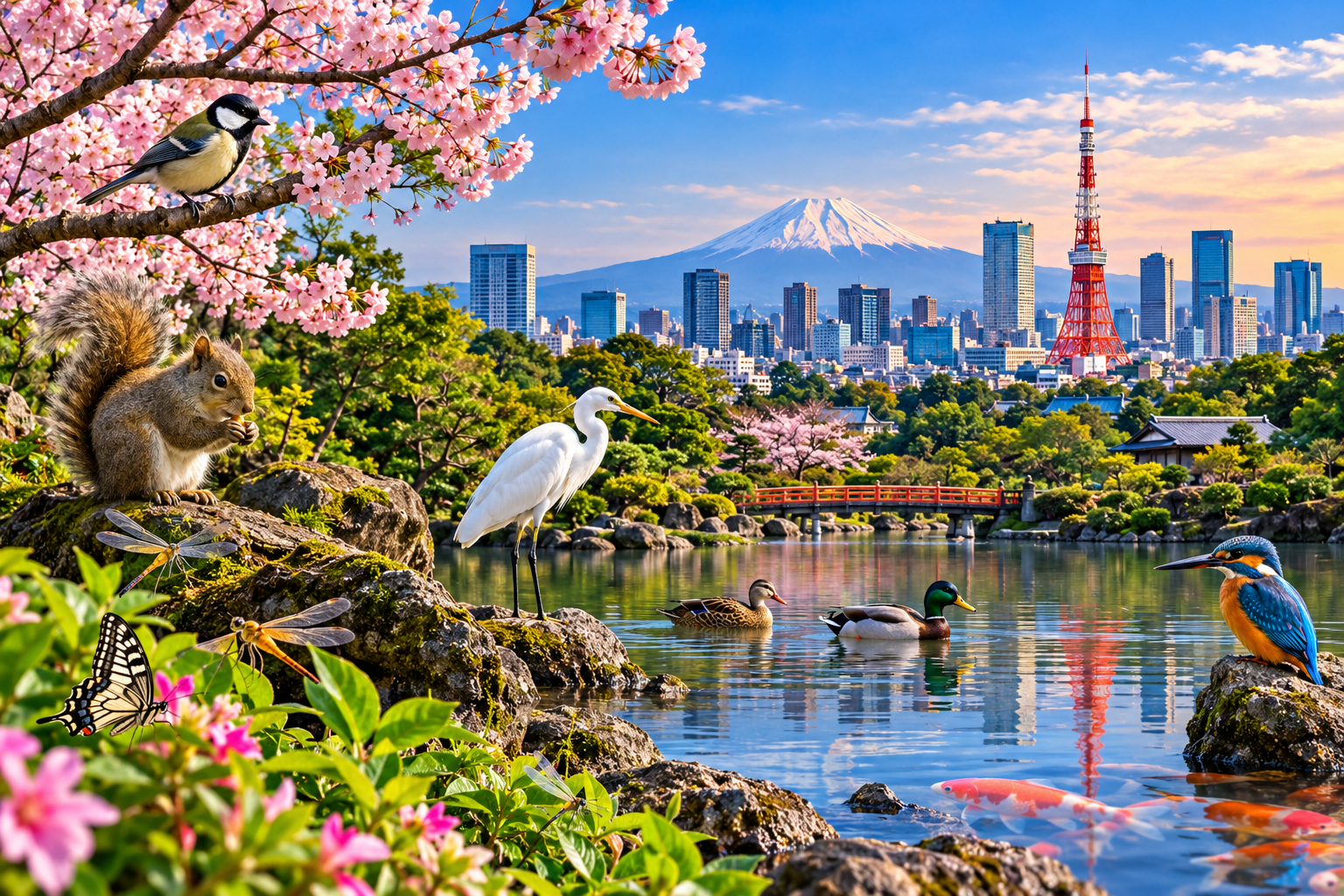
Tokyo Wildlife: 15 Incredible Animals, Wild Places & Essential Tips for Exploring Nature in Tokyo
What comes to mind when you picture Tokyo—towering skyscrapers, packed railway stations, neon streets, and endless shopping? Tokyo wildlife is far more diverse than many visitors expect, with birds, mammals, insects, reptiles, amphibians, and marine species living across forests, parks, rivers, wetlands, islands, and coastal habitats. From urban birdwatching in city parks to subtropical wildlife in the Izu Islands and remote natural areas administered by Tokyo, exploring Tokyo wildlife reveals a quieter and surprisingly biodiverse side of Japan’s capital Tokyo Maps
Understanding Tokyo’s Wildlife Geography
Tokyo Is More Than the Urban Core
One of the biggest mistakes people make when researching Tokyo wildlife is treating Tokyo as if it were simply the built-up central city.
Tokyo’s administrative boundaries encompass a remarkable range of landscapes.
In western Tokyo, the terrain rises toward the mountains of the Okutama region. Forests, valleys and rivers provide habitat for many species associated with woodland and mountain ecosystems.
Central Tokyo contains smaller but important green spaces. Parks, temple grounds, gardens, cemeteries, waterways and tree-lined streets can function as wildlife corridors.
The eastern and southern portions of the metropolitan area include rivers, wetlands and coastal habitats.
Then there are Tokyo’s islands, including the Izu Islands and the much more distant Ogasawara Islands. These environments add another dimension to the meaning of Tokyo wildlife.
Why Habitat Diversity Matters
Wildlife diversity depends heavily on habitat diversity.
A forest can provide nesting sites, shelter and food for woodland species. Wetlands can support waterbirds. Rivers provide aquatic habitats and feeding areas. Coastal environments support marine organisms and seabirds.
Even an urban park can provide valuable ecological functions when it contains:
- Mature trees
- Native vegetation
- Ponds
- Streams
- Shrub layers
- Leaf litter
- Nesting cavities
- Undisturbed corners
This is why a city that appears heavily urbanized can still support surprisingly complex wildlife communities.
The Main Types of Tokyo Wildlife
Birds
Birds are among the easiest forms of Tokyo wildlife for visitors to observe.
They are mobile, adaptable and often active in environments where larger mammals would avoid people.
Depending on location and season, birdwatchers may encounter species such as:
- Japanese tit
- Varied tit
- Oriental turtle dove
- White wagtail
- Eastern spot-billed duck
- Grey heron
- Little egret
- Great egret
- Black-backed gulls
- Cormorants
- Kingfishers in suitable habitats
- Various migratory birds
Bird diversity tends to increase around water, mature vegetation and quieter green spaces.
Mammals
Large terrestrial mammals are not typical sights in central Tokyo, but mammals are certainly part of the wider ecosystem.
The mountainous western areas can support species associated with Japanese forest environments.
Smaller mammals are more likely to be encountered in developed areas.
Urban wildlife may include:
- Squirrels
- Bats
- Rats
- Mice
- Japanese raccoon dogs in suitable areas
- Other small nocturnal mammals
The likelihood of seeing these animals depends heavily on habitat, season and time of day.
Reptiles and Amphibians
Tokyo’s warmer seasons can bring reptiles and amphibians into view.
Depending on habitat, visitors may encounter:
- Frogs
- Toads
- Lizards
- Skinks
- Snakes
These animals are usually much harder to observe than birds because they often remain hidden in vegetation, under rocks, around ponds or in forest environments.
Insects
If you enjoy nature photography, insects can be one of the most rewarding categories of Tokyo wildlife.
Japan’s warm and humid summers create excellent conditions for insect activity.
Possible sightings include:
- Cicadas
- Dragonflies
- Butterflies
- Beetles
- Moths
- Bees
- Wasps
- Mantises
Cicadas are especially characteristic of the Japanese summer soundscape.
Their calls can become an unforgettable part of the Tokyo experience.
Marine Wildlife
Tokyo’s relationship with the ocean is easy to overlook.
Tokyo Bay contains extensive coastal and aquatic environments, while Tokyo’s islands extend far into the Pacific.
Marine wildlife can include:
- Fish
- Crabs
- Shellfish
- Sea turtles in appropriate island environments
- Seabirds
- Dolphins around certain island waters
- Whales in offshore environments
The exact species and likelihood of sightings depend greatly on location and season.
Tokyo Wildlife in Urban Parks
Why City Parks Matter
Tokyo’s major parks are not simply recreational spaces.
They can provide islands of habitat within a dense urban landscape.
Trees offer nesting and feeding opportunities. Ponds attract aquatic birds. Shrubs provide cover. Open lawns support insects and ground-feeding species.
For visitors, parks offer one of the easiest ways to begin exploring Tokyo wildlife without leaving the city.
Wildlife Watching in Meiji Jingu Forest
The forest surrounding Meiji Jingu provides a striking contrast with the surrounding urban environment.
The dense vegetation creates habitat for birds and insects while giving visitors the impression that they have temporarily left the city.
Early morning is particularly valuable for wildlife observation because:
- Bird activity is often higher.
- Human traffic can be lower.
- Temperatures may be more comfortable.
- Light can be better for photography.
- Wildlife may be easier to hear.
The important principle is to observe quietly rather than treating the forest like a zoo.
Wildlife Around Ueno Park
Ueno Park combines cultural attractions with extensive vegetation and water features.
Its urban location makes it convenient for casual wildlife observation.
Visitors can watch birds around ponds and trees while enjoying museums, temples and other attractions nearby.
This makes Ueno especially useful for travelers who have limited time.
Wildlife in Shinjuku Gyoen
Shinjuku Gyoen demonstrates how carefully managed landscapes can still provide ecological value.
Its combination of trees, lawns, ponds and gardens creates different microhabitats.
For photographers, the park can be particularly interesting because the wildlife experience changes considerably between spring, summer, autumn and winter.
Imperial Palace Green Spaces
The green areas around the Imperial Palace are another important urban habitat.
Woodlands, moats and surrounding vegetation create opportunities for birdwatching.
The contrast is remarkable: modern buildings can be visible in the distance while wildlife occupies trees and waterways nearby.
Tokyo Wildlife in Rivers and Wetlands
Why Rivers Attract Animals
Rivers provide water, food and movement corridors.
Tokyo’s waterways can therefore become productive wildlife habitats.
Look carefully around:
- Riverbanks
- Reed beds
- Mudflats
- Bridges
- Shallow water
- Vegetated edges
- Small ponds
Birds are particularly noticeable around these environments.
Waterbirds
Waterbirds are among the most visible wildlife along Tokyo’s waterways.
Herons may stand motionless near shallow water waiting for prey. Ducks can gather in calmer sections. Cormorants may be seen diving for fish.
The key is patience.
Wildlife does not perform on demand. A person who spends twenty quiet minutes in one location can sometimes observe more than someone who walks quickly through ten different places.
Tokyo Bay and Coastal Habitats
Tokyo Bay is heavily influenced by human development, but coastal ecosystems remain important.
Mudflats, tidal areas, reclaimed landscapes and shoreline vegetation can support aquatic organisms and birds.
Coastal wildlife is especially interesting because it demonstrates the connection between Tokyo’s urban environment and the larger Pacific ecosystem.
Tokyo Wildlife in Okutama
A Different Side of Tokyo
If central Tokyo feels like one enormous city, Okutama can feel like an entirely different world.
The western part of Tokyo contains mountainous landscapes, forests, rivers and valleys.
This is one of the most important areas to consider when searching for wildlife near Tokyo.
Forest Animals
Mountain forests can support a wider range of wildlife than heavily urbanized districts.
Potential sightings include birds, insects, amphibians and mammals.
However, visitors should not expect guaranteed encounters.
Wild animals generally avoid people, and some are primarily active during dawn, dusk or nighttime.
Wildlife Photography in Okutama
Okutama can be particularly rewarding for photographers interested in:
- Forest birds
- Butterflies
- Dragonflies
- Mushrooms
- Mountain vegetation
- Reptiles
- Amphibians
- Landscape-wildlife combinations
A telephoto lens is often more useful than trying to approach animals closely.
Tokyo Wildlife on the Izu Islands
Why the Islands Are Different
Tokyo’s island territories dramatically expand the meaning of Tokyo wildlife.
The Izu Islands are influenced by oceanic conditions and have ecosystems that differ from mainland Tokyo.
Visitors can encounter distinctive birdlife, marine organisms and subtropical vegetation.
The islands are particularly valuable for travelers who want nature experiences rather than conventional city sightseeing.
Birdwatching on the Islands
Island environments can be excellent for birdwatchers because isolation can produce distinctive ecological communities.
Some islands also serve as important breeding or resting areas for seabirds.
Before visiting, research current access conditions and local conservation requirements because island ecosystems can be especially sensitive to disturbance.
Ogasawara Islands and Unique Wildlife
A Remarkable Ecosystem
The Ogasawara Islands are one of the most ecologically distinctive parts of Tokyo.
Their isolation has contributed to the evolution of species found nowhere else.
This phenomenon is one reason the islands are internationally recognized for their natural value.
Endemic Species
Endemic wildlife is especially important because species with extremely restricted ranges can be vulnerable to environmental changes.
Visitors may encounter or learn about distinctive birds, insects, plants and marine life.
The islands therefore represent a different type of wildlife experience from urban Tokyo.
Instead of simply looking for animals, visitors can learn how geography, isolation and evolution interact.
Conservation Challenges
Island ecosystems are often vulnerable to introduced species.
A plant, insect, predator or pathogen that arrives from another ecosystem can create serious ecological problems.
That is why biosecurity and visitor behavior matter so much on remote islands.
Seasonal Tokyo Wildlife Guide
Spring Wildlife
Spring brings increasing wildlife activity as temperatures rise.
Birdsong becomes more noticeable, insects begin appearing, and vegetation provides new food and shelter.
Spring is especially attractive for visitors who want to combine wildlife observation with flowering landscapes.
Summer Wildlife
Summer can be one of the most active periods for insects and many other small animals.
Cicadas become especially prominent.
Dragonflies and butterflies can be abundant around suitable habitats.
However, summer heat and humidity can make long wildlife walks physically demanding.
Early morning is often the most comfortable period.
Autumn Wildlife
Autumn creates a different wildlife atmosphere.
Migratory birds may appear, insects remain active during warmer periods, and forests begin changing color.
For photographers, autumn offers the advantage of combining wildlife with dramatic foliage.
Winter Wildlife
Winter does not mean Tokyo becomes wildlife-free.
Some birds remain active, while migratory species may make certain habitats especially interesting.
Leafless trees can also make birds easier to spot.
Winter wildlife watching has another advantage: cooler conditions can make longer walks more comfortable.
Best Times of Day for Tokyo Wildlife
Early Morning
Early morning is often the strongest general recommendation for wildlife observation.
Animals can be more active before temperatures rise and before parks become crowded.
Birdsong is also easier to hear when background noise is lower.
Late Afternoon
Late afternoon can provide another useful observation period.
As temperatures fall, some animals become active again.
Golden-hour lighting can also improve photography.
Nighttime Wildlife
Nocturnal wildlife is an entirely different experience.
Bats, insects and some mammals become active after dark.
However, nighttime wildlife observation should only be undertaken where it is safe and permitted.
Avoid entering restricted forest areas or walking unfamiliar mountain trails after dark.
How to Watch Tokyo Wildlife Responsibly
Keep Your Distance
The best wildlife encounter is one where the animal remains comfortable.
Never chase an animal for a photograph.
If an animal changes its behavior because of your presence, you are probably too close.
Do Not Feed Wild Animals
Feeding wildlife can create several problems.
Animals can become dependent on humans, lose natural fear, gather unnaturally, or consume inappropriate food.
It can also create conflict between wildlife and local communities.
Avoid Loud Sounds
Wildlife observation works best when you become part of the background rather than the disturbance.
Keep voices low and avoid sudden movements.
Stay on Appropriate Trails
Trails exist partly to reduce human impact.
Walking off-trail can damage vegetation, disturb nests and breeding sites, and expose sensitive habitats to unnecessary pressure.
Never Touch Wildlife
Even apparently harmless animals should not be handled.
Touching wildlife can stress the animal and can also expose people to bites, scratches or other risks.
Essential Wildlife Photography Tips
Use a Telephoto Lens
A long lens allows you to photograph animals without moving unnecessarily close.
This is better for both photography and conservation.
Avoid Flash Around Wildlife
Flash photography can disturb animals, particularly nocturnal species.
Natural light is generally preferable.
Photograph Behavior
Instead of collecting only portraits, try documenting behavior.
Interesting subjects include:
- Feeding
- Flying
- Nest building
- Grooming
- Courtship
- Swimming
- Hunting
- Interaction between species
Behavioral photographs often tell a stronger story than simple close-ups.
Be Patient
Wildlife photography rewards patience more than expensive equipment.
Find a suitable location, stay quiet and observe.
Sometimes the best photograph happens after thirty minutes of apparently nothing happening.
Tokyo Wildlife for Families
Easy Wildlife Experiences
Families do not necessarily need a long mountain hike to enjoy Tokyo wildlife.
Urban parks can provide accessible introductions to nature.
Children can look for:
- Birds
- Butterflies
- Dragonflies
- Fish
- Frogs
- Squirrels
- Seasonal insects
A simple wildlife checklist can turn an ordinary park visit into an educational adventure.
Teaching Children About Wildlife
Encourage children to ask questions such as:
What does this animal eat?
Where does it sleep?
Why is it here?
What would happen if its habitat disappeared?
These questions transform wildlife viewing from entertainment into environmental education.
Tokyo Wildlife for Birdwatchers
Beginner Birdwatching
You do not need professional equipment to start.
A small pair of binoculars and a field guide can be enough.
Start by learning to recognize common birds rather than immediately searching for rare species.
Intermediate Birdwatching
Once you become familiar with common birds, begin recording:
- Date
- Location
- Weather
- Time
- Species
- Behavior
- Habitat
Over time, your notes can reveal seasonal patterns.
Advanced Birdwatching
Experienced birders may focus on migration, unusual sightings, island species and habitat-specific birds.
Tokyo’s geographic variety provides opportunities to study urban, freshwater, forest and marine bird communities within the broader metropolitan region.
Tokyo Wildlife for Nature Photographers
Urban Wildlife Photography
Urban wildlife photography is an excellent starting point.
You can photograph birds against skyscrapers, insects among ornamental flowers or waterbirds reflected in city ponds.
These images communicate an important ecological message: wildlife and cities are not always separate worlds.
Forest Photography
Forest environments create opportunities for atmospheric images.
Rather than photographing only individual animals, consider wider compositions showing:
- Animal plus habitat
- Animal plus landscape
- Animal tracks
- Feeding areas
- Seasonal vegetation
Marine Wildlife Photography
Marine photography requires additional planning.
Weather, sea conditions, boat schedules and local rules can all affect the experience.
Safety should always take priority over obtaining a photograph.
Common Tokyo Wildlife Mistakes
Mistake 1: Expecting Zoo-Like Encounters
Wildlife does not appear on a schedule.
Solution: Choose habitat-rich locations and spend more time in fewer places.
Mistake 2: Visiting at the Wrong Time
Midday crowds and heat can reduce the quality of wildlife observation.
Solution: Try early morning or late afternoon.
Mistake 3: Getting Too Close
Approaching animals may cause stress.
Solution: Use binoculars or a telephoto lens.
Mistake 4: Searching Only Central Tokyo
Central Tokyo is convenient, but it does not represent all of Tokyo’s biodiversity.
Solution: Consider western Tokyo, rivers, coastal environments and islands.
Mistake 5: Ignoring Seasonality
The species you see in January may be very different from those active in July.
Solution: Research seasonal wildlife before your trip.
Challenges Facing Tokyo Wildlife
Urban Development
Development can fragment habitats.
Even when individual green spaces remain, wildlife may struggle if those spaces are isolated.
Pollution and Water Quality
Aquatic ecosystems are particularly sensitive to environmental changes.
Healthy rivers and coastal environments require sustained management.
Invasive Species
Introduced species can compete with native wildlife for food and habitat.
On islands, the effects can be especially severe.
Climate Change
Changing temperatures and weather patterns can affect:
- Migration
- Breeding seasons
- Insect emergence
- Plant flowering
- Food availability
- Distribution of species
These changes can create ecological mismatches when species respond differently to environmental shifts.
Pros and Cons of Exploring Tokyo Wildlife
Advantages
Tokyo wildlife offers several significant benefits:
- Easy access: Many wildlife experiences are reachable without leaving the metropolitan area.
- Habitat diversity: Forests, rivers, parks, wetlands, coastlines and islands provide varied environments.
- Seasonal variety: Wildlife changes throughout the year.
- Educational value: Tokyo demonstrates how urban development and biodiversity can coexist.
- Photography opportunities: The combination of wildlife and city landscapes creates distinctive images.
- Family-friendly options: Parks offer accessible introductions to nature.
- Island biodiversity: Tokyo’s islands provide exceptional ecological experiences.
Limitations
There are also practical limitations:
- Wildlife sightings are unpredictable.
- Some natural areas require considerable travel.
- Weather can affect outdoor activities.
- Certain habitats have access restrictions.
- Sensitive ecosystems require strict visitor behavior.
- Central Tokyo does not offer the same wildlife diversity as mountain or island environments.
The key is to approach Tokyo wildlife as nature observation rather than an animal-spotting guarantee.
Ten Tokyo Wildlife Experience Categories Compared
The following comparison is more useful than ranking individual parks because different visitors have different goals.
| Wildlife Experience | Main Habitat | Best For | Accessibility | Wildlife Variety | Ideal Visitor |
|---|---|---|---|---|---|
| Meiji Jingu Forest | Urban forest | Birds and insects | High | Moderate | Beginners |
| Ueno Park | Park and pond | Birds and families | Very high | Moderate | Families |
| Shinjuku Gyoen | Garden and woodland | Birds and insects | High | Moderate | Photographers |
| Imperial Palace Green Areas | Woodland and waterways | Birdwatching | High | Moderate | City visitors |
| Tokyo Bay | Coastal habitat | Waterbirds and marine life | Moderate | High | Nature enthusiasts |
| Tama River | River ecosystem | Birds and aquatic life | Moderate | High | Birdwatchers |
| Okutama | Mountain forest | Forest wildlife | Lower | High | Hikers |
| Izu Islands | Island and marine habitats | Seabirds and marine life | Lower | High | Wildlife travelers |
| Ogasawara Islands | Subtropical island ecosystem | Endemic and marine species | Low | Very high | Serious nature travelers |
| Tokyo urban green corridors | Mixed urban habitat | Everyday wildlife | Very high | Moderate | Casual observers |
The comparison shows why there is no single definition of a Tokyo wildlife experience. A family may prefer an urban park, while an experienced naturalist may want to spend several days exploring remote island ecosystems.
Pairing Tokyo Wildlife With Different Traveler Needs
Tokyo Wildlife for First-Time Visitors
If this is your first trip, begin with accessible green spaces.
You can experience wildlife without dedicating an entire day to nature.
Combine a park visit with nearby cultural attractions.
Tokyo Wildlife for Families
Choose locations with easy walking routes, rest areas and multiple attractions.
Make wildlife observation into a scavenger hunt.
Tokyo Wildlife for Photographers
Prioritize early mornings, seasonal conditions and habitats with water or dense vegetation.
Carry spare batteries because wildlife photography often requires extended waiting.
Tokyo Wildlife for Birdwatchers
Focus on parks, rivers, wetlands and coastal environments.
Keep a species list and return to the same locations during different seasons.
Tokyo Wildlife for Hikers
Western Tokyo and mountainous areas offer a completely different experience.
Plan transportation, weather conditions and trail requirements before departure.
Tokyo Wildlife for International Travelers
Research local etiquette and conservation rules before visiting sensitive environments.
Remember that Tokyo’s natural areas can differ significantly from the dense city center shown in many travel guides.
A Practical Tokyo Wildlife Day Plan
Morning
Start early at a green space or water-rich habitat.
Spend at least an hour observing before moving to another location.
Midday
Use the middle of the day for museums, restaurants or cultural attractions.
This avoids spending the hottest part of the day waiting for wildlife activity.
Afternoon
Return outdoors during the later afternoon.
Look for birds, insects and other animals becoming active again.
Evening
If appropriate and permitted, explore an illuminated urban park or nearby natural environment without disturbing nocturnal wildlife.
Do not enter restricted areas.
How to Build a Tokyo Wildlife Trip
Step 1: Decide What You Want to See
Are you interested in birds, insects, mammals, marine life, forests or endemic species?
Your answer should determine your destination.
Step 2: Match Your Goal With Habitat
For birds, consider parks and waterways.
For forest species, consider western Tokyo.
For marine wildlife, look toward coastal and island environments.
For endemic wildlife, island ecosystems are particularly significant.
Step 3: Check the Season
Wildlife activity changes throughout the year.
A little research before your trip can dramatically improve your experience.
Step 4: Prepare Appropriate Equipment
A useful basic kit can include:
- Binoculars
- Camera
- Telephoto lens
- Comfortable walking shoes
- Water
- Weather protection
- Field guide
- Notebook or wildlife app
Step 5: Follow Local Rules
Rules exist to protect both wildlife and visitors.
Always respect closures, trail restrictions and protected areas.
The Hidden Value of Urban Wildlife
Wildlife Can Improve the City Experience
Urban nature can provide psychological and recreational benefits while creating habitat for other species.
A city park is not merely a decorative space.
It can act as a refuge, feeding area or ecological stepping stone.
Small Habitats Can Have Large Effects
A single pond may support insects and frogs.
A mature tree may provide nesting habitat.
A line of vegetation can help birds move between larger green areas.
This means conservation does not always require enormous wilderness areas.
A network of smaller habitats can also matter.
Future Trends in Tokyo Wildlife
Greater Interest in Urban Biodiversity
As travelers become more interested in sustainable tourism and nature experiences, urban wildlife is likely to receive more attention.
Tokyo is particularly well positioned for this because its natural environments exist alongside world-famous urban attractions.
Citizen Science
Technology is making it easier for ordinary people to document wildlife.
Smartphone cameras, identification applications and online biodiversity databases can help people record observations.
Citizen observations can also contribute to scientific understanding when collected responsibly.
More Wildlife-Friendly Urban Planning
Future urban development may increasingly consider:
- Green corridors
- Native planting
- Wildlife-friendly waterways
- Pollinator habitats
- Tree preservation
- Wetland restoration
Climate Adaptation
Climate change may alter which species can thrive in Tokyo.
Monitoring these changes will become increasingly important for conservation planners and researchers.
What Makes Tokyo Wildlife Special?
Tokyo wildlife is not special simply because unusual animals exist within the metropolitan boundary.
Its importance comes from the combination of urbanization and ecological diversity.
Few travelers expect one administrative region to include:
- Dense urban neighborhoods
- Historic gardens
- Large parks
- Rivers
- Coastal habitats
- Mountain forests
- Remote islands
- Subtropical ecosystems
- Highly distinctive endemic species
That geographical diversity makes Tokyo an unusually interesting destination for anyone who wants to understand how humans and wildlife share space.
FAQs
What wildlife can you see in Tokyo?
Visitors can see many types of wildlife, particularly birds, insects, aquatic animals, reptiles and smaller mammals. Forest and island environments can provide opportunities to observe additional species.
Are there wild animals in central Tokyo?
Yes. Central Tokyo contains parks, gardens, waterways and wooded areas that support wildlife. Birds and insects are among the easiest animals to observe.
Where can I see wildlife near Tokyo?
Good options include urban parks, river environments, coastal areas and the mountainous western part of Tokyo. More remote wildlife experiences are available on Tokyo’s islands.
Can you see monkeys in Tokyo?
Wild monkeys are not a normal sight in central Tokyo. Wildlife experiences involving larger mammals are more likely in suitable mountain or remote natural environments, and sightings are never guaranteed.
Are there wild deer in Tokyo?
Deer are associated with suitable natural habitats rather than ordinary central Tokyo streets and parks. Visitors should not assume that a Tokyo wildlife trip will involve seeing deer.
What birds can you see in Tokyo?
Depending on habitat and season, birdwatchers may encounter tits, doves, wagtails, ducks, herons, egrets, cormorants, gulls and various migratory species.
Is Tokyo good for birdwatching?
Yes. Tokyo offers urban parks, rivers, wetlands, coastal habitats, forests and islands, creating opportunities for both beginners and experienced birdwatchers.
What is the best season for Tokyo wildlife?
There is no single best season for every species. Spring and summer can be excellent for insects and active wildlife, autumn can be attractive for birds and forest habitats, while winter can provide interesting birdwatching opportunities.
What time of day is best for wildlife in Tokyo?
Early morning is generally one of the best periods because wildlife can be active and human disturbance may be lower. Late afternoon can also be productive.
Can children enjoy Tokyo wildlife?
Absolutely. Urban parks provide accessible opportunities to observe birds, insects, fish and other small animals without requiring difficult hikes.
Is wildlife photography allowed in Tokyo?
Photography is generally possible in many public natural areas, but visitors must follow location-specific rules. Avoid disturbing animals, nesting sites and protected habitats.
Should you feed wildlife in Tokyo?
No. Feeding wild animals can alter natural behavior, create dependence and cause conflicts. Observe animals without providing food.
Are there dangerous animals in Tokyo?
Most wildlife encounters are harmless when animals are given appropriate space. Nevertheless, visitors should follow local safety guidance, particularly in mountainous and remote areas.
Does Tokyo have marine wildlife?
Yes. Tokyo’s coastal environment and island territories are connected to the Pacific marine ecosystem and support a variety of marine organisms and seabirds.
Why are the Ogasawara Islands important for wildlife?
Their geographic isolation has contributed to distinctive ecosystems and endemic species. This makes conservation particularly important.
Can you see wildlife without leaving Tokyo?
Yes. Parks, gardens, rivers and other green spaces can provide wildlife encounters within the metropolitan area.
Conclusion
Tokyo wildlife offers a fascinating reminder that one of the world’s most densely developed metropolitan environments is also a place of remarkable ecological variety. From a bird moving through a city park to insects emerging during summer, waterbirds along rivers, forest species in Okutama and distinctive wildlife on remote islands, Tokyo’s natural world is much broader than its famous skyline suggests.The most rewarding approach is not to treat wildlife as another attraction that must be checked off a sightseeing list. Instead, slow down, choose the right habitat, visit at an appropriate time and give animals enough space to behave naturally.





One Comment