25 Authentic Tokyo Local Experiences: Discover Japan Beyond the Tourist Trail
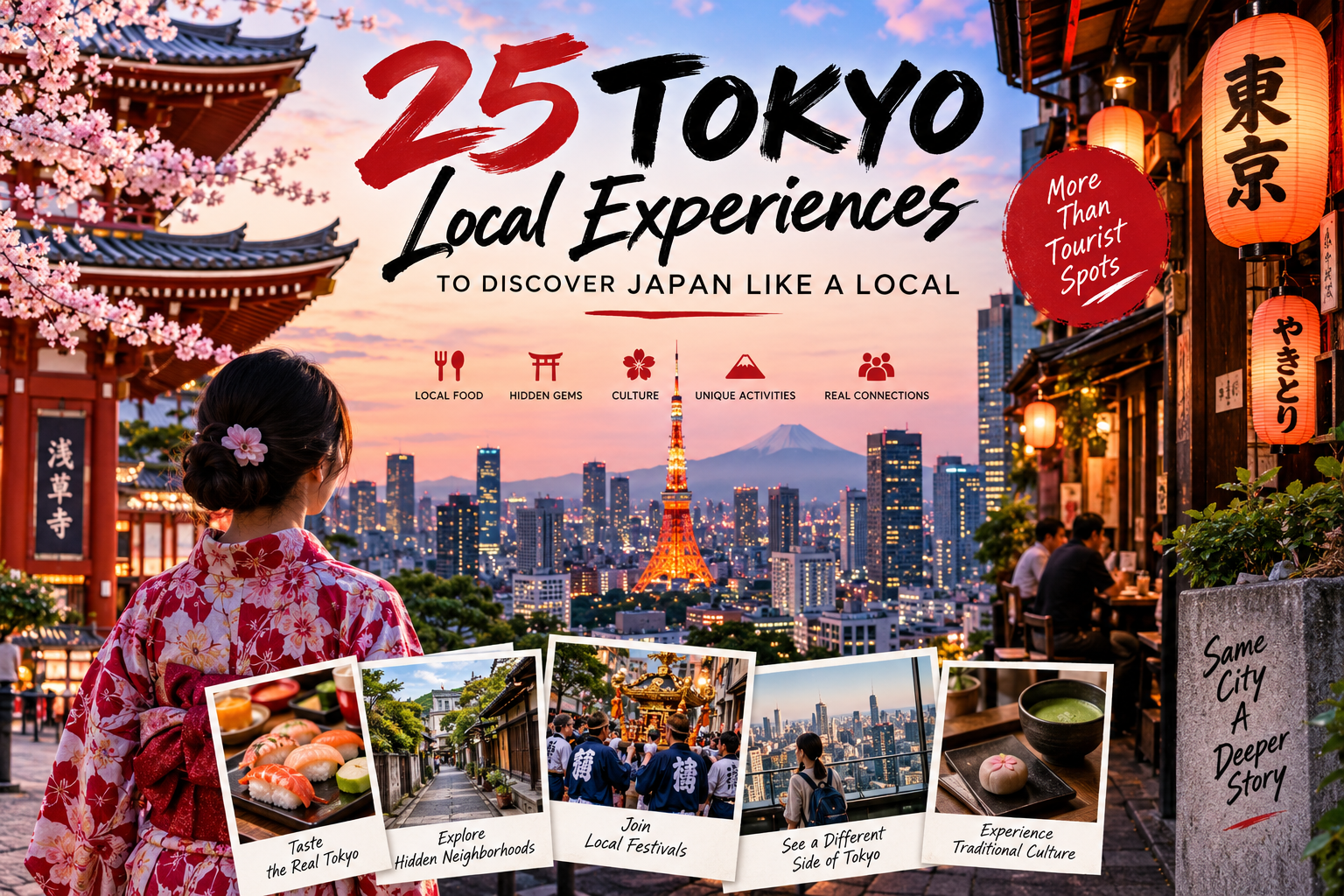
Tokyo local experiences let you see the city through its neighborhoods, food, crafts, traditions, markets, festivals, and everyday routines rather than only through famous landmarks. From neighborhood food walks and tea ceremonies to hands-on crafts, local shopping streets and quiet residential districts, Tokyo offers meaningful experiences for first-time visitors, families, solo travelers and returning Japan enthusiasts Travel Planning
What Are Tokyo Local Experiences?
Tokyo local experiences are activities that help visitors interact with the city’s neighborhoods, culture, food, traditions, crafts, people and everyday lifestyle.
They can be organized experiences, such as a cooking class or guided walking tour, but they do not have to be.
A local experience could be:
- Eating breakfast at a neighborhood restaurant
- Exploring a shotengai, or traditional shopping street
- Joining a small-group food tour
- Taking a Japanese cooking class
- Learning calligraphy
- Making a traditional craft
- Visiting a local festival
- Exploring Yanaka or Nezu on foot
- Cycling through quieter residential streets
- Drinking matcha in a traditional garden setting
- Visiting a local market
- Experiencing a public bath or onsen
- Watching a traditional performance
- Exploring Tokyo’s smaller museums
- Visiting independent cafés and bookstores
- Joining a neighborhood event
- Exploring Tokyo’s outer areas and natural landscapes
The important distinction is participation rather than observation.
Seeing a tea ceremony is interesting. Learning why the utensils are arranged in a particular way and participating in the ceremony creates a deeper memory.
Walking past a craft shop is sightseeing. Sitting with a craftsperson and making something yourself becomes an experience.
Why Tokyo Is Ideal for Local Experiences
Tokyo’s enormous size creates an unusual advantage for travelers.
The city is simultaneously a global metropolis and a collection of highly distinctive neighborhoods.
The Tokyo metropolitan government describes the prefecture as consisting of 23 special wards, 26 cities, five towns and eight villages, extending from densely developed urban districts to mountainous and island environments.
That means “Tokyo” does not describe one travel atmosphere.
Shibuya can feel completely different from Yanaka.
Shinjuku can feel completely different from Kiyosumi Shirakawa.
Asakusa can feel completely different from Shimokitazawa.
And the mountains around Okutama feel far removed from the image many international visitors have of Tokyo.
The official Tokyo tourism guide specifically highlights neighborhoods ranging from Harajuku, Shinjuku, Yanaka and Nezu to Akigawa Valley, while JNTO notes that many destinations on Tokyo’s outer fringes can be reached within roughly one to two hours from Shinjuku.
That diversity makes it possible to design a trip around interests rather than famous attractions.
The Difference Between Tourist Attractions and Local Experiences
There is nothing wrong with visiting Tokyo’s famous attractions.
The problem comes when an entire itinerary consists of them.
A landmark provides a visual memory. A local experience can provide context.
For example, visiting a famous temple might take an hour. Exploring the surrounding neighborhood, learning about the area’s history, eating a local snack and visiting nearby independent shops can turn that one-hour visit into half a day of discovery.
A useful way to think about it is:
| Traditional sightseeing | Local experience |
|---|---|
| See a landmark | Understand its neighborhood |
| Take photographs | Participate in an activity |
| Follow a fixed route | Explore at a slower pace |
| Visit famous shops | Discover independent businesses |
| Eat a famous dish | Learn where and how locals eat |
| Buy a souvenir | Make something yourself |
| Visit a major event | Attend a community event |
| Follow crowds | Explore secondary neighborhoods |
Neither approach is inherently better. They simply serve different purposes.
25 Best Tokyo Local Experiences
Explore a Traditional Shotengai
One of the easiest ways to experience everyday Tokyo is to visit a shotengai, a traditional neighborhood shopping street.
These streets can contain small restaurants, bakeries, grocery stores, cafés, clothing shops, specialty businesses and family-run stores.
Unlike major commercial districts, shotengai often reflect the rhythm of the surrounding community.
The official Tokyo tourism guide specifically identifies shotengai as an important part of Tokyo’s local food and cultural experience.
Instead of rushing through a shopping street, spend an hour observing:
- What people buy
- Which shops are busiest
- What foods are seasonal
- How stores display products
- Which businesses appear family-run
- Where older and younger residents interact
This can tell you more about everyday Tokyo than another large shopping mall.
Take a Tokyo Neighborhood Food Walk
Food is one of the strongest gateways into local culture.
Tokyo’s culinary identity is much broader than sushi and ramen. The city’s restaurants use ingredients from across Japan, while visitors can find traditional Japanese cuisine alongside modern food trends.
A neighborhood food walk could include:
- Soba
- Udon
- Yakitori
- Japanese curry
- Onigiri
- Wagashi
- Taiyaki
- Ramen
- Seasonal vegetables
- Local bakery items
- Matcha sweets
- Regional Japanese dishes
The key is to avoid turning the experience into a checklist.
Choose a neighborhood and sample several smaller foods rather than trying to eat at five famous restaurants.
Join a Japanese Cooking Class
A cooking class turns food from something you consume into something you understand.
Depending on the class, you might learn how to prepare sushi, ramen, wagashi, bento dishes or other Japanese foods.
Some experiences also combine shopping with cooking, allowing visitors to understand ingredients before they enter the kitchen.
Cooking classes can work particularly well for:
- First-time visitors
- Families
- Couples
- Solo travelers
- Food enthusiasts
- Travelers interested in Japanese culture
Current Tokyo experience listings include cooking classes alongside kimono, calligraphy, meditation and other traditional activities.
Experience a Tea Ceremony
Tea is more than a drink in Japanese culture.
A traditional tea experience can introduce visitors to concepts involving hospitality, seasonality, movement, utensils, space and attention.
The experience can range from a short introductory session to a more formal ceremony.
Because experiences differ considerably in price, duration and format, compare what is actually included rather than choosing solely on price.
One current Tokyo tea-experience comparison resource, for example, tracks differences in price, location, group/private formats, English support and optional additions.
Make a Traditional Japanese Craft
One of the most interesting developments in Tokyo travel is the increasing emphasis on hands-on cultural experiences.
Rather than simply purchasing a souvenir, travelers can make something themselves.
Tokyo’s official tourism guide recently highlighted workshops where visitors can work with experienced craftspeople and create souvenirs based on Japanese craftsmanship traditions.
Possible experiences include:
- Pottery
- Wind-bell making
- Washi paper
- Traditional textiles
- Calligraphy
- Mizuhiki
- Food-sample making
- Japanese sweets
- Ceramics
- Woodworking
The advantage is obvious: you leave with both an object and a story.
Explore Yanaka and Nezu
Yanaka and Nezu are useful areas for travelers who want a slower urban atmosphere.
Narrow streets, temples, small shops and older architectural elements create an atmosphere that feels very different from central business districts.
The official Tokyo walking-tour guide specifically highlights Yanaka and Nezu as areas with an old-town atmosphere.
A good approach is to walk without trying to see everything.
Look for:
- Small temples
- Independent cafés
- Traditional sweets
- Local stores
- Residential lanes
- Small galleries
- Neighborhood cats
- Cemeteries and historic spaces
- Local bakeries
The experience is about observation.
Discover Shimokitazawa’s Youth Culture
Shimokitazawa offers another side of Tokyo.
Instead of traditional Japan, the focus here is associated with contemporary youth culture, independent shops, music, vintage clothing and creative spaces.
It is particularly interesting for travelers interested in:
- Vintage fashion
- Independent music
- Alternative culture
- Cafés
- Second-hand shopping
- Small restaurants
- Creative communities
This is a useful reminder that “local Tokyo” does not always mean ancient Tokyo.
Modern culture is local culture too.
Experience Tokyo’s Anime and Manga Culture
For many younger travelers, anime and manga are not side attractions—they are a major reason for visiting Japan.
Akihabara remains strongly associated with otaku culture, while Harajuku is linked with street fashion. Shimokitazawa and Nakano are also recognized for modern youth culture.
A more meaningful anime experience might involve:
- Visiting specialty stores
- Exploring manga shops
- Looking for independent merchandise
- Visiting themed cultural spaces
- Exploring anime-related neighborhoods
- Learning about the history of Japanese animation
- Attending a relevant exhibition
Instead of simply taking photographs outside famous stores, spend time understanding the culture surrounding them.
Visit a Local Festival
Festivals provide one of the strongest opportunities to observe community life.
Tokyo’s annual calendar includes traditional festivals, seasonal celebrations, performances, markets and neighborhood events.
Autumn festivals are especially interesting because many are organized by local residents and can include portable shrine processions, folk dances and traditional markets.
If you attend a festival:
- Observe before participating
- Follow local instructions
- Dress appropriately
- Avoid blocking processions
- Ask before photographing people closely
- Dispose of rubbish properly
- Respect religious spaces
A festival is not a theme park. It is part of community life.
Explore Tokyo’s Local Markets
Markets offer another window into everyday food culture.
Rather than visiting only major tourist-oriented markets, consider exploring smaller neighborhood markets.
Pay attention to:
- Seasonal produce
- Fish
- Pickles
- Sweets
- Prepared foods
- Regional ingredients
- Local shopping habits
The objective isn’t necessarily to buy something.
The objective is to understand what people eat and how food moves through the neighborhood.
Try a Local Public Bath Experience
Bathing culture is an important part of Japanese everyday life.
A public bath experience requires more cultural awareness than simply visiting a spa.
Visitors should learn the basic etiquette before entering:
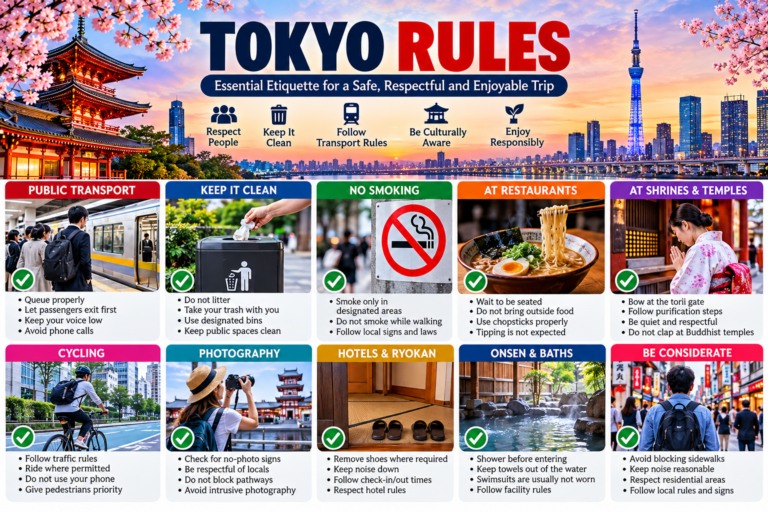
- Wash before entering the bath.
- Keep towels out of the bathing water.
- Follow the facility’s rules.
- Keep voices relatively quiet.
- Respect other bathers’ privacy.
- Follow tattoo policies where applicable.
Some establishments have different rules, so check them before visiting.
Visit a Japanese Garden Slowly
Tokyo has impressive gardens, but many travelers rush through them.
Instead, treat a garden as an experience rather than a checklist.
Notice:
- Seasonal plants
- Water
- Stones
- Bridges
- Architectural details
- Paths
- Framing of views
- Changing light
A garden visit becomes particularly rewarding when combined with tea or another cultural activity.
Official Tokyo volunteer guides offer routes combining Japanese gardens, tea, food, craftsmanship and Japanese culture, demonstrating how several local experiences can be connected in one itinerary.
Try Calligraphy
Calligraphy is accessible even to complete beginners.
The appeal isn’t necessarily producing a perfect character.
It is experiencing the deliberate movement, tools and concentration involved.
A beginner workshop can be especially enjoyable for travelers looking for a calm activity after several busy days of sightseeing.
Learn About Japanese Traditional Performing Arts
Tokyo provides opportunities to experience traditional performing arts alongside contemporary entertainment.
Depending on timing, visitors may encounter:
- Kabuki
- Noh
- Traditional music
- Dance
- Rakugo
- Sumo-related experiences
Look at the performance format before buying tickets because some productions are easier for international visitors to understand than others.
Explore Kiyosumi Shirakawa
Kiyosumi Shirakawa is useful for travelers interested in a combination of:
- Contemporary cafés
- Art
- Gardens
- Independent businesses
- Residential Tokyo
It demonstrates how Tokyo’s local identity can evolve without completely abandoning its older character.
Walk Through Koenji
Koenji offers a different version of Tokyo’s creative scene.
It is known for independent culture, music, second-hand stores and small businesses.
For travelers who dislike heavily packaged tourism, this type of neighborhood can be particularly appealing.
Walk slowly and allow yourself to enter stores that look interesting rather than following a rigid itinerary.
Explore Nakano
Nakano is particularly interesting for visitors interested in Japanese pop culture but who want to look beyond the most famous districts.
The area combines:
- Shops
- Restaurants
- Residential neighborhoods
- Pop-culture businesses
- Local nightlife
The contrast between ordinary neighborhood life and specialized entertainment businesses is part of the attraction.
Take a Cycling Tour
Cycling provides a different perspective because you can cover more ground than walking while still experiencing the street environment.
Some Tokyo cycling experiences deliberately focus on backstreets, neighborhood food and everyday life rather than major landmarks.
Cycling can be particularly useful for:
- Returning visitors
- Active travelers
- Photography enthusiasts
- Travelers who want neighborhood exploration
- People interested in urban design
Always follow local traffic rules and use reputable operators where appropriate.
Explore Tokyo’s Waterfront
Tokyo’s relationship with water is often overlooked.
The city has waterfront districts, rivers, canals and bayside neighborhoods that reveal a different side of the metropolis.
Water-based experiences can include:
- Walking
- Cruises
- Waterfront photography
- Parks
- Architecture
- Local dining
- Bridges and urban landscapes
Tokyo’s official guide includes waterfront walking routes and water-bus itineraries among its suggested experiences.
Take a Day Trip to Okutama
Tokyo isn’t entirely concrete.
The western part of the prefecture extends into mountainous landscapes, and Okutama offers hiking, rivers and outdoor activities.
JNTO describes Tokyo’s outer areas as offering mountain trails, nature and other experiences, with many locations reachable from central Tokyo within approximately one to two hours.
This is one of the best ways to understand how geographically diverse Tokyo actually is.
Visit a Local Sake Brewery
For adult travelers interested in Japanese food culture, a brewery visit can provide insight into:
- Rice
- Water
- Fermentation
- Regional production
- Traditional techniques
- Modern brewing
The focus can remain educational and cultural rather than centered on drinking.
Explore Independent Bookstores
Tokyo’s relationship with books is another experience that can easily be missed.
Instead of visiting only giant commercial stores, look for neighborhood bookstores, specialist shops and independent spaces.
This can reveal interests that are not obvious from mainstream tourism:
- Japanese literature
- Art books
- Photography
- Manga
- Architecture
- Design
- Travel
- Local history
Spend an Hour in a Neighborhood Café
This sounds almost too simple.
That’s exactly why it works.
Choose a café outside the busiest tourist zones, order something appropriate and spend time observing.
Tokyo is a city where slowing down can reveal details that rushing past attractions cannot.
Best Tokyo Neighborhoods for Local Experiences
| Neighborhood | Experience Style | Best For |
|---|---|---|
| Yanaka | Traditional, relaxed | First-time visitors |
| Nezu | Historic, quiet | Culture lovers |
| Asakusa | Traditional | Families and beginners |
| Shimokitazawa | Creative, modern | Young travelers |
| Koenji | Music and independent culture | Alternative travelers |
| Nakano | Pop culture + local life | Anime fans |
| Kiyosumi Shirakawa | Cafés, gardens, art | Slow travelers |
| Kagurazaka | Food and historic streets | Couples and food lovers |
| Shibamata | Old Tokyo atmosphere | History enthusiasts |
| Okutama | Nature and hiking | Outdoor travelers |
These neighborhoods should not be treated as rigid categories. Tokyo’s strength is precisely that different experiences overlap.
Tokyo Local Experiences for First-Time Visitors
First-time visitors often worry that they need to “see everything.”
They don’t.
A better strategy is to combine major attractions with one local experience each day.
For example:
Day One
Major landmark + neighborhood food walk.
Day Two
Traditional attraction + tea or craft workshop.
Day Three
Modern district + independent café and shopping street.
Day Four
Cultural experience + quieter neighborhood.
Day Five
Outer Tokyo nature experience or cycling tour.
This approach provides structure without turning the trip into a race.
Tokyo Local Experiences for Families
Families should prioritize activities where children can participate.
Good options include:
- Food-making workshops
- Craft workshops
- Japanese sweets
- Anime and manga experiences
- Gardens
- Interactive museums
- Local festivals
- Short cycling experiences
- Cultural workshops
Hands-on experiences can be more memorable for children than long historical explanations.
Tokyo Local Experiences for Solo Travelers
Solo travelers have a major advantage: flexibility.
You can:
- Join a small food tour
- Take a cooking class
- Visit a café
- Explore bookstores
- Wander neighborhoods
- Attend cultural events
- Join a walking tour
- Spend an afternoon photographing streets
A solo trip can become much more social by choosing small-group experiences.
Tokyo Local Experiences for Couples
Couples can combine cultural activities with slower experiences.
Consider:
- Tea ceremony
- Japanese garden
- Craft workshop
- Neighborhood dinner
- Evening walk
- Cooking class
- Traditional performance
- Scenic river or waterfront experience
The strongest romantic experiences do not necessarily require expensive restaurants.
Often, sharing something new creates the memory.
Tokyo Local Experiences for Budget Travelers
Tokyo can be expensive, but local experiences do not automatically require a large budget.
Official Tokyo tourism guidance highlights free cultural facilities, affordable food, temples, shrines, markets and other low-cost activities.
Budget-friendly ideas include:
- Neighborhood walks
- Free festivals
- Public parks
- Shrines
- Local shopping streets
- Affordable noodle shops
- Free or low-cost cultural facilities
- Self-guided photography walks
- Local markets
The trick is to spend money on experiences that provide genuine participation rather than paying simply for a premium location.
Tokyo Local Experiences for Food Lovers
Food-focused travelers should think beyond famous restaurants.
Build a food experience around:
Breakfast
Try a neighborhood bakery, rice-based breakfast or casual Japanese restaurant.
Lunch
Look for soba, udon, curry, ramen or a set meal.
Afternoon
Explore sweets, matcha or wagashi.
Evening
Choose a neighborhood restaurant rather than automatically selecting a famous destination.
Tokyo’s culinary variety also makes it possible to accommodate different dietary requirements. The official tourism guide specifically discusses vegetarian, vegan and Muslim-friendly dining considerations.
Tokyo Local Experiences for Older Travelers
Older travelers may prefer experiences that balance walking with rest.
Good options include:
- Gardens
- Tea experiences
- Cultural workshops
- Museum visits
- Short guided walks
- Traditional performances
- Neighborhood cafés
- Scenic boat rides
Avoid packing too many distant neighborhoods into one day.
Tokyo Local Experiences for Travelers With Limited Time
If you have only 24 hours, don’t attempt to experience all of Tokyo.
Choose one area.
For example:
Morning: traditional neighborhood walk
Lunch: local restaurant
Afternoon: cultural workshop
Evening: neighborhood dinner
This produces a coherent experience rather than a collection of disconnected photographs.
How to Find Authentic Tokyo Local Experiences
Start With Neighborhoods, Not Attractions
Instead of searching:
“Best things to do in Tokyo”
try searches such as:
- Tokyo neighborhood experiences
- Yanaka local food
- Tokyo craft workshop
- Tokyo cooking class
- Tokyo local festival
- Tokyo shotengai
- Tokyo cultural workshop
- Tokyo neighborhood walking tour
- Tokyo traditional crafts
This changes the type of information you discover.
Look for Small Group Activities
Small groups generally allow more interaction.
Before booking, check:
- Group size
- Duration
- Meeting location
- Language
- Cancellation policy
- Accessibility
- What is included
- Whether transportation is included
- Whether photography is permitted
Read the Description Carefully
“Authentic” is an attractive marketing word, but it does not automatically tell you what the experience involves.
Look for concrete details.
Who runs it?
Where does it take place?
How long has the operator been doing it?
Is the activity actually hands-on?
Does the experience involve a local business?
Are there cultural explanations?
These questions are more useful than relying on the word “authentic.”
10 Tokyo Local Experience Brands and Platforms Compared
The following comparison focuses on the type of experience or discovery service, rather than declaring one company the overall best.
| Brand / Platform | Main Focus | Experience Style | Best For |
|---|---|---|---|
| GO TOKYO | Official Tokyo tourism | Cultural, neighborhood, events | Research and trip planning |
| JNTO | Japan tourism | Regional and responsible travel | Wider Japan context |
| Tripadvisor | Tours and activities | Large marketplace | Comparing many activities |
| Airbnb Experiences | Local activities | Host-led | Small-group experiences |
| DIG Tokyo Tours | Cycling and food | Neighborhood-focused | Active travelers |
| Tokyo in Season | Tea experiences | Tea-focused comparison | Tea enthusiasts |
| Tokyo Volunteer Guides | Cultural tours | Guided | Cultural exploration |
| Klook | Activities | Booking marketplace | Travelers comparing activities |
| Viator | Tours and activities | Global marketplace | Guided tours |
| GetYourGuide | Tours and activities | Booking marketplace | Flexible activity discovery |
Availability, prices and operators can change, so compare the current listing, inclusions and cancellation terms before booking.
For cultural research, the official Tokyo tourism guide is particularly useful because it categorizes experiences by culture, food, local shopping streets, crafts, traditional performing arts and other interests.
How to Compare Tokyo Local Experiences
Price should not be the only factor.
Use this framework:
| Factor | What to Check |
|---|---|
| Group size | Private, small group or large group |
| Duration | 1 hour, half day or full day |
| Location | Central or neighborhood |
| Participation | Watching or hands-on |
| Language | English or other support |
| Cultural depth | Basic introduction or detailed context |
| Local connection | Independent operator or large marketplace |
| Accessibility | Walking, stairs and transport |
| Seasonality | Available year-round or seasonal |
| Cancellation | Refund and rescheduling terms |
| Cost | Total price including extras |
| Souvenir | Included or additional |
| Photography | Allowed or restricted |
This method prevents a common mistake: comparing two experiences solely because they have similar names.
Why Hands-On Experiences Are Becoming More Important
Modern travelers increasingly want experiences that produce a memory rather than simply a photograph.
Tokyo’s recent tourism content reflects this direction.
In 2026, the official Tokyo tourism guide highlighted hands-on craft experiences where travelers can create their own souvenirs with experienced craftspeople.
The significance goes beyond souvenirs.
Hands-on experiences:
- Encourage slower travel
- Create direct cultural interaction
- Support skilled practitioners
- Give visitors context
- Reduce dependence on mass-produced attractions
- Create personal memories
The trend is particularly relevant for travelers who have already visited Tokyo once and want something different.
Responsible Tokyo Local Experiences
Authentic travel should also be responsible travel.
JNTO recommends considering less-traveled destinations and locally operated experiences because these can help support local communities and preserve regional traditions.
Visitors can contribute by:
- Spending money with independent businesses
- Respecting residential areas
- Avoiding unnecessary noise
- Following photography rules
- Not blocking narrow streets
- Using rubbish facilities correctly
- Respecting religious customs
- Booking legitimate operators
- Avoiding overcrowded spaces when alternatives exist
The idea is simple:
Experience the neighborhood without becoming a burden on the neighborhood.
Common Mistakes When Searching for Tokyo Local Experiences
Mistake: Confusing “Popular” With “Local”
A heavily reviewed activity can still be useful, but popularity does not automatically make something local.
Mistake: Packing Too Much Into One Day
Tokyo’s transport network makes it tempting to visit several distant districts.
The result can be hours spent moving between experiences.
Mistake: Treating Residential Areas Like Photo Sets
Residential neighborhoods are people’s homes.
Keep voices low, avoid entering private spaces and don’t photograph people without permission.
Mistake: Ignoring Seasonal Timing
Tokyo changes dramatically by season.
Cherry blossoms, summer festivals, autumn foliage and winter traditions create different experiences.
The city’s official calendar tracks seasonal festivals, exhibitions, markets and local events throughout the year.
Mistake: Booking Without Checking Language Support
Some activities are excellent but provide limited English instruction.
Check the language before booking if detailed explanations matter to you.
Mistake: Choosing Based Only on Photos
Beautiful photography can hide a very ordinary experience.
Read the actual itinerary.
Pros and Cons of Tokyo Local Experiences
Advantages
- More personal travel memories
- Better understanding of Japanese culture
- Opportunities to meet people
- Exposure to smaller neighborhoods
- Support for local businesses
- Greater variety beyond famous landmarks
- Activities suitable for repeat visitors
- Opportunities to learn practical skills
Possible Disadvantages
- Some experiences are expensive
- Language barriers can exist
- Quality varies between operators
- Some “local” activities are heavily commercialized
- Popular workshops can sell out
- Cultural etiquette may require preparation
- Traveling to less-central neighborhoods takes time
The solution is not to avoid organized experiences altogether.
Instead, evaluate them carefully.
The Best Way to Build a Tokyo Local Experience Itinerary
A strong itinerary should mix three categories:
One Cultural Experience
For example:
Tea ceremony, craft workshop, calligraphy or traditional performance.
One Neighborhood Experience
For example:
Yanaka, Nezu, Koenji, Shimokitazawa or another district.
One Everyday Experience
For example:
Local café, shopping street, market or casual restaurant.
This creates a balanced trip.
A Seven-Day Tokyo Local Experience Plan
Day One: Old Tokyo
Explore Asakusa and nearby traditional streets.
Focus on architecture, food and neighborhood atmosphere.
Day Two: Food and Markets
Choose a neighborhood food experience followed by a local market or shopping street.
Day Three: Craft and Culture
Take a hands-on workshop and explore nearby independent businesses.
Day Four: Modern Tokyo
Visit Shibuya or Harajuku, then explore a less-commercial nearby neighborhood.
Day Five: Youth Culture
Explore Shimokitazawa, Koenji or Nakano.
Day Six: Garden and Tea
Visit a Japanese garden and combine it with a tea experience.
Day Seven: Outer Tokyo
Travel toward Okutama or another suitable nature destination.
This itinerary deliberately avoids treating Tokyo as a single homogeneous city.
Tokyo Local Experiences by Problem-Solving Need
If You Hate Crowds
Choose:
- Yanaka
- Nezu
- Kiyosumi Shirakawa
- Smaller shopping streets
- Early-morning experiences
- Outer Tokyo
If You Want Japanese Culture
Choose:
- Tea
- Crafts
- Calligraphy
- Gardens
- Traditional performances
- Festivals
If You Want Affordable Activities
Choose:
- Walking tours
- Local festivals
- Markets
- Parks
- Neighborhood restaurants
- Free cultural facilities
If You Want Instagram-Friendly Experiences Tokyo local experiences
Choose:
- Japanese gardens
- Traditional streets
- Craft workshops
- Seasonal festivals
- Cafés
- Waterfront areas
But remember that the most photogenic experience is not necessarily the most meaningful one.
If You Want Authentic Food Tokyo local experiences
Prioritize:
- Neighborhood restaurants
- Local shopping streets
- Small food tours
- Cooking classes
- Seasonal dishes
If You Have Already Visited Tokyo
Move away from the standard route.
Explore:
- Koenji
- Shibamata
- Kiyosumi Shirakawa
- Yanaka
- Okutama
- Smaller local festivals
- Specialist workshops
The Role of Seasonality in Tokyo Local Experiences
Spring Tokyo local experiences
Spring is associated with cherry blossoms, but don’t stop there.
Look for:
- Seasonal food
- Gardens
- Local festivals
- Traditional spring celebrations
- Neighborhood walks
Summer Tokyo local experiences
Summer can be hot and humid, but it also brings festivals and evening activities.
Consider:
- Matsuri
- Evening walks
- Waterfront areas
- Indoor craft workshops
- Seasonal foods
Autumn Tokyo local experiences
Autumn is excellent for neighborhood festivals and foliage.
Tokyo’s official autumn festival guide highlights community-organized events across the city.
Winter Tokyo local experiences
Winter can be a good time for:
- Indoor workshops
- Tea experiences
- Museums
- Traditional food
- Illuminations
- Cultural performances
Future Trends in Tokyo Local Experiences
More Hyperlocal Tourism Tokyo local experiences
Instead of asking “What are the top attractions?”, travelers are increasingly interested in individual neighborhoods.
This benefits smaller businesses.
Growth of Hands-On Experiences Tokyo local experiences
Craft workshops, cooking classes and cultural activities are likely to remain attractive because they provide participation rather than passive sightseeing.
Tokyo’s 2026 tourism content already emphasizes hands-on craft experiences as a way to connect travelers with Japanese craftsmanship.
More Interest in Outer Tokyo
The city’s geographic diversity creates opportunities beyond the central wards.
Outdoor tourism around places such as Okutama gives travelers another interpretation of what Tokyo can be.
Technology Will Improve Discovery Tokyo local experiences
Digital maps, multilingual information, reservation systems and AI-assisted trip planning can make it easier to find smaller experiences.
But technology cannot replace cultural sensitivity.
A map can tell you where a neighborhood is.
It cannot automatically tell you how to behave respectfully there.
Local Experiences Will Become More Personalized
Future travelers are likely to search according to specific needs:
- Tokyo local experiences for solo travelers
- Tokyo local experiences for families
- Tokyo local food experiences
- Tokyo craft experiences
- Tokyo experiences for seniors
- Tokyo experiences for Muslim travelers
- Tokyo experiences for vegetarians
- Tokyo experiences for repeat visitors
- Tokyo experiences for budget travelers
- Tokyo experiences for photographers
This shift from generic tourism to problem-specific travel planning can make itineraries more useful.
How to Make Your Tokyo Experience More Meaningful
The most important rule is simple:
Don’t measure your Tokyo trip by how many places you visit. Measure it by how much you understand about the places you visit.
Spend longer in fewer neighborhoods.
Talk to guides.
Ask questions respectfully.
Learn basic Japanese expressions.
Try foods you have never encountered.
Join a workshop.
Walk away from the station.
Look beyond the famous street.
Sit in a café.
Observe.
Tokyo rewards curiosity.
FAQs
What are the best Tokyo local experiences for first-time visitors?
First-time visitors can combine a traditional neighborhood walk, local food experience, cultural workshop and Japanese garden or tea experience. This creates a balance between sightseeing and participation.
How can I experience Tokyo like a local?
Explore residential neighborhoods, visit shotengai, eat at neighborhood restaurants, use public transportation, attend local events and participate in cultural activities rather than spending your entire trip around major tourist attractions.
Are Tokyo local experiences expensive?
They vary significantly. Some neighborhood walks, festivals, markets, parks and cultural facilities can be free or inexpensive, while private workshops and specialist experiences can cost considerably more. Compare what is included before booking.
What is a good local experience in Tokyo for families?
Hands-on craft activities, cooking classes, Japanese sweets workshops, interactive museums, gardens and family-friendly cultural events can work well.
What are the best Tokyo local experiences for couples?
Tea experiences, Japanese gardens, cooking classes, craft workshops, neighborhood food walks and traditional cultural performances are possible options.
What can solo travelers do in Tokyo?
Solo travelers can join food tours, cooking classes, cultural workshops, cycling tours and walking tours. They can also explore cafés, bookstores, markets and independent shops at their own pace.
Where should I go in Tokyo for a traditional atmosphere?
Asakusa, Yanaka, Nezu and Shibamata can provide different versions of Tokyo’s historic and traditional character. The experience varies considerably between districts.
Where can I experience modern Tokyo culture?
Shibuya, Harajuku, Shimokitazawa, Koenji, Nakano and Akihabara offer different forms of contemporary culture, fashion, music, anime, manga and youth-oriented experiences.
Are Tokyo local experiences available in English?
Many tourist-oriented experiences offer English support, but availability varies. Check the language information for each activity before booking.
Should I book Tokyo cultural experiences in advance?
For popular workshops and limited-capacity cultural experiences, advance booking can be sensible. Tokyo’s official tourism guidance also recommends booking traditional cultural workshops in advance to secure a place.
What is a good Tokyo local experience for food lovers?
Consider a neighborhood food walk, cooking class, market visit or casual restaurant crawl focused on a specific district.
Can I find free local experiences in Tokyo?
Yes. Festivals, neighborhood walks, parks, temples, shrines, markets and selected cultural facilities can provide low-cost opportunities. Tokyo’s official tourism guide lists numerous free and affordable options.
What is the best season for Tokyo local experiences?
Every season offers different opportunities. Spring emphasizes seasonal nature, summer brings festivals, autumn offers foliage and community events, while winter is useful for indoor cultural activities and seasonal traditions.
Is Tokyo suitable for travelers who have already visited before?
Absolutely. Repeat visitors can focus on less familiar neighborhoods, local workshops, independent businesses, outer Tokyo and seasonal events.
What should I avoid when experiencing local Tokyo neighborhoods?
Avoid excessive noise, blocking narrow streets, entering private areas, photographing people without permission and treating residential communities as tourist attractions.
Are local experiences better than famous Tokyo attractions?
They serve different purposes. Famous attractions provide iconic sights and historical landmarks, while local experiences can provide deeper interaction with neighborhoods, food, crafts and everyday culture.
How do I find less touristy Tokyo experiences?
Search by neighborhood and interest rather than only by broad terms such as “best things to do in Tokyo.” Official tourism resources, local guides and specialized experience operators can help identify smaller activities.
Can Tokyo local experiences support local communities?
They can, particularly when visitors choose locally operated activities, independent businesses and experiences that respect local communities and traditions. JNTO explicitly encourages travelers to consider less-traveled destinations and locally operated experiences as part of responsible travel.
Conclusion
Tokyo local experiences offer a different way to understand one of the world’s most fascinating cities. The most memorable parts of a Tokyo trip may not always be the largest landmarks or busiest streets. They can be a quiet neighborhood café, a conversation with a craftsperson, a seasonal festival, a bowl of noodles in a small restaurant, a walk through an old shopping street or the experience of making something with your own hands. Tokyo’s enormous geographical and cultural diversity means travelers can build experiences around almost any interest

One Comment