
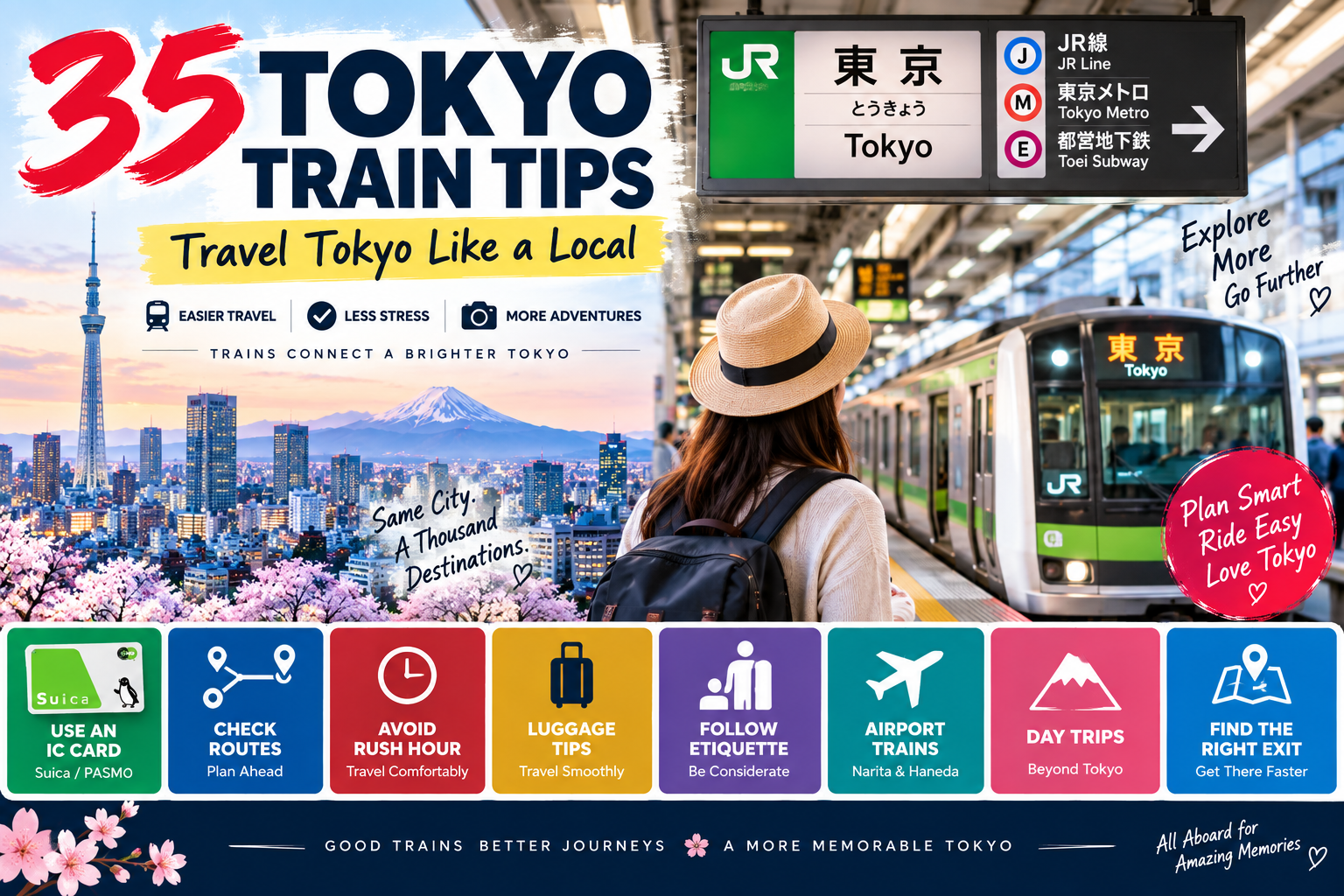
35 Tokyo Train Tips: Travel Tokyo Like a Local
Have you ever looked at a Tokyo train map and wondered how so many lines, colours, station numbers and operators can possibly work together? The good news is that Tokyo trains are much easier to use once you understand a few basic rules: choose the right operator, use an IC card, check the destination and platform carefully, allow extra time for large stations, and follow local boarding etiquette. With the right Tokyo train tips, even a first-time visitor can move around the city confidently, avoid unnecessary ticket problems and spend more time exploring instead of trying to understand the railway network Travel Advice
Understanding the Tokyo Train Network
Tokyo does not have one single railway system
One of the most important Tokyo train tips is to stop thinking of Tokyo’s railway as one company.
Several operators work across the metropolitan area. The main groups a visitor is likely to encounter include:
- JR East
- Tokyo Metro
- Toei Subway
- Tokyu Railway
- Odakyu Railway
- Keio Railway
- Seibu Railway
- Tobu Railway
- Keikyu Railway
- Keisei Railway
- Tokyo Monorail
- Yurikamome
- Rinkai Line
- Tsukuba Express
The official Tokyo tourism guide specifically lists many of these private railway companies and recommends researching the areas you intend to visit before deciding which lines or passes make sense.
This matters because a journey that looks like one trip on a map may actually involve two different operators.
For example, you might travel from a JR station to a Tokyo Metro station, change to another private railway and then walk to your final destination.
The important point is that you do not need to memorise every company.
You simply need to identify:
- Your starting station.
- Your destination.
- The railway or subway line you need.
- The direction of travel.
- Whether you need to change operators.
- Which station exit is closest to your destination.
JR and subway are not interchangeable
Visitors sometimes assume that JR trains and Tokyo Metro trains are essentially the same because both operate within Tokyo.
They are not.
JR East operates the JR network in eastern Japan, including Tokyo, while Tokyo Metro and Toei operate subway networks.
This distinction becomes important when buying tickets or choosing passes.
An unlimited subway ticket does not automatically mean unlimited travel on every JR or private railway line.
Similarly, a JR-oriented pass is not a universal Tokyo transport pass.
Tokyo Metro and Toei Subway are different operators
Another common beginner mistake is assuming that every underground train belongs to Tokyo Metro.
Tokyo’s subway system consists primarily of:
- Tokyo Metro
- Toei Subway
Tokyo Metro operates nine subway lines, while Toei operates the other major subway network.
You can often transfer between them, but the fare system and ticket arrangements can differ.
This is one reason an IC card is so useful.
The Most Important Tokyo Train Tip: Use an IC Card
Why an IC card makes Tokyo easier
For most visitors, using a rechargeable IC card is one of the simplest ways to pay for everyday train journeys.
Common names include:
- Suica
- Welcome Suica
- PASMO
- Mobile Suica
- Mobile PASMO
IC cards can be used across many participating railway and bus services, rather than requiring you to calculate the fare for every individual journey. The official Tokyo tourism guide explains that IC cards are rechargeable and usable on many major rail and bus services in Tokyo and elsewhere in Japan.
PASMO, for example, can be touched against a fare-gate reader when entering and leaving the subway. It can also be used for certain purchases at participating shops and vending machines.
Physical versus mobile IC cards
Depending on your phone, region, travel plans and availability, you may be able to use a mobile version instead of carrying a physical card.
Tokyo Metro notes that mobile IC cards such as mobile Suica and PASMO can be used on smartphones.
For international visitors, however, it is sensible to check your phone’s compatibility and payment setup before relying entirely on a mobile card.
A physical card can also be useful as a backup.
How to use an IC card
The process is simple:
- Charge the card.
- Touch it on the reader when entering.
- Take the train.
- Touch it again when leaving.
- The appropriate fare is deducted.
You do not normally need to calculate the fare before every journey.
Keep enough balance
One practical Tokyo train tip that saves stress is to check your balance before a long journey.
Running out of balance at the gate can create an unnecessary delay, especially when other passengers are moving behind you.
If necessary, recharge the card at a suitable machine.
Tokyo Metro also notes that IC cards can be charged at ticket vending machines.
Welcome Suica for visitors
JR East offers Welcome Suica, a tourist-oriented IC card. JR East currently lists sales locations including selected airports and major Tokyo stations, although availability and sales arrangements can change.
Because transport products can change, check the current official JR East information before travelling.
How to Read a Tokyo Train Station
Learn the station number
Tokyo Metro stations use a combination of a line symbol and station number.
For beginners, this can be easier than trying to recognise Japanese characters.
Tokyo Metro recommends checking the station name, station number and line colour when entering a station.
For example, instead of relying only on the written station name, you can verify:
- Line symbol
- Station number
- Colour
- Destination direction
This gives you several ways to confirm that you are in the right place.
Do not follow the crowd blindly
Tokyo stations can be busy enough that following everyone else feels tempting.
It is better to follow the signs.
A large crowd may be travelling in the same general direction but heading toward a different platform, exit or transfer.
Look for overhead signs showing:
- Line name
- Platform number
- Direction
- Destination stations
- Transfer information
- Exit numbers
Station exits matter more than beginners expect
Tokyo stations often have numerous exits.
Choosing the wrong one can turn a five-minute walk into a much longer journey.
When navigating to a hotel, restaurant or attraction, check the recommended station exit before leaving the platform area.
Tokyo Metro provides numbered exit information and vicinity maps, with exit signs written in Japanese and English.
Tokyo Train Tips for Buying Tickets
When should you buy a regular ticket?
A normal paper ticket can still be useful if:
- You do not have an IC card.
- Your card is unavailable.
- You are travelling on a route where your chosen payment method is not accepted.
- You specifically want a paper ticket.
Tokyo Metro ticket machines allow users to switch to English and search for destinations by station name or station number.
How to buy a paper ticket
The general process is:
- Find your destination.
- Check the fare.
- Select the fare amount.
- Pay.
- Collect your ticket and change.
- Insert the ticket at the gate.
- Retrieve it after entering.
- Keep it until you reach your destination.
If the fare was insufficient, you can generally use a fare-adjustment machine near the exit gates. Tokyo Metro explains that fare adjustment machines can be used when the purchased ticket does not cover the journey.
Why IC cards are usually simpler for tourists
The major advantage is convenience.
You do not need to repeatedly:
- Find the fare.
- Understand the fare table.
- Select the correct amount.
- Buy a ticket.
- Worry about small denominations.
For a multi-day Tokyo trip involving several train journeys, this can make the experience significantly easier.
Tokyo Train Tips for Transfers
Understand the difference between a transfer and an exit
One of the biggest sources of confusion is assuming that every transfer means leaving the railway system.
Sometimes you can change trains inside the paid area.
Sometimes you need to pass through a special transfer gate.
Sometimes changing operators involves a different ticketing process.
Tokyo Metro specifically identifies stations where passengers may need to use orange-coloured transfer gates when changing lines.
Watch for orange transfer gates
At certain stations, an orange transfer gate is used for transfers between lines.
Do not automatically walk through a normal exit gate.
Look for signs saying:
- Transfer
- のりかえ
- Orange transfer gate
- Line name
- Connecting railway
This small detail can prevent unnecessary fare problems.
Allow extra time at major stations
A journey planner may tell you that a transfer takes a few minutes.
That does not always mean a visitor unfamiliar with the station can complete it in the same amount of time.
Large stations such as:
- Shinjuku
- Tokyo
- Shibuya
- Ikebukuro
- Ueno
- Shinagawa
- Otemachi
can involve long walking routes, multiple levels and several exits.
If you have luggage or are travelling with children, build additional time into your schedule.
Do not schedule attractions too tightly
A common itinerary mistake is:
9:00 — hotel
9:30 — attraction
10:30 — second attraction
11:00 — another neighbourhood
Tokyo’s trains may be highly efficient, but your overall journey includes:
- Walking to the station.
- Finding the entrance.
- Finding the platform.
- Waiting for the train.
- Changing lines.
- Finding the correct exit.
- Walking from the station to the attraction.
Build realistic buffers.
Tokyo Train Tips for Rush Hour
When is Tokyo busiest?
Tokyo’s busiest periods generally occur around weekday commuting hours, although crowd levels vary by line, station and season.
The important lesson is not to treat every train at every time as equally crowded.
Some lines can be extremely busy while another route a short walk away may be more comfortable.
Avoid unnecessary rush-hour journeys
If your itinerary is flexible, consider sightseeing outside the busiest commuting periods.
This is especially helpful if you are:
- Travelling with children.
- Carrying large luggage.
- Using a stroller.
- Elderly.
- Uncomfortable in crowds.
- Taking photographs.
- Visiting Tokyo for the first time.
What to do if you encounter a crowded train
Do not panic.
Follow the platform markings.
Wait behind the yellow safety line and allow passengers to get off before boarding. Tokyo Metro explicitly advises passengers to wait behind the yellow warning blocks and let alighting passengers exit first.
Do not force your way into the carriage
During extremely busy periods, trains may be crowded.
If the carriage looks uncomfortably full, waiting for the next train can sometimes be easier than trying to squeeze inside.
Tokyo Train Etiquette You Should Know
Queue before boarding
Tokyo has marked waiting areas on many platforms.
Stand in the designated queue rather than forming your own position.
The official Tokyo travel guide recommends waiting in designated zones and staying behind the yellow line.
Let passengers exit first
This is one of the simplest rules.
Stand to the side.
Let people get off.
Then board.
Trying to enter before passengers have exited creates unnecessary congestion.
Keep backpacks under control
A backpack can take up considerable space in a crowded carriage.
Tokyo’s official guidance recommends keeping luggage from obstructing others. It also suggests wearing large backpacks in front or placing them between your legs where appropriate.
Avoid loud conversations
Tokyo trains are generally quieter than public transport systems in many other cities.
You do not have to remain completely silent, but loud conversations can disturb other passengers.
Avoid phone calls
The official Tokyo travel guide advises visitors to avoid talking on mobile phones while using public transportation.
Messaging, checking maps and using headphones are generally more appropriate.
Be aware of priority seating
Priority seats are intended for people who may need them, including elderly passengers, people with disabilities or illnesses, pregnant passengers and people travelling with infants.
Eating on trains
Eating and drinking on ordinary urban Tokyo trains is generally discouraged.
The official Tokyo travel guide specifically notes that eating or drinking on trains is generally frowned upon.
Long-distance trains can have different customs, so distinguish a city commuter train from an intercity or sightseeing service.
Tokyo Train Tips for Luggage
Large suitcases can change your route
A route that is perfect without luggage may be awkward with a large suitcase.
Consider:
- Elevator availability.
- Station size.
- Number of transfers.
- Walking distance.
- Crowding.
- Platform changes.
Use elevators where available
If you have:
- A heavy suitcase.
- A stroller.
- Mobility limitations.
- Young children.
look for elevator symbols rather than automatically taking stairs.
Tokyo Metro stations provide signs for elevators, escalators and other accessibility facilities.
Avoid blocking train doors
Standing directly in front of a train door with a large suitcase can obstruct passengers.
If the carriage is crowded, position luggage carefully and move deeper inside when appropriate.
Consider luggage delivery
For travellers moving between hotels, luggage forwarding can sometimes make the railway journey easier.
Instead of dragging large suitcases through Shinjuku or Tokyo Station, you may be able to send luggage ahead and travel with a smaller day bag.
Tokyo Train Tips for Families
Travel outside peak crowds when possible
Families often have a smoother experience outside the busiest commuting periods.
Plan children’s major activities during less crowded times where possible.
Keep children close on platforms
Tokyo stations can be extremely busy.
Hold hands with younger children and establish a simple family rule:
Stop at the platform entrance, identify the line, then move together.
Find the correct train before approaching the platform
Avoid standing directly at the edge of the platform while trying to figure out your route.
Use the signs away from the platform edge first.
Check for accessible routes
Parents with strollers should look for elevators.
Some stations are large enough that the accessible route may take longer than the stairs.
Planning this in advance reduces stress.
Tokyo Train Tips for First-Time Visitors
Start with simple routes
Do not make your first journey an unnecessarily complicated five-transfer trip.
For your first day, choose attractions connected by relatively simple routes.
This helps you understand:
- IC card use.
- Station signs.
- Platform directions.
- Transfers.
- Exit numbers.
Save your hotel station
Instead of memorising the hotel’s address, save the nearest station and the exact exit.
This is particularly useful at night.
Screenshot important routes
Mobile data can occasionally be slow or unavailable.
Before leaving your hotel, save:
- Destination station.
- Line name.
- Transfer station.
- Exit number.
- Hotel station.
A screenshot can be useful when you are underground.
Tokyo Train Tips for Using Navigation Apps
Use a journey planner
A good navigation app can calculate routes involving:
- JR
- Subway
- Private railways
- Walking
- Transfers
This is much easier than trying to understand the entire railway map manually.
Check the destination displayed on the train
Do not board simply because the line colour looks correct.
The train may terminate at a different destination or use a service pattern that changes your route.
Look at the destination display.
Check whether the service is local or express
Some private railway lines have different service types.
You may see terms such as:
- Local
- Rapid
- Express
- Limited Express
- Special Express
The fastest-looking train is not automatically the correct one.
Check whether it stops at your station.
Pay attention to platform signs
A platform may serve multiple destinations.
Read the electronic display rather than assuming every train uses the same stopping pattern.
Tokyo Train Tips for Night Travel
Know when the last train is
Tokyo is not a 24-hour railway city.
The official Tokyo tourism guide notes that many last trains are around 23:30 to 00:30, while first trains begin around 5:00, although exact times depend on the line and station.
Always check the specific route.
Do not rely on the final train of the night
If missing the last train would create a serious problem, do not plan to arrive at the station one minute before departure.
Allow a buffer.
Check the route before leaving a late-night venue
Before dinner or nightlife, look at:
- Last train time.
- Transfer times.
- Walking distance.
- Final destination.
- Alternative transport options.
This is particularly important if your hotel is outside central Tokyo.
Tokyo Train Tips for Airport Travel
Narita Airport is not in central Tokyo
Narita Airport is considerably farther from central Tokyo than Haneda Airport.
The correct train option depends on where you are staying.
Possible services include:
- Narita Express.
- Keisei services.
- Airport limousine buses.
- Other rail connections.
Haneda Airport is closer to central Tokyo
Haneda has several rail connections, including services associated with Keikyu and Tokyo Monorail.
Your best route depends on your hotel location.
Do not confuse Tokyo Station with Tokyo’s airports
A common first-time mistake is assuming that Tokyo Station is the main airport station.
It is a major railway hub, but airport transportation requires a specific airport route.
Leave more time for international departures
Airport journeys involve more than train travel.
You also need time for:
- Walking through the station.
- Finding the correct airport terminal.
- Check-in.
- Security.
- Immigration.
- Boarding.
Do not plan your airport train journey based solely on the advertised rail travel time.
Tokyo Train Tips for Shinkansen Travel
Shinkansen is different from ordinary city trains
The Shinkansen is Japan’s high-speed rail system.
Tokyo is a major Shinkansen hub and provides connections to destinations across Japan.
The official Tokyo travel guide notes that Shinkansen services connect Tokyo with major cities throughout the country.
Book ahead during busy periods
The official Tokyo tourism guide recommends advance booking because Shinkansen trains can become busy during weekends and holiday periods.
Understand the station
Shinkansen platforms may be within a large railway station but can involve separate gates and signs.
Do not simply follow signs saying “Tokyo Station”.
Look specifically for:
- Shinkansen
- Your train name
- Train number
- Departure time
- Platform number
Keep your ticket accessible
Do not put your train ticket somewhere difficult to reach while navigating a crowded station.
Keep it secure but accessible until the journey is complete.
Tokyo Train Tips for Day Trips
Choose the railway according to the destination
Different railways serve different regions.
For example:
- Odakyu is useful for destinations toward Hakone and western Tokyo.
- Tobu is useful for destinations toward Nikko and other areas.
- Keisei provides important connections toward Narita.
- Keikyu serves routes toward Haneda and southern destinations.
- JR East covers many Tokyo and eastern Japan routes.
The official Tokyo tourism guide highlights these private operators as important options for exploring Tokyo and destinations beyond it.
Do not automatically use JR
This is an important advanced Tokyo train tip.
A traveller who assumes “JR is always better” can sometimes create a longer or less convenient journey.
Choose the railway based on:
- Destination.
- Travel time.
- Number of transfers.
- Cost.
- Convenience.
- Pass coverage.
Check the return journey
For day trips, do not only plan the outbound journey.
Before leaving Tokyo, check:
- Last return service.
- Final connection.
- Station location.
- Whether your return train requires a reservation.
Comparing 10 Major Tokyo Railway Brands and Operators
The following comparison is designed to explain what each operator is commonly useful for rather than rank them.
| Railway / Operator | Main relevance to visitors | Common travel use | Key thing to remember |
|---|---|---|---|
| JR East | Major Tokyo and eastern Japan network | Tokyo, Shinjuku, Shibuya, Ueno, Yokohama, regional travel | JR services are separate from subway operators |
| Tokyo Metro | Tokyo subway | Central Tokyo sightseeing | Nine subway lines |
| Toei Subway | Tokyo subway | Central and eastern/southern Tokyo | Separate operator from Tokyo Metro |
| Tokyu Railway | Southern/western Tokyo | Shibuya and surrounding areas | Useful for southern Tokyo and through services |
| Odakyu Railway | Western Tokyo | Shinjuku, Hakone, Odawara | Important for Hakone travel |
| Keio Railway | Western Tokyo | Shinjuku, Mount Takao area | Useful for western Tokyo excursions |
| Seibu Railway | Northwestern Tokyo | Ikebukuro/Shinjuku areas and western destinations | Several regional routes |
| Tobu Railway | Eastern/northern Tokyo | Asakusa, Nikko and surrounding areas | Useful for regional day trips |
| Keikyu Railway | Southern Tokyo | Haneda Airport and southern routes | Important airport connection |
| Keisei Railway | Eastern Tokyo | Narita Airport and eastern Tokyo | Important Narita connection |
The official Tokyo tourism guide identifies JR East, Tokyu, Keio, Seibu, Tobu, Tsukuba Express, Odakyu, Keikyu, Keisei, Yurikamome, Rinkai Line and Tokyo Monorail among the local railway options available around Tokyo.
Tokyo Train Tips by Traveller Type
Tokyo train tips for solo travellers
Solo travellers can usually move around efficiently once they understand the basics.
Useful habits include:
- Keep your phone charged.
- Save hotel information offline.
- Use an IC card.
- Avoid unnecessary transfers.
- Check the final exit before leaving the station.
- Keep your belongings secure.
Tokyo train tips for couples
Couples often want to combine several neighbourhoods in one day.
Avoid planning attractions based only on geographical distance.
Two locations may look close on a map but require a long station transfer.
Instead, build your itinerary around efficient railway clusters.
Tokyo train tips for families
Families should prioritise:
- Elevator access.
- Shorter transfers.
- Less crowded travel times.
- Convenient toilets.
- Comfortable walking distances.
Tokyo train tips for older travellers
Older visitors may benefit from:
- Fewer transfers.
- Elevator routes.
- Reserved seating on appropriate long-distance services.
- More generous connection times.
- Avoiding peak crowds.
Tokyo train tips for photographers
Photographers should consider light and timing.
For sunrise or sunset locations, confirm the first and last train times before committing to a viewpoint.
Also remember that crowded platforms are not suitable places to stop for photography.
Tokyo train tips for business travellers
Business travellers often value predictability more than sightseeing flexibility.
Keep:
- Hotel station.
- Office station.
- Backup route.
- Meeting address.
- Departure time.
in an offline note.
Tokyo Train Tips for Budget Travellers
Do not buy a pass automatically
A transport pass can be useful, but it is not automatically cheaper.
Calculate how much train travel you actually expect.
The official Tokyo tourism guide notes that Tokyo’s various transport companies offer different discounted tickets and that researching your travel plans can help you choose appropriately.
Compare the pass with pay-as-you-go travel
Ask:
- How many journeys will I take?
- Which operator operates them?
- Does the pass cover every line?
- Are transfers included?
- Does the pass require a specific route?
- Will I use enough rides to justify it?
Consider an IC card for flexibility
If your itinerary is unpredictable, an IC card can be more convenient than trying to optimise every fare.
Tokyo Train Tips for Accessibility
Look for accessibility symbols
Stations provide symbols indicating facilities such as:
- Elevators.
- Escalators.
- Accessible toilets.
- Information offices.
- Wheelchair facilities.
Tokyo Metro lists these symbols as part of its station information.
Plan accessible transfers
A station may technically be accessible but still involve substantial walking.
If accessibility is important, research the complete route rather than only checking whether the destination station has an elevator.
Allow additional time
Accessible routes can sometimes take longer because the elevator may be located away from the most direct staircase route.
Tokyo Train Tips for Rainy Days
Tokyo trains remain useful in bad weather
Rain does not normally stop the railway network, but walking between stations, platforms and attractions becomes more difficult.
Useful strategies include:
- Carrying a compact umbrella.
- Wearing shoes suitable for wet pavements.
- Choosing attractions close to stations.
- Building extra walking time into your schedule.
Use underground connections when practical
Some central Tokyo areas are connected through extensive underground walkways.
However, these can themselves be confusing.
Follow signs rather than relying entirely on GPS.
Tokyo Train Tips for Hot and Humid Weather
Avoid rushing through stations
Tokyo summers can be hot and humid.
Large stations may involve considerable walking.
Drink water and avoid creating an itinerary with unrealistic transfer times.
Use station facilities
Major stations can offer:
- Shops.
- Toilets.
- Convenience stores.
- Restaurants.
- Lockers.
- Information desks.
A short break can make a long sightseeing day more comfortable.
Tokyo Train Tips for Winter
Check conditions before early travel
Winter mornings can be cold, particularly when waiting outside stations.
If you plan to visit an early-morning viewpoint or Mount Fuji viewing location, check the train schedule before leaving.
Watch the weather for mountain day trips
A train may operate normally even when a mountain destination has poor visibility.
If your goal is a scenic view, transportation availability and sightseeing conditions are two different questions.
Common Tokyo Train Mistakes and How to Fix Them
Mistake 1: Assuming every train is JR
Problem: You may choose a longer route or buy the wrong pass.
Solution: Identify the operator and line before travelling.
Mistake 2: Buying the wrong ticket
Problem: You select a fare without checking the destination.
Solution: Use an IC card or confirm the fare carefully.
Mistake 3: Exiting the station too early
Problem: You pass through the wrong gate and have to navigate outside before finding the correct entrance again.
Solution: Check whether you need a transfer gate rather than an exit gate.
Mistake 4: Choosing the wrong exit
Problem: You reach the station but emerge several blocks from your destination.
Solution: Save the exit number before leaving the platform.
Mistake 5: Ignoring train direction
Problem: You board the correct line but travel in the wrong direction.
Solution: Check the destination displayed on the platform and train.
Mistake 6: Boarding an express without checking stops
Problem: The train skips your station.
Solution: Confirm whether your destination is a stopping point.
Mistake 7: Arriving at the last train too late
Problem: You miss the final service.
Solution: Check the last train before your evening activity begins.
Mistake 8: Carrying huge luggage during rush hour
Problem: The journey becomes uncomfortable for you and other passengers.
Solution: Travel outside peak times, use luggage storage or consider forwarding bags.
Mistake 9: Standing in the doorway
Problem: You obstruct passengers getting on and off.
Solution: Move further into the carriage when possible.
Mistake 10: Treating the station as the destination
Problem: You arrive at Shinjuku Station and assume you are immediately at your attraction.
Solution: Check the final walking route from the correct exit.
Pros and Cons of Travelling Around Tokyo by Train
Advantages of Tokyo trains
Tokyo’s railway system offers several major benefits.
Extensive coverage: Multiple operators serve central Tokyo and surrounding areas.
Frequent services: Many urban routes provide frequent trains, reducing the need to plan every departure far in advance.
Convenient payment: IC cards simplify everyday travel.
Strong signage: Major stations and subway systems provide extensive English-language information.
Connections beyond Tokyo: Railways provide access to airports, regional destinations and major day-trip locations.
Predictable journey planning: Route-planning applications can combine different operators.
Potential disadvantages
Complexity: Multiple operators can confuse first-time visitors.
Large stations: Transfers can involve significant walking.
Crowding: Peak commuting periods can be uncomfortable.
Last-train limitations: Tokyo does not operate an all-night urban train network.
Different fare systems: Passes may not cover every railway.
Exit confusion: Large stations can have many exits.
A Simple Tokyo Train Strategy for Beginners
If you remember nothing else from this article, use this process.
Before leaving your hotel
Check:
- Destination.
- Nearest station.
- Line.
- Direction.
- Transfers.
- Exit number.
- Estimated journey time.
At the station Tokyo train tips
Do this:
- Find the correct railway operator.
- Follow the line symbol.
- Confirm the platform.
- Check the train destination.
- Wait behind the designated line.
- Let passengers leave.
- Board.
During the journey Tokyo train tips
Check the display.
Do not assume you are on the correct train simply because you recognised the line colour.
At your destination Tokyo train tips
Before leaving the platform:
- Check the exit.
- Follow the numbered signs.
- Confirm your destination on the map.
- Walk to the attraction.
This simple routine eliminates many beginner mistakes.
A One-Day Tokyo Train Example
Imagine a visitor staying near Shinjuku.
They want to visit:
- Shibuya
- Asakusa
- Tokyo Station
- Odaiba
Instead of choosing transport randomly, they can group destinations geographically.
The key lesson is not to visit attractions in the order they appear on a tourist list.
Plan around the railway network.
For example:
Morning: Shibuya
Late morning: Central Tokyo
Afternoon: Asakusa
Evening: Odaiba
The exact route should be checked using a current journey planner because service patterns and schedules can change.
Tokyo Train Tips for a Three-Day Trip
Day one: learn the system Tokyo train tips
Use relatively straightforward routes.
Practise:
- IC card entry.
- Platform signs.
- Exit numbers.
- One transfer.
Day two: combine neighbourhoods Tokyo train tips
Once comfortable, plan routes involving different railway operators.
Day three: take a longer railway journey Tokyo train tips
Consider a day trip or regional destination.
This progression helps beginners develop confidence instead of trying to master the entire system on arrival.
How Tokyo Train Tips Can Save Time
The biggest time savings often do not come from finding the fastest train.
They come from reducing mistakes.
For example, saving the correct station exit may save more time than choosing between two trains that differ by only a few minutes.
Likewise, avoiding an unnecessary transfer can be more valuable than chasing a slightly shorter journey time.
Think about the entire journey:
hotel → station entrance → platform → train → transfer → exit → destination
rather than just:
station A → station B
The Hidden Importance of Station Exits Tokyo train tips
Station exits are one of the most overlooked aspects of Tokyo travel.
A station can connect several neighbourhoods.
One exit may lead toward:
- A shopping centre.
Another may lead toward:
- A hotel district.
Another may lead toward:
- A major attraction.
Another may lead toward:
- A bus terminal.
This means “I am at Shinjuku Station” is not always enough information.
You need to know which part of the station you are using.
Tokyo Train Tips for Hotels
Choose accommodation near a useful station Tokyo train tips
When booking a hotel, do not look only at the neighbourhood name.
Ask:
- Which station is closest?
- Which lines serve it?
- How many transfers are required for major attractions?
- Is the station easy to navigate?
- Does it have an elevator?
- Is the route convenient with luggage?
A hotel slightly farther from an attraction but next to a convenient railway station can sometimes make a trip easier.
Save two station names Tokyo train tips
Keep both:
- Hotel station.
- Nearest alternative station.
This gives you flexibility if one route is disrupted.
Tokyo Train Tips During Service Disruptions
Have a backup route Tokyo train tips
Even an efficient railway network can experience delays.
Possible causes include:
- Technical problems.
- Weather.
- Passenger incidents.
- Maintenance.
- Operational changes.
Do not build an itinerary that depends on one specific train arriving at exactly one minute.
Check official railway information Tokyo train tips
The official Tokyo tourism website provides links to railway traffic information for JR East, JR Central, Tokyo Metro and Toei Transportation.
For a disruption, check the relevant operator rather than relying only on an old screenshot or social-media post.
Avoid panic during delays Tokyo train tips
If one line is delayed, a journey planner may suggest:
- Another railway.
- Another station.
- A bus.
- Walking.
- A different transfer.
Take a moment to compare the alternatives.
Tokyo Train Tips for Responsible Travel
Respect queues Tokyo train tips
Queueing is one of the easiest ways visitors can integrate into the rhythm of Tokyo public transport.
Keep platforms clear Tokyo train tips
Do not stop at the bottom of stairs or directly beside escalators.
Move to the side before checking your phone.
Keep noise down Tokyo train tips
Tokyo trains are shared public spaces.
Small acts of consideration make the journey better for everyone.
Respect priority areas Tokyo train tips
Do not treat priority seats as ordinary empty seats when another passenger clearly needs them.
Future Trends in Tokyo Train Travel
Greater mobile ticketing Tokyo train tips
Mobile IC cards and smartphone-based transport are already important parts of Tokyo’s railway experience. Tokyo Metro confirms support for mobile IC cards such as mobile Suica and PASMO.
As smartphone-based payments continue to develop, visitors are likely to encounter increasingly integrated digital transport experiences.
More multilingual navigation Tokyo train tips
Tokyo already provides extensive multilingual signage.
The continued growth of international tourism is likely to encourage even clearer multilingual information, digital maps and route guidance.
Better accessibility Tokyo train tips
Accessibility is becoming an increasingly important part of urban transport planning.
Expect continued emphasis on:
- Elevators.
- Barrier-free routes.
- Accessible toilets.
- Clearer signage.
- Easier route information.
More integrated journey planning Tokyo train tips
Future travel apps are likely to make multi-operator journeys even easier by combining:
- Railways.
- Buses.
- Walking.
- Shared mobility.
- Digital payment.
- Real-time service information.
Smarter crowd management Tokyo train tips
Technology can increasingly help passengers identify crowded routes and alternative journeys.
This may become particularly useful for visitors who are unfamiliar with Tokyo’s railway geography.
Advanced Tokyo Train Tips for Experienced Travellers
Build itineraries around railway corridors Tokyo train tips
Instead of selecting attractions first and transport second, reverse the process.
Pick a railway corridor and explore several nearby areas.
This reduces unnecessary cross-city travel.
Use station-area clusters Tokyo train tips
For example, rather than travelling repeatedly between opposite sides of Tokyo, group destinations that are connected by the same line or nearby stations.
Combine train and walking Tokyo train tips
Tokyo is not just a train city.
Some of the best neighbourhood experiences happen during the walk between two stations.
A route that includes a 10–20 minute walk can sometimes be more interesting than making another transfer.
Use different stations strategically Tokyo train tips
Sometimes two stations serve essentially the same sightseeing area.
Do not assume you must return to the station where you arrived.
If another station is closer to your next destination, use it.
Tokyo Train Tips for Photographers and Content Creators
Avoid blocking public spaces Tokyo train tips
Do not stop at station gates to take photographs.
Move away from passenger flows before preparing your camera.
Use dedicated observation areas Tokyo train tips
If you want railway photography, research appropriate public viewing areas and follow local rules.
Respect privacy Tokyo train tips
Avoid photographing individuals closely without consent.
Consider early morning Tokyo train tips
Early morning can provide quieter surroundings and softer light, while also reducing crowding.
Tokyo Train Tips for Travelling With Children
Create a meeting rule Tokyo train tips
Tell children what to do if they become separated.
For example:
- Stay where you are.
- Do not leave the station.
- Find a station employee.
- Show your hotel card or emergency information.
Keep important information accessible Tokyo train tips
Parents should carry:
- Hotel address.
- Parent’s phone number.
- Child’s name.
- Emergency contact information.
Avoid unnecessary platform changes Tokyo train tips
A route with one extra transfer may not be worth a tiny time saving when travelling with young children.
Tokyo Train Tips for Travelling With Elderly Family Members
Prioritise comfort Tokyo train tips
A route that takes ten minutes longer but has fewer stairs and transfers may be more practical.
Allow time for station navigation Tokyo train tips
Large stations can require significant walking.
Do not make the timetable too tight.
Use station staff when confused Tokyo train tips
If you cannot understand a transfer, asking station staff is often more efficient than walking around randomly.
FAQs
Is Tokyo easy to travel by train for first-time visitors?
Yes. The system can look complicated because many operators share the metropolitan area, but major stations provide extensive signs and Tokyo Metro provides station numbers, line colours and multilingual information.
The key is to learn the basics rather than trying to memorise the entire network.
What is the most useful Tokyo train tip for beginners?
Use an IC card and always confirm the line, direction and destination before boarding.
This removes much of the complexity associated with buying individual tickets.
Do I need to buy a ticket for every Tokyo train?
No. An IC card can be used on many participating railway and bus services, allowing you to tap in and out instead of purchasing a separate paper ticket for each journey.
Can I use Suica and PASMO on all Tokyo trains?
They are widely accepted across participating railway and bus services, but coverage is not literally universal. Check the operator when travelling outside the normal metropolitan network.
Is Tokyo Metro the same as JR?
No. Tokyo Metro and JR East are separate railway operators.
Is Toei Subway the same as Tokyo Metro?
No. They are separate subway operators, although their networks connect at numerous locations.
Do Tokyo trains run all night?
No. Many urban services stop around midnight, and the exact last train varies by line and station. The official Tokyo tourism guide advises that many last trains are around 23:30 to 00:30, with first trains beginning around 5:00.
Always check the exact route.
Can I eat on Tokyo trains?
Eating and drinking on ordinary urban trains is generally discouraged.
Long-distance trains can have different customs.
Can I talk on the phone on a Tokyo train?
It is better to avoid phone conversations on public transport. Tokyo’s official guidance recommends avoiding mobile-phone conversations on trains.
Should I avoid Tokyo trains during rush hour?
If you have flexibility, avoiding the busiest commuting periods can make the experience more comfortable, particularly with luggage, children or mobility concerns.
How do I know which direction to take?
Check the platform signs for the train’s destination and direction. Do not rely only on the line colour.
What happens if I buy the wrong paper ticket?
Tokyo Metro provides fare-adjustment machines near gates, allowing passengers to pay the difference when their ticket does not cover the full journey.
What happens if I miss my station?
Stay calm and check the next station or return direction.
Do not leave the paid area unnecessarily unless the route requires it.
Are Tokyo trains wheelchair accessible?
Many stations provide accessibility facilities, including elevators and accessible toilets, but the exact route varies by station. Tokyo Metro provides accessibility symbols and station information to help passengers navigate.
Should I buy a Tokyo transport pass?
It depends on your itinerary.
Calculate your expected travel and compare it with the pass coverage. Tokyo has several operators and different ticket products, so an unlimited pass is not automatically the cheapest option.
Is JR Pass useful for Tokyo sightseeing?
It can be useful depending on your wider Japan itinerary, especially if you are travelling beyond Tokyo. The official Tokyo guide notes that the Japan Rail Pass can be used on JR lines, including the Narita Express and most Shinkansen, subject to its conditions and specific train restrictions.
It should not be treated as a universal pass for every Tokyo railway.
How early should I arrive for a Shinkansen?
Allow enough time to find the correct station area, platform and train. During busy periods, booking in advance is recommended because Shinkansen services can become crowded.
What should I do if I get lost in a Tokyo station?
Stop somewhere that does not block passengers, check the signs and identify your railway line and destination.
If you are still confused, ask station staff.
Are Tokyo train stations open all night?
Not necessarily. Train stations generally follow the operating hours of their railway services and facilities. Do not assume you can enter or remain inside every station throughout the night.
Can tourists use Tokyo trains without speaking Japanese?
Yes. Major stations have multilingual signage, and Tokyo Metro provides English-language information. Learning a few basic Japanese railway terms can still make navigation easier.
What should I remember when boarding a crowded Tokyo train?
Wait behind the marked line, let passengers exit first, queue correctly and keep your luggage from blocking other passengers.
Is walking between Tokyo stations sometimes useful?
Yes. Some neighbouring stations connect areas that are easier to explore on foot than through another railway transfer.
What is the biggest Tokyo train mistake tourists make?
A common problem is focusing only on the train journey and ignoring the station itself.
Large stations require time for walking, transfers and finding the correct exit.
Conclusion
Tokyo’s train network can seem overwhelming when viewed as a giant map, but travellers rarely need to understand the entire system. The practical approach is to learn a small set of habits: use an IC card where appropriate, identify the correct operator and line, check the destination and direction before boarding, follow platform queues, let passengers exit first, keep luggage under control, pay attention to transfer gates and always check the correct station exit. Tokyo’s official transport guidance confirms that multilingual signs, station numbers, line colours, IC cards and extensive railway connections make the system much more manageable for visitors.



One Comment