
Tokyo History: A Fascinating Journey Through 400 Years of Japan’s Capital
Tokyo history is the story of how a small fishing settlement became one of the world’s greatest cities, shaped by samurai rule, modernization, earthquakes, war, economic growth, and remarkable cultural resilience. From Edo Castle and the Tokugawa shogunate to modern Shibuya and Tokyo Skytree, the city’s past is still visible in its streets, temples, neighborhoods, food, transport, and traditions Tokyo Mountains
Have you ever walked through Tokyo and wondered how a city filled with bullet trains, neon signs, skyscrapers, ancient temples, quiet gardens, and centuries-old neighborhoods can exist in one place?
That contrast is one of the most fascinating parts of Tokyo history.
Tokyo is often presented as a symbol of the future. Its advanced transportation network, high-rise districts, technology, fashion, entertainment, and enormous population make it appear almost futuristic. Yet beneath this modern identity lies a much older story.
The city once known as Edo grew dramatically under the Tokugawa shogunate. It became a political center, a commercial powerhouse, and a major cultural city. Later, the Meiji Restoration transformed it into the imperial capital and accelerated Japan’s modernization.
Tokyo then survived devastating earthquakes, fires, war, reconstruction, rapid economic growth, and enormous social change.
Understanding this history makes a visit to Tokyo much more meaningful. A temple is no longer simply a beautiful building. A traditional garden becomes evidence of an older political and artistic world. A railway station can reveal the story of industrialization. Even the layout of neighborhoods can tell you something about disasters, commerce, migration, and urban planning.
This guide explores Tokyo history from its early beginnings to the modern metropolis, while explaining how the past continues to influence the city travelers experience today.
Quick Summary of Tokyo History
Tokyo’s history can be understood through several major stages:
- Early settlements existed in the area long before modern Tokyo.
- Edo developed around a strategic castle and became increasingly important under the Tokugawa family.
- The Tokugawa shogunate established its government in Edo in the early 17th century.
- Edo grew into one of Japan’s largest cities.
- The city became the imperial capital in the Meiji period and was renamed Tokyo.
- Industrialization and modernization transformed the urban landscape.
- The Great Kanto Earthquake of 1923 devastated large parts of the city.
- Tokyo suffered extensive destruction during World War II.
- Postwar reconstruction produced a rapidly modernizing metropolis.
- The 1964 Tokyo Olympics became a major symbol of postwar recovery.
- Tokyo expanded into a global center of finance, technology, culture, fashion, transportation, and tourism.
- Ancient traditions remain deeply connected to modern urban life.
What Is Tokyo Known for in Japanese History?
Tokyo is historically important because it became the political center of Japan under the Tokugawa shogunate and later the imperial capital during the Meiji period.
Before Tokyo became Tokyo, the city was known as Edo.
The name Edo is closely associated with the city’s transformation from a relatively modest settlement into the headquarters of the Tokugawa shogunate. The Tokugawa government ruled Japan for more than two centuries, during which Edo expanded enormously.
This period shaped many characteristics that visitors still associate with Tokyo.
The city’s commercial culture developed strongly. Entertainment districts flourished. Theater, publishing, crafts, food culture, and urban lifestyles became important parts of life.
When political power shifted during the Meiji Restoration, Edo became Tokyo and took on a new role as the center of a rapidly modernizing Japan.
The city therefore represents two seemingly different sides of Japanese history.
One is the world of samurai, castles, woodblock prints, temples, gardens, merchants, and traditional neighborhoods.
The other is the world of railways, industry, modern government, department stores, skyscrapers, electronics, international business, and digital technology.
Tokyo’s uniqueness comes from the fact that both histories remain visible.
The Early History of the Tokyo Area
Long before skyscrapers appeared on the Tokyo skyline, people lived around what is now the Tokyo region.
Archaeological evidence shows that human settlement in the broader area goes back thousands of years.
The geography helped make the region suitable for settlement. The area around present-day Tokyo included rivers, wetlands, coastal areas, and access to the sea. These natural resources supported communities through fishing, agriculture, trade, and other activities.
The landscape looked completely different from today’s urban environment.
There were no enormous railway stations, elevated expressways, department stores, or dense residential districts. Instead, the region contained villages, fields, waterways, forests, and coastal settlements.
Over time, political structures developed across Japan, and the Kanto region became increasingly important.
The Rise of Edo
The story of Tokyo history becomes especially important when we look at Edo.
Edo was located in a strategically useful position. Its waterways and access to the coast supported transportation and commerce, while its geographical location made it valuable from a military perspective.
A major turning point came when Tokugawa Ieyasu established himself in Edo.
Tokugawa Ieyasu emerged as the dominant political figure after a period of prolonged warfare and political instability.
In 1603, he was appointed shogun, establishing the Tokugawa shogunate.
Edo became the center of the new government.
This decision changed the future of the city dramatically.
Edo Castle and the Tokugawa Shogunate
Edo Castle became the political heart of the city.
The castle complex expanded significantly and became one of the most important centers of power in Japan.
Although the original castle buildings no longer survive in their historical form, the Imperial Palace grounds occupy much of the former Edo Castle site today.
This is one of the clearest examples of how Tokyo’s past and present overlap.
A visitor standing near the Imperial Palace can be close to the same strategic location that once served as the headquarters of the Tokugawa government.
The political system created by the Tokugawa shogunate brought a long period of relative peace after centuries of warfare.
That stability had enormous consequences for Edo.
Peace encouraged population growth, construction, commerce, arts, and cultural development.
How Edo Became a Major City
One of the most important developments in Tokyo history was the rapid expansion of Edo.
The shogunate required regional feudal lords, known as daimyo, to spend periods in Edo under the system commonly known as sankin-kotai, or alternate attendance.
This system had major economic and urban consequences.
Daimyo maintained residences in Edo and traveled between their domains and the city.
Their households, retainers, servants, merchants, craftsmen, and suppliers contributed to the city’s growth.
Edo therefore became more than a political headquarters.
It became a massive urban economy.
Roads, bridges, waterways, warehouses, markets, residences, temples, shrines, and entertainment districts developed around the expanding city.
Edo as a Commercial Center
The growth of Edo created enormous demand for goods and services.
Merchants became increasingly influential in urban life.
Rice, fish, vegetables, textiles, timber, ceramics, clothing, tools, and countless other products moved through the city.
Waterways were particularly important.
Before modern highways and railways, rivers and canals provided efficient ways to move heavy goods.
This helps explain why some parts of modern Tokyo developed around waterways and traditional commercial districts.
Edo’s Social Structure
Tokugawa-era society was structured differently from modern Japanese society.
The traditional hierarchy placed samurai at the top, followed by farmers, artisans, and merchants in the commonly described social order.
However, actual urban life was more complicated.
Merchants could become wealthy despite their lower official social position. Skilled artisans became important to the economy. Entertainment professionals and cultural figures contributed significantly to city life.
Edo’s urban culture became increasingly sophisticated.
This was one of the foundations of what later became associated with traditional Tokyo culture.
The Birth of Edo Culture
The peaceful Edo period allowed cultural life to flourish.
The city developed vibrant forms of theater, literature, art, fashion, food, and entertainment.
Kabuki became an important part of popular culture.
Theatre districts attracted large audiences.
Woodblock printing allowed images and literature to circulate more widely.
Artists such as Utagawa Hiroshige later captured famous views of Edo, giving modern audiences a visual record of landscapes, streets, bridges, weather, festivals, and everyday life.
The famous ukiyo-e tradition is particularly valuable for understanding Edo.
It provides glimpses into how people dressed, traveled, entertained themselves, and experienced the city.
Edo and Ukiyo-e
Ukiyo-e literally relates to the idea of the “floating world.”
The art form developed into a major cultural phenomenon during the Edo period.
Prints depicted actors, beautiful women, landscapes, historical subjects, travelers, and scenes of urban entertainment.
Later landscape works became especially important.
Hiroshige’s views of Edo are among the most recognizable artistic records of the city.
They show a city that looks dramatically different from modern Tokyo but still contains recognizable geographical relationships.
Rivers, bridges, temples, roads, and famous viewpoints appear repeatedly.
Food Culture in Edo
Food is another important part of Tokyo history.
Edo developed a strong food culture because of its large population and commercial economy.
One particularly important development was the popularity of sushi.
Early forms of what became modern sushi developed over time, but the Edo period saw the emergence of Edomae-zushi, associated with seafood available from or around Edo Bay.
The term “Edomae” essentially refers to the area in front of Edo.
Food was not merely about survival.
For urban residents, eating became part of entertainment and everyday culture.
Tempura, soba, sushi, grilled foods, sweets, and street foods became associated with urban life.
Modern Tokyo’s reputation as a food capital therefore has deep historical roots.
Religion, Temples, and Shrines in Edo
Religion was deeply connected to everyday life.
Buddhist temples and Shinto shrines served religious, social, cultural, and community functions.
Some sites were also destinations for leisure and pilgrimage.
As Edo expanded, temples and shrines became integrated into the city’s neighborhoods.
Today, places such as Asakusa allow visitors to experience an environment where religious traditions, shopping, food, festivals, and tourism continue to overlap.
Asakusa and the History of Tokyo
Asakusa is one of the most useful places for travelers who want to understand Tokyo history.
The area around Senso-ji has a long religious and commercial history.
Senso-ji is traditionally associated with a legend involving the discovery of a statue of Kannon by fishermen in the Sumida River area.
The temple complex and surrounding streets became an important destination.
Asakusa later became associated with entertainment and popular urban culture.
Although modern tourism has changed the district, its layered identity remains.
A visitor can move from a major Buddhist temple through traditional shopping streets and food stalls and then into neighborhoods shaped by modern Tokyo.
The End of Edo and the Meiji Restoration
By the 19th century, Japan faced increasing pressure from Western powers.
The arrival of American Commodore Matthew Perry and his ships in 1853 became one of the major events leading to political change.
Japan’s long period of relative isolation began to end.
Internal political tensions grew.
The Tokugawa shogunate eventually collapsed during the upheavals of the 1860s.
The Meiji Restoration of 1868 marked a major transformation.
Political authority was reorganized around the emperor.
Edo became the center of the new government.
The emperor moved to Edo, and the city was renamed Tokyo, meaning “Eastern Capital.”
Why Was Edo Renamed Tokyo?
The name Tokyo reflects its new political role.
“Tokyo” is commonly translated as Eastern Capital.
The change was more than a simple name adjustment.
It represented a new political era.
The city that had served as the center of Tokugawa power was now becoming the center of a modern centralized state.
This transformation changed the city’s architecture, institutions, transportation, economy, and relationship with the outside world.
Tokyo During the Meiji Era
The Meiji period introduced enormous changes.
Japan sought to modernize its military, government, education, economy, communications, and industry.
Tokyo became the center of many of these changes.
Western-style buildings appeared.
Modern roads and infrastructure were developed.
Railways connected Tokyo with other parts of Japan.
Factories and modern businesses emerged.
Schools and universities expanded.
Government institutions were reorganized.
The city began to look increasingly modern.
The Arrival of Railways
Railways transformed Tokyo.
The first railway line between Shimbashi and Yokohama opened in 1872.
This was a major milestone in Japan’s modernization.
Rail transportation changed how people moved around the city and the country.
As railway networks expanded, stations became centers of economic activity.
Neighborhoods developed around transportation routes.
This historical relationship between railways and urban development remains visible in modern Tokyo.
Today’s enormous railway stations are not simply transportation facilities.
They are engines of urban life.
Ginza and Modern Urban Culture
Ginza became one of Tokyo’s most recognizable commercial districts.
Its development accelerated during the modernization of the city.
Western-style architecture and modern retail culture became associated with the area.
Over time, Ginza developed into a major destination for department stores, luxury brands, restaurants, cafes, and entertainment.
The district represents an important historical transition.
It demonstrates how Tokyo incorporated foreign influences while creating a distinctly Japanese urban culture.
Tokyo’s Department Store Culture
Modern retail became increasingly important during the late 19th and early 20th centuries.
Department stores introduced new ways of shopping and socializing.
Large retailers eventually became cultural institutions.
Places such as Nihombashi and Ginza became closely associated with commerce.
Modern Tokyo’s shopping districts continue this tradition.
The names may have changed, and the buildings may be taller, but the relationship between Tokyo’s identity and commercial districts has remained remarkably strong.
The Great Kanto Earthquake of 1923
One of the most devastating events in Tokyo history occurred on September 1, 1923.
The Great Kanto Earthquake struck the Kanto region.
The earthquake and resulting fires caused catastrophic destruction in Tokyo and Yokohama.
Large areas of Tokyo were destroyed.
The fires were particularly devastating because much of the urban environment consisted of wooden buildings and because strong winds helped spread flames.
The disaster caused enormous loss of life and property.
It also transformed the future of Tokyo.
How the Great Kanto Earthquake Changed Tokyo
Rebuilding created an opportunity to redesign parts of the city.
Roads were widened in some areas.
Infrastructure was improved.
Urban planning became more important.
The disaster also demonstrated the enormous vulnerability of dense cities to earthquakes and fires.
Earthquake preparedness remains a defining feature of modern Tokyo.
Buildings, infrastructure, emergency systems, public education, and disaster planning all reflect lessons learned from historical disasters.
Tokyo Before World War II
During the 1920s and 1930s, Tokyo continued to modernize.
The population grew.
Transportation expanded.
Commercial districts became more sophisticated.
Modern architecture and consumer culture developed.
But political tensions were also increasing across Japan.
Japan entered a period of militarization and conflict that would eventually lead to World War II.
Tokyo’s history during this period cannot be separated from the broader history of Japan and East Asia.
Tokyo During World War II
World War II brought devastating consequences to Tokyo.
The city experienced extensive aerial bombing.
One of the most destructive attacks occurred during the night of March 9–10, 1945.
Large portions of the city were destroyed by fire.
The destruction caused enormous civilian casualties and displaced many residents.
Tokyo’s built environment was dramatically altered.
Many historic wooden neighborhoods disappeared.
This is one reason why visitors sometimes find it difficult to understand Tokyo’s ancient history simply by looking at the present-day city.
Large parts of the physical city were rebuilt after the war.
Postwar Tokyo
After 1945, Tokyo entered a remarkable period of reconstruction.
The city faced shortages, damaged infrastructure, housing problems, and economic hardship.
Yet Japan’s economy gradually recovered.
Industrial production increased.
Infrastructure was rebuilt.
Urban populations expanded.
Tokyo increasingly became the center of Japan’s economic revival.
The 1964 Tokyo Olympics
The 1964 Tokyo Olympics were a defining moment in modern Tokyo history.
Japan used the event to demonstrate its postwar recovery and modernization.
The Olympics encouraged major infrastructure projects.
Transportation improved.
New facilities were constructed.
The Shinkansen, or high-speed railway, began operation in 1964, linking Tokyo and Osaka.
The event helped present Tokyo as a modern international city.
For many observers, the 1964 Olympics symbolized Japan’s transition from wartime devastation to economic confidence.
The Shinkansen and Tokyo’s Transformation
The Shinkansen became one of the most recognizable symbols of modern Japan.
High-speed rail transformed travel between Tokyo and other major cities.
Tokyo’s role as a national transportation hub became even stronger.
Today, millions of travelers pass through Tokyo’s railway network, but the basic historical relationship remains the same:
Transportation creates movement, movement creates commerce, and commerce helps shape the city.
This is one of the most useful ideas for understanding Tokyo’s development.
Tokyo’s Economic Boom
Japan experienced rapid economic growth during the postwar decades.
Tokyo benefited enormously.
Companies expanded.
Office districts grew.
Housing spread into surrounding areas.
Railway networks expanded.
Consumer culture flourished.
Tokyo became one of the world’s major business centers.
The city also became increasingly influential in fashion, entertainment, architecture, design, technology, and food.
Shinjuku and the New Tokyo
Shinjuku provides a powerful example of Tokyo’s postwar transformation.
The area developed into a major transportation and commercial hub.
Modern Shinjuku is famous for enormous railway stations, skyscrapers, department stores, entertainment districts, restaurants, and nightlife.
The Tokyo Metropolitan Government buildings dominate part of the skyline.
Yet Shinjuku’s history is much deeper than its modern appearance suggests.
Its development reflects the expansion of Tokyo’s railway network and the movement of the city’s commercial center toward western districts.
Shibuya and Youth Culture
Shibuya became another defining symbol of modern Tokyo.
The district is associated with fashion, music, youth culture, advertising, nightlife, and global popular culture.
Shibuya’s famous crossing is now recognized around the world.
But the district’s rise was closely connected to transportation and redevelopment.
Railways brought enormous numbers of people into the area.
Commercial businesses followed.
The result was a powerful cycle of transportation, retail, entertainment, and urban identity.
Akihabara and Tokyo’s Technology Culture
Akihabara offers another important chapter in modern Tokyo history.
The district developed a reputation for electronics and later became internationally associated with anime, manga, games, and otaku culture.
Its identity changed over time.
This is an important lesson about Tokyo.
Neighborhoods are not fixed.
They evolve as technology, consumer behavior, transportation, and culture change.
Akihabara demonstrates how a commercial district can reinvent itself while retaining connections to its earlier identity.
Tokyo’s Lost Neighborhoods
One of the most overlooked aspects of Tokyo history is the number of neighborhoods that have disappeared or changed dramatically.
Earthquakes, fires, war, redevelopment, infrastructure projects, and rising land values have repeatedly reshaped the city.
As a result, Tokyo should not be understood as a perfectly preserved historic city.
It is better understood as a layered city.
One layer may be centuries old.
Another may date from the Meiji era.
Another may have emerged after the 1923 earthquake.
Another may reflect postwar reconstruction.
Another may be only a few years old.
These layers often exist within the same neighborhood.
Why Tokyo Has So Few Ancient-Looking Streets
Travelers sometimes expect Tokyo to resemble historic cities where large districts of centuries-old architecture survive.
Tokyo is different.
Frequent earthquakes and fires have always posed challenges.
The Great Kanto Earthquake and World War II caused particularly extensive destruction.
Later redevelopment also replaced many older structures.
Therefore, Tokyo’s historical character is often found not in a single preserved old town but in individual temples, shrines, gardens, streets, waterways, festivals, neighborhood layouts, food traditions, and cultural practices.
Tokyo’s Imperial History
The Imperial Palace occupies an important position in modern Tokyo.
The site is historically connected to Edo Castle.
After the Meiji Restoration, the emperor moved from Kyoto to Tokyo.
The former shogunal center therefore became the center of imperial government.
The Imperial Palace remains one of the most recognizable historical landmarks in the city.
Its significance extends beyond architecture.
It represents the transition from Tokugawa political authority to the modern Japanese state.
Tokyo and Japanese Architecture
Tokyo’s architecture tells a story of destruction and rebuilding.
Traditional wooden structures coexist with modern concrete buildings.
Historic gardens sit beside office towers.
Small neighborhood shrines can be surrounded by apartment buildings.
This architectural contrast is not accidental.
It is the physical result of Tokyo’s history.
The city repeatedly had to rebuild.
Each generation added something new.
Tokyo’s Traditional Gardens
Gardens are another way to understand Tokyo history.
Japanese gardens often emphasize carefully arranged landscapes, water, rocks, plants, pathways, seasonal changes, and controlled views.
During the Edo period, wealthy samurai families and feudal lords maintained large gardens and residences.
Some surviving or reconstructed gardens provide a glimpse into the aesthetics of the period.
Gardens also reveal something about political power.
Large landscaped estates required land, labor, money, and organization.
They were not simply decorative spaces.
Tokyo Festivals and Historical Memory
Festivals are living history.
Many Tokyo neighborhoods maintain annual festivals connected to shrines and local communities.
These events can include portable shrines, traditional music, food stalls, processions, decorations, and neighborhood gatherings.
For travelers, festivals can offer something that museums cannot.
Instead of simply looking at history, visitors can observe traditions being practiced.
This is an important distinction.
A city remains historically alive when its traditions continue to function in everyday society.
Tokyo History Through Local Food
Food is one of the easiest ways to experience history.
Try dishes associated with Edo or Tokyo traditions.
Look for sushi, soba, tempura, grilled foods, wagashi, monjayaki, and other regional specialties.
Don’t think of food only as cuisine.
Think of it as evidence.
A dish can reflect available ingredients, transportation, social class, technology, urban demand, and changing tastes.
Tokyo’s food culture developed because the city had an enormous population and a sophisticated commercial network.
Tokyo History for First-Time Visitors
If this is your first trip to Tokyo, you do not need to visit every museum to understand the city’s past.
Instead, build a historical route.
Start around the Imperial Palace.
Then explore Nihombashi and nearby commercial areas.
Continue toward Asakusa and Senso-ji.
Visit Ueno for museums and historic cultural institutions.
Explore older neighborhoods around Yanaka.
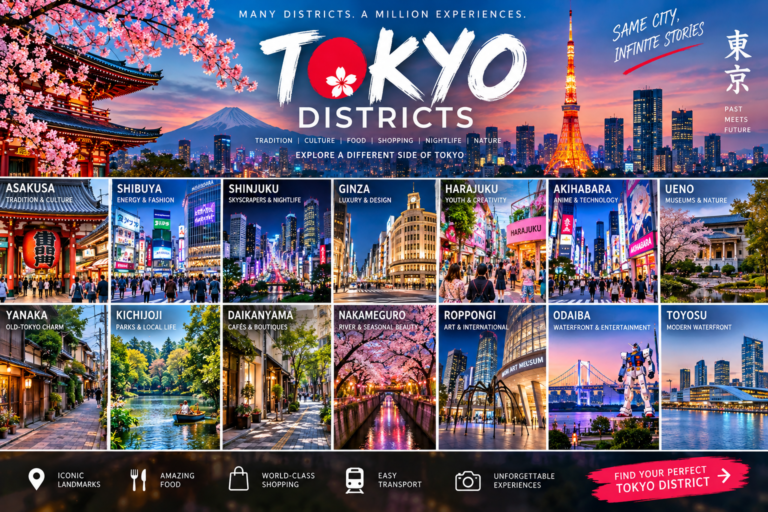
Then compare these areas with Shinjuku and Shibuya.
The contrast will help you understand Tokyo’s transformation.
Best Historic Places to Visit in Tokyo
Imperial Palace and Former Edo Castle Area
The Imperial Palace area provides a direct connection to the political history of Edo and modern Japan.
The surviving stone walls, moats, gates, gardens, and broader layout help visitors imagine the scale and strategic importance of Edo Castle.
Senso-ji and Asakusa
Asakusa is one of the best places for travelers who want a traditional atmosphere.
Explore the temple, surrounding streets, local shops, traditional sweets, and nearby historic districts.
Meiji Jingu
Meiji Jingu connects visitors with the Meiji period and Japan’s modern imperial history.
Its forested setting creates a striking contrast with the surrounding city.
Ueno
Ueno combines museums, parks, temples, shrines, and cultural institutions.
It is an excellent location for travelers interested in art and Japanese history.
Yanaka
Yanaka is valuable because parts of its neighborhood character survived disasters that transformed other areas.
Its temples, narrow streets, small shops, and residential atmosphere offer a slower view of Tokyo.
Nihombashi
Nihombashi has long been associated with commerce.
Its historical importance makes it especially interesting for visitors who want to understand Tokyo as a commercial city.
Zojo-ji
Zojo-ji provides an important connection to the Tokugawa family and the religious landscape of Edo.
Its location near Tokyo Tower also creates one of Tokyo’s most memorable old-and-new contrasts.
How to Experience Tokyo History Without Feeling Like You Are Studying
History does not have to mean spending an entire day reading plaques.
Use the three-layer method.
First, identify the physical environment.
Look at buildings, roads, waterways, gardens, temples, bridges, and neighborhood layouts.
Second, ask what function the location served historically.
Was it political?
Commercial?
Religious?
Residential?
Industrial?
Entertainment-related?
Third, compare it with today’s function.
This approach turns sightseeing into a form of historical investigation.
Tokyo History for Families With Children
Families can make Tokyo history engaging by focusing on stories rather than dates.
Children may enjoy:
- Samurai stories
- Castle history
- Ninja-related folklore and popular culture
- Old transportation
- Traditional crafts
- Food history
- Festivals
- Fire and earthquake stories
- Old Tokyo maps
- Edo-period toys and games
- Museums with interactive displays
The goal is to make history tangible.
Instead of saying “this happened hundreds of years ago,” show children how an old road, temple, market, or bridge relates to the city they see today.
Tokyo History for Students
Students can study Tokyo through several themes.
Political History
Examine the shift from the Tokugawa shogunate to the Meiji government.
Economic History
Study how Edo’s merchant economy developed into modern Tokyo’s financial and commercial systems.
Urban History
Explore how earthquakes, fires, war, railways, and redevelopment changed the city’s physical form.
Cultural History
Study theater, ukiyo-e, food, fashion, festivals, anime, manga, and popular culture.
Technology History
Follow Tokyo’s transformation from preindustrial transportation systems to railways, Shinkansen, electronics, telecommunications, and smart-city technologies.
Tokyo History for Photography Lovers
Tokyo is an extraordinary city for historical photography.
Try comparing different environments.
Photograph an old shrine surrounded by modern buildings.
Capture a traditional shopping street beside a railway line.
Photograph Tokyo Tower from a temple district.
Look for old wooden homes next to contemporary apartment buildings.
These contrasts are not merely visually interesting.
They represent different periods of Tokyo’s development.
Common Mistakes When Learning Tokyo History
Mistake 1: Treating Tokyo as an Ancient City Like Kyoto
Tokyo has a long history, but much of its physical environment is relatively modern because of repeated destruction and redevelopment.
Mistake 2: Focusing Only on Famous Landmarks
Tokyo history is often easier to understand through neighborhoods than isolated monuments.
Mistake 3: Assuming Edo Was a Small Village
Edo became an enormous urban center during the Tokugawa period.
Mistake 4: Ignoring Disasters
Earthquakes, fires, and wartime destruction are essential to understanding why Tokyo looks the way it does.
Mistake 5: Separating Food From History
Tokyo’s cuisine is deeply connected to the city’s commercial and urban development.
Mistake 6: Thinking Modern Tokyo Replaced Traditional Japan
Traditional culture did not simply disappear.
It adapted.
Pros and Cons of Exploring Tokyo Through History
Advantages
Historical travel can make Tokyo easier to understand.
It can help visitors appreciate landmarks beyond their appearance.
It also encourages travelers to explore neighborhoods that may receive less attention than Shibuya or Shinjuku.
History provides context for food, architecture, transportation, festivals, and religion.
Challenges
Tokyo’s history can be complicated.
Many sites have changed names or functions.
Some historic structures were destroyed and reconstructed.
Japanese terminology can also be unfamiliar to first-time visitors.
Modern redevelopment means historical evidence is sometimes subtle.
The solution is to focus on connections rather than expecting perfect preservation.
A Simple Tokyo History Timeline
Before 1600
The broader Tokyo region contained settlements, agricultural communities, religious sites, and strategic locations.
1590
Tokugawa Ieyasu established himself in the Kanto region after receiving control of the area from Toyotomi Hideyoshi.
1603
Tokugawa Ieyasu became shogun, and Edo developed into the center of the Tokugawa government.
17th–18th Centuries
Edo expanded dramatically and became a major political, commercial, and cultural center.
19th Century
Japan faced increasing foreign pressure, and political tensions eventually contributed to the fall of the Tokugawa shogunate.
1868
The Meiji Restoration transformed Japan’s political system.
Edo became Tokyo.
1872
Japan’s first railway opened between Shimbashi and Yokohama.
Early 20th Century
Tokyo continued to modernize and expand.
1923
The Great Kanto Earthquake caused catastrophic destruction across Tokyo and surrounding areas.
1945
World War II bombing caused enormous destruction to the city.
1964
Tokyo hosted the Summer Olympics, while the Shinkansen began service between Tokyo and Osaka.
Late 20th Century
Tokyo became a major global center for finance, technology, fashion, entertainment, and business.
21st Century
Tokyo continued evolving through redevelopment, digital technology, tourism, sustainability initiatives, and major international events.
Ten Brands and Organizations That Help Visitors Experience Tokyo
When exploring Tokyo history today, transportation, cultural institutions, hospitality, and tourism brands can strongly influence how easily visitors access different parts of the city.
The following comparison is not a ranking of historical importance. It compares useful Tokyo-related brands and organizations from a traveler’s perspective.
| Brand / Organization | Main Role | Best For | Historical Connection | Traveler Benefit |
|---|---|---|---|---|
| JR East | Railway | Regional and city travel | Modern railway expansion | Easy access to historic and modern districts |
| Tokyo Metro | Subway | City transportation | Tokyo’s urban expansion | Efficient movement between neighborhoods |
| Toei Subway | Subway | Tokyo transport | Metropolitan development | Access to many central districts |
| Tobu Railway | Railway | Asakusa and eastern Tokyo | Long-term regional transport | Useful for historic areas and excursions |
| Seibu Railway | Railway | Western Tokyo | Suburban development | Connects central Tokyo with western areas |
| Tokyu | Railway and urban development | Shibuya and western Tokyo | Commercial and suburban growth | Easy access to modern cultural districts |
| Odakyu | Railway | Shinjuku and western excursions | Urban expansion | Useful for connecting Tokyo with nearby destinations |
| Tokyo National Museum | Museum | Japanese history and art | Cultural preservation | Deep historical context |
| Tokyo Metropolitan Government | Government institution | City information | Modern Tokyo administration | Visitor information and city resources |
| Tokyo Convention & Visitors Bureau | Tourism | Trip planning | Modern tourism development | Practical destination information |
The important point is that transportation itself is part of Tokyo’s history.
A visitor using today’s rail network is traveling through an urban system that developed over generations.
How Tokyo’s History Shapes Modern Travel
Tokyo history is not simply something that belongs in a museum.
It affects how travelers move.
It affects where neighborhoods developed.
It affects why some districts specialize in certain industries.
It affects where temples and shrines are located.
It affects local festivals.
It affects architecture.
It affects disaster preparedness.
It even affects what people eat.
Consider a simple journey from Tokyo Station to Asakusa.
You are not simply moving between two tourist attractions.
You are moving between areas shaped by different historical phases of Tokyo.
The Hidden Geography of Tokyo History
One of the most interesting ways to study Tokyo is through geography.
The city’s rivers and waterways influenced early settlement and commerce.
Edo Castle shaped political geography.
Roads connected the city to surrounding regions.
Railways later created new commercial centers.
Stations became magnets for offices, department stores, restaurants, and entertainment.
This means Tokyo’s map is effectively a historical document.
You can read it by looking at transportation routes and neighborhood functions.
Why Railways Matter So Much in Tokyo History
Few cities demonstrate the relationship between railways and urban life as clearly as Tokyo.
Railways helped connect suburban residential areas with central business districts.
They enabled enormous daily population movements.
Companies built commercial developments around stations.
Shopping centers emerged above and beside railway facilities.
As the metropolitan area expanded, transportation infrastructure helped determine where people lived and worked.
Modern Tokyo therefore cannot be understood without understanding its railway history.
Tokyo’s Relationship With Disaster
Another major theme in Tokyo history is resilience.
The city has repeatedly faced destruction.
Earthquakes have damaged buildings.
Fires have spread through dense neighborhoods.
War destroyed large areas.
Yet each disaster was followed by reconstruction.
This created a culture in which rebuilding became part of urban life.
Modern earthquake-resistant construction, evacuation planning, emergency preparedness, and public awareness are connected to this history.
What Tokyo History Teaches About Resilience
Tokyo’s history demonstrates that cities are not static.
They can lose buildings but preserve traditions.
They can lose neighborhoods but retain memories.
They can change economic functions while maintaining cultural identity.
This is one reason Tokyo feels both old and new.
The physical environment changes faster than the cultural memory.
Tokyo History and the Future
Tokyo continues to change.
Urban redevelopment is transforming major districts.
New buildings are replacing older structures.
Technology is changing transportation and services.
Tourism is bringing international attention to neighborhoods that were once mainly local.
At the same time, Tokyo faces challenges involving aging infrastructure, demographic change, disaster resilience, housing, environmental sustainability, and maintaining cultural heritage.
The future question is therefore not simply how Tokyo will become more modern.
It is how Tokyo can modernize without losing the historical layers that make it distinctive.
Future Trends in Tokyo’s Historical Tourism
Digital Historical Experiences
Augmented reality, mobile guides, digital maps, and interactive museum technology can make historical information easier to understand.
Visitors may increasingly be able to stand in a modern neighborhood and view reconstructions of what existed there centuries earlier.
Neighborhood-Based Tourism
Travelers are increasingly interested in local neighborhoods rather than only famous landmarks.
This could encourage preservation of small businesses, traditional crafts, local festivals, and historic streets.
Sustainable Heritage Tourism
Tokyo will likely continue balancing tourism growth with the protection of cultural sites and residential communities.
More Interest in Edo
The Edo period provides a particularly rich storytelling opportunity.
Travelers want to understand the origins of Japanese food, arts, crafts, entertainment, architecture, and urban life.
History Through Food
Food tourism will likely remain one of the easiest ways for international travelers to connect with Tokyo’s past.
Walking Tours
Walking remains one of the best methods for understanding historical geography.
A train can move you quickly across Tokyo.
Walking allows you to notice the small details between destinations.
A Practical One-Day Tokyo History Itinerary
If you want to experience Tokyo history in one day, start early.
Begin around the Imperial Palace and former Edo Castle area.
Spend time observing the moats, stone walls, gates, and surrounding urban environment.
Continue toward Nihombashi to explore Tokyo’s historic commercial identity.
Travel toward Ueno and explore the park and cultural institutions.
Continue to Asakusa in the afternoon.
Visit Senso-ji and walk through the surrounding streets.
Finish near the Sumida River.
This route gives you a simplified version of Tokyo’s story:
samurai government → commerce → culture → religion → modern metropolitan life.
A Two-Day Tokyo History Itinerary
For a deeper experience, divide the city into historical themes.
Day One: Edo and Traditional Tokyo
Explore:
- Imperial Palace
- Nihombashi
- Ueno
- Asakusa
- Sumida River
- Traditional shopping streets
Focus on the Edo period.
Day Two: Modern Tokyo
Explore:
- Tokyo Station
- Ginza
- Meiji Jingu
- Shibuya
- Shinjuku
- Tokyo Metropolitan Government area
Focus on modernization, transportation, postwar growth, and contemporary Tokyo.
How to Research Tokyo History Before Your Trip
Before traveling, learn five basic concepts:
Edo — the former name of Tokyo.
Tokugawa shogunate — the military government that ruled Japan from the early 17th century until the 19th century.
Meiji Restoration — the political transformation beginning in 1868.
Great Kanto Earthquake — the devastating 1923 disaster.
Postwar reconstruction — the rebuilding and rapid economic transformation after World War II.
Understanding these five concepts provides a foundation for interpreting much of what you see.
Tokyo History FAQs
When did Tokyo become Tokyo?
Edo was renamed Tokyo during the political transformation of 1868 associated with the Meiji Restoration.
What was Tokyo called before?
Tokyo was known as Edo.
Why was Edo important?
Edo became the political center of the Tokugawa shogunate and grew into a major urban, commercial, and cultural center.
Who founded Tokyo?
It is not accurate to say that one person simply founded modern Tokyo. However, Tokugawa Ieyasu’s establishment of political power in Edo was a decisive turning point in the city’s development.
Who was Tokugawa Ieyasu?
Tokugawa Ieyasu was the founder of the Tokugawa shogunate and one of the most influential political figures in Japanese history.
Was Edo the capital of Japan?
Edo became the seat of the Tokugawa shogunate and functioned as the political center of Japan, although the imperial capital remained Kyoto until the Meiji period.
When did Tokyo become Japan’s capital?
Tokyo became the seat of the imperial government during the Meiji Restoration beginning in 1868.
What happened to Tokyo in 1923?
The Great Kanto Earthquake caused catastrophic damage across Tokyo and surrounding areas, with fires causing especially extensive destruction.
Why does Tokyo have so few old buildings?
Repeated earthquakes, fires, wartime destruction, and redevelopment destroyed or replaced many older structures.
Is Tokyo older than Kyoto?
The broader Tokyo region has ancient settlement history, but Kyoto has a particularly long history as an imperial capital and retains many historic structures. Tokyo’s major urban development occurred especially from the Edo period onward.
What is the oldest temple in Tokyo?
Senso-ji in Asakusa is traditionally regarded as Tokyo’s oldest temple, with a history associated with the 7th century.
Is Edo Castle still standing?
The original Edo Castle complex does not survive intact. Parts of its stone walls, moats, gates, and grounds remain, while the Imperial Palace occupies the central site.
What is the best place to learn Tokyo history?
There is no single best location. The Imperial Palace area, Asakusa, Ueno, Yanaka, Nihombashi, and Tokyo’s major museums each reveal different parts of the city’s history.
What is the best Tokyo neighborhood for history?
Asakusa is one of the easiest choices for first-time visitors, while Yanaka, Ueno, Nihombashi, and the Imperial Palace area provide different historical perspectives.
Can you see Edo-period Tokyo today?
Yes, but mostly through surviving temples, shrines, gardens, street patterns, cultural traditions, museums, artworks, and reconstructed or preserved structures rather than through a completely preserved Edo-era district.
Why is Tokyo famous?
Tokyo is famous for its combination of history, culture, technology, transportation, food, fashion, entertainment, business, architecture, and modern urban life.
What makes Tokyo history unique?
Its most distinctive feature is the coexistence of multiple historical layers. Edo-period traditions, Meiji modernization, disaster reconstruction, postwar development, and contemporary global culture all exist within the same metropolitan environment.
Conclusion: Why Tokyo History Still Matters
Tokyo history is ultimately a story about transformation.
A relatively modest settlement became Edo, a powerful political center. Edo became a massive urban society under the Tokugawa shogunate. The city then became Tokyo and entered an era of rapid modernization.
Earthquakes and fires destroyed neighborhoods.
War devastated much of the city.
Reconstruction created something new.
Railways connected distant communities.
Economic growth produced skyscrapers and enormous commercial districts.
Technology changed everyday life.
Yet the past never completely disappeared.
It survives in the layout of streets, the location of temples, the names of neighborhoods, the food people eat, the festivals they celebrate, the gardens they maintain, and the cultural traditions that continue across generations.
That is why exploring Tokyo history is so rewarding.
You do not need to choose between old Tokyo and modern Tokyo.
You can experience both within the same afternoon.
You might begin beside the stone walls of the former Edo Castle, walk through a modern business district, eat food with roots in Edo culture, ride a railway that represents more than a century of modernization, and finish the day beneath the lights of Shinjuku or Shibuya.
The city itself becomes the museum.
And perhaps that is the best way to understand Tokyo.