
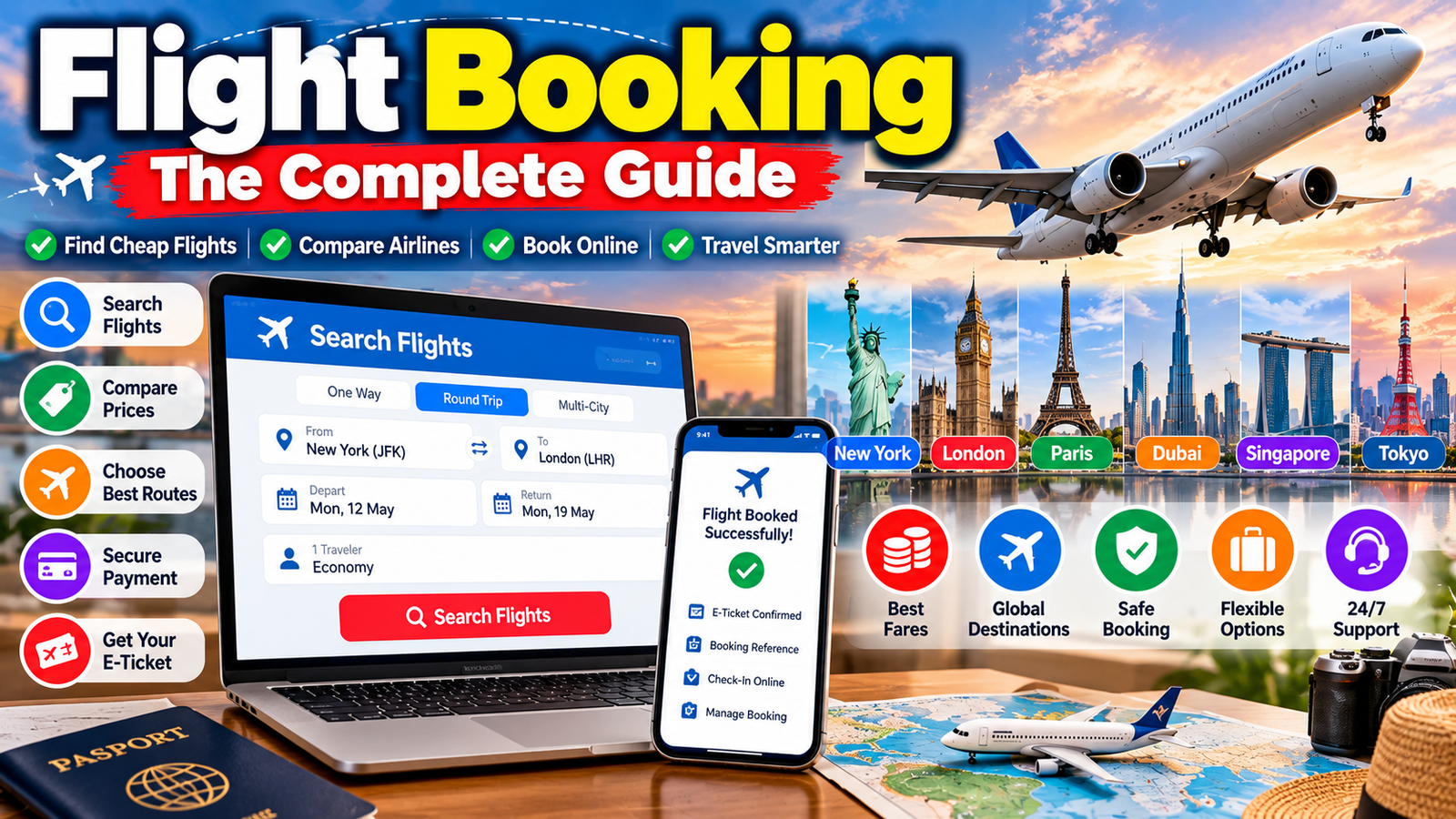
Flight Booking: The Ultimate Guide to Finding Cheap Flights, Comparing Airlines, and Booking with Confidence
Flight booking is the process of searching for, comparing, and purchasing airline tickets for domestic or international travel. By comparing total fares, choosing suitable travel dates, understanding baggage and cancellation rules, and booking through reliable providers, travelers can save money and avoid many common travel problems. Imagine planning a holiday and finding two tickets for the same journey at very different prices. One appears cheaper, but it excludes checked baggage, charges extra for seat selection, and arrives at an inconvenient airport. The other costs slightly more upfront but includes the services you need Travel Technology
What Is Flight Booking?
Flight booking refers to the process of reserving a seat on an airline service and purchasing the ticket under a particular fare and set of conditions.
Depending on the airline and booking channel, you may be able to choose seats, purchase baggage, request special assistance, add meals, and manage other travel services during or after the booking process.
A flight reservation and a confirmed ticket are not always the same thing. Some reservations may be held temporarily without payment, while others become ticketed only after payment and processing are completed. Always check whether you have received a confirmed itinerary and an issued e-ticket.
How the flight booking process works
A typical booking follows these stages:
Step 1: Search for flights. Enter the departure airport, destination, travel dates, passenger numbers, and cabin class.
Step 2: Compare itineraries. Review available airlines, departure times, arrival times, stops, and ticket prices.
Step 3: Select a fare. Check the baggage allowance, seat selection conditions, cancellation policy, and change fees.
Step 4: Enter passenger information. Provide each passenger’s name and other required details exactly as requested by the airline.
Step 5: Pay securely. Complete the payment using an accepted method and wait for confirmation.
Step 6: Receive the ticket. Save the booking reference, e-ticket number when issued, and itinerary receipt.
Step 7: Prepare for departure. Verify travel documents, check-in requirements, baggage rules, and flight status.
Each stage matters. An attractive price cannot compensate for incorrect passenger details, unsuitable transit arrangements, or an itinerary that does not meet your needs.
Flight reservation versus e-ticket
These terms are often confused.
- Reservation: A record showing that an itinerary or seat has been reserved or requested.
- Booking reference: A code used to locate the booking. It may be called a PNR or reservation code.
- E-ticket: The electronic ticket record documenting the passenger’s ticketed air travel.
- Boarding pass: The document or digital pass used to board a particular flight after check-in.
A booking reference alone does not always prove that a ticket has been issued. If you are unsure, check the booking directly with the airline.
Why Flight Booking Requires More Than Comparing Prices
Online flight searches have made it easier to compare thousands of possible itineraries. However, a large number of options can also make decisions more complicated.
Two tickets between the same cities may have different conditions even when their displayed prices are close.
The difference between the advertised price and the total cost
Consider a hypothetical comparison for a return journey.
| Cost component | Ticket A | Ticket B |
|---|---|---|
| Base return fare | $280 | $325 |
| Checked baggage | $70 | Included |
| Seat selection | $25 | Included |
| Additional booking fees | $15 | $0 |
| Total before other expenses | $390 | $325 |
In this example, Ticket B costs less overall even though its initial fare is higher.
The figures are illustrative, not current market prices. Actual charges vary by airline, route, fare type, and booking conditions.
Why the cheapest ticket may not be the best choice
A low fare may involve:
- A long layover.
- A very early departure.
- An airport far from the intended city.
- Limited or no checked baggage.
- Strict change or cancellation conditions.
- Separate tickets with additional connection risks.
- An overnight stop requiring accommodation.
A useful booking strategy evaluates the full journey rather than treating the ticket price as the only important factor.
Calculate the value of your time
Suppose one itinerary saves $45 but adds seven hours to your journey. Another option is more expensive but gets you to your destination much earlier.
For a flexible traveler, the saving may be worthwhile. For someone attending a business meeting, a family event, or a fixed appointment, the longer itinerary may be a poor trade-off.
There is no universally correct answer. The right choice depends on the purpose of the trip and the consequences of arriving late.
Where Should You Book Flight Tickets?
Travelers can book flights through airline websites, online travel agencies, travel-comparison platforms, and traditional travel agents.
Each option offers different advantages.
Booking directly through an airline
An airline’s official website or app lets you purchase tickets directly from the carrier.
Potential advantages include:
- Direct access to the airline’s booking system.
- Easier access to airline-specific services.
- A clear point of contact for many booking questions.
- Direct management of eligible changes and add-ons.
- Access to the airline’s own fare options and loyalty benefits.
However, direct booking does not guarantee the lowest fare in every case. Some travel agencies may offer different prices, package arrangements, or promotions.
Booking through an online travel agency
Online travel agencies, often called OTAs, sell flights and other travel services through websites or apps.
They may offer convenient comparisons, combined itineraries, multiple payment methods, or customer support services.
The main consideration is who controls the ticket after purchase. Depending on the arrangement, you may need to contact the agency rather than the airline for certain changes, refunds, or payment questions.
Before paying, understand the agency’s service fees and support arrangements.
Using flight-comparison websites
Comparison platforms help travelers discover possible flights across different airlines and sellers.
They are useful for identifying:
- Alternative departure dates.
- Different airlines.
- Nonstop versus connecting itineraries.
- Nearby airports.
- Broad price differences.
Some comparison services display offers from third-party sellers rather than issuing tickets themselves. Check the identity of the final seller before completing your purchase.
Using a traditional travel agent
A travel agent can help with complicated itineraries, group bookings, special travel needs, or journeys involving several countries.
The service may be particularly useful when travelers need assistance coordinating flights, accommodation, and transfers.
Before using an agent, confirm the total price, service charges, cancellation arrangements, and how you will receive the ticket.
Which booking method is best?
- Choose direct airline booking when you value direct communication with the carrier.
- Choose comparison platforms when you want to discover a wide range of possible itineraries.
- Choose an online travel agency when its price, package, or service offers a clear advantage.
- Choose a reputable travel agent when the itinerary is complicated or you need personal assistance.
Whatever channel you choose, verify the final itinerary, payment receipt, and ticket status.
Ten Flight Booking Brands Compared
The following ten brands are widely known in the airline and flight-booking market. They serve different purposes, so they should not all be treated as interchangeable.
Some are airlines, while others are comparison services or online travel agencies.
| Brand | Type | Main purpose | Best use case | Important consideration |
|---|---|---|---|---|
| Google Flights | Flight search and comparison | Explore fares and dates | Comparing schedules and flexible dates | Final purchase may happen elsewhere |
| Skyscanner | Travel search and comparison | Discover flights and sellers | Exploring route and date alternatives | Check the final booking provider |
| Kayak | Travel search and comparison | Compare travel options | Researching different itineraries | Verify the final fare and seller |
| Expedia | Online travel agency | Book flights and other travel services | Comparing standalone flights or packages | Review support and change conditions |
| Booking.com | Online travel agency and travel platform | Search for travel services, including flights in supported markets | Combining travel research and bookings | Flight availability and services vary by market |
| Trip.com | Online travel agency | Book flights and other travel products | Comparing international travel options | Check service fees and ticket conditions |
| MakeMyTrip | Online travel agency | Flight and travel bookings | Travelers using supported markets and services | Availability and policies vary by country |
| Emirates | Airline | Sell and manage Emirates flights | Booking journeys operated or sold by Emirates | Check the operating carrier and fare rules |
| Qatar Airways | Airline | Sell and manage Qatar Airways flights | Booking eligible routes through its network | Confirm baggage and connection conditions |
| Turkish Airlines | Airline | Sell and manage Turkish Airlines flights | Booking eligible domestic and international journeys | Review the exact itinerary and ticket rules |
Google Flights
Google Flights is useful for comparing available itineraries and exploring how dates affect prices. Travelers can often inspect alternative airports, flight durations, and fare options.
Its search results do not mean Google is necessarily the seller. Follow the booking destination and check who will issue the ticket.
Skyscanner
Skyscanner helps travelers discover flight options from airlines and travel sellers. It is particularly useful for comparing routes and exploring flexible travel plans.
Before purchasing, check the seller’s identity, total price, baggage rules, and customer support arrangements.
Kayak
Kayak provides travel search and comparison tools. It can help travelers compare different schedules and identify possible alternatives.
As with other comparison services, the actual ticket may be sold by an airline or a third party.
Expedia
Expedia is an online travel agency offering flights and other travel services. Travelers should review the final itinerary and any applicable service or change fees.
Booking.com
Booking.com is a major travel platform whose flight services and availability can vary by market. Confirm which provider is responsible for the flight booking and how changes are handled.
Trip.com
Trip.com provides flight-booking services in many markets. Travelers should review the full itinerary, support arrangements, and fare rules before payment.
MakeMyTrip
MakeMyTrip offers travel-booking services in supported markets. Its suitability depends on the traveler’s location, payment options, and available itinerary.
Emirates, Qatar Airways, and Turkish Airlines
These are airlines rather than flight-comparison platforms. Booking directly can be useful when you want to manage a journey through the carrier’s own systems.
The best choice depends on your route, travel dates, baggage needs, and fare conditions. No single brand is always cheapest or best for every passenger.
How to Find Cheap Flight Tickets Online
Finding an affordable flight is partly about timing, but it also involves flexibility, route selection, and a careful comparison of fare conditions.
Be flexible with travel dates
If your schedule permits, compare multiple departure and return dates. Fares may change because of demand, seat availability, competition, and airline pricing decisions.
Traveling during a major holiday period may cost more than traveling during a quieter period, but the effect varies by destination.
Do not rely on the claim that a particular weekday is always the cheapest. Compare the actual prices for your route.
Compare nearby airports
A large metropolitan area may have more than one airport. A nearby airport could offer a lower fare or a more convenient schedule.
However, calculate the ground transportation cost and travel time before deciding. A ticket that saves $30 but requires a costly transfer may not be a better deal.
Compare one-way and return fares
Sometimes a return ticket from one airline is competitive. In other cases, separate one-way tickets may offer better schedules or prices.
Compare the total cost, baggage rules, and conditions for the complete journey. Separate tickets may also create additional risks if a delay affects a later flight.
Consider connecting flights
Connecting flights may cost less than nonstop options, but this is not guaranteed.
Check the total journey time, the connection airport, whether baggage is transferred, and whether the flights are on one ticket.
A small saving may not justify a very long layover or a risky self-transfer.
Look beyond the base fare
Check the cost of baggage, seats, meals if needed, and any payment or service fees.
If you need a checked bag, compare fares that include it. If you are happy with a basic seat and cabin baggage only, a lower-cost fare may be suitable.
Use price alerts
Some travel-search platforms allow users to track fares for a route or itinerary.
Price alerts can be helpful when travel dates are flexible. They do not guarantee that prices will fall, and a fare may increase or disappear before you act.
Book when your plans are reasonably clear
There is no universal booking window that guarantees the lowest price. The best time to buy depends on route demand, season, competition, airline capacity, and travel dates.
For peak-season or limited-frequency routes, waiting until the last minute may leave you with fewer choices. For other journeys, promotions or schedule changes may create new opportunities.
A practical strategy is to begin comparing early enough to understand normal prices and then purchase when a suitable fare meets your budget and requirements.
The Best Time to Book Domestic and International Flights
Booking decisions should reflect the route and the importance of your travel dates.
Domestic flights
Domestic routes may have frequent departures and several competing airlines, depending on the country and city pair.
Travelers can compare different dates, times, and airports. However, popular events and holiday periods may reduce availability.
International flights
International journeys may require more planning because of passport validity, visas, transit rules, long travel times, and limited nonstop services.
For international travel, compare the full itinerary and confirm your entry requirements before buying a nonrefundable ticket.
Peak and off-peak travel
Demand often increases during school holidays, national celebrations, major events, and popular tourism seasons.
Traveling outside peak periods can provide more options, but the weather, local holidays, and attraction opening hours also matter.
Morning versus evening departures
An early flight can be useful if it allows you to reach your destination sooner. But it may require overnight accommodation near the airport or an expensive early-morning transfer.
Late flights may be convenient for some travelers but can create problems if local transportation is limited upon arrival.
Compare the complete door-to-door journey, not just the flight schedule.
How to Book a Flight Step by Step
Follow this practical process when booking a flight online.
Step 1: Decide your travel requirements
Before searching, establish:
- Departure and destination cities.
- Preferred airports.
- Departure and return dates.
- Number and ages of passengers.
- Cabin class.
- Checked and cabin baggage needs.
- Maximum acceptable travel time.
- Budget and flexibility requirements.
You do not need to know every detail immediately, but clear priorities make comparison easier.
Step 2: Search for available flights
Enter the correct origin and destination. Select the appropriate dates, passenger numbers, and trip type.
Check whether the search includes alternative airports and connecting services.
Step 3: Filter the results
Use filters that reflect your priorities, such as:
- Nonstop flights.
- Preferred departure time.
- Maximum number of stops.
- Total journey duration.
- Airline.
- Price range.
Avoid adding too many restrictions too early, because they may hide useful alternatives.
Step 4: Open the complete itinerary
Check every flight segment, not just the first and last departure times.
Review the connection airport, layover duration, terminal information when available, and the operating carrier for each segment.
Step 5: Compare fare conditions
Read the rules for baggage, seat selection, ticket changes, cancellations, and refunds.
A basic economy fare may have different conditions from a standard economy fare, even on the same flight.
Step 6: Enter passenger details carefully
Use the spelling and format requested by the airline. International bookings may require details that match the passport or other travel document.
Avoid using nicknames or informal spellings. Check all names and dates before proceeding.
Step 7: Review the payment page
Make sure the final total matches your expectations. Look for baggage, seat selection, service fees, and other charges that have been added during the process.
Use a secure payment method and avoid sending card details through unverified messages or unofficial channels.
Step 8: Confirm the booking
Wait for the booking confirmation and ticketing information. If the booking appears pending, contact the seller or airline rather than assuming that the ticket is ready.
Step 9: Save your records
Keep a copy of the itinerary, booking reference, ticket number when available, receipt, and any important travel conditions.
Step 10: Prepare for departure
Check online check-in availability, airport arrival recommendations, baggage limits, terminal information, and the latest flight status.
Understanding Airline Ticket Types and Fare Classes
The fare you purchase can influence what you are allowed to do after booking.
Basic or light economy
A basic or light fare may provide a lower starting price but include fewer services. Depending on the airline, it may restrict checked baggage, advance seat selection, changes, or other options.
Read the exact rules because fare names are not standardized across all carriers.
Standard economy
Standard economy fares may include additional flexibility or services compared with the most restrictive fare.
However, checked baggage and seat selection are not guaranteed to be included. Always check the specific fare conditions.
Premium economy
Premium economy generally offers a different seating and service experience from regular economy, often with more space or additional benefits.
Availability and the precise features vary by airline and aircraft.
Business class
Business class commonly provides more space, upgraded service, and additional airport or baggage benefits, depending on the airline and route.
It may be useful for travelers who value comfort, rest, or flexibility, but its cost should be compared against the purpose of the trip.
First class
First class is offered on selected airlines and routes. Features can differ substantially between carriers and aircraft.
Do not assume that a cabin label guarantees a particular seat or service. Check the aircraft and the specific product being sold.
Fare class versus cabin class
Cabin class describes the general travel cabin, such as economy or business. Fare class or booking class can refer to a specific booking category within that cabin.
These categories may influence ticket flexibility, loyalty-program earning, upgrade eligibility, and other conditions.
Flight Booking for International Travel
International flight booking requires additional checks beyond selecting a seat.
Passport validity
Some destinations require a passport to remain valid for a specified period beyond arrival or departure. The exact rule depends on the destination and the traveler’s circumstances.
Check the official requirements applicable to your passport.
Visa and entry permission
A ticket does not guarantee permission to enter another country. Travelers may need a visa, electronic authorization, residence permit, or other documentation.
Check official government sources before booking, particularly when the ticket is nonrefundable.
Transit visas
Transit requirements depend on nationality, airport, terminal arrangements, destination, and whether the traveler must pass through immigration.
Even if you plan to remain in the airport, a transit visa or other permission may be required in some circumstances.
Airport transfers
If your itinerary uses different airports in the same city, confirm that the transfer is practical and that you have enough time to travel between them.
A booking platform may display an itinerary that is technically possible but inconvenient. Consider transport, traffic, baggage collection, and any immigration procedures.
Currency and payment
International bookings may be priced in a different currency from your bank account.
Review the payment currency and understand whether your bank or card issuer may charge foreign transaction or currency-conversion fees.
Local arrival time
Flight times are usually shown in the local time of each airport. When crossing time zones, the arrival date may differ from the departure date.
Check the dates carefully, especially for overnight flights.
Flight Booking for Families, Students, and Business Travelers
Different travelers have different priorities. A good booking strategy should account for those needs.
Flight booking for families
Families may benefit from:
- Convenient departure times.
- Reasonable connection durations.
- Clear baggage allowances.
- Appropriate seating arrangements.
- Access to necessary assistance.
- Arrival times that work with local transportation.
Check the airline’s policies for infants, children, strollers, child seats, and family seating. Requirements and included services vary.
Flight booking for students
Students traveling for study may need additional baggage and flexible arrangements.
Compare the total price after checked baggage and airport transport. Verify visa or study-permit requirements and make sure the arrival date fits the university’s schedule.
Student fares or promotions may be available in certain markets, but eligibility conditions differ. Confirm the offer with the provider.
Flight booking for business travelers
Business travelers may prioritize punctual arrival, flexible ticket rules, frequent departure options, and loyalty benefits.
When a meeting is important, consider arriving with enough time to recover from delays rather than scheduling the flight to land just before the event.
Flight booking for budget travelers
Budget travelers should compare the final cost of each itinerary, including baggage, airport transfers, overnight accommodation, and meals where necessary.
Flexibility can be valuable, but the lowest price should not come at the expense of essential travel documents or a realistic connection.
Flight booking for older passengers and travelers needing assistance
Consider walking distances, transfer times, terminal layouts, and available assistance.
If mobility assistance or other support is needed, contact the airline before departure and confirm the airport’s procedures.
Flight booking for group travel
Group bookings may require coordination of names, payment, seating, and baggage.
For larger groups, ask the airline or an established travel agent about group fare rules and deadlines. Do not assume that all passengers can be added later at the same price.
How to Choose the Right Flight Connection
A connecting flight can save money or provide access to a destination that has no nonstop service. It can also add complexity to a journey.
Understand the connection time
Airports and airlines use minimum connection time rules, but a connection that meets the formal requirement may still feel rushed.
Consider the terminal layout, security checks, immigration, baggage procedures, and the possibility of delays.
One ticket versus separate tickets
A journey booked as one protected itinerary generally offers more protection for missed connections caused by disruption than two unrelated tickets. The exact obligations depend on the ticket, airline, applicable law, and circumstances.
Separate tickets can require passengers to manage delays themselves, potentially including buying a replacement ticket.
Overnight layovers
An overnight layover may require a hotel, meals, local transportation, or additional visa arrangements.
Calculate these expenses before comparing the itinerary with a shorter alternative.
Baggage transfer
Some itineraries transfer checked baggage to the final destination. Others require passengers to collect and recheck it.
Confirm the arrangement with the airline or booking provider, particularly when different carriers are involved.
Connection planning checklist
Before choosing a connection, verify:
- The layover duration.
- Whether the flights are on one ticket.
- Whether the terminal changes.
- Whether immigration is required.
- Whether baggage is checked through.
- Whether transit permission is required.
- What happens if the first flight is delayed.
Common Flight Booking Mistakes and Their Solutions
Mistake 1: Entering incorrect passenger information Flight booking
A misspelled name or incorrect date of birth can create problems during check-in or document verification.
Solution: Review every passenger detail before paying. If you notice an error afterward, contact the airline or booking provider promptly.
Mistake 2: Ignoring baggage rules Flight booking
Travelers sometimes assume that every ticket includes the same baggage allowance.
Solution: Check cabin and checked baggage rules for every flight segment. Partner airlines may apply different conditions.
Mistake 3: Choosing a risky connection Flight booking
A short transfer may become difficult if the first flight is delayed or the terminal is far away.
Solution: Choose a realistic buffer and understand the consequences of missing the onward flight.
Mistake 4: Overlooking refund conditions Flight booking
A low fare may be nonrefundable or carry strict restrictions.
Solution: Read the conditions before paying. Understand the difference between a voluntary cancellation, a schedule change, and a cancellation by the airline.
Mistake 5: Assuming all third-party sellers offer identical support Flight booking
Booking platforms differ in how they handle customer service, refunds, and changes.
Solution: Identify the ticket seller and review its support process before completing the booking.
Mistake 6: Booking without checking travel documents Flight booking
A ticket alone does not satisfy passport, visa, or transit requirements.
Solution: Check official entry rules for every country involved in the itinerary.
Mistake 7: Focusing only on the base price Flight booking
Extra baggage, seat selection, and transport can increase the final cost.
Solution: Compare complete itineraries with the services you actually need.
Mistake 8: Missing check-in deadlines Flight booking
Check-in deadlines differ by airline, airport, and route.
Solution: Read the airline’s instructions and complete online check-in when available.
Mistake 9: Failing to monitor schedule changes Flight booking
Airlines may adjust departure times, terminals, or flight numbers after booking.
Solution: Keep contact information current, review notifications, and check the itinerary before departure.
Mistake 10: Using unofficial payment channels Flight booking
Messages requesting payment through an unverified account may expose travelers to fraud.
Solution: Pay through the official airline, a reputable seller, or a verified payment process. Do not share passwords or one-time verification codes.
What to Do After Flight booking
Your responsibilities do not end when the payment is completed.
Verify the booking Flight booking
Check the confirmation email and ensure that the itinerary matches the dates, airports, passengers, and fare you selected.
If the ticket has not been issued, contact the provider to clarify the status.
Manage additional services Flight booking
Depending on the fare, you may be able to add checked baggage, reserve seats, request special assistance, or purchase other services.
Compare the available options and check whether an added service is refundable.
Check in online Flight booking
Many airlines provide online check-in during a specified window before departure. The opening and closing times vary.
Some routes or passengers may still require document verification at the airport.
Prepare travel documents Flight booking
Keep passports, visas, travel authorizations, and other required documents accessible.
Check the airline’s requirements for document verification and airport arrival time.
Monitor the flight Flight booking
Review flight status and airline notifications before leaving for the airport. If the airline changes the schedule, follow its official instructions.
Save emergency information Flight booking
Keep the airline’s contact details, booking reference, ticket number, and travel insurance information available.
If a disruption occurs, this information can help you communicate with the relevant provider more efficiently.
What Happens If Your Flight Is Delayed, Changed, or Cancelled?
Travel disruption can occur for weather, technical, operational, airspace, staffing, or other reasons.
The available remedies depend on the airline, route, ticket, cause of disruption, and applicable passenger-rights laws.
If the airline changes your schedule Flight booking
Check the new itinerary and determine whether it still meets your needs.
If the change is significant, review the options offered by the airline or booking provider. Depending on the circumstances and applicable rules, you may be eligible for a rebooking, refund, or other remedy.
If your flight is cancelled Flight booking
Contact the responsible airline or ticketing provider through official channels.
Ask what alternatives are available and keep records of communications and necessary expenses.
Do not assume that every cancellation automatically entitles you to the same compensation. Passenger rights vary across jurisdictions.
If you miss a connecting flight Flight booking
If both flights are part of a protected itinerary, contact the airline or its airport staff as soon as possible.
If the flights were booked on separate tickets, the next carrier may not be responsible for rebooking you without additional payment.
Travel insurance Flight booking
Travel insurance may cover certain disruptions, depending on the policy, exclusions, and circumstances.
Read the policy carefully before purchasing it. Do not assume that every delay, missed connection, or change is covered.
Pros and Cons of Booking Flights Online
Online flight booking has changed the way travelers research and purchase tickets.
Advantages Flight booking
Convenience: Travelers can search for flights from home or while traveling.
Broad comparison: Search tools can show multiple airlines, dates, and itinerary combinations.
Time savings: Filters and sorting features can help narrow the options.
Direct access: Many airlines provide online booking management and digital travel documents.
Flexible research: Travelers can compare different dates and departure airports before making a decision.
Price monitoring: Some services allow users to receive fare alerts.
Disadvantages Flight booking
Information overload: Large numbers of results can make comparisons difficult.
Complex fare rules: Different baggage and cancellation conditions can be hard to evaluate.
Third-party support: Resolving a booking issue may be more complicated when an intermediary is involved.
Price changes: A fare shown in search results may no longer be available when payment is attempted.
Extra charges: Optional services and fees can increase the final cost.
Technology dependence: Payment errors, website problems, or delayed confirmation can create uncertainty.
Is online booking better than using an agent?
For a straightforward return trip, online booking can be efficient. For complex multi-city travel, large groups, or unusual travel needs, an experienced agent may offer useful assistance.
The best method depends on the complexity of the itinerary and the value you place on personal support.
Flight Booking Security: How to Avoid Scams
Because airline tickets can be expensive, booking security deserves careful attention.
Use official or reputable platforms Flight booking
Confirm that the website or app belongs to the airline or a recognized travel provider. Be cautious of advertisements or messages promising unusually low prices without clear terms.
Verify the payment recipient Flight booking
The payment process should clearly identify the seller. Avoid sending money to personal accounts or through informal messaging arrangements unless you have independently verified the provider and transaction.
Protect personal information Flight booking
Provide only the information required for the booking and associated services.
Never disclose your account password, payment card security code, or one-time authentication code to someone claiming to be customer support.
Verify the ticket Flight booking
After booking, use the airline’s official website or app, where available, to check the reservation.
If a seller claims that your ticket is confirmed but the airline cannot locate it, contact the seller promptly and retain your payment records.
Be cautious of fake support numbers Flight booking
Scammers may impersonate airlines or travel agencies. Find customer service contact details through the official website rather than relying on an unsolicited message.
The Future of Flight Booking
Flight booking is changing as airlines and travel platforms introduce new technologies, pricing tools, and digital services.
Artificial intelligence and personalized search Flight booking
AI-powered tools can help travelers compare itineraries, summarize fare conditions, and identify options based on stated preferences.
However, generated recommendations should be checked against the actual airline fare rules, current schedules, and official travel requirements.
More transparent fare comparisons Flight booking
Travelers increasingly want to understand the full price before committing to a ticket.
Better presentation of baggage, seat, and change fees could make comparisons more useful. The exact level of transparency depends on the airline, platform, and market.
Mobile booking and digital travel documents Flight booking
Airline apps and mobile booking platforms allow passengers to manage itineraries, receive notifications, and access digital boarding passes where supported.
Travelers should still keep essential booking information accessible if their phone battery runs out or internet access is unavailable.
Modern airline distribution systems Flight booking
Airlines and travel sellers continue to develop ways to present fares, optional services, and personalized offers.
These systems may change how travel products are displayed and sold. Travelers should focus on the final conditions rather than assuming that a particular booking channel always provides the same offer.
Sustainability and travel choices Flight booking
Some travelers are increasingly considering the environmental impact of their journeys.
When practical, they may compare nonstop versus connecting itineraries, alternative modes of transport, or airlines’ sustainability information. Environmental impact depends on factors such as aircraft, route, occupancy, and operational conditions, so a simple label may not tell the full story.
What travelers should expect Flight booking
Flight booking will likely become more integrated and personalized, but core decisions will remain important: compare the total fare, verify the ticket, understand the conditions, and ensure that the itinerary fits your needs.
FAQs
What is the best website for flight booking?
There is no single best website for every trip. Flight-comparison platforms can help you discover options, while airline websites let you book directly with the carrier. Compare the final price, fare conditions, and support arrangements.
How can I find cheap flights online?
Compare flexible dates, different airlines, nearby airports, and connecting services. Include baggage and other necessary charges in your calculations, and consider using price alerts.
Is it better to book directly with an airline?
Direct booking can simplify communication with the carrier and make it easier to manage eligible services. However, some travel agencies may offer competitive fares or useful package options. Compare the total value.
What is a booking reference number?
A booking reference is a code used to locate a reservation. It is often called a PNR or reservation code. Keep it available when contacting the airline or travel provider.
How do I know if my flight ticket is confirmed?
Check your booking confirmation and ticketing information. Where possible, retrieve the reservation through the airline’s official website or app. A reservation code alone does not always mean that an e-ticket has been issued.
Can I change my flight after booking?
Changes depend on the fare rules, airline, ticket seller, and applicable laws. Some tickets permit changes with a fee or fare difference, while others are more restrictive.
Can I get a refund after cancelling a flight?
Refund eligibility depends on the ticket conditions, the reason for cancellation, and applicable passenger-rights rules. Review the fare conditions and contact the airline or ticketing provider.
Is a connecting flight cheaper than a nonstop flight?
It can be, but not always. Compare the full itinerary, including baggage, travel time, overnight costs, and connection risks.
When should I book international flights?
There is no guaranteed best day or booking window. Start researching early enough to understand the available prices and options, then book when a suitable fare meets your requirements.
What is the difference between a flight reservation and a boarding pass?
A reservation records the itinerary, while a boarding pass is issued after check-in and is used to board a specific flight. Ticket issuance and check-in are separate stages.
Should I buy travel insurance?
Travel insurance may be useful for certain medical emergencies, trip disruptions, lost baggage, or other covered events. Compare the policy terms, exclusions, limits, and conditions before purchasing it.
What should I do if I do not receive a confirmation email?
Check your spam folder and booking account, then contact the seller through official channels. Review your payment status and do not make a duplicate booking until you understand whether the first transaction succeeded.
Can I book a flight without a passport?
Some domestic bookings and certain reservations may allow you to purchase a ticket before entering all travel-document details. International travel requirements vary. Confirm the airline’s booking rules and make sure you obtain the required documents before departure.
Conclusion
Flight booking is more than finding a low price. A successful booking combines a suitable itinerary, clear fare conditions, reliable payment, correct passenger details, and a realistic plan for reaching the airport and completing the journey .Taking a few extra minutes to compare the total cost and understand the conditions can prevent unnecessary expenses and travel stress.