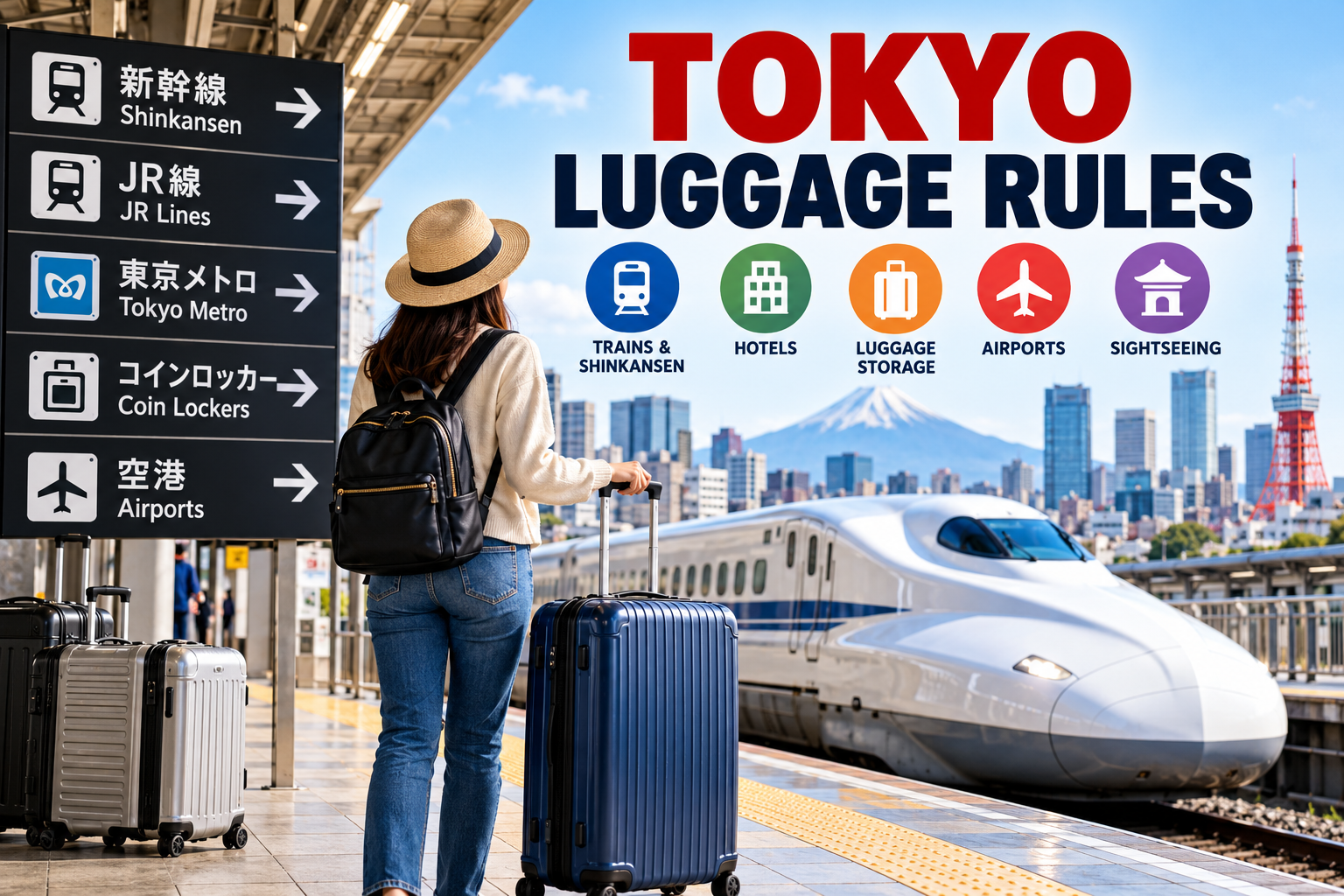
Tokyo Luggage Rules: 15 Essential Tips for Trains, Hotels, Airports and Sightseeing
Imagine arriving at Tokyo Station after a long international flight. You have a large suitcase, a backpack and a hotel reservation on the other side of the city. The station is crowded, the train is approaching, and you suddenly realise that your luggage might not fit where you expected. This is a common challenge for first-time visitors to Japan. Tokyo has excellent public transport, convenient luggage storage and reliable baggage-delivery services, but travelling comfortably requires knowing a few important rules before you arrive Tokyo Tunnels
Understanding Tokyo Luggage Rules
Tokyo is one of the world’s most convenient cities for public transport. However, its transport network was designed primarily to move people efficiently, not to provide unlimited space for large suitcases.
Why luggage size matters in Tokyo
There are several reasons to plan your luggage carefully:
- Crowded trains: Large suitcases can block aisles, doors and priority spaces during busy periods.
- Limited storage: Older trains and some local services have little dedicated baggage space.
- Station layouts: Major stations can involve long corridors, stairs, escalators and complicated transfers.
- Special train requirements: Some Shinkansen services require a designated oversized-baggage seat reservation.
- Storage restrictions: Coin lockers come in different sizes, and large lockers can fill up quickly.
- Delivery limitations: Hotels and luggage couriers may apply size, weight, destination and timing conditions.
The goal is not to avoid travelling with luggage. It is to choose the right bag and the right transport method for each part of your trip.
Are there universal luggage rules across Tokyo?
No. There is no single luggage-size limit that applies to every train, hotel, locker and transport provider in Tokyo.
| Location or service Tokyo luggage rules | What to check Tokyo luggage rules |
|---|---|
| Tokyo Metro and ordinary commuter trains | Available space, safe placement and consideration for other passengers |
| Shinkansen | Combined baggage dimensions and oversized-baggage reservation requirements |
| Airport limousine buses | Operator-specific baggage allowance, number of bags and weight limits |
| Taxis | Boot space and passenger capacity |
| Coin lockers | Internal dimensions, availability and storage fees |
| Hotels | Advance storage, check-in and check-out arrangements |
| Luggage delivery | Size, weight, destination, delivery time and prohibited contents |
| Airports | Airline baggage allowances and security restrictions |
Transport rules can change, and different operators may apply different conditions. Check the official operator’s current policy for your exact route before departure.
Tokyo Train Luggage Rules: Metro, JR and Local Trains
Tokyo’s rail network includes the Tokyo Metro, Toei Subway, JR East and numerous private railway companies. Each network serves different areas, but the practical luggage advice is similar: keep bags under control, avoid blocking doors and choose quieter travel times when possible.
Tokyo Metro luggage rules Tokyo luggage rules
Tokyo Metro is useful for reaching major neighbourhoods, including Shibuya, Ginza, Asakusa and Ueno. You can generally travel with ordinary personal luggage, but you must be able to handle it safely and avoid obstructing other passengers.
For a smooth journey:
- Keep small bags in front of you or close to your legs when the carriage is crowded.
- Place a suitcase where it will not block doors, walkways or wheelchair spaces.
- Avoid leaving luggage unattended.
- Do not assume every carriage has a dedicated suitcase rack.
- Allow extra time to use lifts if you are travelling with heavy baggage.
- Check the operator’s rules if carrying unusually large, heavy or specialised equipment.
A medium suitcase may be manageable outside rush hour, but a large suitcase plus several shopping bags can make transfers difficult.
JR East and ordinary commuter trains Tokyo luggage rules
JR East operates many services within Tokyo and beyond, including the Yamanote Line, which connects major stations such as Tokyo, Shinjuku, Shibuya and Ueno.
Ordinary commuter trains are not designed around reserved luggage spaces. Passengers commonly travel with suitcases, but the available space depends on the train and how busy it is.
Best practice is to stand with your suitcase beside you, keep the handle secure and move away from the doors once you have boarded. If the train is very crowded, waiting for a later service may be more comfortable than forcing your luggage into a packed carriage.
Are suitcases allowed on Tokyo trains during rush hour?
In general, ordinary travel with a suitcase is possible, but rush hour is the least convenient time to do it.
Weekday morning and evening peaks can vary by route and season. Major commuter corridors may be particularly busy around business districts and large stations.
If you must travel during a busy period:
- Choose the shortest route with the fewest transfers.
- Avoid carrying extra shopping bags.
- Keep your suitcase upright and close to you.
- Let passengers exit before boarding.
- Avoid standing directly in front of doors.
- Consider a taxi or luggage-delivery service if your bag is exceptionally large.
There is an important difference between something being permitted and something being practical. A large suitcase may be allowed, but it can still make a crowded commute uncomfortable for you and other passengers.
How many suitcases can you take on Tokyo local trains?
Do not assume there is one universal number of suitcases allowed across all Tokyo rail operators. Ordinary luggage policies and restrictions can vary, particularly for unusual or oversized items.
For a normal holiday, one suitcase and one personal bag are usually easier to manage than multiple large cases. If you are moving several bags, travelling as a family or carrying professional equipment, verify the relevant operator’s current conditions.
Shinkansen Luggage Rules: The Most Important Size Limit
The Shinkansen, or bullet train, is a popular way to travel from Tokyo to destinations such as Kyoto and Osaka. Its baggage rules deserve special attention because certain oversized suitcases require a reservation.
The 160 cm rule explained Tokyo luggage rules
For the Tokaido, Sanyo, Kyushu and Nishi-Kyushu Shinkansen services covered by the relevant rules, baggage is classified by the combined dimensions of its three sides.
Measure your suitcase’s height + width + depth, including protruding wheels and handles where applicable.
- Up to 160 cm combined: Generally does not require an oversized-baggage seat reservation. Use a suitable overhead rack, footwell or permitted baggage-storage area.
- Over 160 cm up to 250 cm: Generally requires a reservation for a seat with an oversized-baggage area on the covered services. There is normally no additional charge when you make the required reservation.
- Over 250 cm combined: Not permitted under the standard baggage rules for these services. Arrange alternative transport or delivery.
These thresholds follow the published guidance for the relevant Shinkansen services. Check the operator for your exact train and route.
How to measure your suitcase correctly Tokyo luggage rules
Suppose your suitcase measures:
- Height: 75 cm
- Width: 48 cm
- Depth: 32 cm
The combined dimension is:
75 + 48 + 32 = 155 cm
This suitcase falls within the 160 cm category.
Now consider a larger case:
- Height: 82 cm
- Width: 52 cm
- Depth: 35 cm
Its combined dimension is:
82 + 52 + 35 = 169 cm
This case falls into the oversized category on the covered Shinkansen services. You should book the appropriate seat with an oversized-baggage area.
Measure the actual packed suitcase rather than relying only on the product’s advertised dimensions. Wheels, handles and external pockets can affect the final measurement.
How do you reserve an oversized-baggage seat?
When booking your Shinkansen ticket, look for the option that specifies a seat with an oversized-baggage area or compartment, where available.
You can generally arrange this through the applicable official online reservation service, ticket machine or station ticket office.
Follow these steps:
- Measure the packed suitcase.
- Confirm that your train is covered by the oversized-baggage rules.
- Select the correct seat option when booking.
- Check the carriage and seat details on your reservation.
- Arrive early enough to board without rushing.
- Store your suitcase in the designated space and keep your valuables with you.
Seats with oversized-baggage space can be limited. If your luggage is larger than 160 cm, booking early is sensible, especially during holiday periods.
What happens if you board without the required reservation?
On the covered services, bringing oversized baggage aboard without the required reservation can result in a ¥1,000 handling fee and instructions from train staff about where to store the suitcase. If appropriate space is unavailable, you may need to change your travel arrangements.
This is why checking your suitcase size before purchasing a ticket is worthwhile. A reservation can prevent an avoidable fee and make boarding easier.
Are the same rules used on every Shinkansen route?
No. Do not automatically apply the exact policy for one Shinkansen operator to every high-speed rail service in Japan.
The rules discussed above specifically cover the Tokaido, Sanyo, Kyushu and Nishi-Kyushu services described by the relevant operators. Other routes and operators may have different instructions or storage arrangements.
Check the operator for your specific journey, including any transfer between different Shinkansen services.
Can you bring two suitcases on the Shinkansen?
Published guidance for the covered services generally permits up to two pieces of ordinary baggage within standard personal-effects limits, with certain exceptions for items such as umbrellas and small personal accessories. Standard guidance includes a maximum combined dimension of 250 cm per piece and a maximum length of 200 cm, but the oversized-baggage reservation requirement still applies where relevant.
For a comfortable trip, however, two large suitcases can be difficult to manoeuvre through stations and onto trains. One medium suitcase and a backpack may be easier for most visitors.
Tokyo Station Luggage Storage: Lockers and Left-Luggage Counters
Tokyo Station is a major transport hub and a common place to store luggage before sightseeing, between hotel stays or while waiting for a train.
However, a locker that appears large enough from the outside may not fit your suitcase internally. Availability can also be limited during busy periods.
Coin locker sizes
Locker dimensions vary by location and provider. A typical station may offer several categories, but you should check the actual measurements displayed at the locker bank.
| Locker category Tokyo luggage rules | Suitable luggage Tokyo luggage rules | Main limitation Tokyo luggage rules |
|---|---|---|
| Small | Handbags, daypacks and compact personal items | Usually too small for a standard suitcase |
| Medium | Some cabin-size suitcases and medium bags | Suitcase shape may prevent the door from closing |
| Large | Many standard or larger suitcases | Availability may be limited |
| Extra-large or special storage | Some oversized bags | Not available at every location |
Treat these as general descriptions, not guaranteed dimensions. Always check the locker itself.
How to find a suitable locker
- Look for station signage indicating coin lockers or luggage storage.
- Check the displayed internal dimensions.
- Measure your bag, including wheels.
- Confirm the price and permitted storage duration.
- Check whether payment is accepted by cash, IC card or another method.
- Keep the receipt, key or access details required to retrieve your bag.
Some locker systems use electronic screens or contactless payment. Others operate differently, so do not assume every station has identical equipment.
What if all the large lockers are occupied?
This can happen at busy stations, especially during peak travel periods.
Try these alternatives:
- Look for another locker bank within the station.
- Ask station staff where the official luggage-storage facilities are.
- Use a staffed left-luggage counter if one is available.
- Find a reputable luggage-storage service nearby.
- Ask your hotel whether it can hold your suitcase.
- Consider sending your luggage to your next hotel.
Avoid leaving a suitcase unattended in a corridor or blocking a station entrance while you search for storage.
Are coin lockers safe?
Coin lockers are useful for temporary storage, but they are not a substitute for careful handling of valuables.
Keep passports, travel documents, cash, medication, electronics and essential items with you whenever possible. Check the storage conditions and opening arrangements before locking the door.
For expensive equipment or unusual luggage, a staffed service with clear terms may be preferable to a self-service locker.
Luggage Delivery in Tokyo: Travel Without Carrying Your Suitcase
One of the most useful options for travellers in Japan is luggage delivery, commonly called takkyubin or takkyūbin. Depending on the provider and service, you can arrange for luggage to travel from an airport, hotel or other accepted location to another destination.
Instead of carrying a large suitcase through multiple train transfers, you can travel with a small day bag and collect the main suitcase later.
How luggage delivery works Tokyo luggage rules
The exact process depends on the service, but the usual steps are:
- Find a provider that accepts your bag and destination.
- Confirm its size, weight, contents and delivery-time conditions.
- Complete the shipping form or booking process.
- Pay the applicable fee.
- Keep the receipt and tracking information if provided.
- Collect the luggage at the agreed destination or arrange delivery as instructed.
Delivery may not be immediate. Cut-off times, distance, weekends, public holidays, weather and the receiving property’s policies can affect arrival.
Can you send luggage from the airport to your Tokyo hotel?
Many airport baggage-delivery services offer delivery to eligible accommodation addresses, but availability depends on the provider, airport, destination and timing.
Before handing over your suitcase:
- Confirm that the hotel accepts deliveries.
- Provide the hotel’s exact name, address and contact details.
- Check whether the hotel requires the booking name or arrival date on the parcel.
- Ask when the bag is expected to arrive.
- Keep essentials with you until the suitcase is available.
If you arrive late at night, do not assume a bag sent that day will be waiting at your hotel when you check in.
Can you send luggage between hotels?
Often, yes, when both properties and the delivery provider support the service.
This is particularly useful if your itinerary includes Tokyo, Kyoto and Osaka, or if you are changing hotels within Tokyo.
For example, a couple staying in Shinjuku for three nights and then travelling to Kyoto might send a large suitcase to their Kyoto hotel and take only overnight essentials on the train.
The benefits include:
- Less lifting on station stairs.
- Easier movement through crowded trains.
- More space in your hotel room during transit.
- Reduced stress when changing trains.
- More comfortable sightseeing before check-in.
The main disadvantage is that you must plan ahead and pay a delivery fee. Always keep the clothes, medication, chargers and documents you need before the suitcase arrives.
What items should not be placed in a delivery suitcase?
Restrictions vary by carrier, but you should never assume a courier will accept every item in ordinary luggage.
Check the provider’s prohibited-items list before sending liquids, batteries, valuables, perishable goods, hazardous materials or other restricted items. Lithium batteries and certain electronic devices can be subject to special transport rules.
Practical tip: Photograph the suitcase and its contents before sending it, remove old shipping labels, secure the luggage tag and retain the shipping receipt.
Tokyo Airport Luggage Rules: Haneda and Narita Tokyo luggage rules
Tokyo’s two main international airports are Haneda Airport and Narita International Airport. Both offer different ways to manage luggage, but your airline’s baggage policy determines what you can check in or carry into the aircraft cabin.
Airline baggage rules are different from Tokyo train rules
This distinction is essential.
A suitcase can be accepted on a Shinkansen train but exceed your airline’s cabin baggage allowance. Likewise, an airline may accept a large checked suitcase that requires an oversized-baggage reservation on certain bullet trains.
Before your trip, confirm:
- Cabin-bag dimensions and weight.
- Checked-baggage allowance.
- Number of permitted bags.
- Fees for additional or overweight luggage.
- Rules for batteries, liquids and restricted items.
- Special arrangements for sports equipment, musical instruments or mobility aids.
Do not assume all airlines use the same weight or size limits, even when they operate flights on similar routes.
Haneda Airport luggage options Tokyo luggage rules
Haneda is relatively close to central Tokyo, so many travellers use trains, buses or taxis to reach their accommodation.
Depending on the terminal and current service arrangements, you may find baggage carts, luggage storage, delivery counters and other passenger services.
If you plan to travel directly from Haneda to a hotel by train, consider whether your luggage is manageable for the route. A direct taxi or airport bus can be more convenient when travelling with several large bags, although cost, traffic and vehicle capacity matter.
Narita Airport luggage options Tokyo luggage rules
Narita is farther from central Tokyo than Haneda, and the journey often involves a longer train or bus ride.
Travellers may choose an airport express train, a conventional rail service, an airport limousine bus or a private transfer. Each option has different luggage-handling considerations.
For example:
- An express train may be quick, but you must manage your luggage through the station and onto the train.
- An airport bus can reduce the need to navigate rail transfers, but baggage limits and luggage-bay arrangements depend on the operator.
- A private transfer can be convenient for a family with several suitcases, but the vehicle must have enough passenger and luggage capacity.
- A delivery service can remove the need to carry the main suitcase across the city, provided the timing and destination are suitable.
Can you leave luggage at an airport?
Airport storage and delivery services can be useful for travellers with long layovers, early arrivals or late departures. Availability, opening hours, storage periods and acceptance conditions vary.
Confirm the service’s current terms before leaving a bag, especially if you intend to collect it after a long sightseeing trip or on a different day.
Tokyo Hotel Luggage Rules: Before Check-In and After Check-Out
Hotels in Tokyo range from compact business hotels to luxury properties and serviced apartments. Their luggage policies are not identical.
A hotel may hold bags before check-in or after check-out, but you should not assume that every property offers free storage or accepts bags sent by courier.
Can hotels store luggage before check-in?
Many hotels provide some form of luggage holding, but the conditions differ.
Before arrival, ask:
- Can I leave my suitcase before check-in?
- Is there a charge?
- How early can I drop it off?
- Can I collect it after check-out?
- Will you accept a suitcase delivered by a courier?
- Does the luggage need to be labelled with my name and reservation details?
Some smaller accommodation providers may have limited storage space, restricted reception hours or no luggage-holding service.
What if your room is too small for a large suitcase?
Compact Tokyo hotel rooms can be challenging for travellers with oversized bags. A large case may block the walkway, bathroom door or space beside the bed.
Helpful strategies include:
- Choose a room with sufficient floor space if travelling with multiple bags.
- Pack cubes or smaller organisers so you can access clothing without fully unpacking.
- Keep the suitcase closed and store it in a designated area.
- Use a luggage rack where available.
- Consider a larger room or serviced apartment for longer stays.
A smaller suitcase can make a noticeable difference to daily comfort, especially when the room is designed primarily for sleeping rather than spending time indoors.
Can you send a suitcase directly to a hotel?
Potentially, yes, but contact the hotel first. Ask whether it accepts courier deliveries, what information must appear on the parcel and how early it can receive luggage before your arrival.
If the hotel cannot accept it, arrange an alternative delivery address or choose another transport method.
Business hotels, ryokans and serviced apartments
| Accommodation type Tokyo luggage rules | Luggage considerations Tokyo luggage rules |
|---|---|
| Business hotel | Often practical for short stays, but room space may be limited |
| Luxury hotel | May offer concierge assistance, subject to property policy |
| Ryokan | Ask about delivery acceptance, arrival arrangements and storage |
| Serviced apartment | May offer more room, but reception and delivery procedures vary |
| Guesthouse or hostel | Storage may be limited or subject to a fee |
| Holiday rental | Confirm access, delivery acceptance and host arrangements in advance |
The best approach is to treat luggage storage as a service to confirm, not a guaranteed part of every booking.
Tokyo Airport Buses, Taxis and Private Transfers
Trains are not the only way to travel around Tokyo with luggage. Depending on your route, a bus or car may be more practical.
Airport limousine buses Tokyo luggage rules
Airport buses can be convenient because passengers may be able to place larger suitcases in the luggage compartment below the passenger cabin.
However, the baggage allowance is operator-specific. Check the permitted number of pieces, size, weight and any restrictions on unusual items.
Before booking, consider:
- Whether the bus stops near your hotel.
- Whether the departure time suits your flight.
- Whether there is room for your entire group’s luggage.
- Whether you must carry a smaller bag into the cabin.
- What happens if your bag exceeds the allowance.
If you have several suitcases, confirm the allowance for the specific service rather than relying on a general description of airport buses.
Taxis Tokyo luggage rules
A taxi can be a good option when you have a large suitcase, mobility needs or several passengers. The main limitation is vehicle capacity.
A standard taxi may not fit three or four large suitcases alongside all passengers. For a group, consider a larger vehicle or pre-booked transfer and specify the number and approximate size of bags.
Is a taxi better than a train with luggage?
It depends on the circumstances.
| Factor Tokyo luggage rules | Train Tokyo luggage rules | Taxi or private transfer Tokyo luggage rules |
|---|---|---|
| Cost | Often economical for one traveller | Usually more expensive |
| Transfers | May require walking between platforms | Usually direct to the destination |
| Luggage handling | You manage bags through stations | Driver or vehicle may reduce carrying |
| Traffic | Usually less affected by road congestion | Journey time can vary with traffic |
| Group travel | Good for many routes, but bags can be awkward | Can be convenient if vehicle capacity is sufficient |
| Accessibility | Station access varies | Door-to-door travel may be easier |
For a solo traveller with one medium suitcase, the train is often sensible. For a family with several large cases arriving late at night, a suitably sized transfer may be worth the additional cost.
Luggage Rules for Tokyo luggage rules
One common mistake is planning an entire sightseeing day around the suitcase rather than the attractions.
Tokyo’s neighbourhoods can involve considerable walking. Even if you can bring a suitcase onto a train, rolling it through crowded shopping streets, temples, museums and restaurants is rarely the most enjoyable option.
Visiting Shibuya and Shinjuku Tokyo luggage rules
Shibuya and Shinjuku are major transport and shopping districts with busy pedestrian areas and extensive station layouts.
If you arrive before your hotel room is ready, consider leaving your main suitcase at the hotel or using a suitable storage service before exploring.
A backpack or small day bag is usually easier for crossing busy intersections, browsing shops and entering restaurants.
Visiting Asakusa and Senso-ji Tokyo luggage rules
Asakusa’s traditional shopping streets and temple area can become crowded, especially around popular visiting times and holiday periods.
Large rolling suitcases can slow you down and may be difficult to manoeuvre through groups of visitors. Leave the main case at your accommodation or use an appropriate storage option if available.
Visiting museums, galleries and attractions Tokyo luggage rules
Some attractions have their own rules about bags, lockers, cloakrooms or prohibited items. A railway’s luggage allowance does not override a museum’s or venue’s entry policy.
Before visiting:
- Check the attraction’s bag policy.
- Confirm whether lockers are available.
- Find out whether large suitcases can be stored.
- Keep essential items in a small bag.
- Leave enough time to retrieve luggage before your next train.
Shopping in Tokyo with luggage Tokyo luggage rules
Tokyo is famous for shopping, but carrying purchases and a suitcase at the same time can become tiring.
A practical approach is to shop near the end of the day, return purchases to your hotel, or use a storage option where appropriate. For fragile or valuable items, keep them with you rather than placing them in an unattended suitcase.
What Type of Luggage Is Best for Tokyo?
The best luggage depends on your itinerary, physical comfort, accommodation and the amount you plan to buy.
Carry-on suitcase Tokyo luggage rules
A compact carry-on suitcase is suitable for shorter trips and travellers who pack lightly.
Advantages
- Easier to lift onto racks.
- More manageable on station stairs.
- Often easier to fit in compact hotel rooms.
- Less demanding during transfers.
Disadvantages
- Limited space for souvenirs.
- May not suit long trips or cold-weather clothing.
- Still awkward on very crowded trains.
Medium checked suitcase Tokyo luggage rules
A medium suitcase is often a practical balance between capacity and manoeuvrability.
It can be suitable for a week-long trip, depending on clothing and packing style. Before travelling by Shinkansen, measure the packed case and check whether its combined dimensions exceed 160 cm.
Large suitcase Tokyo luggage rules
A large suitcase can be useful for long trips, family travel or carrying bulky items, but it creates extra work in Tokyo.
You may need more storage space at hotels, a reservation for oversized baggage on certain Shinkansen services, and a more careful airport-transfer plan.
Consider whether you can send the large case ahead and travel with a smaller overnight bag.
Backpack or travel duffel Tokyo luggage rules
A backpack leaves your hands free and can be practical for stairs, but it may be uncomfortable if heavily loaded. A duffel can be easy to carry over short distances but may become tiring during long station transfers.
Neither option eliminates the need to respect other passengers’ space.
Hard-shell versus soft-sided suitcase
| Feature Tokyo luggage rules | Hard-shell suitcase Tokyo luggage rules | Soft-sided suitcase Tokyo luggage rules |
|---|---|---|
| Protection | Often offers stronger exterior protection | Depends on fabric and construction |
| Flexibility | Less flexible when full | Can sometimes fit more easily into irregular spaces |
| Weight | Varies by model | Varies by model |
| External pockets | Often fewer | Often more |
| Packing shape | Defined shell shape | May compress slightly if not overpacked |
| Best for | Travellers who want structure and protection | Travellers who value flexibility and external access |
Neither construction is automatically better for Tokyo. Choose a bag that you can lift, roll and store comfortably.
Ten Popular Luggage Brands Compared
Choosing the right suitcase can make a Tokyo trip easier, particularly if you expect to use trains frequently. The following comparison covers ten established luggage brands with different price positioning, designs and travel features.
These are general brand-level comparisons, not a ranking of specific models. Product dimensions, weight, durability, warranty and prices vary by model and country.
1. Samsonite Tokyo luggage rules
Best for: All-round travel.
Samsonite offers a broad range of carry-on and checked suitcases. It is a practical starting point for travellers who want a conventional suitcase in multiple sizes.
Tokyo tip: Compare the packed dimensions of the exact model against the 160 cm Shinkansen threshold.
2. American Tourister Tokyo luggage rules
Best for: Colourful, practical travel.
Known for travel bags and suitcases in a range of colours and designs, this brand is worth considering for leisure trips.
Tokyo tip: A smaller, lightweight model can be easier to lift onto train racks and manoeuvre through stations.
3. Travelpro Tokyo luggage rules
Best for: Frequent travellers.
Travelpro is known for luggage designed around practical travel use, including rolling suitcases and organisation features.
Tokyo tip: Check handle stability, wheel performance and the bag’s empty weight before buying.
4. Delsey Paris Tokyo luggage rules
Best for: Style and organisation.
Delsey offers luggage with a focus on design, storage organisation and travel convenience.
Tokyo tip: Compare the external depth of a hard-shell case, including wheels, rather than judging by its advertised capacity alone.
5. Briggs & Riley Tokyo luggage rules
Best for: Premium frequent travel.
This brand is positioned toward travellers looking for premium construction and practical packing features.
Tokyo tip: If you travel regularly, assess repair support and warranty conditions in your home country as well as comfort.
6. RIMOWA Tokyo luggage rules
Best for: Premium design.
RIMOWA is known for premium luggage, including distinctive aluminium and polycarbonate designs.
Tokyo tip: Consider the case’s weight and handling comfort. A premium suitcase still needs to meet the same applicable train and airline rules.
7. Away Tokyo luggage rules
Best for: Minimalist travel design.
Away offers streamlined luggage designs aimed at travellers who value organisation and a modern aesthetic.
Tokyo tip: Verify the current model’s measurements rather than assuming every suitcase marketed as a carry-on will suit every airline.
8. Victorinox Tokyo luggage rules
Best for: Business and organised travel.
Victorinox offers travel products for people who value functionality and organised packing.
Tokyo tip: Look for easy-to-access compartments for travel documents and items you need to keep with you.
9. Eagle Creek Tokyo luggage rules
Best for: Flexible travel and organisation.
Eagle Creek offers luggage and travel-organising products suited to a variety of itineraries.
Tokyo tip: Packing cubes and organisers can help you access essentials without opening your whole suitcase in a busy station.
10. MUJI Tokyo luggage rules
Best for: Understated design.
MUJI is known for minimalist lifestyle products and offers travel-related items in selected markets.
Tokyo tip: If shopping in Japan, check local stock, warranty terms and the exact dimensions before choosing a suitcase for the return journey.
Luggage brand comparison table
| Brand Tokyo luggage rules | General positioning Tokyo luggage rules | Consider it if you want Tokyo luggage rules |
|---|---|---|
| Samsonite | Broad, all-round range | Versatile travel luggage |
| American Tourister | Leisure-oriented designs | Colour and practical value |
| Travelpro | Frequent-travel focus | Functional rolling luggage |
| Delsey Paris | Design and organisation | Style with practical features |
| Briggs & Riley | Premium | Frequent-use construction |
| RIMOWA | Luxury | Premium materials and distinctive design |
| Away | Modern, minimalist | Streamlined travel design |
| Victorinox | Functional, premium | Organised business travel |
| Eagle Creek | Travel-oriented | Flexible luggage and organisers |
| MUJI | Minimalist | Understated, simple design |
Which brand is best for Tokyo? There is no single winner for every traveller. A lightweight, medium-sized suitcase that you can handle comfortably is often more useful than an expensive, oversized model. Prioritise external dimensions, wheel quality, weight, warranty support and ease of lifting.
Practical Packing Tips for Tokyo luggage rules
Knowing the rules is only part of the solution. How you pack determines whether your luggage remains manageable throughout the trip.
Pack according to your itinerary Tokyo luggage rules
Before choosing a suitcase, write down your expected travel pattern:
- How many nights will you stay in Tokyo?
- Will you travel to Kyoto, Osaka or other cities?
- How many times will you change hotels?
- Will you visit during hot, cold or rainy weather?
- Do you plan to buy clothing, electronics or souvenirs?
- Will you use trains for most journeys?
A traveller staying in one Tokyo hotel for seven nights may prefer a different bag from someone changing hotels every two days.
Keep a small essentials bag Tokyo luggage rules
Carry the items you may need before your main suitcase arrives or while it is in storage:
- Passport and travel documents.
- Wallet and payment cards.
- Phone and charger.
- Essential medication.
- A change of clothing if luggage is being delivered.
- Toiletries permitted under applicable transport rules.
- Hotel address and reservation details.
- A compact umbrella or weather-appropriate layer.
Keep valuables and essential documents with you rather than placing them in luggage that will be stored or delivered.
Use packing cubes Tokyo luggage rules
Packing cubes make it easier to separate clothing, accessories and other items. They also help you repack quickly when changing hotels.
For a multi-city trip, consider using one cube for overnight essentials so you can access what you need without unpacking everything.
Weigh your suitcase before departure Tokyo luggage rules
Airlines may impose weight restrictions even when a suitcase’s dimensions are acceptable for rail travel.
Weigh the packed case at home or at the hotel before heading to the airport. Leave room for souvenirs, but do not rely on being able to purchase an extra-baggage allowance at the last minute.
Use a luggage tag Tokyo luggage rules
Attach a tag containing your name and a suitable contact method. Avoid displaying unnecessary sensitive personal information publicly.
If you send your luggage by courier, follow the provider’s labelling requirements and keep the receipt.
Tokyo Luggage Rules for Families With Children
Travelling with children often means carrying additional clothing, snacks, toys, strollers and supplies.
The challenge is not just the total weight. It is managing several items while navigating stairs, boarding trains and keeping children close.
Strollers and baby equipment Tokyo luggage rules
Strollers and other child-related equipment may have special treatment under some railway rules, but storage arrangements vary. Do not assume every train has the same amount of space or that a stroller can be placed in every oversized-baggage area without checking the operator’s instructions.
For a more comfortable journey:
- Choose a foldable stroller if appropriate for your family.
- Check station lift availability on your intended route.
- Avoid blocking doorways with the stroller.
- Reserve suitable space when the operator offers or requires it.
- Consider luggage delivery for large suitcases so you can focus on the children.
Family luggage strategy Tokyo luggage rules
For a family of four, several medium or large cases can be harder to manage than a more consolidated packing plan.
Consider sharing suitable checked luggage, using small backpacks for daily essentials and sending one large case ahead if the service is available.
Do not reduce luggage so aggressively that you cannot manage medication, child-specific supplies or other necessities.
Tokyo Luggage Rules for Older Travellers and People With Disabilities
Luggage handling can be more difficult for travellers with limited mobility, balance concerns or reduced strength.
The best approach is to minimise lifting and choose routes that reduce unnecessary walking.
Practical accessibility strategies Tokyo luggage rules
- Use station maps to identify lifts and step-free routes.
- Allow extra time for transfers.
- Choose a suitcase with smooth-rolling wheels and a comfortable handle.
- Consider a taxi or pre-booked transfer for a route with difficult station changes.
- Use luggage delivery to avoid carrying heavy bags over long distances.
- Ask the railway operator about assistance services if needed.
- Keep mobility aids and essential medication accessible.
Wheelchairs, mobility equipment and other specialised items may be treated differently from ordinary luggage under transport rules. Contact the relevant operator in advance if you need assistance or have unusual equipment.
A route with one extra train stop but fewer stairs may be a better choice than the theoretically fastest route.
Tokyo Luggage Rules for Business Travellers
Business travellers may need a laptop, work documents, presentation equipment and formal clothing. The most efficient setup keeps important equipment accessible without making the main suitcase unnecessarily large.
Separate work essentials from checked luggage Tokyo luggage rules
Keep your laptop, passport, business documents, chargers and any critical equipment with you, subject to applicable security and airline rules.
If you have a meeting shortly after arrival, plan for the possibility that your hotel room will not yet be available. A small work bag allows you to store the main suitcase and continue your day.
Sending luggage ahead for meetings Tokyo luggage rules
For a multi-city business trip, delivery can reduce the time spent carrying a suitcase between stations and hotels.
However, do not send essential presentation materials, passports, medication or irreplaceable items in a bag that might arrive later than expected.
Choosing luggage for business travel Tokyo luggage rules
A compact rolling suitcase combined with a separate laptop bag is often easier to manage than a single oversized case. Select a design that fits your working needs and is comfortable to lift into storage.
Common Tokyo Luggage Mistakes and How to Avoid Them
Mistake 1: Ignoring the Shinkansen 160 cm threshold Tokyo luggage rules
A large suitcase may look ordinary but exceed the combined-dimension threshold.
Solution: Measure the packed suitcase before booking. If it exceeds 160 cm, check whether your service requires an oversized-baggage seat reservation.
Mistake 2: Assuming every train has suitcase racks Tokyo luggage rules
Not all local trains have the same storage arrangements.
Solution: Plan to keep your bag near you without blocking the aisle. Use a smaller case if possible and check the route before departure.
Mistake 3: Travelling with luggage during the busiest hours Tokyo luggage rules
A route that feels easy with a small backpack can be stressful with a large suitcase on a packed commuter train.
Solution: Travel outside peak periods when practical, or choose a more direct transfer.
Mistake 4: Booking a tiny hotel room with several large cases Tokyo luggage rules
Compact rooms can leave little floor space for opening suitcases.
Solution: Check the room size and storage options before booking. Consider a larger room or delivery service if needed.
Mistake 5: Assuming airport buses have unlimited baggage capacity Tokyo luggage rules
Bus operators can limit the number and size of suitcases.
Solution: Confirm the exact baggage policy for your service before purchasing tickets.
Mistake 6: Sending luggage without checking delivery times Tokyo luggage rules
Your suitcase may not arrive at the same time you do.
Solution: Check the cut-off time, delivery estimate and hotel acceptance policy. Keep an overnight bag with you.
Mistake 7: Choosing a suitcase only by its capacity Tokyo luggage rules
A large bag may offer plenty of room but be difficult to lift and manoeuvre.
Solution: Prioritise manageable weight, smooth wheels, suitable dimensions and comfort.
Mistake 8: Forgetting about souvenirs Tokyo luggage rules
Shopping can increase the size and weight of your luggage on the return journey.
Solution: Leave spare capacity, check airline weight limits and plan how fragile purchases will be transported.
Mistake 9: Putting essential medication in a delivered suitcase Tokyo luggage rules
A delivery delay can leave you without important supplies.
Solution: Keep essential medication and critical items with you. Follow the applicable rules for carrying medication and medical supplies.
Mistake 10: Assuming a station locker will always be available Tokyo luggage rules
Large lockers may be occupied when you arrive.
Solution: Have a backup plan, such as a staffed storage service, hotel luggage holding or an eligible delivery service.
Pros and Cons of Travelling With Luggage in Tokyo
Advantages Tokyo luggage rules
- Tokyo has an extensive rail network that makes many destinations accessible.
- Airports and major transport hubs may offer luggage storage and delivery services.
- Shinkansen oversized-baggage rules are published by the relevant operators.
- Hotels may offer luggage holding before check-in or after check-out.
- A well-planned suitcase can support both city sightseeing and longer trips across Japan.
Disadvantages Tokyo luggage rules
- Large suitcases can be awkward on crowded commuter trains.
- Station transfers can involve significant walking.
- Locker sizes and availability vary.
- Delivery services add cost and require advance planning.
- Hotel room sizes and luggage policies differ.
- Shinkansen oversized-baggage reservations may be necessary for certain cases.
Is travelling light worth it?
For many visitors, yes. Travelling with fewer bags reduces lifting, simplifies station transfers and makes spontaneous sightseeing easier.
However, packing light is not always realistic. Families, long-stay visitors, photographers and travellers with medical or mobility needs may require additional equipment.
The best solution is to minimise unnecessary baggage rather than imposing an arbitrary limit on how much you can carry.
Future Trends in Luggage Handling in Tokyo
Luggage services continue to evolve alongside tourism, digital booking and changes in how visitors travel around Japan.
The following are reasonable trends to watch, rather than guarantees about every station or provider.
More digital booking and tracking Tokyo luggage rules
Travellers increasingly expect to book services online, receive digital confirmations and track deliveries.
As these services develop, it may become easier to coordinate luggage delivery with hotel check-in and transport reservations. Availability will still depend on the provider.
Greater emphasis on hands-free travel Tokyo luggage rules
Luggage delivery can make multi-city travel more comfortable, especially for visitors who want to explore a neighbourhood before checking in.
The concept of travelling with only a small day bag is likely to remain attractive wherever services can reliably connect hotels, airports and major transport hubs.
Smarter station navigation Tokyo luggage rules
Digital station maps and route planners can help travellers identify exits, lifts, transfer routes and nearby services. This is particularly valuable for people travelling with heavy bags or mobility equipment.
Travellers should still verify current station facilities, since not every exit offers the same accessibility.
Luggage design focused on mobility Tokyo luggage rules
Manufacturers continue to compete on wheel performance, lighter materials, organisation and practical storage. These features can improve the experience of navigating large stations.
The most useful innovation is not necessarily the suitcase with the most features. It is the one that remains easy to handle when you are tired, the station is busy and your itinerary changes.
FAQs
Are suitcases allowed on Tokyo trains?
Ordinary suitcases are generally carried on Tokyo’s local trains, provided they comply with the applicable operator rules and are stored safely without obstructing other passengers. Space can be limited, especially during rush hour.
What is the luggage size limit on the Shinkansen?
On the covered Tokaido, Sanyo, Kyushu and Nishi-Kyushu Shinkansen services, baggage with combined dimensions up to 160 cm generally does not require an oversized-baggage seat reservation. Baggage over 160 cm and up to 250 cm generally requires a reservation for an oversized-baggage area. Baggage over 250 cm is not permitted under the standard rules. Check the operator for your route.
How do I calculate the 160 cm luggage rule?
Add the suitcase’s height, width and depth in centimetres. For example, a bag measuring 75 × 48 × 32 cm has combined dimensions of 155 cm.
Do I have to pay extra for oversized luggage on the Shinkansen?
On the covered services, the required oversized-baggage seat reservation generally does not cost more than the equivalent reserved seat. Bringing oversized baggage without the required reservation can result in a ¥1,000 fee and instructions from train staff.
Can I take a large suitcase on the Tokyo Metro?
Ordinary luggage can generally be carried, but you need to handle it safely and avoid blocking doors or walkways. Check the operator’s current conditions for unusually large or heavy items.
Can I bring two suitcases on a Tokyo train?
This depends on the operator and service. Ordinary personal baggage is commonly carried on local trains, but multiple large suitcases can be difficult to manage in crowded carriages. Check the relevant rules and available storage.
Are there coin lockers at Tokyo Station?
Tokyo Station has luggage-storage options, including coin lockers in various sizes. Availability, dimensions, prices and payment methods vary. Check the actual locker measurements and have a backup plan for oversized luggage.
Can I leave my luggage at a Tokyo hotel before check-in?
Many hotels offer luggage holding, but it is not universal. Contact your accommodation in advance to confirm opening hours, fees, storage duration and whether courier deliveries are accepted.
Can I send luggage from Narita Airport to my hotel?
Eligible airport baggage-delivery services may offer delivery to Tokyo accommodation. Confirm the destination, cut-off time, expected arrival, price and hotel acceptance policy before sending your bag.
Is luggage delivery worth it in Tokyo?
It can be worth the cost if you have large suitcases, several train transfers, children or a multi-city itinerary. For a solo traveller with one small case and a direct train journey, carrying the luggage yourself may be simpler.
Is it rude to bring a suitcase on a crowded Tokyo train?
Carrying a suitcase is not automatically rude, but blocking doors, taking unnecessary space or allowing a bag to obstruct other passengers can be inconsiderate. Travel at a quieter time when possible and keep your bag close.
Can I store luggage at Tokyo Station all day?
Storage duration depends on the locker or service. Check its stated time limit, opening hours, fees and retrieval procedure. Do not assume that every locker has the same maximum storage period.
Should I use a backpack or suitcase in Tokyo?
A backpack is convenient for daily sightseeing, while a wheeled suitcase is useful for clothing and longer stays. Many travellers find a small backpack for essentials and one medium suitcase for clothing to be a practical combination.
Are strollers subject to the same rules as suitcases?
Not always. Railway operators may treat strollers and other specialised equipment differently from ordinary oversized luggage. Check the operator’s guidance and reserve suitable storage if required for your specific train.
Can I take a suitcase on a Shinkansen without reserving a seat?
For luggage within the applicable 160 cm threshold, an oversized-baggage reservation is generally unnecessary on the covered services. If your luggage exceeds that threshold, check the required reservation and seating options before boarding.
What is the best luggage size for a first trip to Tokyo?
For many visitors, a carry-on or medium suitcase is easier to manage than a very large case. The right size depends on trip length, season, shopping plans and whether you will use luggage delivery.
Do Tokyo hotels charge for storing luggage?
Some hotels provide luggage holding without an extra fee, while others may charge or offer limited storage. Confirm the property’s policy rather than assuming it is included.
Can I take a large suitcase on an airport limousine bus?
Possibly, depending on the operator’s baggage limits and available compartment space. Check the number of bags, dimensions and weight restrictions for the exact service you intend to use.
Should I reserve Shinkansen tickets early if I have oversized luggage?
Booking early is sensible because seats with designated oversized-baggage space are limited. Confirm the baggage option when you book, particularly during busy travel periods.
What is the easiest way to travel around Tokyo with luggage?
For most travellers, the easiest strategy is to use one manageable suitcase, avoid peak commuting periods when practical, check station accessibility and leave the main bag at the hotel or use luggage delivery when it makes sense.
Conclusion
Tokyo is well suited to travellers who plan their luggage around the transport system rather than treating every journey like an airport transfer. The key is understanding that ordinary commuter trains, Shinkansen services, airport buses, hotels and storage facilities can have different requirements. A few minutes of preparation before departure can save you from struggling with a suitcase through a crowded station.