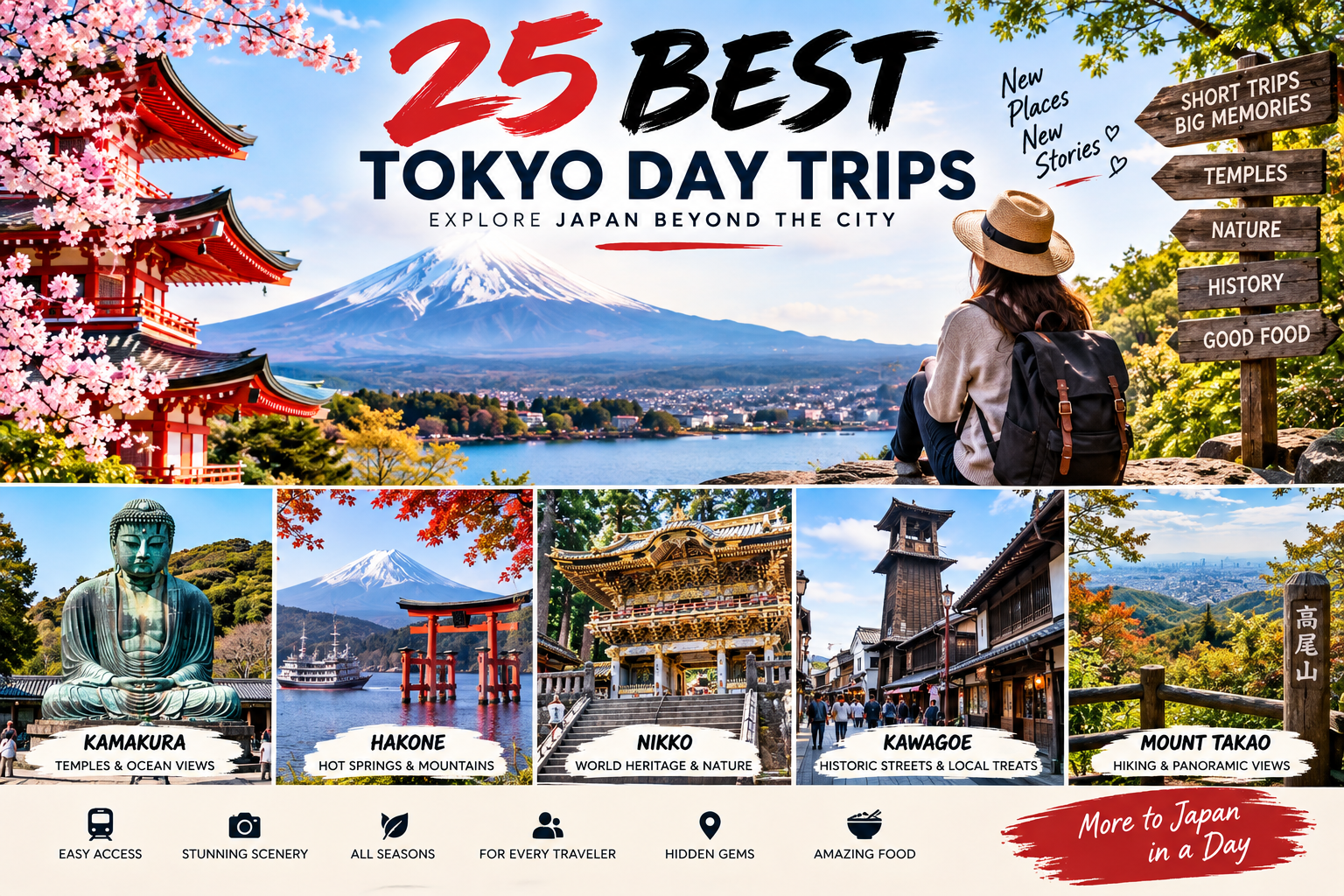
25 Best Tokyo Day Trips: Explore Japan Beyond the City
Tokyo day trips make it possible to experience historic towns, ancient temples, mountain landscapes, hot springs, beaches, traditional Japanese culture and scenic countryside without changing hotels. From Kamakura and Yokohama to Hakone, Nikko, Kawagoe and Mount Takao, there are Tokyo day trips for every type of traveler, budget and season Tokyo Sightseeing
Why Tokyo Is Such a Good Base for Day Trips
Tokyo’s location within the Kanto region makes it an unusually convenient starting point for exploring surrounding areas.
The Greater Tokyo region contains historical towns, coastal destinations, mountains, hot springs, cultural attractions and nature areas. Japan’s National Parks guide notes that Tokyo’s efficient transport network can take travelers from the metropolis to mountains, ancient temples and other natural environments within a few hours.
The official Tokyo tourism guide also points travelers toward western Tokyo for hiking and outdoor experiences, including Mount Takao and Okutama. Mount Takao, for example, is described as being about 50 minutes from Shinjuku and particularly attractive during spring and autumn.
This means you can design a Tokyo holiday around different types of days:
- City sightseeing
- Historic town exploration
- Beach and coastal travel
- Mountain hiking
- Hot springs
- Japanese gardens
- Traditional culture
- Food experiences
- Shopping
- Family attractions
- Nature photography
- Seasonal festivals
The key is to match the destination to your available time.
How to Choose the Right Tokyo Day Trip
Not every destination works equally well as a day trip.
A destination may be geographically close to Tokyo but still require too much local transportation to make a comfortable one-day itinerary.
A useful framework is to consider five things:
Travel Time
Ideally, a day trip should provide enough time at the destination to make the journey worthwhile.
Destinations such as Kamakura, Kawagoe, Yokohama and Mount Takao are relatively convenient. Hakone and Nikko can also be done in a day, although they benefit from careful planning.
Main Interest
Ask what you actually want to experience.
Do you want:
- History?
- Nature?
- Food?
- Beaches?
- Hot springs?
- Hiking?
- Shopping?
- Photography?
- Traditional culture?
- Family entertainment?
Season
The same destination can feel completely different in spring, summer, autumn and winter.
Walking Requirements
Some destinations involve considerable walking, stairs or uneven terrain.
Return Journey
Do not plan your day as if transportation will always run exactly according to your preferred schedule.
Leave some flexibility for delays, queues, weather and spontaneous discoveries.
The 25 Best Tokyo Day Trips
Kamakura
Kamakura is one of the easiest choices for travelers searching for Tokyo day trips.
Located south of Tokyo, Kamakura combines temples, shrines, historic streets, beaches, hiking trails and food.
JNTO describes Kamakura as less than an hour south of Tokyo and notes that Kamakura Station is approximately 55 minutes from Tokyo Station on the JR Yokosuka Line.
The destination’s greatest advantage is variety.
You can begin with historic temples, walk through traditional streets, visit the Great Buddha, stop for lunch and continue toward the coast.
What to Do in Kamakura
Important experiences include:
- Great Buddha of Kamakura
- Zen temples
- Tsurugaoka Hachimangu
- Komachi-dori
- Local cafés
- Traditional sweets
- Hiking trails
- Yuigahama Beach
- Enoshima
Kamakura can easily fill a full day because its attractions extend beyond one central sightseeing area. JNTO specifically notes its temples, literary heritage, beaches, hiking trails and food culture.
Who Should Visit Kamakura?
Kamakura works particularly well for:
- First-time visitors
- Couples
- Families
- History enthusiasts
- Photographers
- Beach lovers
- Culture travelers
Best Time to Visit Kamakura
Spring and autumn are especially attractive for travelers interested in seasonal scenery.
Summer is useful for travelers who want to combine history with the coast, although beach areas can become busy.
Yokohama
Yokohama is technically part of the Greater Tokyo travel sphere and is one of the easiest destinations to reach from central Tokyo.
It provides a striking contrast with Tokyo while still feeling distinctly urban.
JNTO describes Yokohama as an international port city with shopping areas, towers, bay views and a historical connection to international trade.
What to Do in Yokohama
Depending on your interests, consider:
- Minato Mirai
- Yokohama Red Brick Warehouse
- Yamashita Park
- Chinatown
- Waterfront promenades
- Museums
- Port views
- Historic architecture
Yokohama works particularly well if you do not want a long train journey.
Who Should Visit Yokohama?
It is especially suitable for:
- Families
- Couples
- Food lovers
- First-time visitors
- Architecture enthusiasts
- Travelers with limited time
Why Choose Yokohama?
Its biggest advantage is convenience.
If you only have one spare day and do not want to spend hours in transit, Yokohama provides a change of scenery without requiring a complicated itinerary.
Kawagoe
Kawagoe is one of the most interesting Tokyo day trips for travelers who want an old-town atmosphere.
JNTO describes Kawagoe as “Little Edo” because of its historic architecture and preserved atmosphere. The town’s Warehouse District, Toki no Kane bell tower, traditional shops and candy stores are among its key attractions.
Kawagoe is also less than an hour from major Tokyo stations by express train, making it especially practical for a short excursion.
What to See in Kawagoe
Explore:
- Kurazukuri Warehouse District
- Toki no Kane
- Candy Alley
- Kitain Temple
- Historic merchant streets
- Traditional cafés
- Local sweets
Why Kawagoe Feels Different
Kawagoe provides a visual connection with historical Japan without requiring a long journey to a remote region.
It is therefore excellent for travelers who want traditional architecture but have limited time.
Who Should Visit Kawagoe?
Kawagoe is ideal for:
- History lovers
- Photographers
- Families
- Food travelers
- First-time Japan visitors
- Travelers interested in traditional streets
Hakone
Hakone is one of the most famous Tokyo day trips because it combines hot springs, mountains, lake scenery, art and views toward Mount Fuji.
JNTO describes Hakone as a resort area known for hot springs, Lake Ashinoko, Owakudani, art attractions and mountain scenery. Hakone-Yumoto can be reached from Shinjuku by Odakyu train in roughly 90 minutes.
What Makes Hakone Special?
Hakone is less about one attraction and more about the journey through the region.
A typical visit might combine:
- Hakone-Yumoto
- Scenic railway
- Ropeway
- Owakudani
- Lake Ashinoko
- Hakone Shrine
- Open-air museums
- Onsen
Should Hakone Be a Day Trip or Overnight Stay?
It can be either.
For travelers with limited time, a carefully planned day trip works.
However, JNTO recommends two days for its broader Hakone itinerary, reflecting the fact that the area has enough attractions to justify a longer stay.
Who Should Visit Hakone?
Hakone is particularly suitable for:
- Couples
- Nature lovers
- Photography enthusiasts
- First-time Japan travelers
- Art lovers
- Travelers interested in hot springs
Nikko
Nikko is a stronger choice for travelers who want a combination of history and nature.
The city is approximately two hours from Tokyo, depending on the route. JNTO highlights its World Heritage temples and shrines, sacred mountains and surrounding national park.
Nikko’s World Heritage area includes 103 structures spread across three complexes.
What to See in Nikko
Important attractions include:
- Toshogu Shrine
- Rinnoji Temple
- Futarasan Shrine
- Shinkyo Bridge
- Lake Chuzenji
- Kegon Falls
- Senjogahara
- Mountain trails
Why Nikko Requires Better Planning
Nikko’s attractions are geographically spread out.
You can visit the World Heritage area without going deeper into the mountains, but combining temples with Lake Chuzenji and waterfalls creates a much more demanding day.
Japan’s National Parks guidance notes that buses connect Nikko’s main station area with Toshogu Shrine, Lake Chuzenji and Kegon Falls, while additional hiking routes extend into Okunikko.
Who Should Visit Nikko?
Nikko is excellent for:
- History enthusiasts
- Photographers
- Nature lovers
- Hikers
- Returning visitors
Mount Takao
If you want one of the simplest nature escapes from Tokyo, consider Mount Takao.
GO TOKYO describes Mount Takao as a day trip around 50 minutes from Shinjuku and highlights its spring blossoms and autumn foliage.
What to Do at Mount Takao
Depending on fitness and weather, visitors can:
- Hike
- Ride the cable car
- Enjoy mountain views
- Visit Yakuoin Temple
- Explore forest trails
- Eat local mountain food
- Photograph seasonal scenery
Who Should Visit Mount Takao?
It is suitable for:
- Beginners
- Families
- Active travelers
- Photographers
- Travelers with limited time
GO TOKYO also lists Mount Takao among the Tokyo-area hiking destinations alongside Mount Mitake, Mount Hinode and other outdoor areas.
Okutama
Okutama is a different type of Tokyo day trip.
Instead of leaving the Tokyo metropolitan area entirely, you travel toward its mountainous western edge.
JNTO describes Greater Tokyo’s outer areas as offering mountain trails, nature, museums and outdoor attractions, with many destinations reachable within one to two hours from Shinjuku.
Why Visit Okutama?
Okutama offers:
- Mountains
- Forests
- Rivers
- Lakes
- Hiking
- Camping
- Caves
- Rural scenery
The official Tokyo tourism guide also highlights Okutama for mountains, lakes, valleys, hiking and camping.
Who Should Visit Okutama?
This is particularly attractive for:
- Hikers
- Nature lovers
- Outdoor photographers
- Repeat Tokyo visitors
- Travelers escaping urban crowds
Enoshima
Enoshima works well as an extension of a Kamakura day trip.
The island is associated with coastal scenery, temples, viewpoints and seafood.
JNTO notes that Enoshima has long been popular as a day-trip destination from Tokyo and that its Candle Lighthouse provides panoramic views that can include Mount Fuji.
Combine Enoshima With Kamakura
A common mistake is trying to see every part of Kamakura and Enoshima in a few hours.
Instead, choose your priorities.
A relaxed itinerary might be:
Morning: Kamakura temples
Lunch: Local food
Afternoon: Enoshima
Evening: Return to Tokyo
If you want extensive hiking or beach time, consider staying overnight.
Kawaguchi-ko and the Fuji Five Lakes
Travelers searching for a Mount Fuji experience often consider the Fuji Five Lakes region.
The National Parks of Japan guide notes that several viewpoints around the Fuji Five Lakes offer Mount Fuji scenery, while bicycle rental around Lake Kawaguchiko can be used to explore the area.
Why Fuji Day Trips Can Be Tricky
Mount Fuji is weather-dependent.
You can make a long journey and discover that clouds have hidden the mountain.
Therefore, flexibility matters.
Check weather conditions before leaving and avoid building the entire trip around a single viewpoint.
Who Should Visit?
This is especially suitable for:
- Photographers
- First-time visitors
- Couples
- Nature lovers
- Outdoor travelers
Chichibu
Chichibu provides a combination of mountains, shrines, local culture and seasonal scenery.
It is particularly interesting for travelers who have already explored the standard Tokyo route.
The National Parks of Japan identifies Chichibu-Tama-Kai National Park as a convenient getaway from Tokyo, with hiking, mountains, gorges and forests.
Why Choose Chichibu?
It offers a more rural feeling than destinations such as Yokohama or Kamakura.
It can therefore work well for:
- Returning visitors
- Hikers
- Nature photographers
- Travelers seeking quieter areas
Kawasaki
Kawasaki is extremely close to Tokyo and can be useful for travelers who want a short excursion rather than a full day away.
JNTO notes that Kawasaki is about 20 minutes from Tokyo on the JR Tokaido Line.
Who Should Consider Kawasaki?
It can suit:
- Families
- Travelers with limited time
- Architecture enthusiasts
- Repeat visitors
- Travelers looking for an easy side trip
Chiba
Chiba Prefecture provides several different day-trip possibilities east of Tokyo.
Depending on the destination, travelers can find:
- Beaches
- Farms
- Theme parks
- Historic sites
- Nature
- Local food
JNTO’s Kanto itinerary collection specifically includes shopping and entertainment in Chiba as well as theme parks and farms.
Mount Mitake
Mount Mitake is another outdoor option within the broader Tokyo region.
GO TOKYO lists Mount Mitake among the hiking and trekking destinations around Tokyo.
It can appeal to travelers who want:
- Forests
- Hiking
- Mountain temples
- Seasonal scenery
- Fresh air
Yokosuka
Yokosuka offers a coastal perspective on the Tokyo region.
It can be interesting for travelers interested in:
- Maritime history
- Waterfront scenery
- Local food
- Parks
- Coastal culture
It is particularly useful for repeat visitors looking beyond Tokyo’s most familiar destinations.
Atami
Atami is a traditional seaside hot-spring destination that can work as a longer day trip.
It combines:
- Ocean views
- Hot springs
- Seafood
- Gardens
- Coastal scenery
For travelers who want a stronger resort atmosphere without flying elsewhere in Japan, Atami can be an appealing option.
Karuizawa
Karuizawa is farther away and therefore requires more planning, but high-speed rail makes it possible for determined travelers to visit in a day.
The National Parks of Japan notes that the Hokuriku Shinkansen from Ueno can reach Karuizawa in just over an hour.
Is Karuizawa a Good Day Trip?
Yes, but it is better for travelers who prioritize the destination and are comfortable with a longer day.
It is known for:
- Mountain scenery
- Cycling
- Shopping
- Cafés
- Nature
- Resort atmosphere
Kusatsu Onsen
Kusatsu is a famous hot-spring destination in Gunma, but it is not one of the easiest Tokyo day trips.
The National Parks of Japan guide indicates that highway buses can take around four hours from Tokyo, while express train and bus combinations can reduce the journey to under three hours.
Should You Visit Kusatsu as a Day Trip?
Only if the hot springs are a major priority.
For most travelers, an overnight stay makes more sense.
This is an important lesson in day-trip planning: a destination being technically reachable does not automatically make it a good day trip.
Mt. Fuji Versus Hakone for a Day Trip
These destinations are often compared.
| Factor | Hakone | Fuji Five Lakes |
|---|---|---|
| Main appeal | Hot springs, nature, art | Mount Fuji views |
| Transport complexity | Moderate | Moderate |
| Onsen | Excellent | Available |
| Fuji views | Weather dependent | Major focus |
| Art | Strong | More limited |
| Hiking | Good | Good |
| Best for | Relaxation + culture | Scenery + photography |
| Ideal duration | 1–2 days | 1–2 days |
If your priority is relaxation and cultural attractions, Hakone provides a broader mix.
If your priority is Mount Fuji photography, the Fuji Five Lakes area is more directly focused on the mountain.
Kamakura Versus Kawagoe
Both are excellent historic day trips, but their atmosphere differs.
| Feature | Kamakura | Kawagoe |
|---|---|---|
| Historic atmosphere | Strong | Strong |
| Temples | Excellent | Excellent |
| Beach | Yes | No |
| Traditional streets | Yes | Excellent |
| Food | Excellent | Excellent |
| Travel time | Short | Short |
| Best for | History + coast | Edo atmosphere |
| Family suitability | High | High |
| Hiking | Strong | Limited |
| Photography | Excellent | Excellent |
Kamakura is better suited to travelers wanting temples and coastline together.
Kawagoe is particularly attractive for traditional streets and historic merchant architecture.
Nikko Versus Hakone
These two destinations are often considered alternatives for travelers with only one spare day.
| Feature | Nikko | Hakone |
|---|---|---|
| Main theme | History + mountains | Hot springs + nature |
| Temples | Excellent | Moderate |
| Onsen | Excellent | Excellent |
| Fuji views | Limited | Strong potential |
| Hiking | Excellent | Good |
| Cultural heritage | Exceptional | Strong |
| Transport | More demanding | Moderate |
| Best for | History + nature | Relaxation + scenery |
Nikko is particularly compelling if Japanese religious architecture and mountain landscapes are priorities.
Hakone is more suitable when the goal is a combination of scenery, hot springs and art.
Best Tokyo Day Trips for Different Travelers
Tokyo Day Trips for First-Time Visitors
Start with:
- Kamakura
- Hakone
- Yokohama
- Kawagoe
- Mount Takao
These provide a broad introduction without requiring extremely complicated logistics.
Tokyo Day Trips for Families
Consider:
- Yokohama
- Kawagoe
- Mount Takao
- Hakone
- Chiba
Look for attractions with shorter walking distances and facilities suitable for children.
Tokyo Day Trips for Couples
Consider:
- Hakone
- Kamakura
- Enoshima
- Kawaguchi-ko
- Yokohama
Tokyo Day Trips for History Lovers
Consider:
- Kamakura
- Nikko
- Kawagoe
- Chichibu
Tokyo Day Trips for Nature Lovers
Consider:
- Mount Takao
- Okutama
- Nikko
- Hakone
- Fuji Five Lakes
- Chichibu
Tokyo Day Trips for Photographers
Consider:
- Fuji Five Lakes
- Hakone
- Kamakura
- Kawagoe
- Nikko
- Mount Takao
Tokyo Day Trips for Food Lovers
Consider:
- Kamakura
- Yokohama
- Kawagoe
- Kawasaki
- Chiba
Tokyo Day Trips for Repeat Visitors
Try:
- Okutama
- Chichibu
- Mount Mitake
- Yokosuka
- Shibazakura-season destinations
- Outer Tokyo communities
Best Tokyo Day Trips by Season
Spring Tokyo Day Trips
Spring is one of the most popular periods for travel in Japan.
Good choices include:
- Kamakura
- Mount Takao
- Kawagoe
- Hakone
- Fuji Five Lakes
GO TOKYO specifically highlights cherry blossoms around Mount Takao and seasonal nature experiences in western Tokyo.
Summer Tokyo Day Trips
Summer is ideal for:
- Enoshima
- Kamakura beaches
- Chiba
- Yokosuka
- Okutama
- River areas
Start early because heat can make hiking and sightseeing more demanding.
Autumn Tokyo Day Trips
Autumn is particularly attractive for:
- Nikko
- Mount Takao
- Okutama
- Hakone
- Kamakura
- Chichibu
GO TOKYO highlights Mount Takao and western Tokyo for autumn foliage.
Winter Tokyo Day Trips
Winter can be excellent for:
- Hakone
- Kawagoe
- Yokohama
- Kamakura
- Atami
Clear winter weather can also provide excellent mountain views.
Best Tokyo Day Trips for Budget Travelers
A day trip does not need to be expensive.
Choose destinations where the primary attractions involve walking and public spaces.
Good candidates include:
- Kawagoe
- Kamakura
- Mount Takao
- Yokohama
Budget travelers should focus on the total cost rather than only the train ticket.
Consider:
- Transportation
- Meals
- Attraction fees
- Cable cars
- Local buses
- Lockers
- Souvenirs
A cheap train journey can become expensive after several attraction fees and local transfers.
Best Tokyo Day Trips Without a Car
Most travelers do not need a car.
Japan’s rail network makes many destinations accessible by train.
The National Parks of Japan specifically notes that express trains, local railways and buses connect Tokyo with destinations including Nikko, Hakone, Chichibu-Tama-Kai and Fuji-Hakone-Izu.
The easiest car-free destinations include:
- Kamakura
- Yokohama
- Kawagoe
- Mount Takao
- Hakone
- Nikko
When Renting a Car Makes Sense
A rental car can become useful when visiting rural areas where attractions are widely spread.
This is more relevant for:
- Fuji Five Lakes
- Rural Chiba
- Parts of Okutama
- Izu Peninsula
- Remote mountain areas
However, drivers should account for:
- Japanese road rules
- Parking
- Tolls
- Traffic
- Weather
- Narrow roads
For most classic Tokyo day trips, public transportation is simpler.
10 Brands and Services for Tokyo Day Trips Compared
The following brands and services can play different roles in planning or operating Tokyo-area day trips. They are not identical products, so the table compares their typical function rather than ranking them.
| Brand | Main Role | Useful For | Typical Strength |
|---|---|---|---|
| JR East | Railway | Regional travel | Extensive rail network |
| Tobu Railway | Railway | Nikko and northern Kanto | Nikko access |
| Odakyu | Railway | Hakone and western Kanagawa | Hakone access |
| Keio | Railway | Mount Takao | Takao access |
| Seibu Railway | Railway | Kawagoe and western/northern areas | Regional access |
| Tokyo Metro | Urban rail | Tokyo connections | Central-city connections |
| Klook | Activity platform | Tours and tickets | Online activity discovery |
| GetYourGuide | Activity platform | Guided tours | International booking interface |
| Viator | Activity platform | Tours and excursions | Broad tour marketplace |
| GO TOKYO | Official tourism guide | Research and planning | Official Tokyo information |
Transport schedules, passes, fares and activity availability can change, so travelers should check the relevant operator before departure.
For example, current JR East travel content describes direct Spacia Nikko services from Shinjuku or Ikebukuro to Nikko, with the journey taking about two hours.
How to Plan Tokyo Day Trips Efficiently
Start With the Destination
Do not begin with transportation.
Begin with the experience.
Ask:
“What do I want this day to feel like?”
If the answer is peaceful, choose Hakone or a garden-oriented destination.
If the answer is historic, choose Kamakura, Kawagoe or Nikko.
If the answer is active, choose Mount Takao or Okutama.
Choose One Main Area
Trying to combine unrelated destinations can destroy the value of a day trip.
For example, combining Nikko’s World Heritage area, Lake Chuzenji and another distant attraction may leave you spending more time on buses than exploring.
Check the First Train
Starting 60–90 minutes earlier can completely change a day trip.
An early departure often means:
- Fewer crowds
- More sightseeing time
- Better photography
- Easier restaurant access
- More flexibility later
Check the Last Return Option
Never assume trains run late simply because Tokyo’s urban network is extensive.
The transport situation at a rural destination can be very different.
Download or Prepare Navigation Information
Even experienced travelers should have:
- Station names
- Destination names in Japanese
- Offline maps
- Return station information
- Reservation details
Carry a Backup Plan
Weather can change everything.
For a Fuji-focused trip, have an alternative attraction ready.
For hiking, know where a shorter trail or indoor attraction is available.
Common Tokyo Day Trip Mistakes
Trying to See Too Much
This is probably the biggest mistake.
A day trip should not become a race.
Ignoring Local Transportation
The train may get you to the destination, but local buses may be required afterward.
This is particularly important in Nikko and Hakone.
Assuming Google Maps Is Enough
Maps are useful, but understanding the geography beforehand can prevent inefficient routes.
Booking Too Late
Popular transport services and guided activities can sell out during peak seasons.
Ignoring Weather
Mountain and Fuji destinations are especially weather-sensitive.
Forgetting Comfortable Shoes
Many Tokyo day trips involve significantly more walking than visitors expect.
Carrying Too Much Luggage
A day trip is easier with a small bag.
Use station lockers when appropriate.
How to Make Tokyo Day Trips More Sustainable
Responsible travel is becoming increasingly important in Japan.
JNTO recommends considering less-traveled destinations and locally operated experiences as part of responsible travel.
Travelers can help by:
- Traveling outside peak hours
- Exploring less-crowded destinations
- Supporting local businesses
- Following local rules
- Avoiding litter
- Staying on marked trails
- Respecting residential neighborhoods
- Following photography restrictions
- Using public transportation when practical
A quieter destination can also provide a better travel experience.
Pros and Cons of Tokyo Day Trips
Advantages of Tokyo Day Trips
- No need to change hotels
- Easy access to multiple regions
- Huge variety of destinations
- Suitable for different budgets
- Good rail connectivity
- Excellent seasonal variety
- Opportunities to escape urban crowds
- Access to historic towns
- Access to mountains and nature
Disadvantages of Tokyo Day Trips
- Some destinations require long journeys
- Weather can disrupt plans
- Transport connections may be complicated
- Popular areas can become crowded
- One-day visits can feel rushed
- Some destinations are better suited to overnight stays
The solution is not to avoid longer trips.
Instead, distinguish between possible day trips and comfortable day trips.
Day Trip or Overnight Stay?
This is one of the most important decisions.
Stay Overnight When
- The journey is long
- There are many attractions
- You want an onsen experience
- You want to hike extensively
- You want sunrise or sunset photography
- You dislike rushing
- The destination has strong evening culture
Return to Tokyo When
- Travel time is short
- Attractions are concentrated
- You have limited vacation time
- Accommodation prices are high
- Your Tokyo hotel is convenient
Hakone, Nikko and the Fuji Five Lakes can all fall into either category depending on the itinerary.
A One-Day Tokyo Day Trip Formula
A reliable formula is:
7:00–8:00 — Depart Tokyo
9:00–10:00 — Arrive and begin sightseeing
10:00–13:00 — Main attraction
13:00–14:00 — Lunch
14:00–17:00 — Secondary attractions
17:00–18:00 — Local café, shopping or scenic stop
18:00 onward — Return
This is only a framework.
Actual train schedules and destination conditions should determine the precise timing.
A Relaxed Tokyo Day Trip Formula
For travelers who dislike rushing:
Morning: One major attraction
Late morning: Neighborhood exploration
Lunch: Local restaurant
Afternoon: One cultural or nature experience
Late afternoon: Café or scenic area
Evening: Return to Tokyo
This approach is often more memorable than attempting ten attractions.
Tokyo Day Trips for Travelers With Only Three Days in Tokyo
If your entire Japan trip is short, do not spend half of it traveling.
One day trip is usually enough.
A sensible structure could be:
Day 1: Central Tokyo
Day 2: Tokyo neighborhood exploration
Day 3: One nearby destination such as Kamakura, Hakone or Yokohama
The choice depends on your interests.
Tokyo Day Trips for Travelers Staying Seven Days
A week gives you more flexibility.
You could consider two day trips:
- One cultural destination
- One nature destination
For example:
Kamakura + Hakone
or
Kawagoe + Mount Takao
or
Yokohama + Nikko
Tokyo Day Trips for Repeat Visitors
Returning visitors should resist repeating the same famous route automatically.
Consider exploring:
- Okutama
- Chichibu
- Mount Mitake
- Yokosuka
- Smaller coastal towns
- Local festivals
- Regional food destinations
- Rural communities around Greater Tokyo
JNTO specifically points to Tokyo’s outer areas as offering mountains, rivers, parks, breweries and other attractions beyond the central metropolis.
Future Trends in Tokyo Day Trips
Greater Interest in Regional Travel
As visitors become more familiar with Tokyo’s famous attractions, nearby destinations are likely to become increasingly attractive.
More Nature-Based Experiences
Tokyo’s proximity to mountains, forests, rivers and national parks creates significant potential for outdoor tourism.
The official Tokyo guide already promotes hiking, camping, cycling and water-based adventure around the city.
Growth of Slow Travel
Instead of visiting five destinations in one day, travelers increasingly want deeper experiences.
A day spent slowly exploring one historic town can be more rewarding than checking several locations from a list.
More Personalized Day Trips
Travel planning is moving toward specific search intentions such as:
- Tokyo day trips for families
- Tokyo day trips for couples
- Tokyo day trips without a car
- Tokyo day trips for nature lovers
- Tokyo day trips for first-time visitors
- Tokyo day trips for photographers
- Tokyo day trips in winter
- Tokyo day trips from Shinjuku
- Tokyo day trips from Tokyo Station
- Cheap Tokyo day trips
- Easy Tokyo day trips
- Scenic Tokyo day trips
This makes it easier for travelers to find destinations that actually fit their needs.
Better Digital Planning
Mobile navigation, digital tickets, real-time transport information and online reservations make independent day trips easier.
However, technology does not eliminate the need to understand local geography and transport connections.
FAQs
What are the best Tokyo day trips?
Popular choices include Kamakura, Hakone, Nikko, Kawagoe, Yokohama and Mount Takao. Each offers a different experience, from historic temples and traditional streets to hot springs, mountains and coastal scenery. JNTO’s current itinerary collection specifically features Hakone, Kamakura, Mount Takao, Kawagoe, Yokohama and Nikko among Kanto day-trip options.
What is the easiest day trip from Tokyo?
Yokohama, Kamakura, Kawagoe and Mount Takao are among the easiest options because they can be reached relatively conveniently from central Tokyo.
Is Kamakura worth a day trip from Tokyo?
Yes. Kamakura combines temples, historic sites, food, hiking and beaches, and Kamakura Station is about 55 minutes from Tokyo Station by the JR Yokosuka Line.
Is Hakone a good day trip from Tokyo?
Yes. Hakone can work well as a day trip, particularly for travelers interested in hot springs, mountains, Lake Ashinoko, art and possible Mount Fuji views. Hakone-Yumoto is around 90 minutes from Shinjuku by Odakyu Line.
Can you visit Nikko in one day from Tokyo?
Yes. Nikko is reachable in approximately two hours from Tokyo, and travelers can visit its major World Heritage sites in a day. However, combining the historic area with Lake Chuzenji and mountain attractions requires careful planning.
Is Kawagoe a good alternative to Kamakura?
It depends on your interests. Kawagoe is particularly attractive for traditional merchant architecture and its Edo-period atmosphere, while Kamakura combines historic sites with beaches and hiking.
Which Tokyo day trips are best without a car?
Kamakura, Yokohama, Kawagoe, Hakone, Nikko and Mount Takao are all practical options using public transportation.
What is the best Tokyo day trip for nature?
Mount Takao and Okutama are among the most convenient nature-oriented options. Nikko, Hakone and the Fuji Five Lakes provide larger-scale mountain landscapes.
What is the best Tokyo day trip for couples?
Hakone, Kamakura, Enoshima and Yokohama can all work well for couples, depending on whether you prefer hot springs, history, beaches, food or waterfront scenery.
What is the best Tokyo day trip for families?
Yokohama, Kawagoe, Mount Takao and selected Hakone attractions can work well for families. Choose the itinerary according to children’s ages and walking tolerance.
What is the cheapest Tokyo day trip?
The total cost depends on transportation, food and attraction fees. Kawagoe, Kamakura, Mount Takao and Yokohama can all be structured as relatively budget-friendly day trips.
Can I see Mount Fuji on a Tokyo day trip?
Yes, particularly from destinations such as Hakone and the Fuji Five Lakes area. However, Mount Fuji visibility is highly dependent on weather conditions.
Is Mount Fuji guaranteed to be visible from Hakone?
No. Fuji visibility depends on weather and atmospheric conditions. It is better to treat a Fuji view as a possibility rather than a guarantee.
How far is Mount Takao from Tokyo?
GO TOKYO describes Mount Takao as approximately 50 minutes from Shinjuku, making it one of the most convenient mountain day trips from central Tokyo.
Can I visit Tokyo’s mountains without leaving Tokyo?
Yes. Mount Takao and Okutama are within Tokyo’s broader metropolitan boundaries and provide access to mountains, forests, lakes and valleys.
Is Nikko better as an overnight trip?
It can be. A day trip is possible, but an overnight stay allows more time for the World Heritage area, Lake Chuzenji, waterfalls and mountain scenery without rushing. JNTO’s Nikko itinerary recommends two days for a broader cultural and nature experience.
Is Hakone better as an overnight trip?
For a relaxed experience, an overnight stay can be better. JNTO’s dedicated Hakone itinerary recommends two days, although Hakone can also be visited in one day with careful planning.
Are Tokyo day trips suitable for older travelers?
Yes. Yokohama, Kawagoe and some Kamakura itineraries can be relatively manageable, while Hakone can offer sightseeing with less continuous walking if transportation is planned carefully.
Which Tokyo day trips are best for photographers?
Fuji Five Lakes, Hakone, Kamakura, Kawagoe, Nikko and Mount Takao provide varied opportunities for landscape, architecture, street and seasonal photography.
What should I pack for a Tokyo day trip?
Carry comfortable shoes, a small day bag, water, weather-appropriate clothing, a portable charger and any necessary reservations or transport information. Hiking destinations require additional equipment.
Should I book Tokyo day trips in advance?
Popular limited-capacity trains, guided tours and attractions can require advance planning, particularly during busy seasons. Always check current availability and transport schedules before departure.
Can I take a Tokyo day trip during winter?
Yes. Winter can be excellent for clear mountain views, hot springs, historic neighborhoods and coastal destinations. Mountain trips require particular attention to weather and trail conditions.
Are Tokyo day trips crowded?
Popular destinations can become busy, especially during weekends, holidays, cherry-blossom season and autumn foliage periods. Starting early and visiting less-central areas can help.
What is the biggest mistake people make on Tokyo day trips?
Trying to see too much.
The most successful day trips usually have one major destination, a small number of secondary stops and enough time for lunch, rest and unexpected discoveries.
Conclusion
Tokyo day trips are one of the best ways to expand a Japan itinerary without constantly changing hotels. The metropolitan area sits within easy reach of historic towns, coastal landscapes, mountains, hot springs, traditional cultural sites and rural scenery. Kamakura can combine temples and beaches, Kawagoe offers an Edo-period atmosphere, Hakone brings together hot springs and mountain scenery, Nikko connects World Heritage architecture with dramatic nature, while Mount Takao and Okutama provide accessible escapes into the outdoors.