
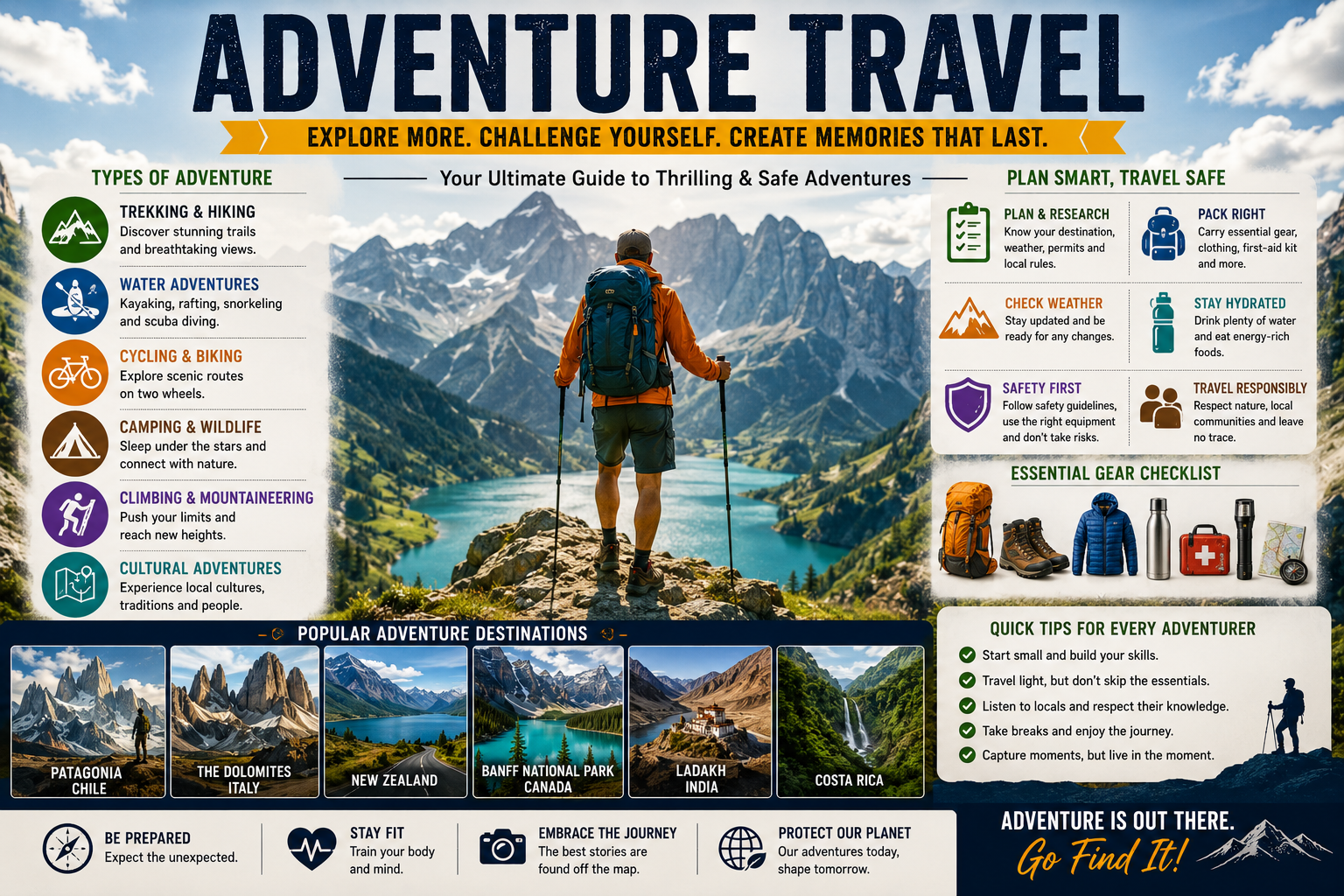
Adventure Travel: 25 Thrilling Tips for Safer, Smarter Adventures
What if your next vacation could give you more than photographs and souvenirs? Adventure travel turns the journey itself into an experience, combining exploration, physical activity, unfamiliar environments, and meaningful encounters with nature and culture. Adventure travel is about stepping beyond ordinary sightseeing while managing risk intelligently, choosing activities that match your abilities, and preparing for the environment you will enter. The best adventure trips are not reckless; they are carefully designed experiences that balance challenge, safety, comfort, curiosity, and respect for local communities and natural environments City Guides
What Is Adventure Travel?
Adventure travel is a form of tourism centered on exploration, activity, challenge, discovery, or experiences outside ordinary routines.
It can involve physical activities such as hiking, trekking, cycling, kayaking, rafting, climbing, skiing, diving, surfing, or camping. It can also involve cultural exploration, wildlife experiences, remote journeys, photography expeditions, and other forms of active travel.
The important point is that adventure does not have one fixed definition.
For one traveler, adventure might mean a multi-day mountain trek.
For another, it might mean cycling through a foreign countryside.
For someone else, it could be a guided wildlife expedition or learning to surf for the first time.
Adventure Does Not Mean Extreme Risk
One of the biggest misconceptions about adventure travel is that an adventure must be dangerous.
It does not.
Adventure is better understood as meaningful uncertainty combined with exploration and challenge.
A beginner hiking a moderately difficult trail may experience a genuine adventure even though an experienced mountaineer would consider the same trail easy.
The challenge is relative to the traveler.
Adventure Travel Versus Traditional Tourism
Traditional tourism often focuses on destinations, attractions, hotels, restaurants, and sightseeing.
Adventure travel places greater emphasis on participation.
Instead of only looking at a mountain, you may hike it.
Instead of watching a river, you may kayak on it.
Instead of viewing a landscape from a road, you may cycle through it.
That active participation often creates a stronger sense of accomplishment and connection with a destination.
Why Adventure Travel Is So Appealing
Adventure travel has become an attractive option for people who want vacations to feel more meaningful and memorable.
It Creates Strong Memories
Physical and emotional experiences can make destinations easier to remember.
A difficult hike followed by an extraordinary viewpoint can become more memorable than visiting another attraction for thirty minutes.
It Encourages Personal Growth
Adventure activities often require patience, problem-solving, resilience, and adaptability.
A traveler may discover that they are capable of more than they expected.
It Connects Travelers With Nature
Hiking, camping, kayaking, cycling, diving, and wildlife experiences can bring travelers closer to natural environments.
This connection can also encourage greater awareness of conservation.
It Can Introduce New Cultures
Adventure travel does not have to be limited to wilderness.
Walking through rural communities, cycling between villages, participating in local activities, or staying with local hosts can create meaningful cultural experiences.
The Main Types of Adventure Travel
There is no universal adventure itinerary.
Different travelers want different levels of physical activity and uncertainty.
Hiking and Trekking
Hiking is among the most accessible forms of adventure travel.
It can range from short day hikes to multi-day treks.
Important factors include trail difficulty, elevation, weather, distance, navigation, water availability, and emergency access.
Mountain Adventures
Mountain travel can include hiking, trekking, climbing, skiing, snowboarding, mountaineering, and other activities.
Mountain environments can change rapidly, making weather awareness and appropriate preparation particularly important.
Water-Based Adventure
Water adventures include kayaking, rafting, sailing, surfing, snorkeling, diving, and paddleboarding.
Water conditions, swimming ability, equipment, local regulations, and weather should always be considered.
Cycling Adventures
Cycling can be an excellent way to explore landscapes at a slower pace than driving.
Routes can range from paved urban and rural roads to dedicated trails and challenging mountain terrain.
Wildlife Adventures
Wildlife-focused travel can involve safaris, birdwatching, marine wildlife experiences, photography trips, and guided nature expeditions.
Responsible wildlife tourism requires maintaining appropriate distance and following local guidance.
Camping Adventures
Camping can range from organized campgrounds to remote wilderness experiences.
The more remote the environment, the more important preparation becomes.
Cultural Adventure
Adventure does not always require physical intensity.
Exploring unfamiliar communities, participating in traditional activities, learning local skills, or traveling through less-visited regions can provide a strong sense of discovery.
How to Choose the Right Adventure
The best adventure is not necessarily the most difficult one.
It is the one that matches your interests, abilities, resources, and comfort level.
Start With Your Experience Level
Consider yourself honestly.
Are you:
- A complete beginner?
- Moderately active?
- Experienced in outdoor activities?
- Highly experienced?
- Professionally trained in a particular activity?
Your answer should influence the difficulty of the trip.
Consider Your Comfort With Uncertainty
Some travelers love uncertainty.
Others prefer a clear schedule, reliable accommodation, guides, and established routes.
Neither preference is wrong.
Choose an adventure that challenges you without overwhelming you.
Consider Your Physical Condition
Different activities place different demands on the body.
A long-distance trek requires endurance.
Cycling may require sustained leg effort.
Climbing requires specific skills.
Water activities can require swimming ability and confidence.
Do not choose an activity simply because it looks impressive online.
How Beginners Should Approach Adventure Travel
Beginners should focus on learning rather than proving themselves.
Start With a Manageable Challenge
Choose an activity that is challenging enough to be interesting but not so difficult that a small mistake becomes dangerous.
Consider a Qualified Guide
For technical, remote, or unfamiliar activities, professional guides can provide local knowledge, equipment guidance, navigation support, and emergency procedures.
Learn Before You Travel
Research the activity itself.
Understand basic terminology, physical demands, equipment requirements, weather considerations, and common risks.
Practice Locally
If you plan to hike, practice hiking.
If you plan to camp, try camping closer to home first.
If you plan to cycle long distances, build your cycling ability gradually.
Adventure Travel for Intermediate Travelers
Intermediate travelers can begin increasing complexity.
Combine Activities
A trip might combine hiking with camping, cycling with cultural exploration, or kayaking with wildlife observation.
Explore Less Familiar Environments
You can gradually move beyond familiar landscapes while maintaining sensible safety margins.
Improve Technical Skills
Navigation, outdoor cooking, first aid, weather awareness, equipment maintenance, and basic survival skills can become increasingly useful.
Adventure Travel for Experienced Travelers
Experienced travelers may be comfortable planning more complex journeys.
However, experience should never create overconfidence.
Research the Environment
A traveler who is highly skilled in one environment may be inexperienced in another.
An experienced desert hiker may not automatically be prepared for high-altitude mountain travel.
Understand Local Conditions
Local knowledge matters.
Weather patterns, terrain, wildlife, regulations, rescue infrastructure, and cultural practices vary greatly.
Use Appropriate Professional Support
Some environments require specialist knowledge.
Hiring qualified local professionals can improve both safety and the quality of the experience.
How to Plan an Adventure Travel Itinerary
Adventure itineraries require more flexibility than ordinary sightseeing trips.
Identify the Main Objective
Start by defining the experience.
For example:
- Complete a trek
- Explore a national park
- Learn to surf
- Cycle through a region
- Photograph wildlife
- Explore remote villages
- Camp in nature
- Experience winter landscapes
Build Around the Main Activity
Do not fill the itinerary with unrelated activities that leave you exhausted before the main adventure.
Add Recovery Time
Physical activities require recovery.
A rest day can be as important as an activity day.
Create a Backup Plan
Ask what happens if:
- Weather becomes unsafe
- A trail closes
- Transport is delayed
- An activity is canceled
- Equipment fails
- You become sick
- You need additional rest
A backup plan reduces stress.
How to Research an Adventure Destination
Destination research should go beyond photographs and social media posts.
Study the Geography
Understand mountains, rivers, coastlines, forests, deserts, elevations, and other physical features.
Research Climate
Do not assume that a destination is warm or cold simply because of its location.
Seasonal conditions can vary significantly.
Check Local Rules
Some parks and protected areas require permits or have restrictions on camping, fires, drones, vehicles, fishing, or other activities.
Understand Access
A destination may look close on a map but require substantial travel time.
Research roads, public transport, transfers, trailheads, boat access, and other logistics.
Adventure Travel Safety
Safety should be part of the trip design rather than an afterthought.
Use the Risk-Benefit Approach
Ask:
What could go wrong, how serious would it be, and how can I reduce the likelihood or impact?
This simple framework can improve decision-making.
Know Your Limits
Stopping early is not failure.
Turning around because weather deteriorates is often a sign of good judgment.
Avoid Unnecessary Risk
A spectacular photograph is not worth standing somewhere unsafe.
A summit is not worth ignoring dangerous weather.
A shortcut is not worth getting lost.
Understanding Weather
Weather is one of the most important variables in outdoor travel.
Check Forecasts
Review reliable forecasts before departure and continue checking them when possible.
Watch Conditions, Not Just Predictions
Actual conditions can differ from forecasts, especially in mountains and other environments with rapidly changing weather.
Have a Threshold for Turning Back
Decide in advance what conditions will cause you to change plans.
This makes it easier to make a rational decision when emotions are high.
Navigation for Adventure Travelers
Navigation becomes more important as you move away from developed areas.
Use Multiple Navigation Methods
Depending on the environment, useful options may include:
- Offline digital maps
- Physical maps
- Compass
- GPS devices
- Clearly marked trail systems
- Local guides
Download Maps Before Leaving
Do not assume mobile service will be available.
Understand Your Route
A device can show your location without giving you the understanding required to make a good decision.
Know the major landmarks, route direction, access points, and alternative paths where appropriate.
Essential Adventure Travel Gear
Equipment should be chosen according to the activity and environment.
Backpack
A good backpack should match the duration and purpose of the trip.
Footwear
Footwear should match terrain and activity.
Hiking shoes, trail footwear, water shoes, cycling shoes, and mountaineering footwear serve different purposes.
Clothing Layers
Layering allows travelers to adapt to changing conditions.
A basic system may include:
- Base layer
- Insulating layer
- Weather-resistant outer layer
Water Storage
Carry an appropriate amount of water for the route and know where reliable resupply is available.
Sun Protection
Depending on the environment, sun protection can include:
- Hat
- Sunglasses
- Appropriate clothing
- Sunscreen
First-Aid Supplies
Carry a first-aid kit appropriate to the activity, group size, duration, and remoteness.
How to Pack for Adventure Travel
Packing requires balancing preparedness and weight.
Pack for the Environment
A tropical beach adventure requires different equipment from a high-altitude trek.
Pack for the Activity
Do not carry equipment simply because it might be useful.
Every item adds weight and complexity.
Protect Critical Equipment
Keep essential documents, communication devices, medication, and other critical items protected from moisture or damage as appropriate.
Adventure Travel and Physical Preparation
Physical preparation can dramatically improve the experience.
Build Endurance Gradually
Start with manageable activity and increase duration or intensity over time.
Practice With Your Equipment
Do not use brand-new boots, backpacks, or technical equipment for the first time on a demanding trip.
Train for the Actual Activity
If the trip involves long climbs, train for climbing.
If it involves cycling, cycle.
If it involves carrying a backpack, gradually practice carrying an appropriate load.
Nutrition During Adventure Trips
Food becomes more important during physically demanding travel.
Prioritize Practical Foods
Choose food that is easy to carry, store, and consume.
Consider Energy Needs
Long physical activities may require more energy than a normal sightseeing day.
Plan Water Carefully
Water requirements depend on activity, climate, altitude, individual needs, and availability.
Never assume that a stream or natural water source is automatically safe to drink.
Adventure Travel on a Budget
Adventure does not have to mean luxury pricing.
Choose Local Experiences
Independent local activities can sometimes provide excellent value while supporting local communities.
Use Public Transportation Where Practical
In suitable destinations, buses, trains, and shared transport can reduce costs.
Camp When Appropriate
Camping can reduce accommodation costs where permitted and safe.
Invest in the Right Equipment
Buying the cheapest equipment is not always economical.
A durable product that suits the activity can provide better long-term value.
Luxury Adventure Travel
Adventure and luxury are not opposites.
A traveler can spend the day hiking, diving, skiing, or exploring and return to high-quality accommodation afterward.
Focus on Comfort After Activity
Comfortable lodging can provide valuable recovery after physically demanding days.
Use Expert Guides
Private or specialist guides can create highly customized experiences.
Reduce Logistical Stress
Premium transport, carefully arranged transfers, and curated itineraries can allow travelers to concentrate on the adventure itself.
Family Adventure Travel
Families can enjoy adventure travel when activities are matched to age and ability.
Choose Age-Appropriate Activities
Younger travelers may prefer shorter hikes, wildlife experiences, beginner water activities, or simple camping.
Keep Emergency Planning Simple
Parents should know where emergency services, medical facilities, and reliable communications are available.
Avoid Excessive Scheduling
Children may need more rest and flexibility than adults expect.
Solo Adventure Travel
Solo adventure travel offers independence but requires additional planning.
Share Your Plans
For remote or challenging journeys, provide a trusted person with your itinerary and expected return information.
Prioritize Communication
Understand where you will and will not have cellular coverage.
Choose Risks Carefully
Solo travelers have fewer resources when something goes wrong.
That does not mean avoiding adventure.
It means designing it intelligently.
Adventure Travel for Older Adults
Age does not automatically prevent adventure.
The right activity depends on individual fitness, experience, mobility, and comfort.
Choose Experience Over Intensity
A scenic hike with comfortable accommodation may be more enjoyable than an unnecessarily demanding expedition.
Build Recovery Time
Allow additional time between demanding activities when needed.
Research Accessibility
Consider transportation, accommodation, trails, restrooms, medical services, and walking requirements.
Adventure Travel for People With Limited Experience
Beginners often worry that they are not adventurous enough.
The opposite may be true.
Starting from a realistic level can create a stronger foundation.
Take Introductory Courses
Courses can provide useful skills before attempting a more challenging activity.
Choose Guided Experiences
A qualified guide can help beginners understand techniques, equipment, local conditions, and safety practices.
Build Confidence Gradually
Adventure is a progression.
You do not need to start with the hardest possible challenge.
Responsible Adventure Travel
Adventure travel takes place in environments that can be environmentally and culturally sensitive.
Follow Leave-No-Trace Principles
Where applicable, travelers should minimize environmental impact.
That can include:
- Carrying out waste
- Staying on designated trails
- Avoiding damage to vegetation
- Respecting wildlife
- Following camping rules
- Using established facilities where available
Respect Wildlife
Never intentionally disturb animals for photographs.
Do not feed wildlife unless explicitly permitted by responsible authorities or operators under appropriate guidelines.
Respect Local Communities
Dress appropriately where cultural expectations require it.
Ask permission before photographing people.
Support legitimate local businesses.
Sustainable Adventure Travel
Adventure tourism can contribute to conservation and local economies when managed responsibly.
Spend Locally
Local accommodation, guides, restaurants, transport providers, and craftspeople can benefit directly from tourism spending.
Reduce Waste
Reusable products can reduce dependence on disposable items when practical.
Consider Transportation
Where practical, choose transportation options with lower environmental impact.
Avoid Overtourism
Consider visiting less crowded areas where tourism is welcomed and infrastructure can support visitors.
Adventure Travel and Local Guides
Local guides can offer value that online maps cannot.
Local Knowledge
Guides may understand seasonal conditions, trail changes, cultural expectations, wildlife behavior, and local logistics.
Safety Support
For technical or remote activities, professional support can be particularly valuable.
Cultural Connection
A knowledgeable local guide can add context to landscapes and communities.
The important consideration is choosing properly qualified and reputable operators.
Adventure Travel Technology
Technology can improve planning and safety.
GPS Devices
GPS technology can assist navigation, particularly in areas with limited cellular coverage.
Satellite Communication
For remote travel, satellite communication devices may provide capabilities that ordinary mobile phones cannot.
The suitability of such equipment depends on destination and activity.
Weather Apps
Weather technology can provide forecasts and alerts.
However, users should understand that forecasts are not guarantees.
Portable Power
Power banks and other charging solutions can be useful during multi-day travel.
Common Adventure Travel Mistakes
Choosing an Adventure Because It Looks Good Online
Social media often presents the best moments.
It rarely shows the long climb, difficult weather, navigation problems, exhaustion, or logistical challenges.
Solution: research the complete experience, not just the final photograph.
Underestimating Weather
Weather can change faster than expected.
Solution: understand seasonal patterns and monitor current conditions.
Buying Gear at the Last Minute
New equipment may require testing or adjustment.
Solution: practice with important equipment before departure.
Ignoring Recovery
Travelers sometimes schedule demanding activities every day.
Solution: include rest and recovery periods.
Relying Completely on Technology
Phones can lose power, connectivity, or functionality.
Solution: carry appropriate backups.
Ignoring Local Regulations
Protected areas may have restrictions that travelers do not expect.
Solution: research official rules before arrival.
Overestimating Physical Ability
Excitement can make a difficult activity appear easier.
Solution: compare your actual fitness and experience with the demands of the activity.
Pros and Cons of Adventure Travel
Major Advantages
Adventure travel can provide:
- Greater connection with nature
- Strong personal memories
- Physical activity
- Cultural discovery
- Personal confidence
- Opportunities to learn new skills
- Unique photography opportunities
- More meaningful interaction with destinations
- A break from routine
- Greater appreciation for natural environments
Potential Disadvantages
Adventure travel can also involve:
- Physical exhaustion
- Weather disruptions
- Equipment costs
- Injury risk
- Higher planning requirements
- Remote access
- Limited connectivity
- Unexpected expenses
- Difficult transportation
- Greater uncertainty
The goal is not to eliminate every challenge.
The goal is to understand and manage reasonable risks.
How to Decide Whether an Adventure Is Worth the Risk
Risk should be evaluated rather than ignored.
Consider Probability
How likely is the problem?
Consider Consequences
What happens if it occurs?
A minor inconvenience and a life-threatening emergency should obviously receive different levels of preparation.
Consider Mitigation
Can you reduce the risk through:
- Better equipment?
- Training?
- A guide?
- A different route?
- Better weather timing?
- Additional communication?
- More experience?
Consider Alternatives
If the same experience can be achieved through a safer route, the safer route may be the better choice.
A Practical Adventure Travel Risk Matrix
A simple framework can help travelers make better decisions.
| Risk | Possible Impact | Preparation |
|---|---|---|
| Bad weather | High | Forecast checks and backup plans |
| Getting lost | Moderate to high | Maps, navigation skills, local guidance |
| Equipment failure | Moderate | Testing and backup essentials |
| Dehydration | High | Water planning and resupply research |
| Injury | High | Training, appropriate equipment, first aid |
| Fatigue | Moderate to high | Rest and realistic schedules |
| Communication failure | High in remote areas | Offline plans and appropriate communication tools |
| Transportation delays | Low to moderate | Buffer time |
| Unexpected expenses | Moderate | Emergency financial reserve |
| Closed trail or attraction | Low to moderate | Alternative itinerary |
The matrix is not a substitute for professional safety guidance, but it can encourage better planning.
Adventure Travel for Different Demographics
Adventure Travel for Students
Students often have limited budgets but can benefit from flexible schedules.
Affordable adventures can include hiking, camping, cycling, hostels, local public transport, and community-based experiences where appropriate.
Adventure Travel for Couples
Couples can combine physical activity with relaxation.
A multi-day adventure followed by a slower recovery period can create a balanced trip.
Adventure Travel for Families
Families should focus on age-appropriate activities, flexible schedules, easy access to food and restrooms, and reliable accommodation.
Adventure Travel for Seniors
Seniors can choose lower-impact activities such as scenic hiking, wildlife observation, cultural exploration, photography, and guided nature trips according to their abilities.
Adventure Travel for Solo Travelers
Solo travelers should place greater emphasis on communication, itinerary sharing, emergency planning, and realistic risk assessment.
Adventure Travel for Budget Travelers
Budget travelers can prioritize free natural attractions, local transportation, camping where permitted, self-guided activities, and longer stays in fewer locations.
Adventure Travel for Luxury Travelers
Luxury travelers can combine challenging daytime activities with high-quality accommodation, private guides, premium transport, and personalized experiences.
Adventure Travel for Different Problems
Adventure travel can also be planned around specific traveler problems.
For Travelers Who Hate Crowds
Consider less-visited destinations, early starts, shoulder-season travel where appropriate, and activities that naturally distribute visitors across larger areas.
For Travelers With Limited Time
Choose one major adventure close to a practical transportation hub rather than trying to cross an entire region.
For Travelers With Limited Fitness
Start with low-intensity activities and build gradually.
For Travelers Who Want More Nature
Prioritize national parks, protected areas, hiking routes, wildlife experiences, forests, coastlines, and other natural environments where responsible access is permitted.
For Travelers Who Want Cultural Connection
Choose local guides, community-based experiences, regional food, traditional activities, and smaller communities where tourism is welcomed.
Ten Brands Commonly Associated With Adventure Travel
Brand suitability depends on the specific product, activity, climate, budget, and personal requirements. A well-known brand does not automatically mean that every product is suitable for every adventure.
| Brand | Main Focus | Common Adventure Use | Best Suited To |
|---|---|---|---|
| Patagonia | Outdoor clothing and equipment | Weather protection and outdoor apparel | Hikers and outdoor travelers |
| The North Face | Outdoor clothing and gear | Hiking, trekking, cold-weather travel | General outdoor users |
| Osprey | Backpacks | Hiking and travel packs | Hikers and backpackers |
| Arc’teryx | Technical outdoor equipment | Technical outdoor activities | Experienced outdoor users |
| Columbia | Outdoor apparel and footwear | Hiking and general outdoor travel | Beginners and general travelers |
| Garmin | Navigation and wearable technology | GPS navigation and outdoor tracking | Hikers and adventure travelers |
| Black Diamond | Climbing and mountain equipment | Climbing and mountain activities | Technical users |
| Deuter | Backpacks | Trekking and outdoor travel | Hikers and backpackers |
| Merrell | Outdoor footwear | Hiking and trail activities | Hikers and casual adventurers |
| Sea to Summit | Outdoor equipment | Camping, trekking, and lightweight travel | Backpackers and campers |
The correct choice should always be based on product specifications, fit, intended activity, climate, safety requirements, and compatibility.
How to Choose Adventure Travel Gear by Trip Type
Hiking
Prioritize footwear, backpack fit, navigation, weather protection, water management, and first-aid supplies.
Camping
Consider shelter, sleeping equipment, cooking equipment, lighting, clothing, water, and weather protection.
Cycling
Focus on bicycle suitability, helmet use, repair equipment, hydration, navigation, visibility, and appropriate clothing.
Water Adventures
Prioritize activity-specific safety equipment, appropriate clothing, communication, and knowledge of local conditions.
Mountain Travel
Equipment needs can become significantly more technical depending on elevation, season, terrain, and activity.
Seek qualified instruction for technical activities rather than relying solely on general travel articles.
How to Build an Adventure Travel Budget
A realistic adventure budget should include more than flights and hotels.
Transportation
Include flights, trains, buses, rental vehicles, transfers, fuel, parking, tolls, and other transportation costs.
Accommodation
Compare hotels, hostels, guesthouses, campsites, lodges, and other legitimate options according to destination.
Activities
Guides, permits, equipment rentals, park fees, lessons, and excursions may add significant costs.
Equipment
Separate essential equipment from optional upgrades.
Food
Physically demanding trips may require additional food or specialized nutrition.
Emergency Reserve
Keep funds available for changes to transport, accommodation, weather, equipment, or medical needs.
How to Make Adventure Travel More Comfortable
Adventure does not require unnecessary suffering.
Improve Sleep
Good sleep supports physical recovery and decision-making.
Choose Comfortable Accommodation When It Matters
After a demanding activity, a comfortable bed can be more valuable than another attraction.
Manage Your Load
Carrying unnecessary weight can reduce enjoyment.
Schedule Recovery
Rest is part of performance.
Adventure Travel and Photography
Adventure destinations are naturally attractive to photographers.
Prioritize Safety Over the Shot
Never enter unsafe terrain for a photograph.
Protect Equipment
Weather, water, dust, sand, and impact can damage equipment.
Travel Light
A smaller camera setup may be more practical on demanding routes.
Respect People and Places
Ask permission before photographing people when appropriate and follow rules in protected areas.
How Social Media Has Changed Adventure Travel
Social platforms have made remote destinations more visible.
This creates both opportunities and problems.
Inspiration
Travelers can discover routes, destinations, equipment ideas, and experiences.
Unrealistic Expectations
Images often hide crowds, difficult access, weather, and physical demands.
Environmental Pressure
Sudden popularity can put pressure on fragile natural areas.
Travelers should therefore research current access rules and choose responsible behavior over copying viral trends.
The Future of Adventure Travel
Adventure tourism is likely to continue evolving alongside technology, transportation, environmental awareness, and changing traveler preferences.
More Personalized Adventures
Travelers increasingly have access to experiences tailored around fitness, interests, budget, duration, and comfort.
Growth of Soft Adventure
Not every traveler wants extreme activities.
Soft adventure can combine nature and activity with comfortable accommodation and professional support.
Better Outdoor Technology
Navigation, weather information, satellite communication, wearable technology, and equipment design are continuing to evolve.
Technology may improve safety and convenience, but it will not eliminate environmental uncertainty.
Greater Focus on Responsible Tourism
Travelers and operators are increasingly considering environmental impact, local communities, wildlife welfare, and destination capacity.
Adventure Near Home
Travelers may increasingly discover that meaningful adventures can happen closer to home.
Short hiking trips, cycling routes, camping weekends, and local nature experiences can provide many benefits without requiring long-distance travel.
Why the Future May Favor Smaller Adventures
The idea that adventure requires a month-long expedition is becoming less useful.
A two-day hiking trip can provide a powerful reset.
A weekend cycling route can create memorable experiences.
A short camping trip can introduce someone to outdoor travel.
This makes adventure more accessible to people with limited vacation time.
The future of adventure travel may therefore be less about how far you go and more about how intentionally you experience the journey.
A Complete Adventure Travel Planning Checklist
Before Booking
- Define the type of adventure
- Evaluate your experience level
- Consider physical requirements
- Research destination climate
- Research local regulations
- Compare travel seasons
- Estimate the total budget
- Decide whether a guide is appropriate
Before Departure
- Check weather
- Confirm transportation
- Confirm accommodation
- Confirm permits where applicable
- Test important equipment
- Download offline maps
- Charge communication devices
- Prepare medication
- Prepare appropriate food and water
- Share important plans when appropriate
- Review emergency procedures
During the Adventure
- Monitor weather
- Stay aware of your physical condition
- Drink appropriate amounts of water
- Eat regularly during demanding activities
- Follow local rules
- Stay on permitted routes
- Protect wildlife
- Avoid unnecessary risks
- Maintain communication when possible
- Adjust the plan when conditions change
After the Adventure
- Inspect equipment
- Clean and dry gear appropriately
- Record useful lessons
- Save route information
- Note what you would change next time
- Share responsible recommendations rather than encouraging risky behavior
The Most Important Adventure Travel Principle
There is one principle that connects almost everything in this guide:
Adventure should expand your experience, not unnecessarily increase your exposure to danger.
A traveler who turns around before a storm is not less adventurous.
A hiker who chooses a simpler route is not less adventurous.
A family that selects a beginner trail is not less adventurous.
A solo traveler who hires a local guide is not less adventurous.
Good adventure travel is not about proving that you can ignore risk.
It is about learning how to recognize risk and make better decisions.
FAQs
What is considered adventure travel?
Adventure travel generally involves exploration, physical activity, challenge, nature, cultural discovery, or experiences outside a traveler’s normal routine. Activities can range from hiking and cycling to kayaking, wildlife trips, camping, diving, and guided expeditions.
Is adventure travel safe?
Adventure travel can be made safer through appropriate planning, training, equipment, weather awareness, professional guidance, and realistic decision-making. No outdoor activity is completely risk-free, so travelers should understand the specific risks associated with their chosen activity.
What is the best adventure travel activity for beginners?
Hiking, guided nature trips, beginner cycling routes, introductory kayaking, organized wildlife experiences, and camping in established areas can be suitable starting points, depending on the traveler and destination.
Do I need a guide for adventure travel?
Not always. However, professional guidance can be particularly valuable for technical activities, unfamiliar environments, remote areas, challenging terrain, or activities where local knowledge is important.
What should I pack for adventure travel?
Packing depends on the destination and activity, but common essentials include suitable clothing, footwear, water storage, navigation tools, communication equipment, personal medication, first-aid supplies, food, sun protection, and activity-specific equipment.
How physically fit do I need to be?
Fitness requirements vary greatly. A short nature walk may require little preparation, while multi-day trekking or technical activities may require substantial conditioning. Research the specific demands of your planned adventure honestly.
Can families enjoy adventure travel?
Yes. Families can choose age-appropriate hiking, wildlife experiences, camping, cycling, water activities, and cultural adventures. Flexible schedules and realistic activity levels are especially important.
Is adventure travel expensive?
It can range from inexpensive local trips to highly specialized expeditions. Costs depend on transportation, accommodation, guides, equipment, permits, activities, and destination. Adventure does not automatically require luxury spending.
What is soft adventure travel?
Soft adventure generally refers to accessible adventure experiences with lower technical difficulty and often greater comfort or professional support. Examples can include guided hiking, wildlife tours, beginner kayaking, cycling, and nature-based trips.
What is hard adventure travel?
Hard adventure generally involves greater physical demands, technical skills, remote environments, or more complex risks. Examples can include technical climbing, mountaineering, demanding expeditions, and certain remote activities.
How do I choose an adventure destination?
Start with your desired activity, experience level, season, budget, physical ability, and comfort with uncertainty. Then research climate, terrain, access, regulations, emergency services, and local infrastructure.
What is the biggest mistake beginners make?
One of the most common mistakes is choosing an activity based on how impressive it looks rather than whether it matches their experience and fitness. A gradual progression usually creates a better and safer learning experience.
How can I make adventure travel more sustainable?
Use established trails and campsites where required, minimize waste, respect wildlife, follow local environmental rules, reduce unnecessary transportation, support local businesses, and choose responsible operators.
Is solo adventure travel a good idea?
It can be rewarding, but solo travelers should assess risks more carefully because they cannot immediately rely on a travel companion. Communication plans, appropriate equipment, realistic routes, and professional support can be especially important.
What should I do if weather becomes dangerous?
Prioritize safety over the itinerary. Follow local warnings, move to an appropriate safe location, and change or cancel the activity when conditions exceed your planned safety limits.
Should I buy expensive adventure gear?
Not necessarily. The best gear is equipment that is appropriate, reliable, comfortable, and suitable for the activity. Expensive equipment can be useful in some situations, but brand or price alone does not determine suitability.
How can I prepare for my first hiking adventure?
Start with shorter walks, gradually increase distance and elevation, practice with the footwear and backpack you plan to use, learn basic navigation, check weather conditions, carry appropriate water and supplies, and choose a route that matches your ability.
How important is travel insurance for adventure trips?
Insurance can be particularly important for adventure travel because some standard policies may exclude certain activities. Travelers should read policy terms carefully and verify that planned activities and destinations are covered.
Can adventure travel be environmentally harmful?
Yes. Increased visitors can create pressure on trails, wildlife, water resources, waste systems, and local communities. Responsible behavior and well-managed tourism can reduce these impacts.
What is the best adventure travel destination?
There is no single best destination. The ideal location depends on the activity, season, budget, experience level, travel time, and personal interests.
How can I make an adventure trip memorable?
Focus on meaningful experiences rather than simply collecting destinations. Learn about local culture, spend time in nature, document moments responsibly, allow space for unexpected discoveries, and avoid rushing from one activity to another.
Conclusion
Adventure travel can change the way you experience the world. Instead of simply moving between attractions, you become part of the journey. You hike through landscapes rather than viewing them from behind glass. You cycle through communities rather than simply passing through them. You learn new skills, adapt to unfamiliar environments, meet people, and discover what you can do when your normal routine disappears. But meaningful adventure does not require unnecessary danger. The strongest adventure travelers understand that preparation creates freedom. When you know your route, understand the weather, carry appropriate equipment, maintain communication options, manage your physical energy, and have a backup plan, you can spend less time worrying about avoidable problems and more time enjoying the experience.







One Comment