
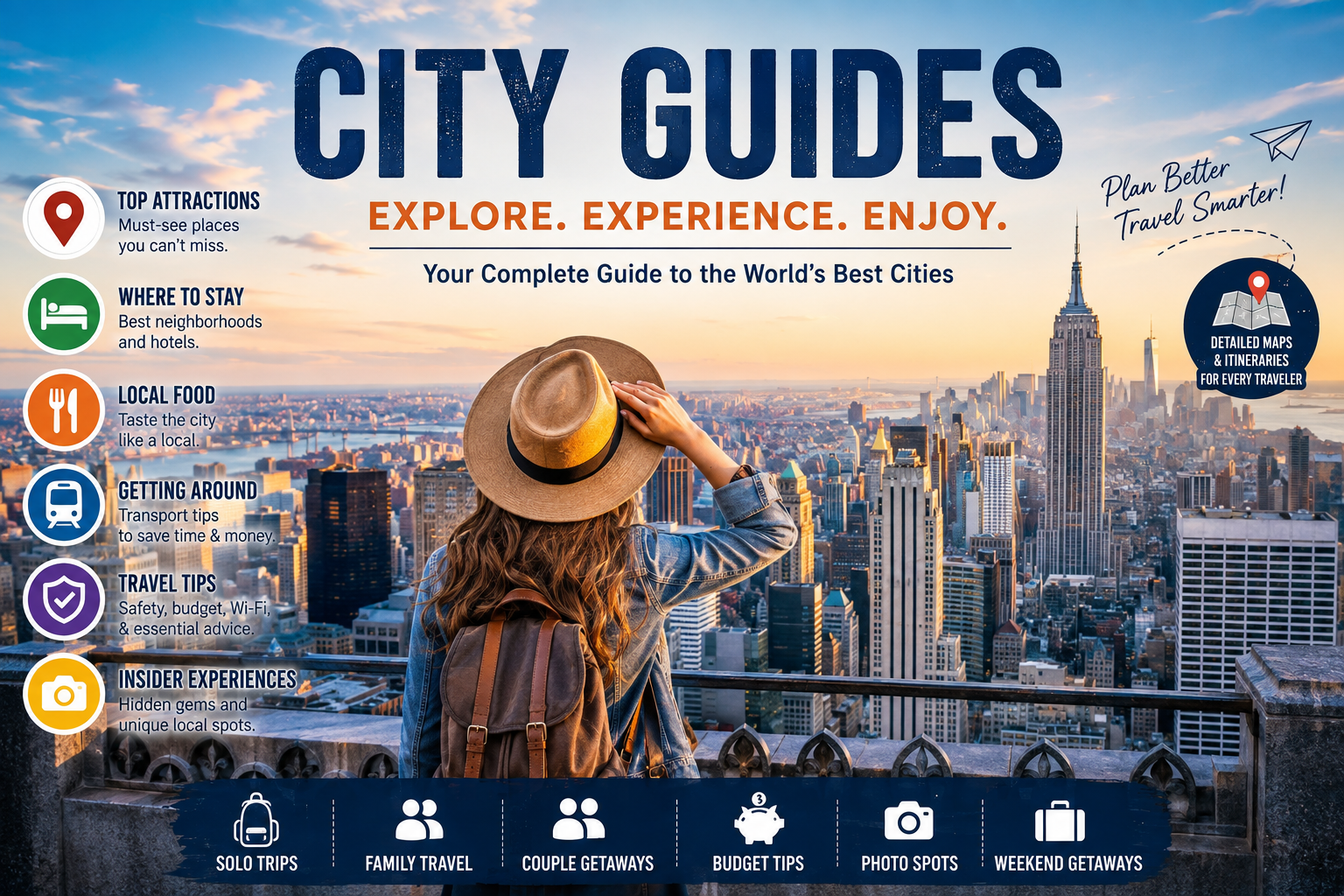
City Guides: Best Travel Tips, Top Destinations & Complete Planning Guide
Have you ever arrived in a new city with a hotel booked, a list of famous attractions saved, and absolutely no idea what to do first? A good city guide turns an unfamiliar destination into a practical, enjoyable journey by combining neighborhoods, attractions, transportation, food, accommodation, safety, costs, local culture, and realistic itineraries. The best city guides do more than tell you where to go; they explain how a city works, when to visit, what to avoid, how to move around, and how to experience the destination beyond its most photographed landmarks Sara International
What Is a City Guide?
A city guide is a practical travel resource designed to help visitors understand and navigate a specific city.
Traditional city guides focused heavily on attractions, restaurants, hotels, maps, and historical information.
Modern city guides need to go further.
A useful guide should connect the destination with the traveler.
For example, a family visiting London may care about museums, parks, transportation, family rooms, child-friendly restaurants, and shorter walking distances.
A solo traveler may prioritize safe neighborhoods, hostels, walking tours, public transportation, social activities, and affordable dining.
A business traveler may care about airport transfers, reliable Wi-Fi, coworking spaces, restaurants suitable for meetings, and proximity to business districts.
The destination is the same.
The city guide should not be.
The Difference Between a Travel Guide and a City Guide
A country travel guide covers a larger geographic area.
A city guide focuses on the urban experience.
For example, a Spain travel guide may cover Madrid, Barcelona, Seville, Valencia, Bilbao, Granada, and other regions.
A Madrid city guide should focus deeply on Madrid itself.
That means understanding:
- neighborhoods
- attractions
- local transportation
- airport connections
- accommodation areas
- food districts
- nightlife
- museums
- parks
- shopping
- cultural etiquette
- seasonal weather
- safety
- day trips
- realistic itineraries
This narrower focus allows a city guide to provide much more actionable information.
Why City Guides Matter in 2026
City travel is becoming more personalized and more complicated at the same time.
Travelers have access to enormous amounts of information, but abundance does not automatically produce better decisions.
In fact, too much information can create a new problem: decision fatigue.
A traveler may find thousands of restaurant recommendations, hundreds of hotels, dozens of neighborhoods, multiple transportation passes, and endless social-media videos.
The challenge is no longer finding information.
The challenge is determining which information matters.
Tourism Demand Remains Strong
Urban destinations continue to benefit from global tourism growth.
For example, EU tourist accommodation recorded 1.279 billion overnight stays during the first half of 2025, up 2.3% from the same period in 2024. Foreign visitors accounted for 48% of those nights.
This means city destinations remain major components of international tourism.
But strong demand can create pressure.
Popular city centers can experience:
- crowded attractions
- expensive accommodation
- transportation congestion
- restaurant queues
- short-term rental pressure
- higher local costs
- environmental stress
A good city guide therefore needs to help travelers distribute their time rather than simply sending everyone to the same famous landmark at noon.
How to Choose the Right City for Your Trip
Choosing a city should start with your travel objective.
Do not begin with a random list of famous destinations.
Begin with the experience you want.
Best Cities for History Lovers
History-focused travelers should look for cities with multiple historical layers rather than just one famous monument.
Strong examples include:
- Rome
- Athens
- Istanbul
- Kyoto
- Cairo
- Prague
- Vienna
- Jerusalem
- Paris
- Kraków
The ideal historical city allows you to understand how different periods influenced one another.
Rome, for example, can be experienced through ancient ruins, Renaissance architecture, Baroque churches, modern neighborhoods, museums, and contemporary Italian life.
Best Cities for Food Travelers
Food-focused travelers should consider cities where cuisine is part of the local identity.
Potential choices include:
- Tokyo
- Osaka
- Bangkok
- Singapore
- Istanbul
- Naples
- Paris
- Lisbon
- Mexico City
- San Sebastián
A good food city guide should not simply list expensive restaurants.
It should explain markets, bakeries, street food, local specialties, neighborhood restaurants, food traditions, dining times, and regional ingredients.
Best Cities for Families
Families usually benefit from cities that combine attractions with open space and easy transportation.
Good characteristics include:
- reliable public transport
- parks
- interactive museums
- pedestrian areas
- family accommodation
- public toilets
- short-distance attractions
- accessible restaurants
Cities such as London, Paris, Amsterdam, Copenhagen, Vienna, Singapore, Tokyo, and Barcelona can work well when the itinerary is designed around family energy levels.
Best Cities for Solo Travelers
Solo travel is becoming increasingly mainstream.
Recent reporting on travel behavior shows strong interest in solo travel, with a 2025 Hostelworld survey of more than 3,300 solo travelers finding freedom and spontaneity to be major benefits.
Solo-friendly cities generally offer:
- walkable neighborhoods
- good public transportation
- social accommodation
- group tours
- cafés
- cultural events
- safe tourist infrastructure
The best city for solo travel is not necessarily the safest city statistically.
It is the city where a solo visitor can comfortably build a daily routine.
Understanding Neighborhoods Before Booking a Hotel
One of the most overlooked parts of city travel is choosing the right neighborhood.
Travelers often search for “best hotels in Paris” or “best hotels in Tokyo.”
A better question is:
Which area is best for my travel style?
Central Tourist Districts
Advantages include:
- easy access to attractions
- short travel times
- many restaurants
- strong tourist infrastructure
Disadvantages can include:
- higher prices
- crowds
- noise
- less local atmosphere
Residential Neighborhoods
Advantages include:
- local restaurants
- quieter streets
- potentially better accommodation value
- stronger everyday atmosphere
Disadvantages include:
- longer travel to major attractions
- fewer late-night tourist services
Business Districts
These can be excellent during weekends when business demand falls.
However, some business districts become quiet at night.
Transit-Oriented Areas
A hotel near a major metro or railway station can be an excellent compromise.
You may save time every day even if the neighborhood itself is not the city’s most famous.
How to Read a City Map Like a Local
Before visiting, identify five things:
- The main tourist center.
- The airport or primary arrival station.
- Major public transportation lines.
- The neighborhood where you plan to stay.
- The attractions you most want to visit.
Then group attractions geographically.
For example, instead of traveling across a city several times each day, create neighborhood-based sightseeing days.
This simple technique can save hours.
How Many Days Should You Spend in a City?
There is no universal answer.
A small city may be enjoyable in two days.
A major global city may require a week.
Two-Day City Break
Two days work well for:
- compact cities
- weekend trips
- business extensions
- repeat visits
Focus on one major neighborhood or cluster of attractions each day.
Three-Day City Break
Three days is often the sweet spot for first-time visitors.
You can combine:
- major attractions
- local neighborhoods
- food
- shopping
- one flexible period
Four to Five Days
This is ideal for larger cities.
You have time for:
- major landmarks
- museums
- neighborhoods
- local food
- parks
- nightlife
- a day trip
One Week or More
Longer stays allow travelers to experience the city at a slower pace.
You can establish routines.
You may find a favorite café.
You may revisit a museum.
You can take spontaneous trips.
This is where a destination stops feeling like a checklist and starts feeling like a temporary home.
Building a Practical City Itinerary
A good city itinerary should have structure without becoming a prison.
Start With Your Non-Negotiables
Choose three to five experiences you absolutely want.
Do not begin by filling every available hour.
Group Attractions by Location
Put geographically close attractions together.
This reduces:
- transportation costs
- walking fatigue
- wasted time
- unnecessary backtracking
Mix High-Energy and Low-Energy Activities
Do not schedule:
museum → museum → historical site → shopping → night tour
every day.
Instead:
museum → lunch → park → neighborhood walk
can create a more balanced experience.
Leave Empty Space
A two-hour unscheduled block can be valuable.
You may discover a market, café, gallery, street performance, viewpoint, or local event.
The 3-Layer City Guide Method
One useful way to understand a city is to divide it into three layers.
Layer One: The Icons
These are the attractions everyone recognizes.
Examples include:
- Eiffel Tower
- Colosseum
- Burj Khalifa
- Statue of Liberty
- Sagrada Família
- Tokyo Skytree
- Acropolis
- Big Ben
They are famous for a reason.
Visit them if they interest you.
Layer Two: The Neighborhoods
This is where the city’s personality becomes clearer.
Explore:
- residential streets
- local markets
- independent shops
- cafés
- parks
- smaller museums
- neighborhood restaurants
Layer Three: The Everyday City
This is the layer most tourists miss.
Watch how people commute.
Visit a grocery store.
Take public transportation.
Have coffee without checking your phone.
Walk through a residential district.
Visit a local market early in the morning.
These ordinary experiences often create the strongest sense of place.
How to Save Money on City Trips
City travel does not have to be expensive.
The biggest savings often come from making better decisions before arrival.
Choose Accommodation Based on Total Cost
A cheap hotel far outside the center may require expensive daily transportation.
A slightly more expensive hotel near a metro station may be cheaper overall.
Calculate:
Accommodation + transportation + time
rather than accommodation alone.
Eat Away From Major Attractions
Restaurants directly beside famous landmarks often charge for location.
Walk several blocks away.
Look for places where local residents actually eat.
Use Public Transportation
Many major cities offer:
- metro systems
- buses
- trams
- commuter trains
- public ferries
Learn the system before you arrive.
Compare City Passes
A city pass can be excellent value if you plan to visit many included attractions.
It can be poor value if you only visit one or two.
Always calculate the actual attractions you expect to use.
City Travel for Different Budgets
Budget City Travel
Budget travelers should prioritize:
- hostels
- guesthouses
- public transport
- free walking routes
- public parks
- free museums or discounted hours
- local markets
- neighborhood restaurants
The goal is not to eliminate spending.
It is to spend on what matters most.
Mid-Range City Travel
Mid-range travelers can combine:
- comfortable hotels
- public transportation
- occasional taxis
- paid attractions
- local restaurants
- guided experiences
This is often the easiest category for city travel because it provides flexibility without requiring luxury pricing.
Luxury City Travel
Luxury city travel is increasingly experience-focused.
Luxury travelers may prioritize:
- boutique hotels
- private guides
- fine dining
- premium transfers
- exclusive cultural experiences
- wellness
- design
- personalized itineraries
The best luxury city trip is not necessarily the one with the highest price.
It is the one with the least friction.
City Guides for Solo Travelers
Solo travelers should plan for both independence and connection.
A strong solo city itinerary can include:
- morning walking tour
- independent lunch
- museum visit
- café break
- neighborhood exploration
- evening group experience
Hostels can be useful even for travelers who do not want traditional dormitory accommodation because many provide social events and common areas.
Solo travelers should also think about arrival logistics.
Landing at night and navigating an unfamiliar city with luggage is very different from arriving at 10 a.m.
Plan the first few hours carefully.
City Guides for Families
Family travel requires a different definition of success.
You do not need to visit every major attraction.
You need everyone to remain reasonably happy.
Plan Around Energy
Children may handle one major attraction and several smaller experiences better than a full day of museums.
Use Parks Strategically
Parks are not wasted sightseeing time.
They give children space to move while adults recover.
Choose Convenient Accommodation
A kitchen, washing machine, family room, or nearby grocery store can be more valuable than a hotel swimming pool.
Avoid Overpacking the Schedule
A family city trip should have fewer fixed commitments.
Flexibility is an advantage.
City Guides for Couples
Couples should avoid turning a romantic trip into a logistical competition.
Build time around:
- slow breakfasts
- scenic walks
- local restaurants
- sunset viewpoints
- cultural experiences
- evening neighborhoods
A couple does not need to visit ten attractions in one day.
Sometimes the most memorable part of the trip is sitting beside a river with no schedule.
City Guides for Seniors and Travelers With Mobility Needs
Accessibility should be considered before booking.
Research:
- elevator availability
- station accessibility
- steep streets
- cobblestones
- public toilet availability
- distance between attractions
- hotel entrance accessibility
Do not assume that a city with an excellent metro system is automatically easy for every traveler.
A city guide should explain the physical reality of moving through the destination.
City Guides for Business Travelers
Business travelers have different priorities.
Useful information includes:
- airport transfers
- business districts
- coworking locations
- reliable Wi-Fi
- meeting-friendly restaurants
- early breakfast options
- transportation during rush hour
- evening dining
- hotel workspace
The best business city guide should answer one practical question:
How can I remain productive without missing the city entirely?
Food: One of the Most Important Parts of a City Guide
Food is not just something you consume between attractions.
It is part of the destination.
A useful city food guide should identify:
- signature dishes
- local breakfast culture
- street food
- markets
- bakeries
- traditional restaurants
- modern food districts
- vegetarian options
- halal options
- family-friendly restaurants
- reservation requirements
Why Local Food Experiences Matter
A local dish often explains geography, history, religion, migration, agriculture, and economics better than a museum label.
For example, a city’s food culture may reveal which empires influenced it, which crops grow nearby, and how migration changed the population.
Food becomes a form of cultural research.
Public Transportation: The Hidden Key to Better City Travel
Transportation can determine whether a city feels easy or exhausting.
Before arrival, learn:
- airport connections
- metro routes
- ticket types
- contactless payment options
- operating hours
- night transportation
- station layouts
- major interchange stations
When Walking Is Better
Walking is ideal when attractions are close together.
It also allows you to see details that disappear from a train window.
When Public Transport Is Better
Use public transport when:
- distances are large
- weather is poor
- you are carrying luggage
- you have limited time
- the city is geographically spread out
When Taxis or Ride-Hailing Make Sense
Taxis can be useful:
- late at night
- with children
- with heavy luggage
- when public transport is disrupted
- when traveling in a group
The key is to use them strategically rather than automatically.
City Safety: What Travelers Should Actually Think About
Safety advice should be practical rather than alarmist.
Most travelers benefit from focusing on predictable risks.
Protect Your Valuables
Use secure bags and avoid displaying expensive electronics unnecessarily.
Be More Alert in Crowded Areas
Tourist centers, public transportation, markets, festivals, and major stations can require greater awareness.
Research Your Accommodation Area
A cheap room is not a bargain if you feel uncomfortable walking back at night.
Save Emergency Information
Keep:
- local emergency numbers
- accommodation address
- travel insurance information
- embassy or consular information
- copies of important documents
on your phone.
Weather Is Becoming More Important for City Travel
Climate conditions are increasingly influencing travel planning.
Booking.com’s 2026 sustainability research found that 74% of surveyed travelers consider extreme-weather risk when choosing both destination and timing, while 55% said unpredictable weather makes it difficult to know when to travel.
This has major implications for city guides.
A useful guide should no longer simply say:
“Summer is the best time to visit.”
Instead, it should explain:
- heat risk
- rainfall
- humidity
- daylight
- seasonal events
- crowd patterns
- indoor alternatives
The Rise of Cool-Climate City Breaks
As extreme summer heat becomes a stronger consideration, some travelers are exploring northern destinations or visiting traditionally hot cities during spring and autumn.
This creates new opportunities for:
- Scandinavia
- northern Europe
- mountain cities
- coastal destinations
- shoulder-season travel
Digital Tools and the Modern City Guide
Smartphones have transformed city exploration.
Travelers now use digital tools for:
- navigation
- translation
- restaurant discovery
- attraction tickets
- transportation
- currency conversion
- weather
- hotel communication
- emergency information
But technology should support judgment rather than replace it.
Offline Maps Matter
Internet access can fail.
Download your destination before leaving the hotel.
Save Important Addresses
Save your accommodation address in both English and the local language when useful.
Keep Digital Tickets Organized
Create a dedicated folder or wallet for:
- flights
- trains
- hotels
- attractions
- insurance
This reduces stress.
The Role of AI in City Guides
AI is becoming an increasingly important travel-planning tool.
Booking.com’s 2026 research reports that travelers are interested in increasingly personalized experiences, while its research also highlights openness to AI-powered suggestions for areas such as customized destinations and themed travel experiences.
AI can help travelers:
- build draft itineraries
- compare neighborhoods
- create restaurant shortlists
- adapt plans to weather
- suggest alternatives
- translate phrases
- summarize transport options
However, AI-generated travel information should be verified when it concerns:
- visa requirements
- opening hours
- border rules
- transportation disruptions
- safety alerts
- official fees
- reservations
The best workflow is:
AI for discovery → official sources for verification → traveler judgment for final decisions.
How to Build a City Guide From Scratch
If you are creating city guides for a travel website, use a repeatable structure.
Section 1: Quick Overview
Explain:
- where the city is
- why visit
- ideal trip length
- best travel seasons
- general budget level
Section 2: Best Neighborhoods
Explain who each neighborhood suits.
Section 3: Top Attractions
Prioritize quality over quantity.
Section 4: Things to Do
Include cultural, outdoor, food, family, and unusual experiences.
Section 5: Where to Stay
Organize accommodation recommendations by traveler type.
Section 6: Transportation
Explain airport transfers, public transport, walking, taxis, and day trips.
Section 7: Food
Discuss local dishes, dining areas, markets, and dietary needs.
Section 8: Safety
Give practical, location-specific advice.
Section 9: Budget
Explain low, medium, and high spending.
Section 10: Itinerary
Provide realistic one-, two-, three-, and five-day options.
Section 11: FAQs
Answer search-intent questions naturally.
This structure is useful for both readers and search engines because it addresses multiple stages of travel planning.
Common City Travel Mistakes and Their Solutions
Mistake 1: Booking a Hotel Before Researching the Neighborhood City Guides
Solution: Understand the city’s geography first.
Mistake 2: Trying to See Everything City Guides
Solution: Select priorities and accept that every city deserves another visit.
Mistake 3: Ignoring Travel Time City Guides
Solution: Estimate door-to-door travel time, not just the metro or train duration.
Mistake 4: Visiting Every Major Attraction at Peak Hours City Guides
Solution: Book timed attractions strategically and visit popular locations early when practical.
Mistake 5: Following Social Media Blindly City Guides
A restaurant with millions of views may not be the best restaurant for you.
Solution: Compare multiple sources and consider what type of experience you want.
Mistake 6: Choosing the Cheapest Accommodation City Guides
Solution: Compare the total cost, location, transportation, and time.
Mistake 7: Overplanning Meals City Guides
Solution: Reserve essential restaurants but leave room for spontaneous discoveries.
Mistake 8: Ignoring Local Customs City Guides
Solution: Research basic etiquette before arriving.
Mistake 9: Forgetting Weather City Guides
Solution: Check seasonal conditions and build indoor alternatives.
Mistake 10: Treating a City as a Theme Park
Solution: Remember that real people live there.
Respect local neighborhoods, avoid unnecessary disruption, and support local businesses.
Pros and Cons of City Travel
Advantages of City Travel
City trips offer:
- excellent cultural access
- museums
- historical landmarks
- diverse restaurants
- public transportation
- nightlife
- shopping
- events
- short-trip flexibility
- many accommodation options
They are particularly suitable for travelers who want variety within a limited number of days.
Disadvantages of City Travel
City travel can also involve:
- crowds
- traffic
- higher accommodation costs
- noise
- pollution
- tourist traps
- long attraction queues
- navigation fatigue
- limited natural space in dense areas
A successful city trip requires balance.
City Guides by Traveler Problem
A strong city guide should also be organized around problems.
City Guides for Travelers With Limited Time
If you only have 48 hours, prioritize:
- one major landmark
- one museum
- one local neighborhood
- one food experience
- one scenic or relaxing activity
Avoid crossing the city repeatedly.
City Guides for Travelers on a Tight Budget
Focus on:
- free attractions
- public transport
- local food
- affordable accommodation
- walking routes
- free viewpoints
- local markets
City Guides for First-Time International Travelers
Prioritize:
- airport arrival
- transport
- accommodation area
- currency
- language basics
- safety
- common scams
- emergency contacts
City Guides for Travelers With Dietary Restrictions
Research restaurants before arrival.
Look for clear information about:
- halal
- vegetarian
- vegan
- gluten-free
- allergies
Do not assume that a menu label always means the kitchen follows the same standards you expect.
City Guides for Digital Nomads
Consider:
- internet reliability
- coworking spaces
- cafés
- long-stay accommodation
- public transport
- cost of living
- community
- visa regulations
City Guides for Luxury Travelers
Focus on:
- premium neighborhoods
- private experiences
- boutique properties
- fine dining
- chauffeur services
- wellness
- cultural access
The key is personalization.
How to Make a City Guide More Useful Than a Search Result
A city guide should answer the questions a traveler is likely to ask next.
If you write:
“Visit the Old Town.”
The reader’s next questions are:
Where is it?
How long should I spend there?
When should I go?
How do I get there?
What else is nearby?
Is it suitable for children?
What should I combine it with?
A high-quality city guide anticipates those questions.
This is also important for semantic SEO.
Search engines increasingly understand topics through relationships between concepts rather than isolated keyword repetition.
A comprehensive city guide should naturally cover entities and concepts such as:
city → neighborhood → attraction → transportation → accommodation → food → season → budget → traveler type → safety → itinerary
That creates a stronger topical structure than repeating “city guide” dozens of times.
How to Create Better City Guide Content for Search Engines
SEO should support the reader rather than interfere with the article.
Use Search Intent City Guides
City travel searches commonly fall into several categories:
Informational:
“What is Paris like?”
Planning:
“How many days do I need in Paris?”
Commercial:
“Best hotels in Paris.”
Transactional:
“Book Paris walking tour.”
A strong city guide can address all four naturally.
Use Related Semantic Terms City Guides
Instead of repeating one keyword, include relevant concepts such as:
- city break
- travel itinerary
- neighborhoods
- local attractions
- public transportation
- restaurants
- accommodation
- travel budget
- sightseeing
- things to do
- local culture
- travel safety
- day trips
- best time to visit
Answer Specific Questions City Guides
Long-tail questions often reveal stronger intent.
Examples include:
- best city guides for families
- best city guides for solo travelers
- how to plan a three-day city break
- best neighborhoods to stay in a city
- how to travel around a city cheaply
- safest areas for tourists
- best time to visit major cities
- city guide for first-time visitors
The Future of City Guides
The future of city guides will be more dynamic, personalized, and context-aware.
AI-Personalized City Guides
Instead of reading one generic guide, travelers may increasingly receive an itinerary generated around:
- budget
- interests
- weather
- mobility
- age
- travel companions
- current events
- attraction availability
The guide could change during the trip.
Real-Time City Information
Future city guides will increasingly integrate:
- transit delays
- weather warnings
- attraction availability
- crowd levels
- temporary closures
- local events
This could make static travel pages less useful unless they provide durable background knowledge.
More Interest-Based Travel
Booking.com’s 2026 research describes a move toward highly individualized trips, including travel based on personal interests and unusual experiences.
This means future city guides may be organized less around generic “top attractions” and more around themes such as:
- architecture city guides
- food city guides
- literary city guides
- fashion city guides
- football city guides
- art city guides
- wellness city guides
- nightlife city guides
- family city guides
- photography city guides
Climate-Adaptive City Guides
Weather volatility means city guides will need more practical climate information.
Instead of simply describing average temperatures, future guides may recommend:
- morning sightseeing during heat
- shaded routes
- museums during extreme weather
- evening attractions
- cooler neighborhoods
- indoor alternatives
This is already becoming relevant as travelers increasingly consider extreme weather when choosing destinations and travel dates.
Smaller Cities Will Become More Important
Overcrowding is encouraging travelers and travel companies to look beyond the world’s most famous destinations.
Expedia’s 2026 travel research specifically highlights efforts to address overcrowding and identifies destinations where interest is growing even before they become globally viral.
This creates a major opportunity for city-guide publishers.
Instead of publishing endless versions of the same famous-city article, publishers can develop detailed guides for:
- secondary cities
- regional capitals
- emerging destinations
- overlooked neighborhoods
- nearby towns
A Complete City Guide Planning Checklist
Before your trip, confirm:
- destination and dates
- passport requirements
- visa requirements
- accommodation location
- airport or station transfer
- public transport options
- weather forecast
- major attractions
- attraction reservation requirements
- local currency
- payment options
- mobile data
- emergency numbers
- travel insurance
- local etiquette
- restaurant priorities
- day-trip options
- backup indoor activities
This simple preparation can eliminate many common travel problems.
Example: How to Plan a Three-Day City Break
Imagine you are visiting a major European city for three days.
Day One: Orientation City Guides
Use the first day to understand the city.
Walk through the central district.
Visit one major landmark.
Eat a local meal.
Explore the surrounding neighborhood.
Avoid scheduling five major attractions.
Day Two: Culture
Choose one or two major cultural experiences.
Visit a museum.
Explore a historic district.
Take a local food experience.
Spend the evening in a neighborhood rather than returning immediately to the tourist center.
Day Three: Local Life
Use the final day to slow down.
Visit a market.
Explore a park.
Shop locally.
Try a neighborhood restaurant.
If time allows, visit one attraction you missed earlier.
This structure gives the trip rhythm.
Why the Best City Guides Do Not Try to Be Perfect
A city guide cannot predict every traveler.
That is not its job.
Its job is to reduce uncertainty while preserving freedom.
The best guide tells you what matters, explains your options, and gives you enough context to make your own decisions.
That is more useful than a rigid schedule.
Travel is ultimately personal.
Two people can visit the same city for five days and have completely different experiences.
One may spend the trip in museums.
Another may eat at local markets.
Another may photograph architecture.
Another may run through parks every morning.
Another may simply sit in cafés and observe city life.
A good city guide should support all of them.
FAQs
What should a good city guide include?
A comprehensive city guide should include neighborhoods, attractions, accommodation areas, transportation, food, costs, safety, weather, local culture, itineraries, day trips, and practical travel tips.
How many days should I spend in a city?
Two days can work for a compact city, while three to five days is often better for a major destination. Longer stays allow travelers to explore beyond the main tourist attractions.
What is the best way to plan a city trip?
Start by choosing your priorities, select a suitable neighborhood, group attractions geographically, research transportation, reserve essential activities, and leave flexible time for spontaneous exploration.
Should I stay in the city center?
Not always. Central accommodation provides convenience but can be expensive and crowded. A neighborhood near reliable public transportation may offer better value.
Are city passes worth buying?
They can be valuable if you plan to visit many included attractions. Calculate the individual prices first and check whether transportation benefits justify the additional cost.
How can I avoid tourist traps?
Research restaurants and attractions in advance, compare multiple reviews, walk away from heavily tourist-oriented areas, and look for businesses serving local communities.
Is walking the best way to explore a city?
Walking is excellent for compact neighborhoods and allows you to discover details you might otherwise miss. Public transportation is better for longer distances.
What is the best city for solo travelers?
There is no universal answer, but cities with good public transport, walkable neighborhoods, social activities, plentiful accommodation, and strong tourist infrastructure can be particularly comfortable for solo travelers.
What is the best city for families?
Look for destinations with reliable transport, parks, interactive museums, family accommodation, pedestrian areas, and attractions suitable for different ages.
How can I make a city trip cheaper?
Stay near public transportation, travel during shoulder season, use free attractions, eat at local restaurants, walk when practical, and compare attraction passes with individual tickets.
Should I book attractions before arriving?
For highly popular attractions, timed-entry museums, major events, and peak-season activities, advance booking can be wise. Less popular attractions may allow more flexibility.
How can I use AI for city travel planning?
AI can help create itinerary ideas, compare neighborhoods, organize attractions by location, suggest activities based on interests, and adapt plans to weather. Always verify critical travel information through official sources.
Are city guides still useful when Google Maps exists?
Yes. Maps are excellent for navigation, but they do not always explain how a city works, which neighborhoods suit different travelers, how to structure an itinerary, or how to balance attractions with local experiences.
What is the difference between a city guide and an itinerary?
A city guide explains the destination broadly. An itinerary creates a sequence of activities for specific dates and time periods. A good city guide can help you build your own itinerary.
How can city guides help with travel safety?
They can identify practical considerations such as transportation, common tourist scams, neighborhood differences, emergency information, crowded areas, and appropriate precautions.
Conclusion
A great city guide should feel like having an experienced friend explain the destination before you arrive. It should help you understand where to stay, how to move, what to see, what to eat, how much to budget, which mistakes to avoid, and how to adapt your plans when reality does not match the itinerary. The most important shift in modern city travel is personalization. Travelers are increasingly looking for experiences that match their interests rather than generic sightseeing programs. Booking.com’s 2026 research highlights this movement toward highly individualized travel, while Expedia’s research points toward greater interest in less crowded and emerging destinations.






One Comment