
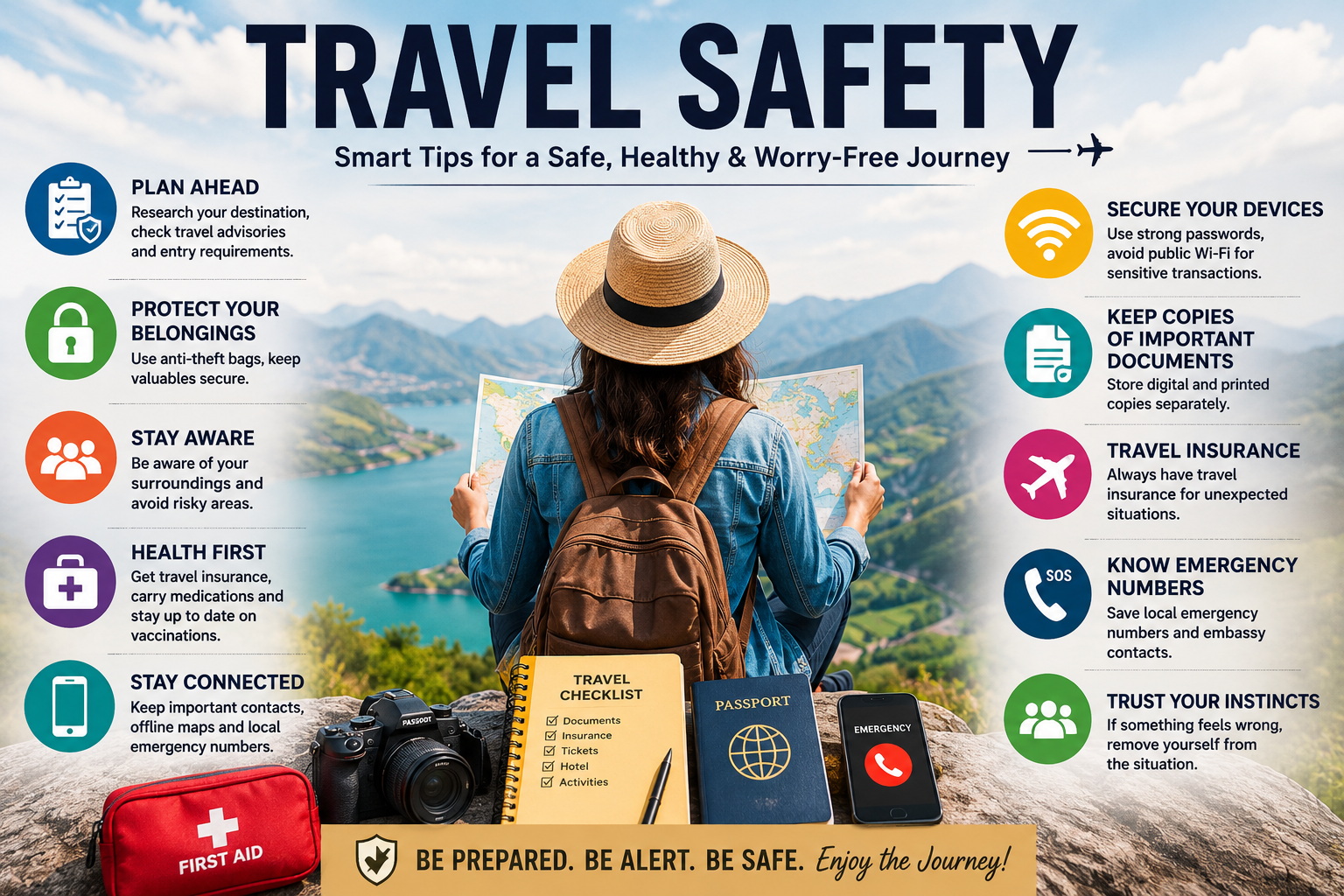
Travel Safety: 25 Essential Tips for Safe and Stress-Free Trips
Imagine arriving in a beautiful new city after a long flight. Your hotel is booked, your camera is charged, and you have a list of places you cannot wait to see. Then your phone disappears in a crowded station, your transportation driver takes an unexpected route, or you discover that the medical insurance you purchased does not cover the activity you planned. Travel safety is not about being afraid of the world; it is about understanding risks, preparing for predictable problems, and knowing what to do when something goes wrong. The safest travelers are not necessarily the most cautious people—they are the people who prepare before a small problem becomes a major emergency Travel Guidelines
What Is Travel Safety?
Travel safety is the process of identifying, reducing, and managing risks before and during a journey. It includes personal security, transportation safety, health protection, financial security, digital privacy, emergency planning, accommodation safety, and awareness of local conditions.
A useful way to think about travel safety is the risk chain:
Destination → Transportation → Accommodation → Activities → Health → Money → Communication → Emergency response
A weakness in any one part can affect the entire trip.
For example, a traveler may choose an excellent hotel in a safe destination but take an unlicensed taxi late at night. Another traveler may carefully protect their passport but connect their banking account to an unsecured public Wi-Fi network.
Travel safety therefore depends less on one perfect decision and more on having several layers of protection.
Why Travel Safety Is Changing in 2026
Travel has become easier, faster, and more connected. At the same time, travelers have more ways to expose themselves to risk.
Smartphones allow travelers to carry boarding passes, banking apps, passports, hotel reservations, maps, photographs, and personal documents in one device. That convenience is powerful, but losing the phone can create several problems at once.
Climate-related hazards are another important consideration. Extreme heat, floods, storms, wildfires, and other weather events can affect transportation and accommodation.
Road safety remains one of the most significant physical risks. WHO reports approximately 1.16 million road deaths each year worldwide, with tens of millions more people suffering non-fatal injuries.
Water safety also deserves attention. WHO estimates approximately 300,000 drowning deaths annually, with children and young people disproportionately affected.
These numbers do not mean travelers should avoid roads, beaches, boats, or adventure activities. They demonstrate why informed decisions matter.
Build a Travel Safety Plan Before Leaving Home
The best time to solve a travel emergency is before it happens.
Before departure, spend time researching your destination rather than only researching attractions.
Research Your Destination
Look at:
- Local laws and regulations
- Areas that travelers are advised to avoid
- Common transportation methods
- Weather conditions
- Seasonal hazards
- Healthcare availability
- Emergency numbers
- Local customs
- Common scams
- Currency and payment practices
- Entry and visa requirements
- Political or civil disruptions
- Natural disaster risks
Do not rely on one source.
Compare official government information, reputable health organizations, local authorities, airline information, and current destination reporting.
Travel conditions can change quickly, so information that was accurate six months ago may not be sufficient for today’s journey.
Understand Local Laws
One of the most underestimated travel safety risks is assuming that something legal at home is legal everywhere.
Rules can differ dramatically regarding:
- Prescription medicines
- Photography
- Drones
- Alcohol
- Public behavior
- Dress
- Driving
- Identification documents
- Religious sites
- Online activity
- Weapons
- Smoking
- Public demonstrations
“I did not know” may not be an effective defense when local law applies.
Save Emergency Information Offline
Do not depend entirely on mobile data.
Before departure, save:
- Hotel address
- Emergency contact numbers
- Embassy or consular contact information
- Insurance information
- Airline booking
- Important medical information
- Copies of essential documents
- Transportation details
Take screenshots or store important information securely so that you can access it without an internet connection.
Protect Your Passport and Important Documents
Your passport is more than an identification document. For international travelers, it is one of the most important documents they carry.
Keep Physical and Digital Copies
Create secure copies of:
- Passport identification page
- Visa
- Travel insurance policy
- Driver’s license
- Important prescriptions
- Emergency contacts
- Hotel reservations
- Flight information
Keep one copy separately from the original.
A digital copy can be stored in an encrypted or secure cloud account, while a physical copy can be kept in a separate part of your luggage.
Do Not Carry Every Document Everywhere
If you are spending the day sightseeing, you may not need every original document.
Follow local requirements regarding identification, but avoid carrying unnecessary documents and large amounts of cash when they are not needed.
Protect Your Passport at the Hotel
When appropriate and permitted, use the hotel’s secure storage facility for documents that you do not need during the day.
However, do not automatically assume that every hotel safe is completely secure. Consider the hotel’s reputation, your destination, and the specific circumstances.
Travel Safety and Personal Awareness
Personal awareness is one of the cheapest security tools available.
You do not need to behave suspiciously or constantly look over your shoulder. Instead, develop the habit of observing your surroundings.
Avoid Predictable Distraction
Pickpockets and opportunistic thieves often benefit when travelers are distracted.
Common distractions include:
- Looking at a phone while walking
- Carrying an open bag
- Arguing over directions
- Managing several pieces of luggage
- Counting money in public
- Wearing headphones at high volume
- Taking photographs without watching surroundings
The solution is simple: pause when you need to use your phone or organize belongings.
Trust Uncomfortable Situations
If a person, location, transportation option, or interaction feels unusually wrong, you do not have to continue simply because you already committed to it.
Travelers sometimes remain in uncomfortable situations because they do not want to appear rude.
Your safety is more important than politeness.
Transportation Safety: The Risk Travelers Often Underestimate
People often associate travel danger with crime, but transportation deserves much more attention.
Road crashes remain a major global cause of death and injury. WHO states that more than half of road traffic deaths involve vulnerable road users such as pedestrians, cyclists, and motorcyclists.
Choose Transportation Carefully
Before using transportation, consider:
- Vehicle condition
- Driver behavior
- Licensing requirements
- Seat belt availability
- Helmet availability
- Road conditions
- Weather
- Time of day
- Traffic patterns
A cheap transportation option is not necessarily a good transportation option.
Be Careful With Rental Scooters and Motorcycles
Motorcycles and scooters can be convenient and enjoyable, but they provide considerably less physical protection than cars.
Before renting one, verify:
- Whether your license permits you to ride
- Whether local law requires additional documentation
- Whether your insurance covers motorcycle use
- Whether helmets are provided
- Whether you understand local traffic rules
- Whether road conditions are suitable for your experience
Never assume that an activity is covered by insurance simply because you purchased travel insurance.
Seat Belts Are Non-Negotiable
Wear a seat belt whenever available.
If a driver is speeding, using a phone, driving aggressively, or appears impaired, reconsider the journey if you have a safe alternative.
Airport and Flight Safety
Air travel is highly regulated, but travelers can still encounter security and logistical problems.
Keep Essential Items in Your Carry-On
If checked luggage is delayed, you should still have access to:
- Passport
- Phone
- Charger
- Essential medication
- Basic toiletries
- Important documents
- Valuable electronics
- A change of essential clothing
Do not put irreplaceable documents or critical medication into checked luggage.
Watch Your Belongings at Airports
Airports can create distraction because travelers are often tired, rushing, or handling multiple bags.
Before leaving a seat, lounge, security area, restaurant, or gate, perform a quick check:
Phone → Passport → Wallet → Bag → Documents
This simple routine can prevent avoidable losses.
Hotel and Accommodation Safety
Your accommodation should be more than comfortable. It should also provide a reasonable level of security.
Check the Location Before Booking
Do not judge a hotel solely by photographs.
Look at:
- Neighborhood location
- Street access
- Transportation options
- Reviews mentioning security
- Building entrances
- Reception availability
- Emergency exits
- Lighting around the property
A beautiful property in an inconvenient or isolated location may create unnecessary risks.
Inspect the Room
When you arrive, locate:
- Emergency exits
- Stairways
- Fire alarms
- Sprinklers
- Room locks
- Safe
- Reception contact information
Do not rely solely on elevators during an emergency.
Do Not Publicize Your Room Number
Avoid loudly announcing your room number in public areas.
If someone asks for your room number and you are uncomfortable, contact reception directly rather than providing unnecessary information.
Food and Water Safety While Traveling
A memorable vacation can quickly become unpleasant when contaminated food or water causes illness.
WHO identifies food, water, sanitation, and infectious disease exposure among the health considerations travelers should evaluate.
Be Selective With Food
Use judgment regarding:
- Raw foods
- Undercooked meat
- Unpasteurized products
- Food kept at unsafe temperatures
- Street food with poor hygiene
- Buffets where food appears improperly stored
This does not mean avoiding local cuisine.
In fact, experiencing local food is often one of the best parts of travel.
The goal is to choose food environments where hygiene appears strong.
Think About Drinking Water
Water safety differs by destination.
Research whether local tap water is considered safe for visitors.
When uncertain, use sealed bottled water or another reliable source.
Remember that water exposure can also involve:
- Ice
- Tooth brushing
- Fresh produce
- Drinks
- Swimming
- Recreational water
Travel Health Safety
Travel health preparation should begin before the trip.
Depending on your destination, consider discussing travel health requirements with a qualified healthcare professional.
Potential considerations include:
- Routine vaccinations
- Destination-specific vaccines
- Prescription medications
- Allergies
- Medical conditions
- Travel-related illness
- Mosquito exposure
- Food and water safety
- Heat exposure
- Altitude
- Long-distance travel
WHO recommends that people planning travel seek information about potential health risks before traveling.
Carry Essential Medication Correctly
Keep necessary medication in appropriate packaging and understand whether your destination has restrictions on specific medicines.
For international travel, check the relevant country’s rules before departure.
Do not assume that a medication available without a prescription at home is treated the same way elsewhere.
Heat, Sun, and Extreme Weather Safety
Weather can become a serious safety issue, especially when travelers underestimate unfamiliar climates.
Heat Safety
Hot destinations can create risks through:
- Dehydration
- Heat exhaustion
- Heatstroke
- Sunburn
- Fatigue
- Reduced concentration
Travelers should gradually adapt to intense heat where possible, drink appropriately, take breaks, seek shade, and avoid unnecessarily strenuous activities during the hottest periods.
Cold Weather Safety
Cold destinations require different planning.
Think about:
- Layered clothing
- Waterproof equipment
- Appropriate footwear
- Wind exposure
- Reduced daylight
- Transport disruptions
- Frostbite risk
- Hypothermia
Severe Weather
Before outdoor activities, check current weather conditions.
A sunny morning does not guarantee a safe afternoon.
Weather can change rapidly in mountainous, coastal, tropical, and desert environments.
Water Safety for Beaches, Pools, Lakes, and Boats
Water activities are among the most enjoyable travel experiences, but they should not be treated casually.
WHO reports roughly 300,000 drowning deaths worldwide each year and highlights unsafe water transport, dangerous weather, lack of safety equipment, and inadequate supervision as important risks.
Beach Safety
Before swimming, consider:
- Lifeguard presence
- Warning flags
- Currents
- Tides
- Waves
- Weather
- Water temperature
- Your swimming ability
Never assume calm-looking water is automatically safe.
Boat Safety
When using ferries, boats, or water taxis, pay attention to:
- Life jackets
- Weather conditions
- Vessel capacity
- Operator reputation
- Emergency exits
- Safety instructions
Do not ignore safety equipment simply because local passengers appear comfortable without using it.
Digital Travel Safety
Travel safety in 2026 is also cybersecurity.
Your smartphone may contain enough information to cause serious problems if compromised.
Use Strong Device Protection
Use:
- Strong device passwords
- Biometric authentication
- Automatic screen locking
- Updated operating systems
- Two-factor authentication
- Device tracking
- Secure backups
Avoid leaving sensitive accounts permanently logged in on devices that other people can access.
Be Careful With Public Wi-Fi
Public Wi-Fi can be convenient, but travelers should avoid treating every network as trustworthy.
Before entering sensitive information, verify that you are using the correct network and website.
For important financial transactions, using your own cellular connection can be preferable when available.
Protect Your SIM and Phone Number
Losing access to your phone number can create problems because many services use SMS verification.
Know how your mobile provider handles:
- SIM replacement
- Roaming
- Account security
- International service
- eSIM activation
Travel Scams: How to Recognize Manipulation
Scams often work because they create urgency.
Common patterns include:
Unexpected problem + emotional pressure + immediate payment request
Examples can include:
- Fake transportation problems
- Fake tickets
- Overpriced tours
- Counterfeit currency exchanges
- Fake police officers
- Friendship scams
- Fake accommodation representatives
- ATM assistance scams
- Online booking scams
Slow Down When Someone Creates Urgency
If someone tells you:
“You must pay now.”
“This is your only chance.”
“Your ticket is invalid.”
“Give me your phone.”
“Come with me.”
Pause.
Verify the information independently.
Urgency is often used to prevent people from thinking.
Money Safety for Travelers
Financial preparation should involve redundancy.
Do not depend on a single payment method.
A stronger setup may include:
- Primary payment card
- Backup card
- Small amount of local currency
- Emergency funds
- Secure banking access
Separate Your Backup Card
If your wallet is stolen, having every payment card in the same wallet creates a bigger problem.
Keep a backup payment method separately.
Be Careful at ATMs
Use ATMs in secure, well-monitored locations.
Check for unusual devices or signs of tampering.
Protect your PIN from view.
If an ATM behaves strangely, cancel the transaction and use another machine.
Solo Travel Safety
Solo travel offers freedom, but it removes one important safety layer: another person who knows where you are.
Share Your Itinerary
Someone you trust should know:
- Where you are staying
- Major transportation plans
- Approximate itinerary
- Emergency contact information
You do not need to share every movement.
The goal is simply to ensure that someone could notice if something unusual happens.
Avoid Excessive Isolation
Solo travelers should be especially cautious about situations where they become completely disconnected from other people.
Consider:
- Keeping your phone charged
- Knowing the route back to accommodation
- Having transportation alternatives
- Avoiding unnecessary risk when intoxicated
- Staying aware of surroundings
Travel Safety for Families With Children
Children require additional planning.
Parents should prepare children for simple emergency situations.
Teach them:
- Their parent’s name
- Hotel name
- Emergency contact information
- How to approach a uniformed official or trusted adult
- What to do if separated from the family
Create a Family Meeting Point
In busy destinations, identify a recognizable meeting point.
Do this before you need it.
Photograph Important Items
Parents may also find it useful to keep current photographs of children and important identification information securely stored.
This can help if a child becomes separated from the group.
Travel Safety for Older Adults
Older travelers may face different challenges involving mobility, medication, fatigue, heat, and access to healthcare.
A good plan should account for:
- Medication availability
- Travel insurance requirements
- Mobility assistance
- Rest periods
- Accessible accommodation
- Healthcare facilities
- Emergency contacts
- Travel pace
The safest itinerary is not always the one containing the most destinations.
Sometimes fewer locations and more recovery time produce a significantly better travel experience.
Travel Safety for Women
Travel experiences differ by destination and individual circumstances.
Women travelers may want to research:
- Local transportation practices
- Areas best avoided at night
- Dress expectations
- Local cultural norms
- Accommodation security
- Emergency services
- Solo traveler experiences
The objective is not to restrict freedom.
It is to understand the environment well enough to make informed choices.
LGBTQ+ Traveler Safety
Travelers should research destination-specific laws and social conditions before departure.
This is especially important because legal protections and social attitudes vary considerably around the world.
Consider:
- Local laws
- Public behavior rules
- Accommodation policies
- Identification requirements
- Consular information
- Local cultural expectations
Personal safety planning should be based on the destination rather than assumptions about how rules work elsewhere.
Travel Safety for Business Travelers
Business travelers often operate under time pressure.
That can create additional risks.
You may have:
- Tight schedules
- Late-night transportation
- Multiple meetings
- Expensive electronics
- Corporate documents
- Sensitive data
Separate personal and work data where possible.
Avoid discussing confidential business information in crowded public spaces.
Do not leave laptops or documents unattended.
Adventure Travel Safety
Adventure activities require a different level of risk assessment.
Activities such as:
- Hiking
- Diving
- Skiing
- Mountaineering
- Paragliding
- Rafting
- Motorcycling
- Rock climbing
can involve specialized hazards.
Verify Insurance Coverage
This is one of the most important overlooked issues.
A policy may provide medical coverage but exclude certain high-risk activities.
Before participating, check the actual policy wording for:
- Activity exclusions
- Medical limits
- Evacuation
- Search and rescue
- Equipment
- Age restrictions
- Pre-existing conditions
- Alcohol-related exclusions
- Licensing requirements
Never rely solely on an advertisement or comparison article.
Travel Insurance: What Should You Look For?
Travel insurance can reduce the financial impact of unexpected events, but it is not a substitute for safe behavior.
Depending on the policy, travelers may encounter coverage related to:
- Emergency medical expenses
- Evacuation
- Trip cancellation
- Trip interruption
- Lost or delayed baggage
- Travel delays
- Personal liability
Coverage varies significantly.
Read the policy.
Do not buy insurance based only on the headline price.
10 Travel Insurance and Assistance Brands to Compare
The following brands represent different approaches to travel insurance, travel medical coverage, assistance, or adventure-oriented protection. They should be treated as comparison starting points, not universal recommendations. Availability, eligibility, policy wording, pricing, exclusions, and geographic coverage can vary by residence and trip.
| Brand | General Positioning | Potentially Suitable For | What to Compare Carefully |
|---|---|---|---|
| Allianz Travel | Broad travel insurance | Vacation travelers | Cancellation, medical, baggage, exclusions |
| World Nomads | Adventure-oriented travel insurance | Adventure travelers | Activity coverage, medical limits, exclusions |
| SafetyWing | Travel medical/nomad-oriented coverage | Long-term travelers and digital nomads | Medical coverage, trip benefits, eligibility |
| IMG | International medical insurance | International and longer-term travelers | Deductibles, limits, geographic coverage |
| Cigna Global | International health insurance | Long-term international living | Premiums, healthcare network, exclusions |
| Genki | Travel/health coverage for internationally mobile travelers | Nomads and long-term travelers | Residency rules, benefits, policy terms |
| Global Rescue | Emergency assistance and evacuation services | Adventure and remote travelers | Rescue scope, membership terms, geography |
| Travel Guard | Travel insurance | Traditional vacation travel | Cancellation, interruption, medical coverage |
| Seven Corners | Travel and international medical products | International travelers | Coverage limits and eligibility |
| Generali Global Assistance | Travel insurance and assistance | Vacation travelers | Medical, cancellation, baggage and assistance benefits |
Recent travel insurance comparisons also show that there is no single policy that works equally well for every traveler; trip duration, age, residence, destination, activities, and desired benefits can substantially change which option is appropriate.
How to Compare Travel Insurance Properly
Instead of asking:
“Which company is the best?”
Ask:
“Which policy covers the risks of my specific trip?”
For example, a person taking a two-week city vacation may prioritize cancellation and medical coverage, while someone hiking for several months may care much more about evacuation and adventure-activity coverage.
What to Do If Your Passport Is Lost
Losing a passport can feel catastrophic, but having a plan makes the situation manageable.
First, move to a secure location.
Then:
- Confirm that the passport is genuinely missing.
- Contact the relevant authorities if theft is suspected.
- Contact your embassy or consulate.
- Provide required identification and supporting documents.
- Contact your airline if travel plans may change.
- Notify your travel insurer if appropriate.
- Protect accounts if other documents were also lost.
Having copies of your passport and travel documents can make this process easier.
What to Do If Your Phone Is Stolen
A stolen phone can become a security emergency.
Use another device to:
- Lock the device remotely
- Track it if possible
- Change important passwords
- Contact your mobile provider
- Block payment methods if necessary
- Review account activity
- Contact financial institutions if sensitive banking access was exposed
The faster you act, the smaller the potential damage.
What to Do During a Natural Disaster
Natural disasters require different responses depending on the event.
For earthquakes, floods, hurricanes, wildfires, volcanic activity, or severe storms, follow instructions from local authorities.
Do not attempt to become a tourist during an active emergency.
WHO highlights floods as a major global disaster hazard, noting that flash floods can rapidly overtake roads and other areas.
If an official evacuation order is issued, prioritize evacuation over retrieving possessions.
What to Do If You Become Lost
Modern navigation makes getting lost less common, but it still happens.
If you realize you are lost:
Stop → Secure yourself → Check the map → Identify landmarks → Contact someone → Choose a safe route
Do not continue walking randomly simply because you feel embarrassed.
If you are in an unfamiliar area at night, returning to a known location may be safer than trying to explore your way out.
Common Travel Safety Mistakes
Mistake 1: Planning Attractions but Not Risks
Many travelers research restaurants and museums for hours but spend only minutes researching emergencies.
Solution: Add a safety section to your trip planning.
Mistake 2: Keeping Everything Together
Putting passport, wallet, phone, cards, and cash in one bag creates a single point of failure.
Solution: Create redundancy.
Mistake 3: Assuming Insurance Covers Everything
Insurance policies contain exclusions.
Solution: Read the coverage conditions before departure.
Mistake 4: Ignoring Transportation Risks
A short taxi ride may feel insignificant.
But transportation is one of the most important travel safety considerations.
Solution: Choose reputable transportation and use seat belts and helmets.
Mistake 5: Trusting Strangers Too Quickly
Friendly people can be genuinely helpful, but travelers should not automatically trust everyone.
Solution: Verify unexpected requests independently.
Mistake 6: Broadcasting Your Travel Plans
Posting every movement publicly can expose information about your location and routine.
Solution: Consider delaying public posts until after leaving a location.
Mistake 7: Overpacking
Large amounts of luggage can reduce mobility and increase distraction.
Solution: Pack strategically.
Mistake 8: Ignoring Fatigue Travel safety
Jet lag and sleep deprivation can reduce judgment.
WHO notes that travel-related stress and disruption of normal sleep patterns can affect travelers in different ways.
Solution: Treat rest as part of your safety plan.
Pros and Cons of Modern Travel Safety Technology
Technology has transformed travel safety.
Advantages Travel safety
Modern travelers can use:
- GPS
- Digital maps
- Emergency alerts
- Translation tools
- Travel apps
- Digital boarding passes
- Location sharing
- Online banking alerts
- Smart luggage tracking
- Emergency communication devices
These tools can dramatically improve situational awareness.
Disadvantages Travel safety
Technology also creates vulnerabilities.
A single stolen smartphone can expose:
- Photos
- Banking
- Travel reservations
- Personal conversations
- Authentication codes
- Social media
Technology should therefore create redundancy, not dependence.
The Three-Layer Travel Safety Model
A useful original framework for travelers is the three-layer model.
Layer One: Prevention Travel safety
Prevent the problem where possible.
Examples include:
- Researching destinations
- Choosing safe transportation
- Protecting documents
- Avoiding risky activities
- Using strong digital security
Layer Two: Resilience Travel safety
Prepare for problems that cannot be prevented.
Examples include:
- Backup cards
- Copies of documents
- Travel insurance
- Offline maps
- Emergency contacts
- Extra medication where legally permitted
Layer Three: Response Travel safety
Know what to do when something actually happens.
Examples include:
- Calling emergency services
- Contacting an embassy
- Locking a stolen device
- Evacuating
- Seeking medical treatment
- Contacting insurance assistance
This model is powerful because it recognizes a simple reality:
Good safety does not mean nothing goes wrong. Good safety means you can recover when something does.
A 24-Hour Pre-Departure Travel Safety Check
The day before departure, review your trip using a simple system.
Documents Travel safety
Confirm that your passport, visa, tickets, insurance documents, and required identification are ready.
Money Travel safety
Confirm that your primary and backup payment methods work.
Communication Travel safety
Charge your phone and power bank.
Accommodation Travel safety
Confirm the address and booking details.
Transportation Travel safety
Know how you will get from the airport or station to your accommodation.
Health Travel safety
Confirm medications and destination-specific health requirements.
Weather Travel safety
Check the latest forecast and significant weather alerts.
Emergency Information Travel safety
Save emergency numbers and relevant contact information.
This review can take less than an hour and may prevent hours of trouble later.
The 10-Minute Daily Travel Safety Routine
You do not need to spend an hour every morning worrying about safety.
A simple daily check can be enough.
Ask:
Where am I?
Where am I going?
How am I getting there?
What is the weather?
Do I have enough battery?
Do I have my essential documents and money?
Does anyone need to know my plans?
Is there anything unusual happening locally?
This routine keeps safety integrated into travel rather than turning it into a source of anxiety.
Travel Safety for Different Traveler Types
Travel Safety for Beginners Travel safety
Beginners should prioritize preparation over spontaneity.
Start with:
- Reliable accommodation
- Familiar transportation
- Basic local research
- Emergency contacts
- Travel insurance
- Document copies
Confidence grows with experience.
Travel Safety for Families Travel safety
Families should focus on communication, child supervision, medical preparation, and contingency plans.
Travel Safety for Solo Travelers Travel safety
Solo travelers should emphasize communication, accommodation security, transportation planning, and backup systems.
Travel Safety for Digital Nomads Travel safety
Digital nomads should add cybersecurity, long-term medical coverage, device protection, and visa compliance to their safety planning.
Travel Safety for Adventure Travelers Travel safety
Adventure travelers need specialized attention to equipment, weather, operator standards, rescue options, and insurance exclusions.
Travel Safety for Older Travelers Travel safety
Older travelers should consider healthcare access, medication continuity, mobility, rest periods, and destination accessibility.
Travel Safety and Responsible Tourism Travel safety
Safety is not only about protecting yourself.
Responsible travelers also consider local communities and environments.
Avoid:
- Entering restricted areas
- Ignoring environmental warnings
- Disturbing wildlife
- Supporting illegal activities
- Disrespecting cultural practices
- Taking unnecessary risks that burden local emergency services
A responsible traveler understands that tourism creates responsibilities as well as opportunities.
How Artificial Intelligence May Change Travel Safety
Artificial intelligence is increasingly becoming part of travel planning.
Future travel tools may be able to combine:
- Weather
- Traffic
- Flight changes
- Local alerts
- Destination conditions
- Personal itinerary
- Health considerations
- Transportation information
This could allow travelers to receive more personalized warnings.
For example, instead of simply saying that heavy rain is expected, an intelligent travel assistant might identify that the traveler has a mountain excursion scheduled during the period of highest risk and recommend changing the plan.
However, travelers should not blindly trust AI-generated safety information.
For critical situations, official local authorities and emergency services should remain the primary sources.
Future Trends in Travel Safety
More Personalized Risk Alerts Travel safety
Travel platforms are likely to become better at delivering destination-specific alerts based on individual itineraries.
Increased Digital Identity Protection Travel safety
As more travel documents become digital, protecting identity and accounts will become increasingly important.
Climate-Aware Travel Planning
Extreme weather will increasingly influence travel decisions, particularly in destinations exposed to heatwaves, floods, storms, wildfires, and other hazards.
Smarter Travel Insurance
Insurance products may become increasingly personalized according to destination, activity, duration, traveler profile, and risk level.
Greater Focus on Emergency Connectivity Travel safety
Travelers heading into remote areas will increasingly use satellite-based communication and emergency technologies where conventional cellular networks are unavailable.
A Balanced View: Should Travel Safety Make You More Cautious?
Yes—but not fearful.
There is a major difference between risk awareness and risk obsession.
If safety planning prevents you from enjoying travel, the system has become counterproductive.
The goal is not to eliminate every risk.
That is impossible.
The goal is to reduce unnecessary risks while preserving the experience that made you want to travel in the first place.
Think of travel safety like wearing a seat belt.
You do not spend the entire journey thinking about the seat belt.
You put it on and continue enjoying the road.
Quick Travel Safety Checklist
Before leaving:
- Research the destination.
- Check local laws.
- Save emergency numbers.
- Make secure document copies.
- Confirm accommodation.
- Review transportation options.
- Check weather.
- Prepare appropriate medication.
- Secure your phone.
- Enable two-factor authentication.
- Carry backup payment options.
- Review travel insurance.
- Tell a trusted person your general itinerary.
During the Travel safety trip:
- Stay aware of your surroundings.
- Protect your passport.
- Use reputable transportation.
- Wear seat belts and helmets.
- Avoid unnecessary displays of cash.
- Be careful with public Wi-Fi.
- Monitor weather alerts.
- Respect local laws.
- Avoid dangerous shortcuts.
- Keep your phone charged.
- Trust your instincts.
In an Travel safety emergency:
- Move to a safe location.
- Contact local emergency services.
- Contact your embassy or consulate when appropriate.
- Notify your travel insurer if relevant.
- Secure your financial accounts.
- Contact someone you trust.
- Follow official instructions.
FAQs
What is the most important travel safety rule?
The most important rule is to remain aware and prepared. Research your destination, understand major risks, protect essential documents, and maintain backup options for money, communication, and transportation.
Is travel safe for solo travelers?
Solo travel can be safe when travelers research destinations, choose accommodation carefully, maintain communication with trusted contacts, and avoid unnecessary high-risk situations. Safety depends heavily on destination, activity, timing, and individual circumstances.
Is travel insurance necessary?
Travel insurance is not universally mandatory, but it can provide valuable financial protection against covered medical emergencies, cancellations, interruptions, delays, baggage problems, and other risks. The appropriate coverage depends on the trip.
What should I do if I lose my passport abroad?
Move somewhere safe, report theft when appropriate, contact your embassy or consulate, and follow the replacement or emergency-document process. Having secure copies of your passport and travel documents can simplify the process.
How can I protect my money while traveling?
Carry only the money you need, use reputable ATMs, protect your PIN, maintain a backup payment method, and avoid keeping all cash and cards together.
Is public Wi-Fi safe while traveling?
Public Wi-Fi can carry security risks. Avoid entering sensitive information on suspicious networks, verify network names, keep devices updated, and use secure connections whenever possible.
How can families keep children safe while traveling?
Parents should establish a meeting point, teach children basic identification information, maintain supervision, carry emergency contacts, and prepare for situations in which a child becomes separated from the family.
How can I stay safe on public transportation?
Research reputable transportation options, remain aware of your belongings, follow local safety rules, use seat belts where available, and avoid transportation where the driver or vehicle appears unsafe.
What are the biggest health risks when traveling?
Health risks vary by destination and traveler. They may include infectious diseases, unsafe food or water, extreme temperatures, road injuries, water-related accidents, pollution, and limited access to healthcare. Destination-specific preparation is important.
Is it safe to swim while traveling?
Swimming can be safe when conditions are appropriate, but travelers should consider currents, tides, weather, water quality, lifeguard availability, swimming ability, and local warnings. Water should never be assumed safe simply because other people are swimming.
How can I prepare for an emergency abroad?
Prepare emergency contacts, document copies, insurance information, backup money, offline maps, communication options, and a basic understanding of local emergency procedures before departure.
Should I post my travel location on social media?
Consider limiting real-time public posts that reveal your exact location, accommodation, or routine. Sharing content after leaving a location can reduce unnecessary exposure of your movements.
What should I do if a situation feels unsafe?
Create distance from the situation and move toward a safer, populated location when possible. Contact trusted people or local authorities if necessary. You do not need to remain in an uncomfortable situation simply to avoid appearing impolite.
Conclusion
Travel safety does not require fear, paranoia, or an endless list of restrictions. It requires preparation, awareness, flexibility, and a willingness to make sensible decisions when circumstances change. The biggest mistake travelers make is thinking that safety begins after something goes wrong. In reality, effective travel safety begins weeks or even months before departure. Research your destination. Protect your documents. Understand transportation risks. Prepare for health issues. Secure your digital accounts. Keep backup payment options. Understand your insurance. Watch the weather. Respect local laws. And most importantly, pay attention to your surroundings.






2 Comments