25 Epic Road Trips Tips: The Ultimate Guide to Planning a Safe, Scenic Adventure
What happens when the journey becomes just as important as the destination? Road trips offer a rare kind of travel freedom: you can change direction, stop for an unexpected view, discover a small town, take a longer scenic route, or simply pull over when something catches your attention. The best road trips combine thoughtful planning with enough flexibility to let the journey unfold naturally. A successful road trip requires more than a full tank of fuel; it depends on route planning, vehicle preparation, realistic driving schedules, smart packing, safety awareness, budgeting, accommodation choices, and the ability to adapt when conditions change Travel Safety
What Makes Road Trips Different From Other Types of Travel?
Road trips combine transportation and exploration in a way that most other forms of travel do not.
When flying, the route is predetermined. When taking a train, the railway network determines much of the journey. On a road trip, the traveler often controls the route, timing, stops, pace, and sometimes even the destination.
That flexibility is the greatest advantage of road travel.
It is also one of its biggest challenges.
The Freedom of Road Travel
A road trip gives travelers the ability to make spontaneous decisions.
You might plan to drive from one city to another but discover a national park, viewpoint, historical site, local restaurant, or small community along the way.
That flexibility can create memories that were never included in the original itinerary.
The Responsibility of Road Travel
Freedom does not mean that planning becomes unnecessary.
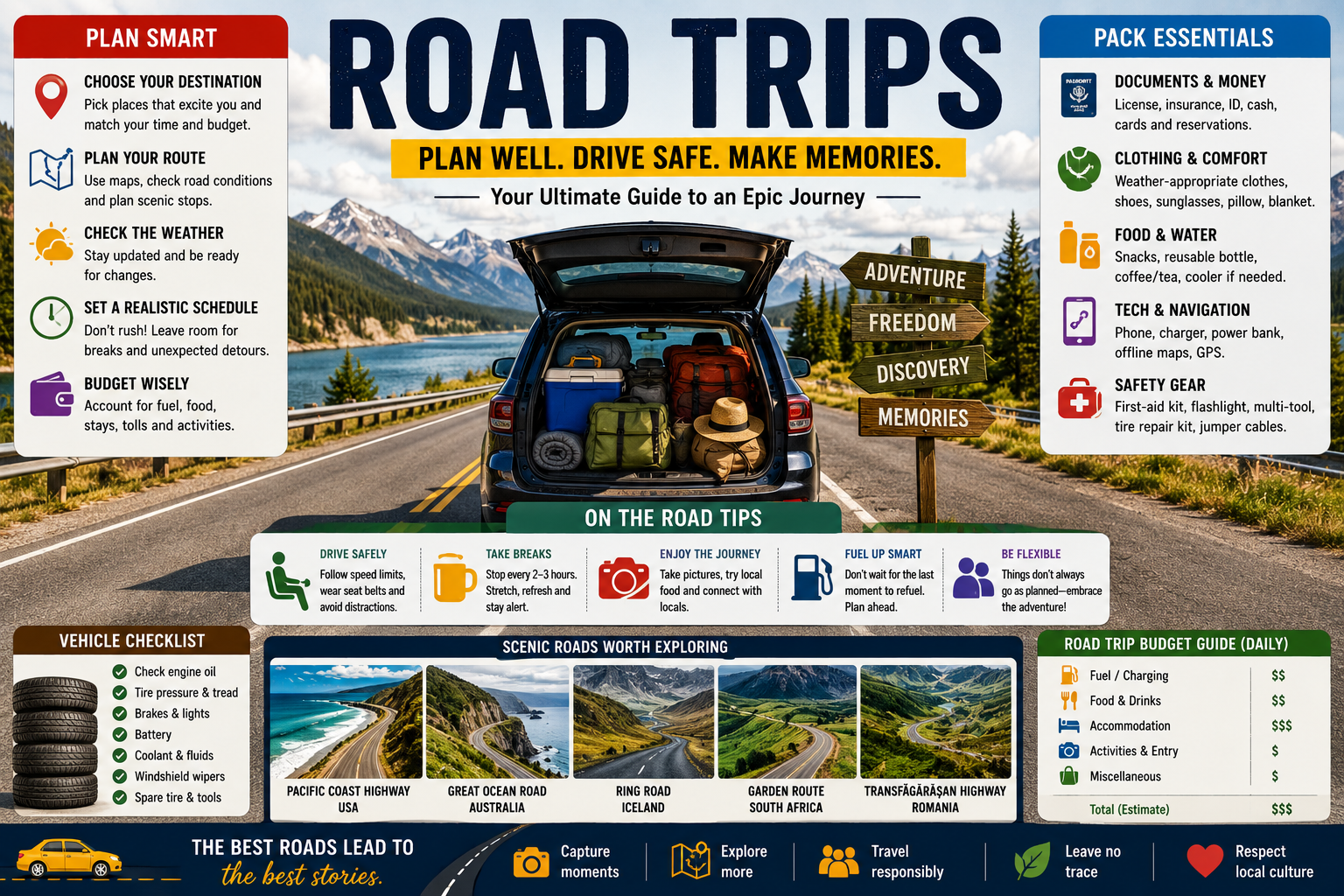
Drivers must consider fuel, road conditions, vehicle reliability, weather, traffic, rest periods, parking, navigation, and emergency options.
The most enjoyable road trips therefore use a flexible structure rather than either extreme.
One extreme is planning every minute.
The other is leaving without understanding the route at all.
A better approach is to establish the major points while leaving space for discovery.
Why Road Trips Remain Popular
Road trips continue to appeal to travelers because they provide control over the journey.
They can also make certain destinations easier to explore, particularly where public transportation is limited.
Road Trips Offer Flexible Travel
A traveler can leave early, stop for coffee, take photographs, change the route, or spend additional time at a destination.
This flexibility is especially valuable for travelers who dislike rigid schedules.
Road Trips Can Connect Multiple Destinations
Instead of staying in one city, a road trip can connect several locations.
For example, a journey might combine:
- A major city
- A coastal area
- A mountain region
- A historical town
- A national park
- A rural community
The road becomes the thread connecting different travel experiences.
Road Trips Create Shared Experiences
Road travel can be particularly memorable for couples, families, and groups of friends.
Long drives create time for conversations, music, games, stories, and shared discoveries.
Even difficult moments can become stories later.
A wrong turn that feels frustrating at the time may eventually become one of the most memorable parts of the trip.
How to Plan a Road Trip From Scratch
Good road trip planning begins long before you start the engine.
The first step is to define what you want the journey to feel like.
Decide What Kind of Road Trip You Want
Ask yourself whether the trip is primarily about:
- Scenic landscapes
- Cities
- Nature
- Food
- History
- Adventure
- Relaxation
- Photography
- Family time
- Outdoor activities
- Cultural experiences
A road trip designed around photography should have different stops from one designed around reaching several cities quickly.
Choose Your Main Route
Start with your primary destinations.
Do not immediately fill the itinerary with dozens of stops.
Choose the major points first and then identify worthwhile locations between them.
Calculate Realistic Driving Time
One of the most common mistakes is assuming that the map’s estimated driving time represents the entire travel experience.
It usually does not include:
- Fuel stops
- Food
- Rest breaks
- Traffic
- Road construction
- Parking
- Photography
- Scenic stops
- Unexpected delays
- Border crossings where applicable
If a route appears to require many hours of driving, treat that as transportation time rather than sightseeing time.
How to Build a Better Road Trip Itinerary
A road trip itinerary should provide direction without eliminating spontaneity.
Use Anchor Points
Choose a few non-negotiable destinations or reservations.
These are your anchors.
Everything else can remain flexible.
Avoid Overloading Each Day
A common mistake is attempting to visit too many places in one day.
A route may technically connect several attractions, but rushing through them can reduce the quality of the experience.
Instead, prioritize.
Ask:
Which three experiences would make this day worthwhile?
Everything else becomes optional.
Build Buffer Time
Unexpected delays are normal.
A small amount of buffer can protect the entire itinerary.
If your schedule has no flexibility, one delay can cause a chain reaction.
How Many Hours Should You Drive in a Day?
There is no single number that is appropriate for every traveler.
Driving ability, road type, weather, traffic, vehicle condition, age, fatigue, and personal health all influence the safe amount of driving.
The key principle is fatigue management rather than maximizing distance.
Recognize Driver Fatigue
Warning signs can include:
- Frequent yawning
- Difficulty concentrating
- Heavy eyelids
- Drifting within a lane
- Missing exits
- Forgetting recent sections of the journey
- Irritability
- Difficulty maintaining attention
These are reasons to stop.
Share Driving When Possible
If multiple people are qualified and insured to drive the vehicle, sharing driving responsibilities can reduce fatigue.
However, a second driver is not a replacement for adequate rest.
Do Not Turn the Road Trip Into a Race
Arriving several hours earlier is rarely worth increasing the risk associated with fatigue or aggressive driving.
The journey should be part of the vacation, not an endurance competition.
Choosing the Right Vehicle for a Road Trip
The ideal road-trip vehicle depends on the route, passengers, luggage, terrain, and weather.
Compact Cars
Compact vehicles can be efficient and easy to park.
They may be suitable for urban routes and well-maintained highways.
Sedans
Sedans can provide a balance of comfort, luggage space, efficiency, and highway performance.
SUVs
SUVs can provide additional passenger and cargo space.
They may be useful for families or travelers carrying outdoor equipment, but larger vehicles can consume more fuel and may be less convenient in dense cities.
Vans
Vans can be practical for larger groups or families.
Their additional interior space can make long journeys more comfortable.
Electric Vehicles
Electric vehicles can work very well for road trips where charging infrastructure is reliable along the planned route.
However, charging requires more planning than simply stopping at a conventional fuel station.
Travelers should check charger availability, compatibility, charging speeds, operating hours where relevant, and backup options.
Vehicle Preparation Before a Road Trip
Your vehicle is one of the most important pieces of road-trip equipment.
Check Tires
Inspect tire condition and pressure before departure.
Also make sure the vehicle’s spare tire or tire repair system is usable if equipped.
Check Fluids
Depending on the vehicle, check appropriate fluids such as engine oil and windshield washer fluid.
Follow the manufacturer’s maintenance recommendations.
Check Lights
Confirm that headlights, brake lights, indicators, and other required lighting systems work properly.
Check Brakes
If you notice unusual braking behavior, vibration, noise, or reduced braking performance, have the vehicle inspected before a long trip.
Check the Battery
A weak battery can create problems far from home.
If your battery is approaching the end of its expected service life or has shown warning signs, have it evaluated before departure.
Check Windshield Wipers
Poor visibility is a safety issue.
Replace worn wipers before a trip if necessary.
Essential Road Trip Safety Equipment
A road-trip emergency kit does not need to be enormous.
The exact contents depend on the environment and route.
Useful items may include:
- First-aid supplies
- Flashlight
- Reflective warning equipment
- Basic tools appropriate to the vehicle
- Phone charging equipment
- Water
- Emergency food
- Blankets in cold conditions
- Work gloves
- Tire-related equipment
- Jumper cables where appropriate
- Vehicle documentation
Remote travel may require additional equipment.
Emergency Communication
Keep a charged phone available.
For remote regions with limited cellular coverage, travelers should research whether additional communication equipment is appropriate.
Emergency Contact Information
Keep emergency numbers and important contacts accessible.
Do not rely entirely on remembering them.
Roadside Assistance
A roadside assistance plan can provide useful support for breakdowns, flat tires, lockouts, or other vehicle problems.
Check exactly what your coverage includes before the trip.
Road Trip Packing Essentials
Packing for a road trip differs from packing for a flight.
You have more space, but that does not mean you should fill it.
Clothing
Pack around the destination and activities.
Include layers when temperatures may change.
Toiletries
Bring personal hygiene items, but avoid unnecessary duplicates.
Food and Water
Bring enough for the route and consider whether safe food and water access will be available.
Technology
Useful technology can include:
- Smartphone
- Charging cables
- Car charger
- Power bank
- Navigation device or app
- Camera
- Headphones for passengers
Organization
Packing cubes, storage bins, and small organizers can prevent the vehicle from becoming cluttered.
A tidy vehicle makes it easier to find what you need.
Food Planning for Road Trips
Food is an overlooked part of road-trip design.
Hungry travelers often make poor decisions simply because they have no convenient options.
Carry Practical Snacks
Depending on the route and climate, useful snacks may include:
- Nuts
- Dried fruit
- Crackers
- Fresh fruit
- Granola
- Sandwiches
- Energy bars
Choose foods appropriate for your dietary needs and storage conditions.
Keep Water Available
Hydration is important during long drives.
In hot environments, travelers need to pay particular attention to hydration.
Research Food Stops
Do not assume that restaurants or service stations will appear exactly when you need them.
Remote routes can have long gaps between services.
How to Budget for a Road Trip
Road-trip budgets involve more than fuel.
A realistic budget should account for the complete journey.
Fuel or Charging Costs
Estimate transportation energy costs using your vehicle’s typical efficiency and the expected route.
For electric vehicles, consider charging prices and the charging network available along the route.
Accommodation
Hotels, guesthouses, campsites, vacation rentals, and other options can have dramatically different costs.
Food
Create a daily food budget.
You can combine restaurant meals with groceries or packed food when appropriate.
Parking and Tolls
Road trips can involve:
- Tolls
- Parking fees
- Congestion charges
- Road permits
- Ferry fees
- Border-related costs
Research these before departure.
Activity Costs
Attractions, tours, parks, museums, equipment rentals, and other experiences can significantly affect the final budget.
Emergency Reserve
Keep some financial flexibility for unexpected expenses.
Vehicle problems, changes in accommodation, weather-related rerouting, and transportation disruptions can cost money.
How to Save Money on Road Trips
Saving money does not require making the trip uncomfortable.
Travel During Shoulder Seasons
Depending on the destination, traveling outside peak periods can reduce accommodation demand and improve availability.
Compare Accommodation Options
Consider hotels, guesthouses, campsites, and other legitimate accommodation types.
Choose based on location as well as price.
A cheap hotel far outside your route may create additional transportation costs and wasted time.
Reduce Unnecessary Detours
Not every attraction deserves a 100-kilometer detour.
Ask whether the experience justifies the additional fuel, time, and energy.
Pack Some Food
Buying every meal on the road can become expensive.
A combination of packed meals, groceries, and local restaurants can provide both savings and variety.
Choosing Scenic Routes
The fastest route is not always the best route.
A road trip is about the journey.
Coastal Roads
Coastal drives can provide beaches, cliffs, viewpoints, fishing communities, and changing landscapes.
Mountain Roads
Mountain routes can be spectacular but may involve challenging driving conditions, elevation changes, narrow roads, or rapidly changing weather.
Desert Roads
Desert travel requires special preparation because services may be widely spaced.
Fuel, water, communication, and weather planning become especially important.
Forest Routes
Forest roads can provide beautiful scenery and outdoor access but may have wildlife, limited services, changing road conditions, or seasonal restrictions.
How to Find Great Road Trip Stops
The best stops are not always the most famous attractions.
Look for Viewpoints
A well-positioned viewpoint can turn a routine driving day into a memorable experience.
Explore Small Towns
Small towns can offer local food, architecture, history, markets, and cultural experiences.
Visit Local Attractions
Museums, historical sites, parks, farms, and community attractions can add depth to the journey.
Leave Room for Discovery
Do not plan every stop.
A little empty space in the itinerary allows you to follow curiosity.
Road Trips and Photography
Road trips are excellent for photography because the landscape continuously changes.
Plan Around Light
Early morning and late afternoon often provide different photographic conditions from midday.
Do Not Photograph While Driving
Never use a camera or phone in a way that distracts you from driving.
If a landscape is worth photographing, find a legal and safe place to stop.
Protect Your Equipment
Heat, dust, moisture, and vibration can affect cameras and electronics.
Store equipment appropriately.
Road Trip Technology
Technology can make road trips easier, but dependence on technology can create weaknesses.
Navigation Apps
Navigation apps can help identify routes, traffic, fuel stations, restaurants, parking, and attractions.
However, travelers should download offline maps where possible.
Phone Mount
A properly positioned vehicle phone mount can make navigation easier while keeping the driver’s attention on the road.
Follow local laws concerning phone use while driving.
Charging System
Carry appropriate charging cables and a reliable car charger.
Offline Information
Keep essential information available offline because mobile coverage can disappear unexpectedly.
The Importance of Offline Planning
One of the most overlooked road-trip essentials is preparation for having no signal.
A phone may work perfectly in a city and suddenly lose service in mountains, deserts, rural areas, or remote highways.
Download Maps
Save maps before entering areas with uncertain connectivity.
Know Your Next Fuel Stop
Do not wait until the fuel gauge is nearly empty before looking for a station.
Save Accommodation Information
Keep addresses and reservation information accessible without requiring a live internet connection.
Road Trips in Different Weather Conditions
Weather can transform road conditions quickly.
Summer Road Trips
Hot conditions can increase vehicle and passenger stress.
Carry adequate water, protect yourself from sun exposure, and check the vehicle’s cooling system according to normal maintenance requirements.
Winter Road Trips
Winter travel requires greater attention to weather, road conditions, visibility, tires, and emergency supplies.
Some destinations may require or recommend specific winter equipment.
Rainy Weather
Heavy rain can reduce visibility and increase the risk of slippery roads or standing water.
Reduce speed appropriately and avoid driving through water when its depth or condition cannot be safely assessed.
Strong Winds
High winds can be especially challenging for high-profile vehicles.
Check weather warnings and adjust plans when conditions become unsafe.
Road Trip Safety in Remote Areas
Remote travel requires more redundancy.
Carry More Water
Do not assume the next service station will be nearby.
Keep the Vehicle Fueled
Fuel availability can be limited.
Tell Someone Your Plans
For remote adventures, sharing your route and expected arrival with a trusted person can be a sensible precaution.
Understand the Environment
Research wildlife, weather, road surfaces, communication coverage, and emergency services before departure.
Solo Road Trips
Solo road trips offer exceptional independence.
They also require greater personal responsibility because there is no passenger to share driving, navigation, or emergencies.
Plan Rest Carefully
Fatigue becomes more important when traveling alone.
Maintain Communication
Keep trusted contacts informed when traveling through remote areas.
Choose Safe Accommodation
Research accommodation location and access before arrival, particularly if reaching the property after dark.
Avoid Unnecessary Risk
Solo travel is not the time to take unnecessary driving or environmental risks simply for a more dramatic story.
Couple Road Trips
Couples can create memorable trips by agreeing on expectations before departure.
Discuss the Budget
Money can become a source of tension.
Agree on major spending categories before leaving.
Share Responsibilities
One person does not need to handle everything.
Responsibilities can include:
- Navigation
- Booking
- Food
- Driving
- Entertainment
- Research
Protect Personal Space
Long journeys can be tiring.
Quiet time is not necessarily a sign that something is wrong.
Sometimes passengers simply need a break from conversation.
Family Road Trips
Family road trips require additional planning.
Plan More Frequent Breaks
Children may need more frequent stops than adults.
Prepare Entertainment
Books, games, downloaded media, and other age-appropriate entertainment can help during long stretches.
Pack Familiar Snacks
Familiar food can be useful, particularly for younger children.
Keep Essential Items Accessible
Do not bury medication, wipes, snacks, or emergency supplies beneath luggage.
Road Trips for Older Travelers
Older travelers may benefit from additional attention to comfort, rest, medication organization, and accessibility.
Prioritize Comfortable Seating
A comfortable vehicle can make a significant difference on long drives.
Build Rest Into the Itinerary
Avoid creating a schedule that requires long driving days repeatedly.
Research Accessibility
Check accommodation, attractions, parking, walking distances, and restroom access in advance when relevant.
Road Trips for Adventure Travelers
Adventure road trips often combine driving with hiking, camping, climbing, cycling, kayaking, or other outdoor activities.
Match the Vehicle to the Terrain
Do not assume that a vehicle can safely handle terrain simply because it has four-wheel drive or high ground clearance.
Follow manufacturer guidance and local road restrictions.
Protect Outdoor Equipment
Secure equipment properly.
Loose objects can become dangerous during sudden braking.
Research Permits
Some parks, campsites, trails, or activities require permits or reservations.
Road Trips for Luxury Travelers
Luxury road travel is less about driving farther and more about improving the quality of the journey.
Choose Better Accommodation
A comfortable hotel or resort can make a useful overnight anchor.
Focus on Experiences
Private tours, exceptional dining, scenic accommodations, and curated local experiences can transform the trip.
Reduce Unnecessary Driving
Luxury road trips often benefit from fewer destinations and more time at each location.
Road Trips for Budget Travelers
Budget travelers should optimize value rather than simply minimize spending.
Use Free Scenic Stops
Many landscapes can be enjoyed without expensive activities.
Compare Accommodation
Look beyond the cheapest nightly rate.
Consider location, parking, breakfast, transportation, and additional fees.
Cook When Practical
Access to a kitchen or simple food preparation can reduce costs.
Common Road Trip Mistakes
Trying to See Everything
A traveler may create a route containing ten destinations because each one looks interesting.
The result is often exhaustion.
Solution: choose fewer major stops and spend more meaningful time at each.
Ignoring Vehicle Maintenance
A road trip exposes vehicles to long periods of continuous use.
Solution: complete appropriate maintenance before departure.
Depending Entirely on GPS
Navigation technology can fail.
Solution: keep offline maps and understand the major route.
Driving While Exhausted
Fatigue can seriously affect driving performance.
Solution: stop and rest instead of treating arrival time as more important than safety.
Failing to Check Weather
A beautiful route can become dangerous during severe weather.
Solution: check forecasts and official warnings before and during the trip.
Carrying Too Much
A packed vehicle creates clutter.
Solution: pack based on actual activities and use organizers.
Forgetting Financial Buffer
Unexpected expenses happen.
Solution: maintain an emergency reserve.
How to Handle a Vehicle Breakdown
A breakdown is stressful, but preparation can make it more manageable.
Move to a Safe Location
If possible and safe, move the vehicle away from traffic.
Use hazard warning systems as appropriate.
Make Yourself Visible
Use appropriate warning equipment where safe and legal.
Contact Assistance
Use roadside assistance or appropriate emergency services.
Avoid Unsafe Repairs
Do not attempt a repair in a dangerous location simply to save money.
Your safety takes priority.
What to Do During a Medical Emergency
If someone experiences a serious medical emergency, contact the appropriate local emergency service immediately.
Know Your Location
Navigation systems can help identify your location, but understand the nearest road, town, landmark, or route when possible.
Carry Essential Information
Relevant medical information can help responders and healthcare providers.
Do Not Delay Professional Help
A road trip should never take priority over urgent medical attention.
Road Trip Etiquette
Road travel involves sharing roads with other people.
Follow Local Traffic Laws
Speed limits, overtaking rules, parking regulations, toll requirements, and other laws vary by jurisdiction.
Respect Local Communities
Do not block roads, trespass on private land, litter, or disturb residents.
Protect Natural Areas
Stay on designated roads and trails where required.
Take waste with you.
Avoid damaging plants, wildlife habitats, or geological features.
Sustainable Road Trips
Road travel has environmental costs, but travelers can make more thoughtful choices.
Travel With Fewer Vehicles
When practical and safe, sharing a vehicle can reduce the number of vehicles required for a group.
Choose Efficient Vehicles
Fuel efficiency or energy efficiency can influence the environmental impact of a journey.
Avoid Unnecessary Detours
Extra distance means extra energy consumption.
Support Local Businesses
Spending money at local restaurants, shops, accommodations, and attractions can help distribute tourism benefits beyond major chains.
Ten Brands Worth Considering for Road Trips
The best road-trip brand depends on your needs, budget, vehicle, destination, and activity. The following comparison covers brands associated with luggage, outdoor equipment, vehicle travel, navigation, or road-trip accessories.
| Brand | Main Category | Best For | Road Trip Strength | Ideal Traveler |
|---|---|---|---|---|
| Thule | Outdoor & vehicle gear | Roof and cargo solutions | Transporting bulky equipment | Active travelers |
| Osprey | Backpacks | Outdoor travel | Comfortable carrying systems | Hikers and backpackers |
| Garmin | Navigation technology | Navigation | Dedicated navigation and outdoor devices | Long-distance travelers |
| Yakima | Vehicle cargo gear | Car transport | Cargo and outdoor equipment solutions | Adventure travelers |
| Coleman | Camping gear | Camping road trips | Tents and outdoor equipment | Campers |
| Stanley | Drinkware & food storage | Road food and hydration | Durable travel containers | Long-distance travelers |
| Patagonia | Outdoor clothing | Outdoor travel | Weather-oriented clothing | Adventure travelers |
| Samsonite | Luggage | General travel | Suitcases and travel organization | Families and general travelers |
| Travelpro | Luggage | Frequent travelers | Practical travel luggage | Frequent road and air travelers |
| Goal Zero | Portable power | Outdoor travel | Portable power solutions | Campers and remote travelers |
Brand choice should always be based on the specific product, current specifications, compatibility, warranty, and intended use rather than the brand name alone.
How to Choose Road Trip Gear
The best road-trip gear is not necessarily the most expensive.
Prioritize Reliability
A product that performs consistently is more valuable than a gadget with dozens of features you never use.
Consider Storage
Every item occupies space.
Before buying something, consider where it will live inside the vehicle.
Choose Multi-Use Items
A product that performs several useful functions can reduce clutter.
Think About Failure
Ask what happens if the item stops working.
Critical systems should have practical backups when appropriate.
The Psychology of a Great Road Trip
Road trips are not only logistical experiences.
They are psychological experiences.
Travelers often remember moments of surprise more strongly than perfectly scheduled activities.
Embrace Controlled Uncertainty
Leave room for discoveries.
A flexible afternoon can be more rewarding than an itinerary packed from sunrise to sunset.
Avoid Travel Burnout
Constant driving, navigation, planning, and decision-making can become tiring.
Schedule slower days.
Create Rituals
Simple traditions can make repeated road trips special.
Examples include:
- A favorite breakfast stop
- A shared playlist
- A photograph at each major destination
- A particular roadside snack
- A sunset stop
- A travel journal
These small rituals become part of the identity of the trip.
How to Create a Road Trip Playlist
Music can strongly influence the feeling of a journey.
Build Different Moods
Create sections for:
- Morning driving
- Scenic roads
- City arrival
- Relaxed evenings
- High-energy sections
- Quiet stretches
Download Music
Offline entertainment is useful when connectivity is unreliable.
Respect the Driver
Passengers should not constantly change music or create distractions when the driver needs concentration.
Road Trips and Digital Detox
A road trip can provide an opportunity to reduce screen time.
Navigation and communication are useful, but travelers do not need to document every moment.
Put the Phone Away
Drivers should avoid unnecessary phone interaction.
Experience the Landscape
Sometimes the best view is the one that never appears on social media.
Keep Some Moments Private
Not every experience needs to be photographed or posted.
A road trip can be valuable simply because you experienced it.
How Road Trips Can Go Wrong
The most common failures are rarely dramatic.
They are usually small planning mistakes that compound.
A late departure leads to traffic.
Traffic causes a missed reservation.
A missed reservation creates an expensive replacement.
The replacement is farther away.
The extra driving creates fatigue.
Fatigue reduces enjoyment.
This is why buffer time is one of the most valuable road-trip resources.
It absorbs small problems before they become large ones.
A Better Road Trip Planning Framework
Instead of planning around destinations alone, divide your preparation into six systems.
Route
Where are you going?
Which roads are realistic?
Where are the major stops?
Vehicle
Is the vehicle appropriate, maintained, fueled, and equipped?
People
Who is traveling?
Who can drive?
What are their comfort and accessibility needs?
Supplies
What food, water, clothing, medication, and equipment are necessary?
Money
What will fuel, charging, accommodation, food, tolls, parking, and activities cost?
Contingency
What happens if the weather changes, the vehicle breaks down, an attraction closes, or someone becomes sick?
This final category is often missing from travel plans.
It should not be.
A Complete Road Trip Checklist
Use this as a starting point rather than a universal rule.
Before Leaving Home
- Confirm route
- Check weather
- Check vehicle condition
- Check tire condition and pressure
- Confirm insurance and vehicle documents
- Confirm accommodation
- Download maps
- Charge devices
- Prepare emergency contacts
- Pack medication
- Prepare food and water
- Check fuel or charging options
- Review road restrictions
- Tell an appropriate contact about your plans when relevant
Inside the Vehicle
- Phone
- Charging cable
- Car charger
- Power bank
- Navigation backup
- First-aid supplies
- Flashlight
- Water
- Snacks
- Emergency equipment appropriate to the route
- Important documents
- Sunglasses
- Tissues and hygiene supplies
Clothing
- Comfortable travel clothing
- Underwear
- Socks
- Weather-appropriate layers
- Outerwear
- Activity-specific clothing
- Comfortable shoes
Optional Comfort Items
- Travel pillow
- Blanket
- Cooler
- Travel organizer
- Reusable bottle
- Entertainment for passengers
- Camera
How to Plan a Seven-Day Road Trip
A seven-day trip can cover a substantial distance, but the best itinerary depends heavily on geography.
Day One: Start Slowly
Avoid beginning with the longest driving day if possible.
Use the first day to settle into the rhythm of the journey.
Days Two Through Five: Explore
Use these days for the major experiences.
Avoid moving accommodation every night unless the route genuinely requires it.
Day Six: Create Flexibility
Keep at least part of the day adaptable.
You may want extra time at a favorite destination.
Day Seven: Return
Do not underestimate the return journey.
If possible, avoid planning a demanding activity immediately before a long drive home.
How to Plan a Weekend Road Trip
Weekend road trips require more discipline because time is limited.
Choose a Nearby Destination
The ideal weekend destination is close enough that driving does not consume most of the trip.
Select One Main Experience
Choose a primary reason for the trip.
Then add smaller experiences around it.
Keep the Packing Simple
A small bag is often enough.
Bring only what you actually need.
How to Plan a Long-Distance Road Trip
Long-distance travel requires greater attention to vehicle condition, rest, fuel, accommodation, weather, and emergency planning.
Break the Journey Into Segments
Think in terms of manageable stages rather than one enormous distance.
Pre-Identify Service Areas
Know where fuel, food, restrooms, accommodation, and medical services are likely to be available.
Keep Plans Flexible
Long routes create more opportunities for unexpected delays.
Road Trips Across Borders
International road travel adds another layer of planning.
Check Entry Requirements Road trips
Requirements vary according to nationality, vehicle registration, insurance, and destination.
Check Vehicle Documentation Road trips
Some borders may require additional vehicle documents or insurance evidence.
Understand Driving Rules Road trips
Traffic signs, road rules, toll systems, parking laws, and driving conventions may differ.
Check Rental Restrictions Road trips
If using a rental vehicle, confirm whether cross-border travel is permitted before departure.
Never assume permission.
The Future of Road Trips
Road travel is changing as vehicles, infrastructure, navigation, and traveler expectations evolve.
Electric Road Trips Road trips
As charging infrastructure expands in many regions, electric vehicles are becoming increasingly practical for longer journeys.
The planning model is different because travelers need to consider charging stops rather than only fuel stations.
Smarter Navigation Road trips
Navigation systems are becoming better at integrating traffic, road conditions, charging availability, and route optimization.
Connected Vehicles Road trips
Modern vehicles increasingly provide information about maintenance, tire pressure, range, charging, and other systems.
Connectivity can improve awareness, but drivers should still understand basic vehicle limitations.
More Flexible Travel
Remote work and flexible schedules can make it easier for some people to extend road trips beyond traditional weekend vacations.
Experience Over Distance Road trips
A growing focus on meaningful travel may encourage travelers to spend more time exploring fewer destinations rather than maximizing the number of places visited.
The Future Road Trip May Be Slower Road trips
One interesting future trend is a move away from measuring road trips by distance.
Instead of asking:
How many places can we visit?
travelers may increasingly ask:
How deeply can we experience one route?
This could mean:
- Longer stays
- Smaller communities
- Local food
- Nature experiences
- Scenic routes
- Fewer hotel changes
- More flexible schedules
The result could be a more sustainable and satisfying approach to road travel.
How to Make Road Trips More Memorable
A great road trip is not necessarily the one with the most attractions.
It is the one with the strongest sense of story.
Create a Journey Theme Road trips
Choose a theme such as:
- Coastal exploration
- Historic highways
- Mountain landscapes
- Local food
- National parks
- Photography
- Architecture
- Cultural discovery
A theme gives the route identity.
Keep a Travel Journal Road trips
Write down short observations each evening.
You do not need to write pages.
A few sentences can preserve memories that photographs cannot.
Photograph the Ordinary Road trips
Do not photograph only famous landmarks.
A roadside café, old sign, local market, sunset, or quiet road may eventually become a favorite memory.
How to Balance Planning and Spontaneity Road trips
The ideal road trip sits between two extremes.
Too much planning removes freedom.
Too little planning creates unnecessary risk.
A useful rule is:
Plan the things that can ruin the trip. Leave flexibility around the things that can improve it.
Book critical accommodation when necessary.
Understand the route.
Prepare the vehicle.
Check weather.
Know where essential services are located.
Then leave room for unexpected discoveries.
FAQs
What is the best way to plan a road trip?
Start by choosing your main destinations, determine a realistic route, estimate driving time, identify fuel or charging stops, choose accommodation, check weather and road conditions, prepare the vehicle, and leave buffer time for unexpected delays.
How far should you drive on a road trip each day?
There is no universal safe distance or driving duration. It depends on road conditions, traffic, weather, driver experience, fatigue, and the number of planned stops. Prioritize alertness and rest over maximizing distance.
What should I pack for a road trip?
Essential items generally include travel documents, clothing, toiletries, medication, food, water, phone and charging equipment, navigation backup, first-aid supplies, and emergency equipment appropriate to the route.
What should I check on my car before a road trip?
Check tires, tire pressure, fluids, lights, windshield wipers, brakes, battery condition, and other maintenance items recommended by the vehicle manufacturer. Address warning signs before departure.
Are road trips cheaper than flying?
They can be, but not always. Fuel or charging, tolls, parking, accommodation, food, vehicle depreciation, and maintenance all affect the total cost. Compare the complete trip cost rather than transportation alone.
How can I save money on a road trip?
Travel during less busy periods when appropriate, compare accommodation, pack some food, avoid unnecessary detours, use efficient transportation, and create a realistic budget before departure.
What is the best vehicle for a road trip?
The best vehicle depends on passenger numbers, luggage, terrain, weather, distance, and budget. A compact car may be ideal for cities, while a larger vehicle may be better for families or outdoor equipment.
Should I use GPS on a road trip?
Navigation technology is extremely useful, but it should not be your only source of route information. Download offline maps and understand the major route, especially when traveling through remote areas.
Should I bring a first-aid kit?
A small first-aid kit can be useful for many road trips. The contents should match the trip, destination, activities, and personal needs.
How do I avoid getting tired while driving?
Take regular breaks, get adequate sleep before the trip, share driving when appropriate, stay hydrated, and stop driving when you notice signs of fatigue. Do not rely on caffeine as a substitute for sleep.
What should I do if I get lost?
Stop somewhere safe and reassess the route. Use navigation, offline maps, road signs, or local assistance. Avoid making risky maneuvers simply because you missed a turn.
Are road trips good for families?
Yes. They can provide flexibility and shared experiences, but families should plan frequent breaks, entertainment, food, comfortable accommodation, and easy access to essential supplies.
Are solo road trips safe?
Solo road trips can be enjoyable when planned responsibly. Pay particular attention to fatigue, communication, vehicle condition, accommodation, weather, and remote areas.
How much food should I bring?
Bring enough for the route and consider how easily food can be purchased along the way. Remote routes require more careful planning than heavily populated areas.
Should I bring extra fuel?
Do not carry fuel improperly or in unsuitable containers. Instead, research fuel availability and follow local safety rules. Remote travel may require specialized planning.
What should I do if my car breaks down?
Move to a safe location if possible, make yourself visible to other road users, contact roadside assistance or appropriate emergency services, and avoid attempting dangerous repairs in traffic or hazardous conditions.
Are electric vehicles suitable for road trips?
Yes, when the route has suitable charging infrastructure and the traveler plans charging stops carefully. Range can vary with weather, speed, terrain, load, and driving conditions.
How can I make a road trip more environmentally responsible?
Choose efficient transportation, avoid unnecessary driving, share vehicles when practical, reduce disposable waste, respect natural areas, and support local businesses.
How many destinations should I visit on a road trip?
There is no ideal number. A better approach is to choose a manageable number of meaningful stops and allow enough time to enjoy them rather than rushing between destinations.
What is the biggest road trip mistake?
One of the biggest mistakes is creating an itinerary that is technically possible but practically exhausting. A road trip should include time for rest, traffic, meals, stops, and unexpected delays.
How do I plan a road trip with no internet?
Download offline maps, save accommodation information, identify fuel and service locations in advance, carry important contact information, and understand the major route before entering areas with limited coverage.
Conclusion
Road trips offer something that few other forms of travel can match: the freedom to make the journey part of the destination. You can leave the main highway to explore a scenic route. You can stop at a small town that was never in the original itinerary. You can watch a sunset from a roadside viewpoint, discover a local restaurant, or spend an extra night somewhere that unexpectedly captures your attention. But the freedom of road travel works best when it is supported by preparation.