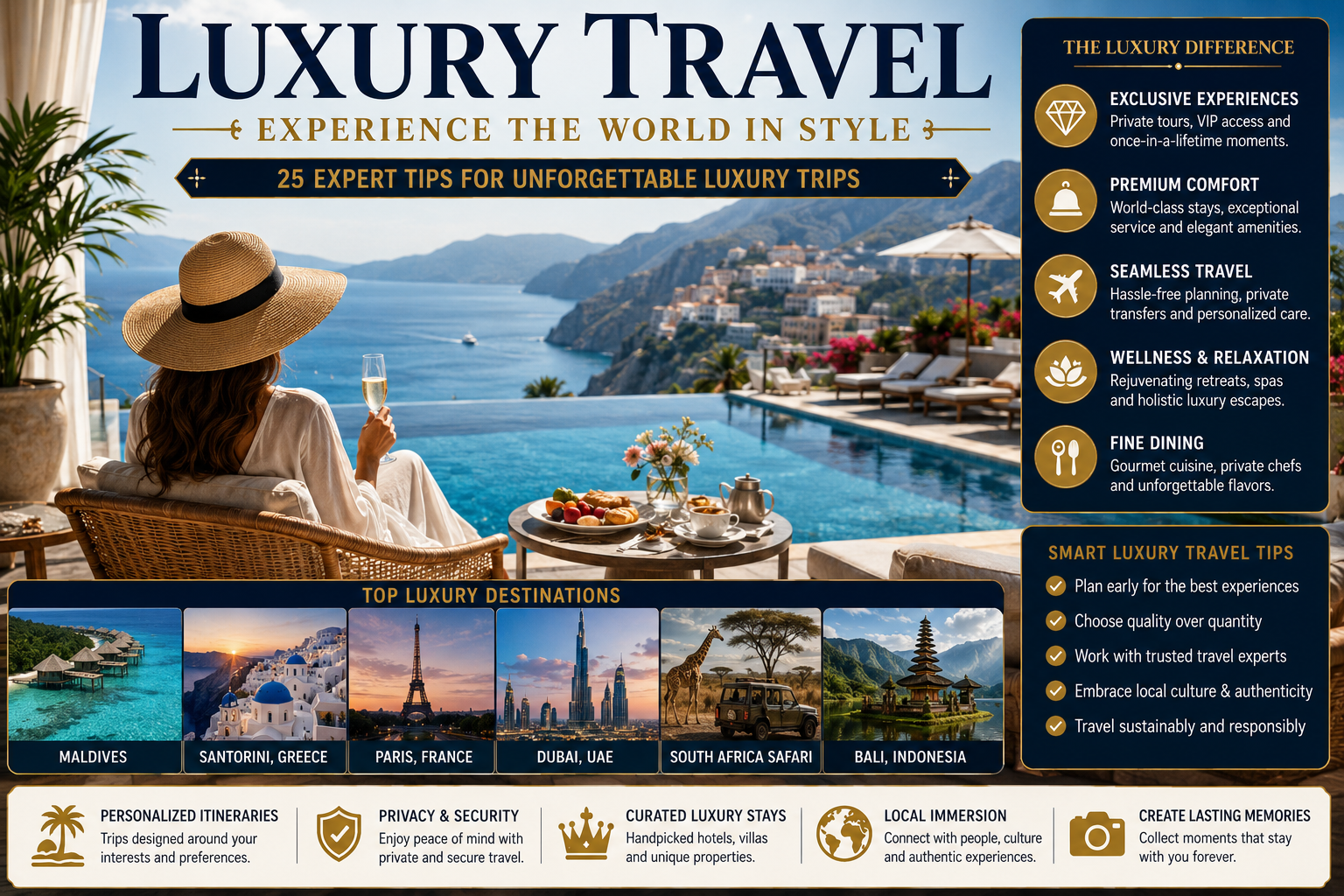
25 Luxury Travel Ideas for an Unforgettable, Personalized Journey
Luxury travel is no longer defined only by expensive hotels, premium transportation, or extravagant amenities; it is increasingly about privacy, personalization, time, comfort, meaningful experiences, and exceptional service. The best luxury trips combine carefully designed itineraries with authentic experiences, seamless logistics, beautiful surroundings, and enough flexibility to make the journey feel entirely your own. A luxury traveler might spend a morning exploring a historic neighborhood with a private guide, have lunch prepared by a local chef, travel by yacht to a secluded coastline, and finish the evening in a private villa overlooking the sea Travel Safety
What Is Luxury Travel?
Luxury travel is a premium form of tourism built around exceptional comfort, service, access, personalization, privacy, convenience, and distinctive experiences.
It can include luxury hotels, private villas, business or first-class aviation, private aviation, yacht charters, exclusive excursions, personal guides, fine dining, wellness retreats, luxury trains, safari lodges, expedition cruises, and customized itineraries.
But price alone does not make a trip luxurious.
A $10,000 hotel stay can feel surprisingly ordinary if the service is poor, the location is inconvenient, or the itinerary is badly planned.
Meanwhile, a carefully organized trip to a small property can feel exceptionally luxurious because everything works effortlessly.
Luxury Is About Frictionless Travel
One of the most overlooked elements of luxury is the removal of unnecessary friction.
Consider two travelers arriving in a foreign city.
The first has to find transportation, wait in a queue, locate the hotel, negotiate luggage, figure out dinner reservations, and arrange transportation for the following morning.
The second has a driver waiting, luggage handled, check-in prepared, restaurant reservations confirmed, and a personalized itinerary ready.
Both travelers may visit the same destination.
But their experiences are completely different.
The second traveler has effectively purchased time and simplicity.
Luxury Is Increasingly About Personalization
Modern luxury travelers increasingly expect services to reflect individual preferences.
That can mean remembering a preferred room type, arranging a particular style of cuisine, organizing activities around personal interests, adjusting the pace of a trip, or creating an itinerary around a specific purpose.
The result is less of a standardized vacation and more of a personal journey.
How Luxury Travel Has Changed
Luxury tourism has evolved significantly.
Older concepts of luxury often emphasized visible status.
Large suites, expensive cars, prestigious restaurants, designer interiors, and exclusive addresses were obvious signals.
Those elements still matter.
But they are no longer the entire story.
From Status to Meaning
Luxury travelers increasingly want experiences that cannot simply be purchased from a menu.
Examples include private access to cultural sites, meeting artisans, learning traditional skills, spending time with local experts, exploring remote landscapes, or staying somewhere with a powerful sense of place.
Current 2026 luxury travel reporting highlights growing interest in immersive experiences such as heritage crafts, farm-based stays, intimate safaris, and destination-specific activities.
From More to Better
Another important shift is the preference for quality over quantity.
Instead of visiting five cities in seven days, a traveler may choose two destinations and spend more time in each.
This slower approach can reduce transportation fatigue while creating deeper connections with a place.
Some travel advisors are reporting longer stays and fewer hotel changes as part of this broader shift toward slow, experience-focused luxury travel.
From Crowded Luxury to Private Luxury
Privacy has become one of the strongest luxury signals.
A private villa, secluded lodge, chartered yacht, private dining room, or small expedition can provide something a crowded five-star property cannot: control over the environment.
For some affluent travelers, privacy itself has become a form of status and comfort.
Why People Choose Luxury Travel
People choose luxury travel for different reasons.
Understanding those reasons can help travelers spend money more intelligently.
Comfort
Comfort remains a fundamental part of luxury.
That can include comfortable beds, spacious rooms, premium transportation, climate control, quiet environments, excellent food, and high-quality service.
Privacy
Privacy can be particularly valuable for families, couples, public figures, executives, and travelers who simply want to disconnect.
Convenience
Luxury travel can reduce the time and effort required to coordinate complex journeys.
Access
Some experiences are difficult to organize independently.
Private guides, specialist operators, local experts, yacht charters, and exclusive reservations can provide access that ordinary tourism may not.
Personalization
A luxury trip can be designed around interests rather than generic sightseeing.
Time
For many travelers, time is more valuable than material possessions.
A well-designed itinerary can reduce unnecessary transfers, waiting, and logistical uncertainty.
The Main Types of Luxury Travel
Luxury travel has many forms, and choosing the right one starts with understanding what kind of experience you actually want.
Luxury Resort Travel
Luxury resorts remain one of the most recognizable forms of high-end tourism.
They often combine premium accommodation with restaurants, spas, pools, private beaches, activities, concierge services, and wellness facilities.
This format works particularly well for travelers who want relaxation with minimal planning.
Luxury City Breaks
A luxury city break can combine premium accommodation with private cultural tours, fine dining, shopping, art, architecture, nightlife, and exclusive experiences.
Cities can be particularly attractive for travelers who want variety without constant transportation between destinations.
Private Villa Travel
Private villas offer a different form of luxury.
Instead of sharing common spaces with hundreds of other guests, travelers can have private pools, kitchens, gardens, terraces, living rooms, and dedicated staff depending on the property.
Villas are especially attractive for families and groups.
Luxury Safari Travel
Luxury safari travel combines wildlife experiences with high-end accommodation and professional guiding.
The strongest safari experiences are not simply about luxury tents.
They are about location, wildlife expertise, conservation, food, service, and the ability to experience landscapes in meaningful ways.
Luxury Yacht Travel
Yacht travel offers mobility and privacy at the same time.
A yacht can allow travelers to visit multiple coastal destinations without repeatedly packing and unpacking.
However, yacht travel requires careful planning around weather, itinerary, vessel type, crew, marina access, and operating costs.
Luxury Train Travel
Luxury rail journeys appeal to travelers who enjoy slow movement, scenery, hospitality, and historic transportation.
The journey itself becomes part of the destination.
Luxury Expedition Travel
Expedition travel can combine premium accommodation with remote environments.
Examples can include polar regions, remote islands, deserts, mountain regions, and other destinations where access is part of the experience.
Luxury Wellness Travel
Wellness has become one of the most important categories in luxury tourism.
Luxury wellness travel can range from spa-focused holidays to structured retreats built around fitness, sleep, nutrition, mindfulness, recovery, or longevity.
The broader wellness market is also moving toward more personalized and science-oriented experiences in 2026.
How to Plan a Luxury Travel Experience
Luxury travel requires planning because the most desirable experiences often have limited capacity.
Define Your Purpose
Start with one simple question:
What do I want this trip to give me?
Possible answers include:
- Relaxation
- Adventure
- Privacy
- Family time
- Romance
- Wellness
- Cultural discovery
- Food and wine
- Wildlife
- Shopping
- Celebration
- Personal growth
- Digital disconnection
This answer should influence every later decision.
Choose the Right Travel Style
Do not book a luxury resort simply because it is famous.
A wellness traveler may prefer a specialized retreat.
A family may prefer a private villa.
An adventure traveler may prefer a luxury expedition lodge.
A couple may prefer a secluded island.
Luxury is about fit.
Build the Trip Around Experiences
Accommodation should support the trip rather than completely define it.
If your main goal is cultural exploration, location may be more important than having the largest suite.
If your goal is privacy, a private villa may be more valuable.
If your goal is relaxation, a resort with excellent wellness facilities may be the better choice.
How to Choose a Luxury Destination
Destination selection should consider more than beauty.
Think About Seasonality
A destination can feel completely different depending on the season.
Weather affects outdoor activities, wildlife viewing, beach conditions, mountain access, crowds, and transportation.
Consider Travel Time
Long travel times can make short trips inefficient.
For a three-night holiday, spending most of the trip in transit may not make sense.
Consider Privacy
Some destinations are naturally better suited to private experiences.
Remote islands, private reserves, small coastal communities, countryside estates, and secluded mountain properties can offer more privacy than major tourist centers.
Consider Local Infrastructure
Luxury does not automatically mean convenience.
A remote luxury property may have excellent accommodation but limited access to medical care, transportation, or other services.
Understanding the destination is essential.
The Most Important Luxury Travel Decision: Where to Stay
Accommodation can dramatically influence the experience.
Luxury Hotels
Hotels are ideal for travelers who value service, dining, wellness facilities, concierge support, and central locations.
Boutique Hotels
Boutique properties can offer individuality and local character.
They are often attractive to travelers who prefer personality over standardized luxury.
Private Villas
Villas provide privacy and can work exceptionally well for families or groups.
Luxury Lodges
Lodges are particularly useful in nature-focused destinations.
They can combine comfortable accommodation with access to wildlife, mountains, forests, deserts, or other natural environments.
Branded Residences
Luxury residences combine residential-style living with hospitality services.
This format is particularly useful for longer stays and multigenerational travel.
How to Select a Luxury Hotel
The star rating is only one factor.
Look at Location
A beautiful hotel in an inconvenient location may create daily transportation problems.
Evaluate Service
Service quality often matters more than room size.
Study the Room Categories
Do not assume that every room in a luxury hotel offers the same experience.
Consider views, floor location, privacy, outdoor space, bathroom design, access to facilities, and room layout.
Check Dining Options
Excellent accommodation can lose value if dining options do not match your preferences.
Consider the Atmosphere
A family resort, wellness retreat, business hotel, party resort, and secluded romantic property offer very different experiences.
Luxury Travel and Private Aviation
Private aviation is one of the most premium forms of transportation.
It can reduce airport-related friction and provide greater scheduling flexibility.
But it is not automatically the best choice for every luxury traveler.
The Main Advantage Is Time
Private aviation can make sense when time is extremely valuable or when the destination has limited commercial connectivity.
Consider the Environmental Cost
Private aviation generally has a substantially higher environmental footprint per passenger than commercial aviation.
Travelers concerned about sustainability should consider the overall impact of their transportation choices.
Compare Alternatives
For some journeys, premium commercial aviation combined with efficient ground transfers may provide a better balance between comfort, time, cost, and environmental impact.
Luxury Travel by Yacht
Yacht travel can be highly personalized.
Charter Versus Cruise
A charter provides greater control over itinerary, guests, schedule, and onboard experience.
Luxury cruises provide hotel-style service with a more structured operating model.
Choose the Right Vessel
Size is not everything.
Consider:
- Number of guests
- Cabins
- Crew
- Outdoor space
- Water equipment
- Dining
- Stability
- Range
- Port access
- Onboard facilities
Build in Flexibility
Weather and sea conditions can affect itineraries.
A good yacht itinerary should allow for reasonable changes.
Luxury Travel and Fine Dining
Food can transform a luxury journey.
But fine dining is not always the same as luxury dining.
The Value of Local Cuisine
A simple meal prepared with exceptional local ingredients can be more memorable than a formal tasting menu.
Private Dining
Private dining experiences can include:
- Chef’s table experiences
- Villa dinners
- Private rooms
- Outdoor meals
- Farm dinners
- Yacht dining
- Destination-based culinary experiences
Food as Cultural Travel
Food can provide a direct connection to a destination’s history and identity.
Market tours, cooking classes, vineyard visits, farm experiences, and artisan food production can be excellent luxury experiences.
Luxury Wellness Travel
Wellness is no longer simply a spa treatment added to a vacation.
It is increasingly becoming the reason people travel.
Wellness Retreats
Retreats may focus on relaxation, movement, sleep, nutrition, mindfulness, or other wellness goals.
Longevity-Oriented Travel
Some luxury properties increasingly incorporate diagnostics, personalized programs, fitness, nutrition, and health-focused services.
Travelers should distinguish between evidence-based medical care and unsupported wellness claims.
Digital Detox
For many travelers, the luxury is simply having fewer notifications.
A quiet property with limited connectivity can become more valuable than a hotel filled with technology.
Luxury Adventure Travel
Luxury and adventure can coexist.
A traveler might spend the day hiking, diving, skiing, kayaking, or exploring wildlife and return to a comfortable lodge in the evening.
Soft Adventure
Soft adventure can include guided hikes, wildlife viewing, scenic cycling, kayaking, and nature experiences.
Hard Adventure
Hard adventure involves greater physical or technical demands.
Luxury support may improve comfort, but it does not eliminate the underlying risks.
Proper training and qualified professional guidance remain important.
Luxury Travel for Families
Family luxury travel requires a different approach.
Choose Space Over Status
A large villa may be more useful than a prestigious hotel suite.
Build Flexible Schedules
Children may not enjoy tightly scheduled itineraries.
Consider Multiple Generations
Multigenerational travel is increasingly important in luxury tourism, with villas, private guides, and flexible experiences helping accommodate different ages and interests.
Give Everyone Something to Enjoy
A successful family itinerary may combine:
- Children’s activities
- Adult dining
- Cultural experiences
- Outdoor adventures
- Relaxation
- Flexible free time
Luxury Travel for Couples
Couples can build trips around shared interests.
Romantic Luxury
Romance does not require extravagance.
Privacy, beautiful surroundings, thoughtful service, and unhurried time can be more meaningful.
Celebration Travel
Anniversaries, proposals, birthdays, and milestones can justify more personalized planning.
Couple-Focused Experiences
Private dinners, yacht excursions, spa treatments, scenic flights, cultural experiences, and secluded accommodations can create memorable moments.
Luxury Solo Travel
Luxury can be particularly valuable for solo travelers because professional support can reduce logistical complexity.
Safety and Convenience
Private transfers, reputable accommodations, local guides, and concierge services can make unfamiliar destinations easier to navigate.
Build Around Personal Interests
Solo travel allows complete control over the itinerary.
A traveler can devote an entire day to photography, food, architecture, shopping, history, or wellness without compromising with a group.
Luxury Travel for Seniors
Luxury travel can be designed around comfort without eliminating exploration.
Prioritize Accessibility
Consider:
- Elevators
- Walking distances
- Room accessibility
- Transport requirements
- Medical facilities
- Flight duration
- Rest periods
Slow Down
A slower itinerary can actually improve the quality of the trip.
Luxury is not about seeing everything.
It is about enjoying what you choose to see.
Luxury Travel for Business Travelers
Business travelers often value time more than sightseeing.
Location Matters
A centrally located hotel can save hours of transportation.
Work-Friendly Facilities
Reliable connectivity, quiet workspaces, meeting facilities, and business services can be important.
Add Recovery Time
A wellness treatment, good meal, or quiet evening can help travelers recover from demanding schedules.
Luxury Travel on a More Reasonable Budget
Luxury travel does not always require unlimited spending.
Travel During Shoulder Seasons
Rates can sometimes be more attractive outside peak periods, although weather and availability should be evaluated carefully.
Stay Longer
Some properties may offer better value for longer stays.
Choose One Luxury Splurge
Instead of paying premium prices for every element, travelers can prioritize one or two areas.
For example:
- Premium accommodation but economy or premium economy flights
- Standard hotel with a private culinary experience
- Business-class flights with a boutique hotel
- Private guide for one important day rather than the entire trip
Focus on Experience Value
A $500 private cultural experience may be more memorable than upgrading to a slightly larger room.
The Psychology of Luxury Travel
Luxury travel is partly psychological.
Control
Travelers often value having choices.
Recognition
Personalized service can make guests feel understood rather than processed.
Privacy
Privacy provides freedom from crowds, schedules, and unwanted attention.
Anticipation
Luxury begins before arrival.
Clear communication, thoughtful planning, and smooth booking contribute to the experience.
Memory
The final measure of a trip may not be what you paid.
It may be what you remember.
Common Luxury Travel Mistakes
Luxury travelers can make mistakes just like budget travelers.
Booking the Most Expensive Option Automatically
Higher price does not guarantee higher personal value.
Choosing a Famous Hotel Without Considering Fit
A famous property may not suit your travel style.
Overplanning
Luxury can disappear when every minute is scheduled.
Underestimating Transfer Times
A beautiful hotel becomes less appealing when every attraction requires hours of transportation.
Ignoring Seasonality
Paying premium prices during poor weather can produce disappointing results.
Focusing Only on the Room
A beautiful room cannot compensate for poor service, inconvenient location, or an unsuitable atmosphere.
Forgetting Travel Insurance
Luxury travel can involve substantial prepaid costs.
Appropriate insurance may help protect against certain covered disruptions.
Assuming Concierge Means Everything Is Guaranteed
Even the best concierge cannot control weather, government restrictions, airline disruptions, or fully booked attractions.
How to Avoid Overpaying for Luxury Travel
Compare the Total Experience
Do not compare nightly rates alone.
Include:
- Breakfast
- Transfers
- Resort fees
- Activities
- Dining
- Spa access
- Taxes
- Service charges
- Transportation
Understand Inclusions
A higher room rate can sometimes provide better value if meaningful services are included.
Ask What Actually Matters
If you do not use a private beach, butler, spa, or chauffeur, paying for those features may not improve your experience.
Luxury Travel and Sustainability
Luxury travel faces an important challenge.
High-end travel can involve significant transportation, energy, construction, food, and resource consumption.
But luxury tourism can also contribute to conservation and local economic development.
Support Conservation
Wildlife lodges, protected areas, and responsible tourism operators can help create economic incentives for conservation.
Choose Local Experiences
Local guides, restaurants, craftspeople, and businesses can receive direct economic benefits.
Reduce Unnecessary Movement
Longer stays in fewer destinations can reduce repeated transportation and create deeper experiences.
Look Beyond Green Marketing
A hotel using recycled towels does not automatically make an entire trip sustainable.
Consider the full journey.
Luxury Travel and Cultural Respect
Luxury should never mean ignoring local customs.
Research Cultural Norms
Understand appropriate clothing, photography, greetings, religious practices, and public behavior.
Support Authentic Experiences
Choose experiences that respect local communities rather than turning traditions into staged entertainment.
Pay Fairly
Local guides and artisans should be compensated fairly for their work.
The Role of Technology in Luxury Travel
Technology is changing luxury travel without necessarily replacing human service.
AI-Powered Planning
AI can help travelers compare destinations, organize ideas, build draft itineraries, and identify potential conflicts.
However, complex travel decisions still require verification of current schedules, availability, entry requirements, weather, and local rules.
Digital Concierge Services
Hotels and travel companies increasingly use apps and digital platforms to handle requests.
Smart Rooms
Technology can allow travelers to control lighting, temperature, entertainment, and other room functions.
The Human Advantage
Technology can improve convenience, but exceptional human judgment remains valuable.
A knowledgeable travel advisor may understand emotional preferences that a booking algorithm cannot fully capture.
Current Luxury Travel Trends in 2026
Luxury travel in 2026 is increasingly defined by experiences that feel personal rather than mass-produced.
Wellness and Longevity
Wellness continues to move from an optional hotel amenity toward a major reason for travel. Current reporting highlights personalized retreats, fitness travel, science-oriented wellness, and longevity programs.
Multigenerational Travel
Families are increasingly organizing trips around several generations, creating demand for villas, private transportation, flexible guides, and activities suitable for different ages.
Slow Luxury
Longer stays and fewer destinations can create more meaningful travel while reducing the stress of constant transfers.
Private Experiences
Private guides, villas, yachts, aircraft, dining rooms, and small-group experiences are increasingly attractive to travelers who prioritize privacy.
Craft and Heritage Travel
Travelers are seeking experiences tied to local skills and traditions, including artisan workshops, calligraphy, cooking, farming, and other forms of cultural participation.
Expedition Luxury
Luxury expedition travel is expanding into remote destinations where access itself becomes part of the experience. Industry reporting highlights continued interest in polar and remote-region journeys.
Destination Hotels
Some travelers increasingly choose destinations because of the property itself.
The hotel or resort becomes the experience rather than merely the place where the traveler sleeps.
The Rise of Quiet Luxury in Travel
Quiet luxury is increasingly visible in hospitality.
Instead of obvious extravagance, the emphasis is on:
- Privacy
- Natural materials
- Excellent service
- Calm environments
- Local character
- Space
- Personalized attention
- High-quality food
- Thoughtful design
The philosophy is simple:
Luxury should be felt rather than announced.
Ten Luxury Travel Brands Compared
The following comparison focuses on major luxury hospitality and travel brands. Brand suitability varies by destination, property, itinerary, and traveler preferences.
| Luxury Travel Brand | Main Strength | Best For | Travel Style |
|---|---|---|---|
| Aman | Privacy and understated luxury | Couples and privacy-focused travelers | Ultra-luxury, tranquil |
| Four Seasons | Personalized service and consistency | Families, couples, business travelers | Classic luxury |
| Mandarin Oriental | Hospitality and wellness | Couples and wellness travelers | Elegant urban and resort luxury |
| Rosewood | Sense of place and design | Cultural and lifestyle travelers | Experiential luxury |
| Six Senses | Wellness and sustainability focus | Wellness travelers and couples | Resort and wellness luxury |
| Belmond | Iconic journeys and heritage | Rail, river, and destination travelers | Experiential and classic |
| Ritz-Carlton | Traditional premium hospitality | Families and business travelers | Classic five-star |
| One&Only | Exclusive resorts and privacy | Couples and high-end leisure | Resort luxury |
| COMO Hotels and Resorts | Wellness and refined design | Wellness-focused travelers | Boutique luxury |
| Auberge Resorts Collection | Intimate properties and experiences | Couples and leisure travelers | Boutique experiential luxury |
Aman
Aman is particularly associated with privacy, minimalist luxury, distinctive destinations, and highly personalized hospitality.
It can suit travelers who prefer understated environments rather than large resort complexes.
Four Seasons
Four Seasons is known for service consistency across a global portfolio.
It can work well for families, couples, business travelers, and travelers who value recognizable service standards.
Mandarin Oriental
Mandarin Oriental combines luxury hospitality with strong associations with wellness, dining, and service.
Rosewood
Rosewood often emphasizes local identity and sense of place.
It can appeal to travelers who want luxury combined with cultural character.
Six Senses
Six Senses places strong emphasis on wellness, sustainability, and immersive resort experiences.
Belmond
Belmond is especially interesting for travelers who value iconic journeys, heritage properties, luxury rail, river experiences, and destination-focused travel.
Ritz-Carlton
Ritz-Carlton represents a more traditional interpretation of luxury hospitality with strong emphasis on service and premium accommodations.
One&Only
One&Only focuses heavily on exclusive resort environments and personalized leisure experiences.
COMO Hotels and Resorts
COMO has a strong wellness identity and can appeal to travelers seeking health, relaxation, design, and calm environments.
Auberge Resorts Collection
Auberge properties tend to emphasize intimate hospitality, distinctive locations, and experience-led stays.
How to Choose Between Luxury Travel Brands
Brand reputation is useful, but it should not be the final decision.
Choose by Destination
The best property may vary by city or country.
Choose by Experience
A wellness traveler should prioritize wellness capabilities.
A family should prioritize space and activities.
A couple should prioritize atmosphere and privacy.
Choose by Service Style
Some travelers like formal service.
Others prefer relaxed hospitality.
Choose by Property
Even within the same brand, individual properties can have very different personalities.
The Future of Luxury Travel
The future of luxury travel will likely be shaped by personalization, technology, sustainability, wellness, privacy, and time efficiency.
Hyper-Personalization
Travel planners and hospitality companies will increasingly use customer preferences to create more customized journeys.
More Meaningful Experiences
Travelers are likely to continue shifting from collecting destinations toward collecting experiences.
Wellness Integration
Wellness will increasingly appear across transportation, accommodation, food, sleep, fitness, and itinerary design.
Private and Small-Scale Travel
Private villas, boutique properties, small expeditions, and customized experiences may continue gaining appeal among travelers who want fewer crowds.
Longer Trips
Longer stays can allow travelers to experience destinations more deeply while reducing constant travel between locations.
AI-Assisted Travel Planning
AI will likely become increasingly useful for itinerary construction, personalization, translation, scheduling, and travel research.
However, travelers will still need human judgment and verification because real-world travel information changes quickly.
More Sustainable Luxury
Luxury travelers may increasingly expect sustainability to be integrated into the experience rather than treated as a separate marketing message.
How to Build the Perfect Luxury Travel Itinerary
A strong luxury itinerary should feel effortless.
Day One: Arrival and Recovery
Do not immediately schedule a demanding activity after a long journey.
Arrange a comfortable transfer and allow time to settle in.
Day Two: Signature Experience
Choose one memorable experience that represents the destination.
Day Three: Flexible Exploration
Leave space for spontaneous discovery.
Day Four: Wellness or Recovery
A slower day can restore energy.
Day Five: Cultural Immersion
Add a private guide, culinary experience, workshop, museum visit, or other meaningful activity.
Final Day: Slow Departure
Avoid scheduling a major experience immediately before a long flight.
Luxury is partly about ending the trip without stress.
A Luxury Travel Planning Checklist
Before Booking
- Define your travel purpose
- Select the ideal destination
- Research the season
- Determine your preferred accommodation
- Compare transportation options
- Decide whether you need a travel advisor
- Research entry requirements
- Check cancellation policies
- Estimate the full trip cost
Before Departure
- Confirm flights
- Confirm transfers
- Confirm hotel reservations
- Confirm private experiences
- Check restaurant reservations
- Review weather
- Prepare travel documents
- Arrange travel insurance
- Organize medications
- Download important travel apps and documents
- Share important itinerary information when appropriate
During the Trip
- Leave room for flexibility
- Respect local customs
- Monitor weather
- Avoid over-scheduling
- Stay aware of transportation times
- Communicate preferences to your hotel or travel advisor
- Protect important documents
- Enjoy the destination rather than constantly documenting it
Pros and Cons of Luxury Travel
Advantages of Luxury Travel
Luxury travel can provide exceptional comfort, personalized service, privacy, efficient logistics, premium accommodation, specialized expertise, and access to distinctive experiences.
It can also make complicated journeys easier by placing transportation, accommodation, activities, and support under coordinated planning.
For travelers with limited vacation time, this can be particularly valuable.
Disadvantages of Luxury Travel
The biggest disadvantage is cost.
Luxury travel can also create unrealistic expectations, environmental concerns, and dependence on premium services.
A traveler may become so focused on comfort that they miss authentic experiences.
There is also the risk of paying for features that do not personally matter.
The Balanced Approach
The best luxury travel strategy is not necessarily to maximize spending.
It is to maximize personal value.
Spend more where the upgrade meaningfully improves your experience.
Spend less where it does not.
A Simple Luxury Travel Value Framework
Before paying for an upgrade, ask five questions.
Does It Save Time?
If yes, the upgrade may be valuable.
Does It Increase Privacy?
If privacy is important to you, it may be worthwhile.
Does It Improve Comfort?
Consider whether the difference will actually affect your trip.
Does It Create a Unique Experience?
An experience that cannot easily be replicated may provide more value than a material upgrade.
Will I Remember It?
This is perhaps the most important question.
A larger hotel room may be forgotten.
A private dinner overlooking an extraordinary landscape may become one of the defining memories of the trip.
What Luxury Travel Really Means
The most important lesson is that luxury is personal.
For one traveler, luxury means a private jet.
For another, it means a quiet room with an ocean view.
For someone else, it means having a private guide explain the history of an ancient city.
For a parent, it may mean having everything organized so the family can relax.
For an entrepreneur, it may mean saving six hours of travel time.
For a couple, it may mean having an entire evening without interruptions.
For an exhausted traveler, luxury may simply mean sleeping well.
This is why the future of luxury travel is likely to become increasingly personalized.
The industry can sell rooms, seats, villas, yachts, and experiences.
But the traveler ultimately buys something more intangible:
time, freedom, comfort, access, privacy, and memories.
FAQs
What is luxury travel?
Luxury travel is premium travel centered on comfort, personalized service, privacy, convenience, exclusive access, exceptional accommodation, and meaningful experiences. It can include luxury hotels, villas, private aviation, yachts, safaris, wellness retreats, luxury trains, and customized tours.
Is luxury travel only for wealthy people?
Luxury travel is generally more expensive than standard tourism, but travelers can incorporate selected luxury elements into a trip without making every part of the journey premium. A traveler might choose one luxury hotel, private experience, special meal, or premium transportation segment.
What is the biggest trend in luxury travel?
Personalization is one of the strongest themes in modern luxury travel. Other important trends include wellness, privacy, slow travel, meaningful cultural experiences, multigenerational trips, expedition travel, and more conscious tourism.
What makes a luxury hotel different?
A luxury hotel generally combines high-quality accommodation with strong service, premium facilities, desirable locations, dining, personalized attention, and a carefully designed guest experience. Exact standards vary by property and destination.
Is a private villa better than a luxury hotel?
Neither is universally better. Villas can be ideal for families, groups, and privacy-focused travelers, while hotels can offer stronger concierge services, restaurants, spas, and centralized facilities.
What is quiet luxury travel?
Quiet luxury travel emphasizes understated elegance, privacy, exceptional service, natural surroundings, high-quality materials, and personalized experiences rather than conspicuous displays of wealth.
What is luxury experiential travel?
Luxury experiential travel focuses on distinctive experiences rather than simply premium accommodation. Examples include private cultural tours, artisan workshops, wildlife expeditions, private dining, remote adventures, and personalized wellness programs.
What are the best luxury travel destinations?
There is no universal best destination. The ideal destination depends on whether the traveler wants beaches, culture, food, wellness, wildlife, adventure, shopping, privacy, history, or nature.
Is luxury travel worth the money?
It can be worthwhile when premium spending improves something that matters to the traveler, such as privacy, comfort, time savings, access, or a memorable experience. Expensive does not automatically mean better.
How far in advance should luxury travel be booked?
Highly sought-after villas, private experiences, luxury safaris, yachts, and popular wellness retreats may require significant advance planning. Timing depends heavily on destination, season, property, and availability.
What is luxury wellness travel?
Luxury wellness travel combines premium accommodation and service with wellness-oriented experiences such as spa treatments, fitness, nutrition, relaxation, mindfulness, sleep programs, or specialized retreats.
Is luxury travel sustainable?
It can be more responsible when travelers choose longer stays, support local businesses, use responsible operators, respect protected environments, and reduce unnecessary movement. However, luxury travel can also have significant environmental impacts, particularly through transportation.
What is the difference between luxury and premium travel?
Premium travel generally means a higher level of comfort or service than standard travel. Luxury travel typically goes further by emphasizing personalization, exclusivity, exceptional service, privacy, and distinctive experiences.
Can families enjoy luxury travel?
Absolutely. Families may benefit particularly from private villas, connecting rooms, personalized guides, flexible itineraries, childcare services where appropriate, and activities designed for different generations.
Is luxury travel good for solo travelers?
Yes. Solo travelers can benefit from private guides, high-quality accommodation, concierge services, reliable transfers, and personalized itineraries that reduce logistical stress.
What should I look for in a luxury travel advisor?
Look for destination expertise, strong supplier relationships, responsiveness, transparent communication, understanding of your travel preferences, and the ability to create an itinerary that matches your priorities rather than simply selling expensive products.
Does luxury travel always mean five-star hotels?
No. Luxury can exist in boutique hotels, private villas, lodges, heritage properties, yachts, trains, camps, and other accommodations. The quality of the experience matters more than a simple star rating.
What is slow luxury travel?
Slow luxury travel emphasizes longer stays, fewer destinations, fewer hotel changes, and deeper experiences. It can reduce travel fatigue while giving travelers more time to understand a destination.
Is luxury travel becoming more private?
Privacy is increasingly important to affluent travelers, particularly those seeking seclusion, fewer crowds, personalized service, and control over their surroundings. Private villas, yachts, guides, and small-scale experiences are part of this trend.
What is the future of luxury travel?
The future is likely to emphasize personalization, wellness, privacy, technology-assisted planning, authentic experiences, slower itineraries, responsible tourism, and more flexible travel design.
Conclusion
Luxury travel has entered a more thoughtful era. The old definition of luxury was largely built around visible extravagance. The new definition is much more personal. A luxury traveler may still want a spectacular suite, a private aircraft, a yacht, or a Michelin-level dining experience. But these products increasingly serve a larger purpose: creating a journey that feels effortless, private, meaningful, and perfectly matched to the traveler. That shift explains why wellness, slow travel, cultural immersion, private experiences, multigenerational journeys, expedition travel, and destination-focused stays are gaining attention. Luxury is becoming less about having more and more about having exactly what matters.