
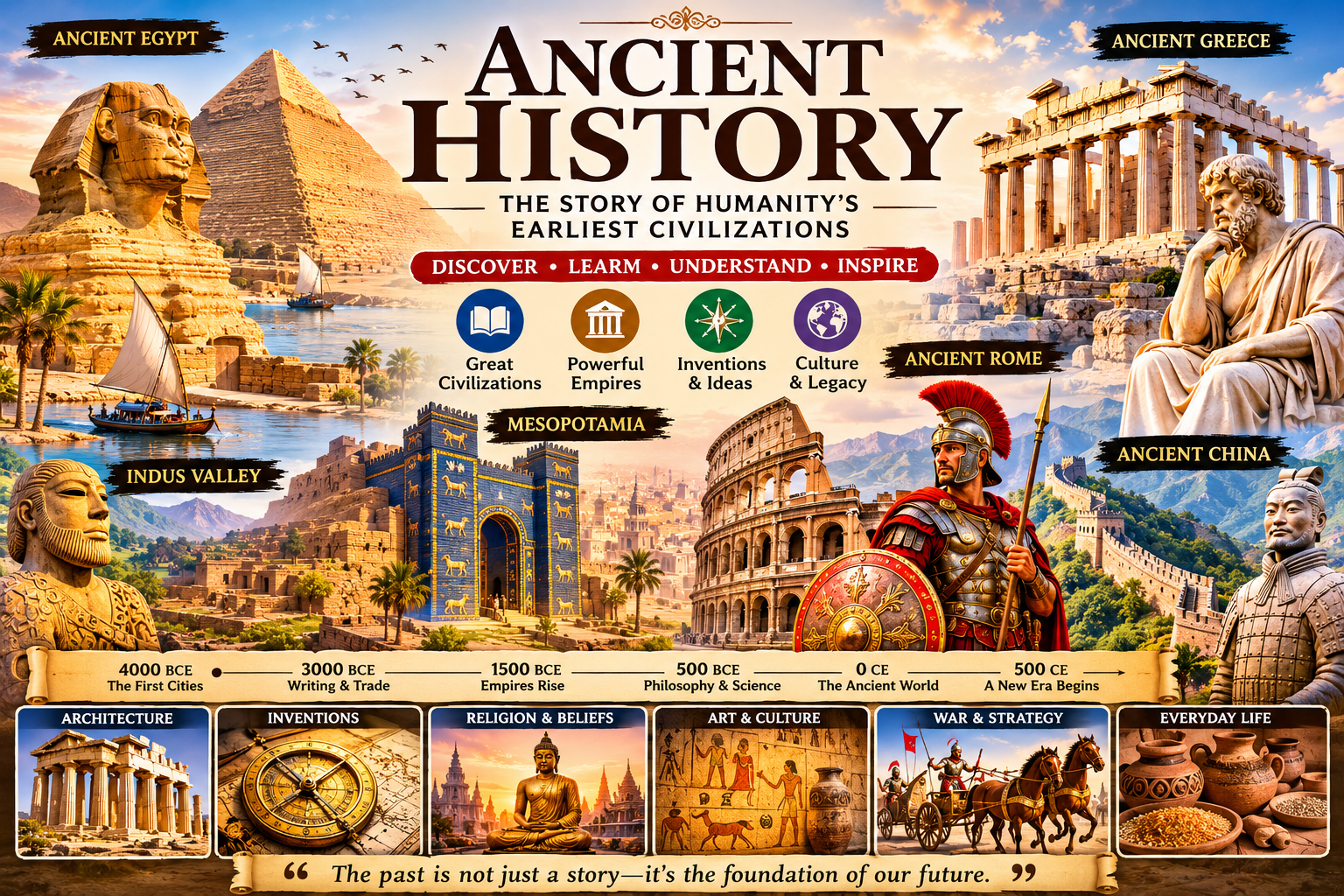
Ancient History: A Fascinating Journey Through the World’s First Civilizations, Empires, Cultures and Ideas
Ancient history is the story of how human communities transformed from early settlements into cities, kingdoms, empires, writing cultures, trading networks, and sophisticated societies that shaped the world we know today. From Mesopotamia and ancient Egypt to the Indus Valley, China, Greece, Rome, Mesoamerica, and beyond, ancient history reveals how people solved problems of food, government, technology, religion, warfare, trade, and social organization thousands of years ago Cultural Heritage
What Is Ancient History?
Ancient history generally refers to the study of human societies from the emergence of written records through the ancient world, although the exact beginning and ending dates differ according to region and scholarly tradition.
The term is therefore not a universal chronological box.
In some contexts, ancient history begins with the emergence of writing in the late fourth millennium BCE. In others, historians discuss prehistoric societies immediately before writing because those communities created the economic and social conditions that eventually produced cities and states.
Ancient history also does not end at exactly the same date everywhere.
The Western Roman Empire’s decline in the fifth century CE is sometimes used as a conventional boundary between ancient and medieval European history. But civilizations in other parts of the world followed different timelines.
Why Ancient History Matters
Studying ancient history helps explain questions that remain relevant today.
How do cities develop?
Why do governments collect taxes?
How does trade connect distant societies?
Why do people build monuments?
How do languages and writing systems spread?
Why do empires expand?
Why do powerful states collapse?
How does climate influence civilization?
How do religions shape political authority?
How does technology transform society?
These are not exclusively ancient questions.
They are human questions.
The Origins of Civilization
One of the most important developments in ancient history was the transition from predominantly mobile hunter-gatherer communities toward increasingly permanent settlements, agriculture, specialized labor, and eventually urban societies.
This transformation did not happen overnight.
Agriculture developed in multiple regions, and communities gradually experimented with cultivating plants, domesticating animals, storing food, and creating permanent settlements.
As food production became more reliable in some environments, populations could grow. Surplus production could support people whose primary occupations were not farming.
That opened the door to specialization.
A community could now support:
- Farmers
- Builders
- Potters
- Metalworkers
- Merchants
- Soldiers
- Priests
- Administrators
- Scribes
- Rulers
- Craftspeople
This specialization created new possibilities, but also new inequalities and administrative challenges.
From Villages to Cities
The emergence of cities was one of the defining developments of ancient history.
Mesopotamia provides one of the clearest examples.
During the Ubaid and Uruk periods, settlements in southern Mesopotamia became increasingly complex, and urbanization accelerated during the fourth millennium BCE. Uruk became one of the most important early urban centers.
The rise of cities required systems for managing:
- Food supplies
- Water
- Construction
- Trade
- Labor
- Security
- Religious institutions
- Property
- Taxes or offerings
Writing became particularly valuable because large societies generate enormous quantities of information.
Mesopotamia: The Land Between Two Rivers
Mesopotamia means “between the rivers,” referring primarily to the Tigris and Euphrates.
Much of ancient Mesopotamia corresponds to areas of modern Iraq, with cultural and political connections extending into parts of Syria, Turkey, Iran, and Kuwait.
Mesopotamia is frequently called a “cradle of civilization,” but this phrase requires some nuance.
It does not mean that civilization appeared nowhere else.
Rather, southern Mesopotamia provides some of the earliest strong evidence for urbanization, writing, centralized administration, and complex city-states. Writing also developed independently in other parts of the ancient world.
Sumer
Sumer was located in southern Mesopotamia.
Sumerian city-states included places such as:
- Uruk
- Ur
- Eridu
- Lagash
- Kish
- Nippur
These cities were not simply large settlements.
They were political and religious centers with temples, administrators, workshops, markets, and agricultural territories.
Sumer is especially important in ancient history because of its association with some of the earliest known urban societies and writing traditions.
Cuneiform Writing
One of humanity’s most important inventions was writing.
Early Mesopotamian writing developed partly from administrative needs.
Officials needed to record quantities of grain, livestock, labor, property, and other resources.
Over time, cuneiform became capable of recording much more than economic transactions.
Scribes used it for:
- Laws
- Letters
- Literature
- Religious texts
- Administrative documents
- Royal inscriptions
- Mathematics
- School exercises
Writing therefore changed not only communication but also the scale at which societies could organize information.
The Akkadian Empire
The Akkadian Empire emerged under Sargon of Akkad in the third millennium BCE.
It is often described as one of the earliest examples of a large territorial or multinational empire.
Sargon’s achievement was significant because he created political connections across previously independent city-states.
The Akkadian experience also demonstrates an important theme in ancient history:
Building an empire and maintaining an empire are different challenges.
Military conquest can happen quickly.
Administration, communication, taxation, loyalty, and supply are much harder to maintain.
Babylon and Hammurabi
Babylon became one of Mesopotamia’s most famous political centers.
Hammurabi, who ruled Babylon in the eighteenth century BCE, is particularly famous for the collection of laws associated with his reign.
The Code of Hammurabi is important not simply because it contains punishments.
It provides evidence about how an ancient state attempted to regulate relationships involving property, trade, family, labor, and social status.
It also demonstrates that ancient legal systems recognized differences between social groups.
Assyria
The Assyrians developed one of the most powerful imperial systems of the ancient Near East.
Assyrian rulers used military organization, administration, infrastructure, provincial governance, and intimidation to maintain a vast empire.
Assyria demonstrates another recurring pattern:
Technology and organization can make a state powerful, but maintaining political legitimacy remains difficult.
Ancient Egypt: Civilization Along the Nile
Ancient Egypt developed along the Nile River.
The river was not simply a source of water.
It shaped agriculture, transportation, settlement patterns, political organization, and cultural identity.
Egyptian civilization endured for thousands of years, although its political structure, rulers, religious practices, and relationships with neighboring powers changed repeatedly.
The Unification of Egypt
Ancient Egyptian history is traditionally divided into periods and dynasties.
The early unification of Upper and Lower Egypt created a centralized political tradition that became one of the most enduring institutions of the ancient world.
The pharaoh became a central figure in Egyptian political and religious life.
The Old Kingdom
The Old Kingdom is famous for monumental pyramid construction.
The pyramids were not simply enormous tombs.
They required:
- Engineering
- Quarrying
- Transportation
- Labor organization
- Food distribution
- Administration
- Religious planning
Their construction demonstrates the organizational capacity of the Egyptian state.
The Great Pyramids
The Great Pyramid at Giza remains one of the world’s most famous ancient monuments.
Its survival is remarkable because it was built thousands of years before modern construction machinery.
Yet ancient Egyptian engineering was not based on magic or mysterious technology.
It was based on accumulated practical knowledge, skilled labor, mathematics, planning, experimentation, and enormous organizational resources.
Egyptian Writing
Egyptians developed hieroglyphic writing alongside other scripts used for administrative and everyday purposes.
Writing was important to religion, government, literature, accounting, and monumental inscriptions.
The ability to preserve information allowed Egyptian institutions to function across generations.
Egyptian Religion
Religion was deeply integrated into Egyptian society.
Egyptian concepts of cosmic order, kingship, death, and the afterlife influenced architecture, rituals, burial practices, and political ideology.
The idea of ma’at, associated with balance, order, and proper cosmic and social organization, was particularly significant in Egyptian thought.
The Indus Valley Civilization
The Indus Valley Civilization, also known as the Harappan Civilization, developed across parts of modern Pakistan and northwestern India.
It represents one of the world’s major early urban traditions.
Important sites include:
- Harappa
- Mohenjo-daro
- Dholavira
- Lothal
Mohenjo-daro
Mohenjo-daro is famous for its carefully planned urban environment.
Archaeological evidence reveals:
- Streets
- Drainage systems
- Brick buildings
- Wells
- Residential areas
- Public structures
- Craft production
Its urban planning demonstrates that sophisticated city organization did not belong exclusively to Mesopotamia or Egypt.
The Mystery of the Indus Script
The Indus civilization produced inscriptions and symbols that remain incompletely understood.
Because the script has not been securely deciphered, historians face an unusual challenge.
We can study:
- Buildings
- Artifacts
- Tools
- Trade objects
- Burials
- Environmental evidence
But we cannot read large bodies of texts explaining how people understood their own society.
This is a powerful reminder that ancient history is sometimes reconstructed from what survives rather than what people intended to preserve.
Why Did the Indus Cities Decline?
The decline of major urban centers was probably not caused by one simple event.
Researchers have considered factors including:
- Environmental change
- Shifts in river systems
- Climate variability
- Changes in trade
- Economic transformation
- Population movement
The evidence suggests transformation rather than a single dramatic disappearance.
Ancient China
Ancient Chinese civilization developed through multiple regional cultures and political traditions.
The Yellow River and other river systems supported agriculture and settlement, while later states developed increasingly sophisticated political and military institutions.
The Shang Dynasty
The Shang Dynasty provides important evidence for early Chinese state formation.
Archaeologists have discovered:
- Bronze vessels
- Tombs
- Weapons
- Ritual objects
- Oracle bones
- Urban remains
Oracle Bone Writing
Oracle bones are among the earliest substantial bodies of Chinese writing.
Inscriptions recorded questions concerning:
- Royal decisions
- Weather
- Warfare
- Agriculture
- Rituals
- Health
This shows how writing could become intertwined with political and religious decision-making.
The Zhou Dynasty
The Zhou introduced the concept commonly translated as the Mandate of Heaven.
This political-religious idea provided a framework for explaining legitimate rule.
A ruler governed under heavenly approval, but immoral or ineffective rule could justify political replacement.
The concept had enormous influence on later Chinese political thought.
The Qin Dynasty
The Qin unified much of China in the third century BCE under Qin Shi Huang.
The Qin state is associated with:
- Centralized government
- Standardization
- Infrastructure
- Legal reforms
- Military organization
- Large-scale construction
The Qin dynasty was short-lived, but its political model profoundly influenced later imperial China.
The Han Dynasty
The Han Dynasty developed a durable imperial system.
It expanded territory, strengthened institutions, supported trade, and contributed to the development of what became known as the Silk Roads.
The Han period is therefore important not only in Chinese history but also in the broader history of Eurasian exchange.
Ancient Greece
Ancient Greece was not a single unified empire for most of its early history.
Instead, the Greek world consisted of independent city-states and communities connected by language, religion, cultural traditions, trade, and competition.
Athens
Athens became famous for political experimentation, philosophy, drama, architecture, and intellectual life.
Athenian democracy was historically significant, but it was not modern democracy.
Large groups—including women, enslaved people, and foreigners—were excluded from political citizenship.
Understanding this distinction is essential.
Ancient institutions should be studied in their historical context rather than romanticized.
Sparta
Sparta developed a highly militarized social system.
Its political and cultural organization differed considerably from Athens.
The rivalry between Athens and Sparta culminated in the Peloponnesian War.
Greek Philosophy
Greek philosophers asked questions that remain central to intellectual history.
Socrates examined ethics and knowledge.
Plato explored politics, reality, education, and justice.
Aristotle studied logic, biology, politics, ethics, and natural philosophy.
Their influence extended far beyond the ancient Mediterranean.
Alexander the Great
Alexander of Macedon created one of the largest empires of the ancient world in a remarkably short period.
His campaigns connected the Greek world with Egypt, Persia, Central Asia, and regions reaching toward India.
The Hellenistic period that followed created extensive cultural interaction.
Greek language and institutions spread, but they also interacted with local traditions.
This is a crucial point:
Cultural exchange is rarely a one-way process.
Ancient Rome
Rome began as a settlement near the Tiber River and eventually developed into one of the most influential states in world history. Its growth was shaped by trade, political institutions, military organization, alliances, conquest, and adaptation.
The Roman Kingdom
Roman tradition describes an early period of kingship.
The exact details are difficult to separate from later Roman legends, but archaeological evidence confirms the early development of Rome as an important settlement.
The Roman Republic
Traditionally, the Roman Republic began in 509 BCE after the expulsion of the monarchy.
The Republic developed complex political institutions involving:
- Senate
- Magistrates
- Assemblies
- Elected officials
- Political alliances
Yet Roman political participation was unequal and strongly shaped by social class.
Roman Expansion
Rome’s expansion was gradual.
The Punic Wars against Carthage were particularly important.
Rome eventually defeated Carthage and became the dominant Mediterranean power.
Military success created enormous wealth and territory.
But expansion also created political tensions.
Julius Caesar
Julius Caesar became one of the most famous figures in Roman history.
His military campaigns, political alliances, civil war, and concentration of power transformed the Republic.
His assassination in 44 BCE did not restore the old political order.
Instead, further civil wars eventually produced a new system.
Augustus and the Roman Empire
Augustus became the first Roman emperor in the conventional historical sense.
He presented his rule as a restoration of stability while fundamentally reshaping Roman government.
The empire then expanded and developed sophisticated systems of:
- Roads
- Aqueducts
- Administration
- Taxation
- Law
- Military logistics
- Urban planning
Roman Engineering
Roman engineering remains one of the most recognizable elements of ancient technological history.
Romans developed extensive infrastructure including:
- Roads
- Bridges
- Aqueducts
- Harbors
- Public baths
- Sewers
- Amphitheaters
Their achievements were based partly on Roman innovation and partly on the adoption and adaptation of technologies and ideas from earlier civilizations.
This is an important pattern across ancient history.
Civilizations rarely invent everything independently.
They borrow, modify, improve, and recombine.
Ancient Persia
Ancient Persian history includes several major imperial traditions.
The Achaemenid Empire became one of the largest empires of the ancient world.
Cyrus the Great
Cyrus established an imperial system that incorporated many peoples and regions.
The Persian approach demonstrates how empire could operate through a combination of military power, administration, local elites, taxation, infrastructure, and political flexibility.
Darius I
Darius strengthened imperial administration.
The empire was divided into provinces often called satrapies.
Road networks and communication systems helped connect distant regions.
The famous Royal Road illustrates the importance of transportation and communication to imperial power.
Persian Influence
Persian political traditions influenced later empires.
The Persian Empire also played a central role in the history of the Greek-Persian Wars.
Ancient Arabia and the Wider Middle East
Ancient history should not be reduced to Egypt, Greece, and Rome.
Arabia and the wider Middle East contained complex societies involved in trade, agriculture, religion, and political organization.
Important centers included:
- Petra
- Palmyra
- Saba
- Dedan
- Hegra
Petra
Petra, associated with the Nabataean civilization, became famous for monumental architecture carved into rock.
Its importance also came from its position within trade networks.
Ancient Trade
Long-distance trade connected the Mediterranean, Arabia, East Africa, South Asia, Central Asia, and China.
Merchants transported:
- Spices
- Textiles
- Metals
- Precious stones
- Incense
- Ceramics
- Agricultural products
Ancient globalization was not identical to modern globalization, but the underlying principle is familiar.
People, products, technologies, and ideas moved across borders.
Ancient Africa Beyond Egypt
Egypt often dominates discussions of ancient African history, but Africa contained numerous other important societies.
Nubia and Kush
The kingdoms of Nubia and Kush developed south of Egypt in the Nile Valley.
They interacted with Egypt through:
- Trade
- Warfare
- Diplomacy
- Cultural exchange
At certain points, rulers from Kush even controlled Egypt.
Carthage
Carthage, located in modern Tunisia, became one of the Mediterranean’s major commercial and political powers.
Its rivalry with Rome produced the Punic Wars.
Hannibal’s invasion of Italy remains one of the most famous military campaigns of antiquity.
Aksum
Aksum developed in the Horn of Africa and became a significant Red Sea trading power.
Its connections demonstrate that ancient African history was deeply integrated into wider commercial networks.
Ancient South Asia Beyond the Indus Valley
South Asian ancient history continued long after the major urban phase of the Indus civilization.
Vedic Traditions
The Vedic period saw the development and transmission of texts and religious traditions that became foundational to later South Asian culture.
The Mauryan Empire
The Mauryan Empire became one of the largest political states in ancient South Asia.
Chandragupta Maurya established the empire, while Ashoka later became one of its most famous rulers.
Ashoka
Ashoka is particularly important because of his inscriptions.
After the Kalinga War, his policies emphasized moral conduct and the promotion of dhamma.
His inscriptions provide direct evidence of royal communication with subjects.
This is historically valuable because inscriptions allow historians to study political ideology in the ruler’s own words rather than only through later accounts.
Ancient Southeast Asia
Southeast Asia is sometimes overlooked in general ancient history surveys, despite its important societies and trade networks.
The region connected:
- India
- China
- Maritime Southeast Asia
- The Indian Ocean
- The South China Sea
Indian religious and cultural influences reached Southeast Asia through complex networks of trade, migration, political interaction, and cultural exchange.
Early Maritime Trade
Monsoon winds made predictable seasonal sailing possible across parts of the Indian Ocean.
This allowed merchants to move between distant ports.
The result was not simply economic exchange.
Trade carried:
- Languages
- Religious ideas
- Artistic styles
- Technologies
- Political concepts
- Crops
- Customs
Ancient Mesoamerica
Ancient history also developed independently in the Americas.
Mesoamerican societies produced complex cities, writing traditions, calendars, monumental architecture, agriculture, and political systems.
The Olmec
The Olmec civilization is associated with monumental stone heads and important early cultural developments.
The Maya
Maya civilization developed sophisticated systems involving:
- Writing
- Mathematics
- Astronomy
- Calendars
- Architecture
- Political organization
Maya cities were often independent political centers rather than one unified empire.
Teotihuacan
Teotihuacan became one of the largest urban centers of ancient Mesoamerica.
Its monumental avenues, pyramids, residential compounds, and artistic traditions demonstrate the scale of urban development in the ancient Americas.
The Aztec World
The Mexica, commonly called Aztecs, established a powerful political system centered on Tenochtitlan.
Their civilization belongs to the later part of the pre-Columbian timeline rather than the earliest phases of ancient history.
Studying them demonstrates that complex urban civilization continued to develop in the Americas independently of Eurasian states.
Ancient South America
South America also produced sophisticated civilizations.
Among the most important early societies were:
- Norte Chico
- Moche
- Nazca
- Tiwanaku
- Wari
These societies demonstrate that complex political and economic organization did not require the same environmental conditions found in Mesopotamia or Egypt.
Environmental Adaptation
Ancient Andean societies developed strategies suited to difficult mountain and coastal environments.
This included agricultural systems adapted to altitude and water availability.
Their history offers an important lesson:
Civilization is not simply the conquest of nature; it is also the ability to adapt to environmental constraints.
Ancient Technology and Inventions
Ancient civilizations produced technologies that transformed everyday life.
Writing
Writing allowed societies to store information beyond individual memory.
The Wheel
The wheel became important for transportation and technology, although its early development and uses varied by region.
Irrigation
Irrigation allowed communities to manipulate water for agriculture.
Metallurgy
Copper, bronze, iron, gold, and silver became important materials for tools, weapons, ornaments, and political display.
Calendars
Agricultural and religious societies needed systems for tracking seasons.
Astronomical observations therefore became politically and economically useful.
Mathematics
Ancient mathematical systems supported:
- Construction
- Land measurement
- Trade
- Taxation
- Astronomy
- Administration
The history of mathematics is therefore closely connected to practical problems.
Ancient Medicine
Ancient medicine was a mixture of observation, experience, religious beliefs, traditional remedies, and sometimes surprisingly sophisticated practical knowledge.
Egyptian medical texts contain information about injuries, treatments, and diagnostic practices.
Greek physicians developed traditions emphasizing observation and reasoning.
In South Asia and China, complex medical traditions also developed.
Ancient medicine should neither be dismissed as primitive nor romanticized as equivalent to modern medicine.
Its importance lies in the history of how humans attempted to understand disease and the body.
Religion in Ancient History
Religion was deeply embedded in ancient societies.
It influenced:
- Government
- Architecture
- Burial
- Warfare
- Festivals
- Law
- Art
- Education
- Kingship
Ancient rulers often presented political authority as connected to divine order.
Temples could therefore function as religious, economic, and administrative institutions.
Ancient Myths
Myths preserved explanations about:
- Creation
- Death
- Nature
- Heroes
- Gods
- Kings
- Morality
Stories such as the Epic of Gilgamesh provide insight into ancient ideas about mortality, kingship, friendship, and human limitations.
Women in Ancient History
Ancient societies were not uniform.
Women’s roles differed dramatically according to:
- Region
- Social class
- Legal status
- Period
- Family structure
- Occupation
- Religious institution
Some women held political power, owned property, managed businesses, served in religious roles, or influenced royal succession.
Others lived under severe legal and social restrictions.
It is therefore misleading to describe “women in ancient history” as though they experienced one universal reality.
Recovering Women’s History
A major challenge is that surviving written records were often created by elite men.
Archaeology can help correct this imbalance.
Objects from homes, workshops, burials, textiles, tools, food remains, and inscriptions can reveal aspects of everyday life that official histories ignored.
Slavery and Social Inequality
Slavery existed in numerous ancient societies.
People could become enslaved through:
- War
- Debt
- Birth
- Punishment
- Raiding
- Human trafficking
The institution varied significantly across cultures.
Ancient slavery should therefore be studied historically rather than treated as identical to every later form of slavery.
At the same time, archaeological and textual evidence shows that ancient societies could be profoundly unequal.
Social hierarchy commonly involved distinctions based on:
- Wealth
- Birth
- Citizenship
- Occupation
- Gender
- Ethnicity
- Legal status
Ancient Warfare
War was one of the most important forces shaping ancient states.
Armies fought over:
- Land
- Resources
- Trade routes
- Political power
- Prestige
- Security
- Religious claims
Military Technology
Weapons evolved from stone and wooden tools to sophisticated metal weapons.
Ancient armies used:
- Spears
- Swords
- Shields
- Bows
- Chariots
- Siege weapons
- Cavalry
Siege Warfare
As cities developed defensive walls, attackers developed ways to overcome them.
Siege warfare required engineering, logistics, patience, and supply.
The Assyrians became particularly famous for siege operations.
Logistics
One of the least glamorous but most important aspects of ancient warfare was food.
An army cannot fight without:
- Food
- Water
- Weapons
- Animals
- Transport
- Medical care
- Communication
Military success was therefore often an administrative achievement as much as a battlefield achievement.
Ancient Trade and the First Global Connections
Ancient societies were connected by trade much earlier than many people realize.
Mesopotamian evidence shows long-distance trade developing significantly during the fourth and third millennia BCE.
Trade routes connected regions across:
- Mesopotamia
- Egypt
- Anatolia
- Persia
- Arabia
- India
- Central Asia
- China
- Mediterranean Europe
- East Africa
What Trade Changed
Trade did more than move objects.
It spread:
- Ideas
- Technologies
- Languages
- Artistic styles
- Religious concepts
- Agricultural products
- Scientific knowledge
This is why ancient history should be studied as a network rather than as isolated civilizations.
Ancient Cities as Engines of Change
Cities were among the most transformative inventions of ancient history.
A city concentrates:
- People
- Wealth
- Labor
- Information
- Political power
- Religion
- Technology
This concentration can accelerate innovation.
But cities also create vulnerabilities.
They depend on reliable food supplies and infrastructure.
If agricultural systems fail or political stability collapses, urban populations can face severe crises.
Ancient Cities Worth Studying
Important examples include:
- Uruk
- Ur
- Babylon
- Nineveh
- Memphis
- Thebes
- Mohenjo-daro
- Harappa
- Athens
- Sparta
- Rome
- Alexandria
- Persepolis
- Carthage
- Teotihuacan
- Tenochtitlan
Why Ancient Civilizations Declined
One of the biggest misconceptions about ancient history is that civilizations usually collapse because of one event.
In reality, decline often results from multiple pressures.
Climate
Climate changes can influence:
- Agricultural production
- Water availability
- Migration
- Food prices
- Political stability
Warfare
Wars can destroy infrastructure, disrupt trade, and weaken states.
Political Conflict
Civil wars can be more destructive than external invasions.
Economic Problems
States require resources.
When taxation, trade, agriculture, or currency systems weaken, governments may struggle to maintain armies and administration.
Environmental Degradation
Deforestation, soil exhaustion, erosion, and water-management problems can undermine long-term stability.
Epidemics
Disease can reduce populations and disrupt economies.
Overexpansion
Large empires face enormous communication and logistical costs.
The central lesson is that civilizations rarely “just disappear.”
They transform.
How Historians Reconstruct Ancient History
Ancient history is not simply copied from old books.
Historians use multiple forms of evidence.
Written Sources
These include:
- Royal inscriptions
- Administrative records
- Letters
- Religious texts
- Laws
- Historical narratives
- Literature
Archaeology
Archaeologists study:
- Buildings
- Pottery
- Tools
- Weapons
- Burials
- Food remains
- Animal bones
- Settlement patterns
- Roads
- Industrial sites
Scientific Techniques
Modern archaeology can also use:
- Radiocarbon dating
- DNA analysis
- Isotope analysis
- Remote sensing
- Satellite imagery
- Geographic information systems
- Microscopy
- Chemical residue analysis
This means ancient history is increasingly interdisciplinary.
Common Mistakes When Studying Ancient History
Treating Myths as Literal Historical Records
Ancient myths can contain historical memories, but they should not automatically be treated as factual chronicles.
Assuming Every Ancient Civilization Was Similar Ancient History
Egypt, Mesopotamia, China, India, Greece, Rome, and Mesoamerica had very different political and cultural systems.
Thinking Ancient People Were Unintelligent Ancient History
Ancient societies lacked modern technology but possessed impressive practical knowledge.
Their achievements demonstrate sophisticated problem-solving.
Assuming Civilization Always Means Progress Ancient History
Civilization brought:
- Cities
- Writing
- Technology
- Art
- Administration
But it also brought:
- War
- Social inequality
- Forced labor
- Disease concentration
- Environmental pressures
Progress is rarely simple.
The Advantages and Limitations of Studying Ancient History
Benefits of Ancient History Ancient History
Ancient history helps readers understand:
- Human creativity
- Political institutions
- Cultural diversity
- Technological development
- Trade networks
- Religious traditions
- Warfare
- Urbanization
- Environmental adaptation
It also teaches critical thinking because evidence is often incomplete.
Limitations Ancient History
Ancient evidence can be:
- Fragmentary
- Biased
- Damaged
- Politically motivated
- Difficult to interpret
- Unevenly distributed
A king might leave hundreds of inscriptions praising himself while ordinary farmers leave almost nothing written behind.
This means historians must constantly ask:
Who created this evidence, why did they create it, and what is missing?
Ancient History for Beginners
Beginners should avoid trying to memorize thousands of dates.
Instead, learn the major framework.
Start with:
- Early agriculture
- First cities
- Writing
- Early states
- Mesopotamia
- Egypt
- Indus Valley
- Ancient China
- Persia
- Greece
- Hellenistic world
- Rome
- Ancient Africa
- Ancient South Asia
- Ancient Americas
Once the framework is understood, individual names and dates become easier to remember.
Ancient History for Students
Students should create timelines and compare civilizations.
A useful comparison asks:
| Question | Civilization |
|---|---|
| Where did it develop? | Geography |
| What supported food production? | Agriculture |
| How were cities organized? | Urban planning |
| Who held power? | Government |
| How was information recorded? | Writing |
| What did people believe? | Religion |
| How did they trade? | Economy |
| How did they fight? | Military |
| What technologies did they use? | Technology |
| Why did the political system change? | Decline/transformation |
This method is much more effective than memorizing isolated facts.
Ancient History for Families and Young Learners
Children often understand ancient history better through stories.
Instead of beginning with a long list of dates, start with questions.
What did children eat?
How did people go to school?
How did they travel?
What happened when someone broke a law?
What did houses look like?
How did farmers grow food?
What did people believe happened after death?
Questions turn history into a human story.
Ten Leading History and Heritage Brands Compared
Because ancient history itself does not have “brands” in the same way as consumer products, the most useful comparison is between major organizations, educational platforms, museums, and heritage institutions that help people research and experience ancient history.
| Organization / Platform | Type | Best For | Main Strength | Limitation |
|---|---|---|---|---|
| Britannica | Encyclopedia | Beginners and general readers | Concise reference information | Less detailed than specialist scholarship |
| Smithsonian | Museum & research institution | General history and archaeology | Strong educational resources | Coverage varies by topic |
| British Museum | Museum | Ancient artifacts and civilizations | Major global collections | Online material varies in depth |
| The Metropolitan Museum of Art | Museum | Ancient art | Excellent art-history resources | Stronger for objects and art than political history |
| UNESCO | Heritage organization | Archaeological heritage | Global cultural preservation | Not primarily a general history textbook |
| National Geographic | Media & education | Visual learning | Strong photography and storytelling | Depth varies by article |
| Khan Academy | Education platform | Students and beginners | Accessible structured learning | Not comprehensive for every ancient culture |
| World History Encyclopedia | History reference | Ancient civilizations | Broad ancient-world coverage | Quality should still be cross-checked |
| JSTOR | Academic research platform | Students and researchers | Scholarly literature | More difficult for casual beginners |
| Google Arts & Culture | Digital culture platform | Visual exploration | Digital museum experiences | Not a substitute for specialist scholarship |
For serious research, the strongest approach is to cross-check information across museum collections, archaeological publications, academic sources, and established reference works rather than depending on one website.
Ancient History and Modern Technology
Technology is changing how ancient history is studied.
Satellite imagery can reveal archaeological landscapes that are difficult to see from the ground.
Digital databases allow researchers to compare inscriptions from different locations.
Three-dimensional scanning can preserve monuments digitally.
Artificial intelligence can help researchers classify large datasets, identify patterns, and assist with damaged inscriptions.
AI and Ancient Texts Ancient History
Ancient texts are often damaged.
Fragments may contain missing sections.
AI-assisted methods can help researchers compare handwriting, predict possible text patterns, or organize large collections.
But AI should remain an analytical tool.
A generated reconstruction is not automatically historical fact.
Human specialists must evaluate context, language, archaeology, and competing interpretations.
Archaeology and the Future of Ancient History
The future of ancient history will likely become increasingly scientific.
Researchers are combining traditional historical methods with:
- Genetics
- Climate science
- Remote sensing
- Computer modeling
- Digital humanities
- Geographic analysis
- Chemical analysis
- Artificial intelligence
This could fundamentally change our understanding of ancient migration, diet, disease, trade, and population movement.
More Stories From Ordinary People Ancient History
Another important trend is the growing interest in everyday life.
Historians increasingly want to know not only what kings did, but how ordinary people lived.
Future discoveries may reveal more about:
- Farmers
- Women
- Children
- Craftspeople
- Merchants
- Soldiers
- Enslaved people
- Migrants
This can produce a more complete history of the ancient world.
What Ancient History Can Teach Modern Society
Ancient history has practical lessons.
Cities Need Infrastructure Ancient History
Mesopotamian and Roman cities show how much complex societies depend on water, transportation, food distribution, and administration.
Trade Creates Interdependence Ancient History
Ancient trade networks demonstrate that societies have been interconnected for thousands of years.
Technology Is Only Part of Success Ancient History
A society can possess impressive technology and still experience political instability.
Environmental Management Matters Ancient History
Agriculture and water management were fundamental to ancient survival.
Institutions Matter Ancient History
Long-lasting states depended on administrative systems rather than only powerful rulers.
Cultural Exchange Creates Innovation
Many civilizations became powerful by adopting and modifying ideas from other societies.
A Better Way to Understand Ancient Civilizations
Instead of asking which civilization was “the greatest,” ask better questions.
What problem did this society solve?
What environmental conditions shaped it?
How did it feed its population?
How did it organize labor?
How did it communicate?
How did it maintain political authority?
How did it respond to crisis?
How did it interact with neighbors?
What did ordinary people experience?
What evidence survives?
What evidence has disappeared?
These questions create a more sophisticated understanding of ancient history.
FAQs
What is ancient history?
Ancient history is the study of early human civilizations, societies, states, cultures, economies, technologies, religions, and political systems, particularly those documented through early written and archaeological evidence.
What was the first civilization?
There is no completely simple answer because the definition of “civilization” varies. Mesopotamian Sumer is traditionally associated with some of the earliest cities and writing, while ancient Egypt and the Indus Valley also developed very early complex societies.
Why is Mesopotamia called the cradle of civilization?
Mesopotamia is called the cradle of civilization because southern Mesopotamia developed some of the earliest known cities, writing systems, administrative institutions, and complex urban societies.
Was Egypt older than Mesopotamia?
Both regions contain extremely ancient settlements, and the answer depends on what is being compared. Mesopotamia is especially associated with early urbanization and writing, while Egyptian civilization developed along the Nile through its own distinctive political and cultural process.
What are the major ancient civilizations?
Major civilizations commonly studied include Mesopotamia, Egypt, the Indus Valley, ancient China, Persia, Greece, Rome, Nubia and Kush, Carthage, Aksum, Mesoamerican civilizations, and ancient South American societies.
When did ancient history begin?
There is no universally agreed beginning. Some historians emphasize the development of writing during the fourth millennium BCE, while others include earlier prehistoric societies because they created the foundations for cities and states.
When did ancient history end?
The ending varies by region. In European history, the fall of the Western Roman Empire in the fifth century CE is a common conventional boundary, but other civilizations continued along different historical timelines.
What was the most advanced ancient civilization?
There is no objective single answer. Ancient civilizations excelled in different areas. Mesopotamia made major contributions to writing and urban administration, Egypt to monumental architecture and long-term state organization, the Indus civilization to urban planning, China to political institutions and technology, Greece to philosophy and political thought, and Rome to infrastructure and administration.
Did ancient civilizations communicate with each other?
Yes. Archaeological and historical evidence shows long-distance trade and cultural interaction across regions of Asia, Africa, and Europe. Mesopotamian trade networks, for example, extended well beyond local communities.
Did ancient people have technology?
Absolutely. Ancient societies developed sophisticated technologies involving construction, metallurgy, transportation, irrigation, mathematics, astronomy, writing, agriculture, and engineering.
Why did ancient civilizations collapse?
Political conflict, warfare, economic problems, environmental change, disease, migration, resource pressures, and administrative weakness could all contribute. Most major collapses resulted from multiple factors rather than one isolated event.
How do we know what happened in ancient history?
Historians combine written records, archaeological evidence, inscriptions, architecture, artifacts, environmental data, scientific dating, human remains, and comparative analysis.
Can ancient history be inaccurate?
Yes. Ancient sources can contain political propaganda, mythology, exaggeration, missing information, and later reinterpretations. Historians therefore compare multiple sources and distinguish evidence from speculation.
Why is archaeology important?
Archaeology provides evidence from physical remains and can reveal information about societies that left few or no written records.
What was cuneiform?
Cuneiform was a writing system used in ancient Mesopotamia and later adapted by different languages and societies. It was initially strongly associated with administrative record keeping before being used for literature, law, letters, and other forms of writing.
What was the Epic of Gilgamesh?
The Epic of Gilgamesh is an ancient Mesopotamian literary tradition centered on the legendary king Gilgamesh. It explores themes including friendship, kingship, mortality, and the human search for meaning.
Why are the pyramids important?
The Egyptian pyramids demonstrate ancient engineering, labor organization, religious ideology, quarrying, transportation, and state administration.
Was ancient Rome the biggest empire?
Rome became one of the largest and most influential empires of antiquity, but it was not the only enormous empire. Persian, Macedonian-Hellenistic, Chinese, and other imperial states controlled vast territories at different times.
What can ancient history teach us today?
Ancient history can teach us about urbanization, government, inequality, technology, environmental management, trade, cultural exchange, warfare, and the consequences of political decisions.
Conclusion
Ancient history is far more than a collection of dates, rulers, battles, and forgotten kingdoms. It is the story of how human societies learned to build cities, organize governments, develop writing, expand trade, create technologies, establish cultural traditions, and respond to challenges such as war, disease, environmental change, and political instability. From the cities of Mesopotamia and the monumental achievements of ancient Egypt to the planned settlements of the Indus Valley, the intellectual traditions of Greece, the vast administration of Rome and Persia, the powerful civilizations of China, Africa, South Asia, and the ancient Americas, each society contributed something unique to human history.