
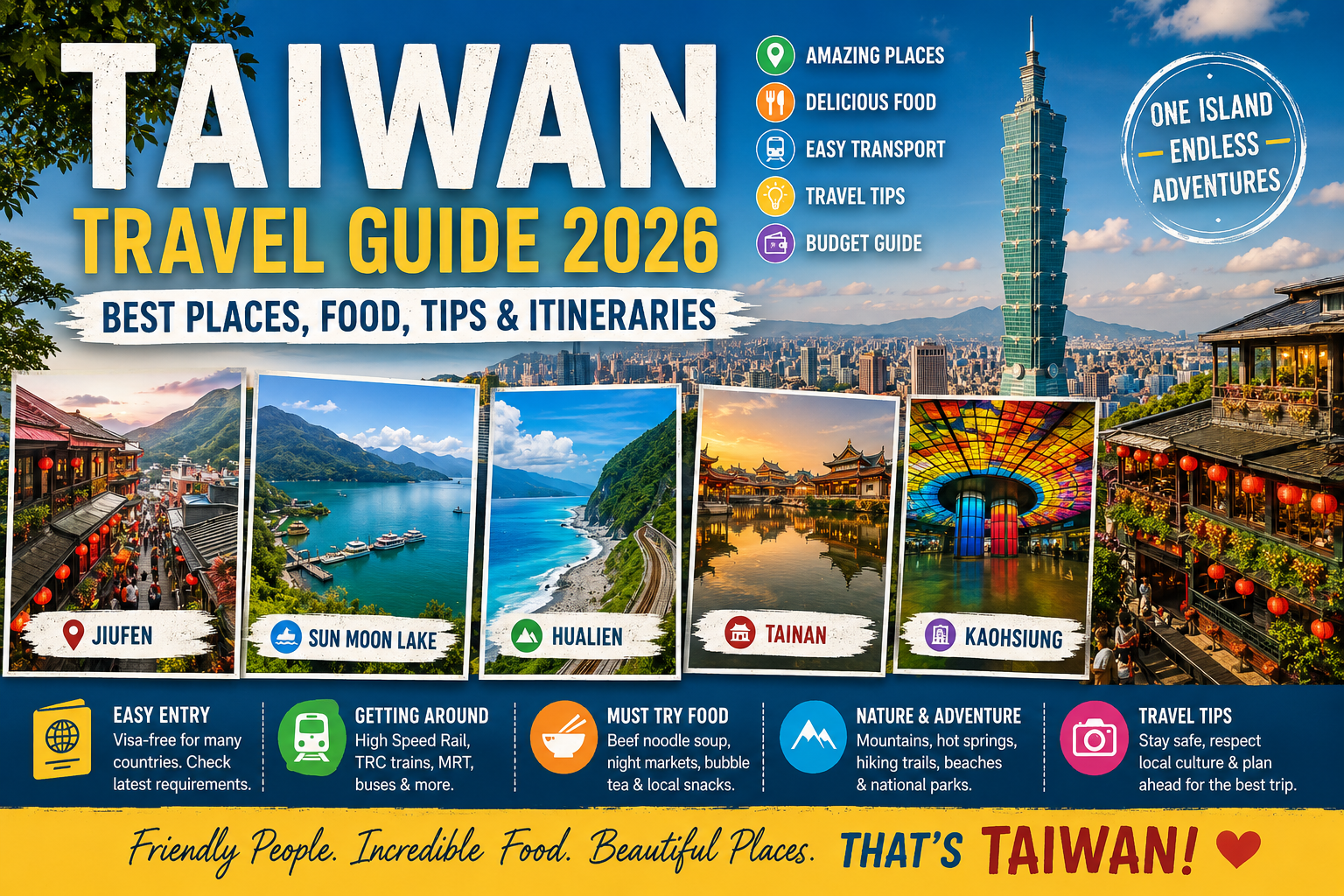
Taiwan Travel Guide 2026: 25+ Best Places, Tips & Itineraries
What if you could experience a futuristic city, ancient temples, dramatic mountains, tropical beaches, tea plantations, night markets, hot springs, historic neighborhoods, and some of Asia’s most efficient public transportation on the same trip? Taiwan travel offers an unusually rich combination of modern cities, traditional culture, spectacular nature, exceptional food, and convenient transportation in a relatively compact destination. For first-time visitors, the best approach is to combine Taipei with one or two regional experiences rather than trying to rush around the entire island International Travellall
Taiwan Travel at a Glance
Taiwan is an island destination in East Asia with a population concentrated heavily around urban areas, while mountains cover a substantial portion of the interior.
For travelers, this creates an unusual geographic advantage. You can start your morning in a major metropolitan area and, with careful planning, spend the afternoon in mountains, forests, hot springs, or coastal landscapes.
The major travel regions include northern Taiwan, central Taiwan, southern Taiwan, and eastern Taiwan, along with offshore islands.
Why Travelers Choose Taiwan
Taiwan is particularly attractive for travelers interested in:
- Food tourism
- Night markets
- Asian city breaks
- Nature and hiking
- Tea culture
- History
- Temples
- Hot springs
- Rail journeys
- Photography
- Shopping
- Technology
- Family travel
- Solo travel
- Cultural experiences
- Sustainable tourism
The destination can also work for very different budgets. Backpackers can use public transportation and local food markets, while luxury travelers can combine premium hotels, fine dining, private tours, and scenic experiences.
Best Time to Visit Taiwan
There is no single “best” month for every traveler because Taiwan’s climate varies by region and season.
Spring and autumn are often attractive for sightseeing because temperatures can be more comfortable than the hottest summer periods, while winter can provide pleasant conditions in the south even when northern Taiwan is cooler and wetter.
Summer can be hot, humid, and affected by tropical weather systems. Travelers planning mountain or coastal activities should pay close attention to weather forecasts.
Taiwan Travel in Spring
Spring can be an excellent period for travelers who want a mixture of cities, flowers, mountains, and outdoor activities.
Potential experiences include:
- Cherry blossoms in suitable mountain areas
- Comfortable urban sightseeing
- Tea-growing regions
- Hiking
- Cycling
- Cultural festivals
Taiwan’s mountain landscapes can change dramatically with elevation. The National Park Service notes seasonal attractions around the Tataka area, including cherry blossoms and Yushan rhododendrons.
Taiwan Travel in Summer
Summer brings heat, humidity, and the possibility of typhoons.
The advantages include:
- Long daylight hours
- Beaches
- Island trips
- Water activities
- Tropical scenery
- Vibrant evening markets
The disadvantages include higher heat and potentially disrupted plans due to severe weather.
If you visit during summer, keep outdoor activities flexible.
Taiwan Travel in Autumn
Autumn is one of the most appealing periods for many travelers because temperatures can become more comfortable, particularly for city exploration and outdoor activities.
It is a good season for:
- Hiking
- Cycling
- Food tours
- City sightseeing
- Mountain trips
- Photography
Taiwan Travel in Winter
Winter is particularly interesting because northern and southern Taiwan can feel quite different.
Taipei can be cool, damp, and cloudy, while southern cities such as Tainan and Kaohsiung generally have warmer conditions.
Winter can therefore be useful for travelers who want to escape colder climates without going to a tropical island.
Taiwan Weather and Typhoon Planning
Weather deserves serious attention when planning Taiwan travel.
Taiwan is exposed to earthquakes, typhoons, flooding, landslides, extreme heat, and other natural hazards. The U.S. State Department currently lists Taiwan at Level 1: Exercise Normal Precautions, while specifically warning travelers about natural disasters including earthquakes, tsunamis, typhoons, flooding, and extreme heat.
This does not mean travelers should avoid Taiwan.
It means your itinerary should be flexible.
A Better Way to Plan Around Weather
Instead of planning:
Day 1 = exact attraction A
Day 2 = exact mountain hike
Day 3 = exact boat trip
create categories:
Good-weather day: mountain, coast, cycling, outdoor attractions.
Rainy day: museums, shopping, food tours, cafés, historic buildings.
Severe-weather day: flexible indoor activities and official safety guidance.
This approach can save an entire vacation when weather changes unexpectedly.
Taipei: The Best Starting Point for First-Time Taiwan Travel
Taipei is the natural introduction to Taiwan for many international visitors.
The city combines:
- Taipei 101
- Traditional temples
- Night markets
- Shopping
- Museums
- Hot springs
- Mountain viewpoints
- Historic districts
- Cafés
- Food culture
- Excellent public transportation
It is also an excellent base for day trips.
Taipei 101
Taipei 101 is one of Taiwan’s most recognizable landmarks.
The skyscraper represents modern Taiwan and provides panoramic city views from its observatory.
For photographers, the building can be interesting from both directions: viewing Taipei from the tower and photographing the tower from surrounding neighborhoods.
Ximending
Ximending is a lively commercial and entertainment district popular with younger travelers.
It works especially well for visitors who enjoy:
- Street food
- Shopping
- Pop culture
- Nighttime photography
- Cafés
- Street performances
Dadaocheng
Dadaocheng provides a different experience.
Historic architecture, traditional commerce, tea culture, and riverside scenery create a slower atmosphere than central shopping districts.
This is an excellent example of why Taiwan travel should not be reduced to skyscrapers and night markets.
National Palace Museum
The National Palace Museum is one of the most important cultural attractions for travelers interested in Chinese art, history, ceramics, calligraphy, and imperial collections.
Allow several hours rather than treating it as a quick photo stop.
Beitou Hot Springs
Beitou is an excellent option for travelers who want to combine Taipei with relaxation.
The district is known for hot springs and can easily be incorporated into a Taipei itinerary.
Taipei Night Markets and Taiwan Food Culture
For many visitors, food becomes the strongest memory of Taiwan.
Night markets are not simply places to eat.
They are social environments where shopping, snacks, entertainment, local habits, and neighborhood culture overlap.
Foods Worth Trying
Depending on your dietary preferences, consider trying:
- Beef noodle soup
- Beef rolls
- Scallion pancakes
- Dumplings
- Gua bao
- Stinky tofu
- Oyster omelets
- Taiwanese fried chicken
- Braised pork rice
- Pepper buns
- Bubble tea
- Pineapple cakes
- Shaved ice
- Traditional pastries
Raohe and Shilin
Raohe Night Market is a popular introduction to Taipei’s street-food culture.
Shilin Night Market is much larger and has historically been one of the city’s best-known night-market experiences.
The most important rule is not to eat everything in one visit.
Choose a few dishes, walk around, observe what locals are buying, and return another evening.
Taipei Day Trips
One of Taipei’s biggest advantages is the number of destinations reachable from the city.
Jiufen
Jiufen is famous for hillside streets, tea houses, ocean views, and atmospheric architecture.
It can become crowded, particularly around peak periods.
A useful strategy is to arrive early or stay into the evening rather than simply visiting during the busiest afternoon window.
Shifen
Shifen is associated with its railway environment, waterfalls, and sky-lantern experience.
Travelers should think carefully about the environmental impact of releasing lanterns and follow local guidance.
Yangmingshan
Yangmingshan National Park provides a nature-focused escape from Taipei.
It is particularly useful for travelers who want:
- Hiking
- Mountain scenery
- Hot springs
- Volcanic landscapes
- Seasonal flowers
Tamsui
Tamsui offers waterfront scenery and sunset opportunities.
It is especially pleasant for travelers who want a slower afternoon after several busy days in central Taipei.
Taichung: Taiwan Travel Beyond Taipei
Taichung is an important stop for travelers exploring central Taiwan.
It combines urban development with arts, cafés, food culture, markets, and access to surrounding destinations.
The Taiwan High Speed Rail network includes Taichung, and the Taichung station connects with Taiwan Railway’s Xinwuri Station, making regional travel easier.
Rainbow Village
Rainbow Village has become a recognizable Taichung attraction and photography location.
Its popularity demonstrates how local neighborhoods can become part of Taiwan’s modern tourism identity.
National Taichung Theater
Architecture enthusiasts should consider the National Taichung Theater.
It provides an interesting contrast with Taiwan’s historic temples and traditional streets.
Fengjia Night Market
Fengjia is a major student-oriented and commercial night-market area.
It is useful for travelers looking for inexpensive food and evening activity.
Sun Moon Lake: A Different Side of Taiwan
Sun Moon Lake is one of Taiwan’s best-known scenic destinations.
The area is particularly suitable for:
- Cycling
- Boat rides
- Scenic viewpoints
- Temple visits
- Photography
- Relaxation
- Resort stays
Recent traveler discussions show that opinions about Sun Moon Lake vary: some visitors consider it a highlight, while others find it less impressive compared with other mountain and coastal landscapes.
That disagreement actually reveals an important travel lesson.
A destination does not need to be universally spectacular to be worthwhile.
Sun Moon Lake works best for travelers who appreciate slow travel rather than attraction collecting.
How Long Should You Stay?
A rushed day trip can work if your schedule is limited.
However, one or two nights can provide a better experience because you can see the lake under changing light and explore without constantly watching the clock.
Alishan: Mountains, Forests, Tea, and Sunrise
Alishan is one of the most distinctive destinations for Taiwan travel.
It is known for:
- Mountain scenery
- Forests
- Sunrise views
- Tea plantations
- Railway heritage
- Hiking
- Sea-of-clouds scenery
The Tourism Administration highlights Chiayi and Alishan for mountain landscapes, railway experiences, sunrise, and sea-of-cloud scenery.
Why Alishan Is Different
Alishan is not primarily about checking off one attraction.
The experience comes from altitude, weather, forest atmosphere, railway history, and the slower rhythm of mountain travel.
Who Should Visit Alishan?
Alishan is particularly suitable for:
- Nature lovers
- Photographers
- Hikers
- Couples
- Slow travelers
- Rail enthusiasts
- Travelers seeking cooler mountain conditions
It can also work for older travelers with mobility limitations if the itinerary is adapted appropriately rather than built around long hikes.
Tainan: Taiwan’s Historic and Food Capital
Tainan is one of the best cities for travelers who want to understand Taiwan’s historical layers.
The city is famous for:
- Historic temples
- Old streets
- Traditional food
- Forts
- Local snacks
- Traditional architecture
- Cultural sites
Taiwan’s Tourism Administration describes Tainan as one of Taiwan’s oldest cities and highlights attractions such as Anping Fort and Chihkan Tower.
Anping
Anping is particularly useful for understanding the historical development of Tainan.
It combines historic landmarks, old streets, food, and waterfront areas.
Chihkan Tower
Chihkan Tower is another important historical landmark.
Travelers interested in history should avoid rushing through Tainan.
The city’s appeal is often found between major attractions: small temples, food stalls, traditional houses, and old streets.
Kaohsiung: Modern Southern Taiwan
Kaohsiung is a major southern city with a strong harbor identity.
The Tourism Administration highlights attractions including Shoushan, Sizihwan, Pier-2 Art Center, and other southern Taiwan experiences.
Pier-2 Art Center
Pier-2 is one of Kaohsiung’s most recognizable contemporary cultural areas.
Former industrial spaces have been incorporated into a creative environment involving art, design, exhibitions, and public spaces.
Lotus Pond
Lotus Pond provides temples, colorful architecture, and photography opportunities.
Sizihwan
Sizihwan is particularly appealing around sunset and for travelers interested in coastal views.
Kenting and Southern Beach Travel
Travelers wanting a more tropical side of Taiwan can consider Kenting and the Hengchun Peninsula.
The region is associated with:
- Beaches
- Coastal scenery
- National park landscapes
- Diving
- Water activities
- Tropical weather
- Relaxed travel
The Tourism Administration highlights Kenting National Park, Eluanbi Lighthouse, and Hengchun Old Town among southern Taiwan attractions.
Who Should Choose Kenting?
Kenting is especially suitable for:
- Beach travelers
- Couples
- Families
- Outdoor enthusiasts
- Travelers combining city and nature
However, travelers should check weather and marine conditions before planning water activities.
Hualien and Taiwan’s East Coast
Eastern Taiwan offers a dramatically different visual experience.
The east coast is associated with:
- Mountains
- Ocean
- Indigenous culture
- Scenic rail journeys
- Cycling
- Hiking
- Rural landscapes
Hualien is a common base for exploring the region.
Taroko and Changing Conditions
Taroko Gorge has historically been one of Taiwan’s most famous natural attractions.
However, access and trail conditions can change following major natural events, earthquakes, landslides, and infrastructure work.
This is a critical travel-planning lesson:
Never assume that a famous attraction is accessible simply because it appears on an older itinerary.
Always verify current conditions before traveling to mountain areas.
Taiwan’s Offshore Islands
Taiwan’s main island is only part of the travel story.
Depending on season and transportation conditions, travelers can consider destinations such as:
- Penghu
- Kinmen
- Matsu
- Green Island
- Orchid Island
These destinations can provide very different experiences from Taipei and western Taiwan.
Green Island
Green Island is associated with:
- Diving
- Marine environments
- Hot springs
- Coastal scenery
Penghu
Penghu offers a more island-oriented travel experience with beaches, coastal landscapes, and seasonal water activities.
Island travel requires additional planning because flights and ferries can be affected by weather.
Taiwan Transportation Guide
Transportation is one of Taiwan’s greatest advantages for independent travelers.
The country offers a combination of:
- High-speed rail
- Conventional rail
- Metro systems
- Buses
- Taxis
- Rental vehicles
- Bicycles
- Domestic flights
- Ferries
Taiwan High Speed Rail
The Taiwan High Speed Rail network currently serves major western Taiwan stations from Nangang/Taipei through Taichung, Tainan, and Zuoying, with additional stops including Taoyuan, Hsinchu, Miaoli, Changhua, Yunlin, and Chiayi.
For travelers moving between major western cities, THSR can dramatically reduce travel time.
Taiwan Railway
Taiwan Railway is more useful when your destination is outside the high-speed rail corridor or when you want to travel through smaller cities and eastern Taiwan.
Its current booking system allows online ticket reservations and provides train information, ticketing, and timetable services.
Taipei Metro
For Taipei-based travel, the MRT is one of the easiest ways to move around the city.
Combine metro travel with walking, buses, taxis, and occasional day tours rather than relying on one transportation method.
EasyCard and Everyday Payments
An EasyCard is widely considered one of the most convenient transportation and payment tools for travelers.
It can simplify everyday transit and selected purchases, although travelers should understand that it is not a replacement for every train ticket or payment method.
Independent travel guides updated in 2026 continue to recommend EasyCard as a practical option for daily transport.
Should You Carry Cash?
Yes.
Taiwan is technologically advanced, but smaller businesses, traditional markets, street vendors, and some local establishments may still prefer cash.
A strong payment strategy is:
Card + cash + transportation card
That creates redundancy.
Taiwan Travel Costs and Budget Planning
Taiwan can accommodate different budgets.
Your total cost depends heavily on:
- Hotel standard
- Number of destinations
- Transportation
- Food choices
- Tours
- Shopping
- Seasonal demand
- Travel style
Budget Travel
Budget travelers can reduce costs through:
- Hostels
- Local restaurants
- Night markets
- Public transportation
- Free attractions
- Convenience stores
- Walking tours
Mid-Range Taiwan Travel
A mid-range traveler might combine:
- Comfortable hotel
- Public transportation
- Occasional taxis
- Restaurant meals
- Night markets
- Paid attractions
- One or two day tours
Luxury Taiwan Travel
Luxury travelers can build an itinerary around:
- Premium hotels
- Private transfers
- Fine dining
- High-end tea experiences
- Private guides
- Premium rail seats
- Spa and hot-spring experiences
The important point is that Taiwan does not force travelers into one style.
Taiwan Travel for Food Lovers
Food should be treated as part of the itinerary rather than something you fit between attractions.
Breakfast in Taiwan
Try local breakfast shops for dishes such as:
- Soy milk
- Youtiao
- Egg pancakes
- Rice rolls
- Traditional breakfast sandwiches
Lunch
Look for:
- Beef noodle soup
- Braised pork rice
- Dumplings
- Local noodle dishes
- Bento meals
Evening
Reserve your evenings for:
- Night markets
- Food streets
- Local restaurants
- Tea houses
- Dessert shops
Tea Culture
Taiwan’s tea culture is particularly interesting for travelers who want a slower cultural experience.
Tea-producing regions provide opportunities to understand not only the drink but also agriculture, altitude, climate, craftsmanship, and local identity.
Taiwan Travel for Families
Taiwan can be a strong family destination because major cities have convenient transportation, diverse food options, and attractions for different age groups.
Family-Friendly Planning
Families should avoid packing too many destinations into one day.
Instead, combine:
One major attraction + one food experience + one flexible activity.
For example:
Morning museum → local lunch → afternoon park or shopping → early dinner.
This leaves room for children to rest.
Family Transportation
Families should consider luggage, stroller access, station transfers, and hotel proximity to public transportation.
A slightly more expensive hotel near a major station can sometimes save significant effort.
Taiwan Travel for Solo Travelers
Taiwan can work particularly well for independent travelers because public transportation makes it easier to move without a private vehicle.
Solo travelers should still:
- Share general itinerary information
- Keep phones charged
- Protect valuables
- Avoid unnecessary late-night risks
- Check weather before outdoor activities
- Maintain backup payment options
- Keep emergency contacts accessible
Solo travel should create independence, not isolation.
Taiwan Travel for Couples
Couples can combine:
- Taipei city experiences
- Hot springs
- Mountain stays
- Tea experiences
- Sun Moon Lake
- Tainan food
- Kaohsiung waterfronts
- Coastal destinations
A good couples itinerary should alternate active days with slower days.
Constant sightseeing can make a romantic trip feel like a work schedule.
Taiwan Travel for Older Adults
Older travelers can enjoy Taiwan extensively by adjusting the pace.
Prioritize:
- Hotels near transport
- Comfortable rail travel
- Fewer hotel changes
- Accessible attractions
- Rest days
- Reliable healthcare access
- Weather-aware scheduling
Alishan and mountain destinations can still be possible, but the itinerary should be designed around mobility rather than around a list of hiking trails.
Taiwan Travel for Muslim Travelers
Muslim travelers may need to plan food and prayer requirements more carefully than travelers with no dietary restrictions.
Research:
- Halal-certified restaurants
- Muslim-friendly accommodation
- Nearby mosques
- Prayer facilities
- Ingredient information
Do not assume that a restaurant is halal simply because it does not serve pork.
For strict dietary requirements, verify ingredients and preparation practices directly.
Taiwan Travel Safety
Taiwan is generally regarded as a destination where travelers should exercise normal precautions, but natural hazards deserve particular attention.
The current U.S. travel advisory lists Taiwan at Level 1 and specifically identifies earthquakes, tsunamis, typhoons, flooding, and extreme heat as risks.
Earthquake Awareness
Taiwan is seismically active.
Travelers should know basic earthquake safety:
- Move away from windows
- Protect your head
- Follow local instructions
- Avoid damaged buildings
- Do not use elevators during an emergency unless authorities specifically say otherwise
Typhoon Safety
During a typhoon:
- Monitor official warnings
- Avoid unnecessary travel
- Follow closure announcements
- Stay away from coastal areas
- Avoid mountain roads
- Do not enter flooded areas
Mountain Safety
Mountain conditions can change rapidly.
Before hiking:
- Check trail status
- Check weather
- Carry sufficient water
- Tell someone your plan
- Use appropriate footwear
- Download offline maps
- Know when to turn back
Taiwan Travel Entry Requirements
Entry requirements depend on nationality, passport type, purpose of travel, and current immigration rules.
Do not assume that because another traveler can enter visa-free, you can do the same.
Taiwan’s Bureau of Consular Affairs currently lists visa-exempt entry for nationals of numerous countries, with permitted stays varying by nationality.
Taiwan also has an eVisa system for nationals of certain countries, and the eligible-country list and conditions can change. The official August 2026 information includes countries such as the United Arab Emirates, Qatar, Saudi Arabia, Oman, Kuwait, and others under specified conditions.
What About Pakistani Passport Holders?
Pakistani travelers should not assume visa-free entry based on lists for other nationalities.
Visa and entry eligibility should be checked directly with Taiwan’s Bureau of Consular Affairs or the relevant Taiwan representative office before booking non-refundable travel.
Requirements can depend on residence status, purpose of travel, documentation, and current policy.
10 Taiwan Travel Brands and Services Compared
For travelers, “brands” can mean airlines, rail services, transportation networks, and travel platforms. The following comparison focuses on recognizable Taiwan-related travel brands and services rather than claiming that one is universally best.
| Brand / Service | Type | Best For | Main Strength | Consideration |
|---|---|---|---|---|
| EVA Air | Airline | International travelers | Extensive Taiwan connectivity | Compare fares and schedules |
| China Airlines | Airline | International travelers | Major Taiwan-based carrier | Route availability varies |
| STARLUX Airlines | Airline | Premium-oriented travelers | Modern brand and cabin experience | Network may be smaller on some routes |
| Tigerair Taiwan | Airline | Budget travelers | Low-cost travel options | Check baggage and add-on fees |
| Mandarin Airlines | Airline | Domestic/regional routes | Regional connectivity | Route-specific availability |
| Uni Air | Airline | Domestic/regional travel | Domestic network | Schedule-dependent |
| Taiwan High Speed Rail | Rail | Taipei–western Taiwan travel | Fast intercity transportation | Limited primarily to western corridor |
| Taiwan Railway | Rail | Regional and scenic travel | Broad conventional rail network | Longer journeys than THSR |
| Taipei Metro | Urban transit | Taipei visitors | Convenient city transportation | Mainly Taipei/New Taipei area |
| Taiwan Tourist Shuttle | Tourist transport | Sightseeing without driving | Access to selected attractions | Routes and schedules vary |
Taiwan High Speed Rail’s official network currently includes major stations such as Taipei, Taoyuan, Hsinchu, Taichung, Chiayi, Tainan, and Zuoying, among others.
Taiwan Railway’s official booking platform provides current timetables, reservations, and train information, while the operator specifically warns travelers to use official channels for ticket purchases.
How to Build a Taiwan Travel Itinerary
The biggest itinerary mistake is trying to see everything.
Taiwan rewards regional travel, but constantly changing hotels can destroy your energy.
5-Day Taiwan Itinerary
For a short trip:
Day 1: Taipei city
Day 2: Taipei cultural attractions
Day 3: Taipei day trip
Day 4: Food, shopping, and flexible exploration
Day 5: Taipei departure
This is ideal for first-time travelers with limited time.
7-Day Taiwan Itinerary
A balanced week could be:
Days 1–3: Taipei
Day 4: Taichung or Sun Moon Lake
Day 5: Tainan
Day 6: Kaohsiung
Day 7: Return toward Taipei or depart from southern Taiwan if flight options allow.
10-Day Taiwan Itinerary
A longer trip can include:
- Taipei
- Jiufen
- Taichung
- Sun Moon Lake
- Alishan
- Tainan
- Kaohsiung
Trying to add every eastern and island destination may make the itinerary too aggressive.
14-Day Taiwan Itinerary
Two weeks allow a much more balanced journey.
Consider:
Taipei → Jiufen → Hualien/East Coast where currently accessible → Taichung → Sun Moon Lake → Alishan → Tainan → Kaohsiung → Kenting
However, mountain and east-coast conditions should always be checked immediately before travel.
The Best Taiwan Travel Strategy: Choose a Theme
Instead of asking:
“What should I see in Taiwan?”
Ask:
“What kind of Taiwan do I want to experience?”
Food-Focused Taiwan Travel
Prioritize:
Taipei → Tainan → Kaohsiung
Nature-Focused Taiwan Travel
Prioritize:
Taipei → Sun Moon Lake → Alishan → East Coast
History-Focused Taiwan Travel
Prioritize:
Taipei → Tainan → Anping → historic towns and temples
Luxury Taiwan Travel
Prioritize:
Taipei → hot springs → scenic mountain resorts → premium dining → Sun Moon Lake
Family Taiwan Travel
Prioritize:
Taipei → Taichung → selected scenic destinations with fewer hotel changes
Budget Taiwan Travel Taiwan Travel
Prioritize:
Taipei → local rail → night markets → hostels → free attractions → selected day trips
Common Taiwan Travel Mistakes and Better Solutions
Trying to Visit Too Many Cities Taiwan Travel
Taiwan looks small on a map.
That can create the illusion that every destination is close.
Better approach: Choose two or three regional bases.
Booking Every Activity in Advance Taiwan Travel
Weather can change.
Transportation can change.
You may discover that you love one city and want another day there.
Better approach: Book essential transportation and accommodation while leaving some activities flexible.
Treating Taipei as the Whole Country Taiwan Travel
Taipei is excellent, but Taiwan’s regional identity is one of its greatest strengths.
Better approach: Spend at least part of your trip outside Taipei if your schedule allows.
Ignoring Food Timing Taiwan Travel
Popular food businesses may have queues or limited hours.
Better approach: Research opening days and consider eating popular dishes during less crowded periods.
Assuming All Mountains Are Easily Accessible Taiwan Travel
Mountain roads and trails are vulnerable to weather and geological events.
Better approach: Verify official access conditions shortly before departure.
Forgetting Cash Taiwan Travel
Digital payments are increasingly common, but cash remains useful.
Better approach: Carry a reasonable amount of local currency alongside cards.
Booking the Cheapest Hotel Far From Transport
Saving money on accommodation can create additional transportation costs and fatigue.
Better approach: Compare the total daily cost, not just the room price.
Pros and Cons of Taiwan Travel
Advantages of Taiwan Travel
Taiwan offers an impressive combination of:
- Diverse landscapes
- Excellent food
- Strong public transportation
- Modern cities
- Traditional culture
- Friendly travel environment
- Night markets
- Mountain destinations
- Hot springs
- Beaches
- Tea culture
- Relatively compact geography
- Multiple budget levels
The rail network is particularly useful because THSR connects major western cities while Taiwan Railway provides broader regional coverage.
Potential Disadvantages Taiwan Travel
Taiwan is not perfect for every traveler.
Potential challenges include:
- Hot and humid summers
- Heavy rain
- Typhoons
- Earthquake risk
- Crowds at popular attractions
- Language challenges outside major tourist areas
- Complicated transport in remote regions
- Mountain access changes
- Limited time if trying to see the entire island
The correct response is planning rather than avoidance.
Sustainable Taiwan Travel
Taiwan’s tourism sector is increasingly emphasizing sustainable and low-carbon travel.
The Tourism Administration reported work around low-carbon tourism and carbon-footprint assessment for selected tourism journeys in 2026.
Travelers can contribute by:
- Using trains instead of unnecessary private vehicles
- Supporting local businesses
- Carrying reusable items
- Avoiding unnecessary plastic
- Respecting trails
- Staying on marked paths
- Avoiding wildlife disturbance
- Choosing locally owned experiences
- Spending more time in fewer destinations
Slow travel is not only environmentally useful.
It can also produce a better vacation.
The Future of Taiwan Travel
Taiwan’s tourism future is likely to move beyond the traditional “Taipei plus famous attractions” model.
The official Tourism Administration is already promoting cross-regional rail tourism, sustainable travel, cultural experiences, and regional destinations.
Rail-Based Tourism Will Grow Taiwan Travel
Rail travel makes it easier to connect cities without requiring travelers to rent cars.
Taiwan’s current tourism strategy includes upgraded Taiwan PASS rail-related products aimed at cross-regional tourism.
More Regional Taiwan Travel Travelers are increasingly interested in:
- Indigenous culture
- Tea regions
- Rural experiences
- Smaller towns
- Coastal landscapes
- Food heritage
- Scenic railways
Sustainable Travel Will Become More Important
Climate pressure and visitor-management challenges will likely make low-carbon tourism increasingly important.
AI-Powered Itineraries Taiwan Travel
AI will probably make destination planning more personalized.
Instead of simply generating “10 places to visit,” future travel platforms may build itineraries around:
- Weather
- Crowd levels
- Transportation
- Budget
- Fitness
- Food preferences
- Family needs
- Accessibility
- Travel duration
The best use of AI, however, will be to support—not replace—official information.
A Practical Taiwan Travel Planning Formula
For a well-balanced trip, use this formula:
40% city and culture + 25% food + 20% nature + 10% flexibility + 5% contingency
The exact percentages do not matter.
The principle does.
Do not fill 100% of your itinerary.
Leave room for:
- Rain
- Delays
- Jet lag
- Unexpected discoveries
- Rest
- Crowds
- Restaurant queues
- Weather changes
An itinerary with 20% flexibility can be more enjoyable than one with 100% scheduled activities.
What to Pack for Taiwan Travel
Your packing list depends on season and destination.
Essential Items Taiwan Travel
Consider:
- Passport
- Required visa or entry documents
- Payment cards
- Local currency
- Phone
- Power bank
- Universal adapter where needed
- Comfortable walking shoes
- Lightweight clothing
- Rain protection
- Small day bag
- Medication
- Travel insurance details
- Copies of important documents
For Mountain Taiwan Travel
Add:
- Layered clothing
- Proper footwear
- Rain protection
- Water
- Offline maps
- Portable battery
- Basic first-aid supplies
For Summer Taiwan Travel
Prioritize:
- Breathable clothing
- Sun protection
- Refillable water bottle
- Umbrella or rain protection
- Light day bag
Taiwan Travel Photography Tips
Taiwan offers several distinct photography environments.
City Photography Taiwan Travel
Best opportunities include:
- Taipei skyline
- Neon streets
- Temples
- Markets
- Architecture
- Street scenes
Mountain Photography Taiwan Travel
Use changing weather to your advantage.
Clouds, mist, forests, and mountain light can create more atmospheric photographs than clear skies.
Food Photography Taiwan Travel
Night markets provide strong visual opportunities, but remember that people and vendors are part of the environment.
Ask before taking close-up photographs of individuals.
How to Make Taiwan Travel More Authentic
You do not need to avoid famous attractions to travel authentically.
Instead, combine major landmarks with ordinary local experiences.
For example:
Taipei 101 + neighborhood breakfast
Tainan historic site + traditional snack shop
Sun Moon Lake + local cycling
Alishan + tea experience
Kaohsiung art district + local market
This combination produces a more complete understanding of Taiwan.
FAQs
Is Taiwan good for first-time travelers?
Yes. Taiwan can be an excellent destination for first-time Asia travelers because major cities offer convenient transportation, a broad range of accommodation, abundant food choices, and many attractions accessible without a private vehicle.
How many days are enough for Taiwan?
Five days can provide a useful introduction to Taipei, while seven to ten days allow travelers to experience several regions. Two weeks is better for a broader island itinerary.
What is the best time to visit Taiwan?
Spring and autumn are often comfortable choices for broad sightseeing, but the best season depends on your interests. Summer is useful for beaches and island activities but can be hot and affected by typhoons. Winter can be cooler and wetter in the north but relatively mild in southern Taiwan.
Is Taiwan expensive to visit?
Taiwan can accommodate budget, mid-range, and luxury travelers. Local food and public transportation can help control costs, while premium hotels and private experiences can significantly increase the budget.
Is Taiwan safe for tourists?
Taiwan is generally considered a destination where normal precautions are appropriate. However, travelers should take earthquakes, typhoons, flooding, extreme heat, and mountain conditions seriously. The current U.S. travel advisory lists Taiwan at Level 1: Exercise Normal Precautions.
Is public transportation good in Taiwan?
Yes. Major cities have strong public transportation, and the combination of Taiwan High Speed Rail and Taiwan Railway makes intercity travel practical.
Should I use Taiwan High Speed Rail?
If you are traveling between major western Taiwan cities such as Taipei, Taichung, Tainan, and the Kaohsiung-area Zuoying station, THSR can be an excellent choice because it provides fast intercity transportation.
Do I need an EasyCard?
It is not mandatory for every traveler, but an EasyCard can make daily transportation and selected small purchases more convenient.
Is English widely spoken in Taiwan?
English is more likely to be useful in major tourist areas, hotels, transportation hubs, and younger urban environments. In smaller towns and traditional businesses, communication may be more challenging. Translation apps can help.
Can I travel around Taiwan without renting a car?
Yes. Major cities and many popular destinations can be reached using trains, buses, metro systems, taxis, and organized tours. A car can become more useful for remote mountain or rural areas.
Is Tainan worth visiting?
Yes, particularly for travelers interested in history, temples, traditional food, architecture, and older urban neighborhoods. Taiwan’s Tourism Administration identifies Tainan as one of the island’s historic cities and highlights sites including Anping Fort and Chihkan Tower.
Is Sun Moon Lake worth visiting?
It depends on your travel style. It is particularly attractive for travelers who enjoy scenic landscapes, cycling, lake views, temples, and slower travel. Travelers seeking dramatic mountains may prefer other destinations.
Is Alishan worth visiting?
Alishan is especially suitable for travelers interested in mountain scenery, forests, sunrise, tea, hiking, and railway heritage. Weather and transport conditions should be checked before travel.
Can Muslim travelers visit Taiwan comfortably?
Yes, but travelers with strict halal and prayer requirements should research suitable restaurants, prayer facilities, and accommodation before departure rather than assuming that all food or facilities meet their requirements.
What should I do during a Taiwan typhoon?
Monitor official weather and government information, avoid unnecessary travel, follow closures and evacuation instructions, and stay away from coastal, flooded, and unstable mountain areas.
What should I do during an earthquake?
Protect yourself from falling objects, move away from windows, follow local emergency instructions, and avoid entering damaged buildings. Do not assume a visibly quiet area is safe after a significant earthquake because aftershocks can occur.
Can I visit Taiwan on a budget?
Yes. Use local eateries, public transportation, affordable accommodation, free attractions, night markets, and carefully selected paid experiences.
Is Taiwan good for solo travel?
Taiwan can work very well for solo travel, particularly in urban areas. Solo travelers should still maintain communication with trusted contacts and use normal precautions.
What are the best cities to visit in Taiwan?
For a first trip, Taipei, Taichung, Tainan, and Kaohsiung provide a useful combination of modern city life, food, culture, history, art, and southern Taiwan experiences.
Should I visit Taiwan in one trip or multiple trips?
If you have limited time, focus on one region. If you have two weeks or more, you can explore several regions. Multiple trips can be better than trying to see the entire island in one rushed journey.
Conclusion
Taiwan is easy to underestimate. On a map, it may appear like a relatively small island that can be quickly explored. In reality, its geography, food culture, history, mountains, coastlines, cities, indigenous traditions, railway routes, tea regions, and local neighborhoods create an enormous range of travel experiences. A first-time traveler could spend several days exploring Taipei and barely scratch the surface. Another traveler might skip the major city attractions and spend a week exploring mountain towns, tea plantations, temples, and rural landscapes. Neither approach is wrong.


One Comment