
Cultural Heritage: 15 Powerful Ways to Preserve History, Culture, and Identity for Future Generations
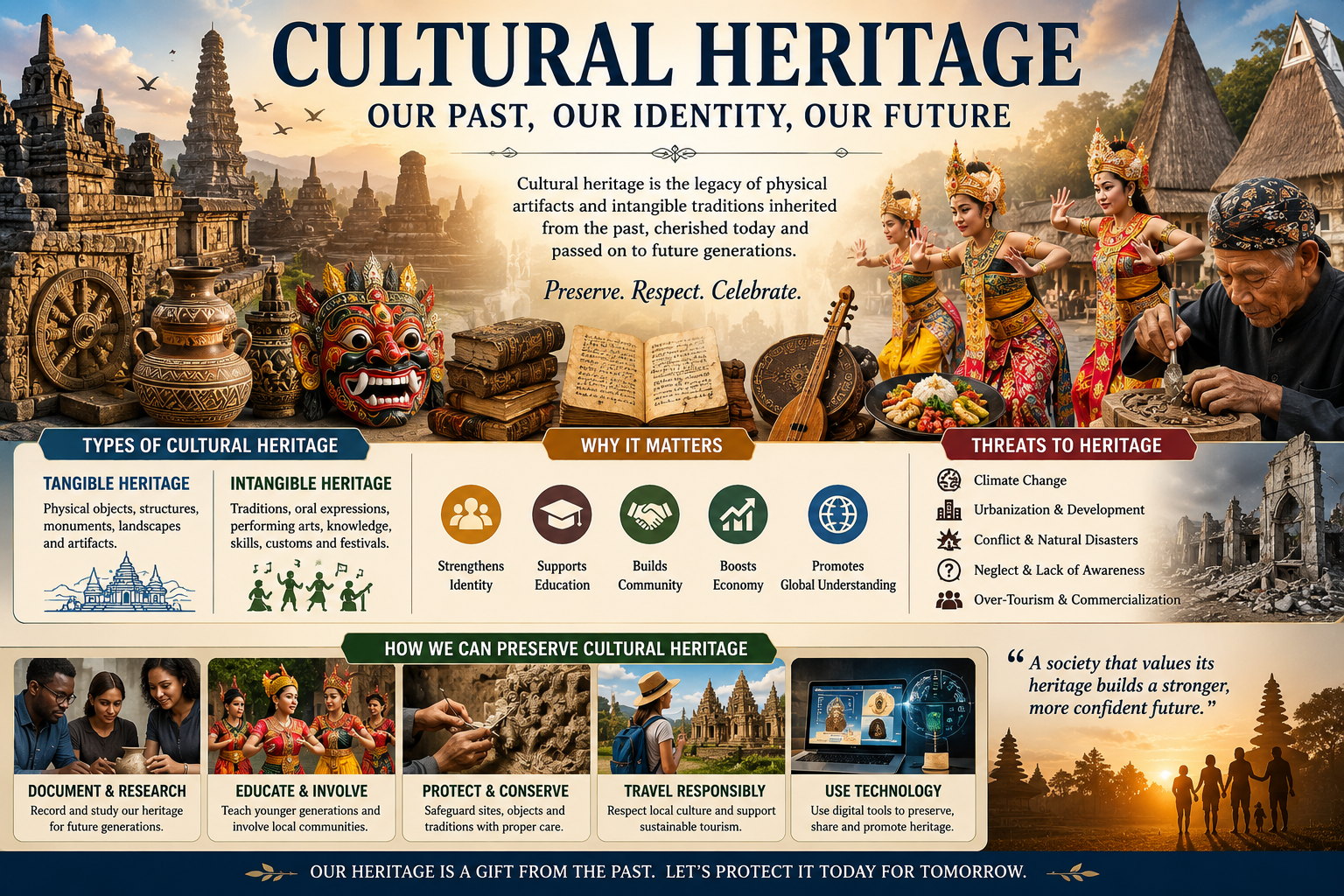
Cultural heritage is the collection of tangible and intangible traditions, places, objects, knowledge, practices, languages, arts, and values that communities inherit from the past and continue to protect, interpret, and pass to future generations. It matters because heritage gives people a sense of identity and belonging while also preserving historical knowledge, supporting education, strengthening communities, and creating opportunities for responsible cultural tourism and economic development David Borhaz
What Is Cultural Heritage?
Cultural heritage refers to the cultural resources, practices, knowledge, places, and expressions that communities consider meaningful and pass from one generation to another.
The concept includes both physical objects and living traditions.
A historic building is cultural heritage.
So is the skill required to construct it.
A museum artifact is cultural heritage.
So is the story explaining why the artifact matters.
A traditional musical instrument is cultural heritage.
So is the music played with it.
This is why cultural heritage should not be understood simply as a collection of old things.
It is better understood as a relationship between people, memory, place, knowledge, and identity.
Why the Definition Matters
A narrow definition might focus only on monuments and artifacts.
A broader definition recognizes that communities are also repositories of cultural knowledge.
For example, a traditional farming community may possess knowledge about:
- Local weather patterns
- Soil management
- Seasonal crops
- Traditional tools
- Water management
- Food preservation
- Medicinal plants
- Community cooperation
Some of that knowledge may never appear inside a museum.
Yet it can have enormous cultural and practical value.
Cultural Heritage Is Not Always Ancient
A common misconception is that something must be hundreds or thousands of years old to qualify as heritage.
Age can contribute to historical significance, but cultural heritage is fundamentally about meaning, continuity, identity, and transmission.
A cultural practice that developed more recently can become meaningful to a community and eventually form part of its heritage.
This is particularly relevant in modern cities where cultures continually evolve.
The Main Types of Cultural Heritage
Cultural heritage can be broadly divided into tangible and intangible forms.
These categories overlap, but they help explain the different ways culture is preserved.
Tangible Cultural Heritage
Tangible cultural heritage consists of physical objects, places, structures, and landscapes with cultural significance.
Examples include:
- Historic buildings
- Monuments
- Archaeological sites
- Museums
- Traditional homes
- Religious structures
- Historic streets
- Ancient manuscripts
- Paintings
- Sculptures
- Traditional clothing
- Tools
- Ceramics
- Jewelry
- Archaeological artifacts
Architectural Heritage
Buildings often provide some of the most visible evidence of cultural history.
Architecture can reveal:
- Building techniques
- Available materials
- Climate adaptation
- Religious beliefs
- Social organization
- Economic conditions
- Political history
Traditional houses, for example, can demonstrate how communities adapted to heat, cold, rainfall, earthquakes, or limited resources.
Archaeological Heritage
Archaeological heritage includes physical evidence of past human societies.
It may include:
- Ruins
- Burial sites
- Ancient settlements
- Tools
- Pottery
- Coins
- Inscriptions
- Foundations
- Roads
- Agricultural systems
Archaeological sites can provide information that written historical records do not.
Movable Heritage
Not all heritage is attached to a particular building or landscape.
Movable cultural heritage includes objects such as:
- Manuscripts
- Paintings
- Sculptures
- Coins
- Ceramics
- Historical clothing
- Musical instruments
- Religious objects
Museums often play an important role in conserving these materials.
Intangible Cultural Heritage
Intangible cultural heritage consists of living cultural practices, knowledge, skills, expressions, and traditions.
Examples include:
- Oral traditions
- Languages
- Traditional music
- Dance
- Performing arts
- Festivals
- Rituals
- Traditional craftsmanship
- Food traditions
- Indigenous knowledge
- Social customs
Traditional Knowledge
Traditional knowledge can be transmitted through observation and participation rather than written instructions.
A craftsperson may learn a technique simply by watching a parent or teacher for years.
This creates an important preservation challenge.
If the younger generation stops learning the skill, written documentation alone may not be enough to preserve it.
Language as Cultural Heritage
Language is one of the most powerful forms of cultural heritage.
A language can contain:
- Historical memory
- Traditional expressions
- Local place names
- Environmental knowledge
- Humor
- Stories
- Poetry
- Social relationships
When a language disappears, the loss is not simply a loss of vocabulary.
Entire systems of knowledge and cultural expression can disappear with it.
Natural and Cultural Heritage Connections
Cultural and natural heritage are often discussed separately, but communities frequently understand them together.
A landscape can have cultural meaning because of:
- Traditional farming
- Sacred associations
- Historical events
- Local stories
- Traditional ecological knowledge
- Seasonal festivals
A river may therefore be more than a geographic feature.
It may be part of a community’s identity.
Why Cultural Heritage Matters
Cultural heritage matters at individual, community, national, and global levels.
Identity and Belonging
Heritage helps people understand where they come from.
Family stories, local traditions, architecture, language, music, and food can create a sense of continuity.
Historical Understanding
Heritage provides evidence about the past.
It allows people to study how societies changed and how previous generations responded to challenges.
Education
Historic sites, museums, cultural landscapes, archives, and traditional knowledge can turn abstract history into something tangible.
A student reading about an ancient civilization in a textbook receives information.
Visiting an archaeological site can create a very different educational experience.
Community Connection
Shared cultural practices can bring people together.
Festivals, traditional celebrations, music, crafts, and food can create opportunities for intergenerational interaction.
Economic Opportunities
Heritage can support:
- Tourism
- Hospitality
- Local crafts
- Museums
- Cultural events
- Guided tours
- Restaurants
- Creative industries
However, economic development must be managed carefully.
A heritage site can lose authenticity if commercial pressure becomes more important than cultural meaning.
Cultural Heritage and Identity
One of the most important relationships is between heritage and identity.
People often express identity through:
- Language
- Food
- Clothing
- Music
- Religion
- Architecture
- Family traditions
- Festivals
- Stories
These expressions help answer a basic human question:
Who are we?
Heritage provides one part of that answer.
Personal Identity
Individuals often inherit traditions from their families.
A person may remember:
- A grandparent’s recipe
- A traditional song
- A childhood festival
- A family craft
- A local story
These experiences can become part of personal identity.
Community Identity
Communities develop shared identities through common experiences.
A town may be known for a traditional craft.
A region may be known for a particular cuisine.
A city may be associated with historic architecture.
These characteristics become part of how residents understand their community.
National Identity
Countries often use cultural heritage to communicate historical narratives.
National museums, monuments, historic buildings, traditional celebrations, and cultural institutions can all contribute to national identity.
However, heritage narratives should recognize complexity.
History rarely belongs to only one group.
Cultural Heritage and Generational Knowledge
Heritage depends heavily on transmission.
A tradition survives when people learn it, practice it, and adapt it.
This creates a chain:
Knowledge → Teaching → Practice → Adaptation → Transmission
If one link disappears, the tradition can weaken.
The Role of Older Generations
Older community members often hold knowledge that has never been fully documented.
They may know:
- Traditional songs
- Family histories
- Craft techniques
- Local stories
- Traditional recipes
- Seasonal customs
Recording their knowledge can be an important preservation activity.
The Role of Young People
Young people are not simply recipients of heritage.
They can become active interpreters and innovators.
A young designer may adapt traditional patterns into contemporary clothing.
A musician may combine traditional instruments with modern production.
A filmmaker may tell an old story using new technology.
This is not necessarily the destruction of tradition.
It can be a form of continuity.
Cultural Heritage in the Digital Age
Technology has transformed heritage preservation.
Digital tools can create:
- High-resolution photographs
- 3D scans
- Digital archives
- Virtual museums
- Interactive maps
- Audio recordings
- Digital language resources
- Virtual reality experiences
Digital Documentation
A historic building can be digitally documented using photographs, laser scanning, or other surveying methods.
If the physical structure later suffers damage, the digital record may help researchers understand its original condition.
Virtual Museums
Digital platforms can make cultural collections accessible to people who cannot travel.
A student in one country can explore objects held by an institution thousands of kilometers away.
Digital Storytelling
Short videos, podcasts, interactive websites, and social platforms can help younger audiences connect with heritage.
The challenge is maintaining accuracy.
Digital accessibility should not come at the expense of historical context.
Artificial Intelligence and Cultural Heritage
Artificial intelligence is creating new possibilities for heritage research and preservation.
AI can potentially assist with:
- Image classification
- Document transcription
- Language analysis
- Pattern recognition
- Archive organization
- Restoration research
- Translation
- Search
- Metadata generation
But AI also introduces important risks.
The Risk of Cultural Misrepresentation
AI systems learn from existing data.
If historical records are incomplete or biased, AI-generated interpretations can reproduce those weaknesses.
Cultural heritage therefore requires human expertise.
AI can be a tool.
It should not automatically become the authority.
Cultural Heritage and Tourism
Cultural tourism allows travelers to experience heritage directly.
Popular cultural tourism activities include:
- Visiting historic cities
- Exploring museums
- Touring archaeological sites
- Attending festivals
- Learning traditional crafts
- Trying local cuisine
- Visiting cultural landscapes
- Participating in community-led experiences
The Benefits of Cultural Tourism
Responsible cultural tourism can create:
- Employment
- Local business opportunities
- Conservation funding
- Cultural awareness
- International exchange
The Problem of Overtourism
Too many visitors can damage heritage.
Potential problems include:
- Physical deterioration
- Waste
- Traffic
- Noise
- Rising local costs
- Commercialization
- Displacement of residents
The solution is not always to stop tourism.
Better approaches may include:
- Visitor limits
- Timed entry
- Alternative routes
- Seasonal management
- Community involvement
- Conservation fees
- Responsible visitor education
How to Travel Respectfully Around Cultural Heritage
Travelers can protect heritage through simple choices.
Learn Before Visiting
Research:
- Local customs
- Appropriate clothing
- Photography rules
- Religious practices
- Conservation restrictions
Respect Sacred Spaces
Not every cultural site is simply a tourist attraction.
Some places remain active religious or community spaces.
Visitors should behave accordingly.
Support Local Communities
Choose:
- Local guides
- Local restaurants
- Local artisans
- Community-owned businesses
This helps keep economic benefits closer to the people who maintain the culture.
Avoid Buying Problematic Artifacts
Travelers should be cautious when purchasing antiques or culturally significant objects.
A cheap souvenir may not be legally or ethically sourced.
Threats to Cultural Heritage
Cultural heritage faces many threats.
Climate Change
Climate-related risks can affect:
- Coastal archaeological sites
- Historic buildings
- Traditional landscapes
- Archives
- Museums
- Cultural infrastructure
Flooding, storms, heat, erosion, and changing environmental conditions can accelerate deterioration.
Urban Development
Rapid development can destroy historic buildings and cultural landscapes.
Modern infrastructure is necessary, but development can often be designed to respect significant heritage.
Conflict
Armed conflict can cause severe damage to cultural heritage.
Historic buildings, museums, archaeological sites, archives, and religious structures may be damaged or destroyed.
Neglect
Heritage does not always disappear dramatically.
Sometimes it simply deteriorates because nobody maintains it.
A building may slowly decay.
A traditional craft may lose practitioners.
A language may gradually lose speakers.
Neglect can therefore be as significant as sudden destruction.
Commercialization
Commercial success can sometimes weaken cultural authenticity.
When traditions are modified solely for tourist expectations, communities may lose control over their own cultural expressions.
Common Cultural Heritage Preservation Mistakes
Treating Heritage as Frozen in Time
Cultures evolve.
Preservation should not necessarily prevent communities from adapting traditions.
Focusing Only on Famous Sites
Small local heritage can be equally meaningful.
Ignoring Local Communities
A preservation project that excludes the people who live around a site may fail.
Over-Restoration
Restoring a historic building too aggressively can remove evidence of its history.
Digital-Only Preservation
A digital copy cannot fully replace a living tradition.
Making Heritage Too Academic
If heritage is presented only through technical language, younger audiences may lose interest.
Good preservation should also tell compelling stories.
How Communities Can Preserve Cultural Heritage
Document Local Knowledge
Record:
- Oral histories
- Songs
- Recipes
- Craft techniques
- Stories
- Photographs
- Family histories
Teach Children
Schools can incorporate local history into education.
Support Traditional Crafts
Buying authentic local products can help artisans continue their work.
Create Community Archives
Local communities can preserve:
- Photographs
- Newspapers
- Letters
- Recordings
- Maps
- Oral histories
Protect Historic Places
Communities can identify significant buildings before they become endangered.
Encourage Young Participation
Young people should have opportunities to reinterpret heritage through:
- Film
- Design
- Music
- Technology
- Photography
- Social media
Cultural Heritage and Education
Heritage education can be more effective when it connects history to everyday life.
Instead of simply asking students to memorize dates, teachers can ask:
- Why was this building constructed?
- What materials were available?
- Who used it?
- What changed over time?
- What stories survive?
- What does this tradition mean today?
This transforms heritage from a list of facts into an investigation.
Cultural Heritage and Food
Food is one of the most accessible forms of cultural heritage.
A recipe can carry information about:
- Geography
- Climate
- Agriculture
- Trade
- Religion
- Family traditions
- Historical migration
Traditional foods often evolve.
That does not automatically make them less authentic.
A cuisine is a living system.
Why Traditional Food Matters
Food connects heritage to everyday experience.
You do not need to visit an archaeological site to experience culture.
A meal can provide a direct connection to family and community history.
Cultural Heritage and Traditional Crafts
Traditional crafts demonstrate how knowledge can exist inside physical skills.
Examples include:
- Weaving
- Pottery
- Woodworking
- Metalworking
- Embroidery
- Basketry
- Calligraphy
- Jewelry making
Craft preservation requires more than displaying finished products.
The process must also be transmitted.
Apprenticeship Matters
A museum can preserve a traditional object.
Only people can preserve the skill required to make it.
This is why apprenticeship programs can be extremely valuable.
Cultural Heritage and Music
Music can preserve memory in ways written history cannot.
Songs can carry:
- Stories
- Religious traditions
- Historical events
- Community identity
- Emotional experiences
Traditional music can also evolve through modern instruments, recording technology, and new audiences.
Cultural Heritage and Architecture
Architecture is a visible record of society.
Traditional architecture can reveal:
- Available resources
- Social structure
- Religious values
- Climate adaptation
- Construction technology
Preserving traditional architecture can therefore protect both physical history and technical knowledge.
Ten Organizations and Platforms Supporting Cultural Heritage
Because cultural heritage is not a conventional commercial market, a comparison of major organizations and platforms is more useful than a comparison of consumer brands.
| Organization or Platform | Main Focus | Heritage Value | Useful For |
|---|---|---|---|
| UNESCO | International cultural and natural heritage | Global recognition and preservation frameworks | Heritage research |
| ICOMOS | Heritage conservation | Conservation principles and expertise | Professionals |
| ICOM | Museums | Museum standards and cooperation | Museum professionals |
| Google Arts & Culture | Digital cultural access | Online collections and experiences | General audiences |
| Europeana | European digital heritage | Digital collections | Researchers and students |
| Smithsonian | Museums and research | Extensive collections and scholarship | Education |
| British Museum | Global cultural collections | Historical artifacts and research | Public learning |
| The Metropolitan Museum of Art | Art and cultural history | Major collections and scholarship | Art education |
| World Monuments Fund | Heritage conservation | Preservation projects | Conservation awareness |
| National Trust | Historic places and landscapes | Conservation and public engagement | Heritage tourism |
These organizations differ significantly in purpose, geographic focus, collection policies, and methods of preservation.
They should therefore be viewed as complementary rather than as direct competitors.
Pros and Cons of Cultural Heritage Preservation
Advantages
Protects identity: Heritage helps communities maintain connections with their history.
Supports education: Historic resources provide evidence and context.
Strengthens tourism: Well-managed heritage can attract visitors.
Supports local economies: Crafts, tourism, museums, and cultural events can create employment.
Encourages intergenerational learning: Heritage provides opportunities for knowledge transfer.
Promotes international understanding: Learning about another culture can reduce stereotypes and encourage dialogue.
Preserves knowledge: Traditional skills and practices may contain valuable information.
Disadvantages and Challenges
High preservation costs: Historic buildings and collections can be expensive to maintain.
Risk of commercialization: Tourism can transform culture into a product.
Community disagreements: Different groups may have different interpretations of heritage.
Political misuse: Heritage narratives can sometimes be used selectively to support political agendas.
Access challenges: Some heritage resources remain difficult to access.
Over-restoration: Excessive reconstruction can compromise historical authenticity.
Digital risks: Digital preservation creates questions about ownership, privacy, access, and technological obsolescence.
The Authenticity Question
One of the most difficult heritage questions is:
What does authentic mean?
Suppose a traditional festival changes over 100 years.
Is it no longer authentic?
Not necessarily.
Living culture changes.
Authenticity can involve:
- Historical continuity
- Community ownership
- Meaning
- Traditional knowledge
- Context
- Practice
A tradition performed only for tourists may have a different cultural meaning from a tradition practiced by a community for its own purposes.
This distinction is important.
Cultural Heritage and Globalization
Globalization creates both opportunities and risks.
The Positive Side
Global communication allows communities to:
- Share traditions
- Find new audiences
- Sell crafts internationally
- Document endangered languages
- Connect diaspora communities
The Negative Side
Globalization can also create pressure toward cultural uniformity.
Local languages may decline.
Traditional businesses may struggle.
Young people may adopt global cultural products while spending less time learning local traditions.
The answer is not to reject globalization.
It is to create room for cultural diversity within it.
Cultural Heritage and Migration
Migration creates new cultural landscapes.
When communities move, they carry:
- Food
- Music
- Language
- Religion
- Clothing
- Family traditions
These traditions may then mix with those of their new environment.
This creates hybrid cultures.
Heritage is therefore not always tied permanently to one geographic location.
Cultural Heritage in Cities
Cities can contain multiple layers of heritage.
A modern city may include:
- Historic neighborhoods
- Religious buildings
- Industrial heritage
- Markets
- Street traditions
- Migrant communities
- Contemporary cultural spaces
Urban heritage preservation should therefore look beyond monumental architecture.
Everyday spaces can also have historical significance.
Industrial Heritage
Old factories, railways, warehouses, mines, ports, and industrial infrastructure can provide evidence of economic history.
Industrial heritage can show how:
- Manufacturing developed
- Workers lived
- Transportation changed
- Cities expanded
- Technology evolved
Some industrial sites can be adapted for museums, cultural spaces, housing, or creative businesses while retaining their historical character.
Cultural Heritage and Technology
Technology can help heritage in several ways.
3D Scanning
Three-dimensional documentation can capture complex structures and objects.
Geographic Information Systems
Mapping technologies can help researchers understand relationships between cultural sites and landscapes.
Virtual Reality
VR can create immersive experiences of historical places.
Augmented Reality
AR can overlay historical information onto present-day locations.
Digital Archives
Digitization can make documents, images, recordings, and collections easier to access.
The Future of Cultural Heritage Preservation
The future will likely combine traditional conservation with digital technology and stronger community participation.
AI-Assisted Archives
AI could help researchers search massive collections more efficiently.
Digital Twins
Historic buildings and sites may increasingly have detailed digital representations that support research and conservation.
Climate Monitoring
Sensors can help monitor:
- Temperature
- Humidity
- Structural movement
- Environmental conditions
Virtual Access
People who cannot travel may experience heritage digitally.
Community-Led Preservation
More projects may focus on giving local communities greater control over how their heritage is documented and presented.
Cultural Heritage and Sustainable Tourism
The future of heritage tourism will likely focus more strongly on sustainability.
Visitors may increasingly seek:
- Smaller groups
- Local experiences
- Authentic cultural interaction
- Community-owned businesses
- Low-impact travel
- Longer stays
This can create a better relationship between tourism and heritage.
How Travelers Can Become Heritage Protectors
Travelers are not passive observers.
They influence what survives.
A responsible traveler can:
- Learn about the destination before visiting.
- Respect local customs.
- Follow site rules.
- Avoid touching protected objects.
- Ask before photographing people or ceremonies.
- Support local artisans.
- Hire local guides where appropriate.
- Avoid purchasing suspicious antiques.
- Reduce waste.
- Share accurate information rather than stereotypes.
Small decisions can collectively have a large impact.
Future Trends in Cultural Heritage
Digital Heritage Will Expand
More collections will become available digitally.
Young Creators Will Reinterpret Tradition
Heritage will increasingly appear in:
- Films
- Games
- Fashion
- Music
- Digital art
- Social media
Climate Adaptation Will Become More Important
Conservation plans will increasingly account for environmental change.
Cultural Tourism Will Become More Community-Focused
Visitors may increasingly want meaningful interactions rather than checklist tourism.
Intangible Heritage Will Receive Greater Attention
Languages, crafts, oral traditions, and local knowledge may receive more preservation investment.
Heritage Data Will Become More Searchable
Digital archives and AI-assisted discovery may make previously inaccessible materials easier to find.
Preservation Will Become More Preventive
Rather than waiting until a building or object is badly damaged, conservation teams can use monitoring technology to identify risks earlier.
Cultural Heritage for Different Audiences
For Families
Visit museums and historic sites together, then discuss what you saw.
Ask children to interview older relatives about family traditions.
For Students
Use local buildings, photographs, archives, and oral histories as research sources.
For Travelers
Research cultural etiquette before arriving.
For Teachers
Connect heritage to geography, history, art, language, science, and economics.
For Business Owners
Consider how local heritage can support authentic products and experiences without exploiting cultural traditions.
For Governments
Invest in conservation, education, documentation, and community participation rather than focusing exclusively on major tourist attractions.
For Technology Professionals
Build digital tools that prioritize accuracy, provenance, accessibility, privacy, and community ownership.
A Practical Cultural Heritage Preservation Framework
A useful way to think about preservation is the 5C framework.
Capture
Document the heritage.
Photograph buildings.
Record oral histories.
Digitize documents.
Document craft techniques.
Contextualize
Explain why the heritage matters.
A photograph without context can lose much of its value.
Connect
Connect heritage with schools, communities, museums, travelers, and researchers.
Conserve
Protect the physical and intangible resources.
Continue
Make sure the next generation can learn, practice, reinterpret, and transmit the heritage.
The final step is often overlooked.
Heritage is not truly preserved if it exists only in an archive but disappears from community life.
FAQs
What is cultural heritage in simple words?
Cultural heritage is the collection of places, objects, traditions, knowledge, languages, skills, stories, arts, and customs that communities inherit from previous generations and continue to value.
What are the two main types of cultural heritage?
The two broad categories are tangible cultural heritage, which includes physical places and objects, and intangible cultural heritage, which includes traditions, knowledge, skills, language, music, rituals, and other living cultural expressions.
Why is cultural heritage important?
Cultural heritage is important because it preserves historical knowledge, strengthens identity, supports education, connects generations, encourages cultural understanding, and can support responsible tourism and local economies.
Is food cultural heritage?
Yes. Traditional food, recipes, preparation techniques, ingredients, and food-related customs can be important expressions of cultural heritage.
Is language part of cultural heritage?
Yes. Language can preserve historical memory, traditional knowledge, stories, poetry, place names, and cultural concepts.
How does tourism affect cultural heritage?
Tourism can provide money and public interest for preservation, but uncontrolled tourism can also cause physical damage, commercialization, overcrowding, and pressure on local communities.
How can technology protect cultural heritage?
Technology can support digital documentation, 3D scanning, virtual museums, digital archives, mapping, environmental monitoring, language documentation, and research.
Can cultural heritage change?
Yes. Living cultures naturally evolve. Preservation does not necessarily mean preventing cultural change; it can mean maintaining knowledge, meaning, identity, and continuity while allowing communities to adapt.
How can young people help preserve cultural heritage?
Young people can learn traditional skills, interview older generations, participate in cultural events, document local history, create educational content, support local artisans, and use modern technology to share heritage responsibly.
What threatens cultural heritage?
Major threats include climate change, conflict, urban development, neglect, illegal trafficking, unsustainable tourism, loss of traditional knowledge, environmental damage, and cultural commercialization.
What is intangible cultural heritage?
Intangible cultural heritage includes living traditions and knowledge such as oral traditions, performing arts, rituals, festivals, traditional craftsmanship, languages, food practices, and community knowledge.
Can a modern building become cultural heritage?
Potentially, yes. Cultural heritage is not defined solely by age. A modern place can acquire cultural, historical, social, architectural, or community significance over time.
Why should local communities be involved in heritage preservation?
Local communities often have the strongest connection to the heritage and possess knowledge that outside organizations may not have. Their participation can also make preservation more legitimate and sustainable.