Travel Trends 2026: 15 Powerful Shifts Changing How the World Travels
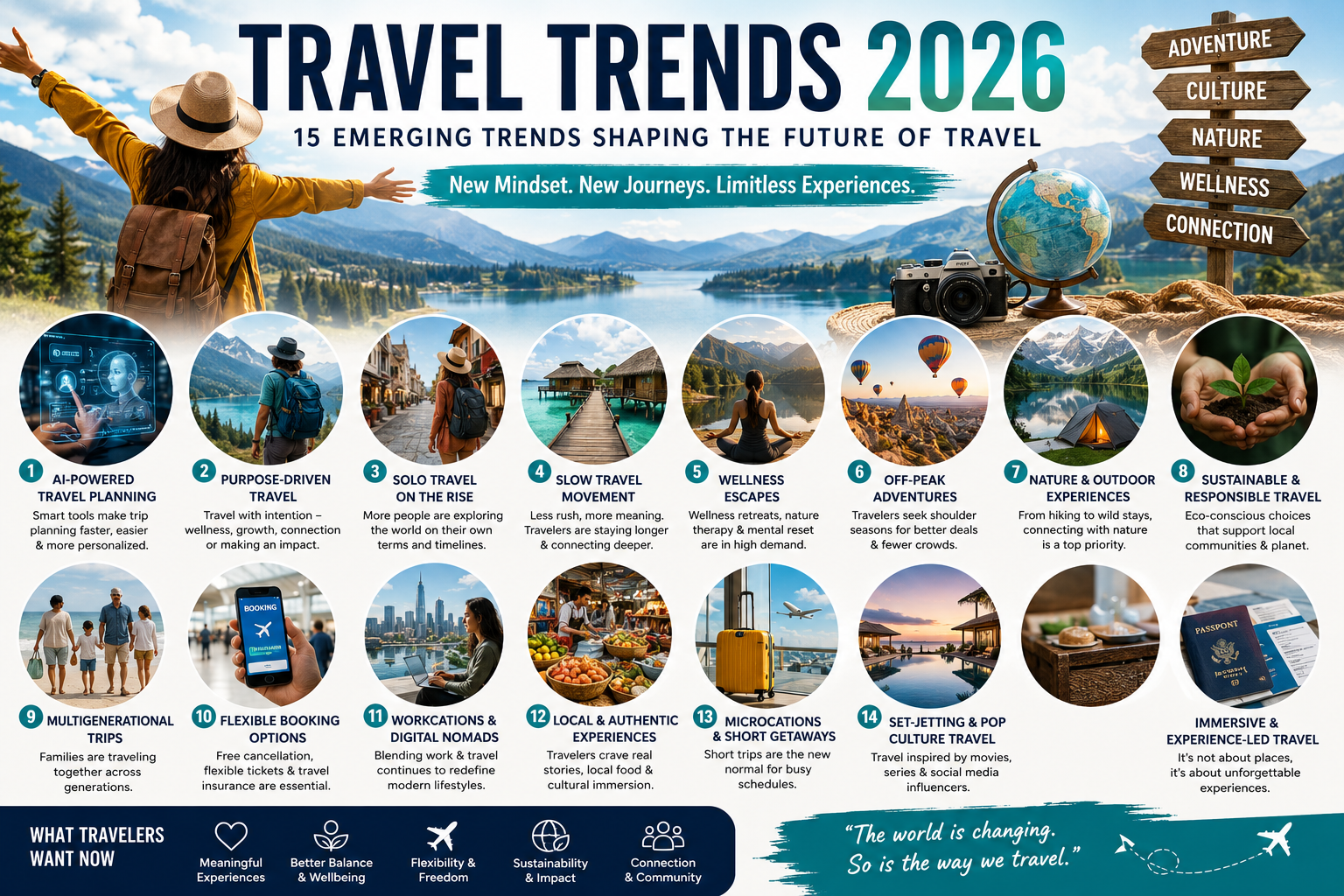
What does the modern traveler actually want from a trip in 2026? Travel trends are shifting from simply visiting famous destinations toward more intentional, flexible, personalized, meaningful, and experience-driven journeys. From AI-assisted itinerary planning and solo travel to slow tourism, wellness trips, shoulder-season escapes, longer stopovers, and quieter destinations, the way people discover, book, and experience travel is changing rapidly Sara International Travel
Quick Summary of Travel Trends in 2026
| Travel Trend | What It Means | Best For |
|---|---|---|
| AI travel planning | Using AI to research and organize trips | Busy travelers |
| Purpose-driven travel | Choosing trips based on personal motivation | Everyone |
| Solo travel | More people traveling independently | Solo travelers |
| Slow travel | Fewer destinations, longer stays | Relaxation seekers |
| Shoulder-season travel | Traveling outside peak periods | Budget travelers |
| Wellness travel | Trips centered on health and restoration | Wellness travelers |
| Quiet destinations | Choosing less crowded alternatives | Introverts and families |
| Microcations | Short, focused trips | Busy professionals |
| Long stopovers | Turning layovers into mini-trips | Explorers |
| Carry-on travel | Traveling with less luggage | Budget travelers |
| Multigenerational travel | Families traveling across generations | Families |
| Experience-led travel | Activities becoming more important than sightseeing | Experience seekers |
| Sports and event travel | Traveling around major events | Sports fans |
| Flexible travel | Prioritizing adaptable bookings | Uncertain planners |
| Sustainable travel | Considering environmental and community impact | Conscious travelers |
What Are Travel Trends?
Travel trends are measurable or observable changes in the way people plan, purchase, experience, and evaluate travel.
They can involve almost every stage of a journey.
Planning Trends
These include:
- AI-powered trip planning
- Social media discovery
- Personalized recommendations
- Flexible itinerary design
- Price comparison
- Destination alternatives
Booking Trends
Travelers are increasingly considering:
- Flexible cancellation
- Price guarantees
- Loyalty programs
- Alternative accommodations
- Direct booking
- Bundled travel products
Destination Trends
Interest can shift toward:
- Smaller cities
- Rural areas
- Nature destinations
- Emerging destinations
- Secondary cities
- Cultural communities
- Less crowded alternatives
Experience Trends
Travelers may prioritize:
- Food
- Wellness
- Sports
- Nature
- Culture
- Local experiences
- Festivals
- Adventure
- Personal interests
The important point is that a trend is not simply something that looks popular on social media.
A genuine travel trend reflects a broader change in traveler behavior, economics, technology, infrastructure, or culture.
Why Travel Trends Are Changing So Quickly
Several forces are interacting at the same time.
Technology
Smartphones, AI assistants, mapping systems, digital payments, translation tools, and online booking platforms have dramatically reduced the friction involved in planning travel.
Consumer Expectations
Travelers increasingly expect:
- Personalization
- Convenience
- Transparency
- Flexibility
- Fast communication
- Digital access
Cost Pressure
Accommodation, airfare, food, and transportation costs influence where people go and how long they stay.
Remote Work
Flexible work arrangements have made longer stays possible for some professionals.
Environmental Awareness
Climate concerns and destination overcrowding are influencing some travelers to reconsider how and when they travel.
Social Media
Instagram, TikTok, YouTube, and other platforms can introduce travelers to destinations that previously received little international attention.
Changing Demographics
Travel is no longer defined by one dominant traveler profile.
Students, retirees, families, solo professionals, remote workers, multigenerational groups, and older adventure travelers all contribute to changing demand.
Travel Trend 1: AI Is Becoming a Travel Planning Partner
One of the most important travel trends is the integration of artificial intelligence into trip planning.
Instead of opening dozens of browser tabs, travelers can increasingly ask an AI system to help organize:
- Destinations
- Hotels
- Restaurants
- Attractions
- Transportation
- Daily schedules
- Budget estimates
- Packing lists
This can make trip planning much faster.
But there is an important distinction.
AI Can Generate an Itinerary Faster Than It Can Validate One
Travel planning is unusually complicated because decisions depend on one another.
A museum might be closed on Monday.
A train might leave before breakfast.
A hotel might be 45 minutes from the attraction someone wants to visit.
An airport transfer might take longer during rush hour.
A seemingly perfect itinerary can therefore fail when real-world constraints are considered.
Recent academic research into AI travel planning highlights exactly this challenge: complex travel plans contain interconnected time, location, and preference constraints, and current AI systems can still struggle with feasibility.
How Travelers Should Use AI
Use AI for:
- Inspiration
- Destination comparisons
- Initial itinerary ideas
- Packing suggestions
- Neighborhood explanations
- Trip structure
- Questions to investigate
Then verify:
- Opening hours
- Visa requirements
- Transportation
- Hotel policies
- Flight schedules
- Weather
- Local restrictions
- Current safety information
AI should be treated as a planning assistant, not an unquestionable travel authority.
Travel Trend 2: Purpose-Driven Travel Is Replacing Destination-Only Planning
One of the strongest emerging travel trends is intentional travel.
Instead of asking:
“Where should I go?”
Travelers increasingly ask:
“Why do I want to travel?”
Hilton’s 2026 research describes this behavior through its “whycation” concept, with travelers emphasizing rest, reconnection, rediscovery, and meaningful experiences.
Different Reasons Create Different Trips
A traveler seeking relaxation may want:
- A quiet resort
- Nature
- Fewer scheduled activities
- Comfortable accommodation
A traveler seeking connection may choose:
- Family travel
- Cultural experiences
- Group tours
- Food-focused trips
A traveler seeking personal growth may choose:
- Hiking
- Language learning
- Photography
- Cooking classes
- Outdoor adventures
This means destination marketing increasingly needs to communicate what a trip helps travelers feel, not just what they can see.
Travel Trend 3: Solo Travel Is Becoming More Mainstream
Solo travel is no longer limited to backpackers and gap-year students.
Interest is spreading across age groups.
Recent reporting indicates that U.S. searches for solo travel reached record levels in 2026, while research cited from Hostelworld found freedom and spontaneity were major motivations among solo travelers.
Why People Choose Solo Travel
Common motivations include:
- Independence
- Flexible schedules
- Personal growth
- Freedom
- Quiet time
- Self-discovery
- Avoiding schedule conflicts
Solo travel can also solve a practical problem.
Suppose three friends want to travel.
One is available in June.
Another is available in July.
The third can only travel in September.
Instead of waiting indefinitely, one person may simply decide to travel alone.
Solo Travel Is Not Necessarily Lonely Travel
Traveling alone does not mean avoiding people.
Solo travelers may stay in:
- Hostels
- Boutique hotels
- Guesthouses
- Group tours
- Retreats
- Community-focused accommodations
The traveler controls when to socialize and when to be alone.
Travel Trend 4: Slow Travel Is Challenging the “See Everything” Vacation
For years, travel culture often encouraged people to maximize destinations.
Three countries in seven days.
Five cities in ten days.
A packed schedule from sunrise until midnight.
Slow travel offers another approach.
What Is Slow Travel?
Slow travel generally means:
- Staying longer
- Visiting fewer places
- Using slower forms of transport
- Spending more time locally
- Avoiding unnecessary transfers
- Building flexible schedules
The goal is not to see less.
It is to experience more deeply.
Why Slow Travel Is Growing
Travelers are increasingly recognizing the hidden cost of constant movement.
Changing hotels every night means:
- Packing repeatedly
- Checking out
- Traveling to another location
- Checking in
- Reorienting yourself
- Losing time
A four-day stay in one city may produce more meaningful experiences than four one-night stays.
Travel Trend 5: Quiet Destinations Are Becoming More Attractive
Overtourism has changed the way some travelers evaluate destinations.
A famous location may offer incredible attractions but also:
- Crowds
- Long lines
- Higher prices
- Traffic
- Noise
- Limited availability
Travelers are therefore looking for alternatives.
The Rise of Secondary Destinations
Instead of the most famous city, travelers may choose a nearby smaller destination.
Instead of a major beach resort, they may select a quieter coastal town.
Instead of a famous hiking route, they may choose a less crowded trail.
Expedia’s 2026 travel trends research specifically highlighted “slow down towns” and less conventional travel experiences as part of changing traveler behavior.
Why This Matters
This trend can benefit local communities.
Tourism spending can spread beyond the most crowded destinations.
But emerging destinations must prepare carefully.
Sudden popularity can create the same overcrowding problem that travelers were trying to escape.
Travel Trend 6: Shoulder-Season Travel Is Getting Smarter
Peak travel seasons can be expensive and crowded.
Shoulder seasons offer a middle ground.
These periods fall between major high and low seasons.
For example:
- Spring instead of midsummer
- Autumn instead of peak summer
- Early winter instead of holiday season
Benefits
Travelers may find:
- Lower prices
- Better accommodation availability
- Smaller crowds
- More relaxed sightseeing
- More personal service
But weather can be less predictable.
Travelers should therefore compare the full experience, not just the hotel price.
Travel Trend 7: Wellness Travel Is Moving Beyond Luxury Spas
Wellness travel has become broader.
It can include:
- Yoga retreats
- Hiking
- Sleep-focused vacations
- Nature escapes
- Meditation
- Thermal baths
- Fitness trips
- Digital detoxes
- Healthy food experiences
The Important Shift
Wellness travel is becoming less about luxury branding and more about how travelers want to feel after the trip.
A wellness vacation does not necessarily require a five-star resort.
A quiet cabin near nature may deliver more value to someone who wants rest.
Travel Trend 8: Microcations Are Turning Short Trips Into Real Vacations
Not everyone can take two weeks off.
That is creating demand for shorter travel experiences.
A microcation might be:
- A weekend city break
- A 24-hour destination visit
- A two-night nature escape
- A short beach trip
- A nearby cultural weekend
Why Microcations Work
They reduce:
- Time away from work
- Planning complexity
- Transportation costs
- Accommodation expenses
They can also provide psychological benefits.
A short break may be easier to schedule than a major vacation.
Travel Trend 9: Long Layovers Are Becoming Opportunities
A layover traditionally meant waiting.
Travelers increasingly see it as a potential mini-adventure.
Expedia’s 2026 travel data reported that 26% of travelers intentionally book longer layovers to explore an additional destination.
How It Works
A traveler flying from one country to another might intentionally choose a connection lasting many hours or even longer, depending on airline and entry requirements.
That can create:
- A second city experience
- A new food experience
- A short cultural visit
- A way to break up a long journey
The Risk
Never assume a long layover automatically means you can leave the airport.
Check:
- Transit visa rules
- Entry requirements
- Baggage arrangements
- Airport distance
- Security procedures
- Minimum connection requirements
Travel Trend 10: Carry-On-Only Travel Is Growing
Travelers increasingly value mobility.
Carry-on-only travel can make it easier to:
- Move between cities
- Avoid baggage claim
- Reduce lost-bag risk
- Save luggage fees
- Use public transportation
Expedia’s 2026 Air Hacks data reported that 48% of travelers were flying carry-on only.
Why Minimal Packing Works
A lighter bag changes the entire travel experience.
You can walk farther.
You can use trains.
You can take stairs.
You can change plans.
You can avoid waiting at baggage carousels.
But carry-on-only travel is not practical for every trip.
Cold-weather travel, long family vacations, sports equipment, medical needs, and specialized activities can require more luggage.
Travel Trend 11: Multigenerational Travel Is Becoming More Important
Families are increasingly traveling across generations.
A trip may include:
- Grandparents
- Parents
- Children
- Teenagers
This creates a unique planning challenge.
A 70-year-old and a 10-year-old may have very different needs.
Successful Multigenerational Travel Requires Flexibility
Look for:
- Accessible accommodation
- Family-friendly transportation
- Flexible meal options
- Rest periods
- Mixed-age activities
- Private downtime
Hilton’s 2026 trends research specifically identified changing family structures and grandparents traveling with grandchildren as important themes.
Travel Trend 12: Experience-Led Travel Is Becoming More Important Than Sightseeing
Travelers increasingly want to do something, not only photograph something.
Examples include:
- Cooking classes
- Local workshops
- Hiking
- Cycling
- Wildlife observation
- Sports
- Art classes
- Music experiences
- Farm stays
- Food tours
Expedia’s 2026 report highlighted experiences such as reading retreats, farm stays, unusual sports, and other activity-based travel as emerging interests.
Why Experience-Led Travel Has Staying Power
An attraction can be photographed in minutes.
An experience can become a memory.
That difference matters.
Travel Trend 13: Sports Tourism Is Expanding
Major sporting events can transform travel patterns.
Examples include:
- Football tournaments
- Formula racing
- Tennis championships
- Cricket
- Basketball
- Rugby
- Olympic events
Sports travelers often combine the event with tourism.
They may arrive early or stay afterward to explore the destination.
Recent reporting on Airbnb’s 2026 results also noted a boost in travel associated with the FIFA World Cup hosted across the United States, Canada, and Mexico.
The Bigger Opportunity
Sports tourism connects:
Travel + Entertainment + Community + Culture
A visitor may travel for a match but remember the city, food, nightlife, and local culture just as much as the event.
Travel Trend 14: Digital Nomad Travel Is Evolving
Remote work changed the relationship between travel and employment.
But the digital nomad lifestyle is also evolving.
The stereotypical digital nomad might spend months moving between countries.
A newer model may involve:
- Two-week work trips
- Monthly stays
- Hybrid work retreats
- Workations
- Extended weekends
- Regional travel
What Matters Most
Digital nomads care about:
- Reliable internet
- Comfortable workspaces
- Time zones
- Visa rules
- Cost of living
- Community
- Safety
- Accommodation flexibility
The best destination is therefore not always the cheapest.
It is the destination where work and life function together.
Travel Trend 15: Sustainable Travel Is Becoming More Practical
Sustainable travel is no longer only about choosing a “green hotel.”
It can involve everyday decisions.
Examples
- Taking trains when practical
- Staying longer instead of taking frequent short flights
- Supporting local businesses
- Avoiding wildlife exploitation
- Choosing responsible tour operators
- Reducing unnecessary waste
- Respecting local communities
The Challenge
Travelers need reliable information.
Environmental claims can sometimes be vague.
A hotel describing itself as sustainable does not automatically mean its entire operation has a low environmental impact.
Travelers should look for specific evidence rather than marketing language alone.
Travel Trend 16: “Coolcations” and Climate-Aware Travel
Hot destinations are not always attractive when temperatures become extreme.
Some travelers are seeking cooler destinations during summer.
This can mean:
- Northern countries
- Mountain regions
- Coastal areas
- High-altitude destinations
- Cooler cities
The logic is simple.
If a traveler wants to explore outdoors, extreme heat can reduce the enjoyment of the trip.
Climate conditions are therefore becoming an increasingly important factor in destination selection.
Travel Trend 17: Nature Travel Continues to Grow
Nature remains one of the strongest motivations for travel.
Popular forms include:
- Hiking
- Camping
- Wildlife trips
- National parks
- Mountain travel
- Lakes
- Forest escapes
- Coastal exploration
Why Nature Travel Is Different
Nature trips often provide a break from:
- Screens
- Traffic
- Noise
- Urban routines
This connects directly with the broader trend toward intentional travel and quiet experiences.
Travel Trend 18: Food Is Becoming a Primary Travel Motivation
Food tourism is evolving from “trying local restaurants” into a broader cultural experience.
Travelers may plan trips around:
- Regional cuisine
- Street food
- Markets
- Cooking classes
- Food festivals
- Farm visits
- Traditional production
Why Food Matters
Food provides a direct connection to:
- History
- Geography
- Religion
- Agriculture
- Family traditions
- Migration
- Local identity
A food-focused itinerary can therefore teach travelers about a destination without requiring a traditional sightseeing schedule.
Travel Trend 19: Travelers Are Looking for Familiarity in New Places
An interesting countertrend is the desire for comfort.
Travelers may want adventure during the day but familiar routines at night.
Hilton’s 2026 research identified “home comforts” as an emerging theme, with travelers increasingly valuing familiarity while away from home.
This can include:
- Familiar foods
- Comfortable bedding
- Reliable technology
- Quiet rooms
- Consistent hotel standards
- Familiar wellness routines
This suggests that future travel may not be about choosing between adventure and comfort.
It may be about combining both.
Travel Trend 20: Personalization Is Becoming the New Standard
Two people visiting the same city may want completely different trips.
Traveler A:
- Museums
- Historic architecture
- Classical music
Traveler B:
- Hiking
- Street food
- Nightlife
Traveler C:
- Luxury shopping
- Fine dining
- Spa treatments
A good travel platform increasingly needs to understand those differences.
Personalization Can Improve Travel
It can reduce:
- Irrelevant recommendations
- Planning time
- Search overload
But excessive personalization can create a problem.
If algorithms only recommend what they think travelers already like, people may stop discovering unexpected places.
The best systems should therefore balance:
Personalization + Discovery
Travel Trend 21: Flexible Travel Is Becoming More Valuable
Travelers have learned that plans can change.
Flights can be delayed.
Weather can disrupt activities.
Prices can move.
Personal circumstances can change.
That makes flexibility valuable.
What Flexible Travel Means
It can involve:
- Refundable accommodation
- Flexible flights
- Travel insurance
- Changeable bookings
- Multiple destination options
Flexibility may cost slightly more upfront but provide greater protection.
The cheapest booking is not always the cheapest overall decision.
Travel Trend 22: Travel Planning Is Becoming More Data-Driven
Travelers now have access to enormous amounts of information.
They can compare:
- Flight prices
- Hotel ratings
- Neighborhoods
- Weather
- Transportation
- Attractions
- Reviews
But information overload creates a new problem.
More Data Does Not Always Mean Better Decisions
A traveler can spend six hours comparing hotels and still be uncertain.
The future of travel planning is therefore likely to focus on decision support, not simply more information.
The goal should be:
“Here are the three options that best match your priorities.”
rather than:
“Here are 3,000 options.”
Travel Trend 23: Alternative Accommodations Are Becoming Mainstream
Travelers have more accommodation choices than ever.
Options include:
- Hotels
- Apartments
- Vacation homes
- Hostels
- Guesthouses
- Boutique properties
- Resorts
- Eco-lodges
- Farm stays
Airbnb’s recent results show the continuing evolution of major accommodation platforms beyond traditional home rentals, including expansion into hotels and other travel services.
The Main Question Is No Longer “Hotel or Airbnb?”
Instead, travelers should ask:
What type of accommodation fits this particular trip?
A hotel may be better for:
- Business travel
- Short stays
- Central locations
- Concierge services
A vacation home may be better for:
- Families
- Longer stays
- Kitchens
- Groups
Travel Trend 24: Secondary Cities Are Competing With Famous Capitals
Travelers are discovering that major capitals are not the only places worth visiting.
Secondary cities may offer:
- Lower prices
- Smaller crowds
- Local culture
- Authentic food
- Unique architecture
This trend also benefits travelers who want to avoid the “checklist” approach to tourism.
Instead of asking:
“What is the most famous place?”
Ask:
“Where can I have the experience I want?”
Travel Trend 25: Travel Is Becoming More About Recovery
One of the most interesting changes is the growing recognition that vacations should actually feel like vacations.
Travelers increasingly want:
- Better sleep
- Less rushing
- Quiet mornings
- Nature
- Comfortable accommodation
- Personal time
This is closely connected to wellness, slow travel, quiet destinations, and purpose-driven travel.
A vacation should not require another vacation to recover from it.
Travel Trends by Traveler Type
Different travelers experience trends differently.
Travel Trends for Gen Z
Gen Z travelers may prioritize:
- Experiences
- Social discovery
- Flexible travel
- Budget accommodation
- Solo trips
- Unique destinations
- Short trips
- Digital planning
Travel Trends for Millennials
Millennials often combine:
- Travel
- Work
- Food
- Wellness
- Family
- Experiences
They may also seek better value rather than simply the lowest price.
Travel Trends for Families
Families increasingly value:
- Convenience
- Multi-room accommodation
- Flexible schedules
- Kid-friendly experiences
- Multigenerational travel
Travel Trends for Older Travelers
Older travelers may increasingly prioritize:
- Comfort
- Accessibility
- Cultural experiences
- Wellness
- Longer stays
- Premium transportation
Travel Trends for Business Travelers
Business travel increasingly blends with leisure.
Travelers may add:
- Weekend extensions
- Local experiences
- Extra destinations
- Personal time
Travel Trends for Budget Travelers
Budget travel is not disappearing.
It is becoming smarter.
Budget Strategies
Choose:
- Shoulder seasons
- Secondary cities
- Public transport
- Longer stays
- Carry-on travel
- Flexible dates
- Local restaurants
- Free attractions
The goal is not simply to spend less.
It is to maximize value per dollar.
Travel Trends for Luxury Travelers
Luxury is also changing.
Luxury increasingly means:
- Privacy
- Time
- Personalization
- Access
- Space
- Wellness
- Authenticity
A luxury traveler may prefer a private local experience over a large five-star hotel.
The definition of luxury is becoming more emotional.
Travel Trends for Families
Family travel is becoming more sophisticated.
Parents increasingly want trips that work for everyone.
A successful family itinerary should balance:
- Children’s interests
- Adult interests
- Rest
- Food
- Transportation
- Budget
Trying to schedule every minute is often counterproductive.
Travel Trends for Solo Travelers
Solo travelers should prioritize:
- Safe accommodation
- Reliable transport
- Communication tools
- Flexible schedules
- Local connections
- Emergency planning
The best solo itinerary often contains enough structure to create confidence without eliminating spontaneity.
Travel Trends for Couples
Couples increasingly seek trips built around shared interests.
Examples include:
- Food trips
- Wellness escapes
- Adventure travel
- Cultural weekends
- Scenic road trips
- Beach vacations
The strongest couple itinerary is usually not the one with the most activities.
It is the one both people actually enjoy.
10 Major Travel Brands and Platforms Compared
| Brand / Platform | Main Strength | Best For | Notable Travel Trend |
|---|---|---|---|
| Booking.com | Accommodation and travel booking | Broad accommodation search | Personalization and flexible booking |
| Expedia | Flights, hotels, packages | Complete trip planning | Data-driven travel trends |
| Airbnb | Homes and experiences | Local-style stays | Alternative accommodation |
| Tripadvisor | Reviews and discovery | Research and traveler opinions | Experience discovery |
| Skyscanner | Flight comparison | Flexible airfare search | Price-conscious travel |
| KAYAK | Travel comparison | Comparing flights and hotels | Data-driven planning |
| Hopper | Price prediction | Travelers watching airfare and hotel prices | Predictive technology |
| Google Travel | Travel research | Integrated trip planning | Search and personalization |
| Marriott | Hotels and loyalty | Premium and business travel | Loyalty-driven travel |
| Hilton | Hotels and experiences | Leisure and business travelers | Purpose-driven travel |
These platforms are not identical competitors. Some focus primarily on accommodation, some on flights, some on search and comparison, and others on hospitality. Their importance reflects how fragmented the modern travel journey has become.
How to Use Travel Trends When Planning Your Next Trip
Knowing trends is useful only if you can turn them into better decisions.
Step 1: Decide Why You Are Traveling
Write one sentence:
“I want this trip to help me ______.”
Possible answers:
- Relax
- Explore
- Reconnect
- Learn
- Celebrate
- Exercise
- Work
- Spend time with family
Step 2: Choose the Experience Before the Destination travel trends
If you want hiking, identify regions with excellent trails.
If you want food, identify culinary destinations.
If you want quiet, avoid major tourist hubs during peak periods.
Step 3: Compare Three Destination Types travel trends
Consider:
- Famous destination
- Secondary city
- Emerging alternative
Step 4: Compare Seasons travel trends
Check:
- Weather
- Prices
- Crowds
- Events
- Transportation
Step 5: Build a Flexible Schedule travel trends
Do not fill every hour.
Leave space for:
- Delays
- Rest
- Unexpected discoveries
Step 6: Use Technology Carefully travel trends
Use AI and travel platforms for research.
Verify critical details independently.
Step 7: Calculate Total Trip Cost travel trends
Do not compare hotel prices alone.
Include:
- Flights
- Transfers
- Accommodation
- Food
- Activities
- Local transport
- Insurance
- Baggage
- Visa expenses
Common Mistakes Travelers Make With Travel Trends
Chasing Every Trend travel trends
A trend may be popular but unsuitable for you.
Choosing a Destination Because It Is Viral travel trends
Social media popularity can create unrealistic expectations.
Overusing AI travel trends
An AI-generated itinerary may look perfect but fail in practice.
Ignoring Seasonality travel trends
A beautiful destination can become uncomfortable during extreme weather.
Packing Too Much travel trends
Heavy luggage reduces flexibility.
Planning Too Many Activities travel trends
Overplanning can turn a vacation into a project.
Ignoring Local Culture travel trends
Visitors should respect local customs, dress expectations, photography rules, and community norms.
Assuming Sustainability Claims Are Automatically True
Look for specific evidence.
Pros and Cons of Today’s Travel Trends
| Trend | Pros | Cons |
|---|---|---|
| AI planning | Fast and personalized | Can produce incorrect plans |
| Solo travel | Freedom and flexibility | Safety and loneliness concerns |
| Slow travel | Deeper experiences | Less geographic coverage |
| Microcations | Easy to fit into schedules | Limited time |
| Shoulder season | Lower prices and crowds | Weather uncertainty |
| Wellness travel | Rest and recovery | Can become expensive |
| Alternative destinations | Less crowded | Less infrastructure |
| Carry-on travel | Faster and cheaper | Limited packing capacity |
| Sustainable travel | Supports responsible tourism | Can require more research |
| Long layovers | See another destination | Connection and visa risks |
The key lesson is that no trend is universally better.
The right choice depends on the traveler.
How Travel Trends Affect Destinations
Travel trends do not only affect tourists.
They affect communities.
Economic Effects
Tourism can generate:
- Employment
- Business revenue
- Tax income
- Infrastructure investment
Social Effects
Tourism can also create:
- Housing pressure
- Crowding
- Cultural commercialization
- Changes in local communities
Environmental Effects
Travel can contribute to:
- Emissions
- Waste
- Water consumption
- Habitat pressure
This creates a difficult balance.
Destinations want visitors because tourism supports economies.
But excessive tourism can reduce quality of life and damage the very attractions that bring visitors.
Overtourism and the Search for Alternatives
Overtourism occurs when visitor numbers create significant pressure on destinations.
Travel trends may offer part of the solution.
Instead of concentrating millions of visitors in a few famous locations, travelers can distribute demand.
This can involve:
- Visiting secondary cities
- Traveling during quieter months
- Supporting local businesses
- Staying longer
- Exploring less crowded attractions
But destination management is essential.
Simply redirecting tourists to another community can move the problem rather than solve it.
The Economics Behind Travel Trends
Travel behavior is strongly influenced by price.
When airfare becomes expensive, travelers may:
- Travel closer to home
- Shorten trips
- Choose shoulder seasons
- Compare more airlines
- Use alternative airports
When accommodation becomes expensive, they may:
- Choose apartments
- Stay outside city centers
- Travel with friends
- Shorten stays
When incomes rise, travelers may:
- Upgrade accommodation
- Take longer trips
- Add experiences
Travel trends therefore reflect both desire and economic reality.
Why Flexibility Is Becoming a Travel Superpower
One of the most valuable travel skills is flexibility.
A traveler who can change:
- Dates
- Airports
- Destinations
- Accommodation
- Transportation
may find significantly better options.
Flexibility allows travelers to respond to price changes, weather, availability, and unexpected opportunities.
This is particularly useful when travel demand is high.
Travel Trends and Air Travel
Air travel remains central to global tourism.
IATA’s June 2026 data showed global passenger demand was down 1.7% year over year for that month, while international demand declined 0.9%; the results also reflected regional disruptions and changing market conditions.
The broader picture is still one of enormous long-term demand.
IATA’s March 2026 long-term forecast projected global air passenger demand could more than double by 2050 under its mid-range scenario.
This suggests an important tension:
More people want to travel, but the industry must manage capacity, infrastructure, affordability, environmental pressure, and geopolitical uncertainty.
What Travel Trends Tell Us About the Future
The future traveler may be less interested in simply collecting destinations.
Instead, travel may become increasingly connected to personal priorities.
The Future Trip May Start With a Question
- How do I want to feel?
- What do I want to learn?
- Who do I want to spend time with?
- What do I want to experience?
- How much time do I actually have?
- What can I afford?
- How can I travel responsibly?
Only after answering those questions does the destination become obvious.
Future Trend 1: AI Travel Agents
AI systems will likely become more capable of handling multiple parts of travel planning.
They may eventually coordinate:
- Flights
- Hotels
- Activities
- Transportation
- Calendar schedules
- Budget limits
- Personal preferences
The biggest challenge will remain trust and verification.
A travel assistant must not simply produce attractive recommendations.
It must produce feasible recommendations.
Future Trend 2: More Personalized Travel
Travel platforms will increasingly understand individual preferences.
Instead of:
“Top 10 things to do in London”
the future recommendation may become:
“Here are five activities in London that fit your interest in history, your walking limit, your budget, and your available time.”
That is much more useful.
Future Trend 3: More Multi-Destination Trips
Travelers may increasingly combine nearby destinations.
Improved transportation and better planning tools can make multi-city trips easier.
But slow travel will create an interesting counterbalance.
Some travelers will want to see more.
Others will intentionally see less.
The market will increasingly serve both.
Future Trend 4: Climate Will Influence Destination Choice
Climate conditions are likely to become a stronger part of travel planning.
Travelers may increasingly consider:
- Heat
- Wildfire risk
- Storm seasons
- Snow conditions
- Water availability
This could shift tourism toward different seasons and regions.
Future Trend 5: Quiet Luxury Will Influence Travel
Luxury travel is likely to emphasize:
- Privacy
- Space
- Personal service
- Authentic experiences
- Wellness
- Time
The future definition of luxury may be less about visible extravagance and more about having control over your environment.
Future Trend 6: Travel Will Become More Purposeful
This may ultimately be the biggest trend.
Travelers will increasingly ask:
“What am I getting from this trip?”
The answer could be:
- Rest
- Connection
- Adventure
- Learning
- Health
- Inspiration
- Celebration
That makes travel more personal than simply moving from one location to another.
A Practical Travel Trends Checklist for 2026
Before booking, ask:
Purpose travel trends
- Why am I traveling?
- What do I want to experience?
Budget travel trends
- What is my complete trip budget?
- Have I included hidden costs?
Timing travel trends
- Is this peak season?
- Could I travel one or two weeks earlier or later?
Destination travel trends
- Is there a less crowded alternative?
- Is the destination suitable for my travel style?
Accommodation travel trends
- Do I need a hotel, apartment, resort, or guesthouse?
Transportation travel trends
- Can I reduce unnecessary transfers?
- Would a longer stay make the trip easier?
Technology travel trends
- Can AI help me research?
- Have I verified important information?
Safety travel trends
- Do I understand entry requirements?
- Have I checked current local conditions?
Sustainability travel trends
- Can I support local businesses?
- Can I reduce unnecessary environmental impact?
Flexibility travel trends
- What happens if my plans change?
Conclusion
Travel is changing, but the biggest change may not be where people go. It is why, how, and how intentionally they travel. The traditional vacation model often encouraged travelers to maximize destinations, attractions, photographs, and activities. The emerging model is more selective. Travelers increasingly want trips that fit their available time, budget, interests, health, relationships, work arrangements, and personal goals.