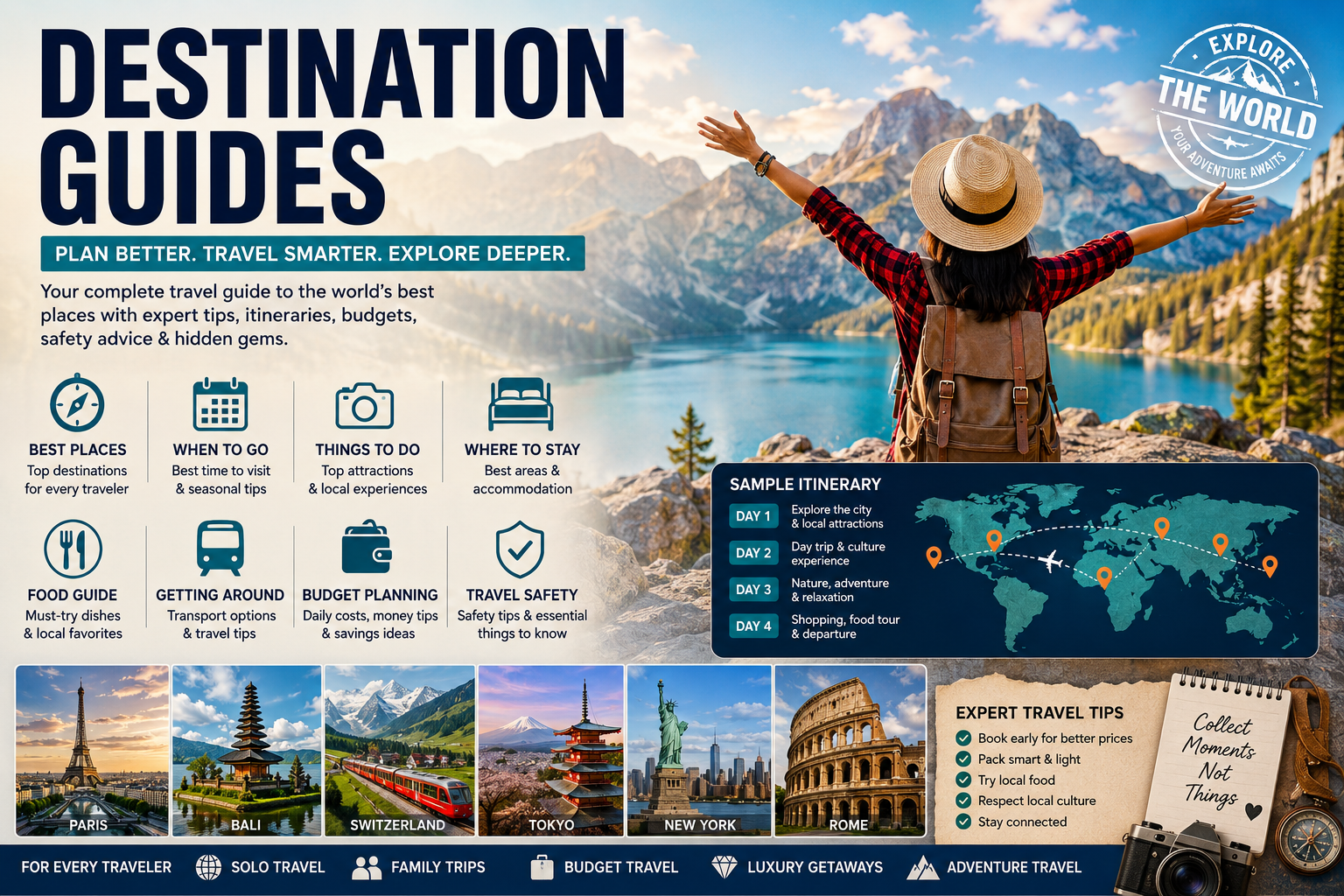
Destination Guides: 25 Expert Travel Tips to Plan Smarter Trips Anywhere
Destination guides help travelers turn a place name into a practical travel plan by explaining where to go, when to visit, what to do, where to stay, how to get around, what to budget, and what local customs to understand. The best destination guides do more than list attractions: they help different types of travelers make better decisions based on time, budget, interests, season, safety, transportation, and the kind of experience they want Egypt
Quick Summary
| Travel Planning Question | What a Good Destination Guide Should Tell You |
|---|---|
| Where should I go? | Best destinations based on interests, season, budget, and travel style |
| When should I visit? | Weather, crowds, prices, festivals, and seasonal conditions |
| What should I do? | Major attractions plus meaningful local experiences |
| Where should I stay? | Best neighborhoods, accommodation types, and location trade-offs |
| How do I get around? | Airports, trains, buses, taxis, walking, rental cars, and local transport |
| How much will it cost? | Accommodation, food, transport, activities, and unexpected expenses |
| What should I eat? | Local dishes, food culture, dietary considerations, and dining etiquette |
| Is it safe? | General precautions, common scams, local laws, and practical awareness |
| How long should I stay? | Suggested trip lengths and realistic daily pacing |
| What should I pack? | Weather-appropriate clothing, technology, documents, and destination-specific items |
| How do I avoid mistakes? | Common tourist errors and practical solutions |
| What is changing? | Technology, sustainable travel, remote work, AI planning, and emerging destinations |
What Are Destination Guides?
A destination guide is a comprehensive travel resource designed to help visitors understand and plan a trip to a particular place.
That place could be:
- A country
- A city
- An island
- A region
- A national park
- A beach destination
- A mountain area
- A historical site
- A road-trip route
- A resort area
A basic travel article might say:
“Visit this museum, eat at this restaurant, and take a city tour.”
A strong destination guide goes much further.
It explains why you should visit, when you should go, how to get there, how long you should stay, where you should base yourself, what you should prioritize, and what could go wrong.
That difference separates a simple travel list from genuinely useful travel planning content.
Common Tourist Scams
Depending on the destination, travelers may encounter:
- Fake taxis
- Inflated prices
- Fake tickets
- Distraction theft
- Unofficial guides
- ATM manipulation
- Counterfeit products
- Fake charity requests
Awareness is often the best defense.
Travel Documents
Before traveling internationally, check:
- Passport validity
- Visa requirements
- Entry rules
- Transit requirements
- Vaccination requirements where applicable
- Travel insurance requirements
- Accommodation documentation
Requirements can change.
Travelers should verify current rules before departure.
Travel Insurance
Travel insurance can protect against certain unexpected costs related to:
- Medical emergencies
- Trip cancellation
- Delays
- Lost baggage
- Certain travel interruptions
Coverage differs substantially between policies.
Travelers should read the actual terms rather than assuming every problem is covered.
Destination Guides and Sustainable Travel
Sustainable tourism is becoming increasingly important.
Travelers can reduce their impact by:
- Using public transportation
- Supporting local businesses
- Avoiding unnecessary waste
- Respecting wildlife
- Following protected-area rules
- Carrying reusable items
- Choosing responsible tour operators
Sustainable travel does not mean eliminating comfort.
It means considering the effect of travel decisions.
Overtourism and Destination Selection
Some famous destinations experience extreme visitor pressure.
Overtourism can result in:
- Crowded streets
- Higher prices
- Housing pressure
- Environmental damage
- Long queues
- Reduced local quality of life
A thoughtful destination guide should not simply send everyone to the same famous attractions.
It can introduce:
- Lesser-known neighborhoods
- Off-season travel
- Alternative destinations
- Smaller towns
- Less crowded attractions
Hidden Gems vs Famous Attractions
“Hidden gem” content is popular online.
But not every obscure location deserves that label.
A truly useful guide should ask:
Is the place actually worth the travel time?
An attraction that takes two hours to reach and provides a five-minute photo opportunity may not be better than a famous attraction that offers a meaningful cultural experience.
The goal should not be avoiding popular places.
The goal should be choosing experiences intentionally.
How to Build a Destination Itinerary
Start with a map.
Mark:
- Hotel
- Major attractions
- Restaurants
- Transport stations
- Airports
- Day-trip locations
Then group nearby activities together.
This reduces unnecessary travel.
Example Three-Day City Structure
Day One: Orientation
- Historic center
- Major landmark
- Local neighborhood
- Easy dinner
Day Two: Deep Exploration
- Museum
- Cultural attraction
- Local market
- Evening experience
Day Three: Flexible Day
- Day trip
- Shopping
- Nature
- Free time
- Favorite attraction revisited
This structure provides balance.
The Geographic Clustering Method
Suppose a city contains six attractions.
Do not automatically visit them in alphabetical order.
Instead, divide them geographically.
Zone A
Visit attractions 1, 2, and 3.
Zone B
Visit attractions 4 and 5.
Zone C
Visit attraction 6.
This can save hours.
It also creates a more relaxed itinerary.
Morning vs Afternoon Attractions
Some attractions work better early.
Examples may include:
- Popular museums
- Major viewpoints
- Outdoor markets
- Famous landmarks
Other activities can work better later:
- Shopping
- Restaurants
- Neighborhood walks
- Night markets
- Entertainment
A destination guide should help travelers understand timing rather than merely listing locations.
How to Plan Day Trips
A day trip should be evaluated by:
Travel time + attraction time + return time
A destination requiring five hours of transportation for three hours of sightseeing may not be worth it.
For some travelers, however, the journey itself is part of the experience.
This is where traveler preference matters.
Destination Guides and Photography
Photography travelers may prioritize:
- Sunrise
- Sunset
- Golden hour
- Viewpoints
- Architecture
- Seasonal scenery
- Night photography
A photography-focused destination guide should provide timing and positioning advice rather than just attraction names.
Travel With Technology
Modern travelers often depend on smartphones.
Useful tools include:
- Maps
- Translation
- Currency conversion
- Digital tickets
- Booking confirmations
- Travel documents
- Weather forecasts
- Transportation applications
But travelers should not depend entirely on technology.
Download important information before leaving reliable internet access.
Offline Travel Preparation
Keep offline copies of:
- Passport information
- Visa documents
- Hotel reservation
- Flight details
- Emergency contacts
- Insurance information
- Important addresses
A dead battery or weak signal should not turn basic travel information into a crisis.
The Role of AI in Destination Guides
AI is changing travel planning.
Instead of searching dozens of pages, travelers can ask an AI system to create a preliminary itinerary based on:
- Budget
- Dates
- Interests
- Family size
- Mobility
- Food preferences
- Hotel location
However, AI-generated travel plans should be checked against current information.
AI can misunderstand:
- Opening hours
- Seasonal closures
- Local transportation
- Visa rules
- Event dates
- Current prices
The best future workflow will combine AI convenience with reliable current sources.
Destination Guides and Personalization
Travel planning is moving away from one-size-fits-all itineraries.
Consider two people visiting the same city.
Traveler A
- 22 years old
- Budget traveler
- Loves nightlife
- Loves street food
- Comfortable walking
Traveler B
- Traveling with children
- Prefers museums
- Wants comfortable transportation
- Has a higher accommodation budget
They should not receive the same itinerary.
The future of destination guides is therefore likely to be increasingly personalized.
Destination Guides for Different Problems
For Travelers With Limited Time
Prioritize:
- Central attractions
- Efficient transportation
- Short travel distances
- Flexible reservations
For Travelers With Small Budgets
Prioritize:
- Free attractions
- Public transportation
- Affordable neighborhoods
- Local markets
- Off-season travel
For First-Time International Travelers
Prioritize:
- Simple transportation
- Clear visa information
- Walkable areas
- Reliable accommodation
- Basic cultural guidance
For Experienced Travelers
Prioritize:
- Neighborhoods
- Local experiences
- Regional food
- Alternative routes
- Lesser-known attractions
Ten Major Travel Brands Compared
Destination guides frequently intersect with major travel brands and platforms. The following comparison is useful for understanding the broader travel-planning ecosystem.
| Brand | Main Travel Role | Best For | Major Strength | Potential Limitation |
|---|---|---|---|---|
| Booking.com | Accommodation and travel booking | Hotel-focused travelers | Huge accommodation inventory | Large choice can make comparison difficult |
| Expedia | Travel booking | Bundled travel | Flights, hotels, cars, packages | Pricing and inventory vary |
| Tripadvisor | Reviews and travel research | Researching experiences | Large review ecosystem | Reviews require careful interpretation |
| Airbnb | Vacation rentals and stays | Longer stays and local-style accommodation | Wide variety of properties | Quality varies by property and market |
| Google Travel | Travel research and planning | Early-stage planning | Strong integration with search and maps | Not every travel product is directly bookable |
| Skyscanner | Flight comparison | Flexible travelers | Useful fare discovery | Final booking may involve another provider |
| Kayak | Travel comparison | Comparing flights and hotels | Broad search tools | Results can vary by market |
| Lonely Planet | Destination information | Independent travelers | Deep destination knowledge | Travelers still need current practical verification |
| Viator | Tours and activities | Experience planning | Large activity marketplace | Tour quality varies |
| GetYourGuide | Tours and activities | Activity booking | Broad selection in many destinations | Availability varies by location |
The key lesson is that no single travel brand is the complete destination-planning solution.
A traveler may use one service for flights, another for accommodation, another for maps, and another for experiences.
How to Compare Travel Brands
Do not compare brands only by headline prices.
Evaluate:
- Total price
- Cancellation policy
- Customer support
- Location
- Reviews
- Payment terms
- Refund policy
- Booking flexibility
- Taxes and fees
A $90 hotel with a restrictive cancellation policy may be less attractive than a $100 option with flexible cancellation.
Common Destination Guide Mistakes
Mistake 1: Too Many Attractions
A guide containing 100 attractions may be less useful than one containing 20 carefully selected experiences.
Solution
Prioritize.
Mistake 2: No Neighborhood Guidance
Telling readers what to see without explaining where to stay creates an incomplete guide.
Solution
Add neighborhood comparisons.
Mistake 3: Ignoring Transportation
A destination may look compact online but be difficult to navigate.
Solution
Explain realistic travel times.
Mistake 4: Treating Every Traveler the Same
Families, couples, solo travelers, and budget travelers have different needs.
Solution
Add traveler-specific recommendations.
Mistake 5: Outdated Information
Travel information changes quickly.
Solution
Review destination content regularly.
Mistake 6: Overpromising
Calling every destination “perfect” damages trust.
Solution
Discuss both advantages and limitations.
Mistake 7: Ignoring Seasonality
An attraction can be completely different in summer and winter.
Solution
Explain seasonal conditions.
Mistake 8: Focusing Only on Famous Attractions
Popular attractions are not automatically the best experiences.
Solution
Include neighborhoods, food, culture, nature, and local activities.
Pros and Cons of Using Destination Guides
Advantages
Saves Time
Research is consolidated.
Improves Planning
Travelers understand the destination before arrival.
Reduces Mistakes
Practical information can prevent common problems.
Helps With Budgeting
Travelers can estimate major expenses.
Supports Personalization
Good guides can be adapted to different traveler types.
Improves Confidence
First-time visitors can feel more prepared.
Disadvantages
Information Can Become Outdated
Travel conditions change.
Personal Preferences Differ
One person’s perfect attraction may be another person’s boring stop.
Reviews Can Be Subjective
Online opinions are not always representative.
Overplanning Can Reduce Spontaneity
Too much structure can make travel stressful.
Popular Recommendations Can Increase Crowds
If everyone follows the same guide, lesser-known destinations may become crowded too.
How to Use Destination Guides Without Overplanning
Treat a guide as a decision-making tool rather than a rulebook.
Choose:
- Three must-see attractions
- Two local experiences
- One food experience
- One flexible period each day
Everything else is optional.
This gives you structure without removing spontaneity.
Future Trends in Destination Guides
The future of travel content is likely to be significantly more personalized.
AI-Powered Itineraries
Travelers will increasingly generate itineraries based on personal preferences.
Real-Time Travel Information
Future guides may adapt recommendations according to:
- Weather
- Traffic
- Crowds
- Delays
- Events
- Opening hours
Hyperlocal Travel
Instead of broad city guides, travelers may receive neighborhood-level recommendations.
Sustainable Recommendations
Travelers will increasingly seek information about environmental impact.
Accessible Travel Planning
More guides will include:
- Wheelchair access
- Elevator information
- Accessible transport
- Sensory considerations
- Family accessibility
Dynamic Destination Guides
Static articles may gradually evolve into living travel resources that update according to changing conditions.
The Future of Personalized Travel
Imagine entering:
“I have four days, a $1,000 budget, I am traveling with my wife, I love food and history, I do not want more than 15,000 steps per day, and I prefer boutique hotels.”
A future destination guide could produce a highly personalized itinerary.
Then imagine the itinerary automatically changing because:
- Rain is expected tomorrow.
- A museum is temporarily closed.
- A train is delayed.
- A local festival begins.
- A restaurant becomes fully booked.
That is where destination guides are heading.
Sustainable Destination Discovery
Future travel guides may increasingly recommend destinations based on carrying capacity.
Instead of directing millions of visitors toward a handful of famous cities, travel platforms could encourage travelers to explore:
- Secondary cities
- Rural regions
- Shoulder seasons
- Less crowded attractions
- Local communities
This could benefit both travelers and destinations.
Why Human Expertise Still Matters
AI can organize information quickly.
But human travel expertise remains valuable.
A local expert can recognize that:
- A technically famous attraction is overrated.
- A small neighborhood is excellent at sunset.
- A particular road becomes congested every evening.
- A restaurant is popular with tourists but not locals.
- A supposedly short walk is difficult in extreme heat.
The strongest future destination guides will likely combine technology with human judgment.
A Practical Destination Guide Checklist
Before publishing or using a destination guide, ask:
Destination Basics
- Is the location clearly explained?
- Is the best time to visit discussed?
- Are major attractions identified?
- Are local experiences included?
Transportation
- Is airport access explained?
- Is public transportation covered?
- Are travel times realistic?
Accommodation
- Are neighborhoods compared?
- Are different budgets considered?
Food
- Are local dishes discussed?
- Are dietary needs considered?
Safety
- Are common problems explained?
- Are practical precautions included?
Budget
- Are hidden costs mentioned?
- Are budget, mid-range, and premium travelers considered?
Itinerary
- Are realistic trip lengths provided?
- Is there enough free time?
Cultural Context
- Are local customs explained?
- Are visitors encouraged to behave respectfully?
Accessibility
- Is useful accessibility information provided where relevant?
Accuracy
- Is time-sensitive information clearly identified?
- Are readers encouraged to verify rules before travel?
Destination Guide Template for Beginners
If you are creating your own destination guide, use this structure:
Destination Overview
Explain what makes the destination interesting.
Best Time to Visit
Explain seasons and weather.
How to Get There
Cover major transportation options.
Where to Stay
Compare neighborhoods.
Best Things to Do
Prioritize attractions and experiences.
What to Eat
Explain local cuisine.
Getting Around
Explain transportation.
Suggested Itineraries destination guides
Create one-, three-, five-, and seven-day options where appropriate.
Budget destination guides
Explain typical expense categories.
Safety destination guides
Discuss practical considerations.
Cultural Etiquette destination guides
Explain important local customs.
Packing Tips destination guides
Connect packing choices to weather and activities.
Common Mistakes destination guides
Explain what visitors should avoid.
How Bloggers Can Build a Destination Guide Content Cluster
For a travel website, one destination article should rarely stand alone.
A strong content cluster might include:
Destination Guides
Create the main comprehensive destination guide.
Things to Do destination guides
Build attraction-focused articles.
Where to Stay destination guides
Create neighborhood and hotel-area guides.
Food Guides
Create local food and restaurant guides.
Transportation destination guides
Explain airport transfers and local transport.
Itinerary Guides destination guides
Create two-day, three-day, five-day, and seven-day itineraries.
Seasonal Guides destination guides
Create summer, winter, spring, and autumn versions where relevant.
Budget Guides destination guides
Create budget travel and luxury travel versions.
This structure can help build topical depth around a destination.
Internal Linking Opportunities destination guides
destination guides
Potential internal articles:
- Best Travel Destinations for Beginners
- How to Plan a Trip
- How to Create a Travel Itinerary
- Travel Budget Planning Guide
Destination-Specific Planning destination guides
Potential supporting articles:
- Best Time to Visit
- Where to Stay
- Best Things to Do
- Local Transportation Guide
- Local Food Guide
Travel Style Guides destination guides
Potential supporting content:
- Solo Travel Guides
- Family Travel Guides
- Luxury Travel Guides
- Budget Travel Guides
- Couple Travel Guides
Problem-Solving destination guides
Potential supporting articles:
- How to Travel on a Small Budget
- How to Avoid Tourist Scams
- How to Pack for International Travel
- How to Plan a Short City Break
- How to Travel During Peak Season
How to Make a Destination Guide More Trustworthy
Trust is one of the most important factors in travel content.
Avoid exaggeration.
Instead of:
“This is the world’s most beautiful city.”
Say:
“The city is particularly appealing to travelers who enjoy historic architecture, local food, and walkable neighborhoods.”
Specific language feels more credible.
Use Examples Instead of Generic Advice destination guides
Weak:
“Plan your transportation carefully.”
Better:
“If your hotel is outside the historic center, compare the daily cost of commuting with the higher room price of a centrally located property.”
The second statement helps the reader make a decision.
That is what authoritative travel content should do.
The Most Important Principle in Destination Guides
The goal is not to help travelers see everything.
The goal is to help them experience the destination well.
A traveler who sees 12 attractions while exhausted may remember very little.
A traveler who sees five meaningful places, eats local food, talks with residents, walks through a neighborhood, and has time to enjoy the atmosphere may leave with a much stronger memory.
Good travel planning creates space for those moments.
Key Takeaways destination guides
- Destination guides are decision-making tools, not simply attraction lists.
- The best guides explain where to go, when to go, what to do, where to stay, how to travel, and what to expect.
- Trip planning should begin with the traveler’s budget, interests, schedule, and travel style.
- The “best time” to visit depends on weather, crowds, prices, events, and personal preferences.
- Accommodation location can be as important as accommodation quality.
- Good itineraries avoid over-scheduling and leave room for unexpected experiences.
- Transportation planning can save both time and money.
- Budget planning should include hidden costs such as transfers, fees, baggage, and transportation.
- Cultural etiquette helps travelers interact respectfully with local communities.
- Safety advice should be practical and destination-specific rather than alarmist.
- Sustainable travel is becoming increasingly important as popular destinations face visitor pressure.
- Families, couples, solo travelers, older travelers, luxury travelers, and digital nomads need different destination information.
- The strongest travel content balances famous attractions with authentic local experiences.
- AI will make travel planning increasingly personalized, but travelers should verify time-sensitive information.
- A successful destination guide should help readers travel better, not simply travel more.
FAQs
What is a destination guide?
A destination guide is a travel resource that provides practical and useful information about visiting a particular city, country, region, island, or attraction. It commonly covers things to do, accommodation, transportation, food, costs, weather, safety, culture, and itineraries.
What should a good destination guide include?
A comprehensive destination guide should include the best time to visit, how to get there, where to stay, transportation, attractions, local experiences, food, budget information, safety advice, cultural etiquette, itinerary suggestions, and frequently asked questions.
How do I choose the best destination for my trip?
Start with your budget, available time, interests, preferred weather, travel companions, activity level, and desired experience. Then compare destinations that match those requirements.
How many days should I spend at a destination?
There is no universal answer. A compact city may work well as a two- or three-day trip, while a large country or region may require several weeks. The right length depends on the destination and the pace you prefer.
What is the best way to plan a travel itinerary?
Start with your must-see attractions, group locations geographically, account for transportation time, and avoid filling every hour. Leave some free time for rest, delays, weather changes, and spontaneous discoveries.
Are destination guides useful for budget travelers?
Yes. A good destination guide can help budget travelers identify affordable neighborhoods, public transportation, free attractions, local food, lower-cost travel periods, and expenses that are easy to overlook.
Are destination guides useful for luxury travelers?
Yes. Luxury destination guides can focus on premium accommodation, private transportation, fine dining, exclusive experiences, privacy, wellness, and services that save time.
How can families use destination guides?
Families should focus on guides that provide information about child-friendly attractions, family accommodation, transportation, walking distances, restaurants, weather, healthcare, and realistic daily schedules.
What should solo travelers look for in a destination guide?
Solo travelers should pay particular attention to accommodation location, transportation, neighborhood safety, walkability, communication, emergency information, social opportunities, and flexible activities.
Why is accommodation location important?
A centrally located or well-connected accommodation can reduce transportation time and costs. A cheaper property far from major attractions may ultimately cost more when daily transportation and lost time are considered.
How can I avoid tourist scams?
Research common scams before traveling, use official transportation and ticketing services where possible, confirm prices before accepting services, protect valuables, and be cautious of unsolicited offers.
Should I visit famous tourist attractions?
Yes, if they match your interests. Popularity does not automatically make an attraction bad. The key is understanding whether the experience is worth your available time and money.
Are hidden gems always better than famous attractions?
No. Some lesser-known places are excellent, while others are obscure for a reason. A useful destination guide should prioritize quality and relevance rather than simply labeling something a “hidden gem.”
How important is the travel season?
Very important. Weather, crowds, accommodation prices, transportation, festivals, and attraction schedules can change significantly between seasons.
How can I make my destination guide more useful?
Use practical examples, realistic travel times, neighborhood comparisons, budget information, traveler-specific recommendations, seasonal advice, and clear explanations of the trade-offs behind your recommendations.
Will AI replace destination guides?
AI will likely change destination guides rather than completely replace them. AI can personalize itineraries and organize information, while human expertise remains valuable for context, judgment, cultural understanding, and first-hand insight.
What is the biggest mistake travelers make when planning a trip?
One of the biggest mistakes is trying to do too much. Overloaded itineraries create stress and leave little room for rest or unexpected experiences.
What makes a destination guide different from a travel blog?
There can be significant overlap. A destination guide usually has a stronger practical and reference-oriented structure, while a travel blog may focus more heavily on personal experiences and storytelling. The best travel websites often combine both approaches.
How often should destination guides be updated?
Time-sensitive information should be reviewed regularly. Transportation, entry requirements, prices, attraction schedules, accommodation policies, and travel regulations can change.
Conclusion
Destination guides are much more than lists of tourist attractions. The best guides combine practical travel information with local context, realistic itineraries, transportation advice, budgeting strategies, cultural awareness, safety considerations, and recommendations tailored to different types of travelers. A destination should never be presented as a one-size-fits-all experience. The ideal trip for a solo backpacker may be completely different from the ideal trip for a family, couple, luxury traveler, older visitor, digital nomad, or food enthusiast.