Tokyo Hiking Spots: 15 Incredible Trails, Mountains & Nature Escapes for Every Hiker
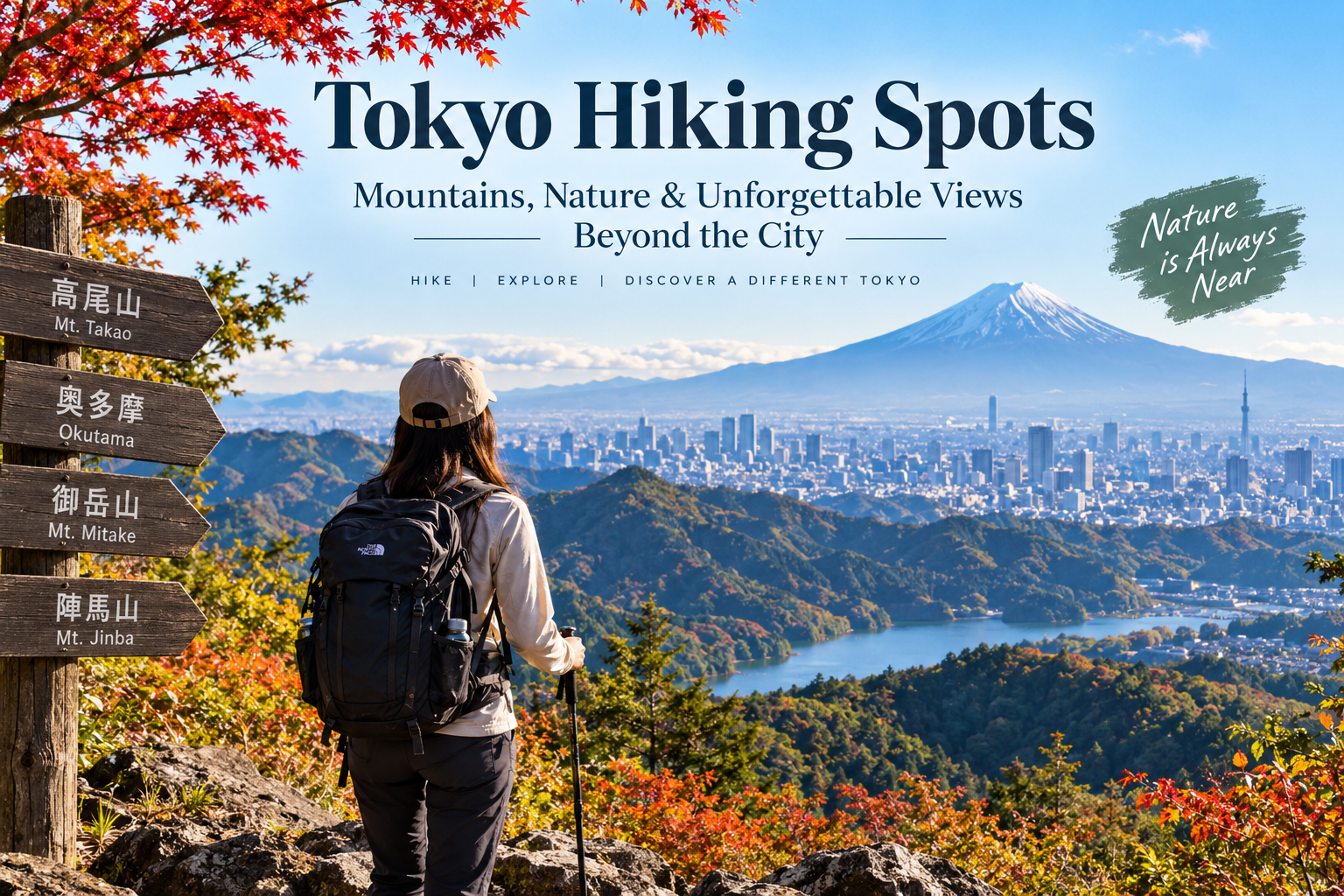
The best Tokyo hiking spots are concentrated mainly in the western and outer parts of the metropolis, particularly around Mt. Takao, Mt. Mitake, Okutama, Mt. Hinode and the Tama Hills. Whether you want an easy half-day walk, a challenging mountain route, autumn foliage, waterfalls, cultural landmarks or a quiet forest escape, Tokyo offers hiking experiences for very different skill levels Tokyo Local Experiences
Why Tokyo Is Better for Hiking Than Many Visitors Expect
Tokyo’s reputation as one of the world’s largest metropolitan areas can make hiking seem almost impossible.
In reality, the geography of Tokyo is unusually diverse.
The metropolitan area extends westward into the Tama region, where mountains, valleys, forests and rivers create opportunities for hiking and trekking. Official Tokyo tourism information specifically highlights Mt. Takao, Mt. Mitake, Mt. Hinode, Mt. Mito, Mt. Odake, Mt. Oyama, Akigawa Valley and other natural areas for outdoor activities.
The city and mountains can be combined in one trip
One of Tokyo’s biggest advantages is accessibility.
You don’t necessarily need to dedicate several days to a remote mountain expedition. Some destinations can work as half-day or full-day trips from central Tokyo.
Mt. Takao is particularly well known for this. GO TOKYO describes it as a day-trip destination from central Tokyo, with access from Shinjuku taking around 50 minutes under typical conditions.
The JNTO also notes that many attractions on the fringes of Greater Tokyo can be reached within approximately one to two hours from Shinjuku.
Tokyo offers different kinds of hiking
Another advantage is variety.
A traveler might choose:
- A relatively gentle mountain walk
- A forest trail
- A shrine-centered hike
- A waterfall route
- A ridge walk
- A valley hike
- An autumn foliage route
- A photography-focused trail
- A beginner-friendly mountain
- A more demanding Okutama trek
This means “best Tokyo hiking spot” is not really one question.
The right choice depends on what you want from the experience.
Best Tokyo Hiking Spots at a Glance
The following destinations provide a useful starting point for planning.
| Hiking spot | Best for | General experience | Difficulty* |
|---|---|---|---|
| Mt. Takao | Beginners, first-time visitors | Mountain, temple, views | Easy–Moderate |
| Mt. Mitake | Culture and nature | Shrine, forest, Rock Garden | Easy–Moderate |
| Rock Garden | Forest and waterfalls | Stream, rocks, waterfall | Moderate |
| Mt. Hinode | Scenic views | Mountain summit and forests | Moderate |
| Okutama | Experienced hikers | Mountains, valleys and rivers | Moderate–Hard |
| Hatonosu Gorge | Nature lovers | Gorge and river scenery | Easy–Moderate |
| Lake Okutama | Scenic walking | Lake, mountains, autumn color | Easy–Moderate |
| Tama Hills | Casual hikers | Rolling hills and countryside | Easy |
| Akigawa Valley | Families and leisure | River valley and forest | Easy–Moderate |
| Mt. Odake | Experienced hikers | Mountain trekking | Moderate–Hard |
| Mt. Oyama | Longer mountain outing | Summit, forest and culture | Moderate–Hard |
| Nippara area | Adventure travelers | Caves and mountain environment | Moderate |
| Mt. Kagenobu | Experienced walkers | Ridge-style mountain hiking | Moderate |
| Mt. Jinba | Longer-distance hikers | Open views and countryside | Moderate |
| Hinohara area | Nature-focused travelers | Forests, streams and mountains | Moderate |
*Difficulty varies according to route, weather, season, trail condition and the individual hiker. Japan’s National Tourism Organization specifically advises travelers to choose routes according to experience and fitness because trail conditions can range from gentle and well maintained to rugged and demanding.
Mt. Takao: The Classic Tokyo Hiking Spot
If you are researching Tokyo hiking spots for the first time, Mt. Takao should probably be one of the first mountains you investigate.
Mt. Takao rises to 599 meters and has several hiking courses. Recent Tokyo tourism material describes seven courses, allowing visitors to choose different ways to experience the mountain.
Why Mt. Takao is so popular
Mt. Takao combines several things that don’t always appear together:
- Convenient transportation
- Multiple trails
- Forest scenery
- Mountain viewpoints
- Cultural attractions
- Seasonal scenery
- Food and facilities
- Options for reducing the amount of climbing
The mountain is therefore useful for both newcomers and visitors who simply want a relatively convenient outdoor day.
Mt. Takao for beginners
A beginner doesn’t necessarily have to approach Mt. Takao like a serious mountaineering expedition.
The available routes provide flexibility, while the cable car and lift can reduce the amount of ascent required. Official Tokyo material describes the mountain as suitable for leisurely hiking and highlights its seven courses.
This flexibility makes it easier to adapt the day according to fitness, weather and time.
Mt. Takao for experienced hikers
Experienced hikers may find the mountain itself less demanding than more remote Tokyo-area routes.
However, that does not make it uninteresting.
You can use Mt. Takao as an introduction to longer routes connecting the surrounding mountains. It can also become more challenging when combined with additional sections rather than treated simply as a summit visit.
Best seasons for Mt. Takao
Spring brings fresh greenery and cherry blossoms in suitable areas, while autumn transforms the mountain into one of the region’s major foliage destinations.
GO TOKYO identifies mid-November to early December as an important period for autumn color around Mt. Takao, although exact conditions vary from year to year.
One important warning about crowds
Beautiful conditions can also mean heavy visitor numbers.
The official Tokyo tourism site warns that late November can become particularly busy around the mountain’s autumn foliage period.
If your priority is quiet hiking, consider:
- Weekdays
- Earlier starts
- Less popular routes
- Non-peak seasons
Mt. Mitake: A Spiritual Mountain Experience
Mt. Mitake offers something different from Mt. Takao.
The experience combines hiking with Japanese cultural heritage.
Mt. Mitake rises to approximately 929 meters and is associated with Musashi-Mitake Shrine, a long-established religious site. Official tourism material describes the mountain as a destination where beginners can also enjoy hiking, particularly because the cable car makes access easier.
Why Mt. Mitake stands out
The mountain provides an interesting mixture of:
- Forest
- Mountain scenery
- Shrine architecture
- Traditional culture
- Water
- Rock formations
- Walking paths
- Viewpoints
That combination makes it particularly attractive for travelers who don’t want their hiking day to be only about elevation.
Musashi-Mitake Shrine
Musashi-Mitake Shrine sits near the summit area and has a long history.
The surrounding area has also been associated with religious pilgrimage and Shugendo traditions.
For international visitors, this creates an opportunity to understand how landscapes and spirituality have historically interacted in Japan.
The Rock Garden
One of the most interesting walking areas around Mt. Mitake is the Rock Garden.
The route includes natural rock formations, forest and flowing water, creating a very different experience from a straightforward summit climb.
Official Tokyo tourism information describes a popular approximately 1.5-kilometer section from Tengu-iwa Rock toward Ayahiro Waterfall as the Rock Garden hiking course.
Why beginners may like Mt. Mitake
The cable car changes the nature of the experience.
Instead of beginning with a long climb from the valley, visitors can reach the upper mountain area and then explore on foot.
That makes Mt. Mitake particularly useful for travelers who want mountain scenery without committing to a demanding ascent.
Rock Garden and Ayahiro Waterfall
For visitors who want a more nature-focused experience, the Rock Garden around Mt. Mitake deserves special attention.
The route provides a combination of:
- Forest
- Moss-covered rocks
- Streams
- Rock formations
- Waterfalls
- Narrow walking sections
- Mountain atmosphere
What makes this route different
A summit hike often focuses on reaching the highest point.
The Rock Garden experience is different.
Here, the environment itself becomes the attraction.
Instead of simply asking, “How high did I climb?”, you notice the sound of running water, the texture of rocks, changing vegetation and the character of the forest.
This is particularly rewarding for photographers and travelers who prefer slower nature experiences.
What to expect
Some sections involve uneven ground and stairs or inclines.
Even when a route is promoted as accessible to beginners, travelers should not interpret that as meaning completely flat or effortless.
Good footwear remains important.
Mt. Hinode: A Scenic Alternative
Mt. Hinode is another important name when researching Tokyo hiking spots.
The mountain provides a more traditional mountain-walking experience while remaining within the broader western Tokyo hiking region.
Who should consider Mt. Hinode?
Mt. Hinode can appeal to travelers who have already experienced Mt. Takao and want something that feels slightly more like a mountain adventure.
It is particularly interesting for:
- Intermediate hikers
- Travelers seeking viewpoints
- Forest walkers
- Autumn foliage visitors
- People looking for an alternative to the busiest trails
GO TOKYO includes Mt. Hinode among the principal hiking and trekking destinations in the Tokyo area.
Okutama: Tokyo’s Mountain Wilderness
If Mt. Takao introduces visitors to hiking around Tokyo, Okutama demonstrates how wild the metropolitan area can become.
Okutama lies in northwestern Tokyo and is characterized by mountains, lakes, valleys, forests and rivers.
The official Tokyo outline describes Okutama as a popular vacation area with mountains, lakes and valleys that support hiking, camping, autumn-leaf viewing and other outdoor activities.
Why Okutama feels so different
The psychological distance is greater than the geographic distance.
After traveling through increasingly rural scenery, the dense urban environment seems far away.
That is one reason Okutama is so appealing to people who want a genuine nature escape while staying within Tokyo Metropolis.
Okutama for experienced hikers
Okutama provides numerous routes where terrain and conditions can become substantially more demanding than the easiest trails around Mt. Takao.
The important lesson is that “Tokyo” does not automatically mean “easy.”
The JNTO explicitly warns that Japanese hiking routes vary significantly in difficulty and maintenance, with some trails requiring greater experience, fitness or even a certified guide.
Lake Okutama: Hiking With Water and Mountain Views
Lake Okutama provides a different perspective on western Tokyo.
Instead of focusing exclusively on climbing a peak, visitors can enjoy landscapes where water, mountains and forests interact.
Why Lake Okutama is worth visiting
The lake is particularly attractive during autumn.
GO TOKYO identifies late October to mid-November as a typical autumn foliage period for Lake Okutama, although actual timing varies according to yearly weather conditions.
Lake Okutama for casual hikers
You don’t need to treat every visit as a serious trekking expedition.
Walking, photography, sightseeing and short nature outings can all be part of the experience.
This makes Lake Okutama useful for groups where hiking ability varies.
Hatonosu Gorge: A Dramatic Valley Experience
Hatonosu Gorge is another excellent option in the Okutama area.
The landscape is characterized by steep valley scenery and the Tama River.
What makes Hatonosu Gorge special?
Instead of the traditional “climb to the top” hiking model, gorge walking focuses on horizontal movement through a dramatic landscape.
You can experience:
- River scenery
- Forest
- Cliffs
- Bridges
- Valleys
- Changing elevations
- Rural landscapes
GO TOKYO includes Hatonosu Gorge among the area’s outdoor attractions and combines it with other Okutama experiences such as the Nippara Limestone Caves.
Akigawa Valley: A Relaxed Nature Escape
The Akigawa Valley offers another useful alternative for travelers who want nature without necessarily seeking a high mountain summit.
Why families may prefer valley hiking
Valley environments can provide more flexibility.
Instead of committing to a summit route, you can:
- Walk beside water
- Stop for breaks
- Explore nearby scenery
- Adjust the length of your outing
- Combine hiking with other local activities
GO TOKYO identifies the Akigawa Valley as one of the Tokyo area’s hiking and outdoor destinations.
Tama Hills: Hiking Without Going Deep Into the Mountains
Not every traveler wants a mountain expedition.
The Tama Hills provide a useful middle ground.
The Tokyo Metropolitan Park Association notes that numerous hiking courses are established throughout the Tama Hills, where visitors can experience landscapes, wildlife and vegetation.
Who should choose Tama Hills?
They can be particularly useful for:
- Casual walkers
- Families
- Local residents
- Beginners
- Travelers with limited time
- People who want greenery without a major mountain climb
This is one of the less obvious Tokyo hiking ideas because international visitors often search only for famous mountains.
Mt. Odake: For a More Serious Hiking Day
Mt. Odake is among the destinations that become more appropriate for hikers seeking a more substantial mountain experience.
GO TOKYO includes Mt. Odake among Tokyo-area hiking destinations.
Why choose Mt. Odake?
Compared with a casual city-adjacent walk, a Mt. Odake outing can provide a stronger sense of wilderness and mountain terrain.
Before choosing it, however, hikers should carefully check:
- Route condition
- Weather
- Daylight
- Transport
- Fitness requirements
- Seasonal restrictions
- Navigation needs
Mt. Oyama and Longer Mountain Routes
Mt. Oyama is another destination highlighted by GO TOKYO for hiking.
It can appeal to travelers who want more than a short recreational walk.
When a longer route makes sense
Choose a longer mountain route when:
- You already hike regularly
- You have suitable footwear
- You can maintain a steady pace
- You understand basic navigation
- You have sufficient daylight
- You have checked the weather
- You have a realistic turnaround plan
The most common mistake among inexperienced hikers is not underestimating the mountain’s height but underestimating how quickly time disappears.
Mt. Jinba and Longer-Distance Hiking
Mt. Jinba can be considered by hikers interested in longer-distance routes and broader countryside scenery.
Why longer routes change the experience
A short hike can feel like an attraction.
A long hike feels more like a journey.
You experience:
- Changing forests
- Different elevations
- Villages and countryside
- Multiple viewpoints
- More varied terrain
- A stronger sense of progression
However, longer routes also magnify every planning mistake.
A missed train connection or slow pace that seems insignificant early in the day can become a major problem near sunset.
Nippara and the Broader Okutama Adventure Area
Nippara is particularly interesting for travelers who want to combine hiking with geological attractions.
The Nippara Limestone Caves provide an unusual contrast to forest hiking.
GO TOKYO describes the cave as having illuminated sections containing stalactites and stalagmites.
Why combining attractions can be smart
A trip doesn’t have to consist entirely of hiking.
A balanced Okutama itinerary might combine:
- A short hike
- A gorge
- A cultural site
- A cave
- A riverside walk
- A local meal
- A relaxing bath
This approach can make western Tokyo appealing even to people traveling with family members who are not serious hikers.
Best Tokyo Hiking Spots by Experience Level
Choosing a trail based only on popularity is not enough.
The better approach is to match the route to your ability.
Tokyo hiking spots for complete beginners
Consider starting with:
- Mt. Takao
- Mt. Mitake’s accessible areas
- Tama Hills
- Selected Akigawa Valley walks
- Lake Okutama sightseeing walks
The objective should be learning how your body responds to elevation, uneven surfaces and longer walking periods.
Tokyo hiking spots for intermediate hikers
Consider:
- Mt. Hinode
- Rock Garden routes
- Longer Mt. Takao combinations
- Hatonosu Gorge
- Selected Okutama routes
- Mt. Jinba-area routes
Tokyo hiking spots for experienced hikers
Consider:
- Mt. Odake
- Longer Okutama routes
- Multi-mountain routes
- Longer ridge walks
- Extended routes involving several peaks
The JNTO recommends selecting routes based on personal experience, fitness and current trail conditions rather than assuming all hiking routes have similar difficulty.
Best Tokyo Hiking Spots for Families
Families should prioritize flexibility over prestige.
A famous summit isn’t necessarily the best family hiking destination.
What makes a family hiking route practical?
Look for:
- Shorter route options
- Reliable transport
- Rest areas
- Toilets
- Food availability
- Alternative attractions
- Multiple exit points
- Manageable elevation gain
Mt. Takao and accessible areas around Mt. Mitake are particularly useful because visitors have more ways to adjust the day.
Mt. Mitake’s cable car is especially valuable for families because it reduces the physical demands of reaching the upper mountain area.
Best Tokyo Hiking Spots for Autumn
Autumn may be the most visually impressive season for many Tokyo hikers.
Forests around the western mountains change color, creating a completely different atmosphere from summer.
Mt. Takao in autumn
Mt. Takao is one of the most recognizable foliage destinations around Tokyo.
GO TOKYO currently identifies approximately mid-November through early December as a typical period for Mt. Takao’s autumn scenery.
Lake Okutama in autumn
Lake Okutama is generally highlighted earlier in the autumn calendar, with late October through mid-November listed as a typical period.
Why autumn hiking requires extra planning
The same foliage that attracts you attracts thousands of other people.
Expect:
- Crowded trains
- Busy trailheads
- Slower walking
- Full facilities
- Limited quiet areas
If solitude matters more than peak foliage, choose a weekday and begin early.
Best Tokyo Hiking Spots in Spring
Spring brings fresh vegetation and, depending on location and timing, cherry blossoms.
Mt. Takao is particularly associated with spring scenery, while the wider Tokyo region offers numerous parks and natural areas.
Spring advantages
Spring can provide:
- Comfortable temperatures
- Fresh greenery
- Seasonal flowers
- Better walking conditions than midsummer
- Excellent photography
But spring weather can change quickly, so layering remains useful.
Tokyo Hiking in Summer
Summer presents a different challenge.
Lower elevations can become hot and humid, while forest shade can make mountain environments more comfortable than exposed urban streets.
Summer hiking strategy
Start early.
Carry enough water.
Avoid assuming that forest shade eliminates heat risk.
Watch weather forecasts carefully, especially where thunderstorms may affect mountain areas.
The JNTO emphasizes that mountain weather can change suddenly and recommends preparing for the conditions that may occur on the route.
Tokyo Hiking in Winter
Winter can offer clear views and quieter trails.
However, colder temperatures, shorter daylight and potentially slippery surfaces require greater preparation.
Winter priorities
Pay attention to:
- Daylight hours
- Temperature
- Wind
- Ice
- Wet surfaces
- Footwear
- Clothing layers
- Transportation schedules
Do not assume a relatively low mountain is automatically safe in winter.
How to Choose the Right Tokyo Hiking Trail
Instead of asking “What is the best Tokyo hiking spot?”, ask five better questions.
How much time do you have?
A half-day trip is very different from a full-day trek.
If you only have a few hours, Mt. Takao may make more practical sense than a remote Okutama route.
How much elevation can you comfortably handle?
Distance alone doesn’t tell you how difficult a hike will feel.
A shorter route with steep climbs can be harder than a longer route with gradual elevation.
What do you want to see?
Choose according to your main attraction:
- Mountain summit: Mt. Takao or Mt. Hinode
- Culture: Mt. Mitake
- Water and rocks: Rock Garden
- Lake scenery: Lake Okutama
- Gorge: Hatonosu
- Deep nature: Okutama
- Casual walking: Tama Hills
Who are you hiking with?
A solo experienced hiker can make different choices from a family with children.
Consider everyone’s ability, not only the strongest person.
What is the weather?
Weather should influence the route, not merely your clothing.
If conditions deteriorate, changing plans is part of good hiking.
What to Pack for Tokyo Hiking
You don’t need an enormous expedition backpack for every Tokyo hiking spot.
But you should pack intelligently.
Essential items
For most day hikes:
- Comfortable hiking shoes
- Water
- Small backpack
- Weather-appropriate clothing
- Lightweight rain protection
- Mobile phone
- Portable battery
- Basic first-aid supplies
- Snacks
- Identification
- Route information
- Cash or suitable payment method
- Personal medication if required
Why footwear matters more than expensive clothing
Beginners sometimes spend too much attention on jackets and backpacks while overlooking footwear.
Uneven terrain, wet rocks, stairs and long descents place considerable stress on feet.
Comfort and traction should be priorities.
How Much Water Should You Carry?
There is no universal quantity that works for every hike.
Water requirements depend on:
- Temperature
- Humidity
- Distance
- Elevation
- Your body size
- Walking speed
- Available refill points
- Personal hydration needs
Hot weather increases requirements.
Always check whether your chosen route actually has reliable water access rather than assuming there will be a shop or fountain along the trail.
Navigation Tips for Tokyo Hiking
One of the biggest misconceptions about hiking near a major city is that navigation doesn’t matter.
It does.
Don’t rely entirely on mobile signal
Mountain environments can have inconsistent connectivity.
Download maps or route information before leaving.
Know your turnaround point
Don’t calculate your hike only by the time required to reach the destination.
Calculate:
outbound time + return time + breaks + navigation margin + transport margin
This is especially important during shorter winter daylight hours.
Keep track of trail intersections Tokyo hiking spots
A route can seem obvious while moving uphill and become surprisingly confusing on the way back.
Take note of distinctive landmarks and junctions.
Safety Rules Every Tokyo Hiker Should Know
The JNTO recommends preparation because Japanese hiking conditions vary significantly by location and season. It also advises hikers to follow route-specific rules and environmental regulations.
Check the weather before departure Tokyo hiking spots
Don’t check only whether it will rain in central Tokyo.
Mountain weather can be different.
A city forecast isn’t always a mountain forecast.
Don’t underestimate wildlife Tokyo hiking spots
Wildlife encounters are possible in mountainous areas.
The JNTO notes that bears can be a concern even in some areas around Tokyo, while also warning about Japanese giant hornets.
This does not mean hikers should panic.
It means they should understand local conditions and follow current trail guidance.
Stay on designated routes Tokyo hiking spots
Shortcuts can create unnecessary risk and damage vegetation.
Stay on established paths unless official route information says otherwise.
Carry your rubbish Tokyo hiking spots
Japan’s outdoor environments depend heavily on responsible visitor behavior.
The JNTO advises visitors not to leave garbage, disturb animals or remove natural objects such as plants and stones.
Common Tokyo hiking spots Mistakes
Mistake 1: Choosing a trail only because it is famous Tokyo hiking spots
Popularity doesn’t equal suitability.
A famous route may be crowded, too difficult, or simply not match what you want.
Mistake 2: Wearing ordinary fashion sneakers Tokyo hiking spots
Some urban sneakers may work for easy walking but become uncomfortable on uneven mountain terrain.
Mistake 3: Starting too late Tokyo hiking spots
This is particularly risky for longer routes.
Mistake 4: Ignoring seasonal conditions Tokyo hiking spots
A route that feels comfortable in autumn may feel completely different during summer heat or winter cold.
Mistake 5: Assuming Tokyo means perfect infrastructure everywhere
Western Tokyo becomes increasingly rural.
Facilities can become less frequent as you move deeper into mountain areas.
Mistake 6: Planning only the hike and forgetting transportation Tokyo hiking spots
The last train or bus can matter as much as the summit.
Mistake 7: Treating every route as a tourist attraction Tokyo hiking spots
Some trails are genuine mountain environments.
Respect them accordingly.
How to Make a Tokyo Hiking Day More Enjoyable
A great hiking day is not necessarily about walking as fast as possible.
Start early Tokyo hiking spots
Early starts usually mean:
- Cooler temperatures
- Better light
- Fewer people
- More time
- Less transport stress
Leave room for exploration Tokyo hiking spots
Don’t schedule every minute.
You may discover a shrine, viewpoint, stream or small local attraction that deserves extra time.
Combine hiking with culture Tokyo hiking spots
Mt. Mitake is an excellent example because the mountain and shrine experience complement one another.
Use public transportation intelligently Tokyo hiking spots
One of Tokyo hiking’s greatest advantages is the ability to combine rail, bus, cable car and walking.
That can allow you to create routes that would be difficult to replicate in a car-dependent destination.
Ten Outdoor Gear Brands for Tokyo Hiking
The following brands are useful reference points when selecting hiking equipment. They are not rankings; the appropriate choice depends on your route, budget, fit and conditions.
| Brand | Known for | Suitable use | Key consideration |
|---|---|---|---|
| The North Face | Outdoor clothing and equipment | Day hikes to mountain use | Broad product range |
| Patagonia | Outdoor clothing | Hiking and travel | Emphasis on durability and environmental practices |
| Arc’teryx | Technical apparel and equipment | Serious hiking | Technical focus and premium pricing |
| Salomon | Hiking footwear and trail equipment | Trail walking and hiking | Strong footwear selection |
| Merrell | Hiking footwear | Day hikes and casual trails | Comfortable hiking-focused footwear |
| Columbia Sportswear | Outdoor clothing | General hiking | Broad range and accessibility |
| Montbell | Lightweight outdoor gear | Japan hiking and travel | Particularly relevant to Japanese outdoor conditions |
| Mammut | Mountain equipment | Technical hiking | Mountain-oriented product range |
| Osprey | Hiking backpacks | Day hikes and trekking | Backpack-focused product range |
| KEEN | Outdoor footwear | Hiking and walking | Known for hiking-oriented footwear |
How to interpret the comparison
You don’t need premium equipment for every Tokyo hiking spot.
For Mt. Takao on a dry day, a comfortable pair of trail shoes and a small daypack may be enough for many visitors.
For longer Okutama routes, however, footwear, rain protection, navigation equipment and clothing become more important.
The route should determine the equipment—not the other way around.
Tokyo Hiking for Solo Travelers
Solo hiking can be rewarding, but it requires more conservative planning.
Choose routes appropriate for your experience
A first-ever solo hike should not be your most ambitious route.
Start with a well-used and clearly established route.
Tell someone your plan Tokyo hiking spots
Share:
- Trail
- Expected start time
- Expected return
- Transport plan
Keep your phone charged Tokyo hiking spots
A power bank is inexpensive insurance against navigation and communication problems.
Don’t chase the summit at all costs Tokyo hiking spots
If conditions deteriorate, turn around.
A mountain summit is never more important than getting home safely.
Tokyo Hiking for Older Travelers
Older hikers can enjoy Tokyo’s mountain areas, but route selection matters.
Mt. Mitake is particularly interesting because cable-car access can reduce the initial ascent. Official material specifically presents Mt. Mitake as accessible to beginner hikers and notes the cable car’s role in reaching the mountain area.
Focus on accessibility Tokyo hiking spots
Consider:
- Elevation gain
- Stairs
- Surface quality
- Rest opportunities
- Toilets
- Transportation
- Emergency access
A shorter route with frequent rest points may provide a much better experience than an ambitious full-day trek.
Tokyo Hiking for Photography
Photographers should think differently from ordinary hikers.
Best subjects include Tokyo hiking spots
- Mountain viewpoints
- Autumn foliage
- Shrines
- Forest paths
- Waterfalls
- Rivers
- Rock formations
- Rural landscapes
- Mist
- Sunrise and morning light
Why early mornings work well Tokyo hiking spots
Early morning often provides softer light and fewer visitors.
It also gives photographers more flexibility before crowds become significant.
Tokyo hiking spots for Nature Lovers
Nature-focused travelers may prefer the less famous areas rather than the iconic peaks.
Look toward:
- Okutama
- Hatonosu Gorge
- Akigawa Valley
- Tama Hills
- Rock Garden
- Lake Okutama
These destinations emphasize ecosystems and landscapes rather than simply reaching a summit.
The Environmental Side of Tokyo Hiking
Outdoor tourism creates an important responsibility.
More visitors can mean:
- Trail erosion
- Waste
- Wildlife disturbance
- Vegetation damage
- Noise
- Pressure on local infrastructure
Responsible hiking principles Tokyo hiking spots
Stay on established paths.
Don’t remove rocks, plants or other natural materials.
Don’t feed wildlife.
Carry rubbish out.
Keep noise under control.
Follow local rules.
The JNTO explicitly recommends minimizing environmental impact and leaving natural areas without taking anything except memories and photographs.
The Future of Tokyo hiking spots
Tokyo’s outdoor tourism is likely to become increasingly important as travelers seek experiences beyond traditional city sightseeing.
The growth of interest in nature-based travel creates an interesting opportunity for Tokyo.
More travelers will combine city and nature
Rather than choosing between Tokyo and rural Japan, visitors can increasingly treat them as complementary.
A traveler might spend:
Day 1: Shibuya and Shinjuku
Day 2: Asakusa and Ueno
Day 3: Mt. Takao
Day 4: Tokyo neighborhoods
Day 5: Okutama
This type of itinerary provides greater diversity without requiring a completely separate rural trip.
Seasonal travel will remain important
Autumn foliage is already a major reason to visit western Tokyo.
GO TOKYO’s current seasonal guidance continues to highlight Mt. Takao, Mt. Mitake, Akigawa Valley and Lake Okutama as important autumn destinations.
Hiking information will become more digital
Travelers increasingly expect:
- Digital trail maps
- Transport information
- Weather updates
- Route planning
- Multilingual information
- Mobile navigation
- Real-time notices
However, digital convenience should not replace traditional preparation.
A charged phone cannot compensate for poor route planning.
How Climate Change May Affect Tokyo Hiking
Long-term climate patterns may influence hiking conditions.
Possible effects include:
- Hotter summer conditions
- Changes in seasonal foliage timing
- More intense rainfall events
- Rapid weather changes
- Increased trail erosion
- Changing wildlife behavior
These changes make flexible planning increasingly important.
Travelers should rely on current weather and local route information rather than assuming conditions will match an old guidebook.
A One-Day Beginner Tokyo Hiking Plan
For a first outdoor experience, a simple structure can work well.
Morning Tokyo hiking spots
Travel toward Mt. Takao.
Start hiking before the busiest part of the day.
Late morning Tokyo hiking spots
Continue toward the summit and enjoy the mountain scenery.
Afternoon Tokyo hiking spots
Explore additional attractions or return through a different route if conditions and energy allow.
Evening Tokyo hiking spots
Return toward central Tokyo and have dinner in the city.
This type of itinerary demonstrates one of Tokyo’s biggest strengths: the ability to move from a mountain environment back into one of the world’s largest urban areas within the same day.
A More Nature-Focused Tokyo Hiking Plan
For travelers with more time, consider an Okutama-centered day.
Morning Tokyo hiking spots
Travel toward the Okutama area.
Midday Tokyo hiking spots
Complete a suitable hike or valley walk.
Afternoon Tokyo hiking spots
Explore another nearby natural or cultural attraction.
Evening Tokyo hiking spots
Return to central Tokyo or stay locally if your itinerary permits.
The official Tokyo tourism authority describes Okutama as an area rich in mountains, lakes and valleys and highlights hiking and other outdoor activities there.
A Cultural Hiking Plan Around Mt. Mitake
Mt. Mitake works particularly well for travelers interested in Japanese culture.
Suggested approach Tokyo hiking spots
Start with transportation toward the mountain.
Use the cable car if appropriate.
Explore the upper mountain.
Visit Musashi-Mitake Shrine.
Continue toward the Rock Garden if conditions and fitness permit.
Explore the natural scenery before returning.
This creates a more complete experience than treating the mountain as simply a physical challenge.
Tokyo Hiking and Public Transportation
Public transportation is one of the reasons Tokyo’s hiking opportunities are so practical for international travelers.
The key is to understand the entire journey.
Think in four stages Tokyo hiking spots
Stage 1: Central Tokyo to the regional station.
Stage 2: Station to trailhead.
Stage 3: Trail to destination.
Stage 4: Trailhead back to transport.
If any one of those stages is poorly planned, the day can become stressful.
Don’t ignore the return journey Tokyo hiking spots
Always check the return schedule before starting a long hike.
This is particularly important in rural and mountainous areas where services can be less frequent.
Pros and Cons of Hiking Around Tokyo
Advantages Tokyo hiking spots
- Excellent contrast between urban and natural environments
- Many destinations reachable as day trips
- Wide range of difficulty
- Strong public transportation connections
- Rich cultural context
- Excellent seasonal scenery
- Options for beginners
- More demanding routes for experienced hikers
- Opportunities for photography
- Nature experiences within Tokyo Metropolis
Challenges Tokyo hiking spots
- Popular routes can become crowded
- Mountain weather can change quickly
- Some routes require good fitness
- Transportation can become less frequent in rural areas
- Summer can be hot and humid
- Winter brings shorter daylight
- Trail conditions vary
- Some areas have wildlife considerations
- Peak autumn periods can be exceptionally busy
The advantages are significant, but the important point is to match the destination with the individual traveler rather than treating Tokyo hiking as one uniform experience.
Tokyo Hiking Spots and Demographic Modifiers
Searches for Tokyo hiking are becoming more specific because travelers have different needs.
Instead of simply searching for “Tokyo hiking spots,” people may look for:
Tokyo hiking spots for beginners
Prioritize Mt. Takao, accessible Mt. Mitake areas and gentler routes.
Tokyo hiking spots for families
Look for routes with flexible distances, facilities and transportation alternatives.
Tokyo hiking spots for couples
Consider scenic areas such as Mt. Takao, Mt. Mitake and Lake Okutama.
Tokyo hiking spots for solo travelers
Favor established routes and plan transportation carefully.
Tokyo hiking spots for photographers
Focus on autumn foliage, waterfalls, viewpoints, forests and cultural landscapes.
Tokyo hiking spots near public transportation
Mt. Takao is especially convenient because of its rail access and mountain facilities.
Tokyo hiking spots in autumn
Mt. Takao, Mt. Mitake, Akigawa Valley and Lake Okutama are particularly relevant.
Tokyo hiking spots for experienced hikers
Look toward longer routes in Okutama and the more demanding mountain areas.
Problem-Solving Modifiers for Tokyo Hiking Searches
Another useful way to plan is to search according to the problem you are trying to solve.
“Tokyo hiking spots without a car”
Focus on destinations with established rail and bus connections.
“Tokyo hiking spots for half a day”
Mt. Takao is a logical starting point because of its accessibility.
“Tokyo hiking spots away from crowds”
Avoid peak weekends and peak foliage periods, and investigate less-famous routes.
“Tokyo hiking spots with waterfalls”
The Mt. Mitake Rock Garden and surrounding Okutama routes deserve investigation.
“Tokyo hiking spots with autumn leaves”
Look toward Mt. Takao, Lake Okutama, Mt. Mitake and Akigawa Valley.
“Tokyo hiking spots for nature photography”
Okutama provides particularly diverse landscapes.
FAQs
What is the most famous hiking spot in Tokyo?
Mt. Takao is one of the best-known hiking destinations associated with Tokyo. It offers several routes, mountain scenery, cultural attractions and relatively convenient access from central Tokyo.
Is Tokyo good for hiking?
Yes. Western Tokyo contains mountains, forests, valleys, lakes and established hiking routes. Official Tokyo tourism information highlights destinations including Mt. Takao, Mt. Mitake, Mt. Hinode, Okutama and Akigawa Valley.
Is Mt. Takao suitable for beginners?
Mt. Takao is widely used by casual and beginner hikers because it has multiple courses and transportation options that can reduce the physical demands of the mountain. However, individual fitness and route conditions should always be considered.
How high is Mt. Takao?
Mt. Takao is 599 meters high. Official Tokyo hiking material identifies seven courses on the mountain.
How high is Mt. Mitake?
Mt. Mitake is approximately 929 meters high. The mountain is known for Musashi-Mitake Shrine, natural scenery and the Rock Garden route.
Can you hike Mt. Mitake without climbing the entire mountain?
Yes. The cable car provides access toward the upper mountain, allowing visitors to explore the area without completing the entire ascent on foot.
What is the best season for Tokyo hiking?
Spring and autumn are particularly attractive for comfortable conditions and seasonal scenery. Autumn is especially popular for foliage around Mt. Takao, Mt. Mitake, Lake Okutama and other western Tokyo destinations. Exact foliage timing changes each year.
Is Tokyo hiking safe?
Many Tokyo-area hiking routes are well established, but safety depends on route selection, weather, preparation and experience. The JNTO warns that hiking routes vary significantly in difficulty and condition, so travelers should select trails appropriate to their abilities.
Are there bears around Tokyo hiking areas?
The JNTO notes that bears can be a concern in some areas around Tokyo. Hikers should check current local guidance for their chosen route and understand applicable wildlife precautions.
Can I hike in Tokyo without a car?
Yes. Several major hiking destinations can be reached using Tokyo’s extensive rail and bus network, although the final connection to some trailheads may require a local bus, cable car or substantial walk. Mt. Takao is particularly convenient for public-transport travelers.
Is Okutama part of Tokyo?
Yes. Okutama is within Tokyo Metropolis and is located in the northwestern part of the metropolitan area. It is known for mountains, lakes, valleys and outdoor activities.
What should I wear for Tokyo hiking?
Wear comfortable footwear with appropriate traction and clothing suitable for the season. For mountain routes, carry weather protection and consider layers because conditions can differ from central Tokyo.
Do I need expensive hiking gear?
No. Expensive equipment is not automatically necessary for every Tokyo hiking trail. Match your equipment to the route, weather, terrain and duration.
Can children hike around Tokyo?
Yes, some routes and mountain areas are suitable for families, but parents should choose trails according to the children’s age, stamina and terrain. Mt. Mitake’s cable-car access can make the area more flexible for families.
What is the difference between Mt. Takao and Mt. Mitake?
Mt. Takao is particularly convenient and has multiple hiking courses, while Mt. Mitake combines mountain scenery with a significant cultural and spiritual setting around Musashi-Mitake Shrine. Mt. Mitake also provides access to the Rock Garden and waterfall area.
Is hiking in Tokyo possible during winter?
Yes, but winter conditions require more preparation. Shorter daylight, colder temperatures and potentially slippery surfaces should be considered before selecting a route.
Can I combine Tokyo hiking with sightseeing?
Absolutely. This is one of the strongest advantages of the destination. A traveler can spend part of a trip exploring central Tokyo and another day visiting western mountains and valleys.
Conclusion
Tokyo’s hiking scene is much broader than many first-time visitors expect. The city may be famous for skyscrapers, railways, shopping districts and technology, but its western landscape provides an entirely different experience. From the accessible trails of Mt. Takao to the spiritual atmosphere of Mt. Mitake, the waterfalls and rocks of the Rock Garden, the valleys of Okutama and the peaceful landscapes around Lake Okutama, there is a remarkable range of outdoor experiences within Tokyo Metropolis.