Tokyo IC Cards: The Complete 2026 Guide to Suica, PASMO, Prices, and Travel Tips
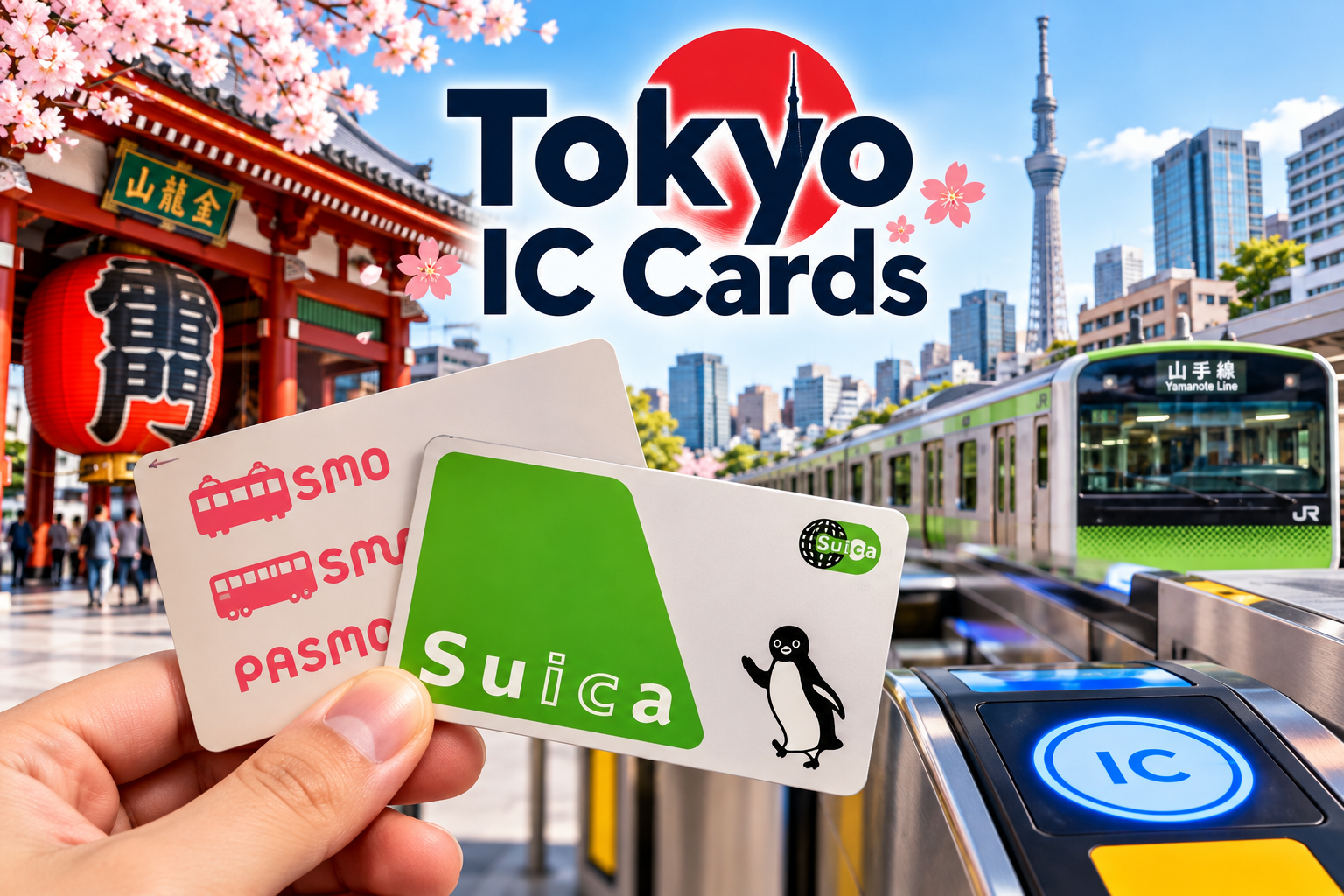
Imagine arriving at Tokyo Station during the morning rush. Trains are arriving, commuters are moving quickly through ticket gates, and you need to reach your hotel without wasting time buying individual tickets. This is where a Tokyo IC card becomes one of the most useful tools for your journey. Tokyo IC cards are rechargeable contactless smart cards that let travellers pay for most participating trains, subways, and buses by tapping a card at the ticket gate. Popular options include Suica and PASMO, which can also be used for many convenience-store purchases, vending machines, and other participating shops Tokyo Towers
What Is a Tokyo IC Card?
An IC card is a rechargeable contactless smart card used to pay for transport and, at participating locations, everyday purchases. IC stands for integrated circuit, referring to the electronic technology used by the card.
In Tokyo, IC cards are widely used on urban railway networks, subway lines, and many buses. Rather than calculating a fare and purchasing a ticket at every station, passengers tap their card when entering and exiting a participating railway system.
The system calculates the applicable fare and deducts it from the stored balance.
How Tokyo IC Cards Work
The process is straightforward:
- Obtain a compatible physical IC card or set up a supported mobile version.
- Add money to the card.
- Tap the card on the reader at the entrance to a participating station or bus.
- Tap again when exiting where the transport system requires it.
- The appropriate fare is deducted automatically.
For example, imagine travelling from Shinjuku to Shibuya on a participating railway service. Instead of finding a ticket machine and selecting the correct fare, you can generally tap your IC card at the entry and exit gates.
The exact fare depends on the operator, route, and applicable fare rules.
Why IC Cards Are Popular in Tokyo
Tokyo’s transport network includes multiple railway and subway operators. A journey that looks like one continuous trip may involve services managed by different companies.
Compatible IC cards reduce the need to understand every operator’s ticketing system before travelling. They are especially helpful for visitors making several journeys in one day.
Other benefits include:
- Less time spent buying individual tickets.
- Easier transfers between participating operators.
- No need to calculate most ordinary fares manually.
- Convenient payments at participating retail outlets.
- Reusable stored value throughout the trip.
- Support for certain regional transport systems elsewhere in Japan.
IC cards do not make every journey free or eliminate every ticketing requirement. They are payment tools, not unlimited travel passes.
Understanding the Main Tokyo IC Cards
Suica and PASMO are the two most familiar IC card options for ordinary travel around Tokyo. They are different brands, but their transport functions overlap considerably.
1. Suica Tokyo IC cards
Suica is associated with JR East and is widely accepted across participating Tokyo transport networks. It is a practical choice for visitors using JR East trains, subways, buses, and participating shops.
Best for: General Tokyo travel and journeys involving JR East services.
2. PASMO Tokyo IC cards
PASMO is associated with Tokyo-area private railway, subway, and bus operators. Its ordinary transport functions are broadly comparable with Suica across participating systems.
Best for: Visitors who primarily use private railways, Tokyo Metro, and participating buses.
3. Welcome Suica Tokyo IC cards
Welcome Suica is a visitor-oriented option designed for short-term travel. It has special conditions, including a limited validity period and no refundable deposit.
Best for: Tourists who prefer a dedicated visitor card and do not need to recover unused stored value.
4. PASMO PASSPORT and Other Tourist Products
Tourist-oriented card products have changed over time. Do not assume an older visitor card is still being issued simply because it appears in an older travel article.
Best for: Travellers only when a specific visitor product is currently available and its conditions suit their plans.
Important: Card designs, tourist products, sales locations, and issuance conditions can change. Confirm current availability with the relevant official operator before travelling.
Suica vs PASMO: Which Tokyo IC Card Is Better?
For most visitors, the practical difference between ordinary Suica and PASMO is small. Both can be used across much of Tokyo’s participating public transport network, and both belong to Japan’s interoperable IC card system.
| Feature Tokyo IC cards | Suica Tokyo IC cards | PASMO Tokyo IC cards |
|---|---|---|
| Main association | JR East | PASMO transport operators |
| Tokyo trains and subways | Widely accepted on participating services | Widely accepted on participating services |
| Participating buses | Yes | Yes |
| Participating shops | Yes | Yes |
| Mobile options | Mobile Suica on supported devices | Mobile PASMO on supported devices |
| Visitor-specific option | Welcome Suica, subject to current availability | Check current tourist products |
| Refund and validity conditions | Depend on the card version | Depend on the card version |
| Best reason to choose | JR East association or Welcome Suica | Preference for PASMO or its supported products |
When Should You Choose Suica?
Choose Suica if you want a widely recognised IC card for Tokyo and other participating areas, or if Welcome Suica suits your visit.
Welcome Suica is designed for temporary visitors and has a different set of conditions from an ordinary reusable Suica card. It is generally valid for 28 days from purchase, has no refundable deposit, and can be used at participating transport services and shops.
Before purchasing, check the latest issuance arrangements and the rules for any unused balance.
When Should You Choose PASMO?
Choose PASMO if you prefer the PASMO brand, are using a supported PASMO product, or find it more convenient to purchase at your arrival point.
PASMO supports participating railways, buses, and electronic-money merchants. Some services and routes have restrictions, so nationwide compatibility should not be interpreted as acceptance on every railway or bus.
Can You Use Suica and PASMO Interchangeably?
For ordinary journeys within their shared participating areas, generally yes. You normally do not need one card for JR trains and a different card for Tokyo Metro or private railways.
However, avoid tapping one card to enter and another to exit the same journey. The transport system needs a consistent record of the trip, and using different cards can leave the journey incomplete.
How to Buy a Tokyo IC Card
The best purchase method depends on whether you want a physical card or a mobile version.
Option 1: Buy a Physical IC Card
Physical cards are useful if you prefer not to depend on your phone or want a straightforward option for a family trip.
A typical process is:
- Visit a participating station or authorised sales point.
- Look for an IC card ticket machine, service counter, or designated sales location.
- Select the available card product.
- Follow the machine’s instructions and choose the initial stored value.
- Pay using the accepted payment method.
- Keep the card somewhere accessible for tapping at gates.
Not every machine sells every card type. Tourist-specific cards may have separate sales arrangements, and stock or issuance rules can change.
Practical tip: If you arrive at Haneda or Narita Airport, check the official information for the specific airport and card you want rather than assuming every machine offers the same products.
Option 2: Set Up a Mobile IC Card
A compatible smartphone or smartwatch may allow you to use a digital version of Suica or PASMO.
Depending on the device and service, you may be able to add the card to your phone’s digital wallet, add stored value, and tap your device at transport gates.
Before travelling, check:
- Whether your device supports the relevant Japanese transit-card service.
- Whether your phone’s region, operating system, and wallet configuration are compatible.
- Whether your payment card can add money successfully.
- How the service works when your phone battery is low.
- Whether your phone supports the required contactless transit functionality.
Apple Wallet supports transit-card features for compatible devices, but availability and setup depend on the specific card and device configuration. Android support can be more restrictive: overseas Android phones may not support Mobile PASMO.
For this reason, travellers with an overseas Android phone should verify compatibility before relying on a mobile card.
Option 3: Use an IC Card You Already Own
You may not need to buy a new Tokyo card if you already have a compatible Japanese transport IC card.
Japan’s nationwide mutual-use arrangement includes ten major card systems, such as Suica, PASMO, ICOCA, and Kitaca. These cards can generally be used in the participating areas of the other systems, subject to route and service restrictions.
If you have previously visited Japan, check your existing card before buying another one.
Tokyo IC Card Prices, Deposits, and Initial Balances
The cost of an IC card is not necessarily the same as the amount of money you can spend on transport.
When comparing card options, distinguish between:
- Stored value: The money available for transport and eligible purchases.
- Deposit: An amount associated with certain reusable physical cards that may be refundable under the applicable rules.
- Card purchase price: Any charge associated with a particular card product.
- Transport fare: The amount deducted for each journey.
These amounts depend on the card and the conditions in force when you buy it.
Ordinary Suica and PASMO Tokyo IC cards
Some ordinary physical cards have historically involved a refundable deposit, while tourist-oriented products may have different conditions. Check the current price and deposit arrangements for the exact card being sold.
Do not assume that every Suica or PASMO product has identical rules.
Welcome Suica Tokyo IC cards
Welcome Suica does not require the same refundable deposit arrangement as a standard deposit-based card. It is designed for temporary visitors, with a validity period of 28 days from purchase.
Because it has different conditions from ordinary cards, consider how much you expect to spend and whether you will have time to use the remaining balance.
How Much Money Should You Load?
Your ideal starting balance depends on the length of your visit, how often you use public transport, and whether you plan to make small purchases with the card.
The following are example budgets for planning purposes, not official fare estimates.
| Trip Style Tokyo IC cards | Suggested Initial Budget Tokyo IC cards |
|---|---|
| Short visit with limited train journeys | ¥1,000–¥2,000 |
| One full day of sightseeing | ¥2,000–¥3,000 |
| Several days of regular city travel | ¥3,000–¥5,000 |
| Longer stay with frequent travel and eligible purchases | ¥5,000 or more, added gradually |
These amounts are starting points rather than fixed recommendations. Airport transfers, long-distance journeys, shopping, and the number of daily trips can change your needs considerably.
Should You Load a Large Amount at Once?
Usually, starting with a modest balance is sensible for a short visit.
You can add more money later if necessary, while a large unused balance may be inconvenient if your card has restrictions on refunds or validity.
A useful approach is to review your remaining balance at the end of each day and add money when you know your next day’s plans.
How to Recharge a Tokyo IC Card
Recharging, also called topping up, adds money to the stored balance.
Recharge at a Station Tokyo IC cards
At a compatible ticket machine:
- Find the machine that supports IC card charging.
- Select the charge or top-up option.
- Place your physical card on the designated reader or follow the machine’s instructions.
- Select an available amount.
- Insert or use an accepted payment method.
- Confirm that the transaction has completed and check the updated balance.
Machine interfaces vary, and some provide English-language instructions.
Recharge at a Convenience Store Tokyo IC cards
Some convenience stores accept IC card top-ups at the checkout. Availability and payment rules depend on the store and card.
Ask the cashier whether they can charge your particular card and confirm the accepted payment method before proceeding.
Recharge a Mobile Card
Mobile Suica and Mobile PASMO may allow compatible users to add funds through their digital wallet or the relevant service.
The process depends on the device, wallet, card, and payment method. If your payment card is issued overseas, confirm that it is supported rather than assuming every international card will work.
What If Your Balance Is Too Low?
A railway gate may refuse entry if the balance is below the applicable minimum required amount. If you are already inside the paid area and do not have enough money to complete the journey, use a fare-adjustment machine where available or ask station staff for help.
Do not try to solve an incomplete journey by tapping a different card at the exit.
How to Use Tokyo IC Cards on Trains, Subways, and Buses
Tokyo’s railway system can initially look complicated because several operators share the same urban area. An IC card makes ordinary journeys much easier, but using it correctly is still important.
Using an IC Card at Railway Gates Tokyo IC cards
Follow these steps when travelling by train or subway:
- Approach a gate marked for IC card use.
- Tap your card or compatible mobile device against the reader.
- Wait for the reader’s confirmation sound or indicator.
- Enter the station.
- Tap the same card or device when exiting the destination station.
Keep the card steady against the reader until the gate registers it. A quick tap that does not register may result in a failed entry or exit.
Carrying multiple IC cards together can interfere with reading, so use the intended card by itself.
Using IC Cards on Tokyo Metro
Tokyo Metro operates a substantial subway network serving major shopping areas, business districts, and tourist attractions.
Suica and PASMO can generally be used on participating Tokyo Metro services. You do not normally need to buy a separate Tokyo Metro ticket for every ordinary journey.
However, an IC card does not automatically provide unlimited travel. Each eligible journey is charged according to the applicable fare rules.
Using IC Cards on JR East Trains
JR East operates many important urban and suburban railway services in the Tokyo region.
Suica is associated with JR East, but compatible PASMO cards also work on participating shared networks.
Remember that the card covers eligible fares, not every additional service. Reserved seats, certain limited-express services, Green Cars, and Shinkansen journeys may require separate tickets or additional charges.
Using IC Cards on Buses Tokyo IC cards
Many participating Tokyo-area buses accept Suica and PASMO.
The procedure varies by operator. On some buses, passengers tap when boarding; on others, they may need to tap when exiting as well.
Look for an IC card reader and follow the instructions displayed on the bus. Do not assume that every bus uses the same boarding procedure.
Using IC Cards for Airport Transfers Tokyo IC cards
IC cards can be convenient for journeys involving participating services to and from Haneda Airport, including the Tokyo Monorail.
However, an IC card balance alone may not cover all airport transfer options.
If you choose a reserved-seat train or another service requiring an additional ticket, purchase the required ticket separately.
Using IC Cards Between Different Railway Operators Tokyo IC cards
One of the main benefits of Tokyo IC cards is interoperability.
You can generally use the same compatible card across participating JR, private railway, and subway services. However, the card does not override route restrictions or fare rules.
For complex journeys involving multiple operators, follow the signs for the intended route and use the appropriate transfer gates. If you accidentally exit the paid area, you may need to begin a new journey and pay another fare.
Where Else Can You Use Tokyo IC Cards?
An IC card can be useful even when you are not travelling.
Many participating retailers and vending machines accept transport IC cards as electronic money.
Convenience Stores Tokyo IC cards
Participating convenience stores may accept IC cards for eligible purchases, including snacks, drinks, and small travel essentials.
Check for the relevant payment logo at the checkout.
Vending Machines Tokyo IC cards
Some vending machines accept compatible IC cards, allowing you to pay for drinks without searching for coins.
Station Shops and Cafés Tokyo IC cards
Selected station shops, cafés, and other retailers accept IC card payments. Acceptance varies by location, so check the payment symbols before purchasing.
Lockers and Other Services Tokyo IC cards
Some electronic coin lockers and other services support IC card payments or card-based access. Availability depends on the equipment and operator.
What You Cannot Assume Tokyo IC cards
An IC card is not a universal payment card.
It may not work at a retailer that accepts ordinary bank cards, and its acceptance at transport facilities does not mean it can pay for every ticket or service.
Also, transport stored value and a separate commuter pass are not the same thing. A commuter pass has specific validity conditions and does not provide unlimited travel outside its covered area.
Tokyo IC Cards vs Travel Passes: Which Saves More Money?
An IC card and a travel pass solve different problems.
An IC card is a stored-value payment method. You add money and pay for each eligible journey.
A travel pass provides unlimited or specified travel under its own rules for a defined period or area.
When an IC Card Is Better Tokyo IC cards
An IC card is often a sensible choice when:
- You are visiting Tokyo for a few days.
- Your sightseeing plans involve different areas.
- You expect a moderate number of train journeys.
- You prefer flexibility rather than planning a fixed route.
- You want to make eligible small purchases as well as travel.
When a Travel Pass Might Be Better Tokyo IC cards
A travel pass may be worth considering if:
- You plan to make many journeys within a defined period.
- Your itinerary concentrates on the services covered by the pass.
- The pass includes the lines you intend to use.
- Its price is lower than the equivalent fares you expect to pay.
Example: Two Different Travellers Tokyo IC cards
Imagine two visitors spending a day in Tokyo.
The first visitor travels from a hotel to one attraction, visits a nearby neighbourhood, and returns to the hotel. A stored-value IC card may be convenient because there are relatively few journeys.
The second visitor plans a full day of sightseeing involving several trips between distant areas. Depending on the actual routes and the conditions of an available pass, a day pass may offer better value.
Neither option is always cheaper. The answer depends on the routes, the number of trips, and the services included.
How to Compare Costs Properly Tokyo IC cards
- Write down the journeys you plan to make.
- Check the fares for those journeys.
- Add the expected fares together.
- Compare the total with the cost of an eligible travel pass.
- Check whether the pass covers the exact lines and areas you will use.
Avoid buying a pass simply because it advertises unlimited travel. If you use only a few journeys, its cost may exceed the amount you would otherwise spend.
Ten Major Japanese Transport IC Card Brands Compared
Suica and PASMO are not Japan’s only transport IC cards. The country’s nationwide mutual-use system includes ten major card brands, although acceptance and usage conditions vary by operator and area.
| IC Card Brand | Main Region or Association Tokyo IC cards | Best Use Tokyo IC cards |
|---|---|---|
| 1. Suica | JR East and participating networks | Tokyo and participating regional transport |
| 2. PASMO | Tokyo-area private railway, subway, and bus operators | Tokyo urban travel |
| 3. Kitaca | JR Hokkaido | Participating services in Hokkaido |
| 4. TOICA | JR Central | Participating services in central Japan |
| 5. manaca | Participating Nagoya-area transport operators | Nagoya-area journeys |
| 6. ICOCA | JR West | Participating services in western Japan |
| 7. PiTaPa | Participating Kansai-area operators | Participating regional transport |
| 8. SUGOCA | JR Kyushu | Participating services in Kyushu |
| 9. nimoca | Participating operators, particularly in Kyushu | Regional transport and participating networks |
| 10. Hayakaken | Fukuoka City Subway | Participating services in Fukuoka |
Can You Use All Ten Cards in Tokyo?
Generally, cards participating in the nationwide mutual-use arrangement can be used on eligible Tokyo services. You do not normally need to replace a compatible ICOCA or Kitaca with Suica merely because you have arrived in Tokyo.
However, there are important limitations:
- Some local routes do not accept every IC card.
- You generally cannot use one IC card to travel continuously across separate, non-interconnected IC fare areas.
- Special tickets and certain reserved services require additional arrangements.
- PiTaPa has different electronic-money shopping interoperability from several other major cards, even though it participates in transport interoperability under applicable rules.
If your trip includes multiple regions, check the rules for each journey before relying entirely on an IC card.
Common Tokyo IC Card Mistakes and How to Avoid Them
Even though IC cards are simple to use, a few common errors can cause delays or unexpected charges.
Mistake 1: Tapping Two Cards Together Tokyo IC cards
If your wallet contains two IC cards, the reader may detect the wrong card or fail to process the tap correctly.
Solution: Remove the intended card from your wallet or keep only one IC card near the reader.
Mistake 2: Forgetting to Tap Out Tokyo IC cards
Most ordinary railway journeys require a successful entry and exit record.
Solution: Always tap the same card or mobile device at the destination gate. If you forget, ask station staff to correct the incomplete journey.
Mistake 3: Assuming Every Railway Accepts Every Tokyo IC cards
Nationwide interoperability is broad but not universal.
Solution: Check the transport operator’s information, particularly for regional railways, local buses, and unusual routes.
Mistake 4: Using an IC Card Across Separate Fare Areas
A card may be accepted in two different regions without supporting one continuous journey between them.
Solution: Buy the appropriate ticket when travelling across incompatible areas or ask staff how to complete the trip.
Mistake 5: Expecting an IC Card to Cover a Shinkansen Ticket
An ordinary stored-value card does not automatically provide a Shinkansen reservation or the required high-speed rail fare.
Solution: Purchase the required Shinkansen ticket or use a supported booking arrangement that explicitly permits IC card integration.
Mistake 6: Assuming a Low Balance Will Always Be Accepted Tokyo IC cards
A gate may reject a card if it does not contain enough money for the required entry or fare.
Solution: Check the balance before travelling and top up when necessary.
Mistake 7: Forgetting Tourist Card Expiry Rules Tokyo IC cards
Visitor-oriented cards may have a limited validity period and different refund conditions from ordinary cards.
Solution: Read the expiry and refund terms before purchasing. Welcome Suica, for example, is valid for 28 days from purchase.
Mistake 8: Assuming Mobile IC Cards Work on Every Overseas Phone
Device compatibility varies, particularly among Android phones purchased outside Japan.
Solution: Check official device requirements before travelling. Carrying a physical IC card as a backup may be useful.
Mistake 9: Confusing Stored Value with a Commuter Pass Tokyo IC cards
An IC card may hold stored money and also support a separate commuter pass, but the two functions have different conditions.
Solution: Check whether your card is being used as stored value, a commuter pass, or both.
Mistake 10: Leaving an Incomplete Journey Unresolved Tokyo IC cards
If an entry or exit record is missing, the card may not work correctly on your next trip.
Solution: Visit a station service point or speak to staff before starting another journey.
Tokyo IC Cards for Different Travellers
The best IC card setup depends on how you travel, what devices you use, and how long you plan to stay in Japan.
For First-Time Visitors to Tokyo IC cards
If this is your first trip, an ordinary Suica or PASMO card is usually a straightforward option.
Choose a physical card if you want a simple payment method that does not depend on your phone. Consider a supported mobile card if you are comfortable using your smartphone for payments.
Focus on learning the basic tap-in and tap-out procedure before exploring more complicated journeys.
For Families Travelling with Children Tokyo IC cards
Each traveller generally needs their own IC card for ordinary individual travel. One physical card cannot be used to tap multiple passengers through a railway gate at the same time.
For families:
- Check whether children qualify for child fares.
- Ask about the appropriate child IC card and identification requirements.
- Keep each card clearly assigned to its user.
- Check the balance of each card before starting the day.
- Consider whether a family travel pass or another fare product is more economical.
Do not assume that an adult IC card automatically charges the correct child fare.
For Business Travellers Tokyo IC cards
Business travellers often benefit from a rechargeable IC card because it simplifies repeated journeys between hotels, offices, stations, and meeting venues.
If your employer requires expense records, check how transport transactions can be retrieved or printed. An IC card’s transaction history may not provide the same detail as an itemised receipt for every journey.
A commuter pass may be more appropriate for regular travel along a fixed route.
For Budget Travellers Tokyo IC cards
A stored-value IC card can help you control transport spending because you decide how much money to add.
However, the card does not reduce every fare simply because it is rechargeable. Compare the cost of an IC card with eligible day passes if you expect to travel frequently.
Walking between nearby neighbourhoods can also reduce transport expenses and give you more opportunities to explore Tokyo.
For Travellers Visiting Several Japanese Cities Tokyo IC cards
If you plan to visit Tokyo, Osaka, Kyoto, Nagoya, or Fukuoka, a compatible IC card can simplify many local journeys.
Nevertheless, do not confuse nationwide interoperability with unrestricted long-distance travel. IC cards generally work within participating areas, and journeys crossing separate fare areas may require a paper ticket or another valid arrangement.
For Shinkansen travel, check the relevant booking and ticket requirements separately.
For Travellers Who Prefer Smartphones Tokyo IC cards
A mobile IC card can reduce the number of physical items you carry and may make recharging convenient.
Before relying on it, confirm device compatibility, wallet setup, payment-card support, and the process for managing your card if your phone is lost or its battery runs out.
If your device is incompatible, a physical card remains a practical alternative.
Future Trends: What Is Next for Tokyo IC Cards?
Tokyo’s transport payment systems continue to develop alongside smartphones, digital wallets, and changes in travel behaviour. The following are reasonable areas to watch, rather than guaranteed future developments.
1. Greater Use of Mobile Payments Tokyo IC cards
Smartphones and smartwatches allow compatible users to carry transit cards digitally. As devices and payment systems evolve, digital ticketing may become more convenient for both residents and international visitors.
Physical cards are still important, particularly for people who prefer not to depend on their phones or whose devices are incompatible.
2. Easier Tourist Access Tokyo IC cards
International visitors benefit when ticket machines, mobile apps, and instructions are available in multiple languages.
Clearer information about card availability, payment methods, and refunds can reduce confusion at airports and major railway stations.
3. More Integrated Travel Planning Tokyo IC cards
Travel apps can help users combine route planning, station information, ticket purchases, and transport payment.
However, route planning and payment are separate functions. An app showing a route does not necessarily mean an IC card covers every service on that route.
4. Better Spending and Journey Management Tokyo IC cards
Digital services may make it easier to review balances and journey histories. This can help travellers understand their transport expenses and plan future top-ups.
Users should still distinguish transport transactions from retail purchases and retain receipts where required.
5. Continued Importance of Interoperability Tokyo IC cards
Tokyo’s railway network benefits from having payment systems that work across participating operators. Continued interoperability is likely to remain important as the city serves commuters and international tourists.
The key challenge is balancing convenience with the distinct fare rules, technologies, and operating requirements of different transport companies.
FAQs
What Is the Best IC Card for Tokyo?
Suica and PASMO are both excellent options for most visitors. Choose based on availability, your preferred physical or mobile format, and any special conditions associated with the card.
Is Suica Better Than PASMO?
Neither is universally better. Their ordinary transport functions are broadly similar across participating Tokyo networks. The best choice is usually the one that is easiest for you to obtain and manage.
Can Tourists Buy Suica Cards in Tokyo?
Tourists can use available Suica products, subject to the current sales arrangements and eligibility conditions. Welcome Suica is a visitor-oriented product, but travellers should verify its current availability and purchase locations before arriving.
What Is Welcome Suica?
Welcome Suica is a tourist-oriented IC card intended for temporary visitors. It supports participating transport and retail payments and has a validity period of 28 days from purchase. It does not have the same refundable deposit arrangement as an ordinary deposit-based card.
How Much Does a Tokyo IC Card Cost?
The cost depends on the specific card and its current issuance conditions. Some physical cards may involve a refundable deposit, while visitor-specific products can have different terms. The stored value you add is separate from any deposit or card charge.
Can I Use PASMO on JR Trains?
Yes, PASMO can generally be used on participating JR services within compatible areas, including much of the Tokyo region. Specific routes and journeys may have restrictions.
Can I Use Suica on Tokyo Metro?
Yes, Suica can generally be used on participating Tokyo Metro services and other compatible transport networks.
Can I Use One IC Card for Trains, Subways, and Buses?
Yes, on participating services. However, bus boarding procedures and transport operator rules may differ, so follow the instructions for each service.
Can I Use My Tokyo IC Card in Osaka?
A compatible card can generally be used for eligible local journeys in Osaka’s participating IC card areas. You cannot assume it will support every route or one continuous journey between separate regional fare areas.
Can I Use My IC Card on the Shinkansen?
Not automatically. Shinkansen journeys generally require the appropriate ticket or a supported ticketing arrangement. Check the specific service and booking requirements before travelling.
Can I Use Suica or PASMO for Shopping?
Yes, at participating retailers, vending machines, and other electronic-money merchants. Acceptance is not universal, so look for the relevant payment symbol.
Can Two People Share One IC Card?
Not for simultaneous individual travel through railway gates. Each passenger generally needs their own card or an applicable group ticketing arrangement.
Can I Recharge My IC Card at a Convenience Store?
Some participating convenience stores offer IC card top-ups. Check the store’s service availability and accepted payment methods.
What Happens If I Lose My IC Card?
The options depend on whether the card is registered, anonymous, physical, or mobile. Registered cards may have different support and replacement arrangements. Keep the card information and purchase records where possible, and contact the relevant issuer promptly.
Can I Get My Unused IC Card Balance Refunded?
Refund eligibility depends on the card type and issuer’s conditions. Certain ordinary cards may be refundable subject to applicable rules and fees, while tourist-oriented cards can have different restrictions.
Check the specific terms before purchasing if you expect to have money left over at the end of your trip.
Does My IC Card Expire?
Validity rules differ by product. Ordinary cards and visitor-specific cards may have different conditions, so check the issuer’s official guidance rather than assuming all cards have the same expiry policy.
Can I Use an IC Card Without Internet Access?
A physical IC card does not require an active internet connection at the gate. Mobile card functionality depends on the device and service, so understand your phone’s requirements before relying entirely on a digital card.
What Should I Do If the Ticket Gate Rejects My Card?
Check your balance, make sure you are using the same card you used to enter, and ensure that no other IC card is interfering with the reader. If the problem continues, ask station staff for assistance.
Should I Buy an IC Card or a Tokyo Subway Pass?
Choose an IC card for flexible pay-as-you-go travel. Consider a subway pass if you expect to make enough eligible journeys within its validity period to justify the price. Compare your planned routes and the exact services covered before deciding.
Is a Tokyo IC Card Worth It for a Short Visit?
For many visitors, yes. It reduces the need to buy individual tickets and makes eligible journeys more convenient. If you plan only one or two trips, however, buying individual tickets may be sufficient.
Conclusion
Tokyo IC cards are among the most practical tools for navigating Japan’s capital. They simplify ordinary public transport journeys, reduce the need to buy individual tickets, and offer a convenient way to pay at participating shops and vending machines. For most visitors, Suica and PASMO provide similar everyday benefits. Welcome Suica is another option for eligible short-term visitors, while compatible cards from other Japanese regions may also work across participating Tokyo networks. The best approach is to choose a card that suits your device and travel plans, understand its validity and refund conditions, and maintain enough stored value for your journeys.