Tokyo Resorts: 15 Incredible Resort Experiences, Best Areas, Luxury Stays & Complete Travel Guide
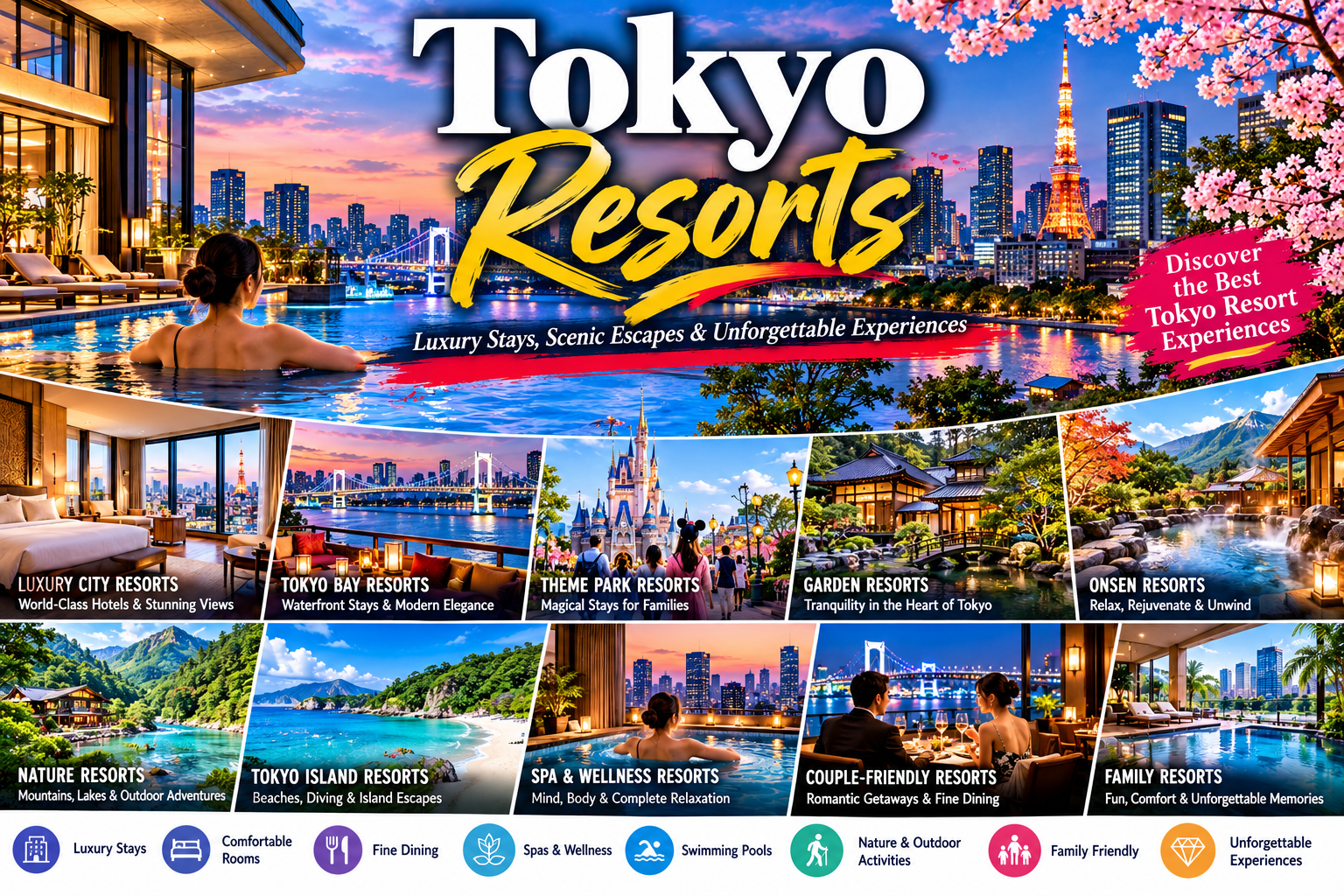
Tokyo resorts offer much more than traditional beach-style accommodation, combining luxury hotels, wellness retreats, Japanese gardens, pools, waterfront escapes, theme-park stays, mountain getaways and island adventures. From sophisticated urban resorts in central Tokyo to the beaches and volcanic landscapes of the Tokyo Islands, travelers can choose between convenience, relaxation, culture, nature and family entertainment Tokyo Retreats
Understanding the Tokyo Resort Experience
Tokyo Resorts Are Different From Traditional Beach Resorts
A traditional resort often encourages guests to stay inside the property for most of their holiday.
Tokyo works differently.
Even the most luxurious hotel is usually surrounded by restaurants, museums, shopping districts, gardens, railway stations and cultural attractions.
This creates a hybrid experience.
You might spend the morning at a hotel spa, have lunch in Ginza, visit a museum in the afternoon, return for a swimming session, and then have dinner overlooking the city.
The resort is therefore not necessarily an isolated destination.
It can be a base for experiencing Tokyo.
The City Itself Becomes Part of the Resort
This is particularly important when choosing accommodation.
A hotel in Otemachi gives you access to the Imperial Palace area and major transport connections.
A property in Odaiba provides waterfront scenery, shopping and entertainment.
A hotel around Shinagawa combines transportation convenience with gardens, restaurants and hotel facilities.
A property around Maihama places theme-park entertainment at the center of the experience.
A mountain stay in Okutama provides a completely different relationship with nature.
Your choice of resort location therefore shapes the entire trip.
The Main Types of Tokyo Resorts
Luxury Urban Resorts
Luxury urban resorts provide the most convenient combination of relaxation and sightseeing.
These properties often feature:
- Spa facilities
- Swimming pools
- Fitness centers
- Fine dining
- Lounge areas
- Concierge services
- Large rooms or suites
- Skyline views
- Business facilities
They are particularly suitable for travelers who want luxury without sacrificing access to central Tokyo.
Tokyo Bay Resorts
Tokyo Bay creates a more open, waterfront atmosphere.
Odaiba is especially interesting because it combines seaside views with shopping, entertainment, technology, public spaces and transportation.
Tokyo’s official tourism guide describes Odaiba as a modern waterfront entertainment area with shopping, cruising, family attractions and views of Rainbow Bridge.
For visitors who want a holiday atmosphere while remaining connected to the city, Tokyo Bay can be an excellent compromise.
Theme-Park Resorts
Tokyo Disney Resort represents a completely different category.
Here, the accommodation is part of the entertainment experience.
The resort currently includes six Disney hotels, official hotels, partner hotels and Good Neighbor Hotels.
Nature Resorts
Nature-oriented Tokyo resorts are mainly found outside the dense central districts.
Okutama is the clearest example.
The area features mountains, valleys, lakes, hiking opportunities, camping, autumn foliage and limestone caves. Tokyo’s official tourism guide identifies Okutama as a popular vacation area within the Tama region.
Island Resorts
The Tokyo Islands may be the most surprising resort option.
The Izu Islands and Ogasawara Islands belong administratively to Tokyo, but they feel dramatically different from central Tokyo.
Travelers can find:
- Beaches
- Diving
- Snorkeling
- Hiking
- Volcanic landscapes
- Stargazing
- Wildlife
- Traditional island communities
Tokyo’s official tourism guide describes the islands as destinations for marine sports, nature and local culture.
Best Tokyo Resort Areas
Odaiba
Odaiba is one of the strongest choices for a waterfront resort-style stay.
The district sits on Tokyo Bay and has a more relaxed holiday atmosphere than many central commercial districts.
Visitors can combine:
- Waterfront walks
- Shopping
- Dining
- Museums
- Entertainment
- Cruises
- Rainbow Bridge views
- Family activities
The area’s transportation is also convenient, with the Yurikamome and Rinkai lines and water-bus services.
Shinagawa and Takanawa
Shinagawa and Takanawa are particularly interesting for travelers who want an urban resort experience.
Large hotels in the area have gardens, pools, restaurants, wellness facilities and event spaces.
Grand Prince Hotel Shin Takanawa, for example, describes itself as a modern urban resort and has a roughly 20,000-square-meter Japanese garden, seasonal pools, restaurants and fitness facilities.
This is an excellent illustration of Tokyo’s distinctive resort concept.
You can be minutes from major transport connections while still walking through a traditional Japanese garden.
Otemachi
Otemachi is not normally described as a resort district.
It is one of Tokyo’s major business areas.
However, luxury hotels have transformed parts of the district into sophisticated urban retreats.
Four Seasons Hotel Tokyo at Otemachi, for example, occupies the upper floors of Otemachi One Tower and offers a spa, indoor heated pool, fitness facilities, dining and views toward the Imperial Palace area.
This type of resort is particularly suitable for:
- Business travelers
- Couples
- Luxury travelers
- Short city breaks
- Wellness-focused visitors
Maihama
Maihama is the primary location to consider if your main goal is Tokyo Disney Resort.
It is important to remember that Maihama is in Urayasu, Chiba Prefecture, rather than Tokyo city.
However, the destination is marketed as Tokyo Disney Resort and is one of the most important resort experiences associated with a Tokyo trip.
The resort includes Tokyo Disneyland, Tokyo DisneySea, Disney hotels, official hotels, shopping, dining and the Disney Resort Line.
Okutama
Okutama is the better choice for travelers who want mountains instead of skyscrapers.
The area is suited to:
- Hiking
- Camping
- Nature photography
- Autumn foliage
- Caves
- Lakes
- Rivers
- Hot-spring experiences
Tokyo’s official tourism guide specifically presents Okutama as a vacation area with mountains, lakes and valleys.
Tokyo Islands
If your idea of a resort involves ocean scenery and isolation, look south.
The Izu Islands and Ogasawara Islands offer a dramatically different Tokyo experience.
The islands can be reached by ship or aircraft depending on the destination. Official Tokyo travel information lists routes from Takeshiba Pier, Haneda Airport and Chofu Airport, although journey times vary substantially by island.
Tokyo Luxury Resorts
What Defines a Luxury Tokyo Resort?
Luxury in Tokyo is often less about enormous grounds and more about service, design, location and experience.
A luxury resort-style property may provide:
- High-quality bedding
- Spacious rooms
- Fine dining
- Spa treatments
- Indoor pools
- Japanese gardens
- Club lounges
- Personalized concierge service
- Cultural experiences
- Premium transportation
Four Seasons Hotel Tokyo at Otemachi
Four Seasons Hotel Tokyo at Otemachi demonstrates how a high-rise city hotel can operate like a wellness retreat.
Its 39th-floor spa includes Japanese-influenced treatments, while the property also has a 20-meter indoor heated pool and fitness facilities with city views.
The location next to the Imperial Palace and directly connected to Otemachi Station also makes it highly practical for sightseeing.
HOSHINOYA Tokyo
HOSHINOYA Tokyo takes a different approach.
Hoshino Resorts describes it as a modern interpretation of a traditional ryokan in central Tokyo.
This is important because it demonstrates that a Tokyo resort does not have to imitate a Western luxury hotel.
Instead, the resort experience can be built around Japanese aesthetics, hospitality and cultural interpretation.
Tokyo Resorts With Japanese Gardens
Why Gardens Matter
A Japanese garden can completely change the experience of staying in a major city.
Instead of seeing traffic and towers from every direction, guests can encounter:
- Ponds
- Bridges
- Seasonal flowers
- Stone features
- Trees
- Traditional structures
- Quiet walking paths
Takanawa’s Urban Garden Experience
The Takanawa area provides an excellent example.
Grand Prince Hotel Shin Takanawa’s garden covers about 20,000 square meters and includes ponds, historical structures, a Kannon temple, a bell tower and around 210 cherry trees across 17 varieties.
The hotel also promotes seasonal experiences involving cherry blossoms, pools, autumn foliage and traditional New Year events.
This type of property is ideal for travelers who want:
city access + nature + Japanese culture + resort amenities.
Tokyo Resorts With Swimming Pools
Why Pools Matter in Tokyo
Swimming pools can turn a business-oriented city hotel into a genuine leisure destination.
This is particularly valuable during Tokyo’s hot and humid summer.
Outdoor Pools
Outdoor pools are usually seasonal.
Tokyo Prince Hotel, for example, operates a garden pool during the summer and provides a children’s pool alongside views toward Tokyo Tower. Its 2026 day-pool season has concluded, with future operating information to be announced by the property.
Rooftop and Sky Pools
Some properties emphasize elevated city views.
Grand Prince Hotel Shin Takanawa has seasonal pool experiences including a sky pool and garden pool.
Indoor Pools
Indoor pools provide greater year-round flexibility.
Four Seasons Hotel Tokyo at Otemachi has a 20-meter heated indoor pool, while other Tokyo hotels provide indoor aquatic facilities.
Tokyo Resorts With Spas and Wellness
The Growth of Urban Wellness
Wellness has become an increasingly important part of modern hotel design.
Travelers no longer necessarily want to leave the city to relax.
They may prefer a hotel where they can:
- Sleep late
- Exercise
- Swim
- Have a massage
- Eat healthy food
- Enjoy a sauna
- Visit a garden
- Continue sightseeing
without changing accommodation.
Japanese-Inspired Wellness
The most interesting Tokyo wellness experiences combine international spa standards with Japanese concepts.
These may include:
- Onsen-inspired bathing
- Japanese body treatments
- Seasonal therapies
- Tea experiences
- Meditation
- Minimalist interiors
- Traditional bathing culture
Public Baths and Hotel Wellness
Travelers should also remember that the resort experience does not always have to take place inside the hotel.
Tokyo’s wider bathing culture can be part of a wellness itinerary.
A luxury hotel spa can be followed by a neighborhood sento experience, creating a more varied understanding of Japanese relaxation culture.
Tokyo Family Resorts
Why Families Choose Resort Hotels
Family travel in Tokyo can be physically demanding.
A full day may involve:
- Trains
- Walking
- Museums
- Shopping
- Restaurants
- Attractions
A resort-style hotel gives children and parents a chance to slow down.
Useful facilities can include:
- Swimming pools
- Family rooms
- Children’s pools
- Restaurants
- Shuttle services
- Nearby entertainment
- Large rooms
- Laundry facilities
Tokyo Disney Resort
For families whose main goal is Disney, staying within the resort ecosystem can simplify the trip.
Tokyo Disney Resort currently lists six Disney hotels, including Tokyo Disneyland Hotel, Disney Ambassador Hotel, Tokyo DisneySea Hotel MiraCosta, Tokyo Disney Resort Toy Story Hotel, Tokyo Disney Celebration Hotel and Tokyo DisneySea Fantasy Springs Hotel.
The Fantasy Springs Hotel includes both a luxury Grand Chateau and a deluxe Fantasy Chateau.
Official Disney Resort Hotels
The resort also has six official hotels, including Hilton Tokyo Bay, Sheraton Grande Tokyo Bay, Hotel Okura Tokyo Bay, Grand Nikko Tokyo Bay Maihama, MAIHAMA VIEW HOTEL and Tokyo Bay Maihama Hotel First Resort.
These properties can be useful for families who want proximity to the parks while considering a wider range of accommodation styles.
Disney Good Neighbor Hotels
Good Neighbor Hotels are located in several Tokyo and Chiba areas, including Shinjuku, Koto/Sumida, Daiba/Ariake and Makuhari. Some offer complimentary shuttle services, subject to reservation and availability.
Tokyo Resorts for Couples
Romantic City Resorts
Tokyo can be surprisingly romantic.
Couples can combine:
- Skyline views
- Fine dining
- Spa treatments
- Private baths
- Gardens
- Sunset cruises
- Waterfront walks
- Luxury rooms
Odaiba for Waterfront Romance
Odaiba is particularly atmospheric after sunset.
Rainbow Bridge, Tokyo Bay and the city skyline create a strong evening setting.
The official Tokyo tourism guide highlights nighttime Rainbow Bridge views and waterfront activities in the district.
Takanawa for Quiet Luxury
Takanawa is better suited to couples who prefer gardens and tranquility.
The large Japanese garden provides a calmer environment than central entertainment districts.
Otemachi for Contemporary Luxury
Otemachi works well for couples who want luxury architecture, fine dining, spa experiences and central access.
Tokyo Resorts for Solo Travelers
Solo travelers often benefit from resort-style hotels with strong public facilities.
A good solo resort can provide:
- A comfortable room
- Spa
- Fitness center
- Restaurant
- Lounge
- Easy transport
- Nearby attractions
Hoshino Resorts’ OMO brand takes an interesting approach by treating the city around the hotel as part of the guest experience. The brand describes its hotels as city tourism properties that connect visitors with local culture, food and shopping.
This is particularly useful for independent travelers.
Tokyo Resorts for Seniors
Older travelers may benefit from choosing a resort with easy transportation and on-site facilities.
Consider:
- Elevator access
- Step-free routes
- Restaurants inside the property
- Indoor pools
- Spa services
- Comfortable seating
- Nearby stations
- Hotel shuttle services
The Tokyo Metropolitan Government also publishes accessibility information covering Tokyo’s wards, Tama region and islands.
Why Location Matters More With Age
A hotel with excellent amenities is not necessarily convenient if reaching it requires multiple transfers and long walks.
For senior travelers, a slightly less isolated resort with strong transport access can be more practical.
Tokyo Resorts for Business Travelers
The Business Resort Concept
Business and leisure increasingly overlap.
A traveler might attend meetings during the day and want:
- A swimming pool
- Spa
- Restaurant
- Gym
- Quiet lounge
- Garden
- Easy airport access
in the evening.
Otemachi
Otemachi is especially suited to this model.
Four Seasons Hotel Tokyo at Otemachi is directly connected to Otemachi Station and sits in one of Tokyo’s major business districts.
Shinagawa
Shinagawa is another useful base.
Tokyo Marriott Hotel describes itself as being close to Shinagawa Station and combines city access with nearby Gotenyama Garden and hotel dining facilities.
Tokyo Bay Resorts
Why Tokyo Bay Feels Different
Tokyo Bay provides more open space than central Tokyo.
The waterfront creates:
- Wider horizons
- Sea views
- Bridges
- Waterfront promenades
- Cruises
- Beaches and artificial beaches
- Large entertainment complexes
Odaiba as a Resort-Style Destination
Odaiba’s holiday atmosphere is partly the result of its waterfront setting.
The official Tokyo guide describes it as a seaside entertainment hub with shopping, museums, family attractions and cruising.
New Waterfront Attractions
Tokyo Bay’s tourism environment continues to evolve.
Tokyo Aqua Symphony opened at Odaiba Seaside Park in March 2026 as a free outdoor fountain show combining water, music and lighting, providing another evening attraction for visitors.
This development illustrates an important trend.
Waterfront districts are becoming destinations where visitors can spend an entire day rather than simply passing through.
Tokyo Resorts and Onsen Experiences
Can You Experience Onsen in Tokyo?
Yes, although travelers should distinguish between authentic natural hot-spring facilities and hotels or spas that offer onsen-style bathing.
Tokyo has public baths and hot-spring facilities, while some resort-style properties outside the central area provide stronger connections to natural hot springs.
Okutama and Western Tokyo
Western Tokyo provides a more nature-oriented setting for bathing and relaxation.
A typical Okutama day could include:
- Hiking
- River scenery
- Local food
- Hot-spring relaxation
- Return to central Tokyo
This combination is one of the easiest ways to create a resort-style day without booking a traditional luxury resort.
Tokyo Island Resorts
Why Tokyo’s Islands Are a Major Surprise
Many travelers do not realize how far Tokyo extends into the Pacific.
The metropolitan area includes the Izu Islands and Ogasawara Islands.
Official Tokyo information describes the Izu Islands as including Oshima, Toshima, Niijima, Shikinejima, Kozushima, Miyakejima, Mikurajima, Hachijojima and Aogashima.
The Ogasawara Islands include Chichijima and Hahajima as the two inhabited islands.
Izu Oshima
Izu Oshima is one of the more accessible islands.
It offers volcanic landscapes, ocean scenery, hiking and island culture.
Hachijojima
Hachijojima is farther south and has a warmer climate than central Tokyo.
Visitors can enjoy nature, beaches, hiking and marine activities.
Shikinejima
Shikinejima is particularly interesting for travelers seeking coastal scenery and bathing experiences.
Aogashima
Aogashima is among the most remote and unusual Tokyo destinations.
It is dramatically different from the urban core and requires more careful planning.
Ogasawara Islands
The Ogasawara Islands are much farther away.
Official Tokyo travel information indicates that Chichijima requires roughly a full day by passenger ship, while there are no commercial flights to the islands.
That journey is part of the experience.
These islands are better suited to travelers seeking nature and isolation than those looking for a quick weekend hotel break.
Tokyo Resorts and Nature Escapes
Okutama
Okutama provides mountains, rivers, lakes and forests.
It is especially attractive during:
- Spring greenery
- Summer outdoor activities
- Autumn foliage
- Winter landscape
Mt. Takao
Mt. Takao is another convenient nature escape.
Its proximity to central Tokyo makes it suitable for travelers who want a mountain experience without committing to a multi-day trip.
Camping and Glamping
Tokyo’s official tourism guide includes camping and glamping among its outdoor travel categories.
This reflects a wider shift in Tokyo tourism.
The resort experience is increasingly being defined by nature and activities rather than only hotel luxury.
Ten Tokyo Resort Brands and Operators Compared
The following table is designed to help travelers understand different resort-style accommodation categories. It is not a ranking; the brands serve different travel needs.
| Brand / Resort Group | Tokyo-Area Resort Style | Main Strength | Best For | Resort Character |
|---|---|---|---|---|
| Tokyo Disney Resort | Theme-park resort | Parks + hotels + entertainment | Families | Immersive |
| Seibu Prince Hotels & Resorts | Urban resort hotels | Gardens, pools, dining | Couples & families | Japanese urban resort |
| Hoshino Resorts | Japanese lifestyle & city resorts | Local culture & design | Couples, solo travelers | Experience-focused |
| Hilton | Bay, Disney-area & city hotels | Facilities & international service | Families & business | Full-service |
| Marriott | City and leisure hotels | Service, rooms & dining | Business + leisure | Contemporary |
| Four Seasons | Luxury urban resort | Spa, dining & service | Luxury travelers | High-end urban |
| Hyatt | Luxury and upscale city stays | Design & hospitality | Couples & professionals | Modern |
| Mandarin Oriental | Luxury city retreat | Wellness, dining & views | Luxury travelers | Sophisticated |
| Aman | Ultra-luxury urban retreat | Privacy & design | Luxury couples | Minimalist |
| InterContinental Hotels & Resorts | Premium city/waterfront stays | Location & international service | Leisure + business | Full-service |
Tokyo Disney Resort
Tokyo Disney Resort is the clearest example of a purpose-built resort destination in the wider Tokyo travel market.
Its two theme parks, Disney hotels, official hotels, shopping complex and monorail create an integrated destination.
Seibu Prince Hotels & Resorts
Seibu Prince has a particularly strong urban-resort presence.
The Takanawa properties are notable for their gardens, seasonal experiences and pools.
Grand Prince Hotel Shin Takanawa specifically describes itself as a modern urban resort.
Hoshino Resorts
Hoshino Resorts offers several Tokyo properties across different concepts.
HOSHINOYA Tokyo provides a high-rise interpretation of the ryokan, while OMO properties focus on city exploration and neighborhood culture.
Hilton
Hilton operates several properties around the wider Tokyo area.
Its Tokyo-area portfolio includes Hilton Tokyo Odaiba and Hilton Tokyo Bay, among others.
Hilton Tokyo Odaiba provides Tokyo Bay and Rainbow Bridge views, while Hilton Tokyo Bay is an official Tokyo Disney Resort hotel in Maihama.
Marriott
Tokyo Marriott Hotel in Shinagawa combines a central location with access to Gotenyama Garden, restaurants and views toward Tokyo Bay and the city.
Four Seasons
Four Seasons Hotel Tokyo at Otemachi is a strong example of the urban wellness-resort concept.
Its spa, indoor pool, dining and location near the Imperial Palace allow travelers to combine sightseeing and relaxation without leaving central Tokyo.
Hyatt
Hyatt’s Tokyo properties span luxury and upscale city experiences.
For travelers interested in a resort-style stay, the key consideration is usually not the brand alone but the specific property and its spa, pool, dining, views and location.
Mandarin Oriental
Mandarin Oriental’s Tokyo presence is particularly relevant to travelers looking for a luxury urban stay centered around dining, wellness and high-touch service.
The experience is closer to a sophisticated city retreat than a conventional beach resort.
Aman
Aman Tokyo represents an ultra-luxury urban interpretation of the resort concept.
Its appeal is based on privacy, design, spaciousness and wellness within the city rather than large outdoor grounds.
InterContinental Hotels & Resorts
InterContinental properties provide an international full-service approach and can work well for travelers combining business and leisure.
As with other major hotel groups, the exact facilities and resort character depend on the individual Tokyo-area property.
How to Choose the Right Tokyo Resort
Choose by Purpose
Start by asking one question:
What do you want the resort to do for you?
If you want entertainment, choose a theme-park resort.
If you want relaxation, choose a spa-oriented hotel.
If you want nature, choose Okutama or an island.
If you want luxury, choose a high-end urban hotel.
If you want the sea, choose Tokyo Bay.
If you want culture, consider a Japanese-style property.
Choose by Location
Location often matters more than star rating.
A five-star hotel far from your planned activities may be less convenient than a slightly smaller property near the places you actually want to visit.
Choose by Facilities
Make a list of your essential facilities.
For example:
- Pool
- Spa
- Gym
- Sauna
- Garden
- Restaurant
- Kids’ facilities
- Shuttle
- Parking
- Laundry
- Club lounge
Then compare properties.
Tokyo Resort Planning for Families
Plan Around Downtime
Families often make the mistake of scheduling attractions from morning until night.
Instead, reserve time for the hotel.
If the property has a pool, let children swim.
If it has a garden, walk through it.
If it has a lounge, take a break.
The point of staying at a resort is not to spend every minute outside it.
Consider Transportation
A resort near a railway station or shuttle service can significantly reduce family stress.
This is particularly relevant around Tokyo Disney Resort, where affiliated hotels offer different transport arrangements to the parks.
Tokyo Resort Planning for Couples
Plan One Slow Day
Tokyo sightseeing can be intense.
Consider making one day deliberately slow.
Have breakfast at the hotel.
Use the spa.
Swim.
Walk through a garden.
Have afternoon tea or a relaxed lunch.
Take a sunset cruise.
Return for dinner.
This can be more memorable than visiting another ten attractions.
Tokyo Resort Planning for Solo Travelers
Look for Social Spaces
Solo travelers may prefer hotels with:
- Lounges
- Cafés
- Shared spaces
- Local tours
- Cultural activities
- Convenient restaurants
Hoshino Resorts’ OMO approach is particularly interesting because it explicitly connects hotel guests with neighborhood culture and local recommendations.
Tokyo Resort Planning for Seniors
Prioritize Accessibility
Before booking, check:
- Step-free entrance
- Elevators
- Accessible rooms
- Bathroom design
- Pool access
- Restaurant distance
- Station distance
- Shuttle services
Tokyo’s official accessibility guide covers tourist facilities across the city’s wards, Tama region and islands.
Tokyo Resorts for Wellness Travelers
Build a Wellness Itinerary
A wellness-focused Tokyo trip might look like:
Day 1: Luxury hotel + spa
Day 2: Garden + walking + healthy dining
Day 3: Onsen or public bath
Day 4: Okutama nature escape
Day 5: Slow breakfast + massage + early evening
The important idea is not to turn wellness into another checklist.
Allow time to rest.
Tokyo Resorts for Adventure Travelers
Choose the Islands
Adventure travelers should look beyond central Tokyo.
The Izu and Ogasawara Islands offer opportunities for diving, snorkeling, swimming, hiking and wildlife experiences.
Choose Okutama
For mountain activities without traveling deep into Japan, Okutama offers hiking, caves, rivers, lakes and forest landscapes.
Best Seasons for Tokyo Resorts
Spring
Spring is excellent for:
- Cherry blossoms
- Gardens
- Outdoor dining
- Walking
- Island travel
Hotels with Japanese gardens can be especially attractive during blossom season.
Takanawa’s garden, for example, contains about 210 cherry trees across 17 varieties.
Summer
Summer is ideal for:
- Pools
- Tokyo Bay
- Beaches
- Island travel
- Water activities
However, central Tokyo can be hot and humid.
Autumn Tokyo resorts
Autumn is one of the strongest seasons for nature-oriented resorts.
Okutama and garden hotels become especially attractive for foliage.
Winter Tokyo resorts
Winter works well for:
- Luxury hotels
- Spa breaks
- Fine dining
- Indoor pools
- Clear city views
- Island escapes
The Ogasawara Islands also remain comparatively warm in winter because of their subtropical location.
Tokyo Resort Amenities to Compare
Swimming Pool Tokyo resorts
Ask whether the pool is:
- Indoor
- Outdoor
- Seasonal
- Adults-only
- Family-friendly
- Heated
Spa Tokyo resorts
Check whether treatments require reservations.
Fitness Center Tokyo resorts
Some gyms are available only to hotel guests.
Dining Tokyo resorts
A resort with several restaurants may be more convenient for families and travelers who prefer not to leave the property.
Garden Tokyo resorts
A garden can be one of the most valuable amenities in a dense city.
Club Lounge Tokyo resorts
Club lounges can be useful for travelers who value breakfast, afternoon refreshments and quiet workspaces.
Shuttle Tokyo resorts
A shuttle can significantly improve the experience when staying near theme parks or major attractions.
What to Pack for a Tokyo Resort
For Central Tokyo resorts
Pack:
- Comfortable shoes
- Smart-casual clothing
- Lightweight layers
- Travel adapter
- Swimwear if using the pool
- Small day bag
For Okutama Tokyo resorts
Add:
- Hiking shoes
- Rain protection
- Warm layer
- Water bottle
- Outdoor clothing
For Tokyo Islands Tokyo resorts
Add:
- Sun protection
- Swimwear
- Marine footwear where appropriate
- Waterproof bag
- Motion-sickness preparation if traveling by boat
Always check the latest transportation and weather information before island travel.
Common Tokyo Resort Mistakes
Mistake 1: Assuming Every Tokyo Resort Is Near Central Tokyo
Tokyo’s administrative boundaries extend far beyond the city center.
The islands can be hundreds or even more than 1,000 kilometers from central Tokyo depending on the destination.
Mistake 2: Confusing Tokyo Disney Resort With Tokyo City
Tokyo Disney Resort is in Urayasu, Chiba Prefecture.
It is associated with Tokyo tourism but is not physically inside Tokyo.
Mistake 3: Choosing a Hotel Without Checking the Pool Season
Outdoor pools are frequently seasonal.
Tokyo Prince Hotel’s 2026 garden pool season, for example, has already concluded, illustrating why travelers should check current operating information rather than assuming a pool will be open year-round.
Mistake 4: Booking an Island Without Checking Transport
Island travel requires more planning than central Tokyo.
Ferry schedules, flights, weather and accommodation availability can all affect the journey.
Mistake 5: Trying to Combine Too Many Resort Types
A traveler might attempt:
Tokyo city + Disney + Okutama + Izu Islands + Ogasawara
in one short holiday.
That is usually unrealistic.
Choose one primary resort style and perhaps one secondary experience.
Pros of Staying at Tokyo Resorts
Convenience Tokyo resorts
Urban resorts allow guests to combine sightseeing with relaxation.
Facilities Tokyo resorts
Pools, spas, restaurants and gyms make the hotel part of the holiday.
Variety Tokyo resorts
Tokyo offers far more resort styles than many visitors expect.
Cultural Experiences Tokyo resorts
Japanese gardens, ryokan-inspired hospitality, bathing culture and seasonal activities add cultural depth.
Family Options Tokyo resorts
Theme-park resorts and large full-service hotels provide useful family facilities.
Nature Access Tokyo resorts
Okutama and the Tokyo Islands provide genuine nature-based escapes.
Cons of Tokyo Resorts
Cost Tokyo resorts
Luxury facilities can be expensive, particularly during peak seasons.
Urban Environment Tokyo resorts
Even a luxury city resort may still be surrounded by traffic, towers and crowds.
Limited Resort Grounds Tokyo resorts
Some central Tokyo properties cannot offer the expansive grounds found at conventional destination resorts.
Seasonal Facilities Tokyo resorts
Pools and outdoor amenities may close outside their operating season.
Travel Time to Remote Areas
Island and mountain resorts can require significantly more planning.
Tokyo Resorts vs City Hotels
When a Resort Is Better Tokyo resorts
Choose a resort-style property if:
- You want to spend time at the hotel
- You value pools or spas
- You are traveling with children
- You want a romantic break
- You want a wellness experience
- You need a slower itinerary
When a City Hotel Is Better Tokyo resorts
Choose a standard city hotel if:
- You will spend most days sightseeing
- You mainly need a place to sleep
- You prioritize station access
- You have a limited budget
- You want to move between several neighborhoods
The best accommodation depends on how you intend to use it.
Tokyo Resorts and Sustainable Travel
Public Transportation Tokyo resorts
Tokyo’s rail network makes it possible to visit many resort-style properties without renting a car.
Longer Stays Tokyo resorts
Staying longer at one property can reduce unnecessary transportation.
Local Experiences Tokyo resorts
Choosing local restaurants, neighborhood businesses and regional activities can distribute tourism spending beyond large international brands.
Island Sustainability Tokyo resorts
The Tokyo Islands require particular care because many ecosystems are fragile.
Travelers should respect:
- Wildlife
- Beaches
- Coral environments
- Hiking trails
- Local rules
- Waste-management systems
The Ogasawara Islands are recognized for their unique ecosystems and World Natural Heritage status.
Future Trends in Tokyo Resorts
More Wellness-Oriented Hotels Tokyo resorts
Urban wellness is likely to continue growing.
Travelers increasingly want hotels to provide more than accommodation.
Pools, spas, fitness facilities, saunas and quiet spaces can turn a business hotel into a destination.
More Japanese-Inspired Luxury Tokyo resorts
International travelers increasingly value authentic cultural design.
This could lead to more hotels incorporating:
- Japanese gardens
- Tea
- Seasonal cuisine
- Traditional craftsmanship
- Ryokan-inspired rooms
- Local cultural activities
More Mixed-Use Tokyo resorts
Tokyo’s newest developments increasingly combine:
- Hotels
- Restaurants
- Offices
- Shopping
- Residences
- Wellness
- Public spaces
This creates a resort-like environment without requiring a traditional resort complex.
More Nature-Based Tourism Tokyo resorts
The popularity of Okutama, Mt. Takao and the Tokyo Islands suggests that travelers are increasingly interested in the natural side of Tokyo.
More Island Tourism Tokyo resorts
Official Tokyo tourism information continues to position the islands as destinations for nature, marine sports, local culture and outdoor adventure.
Longer, Slower Trips Tokyo resorts
Instead of moving between several hotels, future travelers may increasingly choose one premium property and explore its surrounding area slowly.
This is particularly attractive for couples, wellness travelers and remote workers.
A Perfect Three-Day Tokyo Resort Itinerary
Day One: Luxury Tokyo resorts
Check into an urban luxury resort.
Spend the afternoon at the spa.
Walk around the hotel garden or nearby district.
Enjoy dinner at the property.
Day Two: Tokyo Bay Tokyo resorts
Travel toward Odaiba.
Explore the waterfront.
Visit museums and shopping areas.
Enjoy the evening skyline.
Watch Tokyo Aqua Symphony if its schedule suits your visit.
Return to the hotel for a relaxed evening.
Day Three: Nature Tokyo resorts
Take a day trip toward Okutama.
Walk through nature.
Enjoy a local meal.
Relax in a hot-spring facility.
Return to central Tokyo in the evening.
This itinerary provides three versions of Tokyo:
luxury + waterfront + nature.
A Seven-Day Tokyo Resort Itinerary
Days One and Two: Central Tokyo Resort
Stay in Otemachi, Takanawa or another central luxury district.
Explore:
- Imperial Palace
- Ginza
- Tokyo Station
- Asakusa
- Tokyo Skytree
Return to the resort each evening.
Days Three and Four: Tokyo Disney Resort
Move to the Maihama area if theme parks are a priority.
Spend time at Tokyo Disneyland and Tokyo DisneySea.
Day Five: Tokyo Bay Tokyo resorts
Explore Odaiba and the waterfront.
Day Six: Okutama Tokyo resorts
Take a nature day trip.
Day Seven: Spa and Shopping Tokyo resorts
Finish with a slow hotel morning, spa treatment and shopping before departure.
How Much Time Should You Spend at a Tokyo Resort?
One Night Tokyo resorts
Suitable for:
- Business travelers
- Airport stopovers
- Couples wanting a special night
- Visitors testing a luxury property
Two to Three Nights Tokyo resorts
Ideal for a genuine resort experience.
You have enough time to use the facilities without sacrificing too much sightseeing.
Four to Seven Nights Tokyo resorts
Better for:
- Families
- Honeymooners
- Wellness travelers
- Slow travelers
- Disney-focused holidays
- Island stays
Tokyo Resorts for Different Traveler Profiles
Tokyo Resorts for Families
Prioritize:
- Pools
- Larger rooms
- Shuttle services
- Family restaurants
- Theme parks
- Nearby entertainment
Tokyo Resorts for Couples
Prioritize:
- Spa
- Fine dining
- Garden
- Skyline views
- Private experiences
Tokyo Resorts for Solo Travelers
Prioritize:
- Central transportation
- Local experiences
- Lounges
- Cafés
- Wellness
Tokyo Resorts for Luxury Travelers
Prioritize:
- Suites
- Spa
- Fine dining
- Concierge
- Private experiences
- High service levels
Tokyo Resorts for Nature Lovers
Prioritize:
- Okutama
- Tama
- Izu Islands
- Ogasawara Islands
Tokyo Resorts for Adventure Travelers
Prioritize:
- Hiking
- Diving
- Snorkeling
- Kayaking
- Island exploration
- Mountain activities
Tokyo Resorts for Business Travelers
Prioritize:
- Station access
- Business facilities
- High-speed internet
- Restaurants
- Fitness
- Spa
FAQs
Are there resorts in Tokyo?
Yes. Tokyo has urban resort-style hotels, waterfront properties, luxury hotels with pools and spas, garden resorts, nature retreats and island accommodations.
What is the best Tokyo resort?
There is no single best resort for every traveler. The right choice depends on whether you prioritize luxury, family entertainment, wellness, nature, waterfront scenery, Japanese culture or convenience.
Are Tokyo resorts expensive?
Some luxury Tokyo resorts are expensive, but the wider Tokyo resort market includes many accommodation levels. Prices vary according to location, season, room type, facilities and demand.
Is Tokyo Disney Resort actually in Tokyo?
No. Tokyo Disney Resort is located in Maihama, Urayasu, Chiba Prefecture. It is nevertheless one of the most important resort destinations associated with Tokyo travel.
How many hotels are at Tokyo Disney Resort?
The official Tokyo Disney Resort website currently lists six Disney Hotels, six official hotels, four partner hotels and a group of Good Neighbor Hotels.
Which Tokyo resorts are best for families?
Tokyo Disney Resort and large Tokyo Bay hotels are particularly convenient for families because of their proximity to attractions and family-oriented facilities.
Which Tokyo resorts are best for couples?
Luxury properties in Otemachi, Takanawa and Tokyo Bay can work well for couples, particularly when they offer spas, fine dining, gardens and skyline or waterfront views.
Are there Tokyo resorts with swimming pools?
Yes. Several Tokyo hotels have indoor or seasonal outdoor pools. Pool availability varies by property and season.
Are Tokyo hotel pools open all year?
Not necessarily. Outdoor pools are often seasonal, while some indoor pools operate for longer periods.
What is a resort-style hotel in Tokyo?
A resort-style hotel generally provides enough leisure facilities and experiences that guests can enjoy substantial time at the property rather than using it only as a place to sleep.
Are there Tokyo resorts with onsen?
Yes. Tokyo and the wider metropolitan area have public baths, hot-spring facilities and properties with bathing-oriented experiences. Travelers seeking natural hot springs can also look toward western Tokyo and nearby regions.
Is Okutama a resort destination?
Okutama is better described as a nature and vacation area than a conventional resort district. It offers mountains, valleys, lakes, hiking, camping, caves and hot-spring experiences.
Can I stay at a resort in the Tokyo mountains?
Yes. Western Tokyo’s Tama region includes mountainous areas such as Okutama where visitors can find nature-oriented accommodation and outdoor activities.
Are there beach resorts in Tokyo?
Tokyo’s central districts are not conventional beach-resort destinations, but the Tokyo metropolitan area includes the Izu and Ogasawara Islands, which have beaches, marine activities and subtropical landscapes.
Which Tokyo islands are good for a resort holiday?
Izu Oshima, Hachijojima, Niijima, Shikinejima and other Izu Islands can provide different combinations of beaches, hiking, marine activities and local culture. Ogasawara offers a much more remote experience.
How long does it take to reach Tokyo’s islands?
Travel times vary enormously. Some Izu Islands can be reached in a few hours by high-speed boat or by air, while the Ogasawara Islands require approximately a full day by passenger ship.
Are Tokyo resorts good for honeymooners?
Yes. Luxury hotels with spas, gardens, fine dining and city views can work well for honeymoons, particularly when combined with a slower itinerary.
Can I combine a Tokyo resort stay with sightseeing?
Yes. This is one of the biggest advantages of Tokyo’s urban resorts. You can enjoy hotel facilities while remaining close to attractions, shopping, restaurants and transportation.
Which area is best for Tokyo Bay resorts?
Odaiba and the wider Tokyo Bay waterfront are strong options for travelers who want waterfront views, entertainment, shopping and a more relaxed atmosphere.
Are Tokyo resorts accessible by train?
Many urban properties are. Accessibility varies significantly for mountain and island destinations.
Should I stay in a Tokyo resort or regular hotel?
Choose a resort-style hotel if you plan to use the hotel’s pool, spa, garden, dining or leisure facilities. Choose a standard city hotel if you mainly need a convenient base for sightseeing.
What is the best season for Tokyo resorts?
Spring and autumn are excellent for gardens and comfortable outdoor sightseeing, summer is attractive for pools and waterfront destinations, and winter can be ideal for luxury indoor wellness experiences.
Are Tokyo resorts suitable for solo travelers?
Yes. Solo travelers can benefit from hotels with spas, lounges, restaurants, fitness facilities and easy transportation.
Are there luxury resorts in central Tokyo?
Yes. Several high-end hotels provide resort-like facilities despite being in central business districts. Four Seasons Hotel Tokyo at Otemachi is one example, with a spa, indoor pool, fitness facilities and fine dining.
What is HOSHINOYA Tokyo?
HOSHINOYA Tokyo is a luxury property by Hoshino Resorts that describes itself as a modern interpretation of a traditional ryokan in central Tokyo.
Are there Japanese-style resorts in Tokyo?
Yes. Some properties incorporate ryokan-inspired design, Japanese gardens, seasonal experiences, traditional cuisine and Japanese hospitality.
What should I check before booking a Tokyo resort?
Check:
- Exact location
- Transportation
- Pool operating dates
- Spa availability
- Room size
- Family facilities
- Restaurant options
- Accessibility
- Cancellation rules
- Seasonal activities
Can Tokyo resorts be part of a budget trip?
Yes, although luxury resorts can be expensive. Travelers can balance the budget by spending one or two nights at a resort and the remainder at a more affordable city hotel.
Conclusion
Tokyo resorts are not defined by one style, one neighborhood or even one landscape. The most interesting thing about the Tokyo resort experience is its variety: a sophisticated hotel above the city, a Japanese garden surrounded by skyscrapers, a waterfront property overlooking Tokyo Bay, a family-focused theme-park hotel, a mountain escape in Okutama or a remote island accommodation can all be part of the wider Tokyo travel experience. For travelers who want luxury and convenience, central areas such as Otemachi and Takanawa provide sophisticated hotel experiences with spas, pools, gardens, dining and excellent transportation. For families, the Tokyo Disney Resort and Tokyo Bay hotel ecosystem offers an integrated combination of accommodation, entertainment and convenient access to the parks.