Tokyo Mobility: The Ultimate 2026 Guide to Trains, Subways, Buses, Bikes, Taxis & Smart Travel
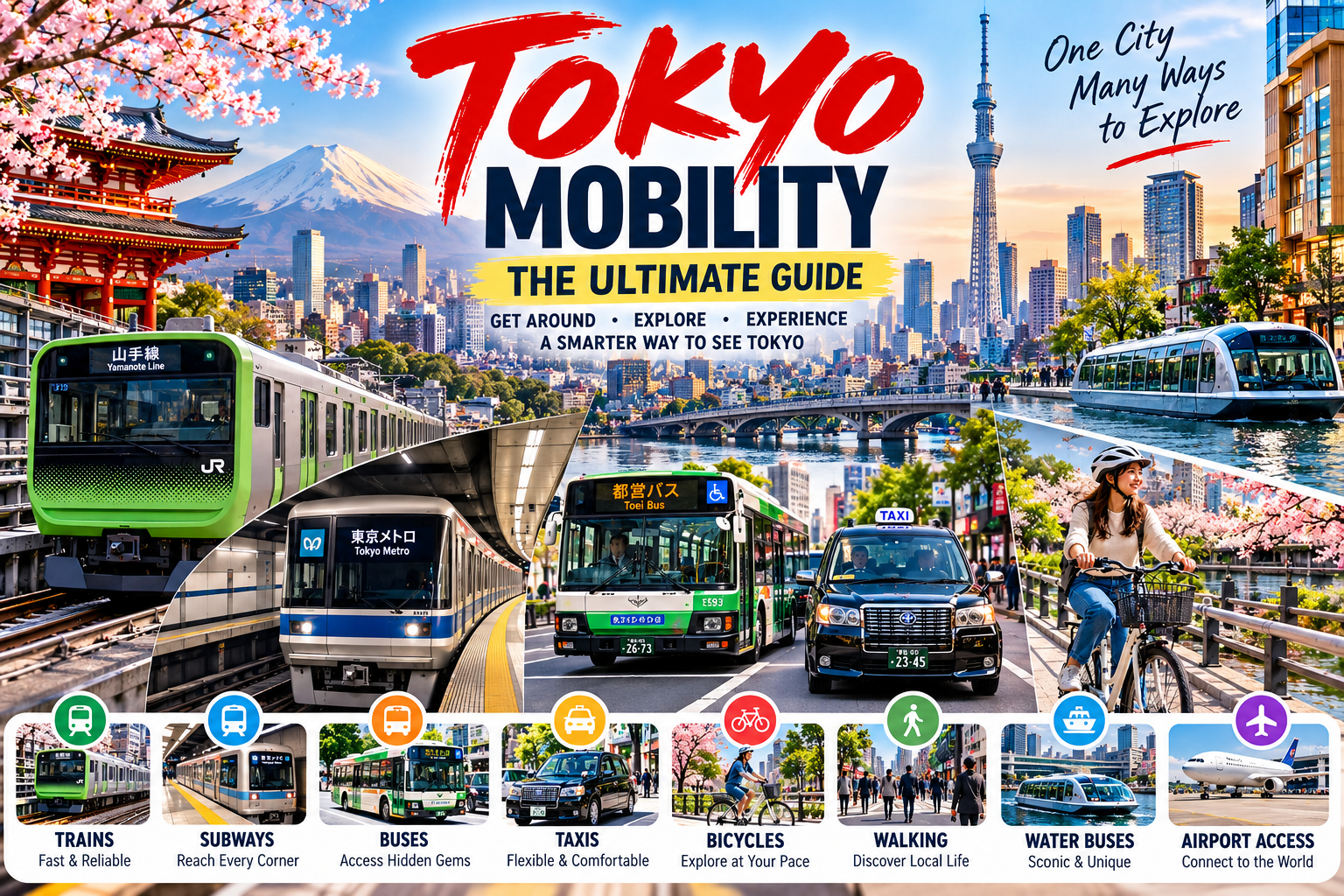
Tokyo mobility is built around a remarkably interconnected transportation ecosystem that combines trains, subways, buses, bicycles, taxis, walking, water transport, airports, and increasingly digital travel services. For visitors, commuters, families, students, older travelers, and business travelers, the key to moving around Tokyo is not choosing one transportation method but knowing when to combine several of them Tokyo Railway
What Is Tokyo Mobility?
Tokyo mobility refers to the complete system through which people move around Tokyo and the wider metropolitan region.
It includes:
- JR railway services
- Tokyo Metro
- Toei Subway
- Private railway companies
- Local buses
- Airport buses
- Taxis
- Bicycles
- Bicycle-sharing services
- Walking
- Water buses
- Monorails
- Automated transit systems
- Shinkansen connections
- Airport transportation
- Digital tickets
- IC transportation cards
- Emerging electric and autonomous mobility
The important point is that these systems do not operate independently.
A traveler may use an airport train to reach a central station, walk to a hotel, use the subway for sightseeing, take a bus to a less central neighborhood, and then walk or cycle locally.
That is multimodal mobility.
Why Tokyo Mobility Is Different
Tokyo’s transportation environment is unusual because of its combination of scale and density.
The metropolitan area contains huge numbers of residents, workers, students, tourists, businesses, commercial centers, residential neighborhoods, airports, universities, shopping districts, entertainment areas, and industrial zones.
Yet many journeys can be completed without a private car.
This changes how transportation works.
Instead of asking:
“How do I drive from A to B?”
Tokyo travelers often ask:
“Which combination of transportation modes gets me from A to B most efficiently?”
That change in thinking makes Tokyo considerably easier to navigate.
The official Tokyo tourism guide describes the city as having extensive public transportation, multilingual signage, railways, subways, buses, taxis, bicycles, waterbuses, and other options. It also notes that bicycles can be practical for exploring central areas. The guide was updated in September 2026.
The Main Pillars of Tokyo Mobility
Railways
Railways are the backbone of Tokyo mobility.
They connect major business districts, residential areas, shopping centers, airports, universities, suburbs, and neighboring cities.
The Tokyo railway environment includes:
- JR East
- Tokyo Metro
- Toei Subway
- Tokyu
- Keio
- Odakyu
- Seibu
- Tobu
- Keisei
- Keikyu
- Yurikamome
- Rinkai Line
- Tokyo Monorail
- Other regional and private operators
This variety is both a strength and a potential source of confusion.
Different companies operate different lines, and the same destination may sometimes be accessible through multiple routes.
Why Trains Are So Important
Trains are particularly useful for:
- Long urban journeys
- Cross-city travel
- Commuting
- Airport connections
- Traveling during busy periods
- Connecting major tourist districts
- Reaching suburban attractions
For many visitors, the railway system becomes the foundation of their Tokyo itinerary.
JR East
JR East operates a major portion of the railway network serving Tokyo and eastern Japan.
The Yamanote Line is particularly recognizable to international visitors because it loops through many major Tokyo districts.
Other JR services provide connections beyond central Tokyo.
Private Railways
Tokyo’s mobility system is not simply a JR system.
Private operators are extremely important.
Tokyu can be useful for areas such as Shibuya and southwestern Tokyo.
Keio connects western Tokyo and areas toward Mount Takao.
Odakyu provides access toward areas such as Setagaya and destinations beyond central Tokyo.
Seibu and Tobu connect large parts of western and northern Tokyo and surrounding areas.
Keikyu provides important airport and southern Tokyo connections.
Keisei is especially relevant to Narita Airport access.
This network gives travelers alternatives beyond the central subway.
Tokyo Subway
Tokyo’s subway system is one of the most important components of urban mobility.
Tokyo Metro operates nine subway lines, while Toei Transportation operates four subway lines.
Together, these systems create an extensive underground network.
The official Tokyo tourism guide currently describes Tokyo’s subway network as covering more than 280 stations, while Tokyo Metro itself operates 195 km of track across nine lines and 180 stations.
Why the Subway Is Useful
Subways are particularly effective for:
- Central Tokyo
- Business districts
- Shopping districts
- Tourist attractions
- Short and medium-distance journeys
- Avoiding surface traffic
Major destinations connected by subway include areas around:
- Ginza
- Asakusa
- Ueno
- Shibuya
- Shinjuku
- Roppongi
- Akasaka
- Nihombashi
- Otemachi
- Tokyo Station
Understanding Tokyo Subway Maps
The subway map can initially look intimidating.
There are many colored lines, station codes, exits, transfers, and different operators.
Do not try to memorize everything.
Instead, learn three things:
- Your starting station
- Your destination station
- Your transfer station if necessary
Then follow station signage.
Tokyo’s extensive multilingual signage makes the system more approachable for international travelers.
Tokyo Bus Transportation
Buses are sometimes overlooked because trains are so famous.
That is a mistake.
Buses can be extremely useful when a destination is not directly beside a railway station.
They can also provide a better option for travelers who want to avoid multiple station transfers.
When Buses Make Sense
Consider a bus when:
- Your destination is far from a station
- You are carrying luggage
- You are traveling with children
- You are visiting a residential neighborhood
- You want to reduce walking
- A direct bus exists
- The subway route requires several transfers
Bus Travel for Visitors
Bus systems can initially feel less intuitive than trains.
Pay attention to:
- Boarding location
- Direction
- Fare procedure
- Exit location
- Destination display
- IC card compatibility
If you are unsure, checking the route before boarding can save considerable time.
Tokyo Taxis
Taxis are an important part of Tokyo mobility even though many visitors rely primarily on railways.
A taxi becomes particularly valuable when:
- Traveling with heavy luggage
- Traveling with young children
- Traveling late
- Traveling in a group
- Reaching an address away from a station
- Traveling with mobility limitations
- Moving between nearby destinations where a train transfer would be inconvenient
Taxi vs Train
A train is generally designed for network efficiency.
A taxi is designed for flexibility.
This is why they complement one another.
For example, you might take a train from Tokyo Station to a broad district and then use a taxi for the final few kilometers.
Taxi Considerations
Before using a taxi, consider:
- Distance
- Traffic
- Number of passengers
- Luggage
- Time of day
- Destination accessibility
For groups, the cost per person can sometimes become more reasonable than a single traveler might expect.
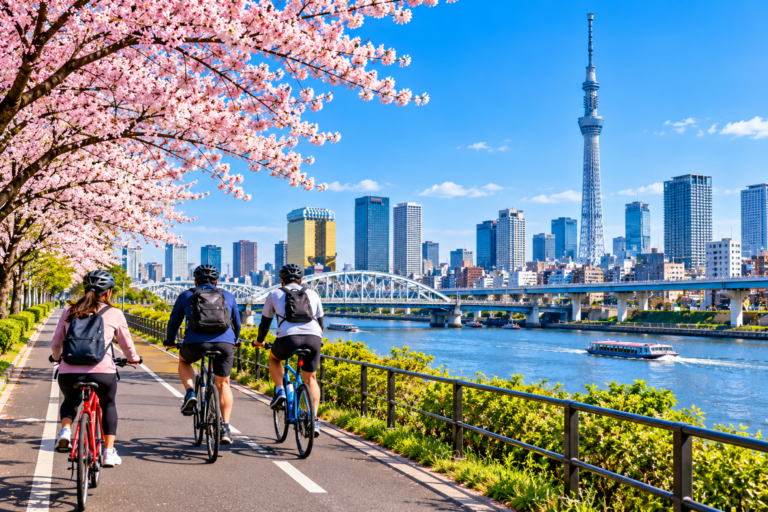
Tokyo Bicycles
Bicycles are another important part of Tokyo mobility.
The official Tokyo tourism guide specifically describes bicycle rental as a practical way to explore central Tokyo.
Bicycles are particularly effective for:
- Short journeys
- Neighborhood exploration
- Riverside cycling
- Park visits
- Local shopping
- Connecting nearby destinations
- Exploring areas between train stations
Why Bicycles Fill a Mobility Gap
A train station might be 1.5 km away.
Walking may take considerable time.
A taxi might be unnecessary.
A bicycle can bridge the gap.
This is known as first-mile and last-mile mobility.
Bicycle Mobility for Tourists
Tourists can use rental bicycles to explore areas where train stations are less convenient.
A bicycle can also change the character of sightseeing.
Instead of moving directly between major attractions, travelers experience the streets connecting them.
Walking as a Transportation Mode
Walking is one of the most important but least discussed elements of Tokyo mobility.
Even if you use trains all day, you will probably walk between:
- Hotel and station
- Station and attraction
- Subway platforms
- Train transfers
- Restaurants
- Shopping streets
- Parks
- Museums
This means that a Tokyo itinerary should never be designed solely around train stations.
The walking distance between stations and destinations matters.
The Hidden Cost of Transfers
A journey may look short on a map but involve:
- Long station corridors
- Multiple escalators
- Stairs
- Platform changes
- Underground exits
- Crowded passageways
Sometimes a route with one extra train stop can be easier because it reduces walking and transfers.
Water Transportation in Tokyo
Tokyo’s relationship with water creates another mobility opportunity.
Water buses and river services can connect parts of the city while providing sightseeing value.
They are not always the fastest way to travel.
But transportation does not always need to maximize speed.
Sometimes the journey itself is part of the experience.
Tokyo Water Mobility
Water transportation can be useful for:
- Sightseeing
- Waterfront exploration
- Leisure travel
- Connecting selected riverside destinations
- Experiencing Tokyo from a different perspective
In 2026, Tokyo is also showcasing newer electric water transportation concepts, including an electric boat service linking Nihonbashi and Toyosu.
Tokyo Monorail
The Tokyo Monorail is particularly important for Haneda Airport access.
It connects Haneda Airport with Hamamatsucho, where travelers can connect with the wider railway network.
For visitors staying near Tokyo Station, Shimbashi, Ginza, or other central areas, the Monorail can be part of a convenient airport journey.
Yurikamome and Automated Transit
The Yurikamome provides access to Tokyo Bay destinations including Odaiba.
Its automated operation gives it a distinct identity among Tokyo transportation systems.
It is useful not only as transportation but also as a way to see the modern waterfront landscape.
Airport Mobility in Tokyo
Tokyo’s airport transportation system is an important part of the wider mobility network.
The two major international gateways are:
- Haneda Airport
- Narita International Airport
Haneda Airport Mobility
Haneda is geographically much closer to central Tokyo than Narita.
The airport is approximately 15 km from central Tokyo, and many major districts can be reached in under an hour.
Key transportation options include:
- Keikyu Line
- Tokyo Monorail
- Airport buses
- Taxis
The official Tokyo tourism guide currently lists Terminal 3 to Shinagawa at approximately 11 minutes by Rapid Express on Keikyu and approximately 13 minutes from Hamamatsucho to Tokyo Station after using the Monorail.
Narita Airport Mobility
Narita is much farther from central Tokyo.
It is approximately 50–60 km from central Tokyo.
However, strong rail and bus connections make it accessible.
Major options include:
- Narita Express
- Keisei Skyliner
- Airport buses
- Other train services
- Taxis
Choosing Haneda vs Narita Transportation
The airport itself often determines the first mobility decision of your Tokyo trip.
Haneda generally offers a shorter geographic journey into central Tokyo.
Narita requires more planning because of the longer distance.
This does not mean Narita is difficult.
It simply means airport transportation should be considered before choosing an accommodation location.
IC Cards and Digital Tokyo Mobility
One of the easiest ways to simplify Tokyo transportation is to use an IC transportation card where accepted.
Examples include:
- Suica
- PASMO
- Other interoperable Japanese IC cards
These cards can reduce the need to purchase individual tickets for every journey.
Why IC Cards Are Useful
They can help with:
- Train travel
- Subway travel
- Bus travel
- Convenience-store purchases
- Vending machines
- Other participating payments
The important advantage is not just speed.
It is reduced decision-making.
You do not need to calculate every fare manually.
Tourist PASMO
PASMO currently offers a TOURIST PASMO product for international visitors, subject to its current terms and conditions.
The tourist version is designed specifically for foreign visitors and has a defined validity period.
Mobile Transportation
Mobile versions of transportation cards have also become increasingly important.
A smartphone can potentially replace several physical travel items.
However, travelers should prepare for battery problems by keeping their phones charged.
Contactless Payment and Tokyo Metro
Tokyo Metro has expanded contactless and QR-based ticketing options.
Tokyo Metro currently supports tap-to-ride services using compatible credit, debit, or prepaid cards and smartphones.
In 2026, Tokyo Metro and Toei Transportation expanded QR-code usage to the Tokyo Subway Ticket and combined subway day ticket.
This means digital mobility is increasingly becoming part of the Tokyo transportation experience.
Tokyo Mobility for International Tourists
International visitors have different needs from residents.
They may have:
- Limited Japanese-language ability
- Large luggage
- Limited knowledge of station layouts
- Short travel periods
- Multiple attractions to visit
- Unfamiliarity with local etiquette
Best Strategy for First-Time Visitors
Do not try to understand the entire transportation network.
Instead:
- Learn your nearest station.
- Learn the station closest to your main attractions.
- Use a reliable navigation app.
- Keep your IC card or payment method ready.
- Allow extra time for large stations.
- Check the final walking section.
Station Exits Matter
This is an overlooked part of Tokyo mobility.
A station can have many exits.
Choosing the wrong exit can add significant walking time.
When navigating, pay attention not only to the station name but also to the exit number or landmark associated with your destination.
Tokyo Mobility for Families
Families experience transportation differently.
A route that is easy for one adult may be difficult with:
- A stroller
- Young children
- Multiple bags
- Tired children
- Limited mobility
- Car seats
Family Mobility Strategy
Families should consider:
- Fewer transfers
- Elevator availability
- Station exit location
- Bathroom access
- Seating
- Bus alternatives
- Taxi options
Sometimes the cheapest route is not the easiest route.
A small additional transportation expense may dramatically reduce stress.
Tokyo Mobility for Older Travelers
Older travelers may want to reduce:
- Stairs
- Long station walks
- Crowded transfers
- Excessive standing
- Long walking distances
Better Planning for Seniors
Before traveling, identify:
- Elevator-equipped entrances
- Accessible routes
- Short-transfer options
- Nearby bus services
- Taxi alternatives
- Rest locations
Tokyo’s accessibility infrastructure continues to develop, and the Tokyo Metropolitan Government maintains policies and regulations addressing barrier-free access.
Tokyo Mobility for Travelers With Disabilities
Accessibility should be considered before starting a journey.
Important questions include:
- Is there an elevator?
- Is the platform accessible?
- Is there a step-free route?
- Is assistance available?
- Can the destination itself be accessed?
- How far is the accessible station entrance from the attraction?
The best route for an accessibility-focused traveler may not be the shortest route on a map.
It may be the route with the fewest physical barriers.
Tokyo Mobility for Business Travelers
Business travelers often prioritize:
- Reliability
- Predictability
- Time
- Connectivity
- Proximity to stations
- Luggage handling
For business travel, choosing a hotel close to an appropriate railway or subway station can save significant time over several days.
Business District Mobility
Major business districts include:
- Marunouchi
- Otemachi
- Nihombashi
- Shinjuku
- Shibuya
- Shinagawa
- Roppongi
- Akasaka
- Toranomon
Rail and subway connections are particularly valuable in these areas.
Tokyo Mobility for Students
Students may prioritize:
- Low transportation costs
- Reliable routes
- Bicycle access
- Local trains
- Walking
- Easy connections between campus and accommodation
A student living close to a railway station may have very different transportation needs from a student living farther from central Tokyo.
Tokyo Mobility for Remote Workers
Remote workers have another interesting mobility pattern.
They may not commute during traditional rush hours.
Instead, their transportation may involve:
- Walking to cafés
- Cycling to coworking spaces
- Short subway journeys
- Buses
- Occasional taxis
This creates opportunities to explore neighborhoods beyond the traditional tourist core.
Tokyo Mobility for Families With Children
A family transportation plan should avoid overloading every day with distant destinations.
A practical day might group attractions geographically.
For example:
Morning: Asakusa
Afternoon: Ueno
Evening: Nearby restaurant
Instead of:
Morning: Shinjuku
Afternoon: Asakusa
Evening: Odaiba
The second itinerary may involve significantly more transportation and transfers.
The Importance of Last-Mile Mobility
Last-mile mobility describes the final portion of a journey.
It is often the most underestimated part.
Imagine:
Train station → 20-minute walk → hotel.
The train may be excellent, but the final 20 minutes can become difficult with luggage.
Possible solutions include:
- Bus
- Taxi
- Bicycle
- Short ride service
- Choosing a different station
First-Mile Mobility
The same problem occurs at the beginning.
Hotel → station.
Walking may be easy for one traveler but inconvenient for someone carrying luggage.
This is why Tokyo mobility should always be viewed as a complete journey rather than one transportation segment.
Tokyo Mobility and Luggage
Luggage can completely change the best transportation choice.
With a Small Backpack
Walking and trains are usually easy.
With One Suitcase
Rail remains practical, but station walking becomes more important.
With Multiple Large Bags
A taxi or airport bus can become more attractive.
With Children and Luggage
The value of direct transportation increases further.
Tokyo Mobility During Rush Hours
Rush hour changes the experience of the city.
Trains may become extremely busy.
Large stations may require more time to navigate.
Walking speeds can decrease.
How to Reduce Rush-Hour Stress
Consider:
- Traveling earlier
- Traveling later
- Walking short distances
- Using buses where practical
- Avoiding unnecessary transfers
- Grouping attractions by area
Tourists often have more flexibility than commuters.
Use that flexibility.
Tokyo Mobility and Weather
Weather is an important transportation variable.
Rain
Rain can make walking and cycling less attractive.
Public transportation becomes more useful.
Extreme Heat
Walking several kilometers can become exhausting.
Subway and bus travel can reduce physical exposure.
Cold Weather
Layering becomes important.
Typhoons and Severe Weather
Transportation schedules can change during severe weather.
Travelers should check current transportation information rather than assuming that normal service will continue.
Tokyo Mobility During Nighttime
Tokyo has extensive transportation, but late-night travel requires more planning than daytime travel.
Some train services stop overnight.
When trains are unavailable, travelers may need to consider:
- Walking
- Taxi
- Accommodation near the destination
- Late-night bus options where available
Never assume that because a district is active at midnight, its regular train service will continue all night.
Tokyo Mobility and Car Rental
For most central Tokyo sightseeing, renting a car is often unnecessary.
The combination of:
- Trains
- Subways
- Buses
- Taxis
- Walking
- Bicycles
can cover a very large range of journeys.
A car can become more useful when traveling:
- Outside central Tokyo
- With specialized equipment
- With several passengers
- To rural destinations
- To areas with limited public transportation
The Parking Problem
Driving in central Tokyo can create another challenge:
Where will you park?
The cost and availability of parking should be considered before deciding that a car is more convenient.
Tokyo Mobility and Tourism
Transportation is not just infrastructure.
It is part of the Tokyo travel experience.
The Yamanote Line offers a view of different urban districts.
The subway reveals the scale of Tokyo underground.
The Yurikamome provides elevated views of the waterfront.
A waterbus provides a completely different perspective.
A bicycle reveals neighborhood streets.
Walking reveals details that vehicles often hide.
This is why travelers should not judge transportation only by speed.
Tokyo Mobility and Neighborhood Exploration
Different mobility modes suit different Tokyo neighborhoods.
Shibuya
Walking and rail are particularly useful because of density and pedestrian activity.
Shinjuku
Rail is extremely important because of the size of the station and the number of surrounding destinations.
Asakusa
Rail and walking work well for major attractions, while buses and bicycles can help explore nearby neighborhoods.
Odaiba
Rail, automated transit, buses, walking, and waterfront services can all be relevant.
Kichijoji
Rail and walking are convenient, with cycling potentially useful for local exploration.
Yanaka
Walking and cycling can provide a more intimate neighborhood experience.
Tokyo Bay
Rail, automated transit, buses, bicycles, walking, and water transport can all contribute to mobility.
Tokyo Mobility Brands and Operators
The transportation sector contains many organizations rather than one single mobility company.
JR East
JR East is one of the most important railway operators serving Tokyo and eastern Japan.
Its services are essential for commuters, tourists, airport passengers, and intercity travelers.
Tokyo Metro
Tokyo Metro is one of the central components of Tokyo’s subway network.
Its nine lines serve major central districts and connect with many other operators.
Toei Transportation
Toei operates subway lines and buses and plays a major role in Tokyo’s public transportation system.
Tokyu Railway
Tokyu connects major southwestern Tokyo districts and provides important connections around areas such as Shibuya.
Keio Railway
Keio serves western Tokyo and is useful for destinations including Mount Takao.
Odakyu
Odakyu provides connections from Tokyo toward western suburbs and tourist destinations outside the central core.
Seibu Railway
Seibu operates railway services serving western Tokyo and surrounding areas.
Tobu Railway
Tobu connects northeastern Tokyo and provides access to destinations beyond the metropolitan core.
Keikyu
Keikyu is particularly important for southern Tokyo and Haneda Airport access.
Keisei
Keisei is especially relevant for Narita Airport connections and northeastern Tokyo.
Tokyo Mobility Brand Comparison
| Operator or Brand | Main Mobility Role | Strongest Use Case | Key Strength | Typical User |
|---|---|---|---|---|
| JR East | Railway | City and regional travel | Extensive rail network | Commuters and tourists |
| Tokyo Metro | Subway | Central Tokyo | Dense subway coverage | Tourists and commuters |
| Toei Transportation | Subway and buses | Central and eastern Tokyo | Integrated public services | Residents and visitors |
| Tokyu | Private railway | Southwestern Tokyo | Urban and suburban connections | Commuters |
| Keio | Private railway | Western Tokyo | Western-area access | Residents and tourists |
| Odakyu | Railway | Western Tokyo and beyond | Regional connections | Tourists and commuters |
| Seibu | Railway | Western Tokyo | Suburban access | Residents |
| Tobu | Railway | Northern/eastern Tokyo | Regional reach | Residents and visitors |
| Keikyu | Railway | Airport and southern Tokyo | Haneda connectivity | Airport travelers |
| Keisei | Railway | Airport and northeastern Tokyo | Narita access | International travelers |
Comparing Tokyo Mobility Options
| Transportation | Speed | Flexibility | Cost Level | Best For | Main Limitation |
|---|---|---|---|---|---|
| Subway | High | Medium | Low–Medium | Central Tokyo | Transfers |
| JR Train | High | Medium | Low–Medium | Cross-city trips | Station complexity |
| Private Railway | High | Medium | Low–Medium | Suburban travel | Different operators |
| Bus | Medium | High | Low | Local connections | Traffic |
| Taxi | High in light traffic | Very High | High | Door-to-door travel | Cost and congestion |
| Bicycle | Medium | Very High | Low after rental/ownership | Neighborhood travel | Weather |
| Walking | Low | Very High | Very Low | Short distances | Distance |
| Water Bus | Low–Medium | Low–Medium | Medium | Waterfront travel | Limited routes |
| Monorail | High | Medium | Medium | Haneda access | Limited network |
| Shinkansen | Very High | Low | High | Intercity travel | Not for local journeys |
How to Build a Smart Tokyo Mobility Plan
A good transportation plan starts with the itinerary rather than the transportation method.
Step One: Group Attractions by Area
Instead of crossing Tokyo repeatedly, group nearby attractions.
Step Two: Identify the Nearest Major Station
Choose a station that provides convenient access to multiple destinations.
Step Three: Check Walking Distance
Do not stop planning at the station.
Check the actual distance from the station exit to your destination.
Step Four: Identify Alternative Modes
Have a backup:
- Bus
- Taxi
- Walking
- Bicycle
Step Five: Prepare Your Payment Method
Have an IC card, digital payment method, or suitable ticket ready.
Step Six: Add Buffer Time
Large stations can take longer to navigate than expected.
A Practical One-Day Tokyo Mobility Strategy
Imagine a visitor staying near Ueno.
Morning
Walk to the station.
Take a train or subway toward Asakusa.
Explore on foot.
Afternoon
Use a short train journey toward another district.
Explore local streets.
Evening
Return by rail.
If tired, take a taxi for the final portion.
This approach uses multiple mobility modes without overcomplicating the day.
Tokyo Mobility for Budget Travelers
Budget travelers can keep transportation costs under control by reducing unnecessary cross-city journeys.
Useful Strategies
- Group attractions geographically
- Use regular public transportation
- Compare day passes with pay-as-you-go fares
- Walk between nearby destinations
- Use bicycles for selected short journeys
- Avoid unnecessary taxis
- Stay near a convenient station
When a Pass Makes Sense
A pass is useful when it genuinely matches your itinerary.
Do not buy a pass simply because it looks like a discount.
Calculate your planned journeys.
Tokyo Metro currently offers 24-, 48-, and 72-hour Tokyo Subway Tickets, with the current adult prices listed as ¥1,000, ¥1,500, and ¥2,000 respectively.
The important question is not:
“Is this pass cheap?”
It is:
“Will my planned travel make the pass worthwhile?”
Tokyo Mobility for Luxury Travelers
Luxury travelers may prioritize:
- Airport transfers
- Private taxis
- Premium hotels near stations
- Luggage services
- Private transportation
- Reduced walking
- Flexible schedules
A hybrid strategy can still be useful.
For example:
Airport transfer → hotel
Train → major attraction
Taxi → dinner
Walking → nearby nightlife
Luxury does not require using one transportation method exclusively.
Tokyo Mobility for Eco-Conscious Travelers
Travelers interested in lower-impact mobility can prioritize:
- Walking
- Cycling
- Public transportation
- Electric transportation
- Shared mobility
Tokyo’s dense urban structure makes multimodal travel practical.
Tokyo Mobility for Photographers
Photographers often benefit from slower transportation.
Walking and cycling allow travelers to stop when they see something interesting.
A train may get you to a neighborhood.
A bicycle can help you explore its edges.
Walking allows you to notice small details.
This makes multimodal mobility particularly valuable for creative travelers.
Tokyo Mobility for Food Travelers
Food-focused itineraries can also benefit from flexible transportation.
A famous restaurant may be near a station.
A smaller local restaurant may be several streets away.
A combination of train, walking, and short taxi rides can provide better access.
Tokyo Mobility for Solo Travelers
Solo travelers can take advantage of the city’s transportation network without needing to coordinate with others.
Useful strategies include:
- Keep routes simple
- Avoid unnecessary transfers
- Stay near a station
- Use digital maps
- Keep your phone charged
- Carry an emergency backup payment method
Tokyo Mobility for Groups
Groups often move more slowly than individuals.
People need to:
- Find each other
- Navigate stations
- Board trains
- Manage luggage
- Choose restaurants
- Wait for slower travelers
A taxi can sometimes simplify group movement.
Public transportation remains extremely useful, but groups should build in additional time.
Common Tokyo Mobility Mistakes
Mistake 1: Assuming the Nearest Station Is Always Best
The closest station may have a complicated transfer.
Another station a few minutes farther away may provide a direct route.
Solution
Compare routes rather than simply distance.
Mistake 2: Ignoring Station Exit Numbers
Tokyo stations can be enormous.
Solution
Check the exit before leaving the station.
Mistake 3: Planning Too Many Attractions
Transportation takes time.
Solution
Group attractions geographically.
Mistake 4: Assuming Every Train Is the Same
Different services may be:
- Local
- Rapid
- Express
- Limited Express
Solution
Check whether your train stops at your destination.
Mistake 5: Treating Travel Time as Only Train Time
The true journey includes:
Hotel → station → platform → train → transfer → exit → destination.
Solution
Calculate door-to-door time.
Mistake 6: Ignoring Luggage
A route may be easy without luggage but difficult with two suitcases.
Solution
Choose luggage-friendly transportation.
Mistake 7: Buying a Pass Without Calculating
A pass is not automatically cheaper.
Solution
Estimate your expected journeys first.
Mistake 8: Depending Entirely on One App
Technology can fail.
Solution
Keep basic destination information available offline.
Mistake 9: Forgetting the Last Train
Nightlife can create transportation problems.
Solution
Check the last practical train before staying out late.
Mistake 10: Choosing Speed Over Convenience
The fastest route is not always the best route.
Solution
Consider:
- Transfers
- Walking
- Crowding
- Luggage
- Accessibility
- Cost
The Pros of Tokyo Mobility
Excellent Connectivity
Large parts of the metropolitan area are connected by rail and subway.
Multiple Transportation Choices
Travelers can switch between:
- Train
- Subway
- Bus
- Taxi
- Bicycle
- Walking
- Water transport
Strong Airport Connections
Both Haneda and Narita have multiple transport options.
Useful Digital Tools
IC cards, smartphone navigation, QR tickets, and contactless payment are increasingly integrated into the travel experience.
Reduced Dependence on Cars
For many central Tokyo journeys, private cars are unnecessary.
Excellent Neighborhood Access
Walking and cycling make it possible to explore areas that major rail routes do not directly serve.
The Cons of Tokyo Mobility
Complexity
The sheer number of operators can initially be confusing.
Large Stations
Some stations require significant walking.
Crowding
Peak periods can be uncomfortable.
Transfer Challenges
A route with multiple operators can require careful navigation.
Weather
Rain and extreme heat can change the best transportation choice.
Limited Late-Night Rail
Travelers staying out late need a backup plan.
Cost Can Accumulate
Frequent journeys across the city can become expensive without careful planning.
Accessibility Is Not Identical Everywhere
Although accessibility continues to improve, not every route offers the same level of convenience.
The Future of Tokyo Mobility
Tokyo mobility is moving toward a more connected and digitally enabled future.
The future is unlikely to be about replacing trains with one new technology.
Instead, it will probably involve better integration among existing systems.
More Digital Tickets
QR-code and smartphone-based ticketing are already expanding.
The Tokyo Metro and Toei Transportation expansion of QR-based use for selected tickets in 2026 illustrates this direction.
More Contactless Travel
Contactless card and smartphone payment is increasingly becoming part of everyday public transportation.
More Electric Mobility
Electric vehicles, electric boats, electric-assist bicycles, and other forms of low-emission mobility are likely to become increasingly visible.
Autonomous Mobility
Tokyo is also experimenting with next-generation transportation.
In 2026, the Odaiba area introduced PALETTE RIDE, using Toyota’s e-Palette vehicle, while an electric boat service in Nihonbashi introduced another technology-oriented mobility concept.
These developments suggest that transportation itself may increasingly become part of the visitor experience.
Mobility as a Service
The future may increasingly treat transportation as one connected journey.
Instead of thinking:
Train + bus + bicycle
the traveler simply thinks:
Get me there.
Behind the scenes, multiple systems can potentially work together.
Better Real-Time Information
Future transportation systems are likely to provide increasingly useful information about:
- Crowding
- Delays
- Weather
- Vehicle availability
- Route changes
- Accessibility
- Payment
- Connections
More Personalized Mobility
A family may receive one recommended route.
A wheelchair user may receive another.
A cyclist may receive another.
A tourist carrying luggage may receive another.
This is where artificial intelligence and real-time transportation data could become particularly useful.
The Most Important Future Trend: Integration
The future of Tokyo mobility is not necessarily about one revolutionary vehicle.
It is about integration.
A traveler may:
- Fly into Haneda.
- Use contactless payment at a station.
- Take a train.
- Walk to a hotel.
- Rent a bicycle.
- Return the bicycle.
- Use a subway.
- Take an electric water service.
- Use a taxi.
- Return to the airport by rail.
The transportation modes already exist.
The future challenge is making the transitions between them even easier.
How Tokyo Mobility Could Become More Traveler-Friendly
Several developments could improve the system further.
Better Wayfinding
Clearer instructions could reduce confusion in large stations.
Unified Ticketing
More transportation services could potentially become easier to access through one digital platform.
Improved Accessibility Data
Travelers could receive better information about elevators, ramps, step-free routes, and accessible entrances.
More Mobility Hubs
Rail stations could increasingly connect:
- Bicycles
- Buses
- Taxis
- Walking
- Shared mobility
Better Multilingual Assistance
Tokyo already provides extensive multilingual transportation information, and continued improvements can make mobility even easier for international visitors.
Tokyo Mobility and Sustainable Urban Travel
A sustainable transportation system is not simply one that uses fewer cars.
It also needs to make sustainable choices practical.
If walking is safe, people walk.
If cycling is convenient, people cycle.
If public transportation is reliable, people use it.
If transfers are easy, multimodal journeys become more attractive.
This is why transportation design matters.
How Businesses Can Benefit From Tokyo Mobility
Mobility influences where people shop, work, eat, and spend time.
A business near a convenient station can potentially benefit from high pedestrian traffic.
A restaurant away from a station may benefit from:
- Bus access
- Bicycle access
- Taxi accessibility
- Strong neighborhood loyalty
Retail and hospitality businesses therefore need to understand more than simple geographic distance.
They need to understand mobility distance.
Mobility Distance vs Geographic Distance
Two restaurants may be only 1 km apart.
Restaurant A is directly beside a station.
Restaurant B requires a 15-minute walk from the nearest station.
Geographically, they are close.
From a mobility perspective, they are different destinations.
This is one of the most important concepts for understanding Tokyo.
How Hotels Should Think About Tokyo Mobility
Hotel location should not be judged solely by neighborhood reputation.
Ask:
- Which station is closest?
- Which lines serve it?
- How many transfers are needed?
- Is there an elevator?
- How far is the airport route?
- Is there a bus?
- Are taxis easy to find?
- Is the surrounding area walkable?
A slightly less famous neighborhood with excellent transportation can sometimes provide a very convenient base.
How Travelers Should Choose a Tokyo Hotel
Instead of asking:
“What is the best neighborhood in Tokyo?”
Ask:
“Which neighborhood gives me the mobility pattern I need?”
For First-Time Tourists
Prioritize central rail access.
For Families
Prioritize elevators, space, and simpler routes.
For Nightlife
Prioritize transportation that makes returning easier.
For Business Travelers
Prioritize access to meeting locations.
For Airport Convenience
Consider Haneda-accessible areas.
Tokyo Mobility and Travel Time
A common mistake is optimizing the shortest route rather than the most comfortable route.
Suppose Route A takes 35 minutes:
- 3 transfers
- Long walking
- Crowded stations
Route B takes 42 minutes:
- 1 train
- 1 short walk
Route B may feel significantly easier.
This is why travel planning should include a comfort factor.
A Simple Tokyo Mobility Decision Framework
When choosing transportation, ask five questions.
Question 1: How Far?
Short distance?
Walk or cycle.
Medium distance?
Train, subway, bus, bicycle, or taxi.
Long distance?
Rail.
Question 2: How Much Luggage?
Heavy luggage increases the value of direct transportation.
Question 3: Who Is Traveling?
A solo adult has different needs from a family with young children.
Question 4: What Is the Weather?
Rain and heat can change the best choice.
Question 5: What Is the Destination?
A station-adjacent destination favors rail.
A remote residential destination may favor bus or taxi.
A Practical Tokyo Mobility Checklist
Before leaving your hotel, check:
- Destination
- Nearest station
- Correct station exit
- Train direction
- Transfer station
- IC card balance
- Weather
- Last train if staying out late
- Walking distance
- Alternative route
For longer journeys, also check:
- Luggage requirements
- Accessibility
- Reservation requirements
- Airport terminal
- Platform information
Tokyo Mobility Etiquette
Transportation works well partly because people generally understand that shared spaces require cooperation.
On Trains Tokyo mobility
Avoid loud conversations.
Keep bags from blocking others.
Follow boarding lines.
Allow passengers to exit before entering.
On Escalators Tokyo mobility
Follow local signage and station guidance.
On Buses Tokyo mobility
Pay attention to boarding and exit procedures.
On Bicycles Tokyo mobility
Respect pedestrians and traffic rules.
In Taxis Tokyo mobility
Have the destination ready and allow the driver to operate the vehicle without distraction.
Tokyo Mobility for First-Time Visitors: A Simple Formula
If Tokyo transportation feels overwhelming, use this formula:
Walk + Train + Subway + Occasional Taxi
This combination can cover most common tourist situations.
Add:
Bus
when the destination is inconveniently located from a station.
Add:
Bicycle
when exploring neighborhoods.
Add:
Water transport
when the route and experience make sense.
Tokyo Mobility for Experienced Travelers
Once you understand the basics, become more flexible.
Try:
- Local railway lines
- Buses
- Cycling
- Waterfront transportation
- Neighborhood walking
- Different station entrances
- Less-touristy districts
This is when Tokyo becomes more than a collection of famous attractions.
Tokyo Mobility and the Everyday City
The most interesting mobility experience may not be the famous train station.
It may be a local bus moving through a residential neighborhood.
It may be a bicycle passing through a quiet street.
It may be a walk from a station to a small restaurant.
It may be a short water journey.
Transportation reveals how the city actually works.
FAQs
What is the best way to get around Tokyo?
For most visitors, a combination of trains, subways, walking, and occasional buses or taxis is highly practical. Bicycles and water transport can add useful alternatives depending on the destination.
Is Tokyo easy to navigate without a car?
Yes. Tokyo has an extensive public transportation network, and official tourism information highlights trains, subways, buses, taxis, bicycles, and waterbuses as transportation options.
Do I need a car in Tokyo?
Most visitors staying in central Tokyo do not need to rent a car. Public transportation, walking, bicycles, and taxis can cover many urban journeys.
What is the main transportation in Tokyo?
Railways and subways form the core of Tokyo’s urban transportation system.
Is the Tokyo subway difficult for tourists?
It can look complicated initially, but multilingual signage, color-coded lines, station codes, navigation apps, and digital ticketing make it considerably easier to use.
How many subway stations are there in Tokyo?
The official Tokyo tourism guide currently describes the Tokyo subway network as covering more than 280 stations across Tokyo Metro and Toei networks.
Can tourists use buses in Tokyo?
Yes. Buses can be especially useful for destinations that are not close to railway or subway stations.
Can I use an IC card on Tokyo trains?
IC transportation cards such as Suica and PASMO are widely used on participating rail and bus services.
Is PASMO available for tourists?
Yes. PASMO currently offers a TOURIST PASMO product specifically for international visitors, subject to its current conditions.
Can I use a credit card on Tokyo transportation?
Some Tokyo transportation services support contactless credit, debit, or prepaid cards. Tokyo Metro currently offers tap-to-ride functionality on compatible services.
Are Tokyo transportation tickets available digitally?
Yes. Tokyo Metro and Toei Transportation have expanded QR-based ticket services, including selected subway tickets.
Is Tokyo mobility expensive?
Tokyo transportation costs depend on distance, operator, travel frequency, and ticket type. Regular public transportation is generally more economical than relying heavily on taxis.
Are Tokyo taxis expensive?
Taxis are generally more expensive than trains or buses, but they provide valuable door-to-door flexibility and can be useful for groups, luggage, late-night travel, and mobility needs.
Is cycling practical in Tokyo?
Yes. Bicycles can be particularly useful for short journeys and neighborhood exploration.
Is walking practical in Tokyo?
Yes. Walking is essential to Tokyo mobility because many destinations are located between stations.
Is Tokyo accessible for wheelchair users?
Tokyo has extensive accessibility infrastructure, although conditions vary by station and route. Travelers with accessibility needs should check specific station and destination arrangements before traveling.
Which Tokyo airport is easier for central Tokyo?
Haneda is geographically closer to central Tokyo than Narita and has strong rail and bus connections.
How far is Haneda Airport from central Tokyo?
Haneda Airport is approximately 15 km from central Tokyo.
How far is Narita Airport from Tokyo?
Narita Airport is approximately 50–60 km from central Tokyo.
How long does Haneda to Tokyo take?
Travel time depends on the destination and transportation method, but rail connections can reach central areas quickly. The official Tokyo tourism guide lists approximately 11 minutes from Haneda Terminal 3 to Shinagawa by Keikyu Rapid Express and approximately 13 minutes from Hamamatsucho to Tokyo Station by the Yamanote Line.
How long does Narita to Tokyo take?
The Narita Express takes approximately 60 minutes to Tokyo Station according to current Tokyo tourism information, while the Keisei Skyliner takes approximately 45 minutes to Ueno.
Is the Tokyo Monorail useful?
Yes. It provides a major rail connection between Haneda Airport and Hamamatsucho.
Is Yurikamome useful for tourists?
Yes. It connects parts of the Tokyo Bay and Odaiba area and is also an enjoyable way to see the waterfront.
Can I travel around Tokyo by bicycle?
Yes. Bicycle rental can be a practical way to explore central neighborhoods and destinations between major train stations.
Should I buy a Tokyo subway pass?
It depends on your itinerary. Calculate the number of subway journeys you expect before purchasing a pass.
What are the current Tokyo Subway Ticket options?
Tokyo Metro currently lists 24-hour, 48-hour, and 72-hour Tokyo Subway Tickets. Current adult prices are ¥1,000, ¥1,500, and ¥2,000 respectively.
Is Tokyo mobility good for families?
Yes, but families should consider elevators, walking distances, station layouts, luggage, stroller access, and transfer complexity when planning routes.
Is Tokyo mobility good for seniors?
Tokyo offers many transportation options, but seniors may benefit from planning routes around elevators, fewer transfers, buses, taxis, and shorter walking distances.
What is multimodal mobility?
Multimodal mobility means combining different transportation modes during one journey, such as walking to a station, taking a train, transferring to a subway, and using a bus or taxi for the final section.
Why is multimodal mobility important in Tokyo?
Because no single transportation mode reaches every destination directly. Combining modes provides greater flexibility.
What is last-mile mobility?
Last-mile mobility refers to the final section between a major transportation point and the actual destination.
What is first-mile mobility?
First-mile mobility refers to the journey from your starting location to a major transportation connection.
Does Tokyo have water transportation?
Yes. Waterbuses and other services operate on selected waterways and can be useful for sightseeing and some local journeys.
Is public transportation better than taxis in Tokyo?
They serve different purposes. Public transportation is highly useful for network travel, while taxis provide flexible door-to-door service.
Is Tokyo mobility environmentally friendly?
Public transportation, walking, cycling, and electric mobility can support lower-car urban travel, although the environmental impact varies by vehicle, energy source, distance, and infrastructure.
What is the future of Tokyo mobility?
Future developments are likely to include more digital ticketing, contactless payments, electric mobility, connected transportation, accessibility improvements, autonomous systems, and better integration among transportation modes.
Conclusion
Tokyo mobility is much more than a train network. It is a connected ecosystem of trains, subways, buses, taxis, bicycles, walking routes, water transportation, monorails, and airport services, giving travelers and residents multiple ways to move around the city. The real advantage comes from combining these options according to distance, time, budget, luggage, weather, and personal mobility needs. For most visitors, trains and subways provide the foundation, while walking fills the gaps between stations and attractions. Buses and taxis are valuable when destinations are away from major stations, while bicycles can provide a slower and more personal way to discover Tokyo’s neighborhoods. Water transportation and newer electric mobility services add even more possibilities.